Showing posts with label Richard H Dana. Show all posts

Wednesday, January 23, 2019

Parke Godwin on Melville and Typee

The Author of "Our New President" [Parke Godwin]
Putnam's Monthly Vol. 4 - October 1854

Two 1915 columns by Elisha Jay Edwards record interesting reminiscences about Herman Melville by Parke Godwin. According to Edwards in the first article below, Godwin at 80 (so, on or after February 28, 1896) thought Melville, along with Richard Henry Dana and Francis Parkman, excelled at writing factual narratives of personal experience. In the second article, "When the Government Encouraged Authorship," Parke Godwin says that he talked with Melville beforehand about his plans to make a book of his Marquesan adventures. Melville was "doubtful" but Godwin, as quoted by Edwards, assured him of its certain popularity.
"When he [Herman Melville] returned to New York I [Parke Godwin] met him, and he told me that he was going to narrate these experiences, although he was somewhat doubtful about finding a publisher for the book. I was satisfied that he would find no difficulty in obtaining readers and in that judgment I was correct. He called his book 'Typee,' and it was published in the same year that Parkman started out upon his adventures across the continent, which he described in a very successful book, now a classic, which he called 'The Oregon Trail.'" --E. J. Edwards, When the Government Encouraged Authorship in the Raleigh, North Carolina News and Observer, August 28, 1915.
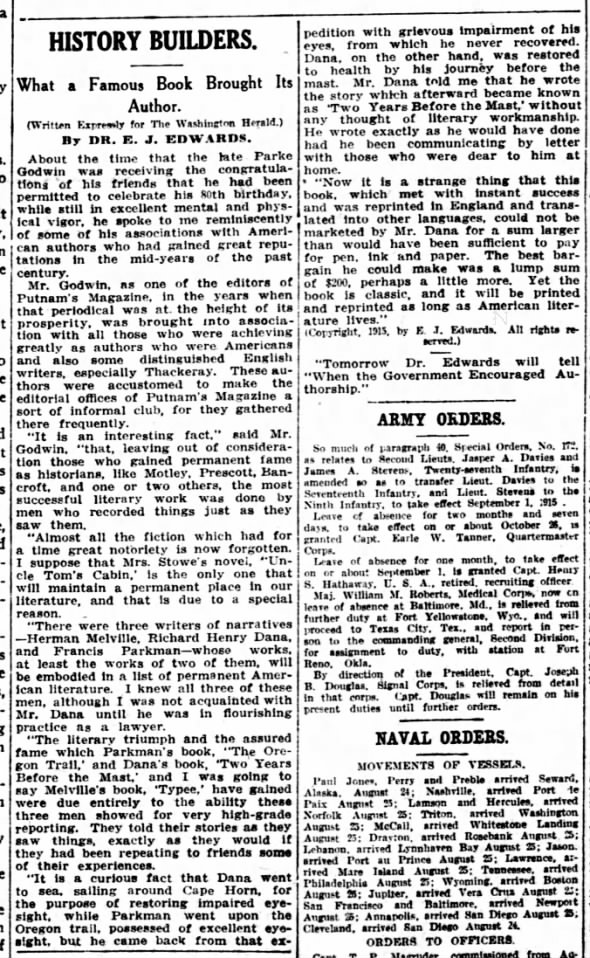
Parke Godwin at 80 remembers Melville with Dana and Parkman for their Parke Godwin at 80 remembers Melville with Dana and Parkman for their "high-grade reporting." Fri, Aug 27, 1915 – Page 4 · The Washington Herald (Washington, District of Columbia, United States of America) · Newspapers.com
... Mr. Godwin, as one of the editors of Putnam's Magazine, in the years when that periodical was at the height of its prosperity, was brought into association with all those who were achieving greatly as authors who were Americans and also some distinguished English writers, especially Thackeray. These authors were accustomed to make the editorial offices of Putnam's Magazine a sort of informal club, for they gathered there frequently.

"It is an interesting fact," said Mr. Godwin, "that, leaving out of consideration those who gained permanent fame as historians, like Motley, Prescott, Bancroft, and one or two others, the most successful literary work was done by men who recorded things just as they saw them.

"Almost all the fiction which had for a time great notoriety is now forgotten. I suppose that Mrs. Stowe's novel, "Uncle Tom's Cabin,' is the only one that will maintain a permanent place in our literature, and that is due to a special reason.

"There were three writers of narratives--Herman Melville, Richard Henry Dana, and Francis Parkman--whose works, at least the works of two of them, will be embodied in a list of permanent American literature. I knew all three of these men, although I was not acquainted with Mr. Dana until he was in flourishing practice as a lawyer.

"The literary triumph and the assured fame which Parkman's book, "The Oregon Trail,' and Dana's book, 'Two Years Before the Mast,' and I was going to say Melville's book, 'Typee,' have gained were due entirely to the ability these three men showed for very high-grade reporting. They told their stories as they saw things, exactly as they would if they had been repeating to friends some of their experiences...." --E. J. Edwards, "History Builders / What a Famous Book Brought its Author" in the Washington, D. C. Herald, August 27, 1915.
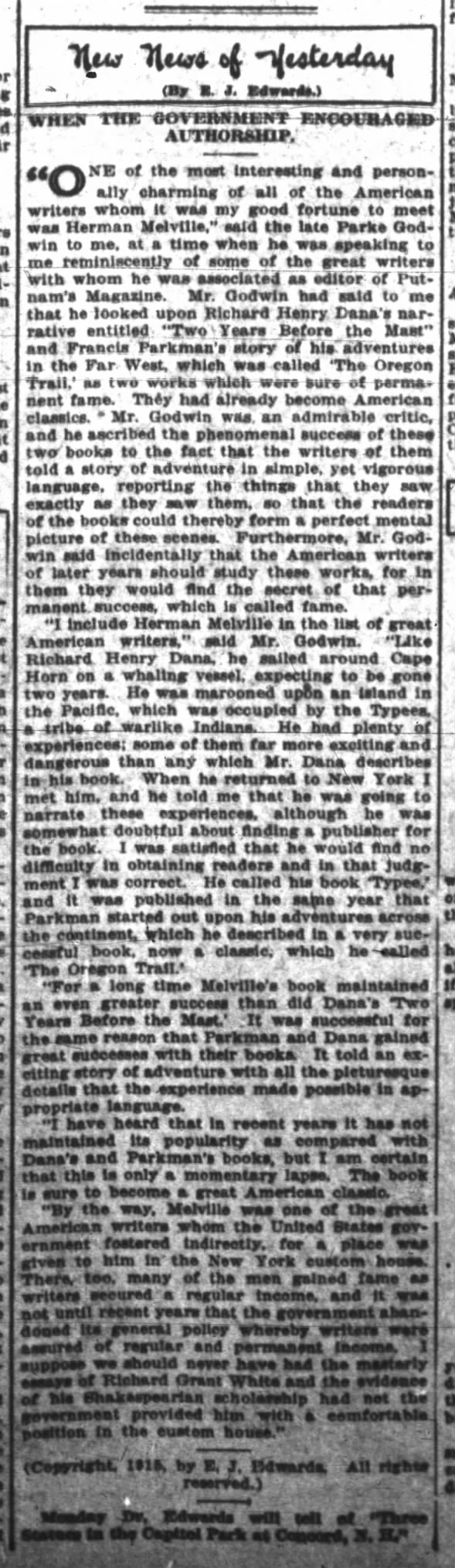

Parke Godwin on Herman Melville, as quoted by Elisha Jay EdwardsParke Godwin on Herman Melville, as quoted by Elisha Jay Edwards Sat, Aug 28, 1915 – Page 4 · News and Observer (Raleigh, Wake, North Carolina) · Newspapers.com

New News of Yesterday

(By E. J. Edwards)

WHEN THE GOVERNMENT ENCOURAGED AUTHORSHIP.

"One of the most interesting and personally charming of all of the American writers whom it was my good fortune to meet was Herman Melville," said the late Parke Godwin to me, at a time when he was speaking to me reminiscently of some of the great writers with whom he was associated as editor of Putnam's Magazine. Mr. Godwin had said to me that he looked upon Richard Henry Dana's narrative entitled "Two Years Before the Mast" and Francis Parkman's story of his adventures in the Far West, which was called "The Oregon Trail," as two works which were sure of permanent fame. They had already become American classics. Mr. Godwin was an admirable critic, and he ascribed the phenomenal success of these two books to the fact that the writers of them told a story of adventure in simple, yet vigorous language, reporting the things that they saw exactly as they saw them, so that the readers of the books could thereby form a perfect mental picture of these scenes. Furthermore, Mr. Godwin said incidentally that the American writers of later years should study these works, for in them they would find the secret of that permanent success, which is called fame. 
"I include Herman Melville in the list of great American writers," said Mr. Godwin. "Like Richard Henry Dana, he sailed around Cape Horn on a whaling vessel, expecting to be gone two years. He was marooned upon an island in the Pacific, which was occupied by the Typees, a tribe of warlike Indians. He had plenty of experiences; some of them far more exciting and dangerous than any which Mr. Dana describes in his book. When he returned to New York I met him, and he told me that he was going to narrate these experiences, although he was somewhat doubtful about finding a publisher for the book. I was satisfied that he would find no difficulty in obtaining readers and in that judgment I was correct. He called his book 'Typee,' and it was published in the same year that Parkman started out upon his adventures across the continent, which he described in a very successful book, now a classic, which he called 'The Oregon Trail.' 
"For a long time Melville's book maintained an even greater success than did Dana's 'Two Years Before the Mast.' It was successful for the same reason that Parkman and Dana gained great successes with their books. It told an exciting story of adventure with all the picturesque details that the experience made possible in appropriate language.  
"I have heard that in recent years it has not maintained its popularity as compared with Dana's and Parkman's books, but I am certain that this is only a momentary lapse. The book is sure to become a great American classic. 
"By the way, Melville was one of the great American writers whom the United States government fostered indirectly, for a place was given to him in the New York custom house. There, too, many of the men gained fame as writers secured a regular income, and it was not until recent years that the government abandoned its general policy whereby writers were assured of regular and permanent income. I suppose we should never have had the masterly essays of Richard Grant White and the evidence of his Shakespearian scholarship had not the government provided him with a comfortable position in the custom house." --E. J. Edwards, When the Government Encouraged Authorship in the Raleigh, North Carolina News and Observer, August 28, 1915; accessible via Newspapers.com and GenealogyBank.
In a letter to the editor of The People's Journal dated July 17, 1847 Parke Godwin confirmed "the real existence of Mr. Herman Melville" for skeptical Brits:
"... let me say that I saw him in Albany the other day as large as life, where he and his family are well known, and his narratives bearing a little artistic ornament, are held to be perfectly authentic. The writer under no assumed name, but under his own veritable Christian and patronymic designation. It is no unusual thing, by the way, for our young men of fortune to go as sailors, to the South Seas, in quest of adventure."  --The People's Journal v. 4


Related post:

Saturday, August 27, 2016

Herman Melville regarded in Boston as "a cosmopolitan" at heart, his widow as "the comrade of his literary labors"

 CURRENT LITERATURE

HERMAN MELVILLE IN NEW EDITION.

Four of the most notable marine romances of Herman Melville—“Typee” and “Omoo,” stories of the South Seas, “Moby Dick, or the White Whale,” and “White Jacket—the World in a Man-of-War”—have been published in an attractive new edition by Dana Estes & Co. “Moby Dick” is perhaps Melville’s masterpiece. It is the most vivid picture of the whale fishery ever drawn. The imaginative quality is strong in all of Melville’s work, but these four volumes are really autobiographical. The author in his youth sailed many seas and had his full share of perilous adventures.

Herman Melville’s works should be better known than they are to the present generation of Americans. Rarely has such consummate talent won such ephemeral reward. At times it has seemed as if his brilliant romances were forgotten, but there has always come a revival of interest. In Massachusetts especially should Melville’s name be held in lasting honor, for he was of Boston lineage, and his wife, the comrade of his literary labors, was a daughter of Chief Justice Lemuel Shaw.

Melville had the eccentricities of genius. A dreamy, philosophical habit of mind into which he fell in the later fifties helped to dim his fame as a popular romancer. For a season his writings were more than mystical—they were actually incomprehensible. And yet Melville passed the later years of his life in the matter-of-fact vocation of a Custom House officer. It is a just estimate which sets Melville second only to Richard H. Dana as a writer of sea tales. Marryat is a bungler compared with him. But Marryat was a Briton through and through, who even now makes a powerful appeal to British national spirit, while Melville stirs no such chord in the American breast, for Melville was—or tried to be—a cosmopolitan.  --Boston Journal, Wednesday, November 21, 1900; found in the online Newspaper Archives at Genealogy Bank.
Who wrote book reviews for the Boston Journal c. 1900? This is somebody who rightly regards Melville as "a cosmopolitan" at heart, and refers with great respect to his wife Elizabeth as "the comrade of his literary labors."

Frank Foxcroft? seems a good guess to start with, educated in Boston and Pittsfield, 1871 graduate of Williams College.
“Mr. Foxcroft retained his editorial connection with the Boston Journal from 1871 to 1904, as literary editor, editorial writer, and associate editor." --A History of Cambridge, Massachusetts
On the other hand, as a warrior for Temperance Foxcroft seems like the Anti-Melville. And Frank Foxcroft is so mightily Against Woman Suffrage you have to wonder if he would really recognize Elizabeth Shaw Melville as Herman's equal, his co-worker, "the comrade of his literary labors."

Wait, better check the range of meanings for comrade: mate, companion, or associate--especially in arms; more literally "one who lives in the same chamber, chamber-fellow." Room-mate. Not yet "my fellow Bolshevik," although Melville (in his late Weeds and Wildings dedication To Winnefred) did write of himself and his wife as "communists" on their Berkshire farm, in their enjoyment of common Red Clover. The speaker in Foxcroft's 1894 poem Little Esther Margaret refers to his daughter as "Little comrade tried and true." Later in time but closer to the context of the reference to Elizabeth Shaw Melville as "comrade" of Herman's "literary labors" is the partnership of Edwin Markham and his wife Catherine, as described by Bailey Millard in Suburban Life Volume 9:
 His wife, the Catherine Markham whose name is seen sometimes in print under the title of a short story or a poem, is a highly cultivated, robust, active woman, and she is a helpmeet to him in every sense of the word; for not only does she take full charge of the house, but is of the greatest assistance in his literary labors. He has beautifully alluded to her in his poem, "My Comrade."
Regarding Elizabeth Shaw Melville, the Boston Journal reviewer in essence has paraphrased what Arthur Stedman wrote about Melville's "devoted wife" being
"a constant assistant and adviser in his literary work." --Introduction to Typee
Anyhow, the progression of Foxcroft's work from "literary editor" to "associate editor" makes it sound like he no longer does the literary dirty work of mere book reviews.

We want a real book reviewer. Possibly a woman, definitely a feminist. How about Grace Weld Soper (1859-1917); married December 6, 1893 to William Andrews Dole...
“With him [Frank Foxcroft] are associated as editorial writers Mr. W. L. Marvin, Mr. Geo. A. Rich and Miss G. W. Soper, all of whom have been connected with the Journal for a number of years…Miss Soper devotes her attention to literature, and serves the Journal in the capacity of book reviewer. As a writer of short stories she is a contributor to the Harper’s Young People and Bazaar, St. Nicholas and Wide Awake. Mr. W. W. Hill, the day editor, is also a contributor to this page." --"Our Staff, Personnel of Those Who Make the Journal" - Boston Journal, Monday, April 24, 1893.
A Cornell alumna
"one of the most reliable reporters of the conservative Boston Journal. Miss Soper was a student here in the palmy days when journalism was a university study."  --The Cornell Era
who enjoys tennis and automobiling, and yes! favors woman suffrage. Grace Soper Dole was a founder of the New England Women's Press Association. The 1914 Woman's Who's Who entry states her occupation as "Journalist before marriage." So I'm not sure if or how long Grace Soper continued working at the Boston Journal after she married William A. Dole in 1893.

For a sample of fine writing by Grace Weld Soper, Google Books has her article Among the Friendly Indians at Mashpee in The New England Magazine Volume 2 (March-August 1890).

Alas, Google Books gives only a snippet about "this interesting and distinguished figure" from the History of the New England Woman's Press Association, 1885-1931.

Question: would Mrs. Grace Soper Dole call Frederick Marryat "a bungler"? I'd like to think so. If not, let's consider Philip Hale (1854-1934), Soper's colleague (for several years at least) on the editorial staff of the Boston Journal and music critic there from 1891-1903. After that, Hale enjoyed a long career (1903-1934) as music and drama critic for the Boston Herald. Philip Hale's column "As the World Wags" in the Boston Herald featured many knowledgeable references to Herman Melville over the years--great stuff for another day.

On October 22, 1921 Herman Melville's granddaughter Eleanor Melville Metcalf wrote Philip Hale to thank him for his articles on Melville's writings.

Related Post:

Sunday, March 27, 2016

Fragments from a Writing Desk: 1912 Report of a Conversation Melville had with C....

Hershel Parker's fine find (linked below) is another printing of the 1912 article by E. J. Edwards which circulated under different headings in different newspapers. The Raleigh News and Observer (February 8, 1912) published it under the heading, "The Classic that Inspired a Famous Romance." George Monteiro in Resources for American Literary Study Volume 33 (2008; AMS Press, 2010) cites the same article from the Columbia, South Carolina newspaper The State, published there as "Dana's Book and 'Typee,'" also on February 8, 1912. Professor Monteiro's large 2008 inventory of Fugitive References only excerpts the first paragraph, without mentioning Briggs or anything of  Briggs's Melville anecdote as reported by Edwards.

Fragments from a Writing Desk: 1912 Report of a Conversation Melville had with C....: There is plenty of evidence that young EJE knew CFB well. presumably in the early or mid 1870s. So the story could be true, in substance,...

Found on Newspapers.com

Related post:

Tuesday, May 27, 2014

Dana mentions Melville, October 1853

John Parker Hale
Library of Congress
On Thursday, October 13, 1853 in Boston, Richard Henry Dana, Jr. publicly invoked "[my] friend Herman Melville" in the course of a brief address at Tremont Temple in honor of John Parker Hale. The occasion was the presentation of a special medal to then Senator Hale from New Hampshire, in commemoration of his role in securing the abolition of flogging in the navy. Dana spoke on behalf of the sailors who had commissioned the medal for Hale months before, in early June. As related in the Boston Atlas on Friday, October 14, 1853:

HALE MEDAL PRESENTATION. 

The Tremont Temple was well filled last evening, upon the occasion of the presentation of a Gold Medal to Hon. John P. Hale, by the seamen of the sloop-of-war Germantown, as a testimonial to his efforts in abolishing the use of the lash in the Navy. The meeting was called to order by Dr. J. W. Stone, who regarded the gathering as a cheering omen in the moments of political excitement, that irrespective and independent of party, the vast audience came together to honor a representative man; one whose whole life exhibited him as the friend of all mankind....
After remarks by honorary president Henry Wilson, prayer conducted by the Rev. Dr. Jenks, and some further comments by the Rev. Phineas Stowe and Moses Grant Dana delivered his speech, again as reported in the Daily Atlas:
RICHARD H. DANA, Jr., Esq., on rising to make the presentation, was warmly received. After narrating the various modes of triumph by which men are honored in this world, he addressed Mr. Hale, as having at the hazard of power and popularity, devoted his energies for the obscure and the humble, for men who had no means of requiting such service, and when at length he was successful, it was a triumph far above all others. The military and naval service being of necessity measures of force; it had come to be regarded that they must be sustained internally by force, consequently, while the horrors of war had been ameliorated through Christianity and civilization, captives were no longer put to death, captured cities were not burned, and non-combatants were released on parole, the abolition of the lash was reserved as one of the last reforms.
In all times the public scourge had been deemed the depth of degradation,—a degradation deeper than that of the block or the scaffold, and while eighteen hundred years ago, it was the boast that a Roman citizen could not be scourged, until the 28th Sept., 1850, an American citizen could be scourged under the waving of the stars and stripes, and in the sight of foreigners who made little claim to the acknowledgment of human rights.
Mr. Dana said he wished to add his testimony to the fact that this horror of the gangway, the lash, prevented many men from engaging in the service of the mercantile marine. His friend, Herman Melville, had expressed the same sentiment, and he had no hesitation in saying that more men had been killed at the gangway than at the guns. Many persons who at first expressed doubts on the expediency of the abolition of the lash, had since acknowledged they were in error, and that favorable results had followed from it. He confessed he was somewhat doubtful on the subject of carrying the act into immediate effect, but he whom he had the honor to address was a man of more faith, and he had now the satisfaction of realizing all that he could have anticipated. As the organ of the sailors who tendered to him this evidence of their respect, he entreated that among the triumphs which may yet await him, he would not forget this, their humble testimonial.
Mr. HALE, in reply, said it was pleasant and gratifying to reflect that one’s services, however humble, had been appreciated, and in a labor so important, it was an additional gratification that the consequences of the act were fixed beyond a peradventure. He then proceeded to relate the progress of the efforts in Congress for the abolition of the lash, from the first proposition introduced by him in 1844, till the measure was carried. In these labors he made honorable mention of Mr. Webster and Mr. Benton, which was enthusiastically cheered. As evidence of the good effects of the measure, he gave the testimony of Capt. Nicholas, Com. Lavallette, Capt. Long, and others.
The exercises were interspersed with music by he Chelsea Brass Band, and after the adoption of a series of resolutions, the meeting was closed.

(Boston Daily Atlas, October 14, 1853, available online in the Newspaper Archives at Genealogy Bank)
Earlier that year, in May 1853, Dana recommended Melville for a diplomatic appointment. It's good to find Dana in October publicly and comfortably affirming his friendship with Melville. Without the Boston Atlas we might never have known, since other reports fail to include the Melville mention. The Boston Herald, for example, skips right over Dana's nod to "his friend Herman Melville":
In all ages public scourging has been deemed the depth of degradation, but until the 28th day of September, 1850, the American sailor could be publicly whipped on board a national vessel. The horror of the gangway has kept the best of seamen from the navy. More men have been ruined in the gangway than have been slain in battle....

(Boston Herald, Friday, October 14, 1853; available online in the Newspaper Archives at Genealogy Bank)
Also missing in the Herald report is Dana's reference to "the mercantile marine." The Herald report has Dana referring simply to "the navy." But as reported in the Atlas, Dana invokes Melville specifically on this point with reference to "the mercantile marine."  Melville, says Dana, with me believes that the fear of flogging keeps good men out of the mercantile or merchant marine.  Is Dana thinking of a published view, something from one of the chapters against flogging in White-Jacket?  Or does he mean that Melville expressed this corollary opinion about flogging and the merchant marine in a letter—or verbally, at a dinner party?

Update: From the Boston Atlas report, it does sound like Dana was offering additional insight from his own experience as a merchant sailor. Famously narrated in Two Years before the Mast.  And Dana's practical manual The Seaman's Friend specifically explains "sea terms, customs and usages of the merchant service."

In any case the crowd loved it. According to the glowing report in the Pennsylvania Freeman (October 27, 1853), the "immense audience" at Tremont Temple warmly approved everything: "The presentation speech by Mr. Dana and Mr. Hale's reply were both eloquent and stirring, and the responses of the audience enthusiastic."

Several accounts describe the medal awarded to Senator Hale:
The Medal is from the manufactory of Messrs. Guild & Stevens, Boston. Its design and workmanship evince great taste and skill on the part of the manufacturers. The Medal is not, as usual, an impression from a die, but is worked from the solid metal, by process of manufacture. It consists of an oval plate, bearing upon one side the following inscription:—
"Presented to the Hon. John P. Hale by the crew of the sloop-of-war Germantown, as a mark of their appreciation of his efforts in securing the abolition of flogging in the U. S. Navy, Oct 13, 1853."
On the other side, an engraving represents a scene on shipboard. It supposes flogging to exist, and the barbarous act is again to be repeated. The victim stands with nude back, turning away from his fellows in conscious degradation, while the boatswain's mate, with the instrument in his hand, is ready to strike—when over the other side appears the advocate of Humanity, and, stretching forth his hand, says, "Stop!" displaying to view the law. The centre is surrounded with appropriate designs. At the top is the upper portion of the capstan, spars, cords, blocks, &c; at the sides, filling from staffs, from the top, the national flag, which falls, and appears to mingle in its folds the surrounding objects, consisting of nautical implements. (The Hale Medal Presentation, [Boston] Liberator, October 21, 1853; found at GenealogyBank.com)
And look who's listed among the presiding officers: Dr. J. Ross Dix, named as one of the honorary Secretaries! (Presentation of the Hale Medal, Boston Herald, October 14, 1853)