Thursday, February 1, 2018

Deuceace on Melville and other living "Authors in the Shade"

Signed "Deuceace" and published under the major heading "Authors in the Shade" in the St. Louis Globe-Democrat (November 19, 1876):

AUTHORS IN THE SHADE.

The Fleeting Character of Literary Reputation--Noted Names Obscured by Twenty or Thirty Years.

Puffer Hopkins Brought to the Surface--The Dickens of America in a Saturnine Business.

The Widow of Maj. Jack Downing as a Septuagenarian--
A Gifted Tailor [Sailor?] Moored in the Custom House.

 Special Correspondence of the Globe-Democrat.
NEW YORK, November 16.--Passing in Broadway, only a day or two since, a literary man who had a wide and apparently an established reputation when I was a mere boy, it occurred to me that very few persons would now recall his name, if they should hear it. Then I fell to thinking how many living authors there are in the East who enjoyed a large degree of fame twenty to thirty years since, but who at present are well-nigh forgotten. A number of them no doubt are supposed to be dead, and so far as any remembrance of the public is concerned, they are as dead as if they had been sleeping for a decade in Greenwood. One that writes anything that attracts attention must keep on writing just such things, or he will sink into oblivion. To preserve even the hope of a little reputation, one must be perpetually and laboriously at work, and even then his exertion may be without recompense.
THE VANITY OF REPUTATION.
Even in so young a country as this, where literature has just begun to be cultivated, writers of both sexes, not yet old, have survived their fame, and appear to be veteran representatives of a misty past. Go into any of the second-hand book stores of Nassau street, and you will find scores on scores of volumes which were praised at the time of publication--only a few years ago--and of which their authors had high expectations, that have passed completely out of your mind. A book may be the only immortality; but the book that has any chance of immortality is not written more than once a century. It is very doubtful if any work has been printed in the New or the Old World, since the foundation of our Government, which will be remembered in 1976; and yet nearly every commonplace scribbler has a sneaking notion that he has said something that the world will be willing to keep. O, the vanity and egotism of man! How limitless, immeasurable, inexhaustible they are! It is well they are so, if human effort be desirable. Seeing ourselves as we are, how insignificant is the best and greatest of our performance, we should be reduced into eternal inactivity, and should adopt universal suicide as a relief from the supreme bitterness of self-contempt.

Every year that slips away leaves new literary ventures, launched with pride and promise, upon the beach, to be broken up by the returning waves on which they had hoped to ride. Full half the books issued this autumn will be forgotten next autumn, and those that are making a noise now, will, after a few seasons, be silent as the grave. Let me summon out of the limbo of oblivion some of the authors who still stalk the earth in a thick mist of unappreciation which they fondly imagine will one day be lifted. There is
CORNELIUS MATHEWS,
as a sample. "Who is he?" I fancy many of your readers inquiring.  "Never heard of him; when did he flourish. Certainly he is not alive." He is very much alive, and in abundant flesh, as one may see almost any day on Nassau street. He is not very old either--not quite sixty yet. He was a conspicuous literateur a quarter of a century ago, and his name and his writings figured in the newspapers prominently and with commendation. Born near here, and graduated at the New York University, he began his career at nineteen as a contributor, in prose and verse, to the American Monthly. He afterward appeared in the New York Review, Knickerbocker and other periodicals, and, when he was twenty-two, as the author of "Behemoth, a Legend of the Mound Builders," which was favorably received. He wrote a comedy--"The Politician"--presented without success, and a novel, "The Career of Puffer Hopkins," illustrating various phases of political life, which was widely read, and which caused him to be named after its hero. He produced several other stories and plays, one of them, "Witchcraft," a tragedy, praised by Margaret Fuller, which met with a fair reception, and enhanced his reputation.
He has been editor and assistant editor of different publications, long since gathered to their typographical fathers, and has for some time presided over the dull destinies of a professedly comic monthly, made up of clippings from all sources. This is said to yield him a fair revenue, as it ought to, for it is reputed to be much more tragic in its tone and tendency than "Witchcraft" ever was. Mathews writes little or nothing in these days. His fame rests in the past, to which he is fond of referring, speaking of himself not infrequently as "The American Dickens,"-- a title some of his injudicious admirers once bestowed on him.

Mathews is of liberal avoirdupois, very good-natured, pleasant, talkative, entertaining, with a strong inclination to believe that the present generation is not so good a judge of literature as the generation that has passed. He has vivid recollections of Washington Irving, Paulding, Poe, Willis, Clark, Seba Smith, N. P. Willis, Halleck, Malcolm Clarke, the mad poet, as he was styled, and many other authors of a by-gone period, and his reminiscences are extremely interesting.

One of the feminine antiquities which it will surprise many to know as still alive is

ELIZABETH OAKES SMITH,
widow of Seba Smith, of Maj. Jack Downing fame. She used to be one of the most prominent feminine writers and lecturers in the country--in the days when women filled very little space in public life. Born in Maine (her maiden name was Prince), of distinguished Puritan ancestry, she was married at seventeen to Seba Smith, then a well-to-do citizen of Portland. Afterward, entering into land speculation, he lost all his property. His wife urged him to go into the woods of his native State, adopt frontier life, and rear their children as best they might. She was very anxious to do this, believing that they would be better able to contend with poverty in that way than any other. He was opposed, however, to his family enduring any such hardship. He proposed that they should come to New York, and thither they came, to live by their pens. Mrs. Smith had written anonymously and as an amateur before; but now she entered upon literature as a serious business, and no one who has ever attempted it will doubt that it is a very serious business.
THE BATTLE OF LIFE.
She had versatility, though her talent was not remarkable, and both she and her liege found more employment than they had anticipated. Verses, stories, plays, essays and lectures followed in quick succession, and she became quite a favorite on the platform. She was one of the earliest advocates of women's rights, and a work, "Woman and Her Needs," published twenty-five years since, had many and earnest readers. Her husband died eight or nine years ago, and she has since been living very quietly on Long Island, not far from here, taking very small part in passing events. She has always felt a deep interest in all practical reforms, and has aided them with her voice and pen. The present excellent charity, the Newsboys' Home, is said to owe its beginning to a work of hers, "The Newsboy," in which she faithfully and pathetically depicted the hardships, the trials and the temptations to which he is exposed. Her latest contributions to literature were two serials printed in the Herald of Health, in 1870 and 1871.
Mrs. Smith is now seventy, and in delicate health. She had many troubles, and she has struggled hard to overcome or resist them, but with only partial success. Her hair is white as snow, and age, anxiety and suffering have told heavily upon her. But she still owns a strong will and stout heart and should be comforted for the thought that she has valiantly and stubbornly fought the battle of life.
HERMAN MELVILLE
is an author who was once a great favorite, and deservedly such, though of late he has gone into the shade. He is one of the few writers of note who have been born in the metropolis, his grandfather, Thomas Melville, having been a member of the historic Boston tea-party. His boyhood was spent in the neighborhood of Albany, in this State, and of the Berkshire Hills, Massachusetts; but, seized with a love of the sea from reading marine novels, he ran away from home at eighteen and shipped before the mast on a vessel bound for Liverpool. He was not cured, as many lads have been, by actual experience; his passion for adventure was increased, instead, and when he had reached his majority he embarked as a sailor on a whaling ship, destined for the Pacific. After sailing for eighteen months, the behavior of the captain was so tyrannical and cruel that Melville and one of his messmates decided to desert. His plan was carried out at Nukahira, one of the Marquesas Islands. He had intended to throw himself on the hospitality of a friendly tribe of savages there, but, losing his way, he fell among the Typees, warlike natives, who held him prisoner for six months without offering to molest him, and, on the whole, treating him kindly. He was taken off by a boat from an Australian whaler, and conveyed to Tahiti. After wandering for two years, staying some time on the Society and Sandwich Islands, he returned home, arriving at Boston in the autumn of 1844.
THE WRITING MANIA.
Two years later he published "Typel," a graceful, picturesque, interesting narrative of his experiences in Nukahira, which, owing to the sentimental coloring and artistically exaggerated character given to it, became very popular, and made for him a fine reputation. "Omoo," an account of his adventures in the South Seas, followed, and then "Mardi and a Voyage Thither," a philosophic romance, and "Redburn," founded on the incidents of his first voyage. Since then he has written seven or eight more sea tales and queer novels, or romances, not one of which has met with favor. His first book was by all odds his best, and each one that succeeded diminished in merit. He seems to be a striking instance of an author unable to sustain himself at his earliest level; he appears to have been for some time entirely written out, and he has come at last to recognize the fact himself.

When twenty-eight he married the daughter of Chief Justice Shaw, of Massachusetts, since when he has been around the globe on a whaling vessel, lived on a farm in New England, and pursued  several vocations, without any decided success. His friends say he is not practical, which is undoubtedly true, as he has not made any money--having been some years in the Custom House here on a salary of $2000 to $2,500. He is a very pleasant, entertaining fellow, with a great deal of culture, with broad experience in travel and large acquaintance with men. He has many warm friends, though he goes very little into society, and is likely to stay in the Custom House until he is in demand by the undertaker. He is far from old, having passed by his fifty-ninth birthday last August.
SARAH JOSEPHA HALE
is a veteran, indeed, being in her eighty-second year, and still able to work. Our grandmothers read her books, and thought them clever; but those dear old ladies had not the culture and critical taste that mark the present generation. Her native place is Newport, N. H., and her maiden name was Buell. In her nineteenth year she was married to David Hale, a lawyer of some local repute, with whom she studied for near eight years, when he died, leaving her with five small children, and less than $500 worth of property. With the necessity of supporting herself and family, she devoted herself to authorship. Her initial work was a small volume of poems, issued at Concord, and liberally purchased by the Freemasons, of which order her husband had been a member. Four years later she published "Northwood," a tale of New England, and soon after removed to Boston, where she became editor of The Ladies' Magazine, a monthly, and continued in that capacity until 1873.
The periodical was then untied with The Lady's Book, Philadelphia, and she was made its literary editor, a position she has held ever since. She is a rival of Bryant. She is very near as old as he, and has been connected with The Lady's Book, in its two-fold form, almost as long as he has been with the Evening Post. It is said, too, that she does work on it regularly even to the present day, while Bryant is asserted not to have written a line for his paper for four or five years; his connection with it being merely nominal.
REMUNERATIVE COMPILING.
Mrs. Hale has published several volumes of verses, tales and dramas, of no extraordinary merit, and has made a number of compilations that have proved very profitable. Among these are "Flora's Interpreter;" The Ladies' Wreath," a selection from the women poets of England and America; "The Good Housekeeper," a manual of cookery; and a "Dictionary of Poetical Quotations"; all of which have had a large sale, yielding to the compiler some $50,000 or $60,000. Her principal work is "Woman's Record," a volume of nearly 1,000 pages, as it well may be, considering that it claims to include biographical sketches of all the distinguished women from ancient times down to the middle of the nineteenth century. If any man had done that, he would have been called a satirist. I will be gallant enough to say that such a record, to do justice to the sex, should be printed in 5,000 volumes.
DEUCEACE.
Facsimile images of the St. Louis Globe-Democrat are available in Gale's 19th Century U. S. Newspapers. The Kansas City Research Center has a good long run on microfilm, starting in 1875.. For more than a decade, from 1876 until late in the 1880's, The St. Louis Globe-Democrat featured columns by New York correspondent "Deuceace," usually in the Sunday edition. The follow-up piece on "Authors in the Shade" in the Globe-Democrat for November 26, 1876 gave sketches of Charles F. Briggs and Alfred B. Street.

Years later Deuceace profiled Melville along with other supposedly self-educated writers in a column titled "Literature and College," published in the St. Louis Globe-Democrat on October 24, 1886.
... Herman Melville, once renowned as an author, though seldom mentioned of late, published more than forty years ago, "Typee" and "Omoo," delightful narratives of his adventures in the South Seas. He wrote other clever books, but none of them won so much reputation as his two first. He had no academic training. A native of this city, he conceived a romantic attachment for the sea, and at 18 shipped before the mast on a vessel bound for England. Two years later he embarked as a common sailor on a whaling vessel for the Pacific, cruising for eighteen months. Rebelling against the tyranny of the captain, he deserted with one of his shipmates; while lying off Nookaheeva, one of the Margnesas [Marquesas]. Losing his way, he roamed about until he stumbled into the Typee Valley. The warlike natives held him a prisoner for some months, but treated him kindly. He was taken off by an Australian whaler, and after many wanderings in Polynesia, returned to these shores. His writings show a thorough understanding of the force and delicacy of the English language, which he seems to have learned instinctively. He has published nothing for twenty years, having been much of that time buried in a department of the New York Custom House.
The article by Deuceace on "American Magazine Editors" was reprinted from the St. Louis Globe-Democrat in The Journalist: Devoted to Newspapers, Authors, Artists and Publishers (November 19, 1887). There Deuceace sketched Melville's former editor at Putnam's magazine, the late Charles F. Briggs:
Briggs had an ample fund of humor and remarkable quickness of mind, but found it difficult, it is said, to form a staple judgment of any literary work. What he thought clever after breakfast, he would pronounce stupid before dinner, owing to his change of mood. Personal interviews with him often ended in serious disagreement, for he had a singularly irritating way, and was a great exception taker. Instinctively kind and ready to help any one needing help, he was constantly making enemies by his unpleasant manner. Parke Godwin is reported to have lacked punctuality and system. When he undertook to examine a MS. he would frequently mislay and forget it, and his engagements were kept or broken according to his recollection of them. Curtis was a delightful editor, but had few dealings with contributors. He thought that they could hardly be paid too much, and Godwin that they could not be paid too little. The second issue of Putnam's retained Briggs and Godwin; but Curtis was then intently occupied in making money to meet the liabilities he had incurred as a special partner of Dix, Edwards & Co., the firm to which the magazine had been transferred by Putnam during its first series. The revival of the magazine after the war was ill advised. It needed capital, and was not properly managed. Then articles were sent back after formal acceptance, and published after they had been declined. That was not the fault of any editor so much as the result of the periodical having no editor. The last year of Putnam's everything was by sixes and sevens.
Whoever he was, Deuceace belonged to a crew of "special correspondents" that editor Joseph B. McCullagh (aka Little Mack) employed with great success after the merger in 1875 of the St. Louis Globe and Democrat. Considering the influential role of McCullagh's Globe-Democrat in the development of "mass-circulation journalism in America" the 1876 profile of Melville "in the shade" might be regarded as the start of Melville's amazingly popular reputation as a forgotten artist.  Deuceace in November 1876 does not seem to know about the epic poem that was published in June, but who does?

New York Evening Post - June 7, 1876

Tuesday, January 30, 2018

Deuceace on Herman Melville as "a very pleasant, entertaining fellow" in the Custom House

Boston Daily Globe - November 23, 1876
Deucease writes to the Globe-Democrat that Herman Melville is a very pleasant, entertaining fellow, with a great deal of culture, with broad experience in travel and large acquaintance with men. He has many friends, though he goes very little into society, and is likely to stay in the Custom House until he is in demand by the undertaker. --Boston Daily Globe, November 23, 1876
This 1876 item appeared under the heading of "Notes on New Literature." By "Globe-Democrat" I guess the anonymous writer of literary news for the Boston Daily Globe means the St Louis Globe-Democrat. "Deucease" apparently refers to the pen-name of a New York correspondent, somebody who included a character sketch of Herman Melville in a published letter to the Globe-Democrat in St Louis. Perhaps not too many days before November 23, 1876.

Maybe the name should be Deuceace, Deuce-Ace, after Algernon Percy Deuceace in Thackeray's Yellowplush Papers. Yes! Deuceace. Earlier in 1876 this Deuceace made a stir with, as the west-coast headline read, "Some information about the religion, or lack of it, of New York journalists" (San Francisco Evening Post, June 20, 1876, reprinting "Impertinent Personalities" from the New York Graphic of June 5, 1876). In August and September 1876 the Globe-Democrat ran a series on "Humorists" in which Deuceace referred to "London friends" (quoted by James E. Mueller in Shooting Arrows and Slinging Mud). True Whitman fans already know Deuceace as the author of "Walt Whitman, Rhapsodist and Loafer" in the Globe-Democrat (July 2, 1882). Who the deuce was Deuceace? And what else did he have to say about Melville in the St. Louis Globe-Democrat?

It looks like GALE has the Globe-Democrat in the collection of 19th Century U. S. Newspapers. Unfortunately my local library does not subscribe. And my treasured NYPL card from last year's research trip expired months ago. Wilson Library calls, again.

Found! in the St. Louis Globe-Democrat, November 19, 1876. For my transcription of the whole article by "Deuceace," please see the next post:

Monday, January 29, 2018

Battle-Pieces in Indianapolis

Indianapolis Daily Journal - December 15, 1866

Kevin J. Hayes gives this one in Herman Melville, part of the Critical Lives series published by Reaktion Books (London, 2017); and distributed "in North and South America only" by The University of Chicago Press. There, I just ordered the Kindle Edition.
BATTLE-PIECES AND ASPECTS OF THE WAR. By Herman Melville. New York: Harper & Bros. Cincinnati: Robert Clarke & Co. Indianapolis: Merrill & Co. Price $1.75.
We have often wondered why Herman Melville did not write poetry. The volume before us shows that he does write it, and that of the best quality. The battle pieces have the true martial ring. They are swift in movement, stirring in tone, and vividly suggestive of shot, shell, sabre stroke, and garments rolled in blood. "Sheridan at Cedar Creek," is a lyric unsurpassed; and this is but representative of the excellences manifested throughout the work.  --Indianapolis Daily Journal, December 15, 1866
The Journal was published in Indianapolis, Indiana by Douglass and Conner--meaning James G. Douglass and Samuel M. Douglass (sons of founder John Douglass) with Alexander H. Conner.


Conner was a lawyer and prominent Republican, later honored in Nebraska as Alexander H. Connor according to one Biographical Souvenir.

Related Post

  • Battle-Pieces
    https://melvilliana.blogspot.com/2018/01/battle-pieces.html

More newspaper reprintings of Melville's chapters on Ethan Allen in captivity

In the "Historical Note" for the Northwestern-Newberry Edition of Israel Potter, Walter E. Bezanson mentions two nineteenth-century printings of "Ethan Allen's Captivity," compiled from two chapters (21 and 22) in Melville's story of Israel Potter that originally appeared in the February 1855 issue of Putnam's magazine and were duly incorporated in the 1855 book version. One reprinting, in the Western Literary Messenger for September 1855, had been cited by Jay Leyda in volume 2 of The Melville Log. Another reprinting, from the New York Leader of June 8, 1856, was listed by Steven Mailloux and Hershel Parker in the pamphlet Checklist (Melville Society, 1975), later revised by Kevin J. Hayes and Hershel Parker in their Checklist of Melville Reviews (Northwestern University Press, 1991).

Putnam's Monthly Magazine - February 1855
Titled "Ethan Allen's Captivity" or in later reprintings, "Ethan Allen in Captivity," newspaper texts reverse the sequence of chapters as given in Putnam's magazine and the book version. The first three paragraphs come from Melville's chapter 22. More or less abridged, depending on the version, these opening paragraphs lifted from chapter 22 now serve to introduce the matter of chapter 21, highlighted by Ethan Allen's witty and chivalrous dialogue with visiting ladies--the "comic courtship," as Bezanson terms it, being Melville's invention. In compressing the introductory paragraphs some of the later items titled "Ethan Allen in Captivity" delete Melville's characterization of Ethan Allen as sociable "Pagan" and "Roman." Of those found so far, all newspaper reprintings qualify the sentence in which Melville denies the influence of Ethan Allen's New England roots on his personality. Melville wrote:
Though born in New England, he exhibited no trace of her character. --Putnam's magazine, February 1855; and Israel Potter: His Fifty Years of Exile (New York: G. P. Putnam and Co., 1855)

To which the newspaper versions unfailingly add,
 "except that his heart beat wildly for his country's freedom."
Washington, D. C. Evening Star - May 20, 1856
For a bridge back to the matter of chapter 21, newspaper reprintings employ the following sentence, or something like it, which does not appear either in the magazine or book versions of Melville's Israel Potter:
"Israel Potter, an exiled Englishman, while strolling around Pendennis Castle, where Allen was confined, chanced to hear him in one of his outbursts of indignation and madness, of which the following is a specimen...."
Israel Potter was of course American, not "an exiled Englishman" as stated in many nineteenth-century reprintings, for example in the Wellsborough, Pennsylvania Agitator, and the Western Literary Messenger. With specific reference to the Western Literary Messenger version, Alide Cagidemetrio points out the "exiled Englishman" bit as a "rare, historically humorous twist" (Fictions of the Past: Hawthorne & Melville, University of Massachusetts Press, 1992, page 113). But however ironic in effect, the turning of Melville's unfortunate war hero into "an exiled Englishman" was not unique and did not originate in the Western Literary Messenger, as will be seen. And some reprintings quietly corrected the error, making Israel Potter "an exiled American."

The "Ethan Allen" extract from Melville's story of "Israel Potter" in Putnam's magazine enjoyed a wider circulation in contemporary newspapers than previously recognized. Below are listed additional reprintings, not cited in the Northwestern-Newberry Edition of Israel Potter. "P" indicates that Melville's descriptor "Pagan" or "pagan" has been retained; EE = "exiled Englishman" in reference to Israel Potter; EA = "exile (or "exiled") American."
  • The Agitator (Wellsborough, Pennsylvania), May 3, 1855. P, EE.
From Putnam's Magazine
ETHAN ALLEN'S CAPTIVITY.
A TRUE AMERICAN STORY OF THRILLING INTEREST.
Found on Newspapers.com

Saturday, January 27, 2018

Another jokey birth announcement

Here's one more like those identified in the earlier post on 1853 birth announcements.

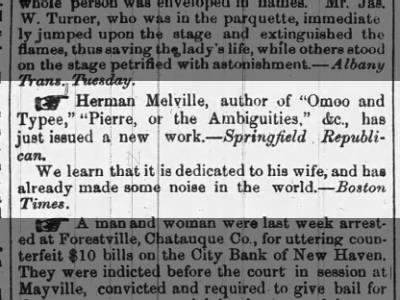
Same year, same baby girl (Bessie Melville, born May 22nd) but involving different newspapers in Boston and Buffalo. The original Springfield notice has been abbreviated for the sake of another joke, contributed by the Boston Times and reprinted in the Buffalo Morning Express on June 2, 1853:


Herman Melville, author of "Omoo and Typee," "Pierre, or the Ambiguities," &c., has just issued a new work.Springfield Republican.

     We learn that it is dedicated to his wife, and has already made some noise in the world.Boston Times
Related post:

Friday, January 26, 2018

Different versions for sure. Different manuscripts too?

The version of "Poor Man's Pudding and Rich Man's Crumbs" that appeared in the August 1854 issue of The Western Literary Messenger shares many textual features with the printing of Melville's paired sketches in the Concord, New Hampshire Independent Democrat (June 29, 1854). How many? A lot more than I first realized. Before now I never bothered to read the Western Literary Messenger text closely, assuming it to have been reprinted straight from the June 1854 issue of Harper's magazine. Finding Melville's paired sketches in the Concord Independent Democrat (edited by George Gilman Fogg) made me look again at the known reprintings, in the Western Literary Messenger and also the Salem Register for June 19, 1854. The Salem Register version basically follows the text in Harper's. Not so for the later printings in Concord and Buffalo--which agree with each other in most of the places where they differ from the Harper's and the Salem printings.

The lists below identify many (not all) of the textual features that distinguish the Concord (C) and Buffalo (B) versions of "Poor Man's Pudding and Rich Man's Crumbs" from the printings in Harper's (H) and Salem (S).
ABBREVIATIONS
  • H = Harper's magazine, June 1854
  • S = Salem Register, June 19, 1854
  • C = Concord [New Hampshire] Independent Democrat, June 29, 1854
  • B = [Buffalo, New York] Western Literary Messenger, August 1854
Where B departs from C the differences are mostly typos, mostly in B, for example: "mirrily" for "merrily" in "merrily dream of"; "Nw" for "No" in "No, said William, rising."; "haoked" for "hacked" in "hacked crust"; "in fouoled" for "is fouled"; "rack" for "reek"; and the misspelling "prooceed."

Of the numerous departures from the Harper's text that C and B share, some would appear, possibly, to reflect a manuscript exemplar at some stage of transmission, rather than or in addition to a printed one. The conjectured manuscript behind C and B was probably difficult to read in places, hence misreadings such as "earnestly" and "earnestness" for "enthusiastically" and "enthusiasm"; "thrice" for "trice"; and "magnificence" for "magnificoes." Not only that, the conjectured manuscript may have differed significantly in places from the printer's copy used by Harper's magazine. The availability of an alternate manuscript or manuscript stage might explain some of the more remarkable and suggestive variants in C and B, in particular:
  • "thro' kind Nature"; "thro'" for "through" being a characteristic spelling for Melville in manuscript.
  • extra dashes, again characteristic of Melville's narrative style. 
  • the expression "once in awhile" in the Concord version ("once in a while" in the Buffalo Western Literary Messenger) seems hard to account for, unlikely to be merely a mistaken reading or careless transcription of "sometimes."
Harper's magazine - June 1854
Concord Independent Democrat - June 29, 1854
  • friend Blandmour, "friend" being unexampled in the Harper's text.
  • "tho't" abbreviating "thought" in CB replaces "mused" in the Harper's text. The difference appears to reflect either an illegible exemplar, or a different base-text. ("Thought I" occurs repeatedly in Melville's published writings, including short stories Bartleby and Cock-a-doodle-doo!--don't know yet about this contracted form, "tho't".)
You find rare wisdom in the woods, tho't I.  -- Concord Independent Democrat; and Buffalo Western Literary Messenger
You find rare wisdom in the woods, mused I. --Harper's magazine
Concord Independent Democrat - June 29, 1854
  •  gulph, which Melville uses elsewhere, for instance in Moby-Dick chapter 3, "the Cape Horn measure, which you may gulph down for a shilling."
Western Literary Messenger - August 1854
Listed below are textual features shared by the Concord and Buffalo versions that distinguish them from the first known printing in Harper's magazine (June 1854), and the early reprinting from Harper's in the Salem Register (June 19, 1854).

POOR MAN'S PUDDING
  1. "earnestly" in CB replaces "enthusiastically" in HS
  2. no hyphens in CB for these: farm yard; spring snow; snow fleece; all bountiful; rain water; receipt book; wash tub; infirm looking; half rotten; heart trouble; washing day; picked up; dinner time; window sills; chimney shelf; stock still; maple sugar; good enough; up stairs; grindstone....
  3. "earnestness" (CB) for "enthusiasm" (HS)
  4. "Blandmour" in CB not "dear Blandmour"; 2x at least.  Thus: "...I presume, Blandmour" (but see the reverse below, #22: "dear Blandmour" for Blandmour).
  5. "winter" singular not "winters" in "long, long winter here"
  6. "itself" not italicized in "winter's snow itself"
  7. long dash after "dear Blandmour"; likewise dash not semicolon after "bodily harms"; dash after "poor man's house."; dash not semicolon after "give up the point altogether"; dash after "many autumns." dash after "aspect of the room." dash after "long way sir"; after shavings away"; dash after "footfall was heard"
  8. "ever" not "never" in "Did you ever hear of the Poor Man's Eye-water?"
  9. "there is" not conracted in "there is 'Poor Man's Plaster'"..."
  10. "feed" not fe'ed as in "feed physician" (capitalized "Physician" in B, but "physician" in C)
  11. Go on, go on (repeated expression in BC where HS have "Go on." once only.
  12. "thro' kind Nature" abbreviated form, instead of "through kind Nature"
  13. semicolon within parenthesis "for the benefit of my health;)"
  14. no parentheses around "for the snow had thawed"
  15. "1 o'clock meal" numeral in CB where HS versions spell out "one o'clock"
  16. no dashes setting off "unobservantly" (emended to "unobservedly" in the Northwestern-Newberry edition): "unobservantly as I could"
  17. CB have no comma after "old" in "old and constitutionally damp."
  18. "blue eyes" plural in CB instead of "blue eye" in "soft, sad blue eye"; B has "her soft, and blue eyes" giving "and" instead of "sad"; C has "her soft, sad blue eyes"
  19. CB have lowercase m's and t in "Poor man's matches" and "Poor man's tinder"
  20. CB use question mark instead of period: "Ah, what they call 'Poor Man's Pudding,' I suppose you mean?"
  21. "We" not italicized in "We do not call it so, sir...."; "must" not italicized in "must take all my meals at home"
  22. Added "dear" in CB, "what dear Blandmour would have said" instead of "what Blandmour would have said"
  23. "thrice" in CB for trice, "in a thrice"
  24. CB have "friend Blandmour" instead of "Blandmour"
  25. "But you don't eat pork" (CB) instead of "But you don't eat of the pork!"  (HS)
  26. extra "a" "with a sly significance" in CB, not "with sly significance" as in HS
  27. "I am off" in CB instead of "I'm off."
  28. Poor man, lowercase 'm' in CB where HS have "Poor Man"
  29. "But once in a while his man gives me a Sunday ride." (CB, with "awhile" as one word in C)
    "But sometimes his man gives me a Sunday ride." (HS)
  30. "friend Blandmour" in CB instead of just "Blandmour" as in HS
  31. "our wedding-day, sir" in CB instead of "the wedding-day, sir" as in HS
  32. same reversed and misplaced parenthesis in CB, thus: "(and the soft, blue, beautiful eyes turned into two well-springs, ("
  33. "self-upbraiding" singular in CB, instead of "self-upbraidings" as in HS
  34. "bade the dame good-bye" in CB, good-bye instead of "good-by" as in HS
  35. "ill-ventilated cold" in CB, mistake for "well-ventilated cold" in HS
  36. "ruddy children" in CB, not "ruddy little children" as in HS
  37. "tho't" not "mused" in CB, thus: "tho't I" instead of "mused I" (HS)
 RICH MAN'S CRUMBS
  1. "George and Prince Regent" not "George the Prince Regent."
  2. traveller (CB) not traveler (HS)
  3. past tense "forgot exactly what" (CB) instead of "forget exactly what" (HS)
  4. past tense came, "I came to roam and see" (CB) instead of "I come but to roam and see." (HS)
  5. exclamation mark (CB) not question mark in "I hope you have not on your drawing-room suit!"
  6. "a civil, as well as a civil guide" (CB) instead of "a civic, as well as civil guide" (HS)
  7. was (CB) not were in "just the same as if I was pressed by a mob of cannibals...."
  8. "; in the country it softens" (clause instead of new sentence: "In the country it softens." (HS)
  9. dash in CB instead of semicolon, thus "not a swordI know not"
  10. Frederick William in CB not Frederic William (HS)
  11. "mob of magnificence" (CB) instead of "mob of magnificoes"
  12. "no windows" in CB instead of "No windows...." (HS)
  13. splendid "everywhere" (one word in CB) instead of "every where" (two words in HS)
  14. "pine tables" no hyphen in CB; sidewalk in CB not side-walk
  15. "dined of that" in CB instead of "dined off that" (HS)
  16.  "one broad gulph" in CB for "one broad gulp"
  17. minus two "ands" in CB, thus: "Emperors, prince-regents, kings, and field-marshalls" instead of "Emperors, and prince-regents, and kings, and field-marshals...."
  18. ...plain beef and bread; so the leavings are accordingly." (CB)
    ...plain beef and bread. So the leavings are according. (HS)
  19. "red-gowned official near the board": near in CB instead of "nigh the board" (HS)
  20. "me" italicized only once in CB, not twice as in HS.
  21. "See!" with exclamation mark in CB, not "See?"
  22. "not only stands your hat away"; "away" in CB, not "awry" as in HS.
  23. added dash (no semicolon) in "an unfortunate friend--a simple spectator"; same in "You faint.--Ho!"
  24. "banquets of kings" with lower case nouns in CB, not capitalized as in HS, "Banquets of Kings"; typo in C only, "bonquets"
  25. CB have "mouthfulls" in "unsatisfying mouthfulls of disembowelled pasties...."; not "mouthfuls" as in HS.
  26. "answered my back" in CB, mistake for "answered my beck"
  27. "defined all tumblings and tearings" in CB; mistake for "defied all tumblings and tearings" (HS)
  28. "Good-bye" in CB for "Good-by" in HS.
  29. "addressing the driver on the box" set off by commas in CB, not dashes as in HS.

Related post


Thursday, January 25, 2018

Notice of The Town-Ho's Story, Newark Daily Advertiser

The Town-Ho's Story first appeared in the October 1851 issue of Harper's New Monthly Magazine, offered as an extract from Herman Melville's forthcoming novel The Whale (as the British edition was titled). The Town-Ho narrative forms chapter 54 in the American edition of Moby-Dick.

Reviewing Harper's for October, the Newark Daily Advertiser on September 29, 1851 alluded to "The Town-Ho's Story" and the forthcoming Whale, both favorably:

Newark Daily Advertiser - September 29, 1851
via GenealogyBank
"We are glad to have a foretaste of the fine dish which Herman Mellville is soon to offer us, and we venture to predict, that our friends will not shrink from going the whole WHALE (which is the title of the note from which this extract is taken) as soon as they have the chance."
Edited by Samuel Jackson Gardner, the father of Melville's friend Augustus Kinsley Gardner.

Related posts: