Friday, February 14, 2020

White-Jacket in Sleeper's Boston Journal

The Boston Journal, then edited by John Sherburne Sleeper, published this brief, favorable notice of Melville's White-Jacket on March 25, 1850. Not included in Gary Scharnhorst's 1988 inventory of discoveries, "Melville Bibliography 1846-1897: A Sheaf of Uncollected Excerpts, Notices, and Reviews" in Melville Society Extracts 74 (October 1988) pages 8-12; and 75 (November 1988) pages 3-8. Not transcribed or listed in Herman Melville: The Contemporary Reviews, edited by Brian Higgins and Hershel Parker (Cambridge University Press, 1995; paperback 2009).

Boston Journal - March 25, 1850
Vol. 18 no. 5256, page 1, col. 4.

New Publications. 

... White-Jacket; or the World in a Man-of-War. By Herman Melville. New York: Harpers & Brothers.
The author in this volume gives a description of life on board a man of war, as seen from the forecastle. We have not yet had an opportunity to bestow more than a casual glance at the contents of this book, but judging from a perusal of one or two chapters and from the wide reputation which the author has acquired, we hazard little in predicting that the book will be read with great interest. In London, where the work was published some six or eight weeks since, it is very highly spoken of. The little which we have read in "White Jacket," has served to awaken a desire to read more, and we have laid the book aside for perusal at the earliest opportunity. It is for sale by Redding & Co.
Boston Daily Journal - May 23, 1850
Vol. 18 no. 5306, page 1, columns 4-5.
Two months later, a more substantial critique of White-Jacket appeared in the evening edition of Sleeper's Boston Journal over the pseudonym, "Johnny Raw." This item also is not counted in Scharnhorst's 1988 "Sheaf" or the 1995 edition of Contemporary Reviews. The pseudonymous reviewer in the Boston Journal argues that Melville's book is best regarded as fiction, taking pains to show specific ways that White-Jacket is unreliable as a "true narrative." According to "Johnny Raw," Melville actually belonged to the after-guard, never the maintop as claimed, "his duties seldom carrying him above the hammock netting." The writer takes pains to correct Melville on the legal basis for flogging in the U. S. Navy. Without saying how exactly, "Johnny Raw" appears to have some knowledge of the frigate United States during Melville's service, including what might be regarded as inside information about particular officers and crew members. 

Critique of Melville's White-Jacket by "Johnny Raw"
Boston Daily Journal - May 23, 1850
Melville's informed critic approves the portrayal of "Mad Jack" as "the most correct character in the book," but denies any factual basis for the caricatures of Selvagee and the amputation-crazy Dr. Cuticle. The critic exposes the real age of old Ushant ("about forty") and his lack of naval experience. Nevertheless, "Johnny Raw" acknowledges that Melville's Ushant had a real-life model whose "great peculiarity was his fondness for his bushy and Turk-like beard." In this case, the exercise of fact-checking nicely corroborates the main lines of the story as Melville told it in The Great Massacre of the Beards.

[For the Boston Journal]
WHITE JACKET--OR THE WORLD IN A MAN-OF-WAR
The title of this work would lead its readers, generally, to believe it a correct statement of the routine and discipline of a man-of-war; at least, they would expect a true narrative of occurrences in the vessel, on board which its author--pretending to be a maintop-man--was the literary man of that body of men termed the After-Guard; (who, in his own language, are composed chiefly of landsmen, the least robust, least hardy, and least sailor-like of the crew). Such, however, is far from being the case; much of this volume is fiction, composed, I should judge, in a great measure, of yarns gathered from sailors--having about the same claim to reality as "Sinbad the Sailor," or the "Baron Munchausen." When the author condescends to treat his readers to a bit of reality, his facts are so much distorted, and represented in so incorrect a light, as to render them, under the circumstances, more blameable than fiction. Tending, as they do, to mislead the public, (who generally being wholly unacquainted with the subject, are entirely at the mercy of an author,) such want of faith in portraying events, cannot be too severely censured. As a work of fiction, the book may have its merits; but deeming it the intention of its author that it should not be considered such, I will point out some few of these misrepresentations and attempt to place them in their true position.
Commencing with the author's statement of the truth and fidelity of his picture, we find, in Chap. 12th, in speaking of the topmen-- 
"The reason of their lofty-mindedness was, that they were high lifted above the petty tumults, carping cares, and paltriness of the decks below. And I feel persuaded, in my inmost soul, that it is to the fact of my having been a maintop-man, and especially my particular post being on the loftiest yard of the frigate, the main-royal-yard, that I am now enabled to give such a free, broad, off-hand, birds-eye and , more than all, impartial account of our man-of-war world; withholding nothing, inventing nothing, nor flattering, nor scandalizing any, but meting out to all--Commodore and messenger-boy alike--their precise description and deserts." 
There is no knowing but such might have been the case, had the author been a maintop-man, and his station on the giddy heighth of the main-royal-yard of the frigate; but stationed as he was, among the landsmen of the After-Guard, his duties seldom carrying him above the hammock netting; it may have been "the petty tumults, carping cares, and paltriness of the decks below," together with a want of sufficient knowledge of sea service, which has caused him to view every thing through so incorrect and distempered a medium.
The characters introduced into this work, are in a great measure those of the imagination, and are made to speak and act to suit the author's pleasure. Captain "Claret," or rather the Captain's Claret, (there being no mention made by the author of the Captain Claret to whom he alludes having, during the latter part of the cruise, relinquished the command of the frigate to a commander, himself taking command of the squadron, owing to the death of the Commodore,) are officers of high standing both in their profession and among their fellow citizens. "Mad Jack" is the most correct character in the book. "Selvagee" is most outrageously caricatured; in reality he is a neat, gentlemanly man, intelligent and much above mediocrity in ability and acquirement, with a knowledge of his profession, which renders him competent to discharge all its duties. The venerable "Old Ushant," "the ancient captain of the forecastle," the seaman whose "back had bowed at the guns of the Constitution when she captured the Guerriere." In fact, with all this high sounding decoration, the author's Ushant was a seaman on the forecastle, who, so far from having been in the Constitution at the time of the capture of the Guerriere, from his own admission, had never served in a man-of-war previous to the cruise of this frigate; neither was he the venerable man, "the Nestor of the crew," as described, but a seaman of about forty years of age, whose great peculiarity was his fondness for his bushy and Turk-like beard. 
A few words now on the subject of flogging. The first case mentioned by the author, in chapter 33d, for the edification of his readers, is that of four men guilty of fighting; the description itself is tolerably fair, but something more is required to convey a correct idea of punishment in the naval service to general readers.
By law of Congress, the punishment in the naval service is flogging; the instrument and its material being designated. No officer has power to punish but the commanding officer, and that in presence of the officers and crew. The following are the regulations under which punishment is made:
GENERAL ORDER. 
"The President of the United States, believing that greater formality in the infliction of such corporeal punishments as are authorized by law, may be adopted in the Navy with beneficial consequences, directs that no such punishment shall be inflicted on any person in the service without sentence of a court-martial, when required bylaw, or the written order of the captain or commanding officer of the vessel, or commandant of the navy yard to which he is attached, where the authority to cause it to be inflicted rests with the commanding officer; specifying the offence or offences, and the extent of the punishment to be inflicted; which order shall be read, and the punishment inflicted in presence of the officers and seamen belonging to the vessel or navy yard.
All such orders for punishment shall be entered on the log-book, and a quarterly return made to the Secretary of the Navy, stating the names of the persons punished, their offences, and the extent of the punishment inflicted, together with such explanations or remarks as the commanding officer may deem necessary to a proper understanding of the case, &c.
(Signed,)
J. K. PAULDING.
Navy Department, May 29th, 1840." 
A list of all punishments taking place on board of all vessels of the Navy, containing the offence and number of lashes inflicted, is required to be kept and forwarded to Congress through the Secretary of the Navy.
"And be it further enacted, that the Secretary of the Navy be, and he is hereby directed to report to Congress at the commencement of the next session, the number of persons in the naval service flogged in each of the years eighteen hundred and forty-six, and eighteen hundred and forty-seven; specifying the name of the ship, the offence, the sentence, and the number of lashes inflicted; and it shall be his duty to make a similar report for each year thereafter." (Approved August 3, 1848.)
The regulations for the government of the Navy are laws of Congress, specifying the offences, and the punishment for such offences, leaving it only discretionary with the captain of a vessel to limit the punishment for such offences as are not subject for a court-martial, from one to twelve lashes (twelve lashes being the extent of the law); strictly, in all offences against the law, the captain has no power to remit punishment altogether, the law reading, "shall be punished," &c.
Chapter 34. "Some of the evil effects of flogging."-- "One of the arguments advanced by officers of the navy in favor of corporeal punishment is this: it can be inflicted in a moment; it consumes no valuable time; and when the prisoner's shirt is put on, that is the last of it, whereas if another punishment were substituted it would probably occasion a great waste of time and trouble; besides thereby begetting in the sailor an undue idea of his importance." 
I say with the author, "absurd, or worse than absurd," but beyond this I cannot go, and agree with him, that "all this is true," but decidedly deny its truth. That any such argument is advanced by officers of the Navy is altogether a misstatement. Not being aware that the opinions of officers (were they asked) would make any difference in the law, they having no part in their framing, being in no manner responsible for them, but being obliged to execute them to the best of their ability, whatever they may be. I will mention none of the arguments made use of by those in favor or against corporeal punishment:
"For besides the formal administering of the 'cat' at the gangway for petty offences, he is liable to the 'colt,' or rope's end, a bit of ratlin stuff, indiscriminately applied."
By referring back, it will be found in General Order from the Hon. J. K. Paulding, then Secretary of the Navy, that all punishment except in presence of the officers and crew, was prohibited in 1840, some three years previous to the author's serving on board the "Never-sink." 
"Nor was it a thing unknown for a Lieutenant in a sudden outburst of passion, perhaps inflamed by brandy, or smarting under the sense of being disliked or hated by the seamen, to order a whole watch of two hundred and fifty men, at dead of night, to undergo the indignity of the colt." 
Here again the author deals in the marvelous; such a scene cannot be proved to have been ever enacted in the navy of the United States. The laws in the naval service bind equally on all to whom they refer, officers as well as crew. Would not common sense teach any one, that an officer is not going to risk his position (which he most certainly would do) by acting directly at variance with the law, for the sake of gratifying such a paltry feeling of revenge, as the author imagines.
I would also mention here, that for illegal punishment, inflicted at any time during a cruise, every officer is aware that he would not only subject himself to a court-martial for violation of military law, but also to heavy penalty, at the expiration of the vessel's cruise, were the circumstances brought to a civil court; and there are ever a class in our sea port cities on the look out for such cases, on the return of both government and merchant vessels. 
"Flogging not lawful." Such is the title of chapter 35th. Is it not indeed wonderful that this should not have been found out an an earlier period, that the judgment of our members of Congress and heads of Department should have been thus obscured! that Congress, when legislating on this subject, should labor under the delusion that their acts were law! that no member of Congress has been sufficiently acute, when advocating the abolishment of corporeal punishment, to perceive that such punishment was unlawful! and that at last this discovery should be made by one whose talent seems by far better adapted to fiction, than to unravelling the substantial intricacies of the law. The laws for the government of the Navy are in themselves a sufficient comment upon this chapter. 
Although the seamen themselves, generally, are of opinion that flogging should not be done away with--and the only petition which I have heard of their sending to Congress for years, was a request that such punishment should not be abolished. Still I would say, make the trial--let Congress make the experiment in a few vessels--should they not deem it prudent to do so altogether--and indeed can I say that for one out of very many, most sincerely should I rejoice to see that order and discipline can be maintained, (on the high sea), among such a number, composed of every description of men, without the lash.
"Flogging not necessary." Chapter 36. Whether necessary or not, I should not presume to discuss, (although one-half of my life has been spent in sea service,) until a fair trial had been made without its use. 
"And as in this matter we cannot go further back than to Blake, so we cannot advance further than to our own time, which shows Commodore Stockton, during the recent war with Mexico, governing the American squadron in the Pacific, without employing the scourge." 
Having for authority those who served on board the U. S. frigate Congress, the flag-ship of Commodore Stockton, I can state that in this also the author is mistaken, and that as elsewhere corporeal punishment was inflicted for violation of the law; I should judge that the author might be equally if not more likely, misinformed with regard to the opinions of Blake, Collingwood and Nelson, on this subject, than of those of his contemporary whom he has mentioned. 
"Old Ushant at the gangway." Chapter 77. I will close this subject with a correct story of this incident, of the genuineness of the author's "Old Ushant," I have before spoken. General orders from the Secretary of the Navy, sent by circular to the Commodores of Squadrons, and from them to the commanders of vessels, are regulations which officers are obliged to obey and enforce equally with the laws.
GENERAL ORDER.
"The hair of all persons belonging to the Navy, when in actual service, is to be kept short. No part of the beard is to be worn long excepting the whiskers; which shall not descend more than one inch below the tip of the ear, and thence in a line towards the corners of the mouth.
[Signed] BADGER."
In the instance before us, each order was given by Captain "Claret." The order being obeyed by the officers, it was passed among the crew, who, with the exception of some six to twelve, obeyed it--they being probably sufficiently acquainted with the naval service to be aware that such orders do not emanate from the Captain without authority. On being remonstrated with, all obeyed, with the exception of the author's venerable Ushant, and he, after being reasoned with by the Captain, and informed that he should be obliged to punish him, did he continue to set his authority at defiance--the Captain at the same time expressing his unwillingness to do so--still continued to defy the authority of a regulation of the naval service, which all his shipmates and officers had seen the necessity of complying with. For this, in accordance with the law, was he punished. Here I will leave it to the good sense of every individual to say how justly.
"A man-of-war's man shot at," Chapter 50th. Without quoting from the author in this chapter, it is sufficient to say that he relates as fact, that a top-man, a messmate of his own, having been prohibited going on shore at night, was fired upon by the sentry on post, and severely wounded in the right thigh. Strange to say! this occurrence, unusual as it is, and of such a serious nature, cannot be remembered by others who were on board; so far from it, they decidedly maintain that, neither did such a circumstance occur during the cruise of the frigate, nor did a man die from having a limb amputated, as related in the case of this imaginary man of the author, in Chap. 53d; and furthermore, that no amputation took place on board the "Neversink," during her cruise. 
Growing out of this creation of the fancy, the author presents to his readers three chapters equally devoid of fact; and at last destroys his phantom messmate, under the hands of the surgeon; the description of whom, in justice to an upright and estimable man, I cannot pass over. "The Surgeon of the Fleet," Chap. 51st.
"He was a small, withered man, nearly, perhaps quite, sixty years of age. His chest was shallow, his shoulders bent, his pantaloons hung round skeleton legs, and his face was singularly attenuated. In truth, the corporeal vitality of this man seemed, in a good degree, to have died out of him, &c.
Like most old physicians and surgeons who have seen much service, and have been promoted to high professional place for scientific attainments, this Cuticle was an enthusiast in his calling. In private, he had once been heard to say, confidentially, that he would rather cut off a man's arm than  dismember the wing of the most delicate pheasant, &c." 
What a walking study for an anatomist! what a hideously ugly looking varmint, has the author drawn in caricaturing you, "Cuticle,"--quite a demon, hardly possessing the form of humanity; how amazingly is the real appearance and disposition of "Cuticle" at variance with the author's picture. Slightly above the medium height, he is erect, and stout without being corpulent, of about forty-five years of age, his features fine and expressive of that mildness and benignity which characterizes him. I am told by those who have been under his treatment (in the sick bay,) several times during the cruise of the frigate, he was ever extremely kind and attentive, doing all that professional skill, aided by an excellent heart, could do to alleviate the suffering of those under his care.
Here I "wind up" for the present, what was only undertaken to show the public how much they have been imposed upon, if they have taken "White Jacket" for other than a work of fiction.
JOHNNY RAW. 
--Boston Daily Journal, Thursday Evening, May 23, 1850; vol. 18 no. 5306, page 1.
Boston Daily Journal - May 23, 1850
Related post:

Monday, February 10, 2020

Moby-Dick in Sleeper's Boston Journal

Review of Moby-Dick, first three paragraphs in the
Boston Morning Journal - November 18, 1851
Herein I want to share all of the favorable review of Moby-Dick that appeared on November 18, 1851 in the morning edition of the Boston Journal. Although this review was located and partially reprinted in the late 1980's, the complete text has not been readily available. Gary Scharnhorst discovered the review of Moby Dick in Boston Journal of November 18, 1851 as well as the "Death Scenes of the Whale" excerpt that appeared on November 28, 1851; both items are listed in
Gary Scharnhorst, "Melville Bibliography 1846-1897: A Sheaf of Uncollected Excerpts, Notices, and Reviews" continued from Number 74 in Melville Society Extracts 75 (November 1988), pages 3-8 at 4 and 5. 
Scharnhorst transcribed parts of the Boston Journal review of Moby-Dick, omitting the plot summary with repeated references to the "monomaniac" Captain Ahab. 

Presumably by editor John Sherburne Sleeper (1794-1878), the review of Moby-Dick in Sleeper's Boston Journal is not transcribed or listed in Herman Melville: The Contemporary Reviews, edited by Brian Higgins and Hershel Parker (Cambridge University Press, 1995; paperback 2009). What led me to hunt it up in the Boston Morning Journal was the mostly negative notice that Richard E. Winslow III discovered in a different Boston newspaper, the Saturday Evening Gazette for December 6, 1851. That later Saturday Evening Gazette item is collected and transcribed at page 102 in Melville Reviews and Notices, Continued, Leviathan, vol. 13 no. 1, 2011, p. 88-115. Project MUSE muse.jhu.edu/article/493025.

The Boston Saturday Evening Gazette, then edited by twenty-five year old William Warland Clapp, Jr., wished Melville had quit while he was ahead, having peaked with the brilliant Typee (1846) and Omoo (1847): "We have read portions of Moby Dick, but fail to discover any marks of freshness, any traces of originality." But here's the clue. With admirable humility and fairness, Clapp went on to acknowledge the contrary opinion of an older and possibly wiser editor:
"The work [Moby-Dick] is highly spoken of by our neighbor of the Journal, a nautical gentleman, and our opinion of its merits may be erroneous. The only way for the reader to decide is by perusing the volume." 
So then, according to Clapp's Saturday Evening Gazette, a "highly" positive take on Moby-Dick had recently graced the Boston Journal. Without needing to name him, Clapp respectfully acknowledged Journal editor John Sherburne Sleeper as the "nautical gentleman" who had endorsed Moby-Dick, apparently in glowing terms.

As confirmed in Appletons' Cyclopaedia of American Biography, Volume 5, Sleeper edited the Boston Journal for twenty years from 1834 to 1854; and before that "was during twenty-two years a sailor and a shipmaster in the merchant service from Boston."

SLEEPER, John Sherburne, author, born in Tyngsboro, Massachusetts, 21 September, 1794; died in Boston Highlands, Massachusetts, 14 November, 1878. He was during twenty-two years a sailor and a shipmaster in the merchant service from Boston. He afterward engaged in journalism, was connected with the New Hampshire "News Letter" at Exeter in 1831-'2, and the Lowell "Daily Journal" in 1833, and was editor of the Boston "Journal" in 1834-'54. He was mayor of Roxbury, Massachusetts, in 1856-'8, and published "Tales of the Ocean "(Boston, 1842); "Salt-Water Bubbles" (1854); "Jack in the Forecastle" (1860); " Mark Rowland, a Tale of the Sea, by Hawser Martingale "(1867); and various addresses. 


One of Sleeper's nautical tales provided a source for White-Jacket, as Howard P. Vincent shows in The Tailoring of Melville's White-Jacket (Northwestern University Press, 1970) pages 150-154. In chapter 67, White-Jacket arraigned at the Mast, the narrator's determination to kill himself and Captain Claret rather than submit to flogging is re-imagined from Sleeper's dramatic passage on the flogging of an impressed Yankee boy in Tales of the Ocean. Melville's White Jacket escapes punishment with help from Jack Chase, and never enacts the desperate murder-suicide that actually happens in Sleeper's account. Published under the pseudonym "Hawser Martingale," Sleeper's "Tales of the Ocean is number 647 in Mary K. Bercaw, Melville's Sources (Northwestern University Press, 1987) page 120.


The Library of Congress has bound volumes of the Boston Morning Journal and Boston Daily Journal, stored offsite at Fort Meade, Maryland. With generous help from Library of Congress experts in the James Madison Memorial Building, I was able to examine volumes in the Newspaper and Current Periodical Reading Room. For major assistance there I am grateful to Amber Paranick, Reference Librarian; and Robin Butterhof, Digital Conversion Specialist.

Boston Morning Journal - November 18, 1851

New Publications. 

... Moby-Dick; or the Whale. By Herman Melville. New York: Harper & Brothers. The appearance of this work has been awaited with much interest. The author of "Omoo," "Typee," &c., has taken a high rank among the writers of the day, and his works have attained considerable popularity, as well in England as in this country.

Moby-Dick is the soubriquet given by whalemen to a white whale of unusual ferocity, and whose exploits form the subject of many a tale of havoc. This whale had been attacked by Captain Ahab of the Pequod, on board of which vessel the scenes of this volume are laid. Captain Ahab came off from the encounter with the loss of a leg. From that hour he became a monomaniac, and lived for revenge. He returned to Nantucket, and dissembling with the cunning of a madman the condition of his mind, again took command of the Pequod for another whaling cruise. When well out to sea, the monomaniac Captain assembled his crew, declared his determination to hunt the white whale to the death, and influenced them also to swear to aid him in his work of revenge. From that hour the Pequod pursued the seemingly hopeless search to all quarters of the world, and in spite of all warnings of evil. The white whale is finally overtaken, but his malice and ferocity proved more than a match for the hatred of Captain Ahab, and a terrible tragedy ends the tale.

The work is a singular mixture of fact and fiction.— The supernatural is interwoven with the matter-of-fact delineations of life on board a whale ship. The descriptions of the various operations of the whalemen are remarkably life like. The chapters upon the whale, for minute description of the characteristics of the different varieties of the leviathan, would do credit to the researches of the most enthusiastic naturalist.
We take a few leaves from this volume for the perusal of our readers. They afford striking illustrations of the descriptive powers of the author. And first we quote a picture of cabin life on board a whale ship— time, the dinner hour. This chapter [34: The Cabin-Table] is a life-like delineation of the social distinctions which exist among the officers of a large ship: 
"It is noon; and Dough-Boy, the steward, thrusting his pale loaf-of-bread face from the cabin-scuttle, announces dinner to his lord and master; who, sitting in the lee quarter-boat, has just been taking an observation of the sun; and is now mutely reckoning the latitude on the smooth, medallion-shaped tablet, reserved for that daily purpose on the upper part of his ivory leg. From his complete inattention to the tidings, you would think that moody Ahab had not heard his menial. But presently, catching hold of the mizen shrouds, he swings himself to the deck, and in an even, unexhilarated voice, saying, 'Dinner, Mr. Starbuck,' disappears into the cabin.

When the last echo of his sultan's step has died away, and Starbuck, the first Emir, has every reason to suppose that he is seated, then Starbuck rouses from his quietude, takes a few turns along the planks, and after a grave peep into the binnacle, says, with some touch of pleasantness, 'Dinner, Mr. Stubb,' and descends the scuttle. The second Emir lounges about the rigging awhile, and then slightly shaking the main brace, to see whether it be all right with that important rope, he likewise takes up the old burden, and with a rapid 'Dinner, Mr. Flask,' follows after his predecessors.

But the third Emir, now seeing himself all alone on the quarter-deck, seems to feel relieved from some curious restraint; for, tipping all sorts of knowing winks in all sorts of directions, and kicking off his shoes, he strikes into a sharp but noiseless squall of a hornpipe right over the Grand Turk's head; and then, by a dexterous sleight, pitching his cap up into the mizentop for a shelf, he goes down rollicking, so far at least as he remains visible from the deck, reversing all other processions, by bringing up the rear with music. But ere stepping into the cabin doorway below, he pauses, ships a new face altogether, and, then, independent, hilarious little Flask enters King Ahab's presence, in the character of Abjectus, or the Slave.

It is not the least among the strange things bred by the intense artificialness of sea-usages, that while in the open air of the deck some officers will, upon provocation, bear themselves boldly and defyingly enough towards their commander; yet, ten to one, let those very officers the next moment go down to their customary dinner in that same commander's cabin, and straightway their inoffensive, not to say deprecatory and humble air towards him, as he sits at the head of the table; this is marvellous, sometimes most comical. Wherefore this difference? A problem? Perhaps not. To have been Belshazzar, King of Babylon; and to have been Belshazzar, not haughtily but courteously, therein certainly must have been some touch of mundane grandeur. But he who in the rightly regal and intelligent spirit presides over his own private dinner-table of invited guests, that man's unchallenged power and dominion of individual influence for the time; that man's royalty of state transcends Belshazzar's, for Belshazzar was not the greatest. Who has but once dined his friends, has tasted what it is to be Caesar. It is a witchery of social czarship which there is no withstanding. Now, if to this consideration you superadd the official supremacy of a ship-master, then, by inference, you will derive the cause of that peculiarity of sea-life just mentioned."
The following we take from a chapter [60: The Line] descriptive of some of the implements used in the capture of whales:
"The whale line is only two thirds of an inch in thickness. At first sight, you would not think it so strong as it really is. By experiment its one and fifty yarns will each suspend a weight of one hundred and twenty pounds; so that the whole rope will bear a strain nearly equal to three tons. In length, the common sperm whale-line measures something over two hundred fathoms. Towards the stern of the boat it is spirally coiled away in the tub, not unlike the worm-pipe of a still though, but so as to form one round, cheese-shaped mass of densely bedded 'sheaves,' or layers of concentric spiralizations, without any hollow but the 'heart,' or minute vertical tube formed at the axis of the cheese. As the least tangle or kink in the coiling would, in running out, infallibly take somebody's arm, leg or entire body off, the utmost precaution is used in stowing the line in its tub. Some harpooneers will consume almost an entire morning in this business, carrying the line high aloft and then reeving it downwards through a block towards the tub, so as in the act of coiling to free it from all possible wrinkles and twists.

In the English boats two tubs are used instead of one; the same line being continuously coiled in both tubs. There is some advantage in this; because these twin tubs being so small they fit more readily into the boat, and do not strain it so much; whereas, the American tub, nearly three feet in diameter and of proportionate depth, makes a rather bulky freight for a craft whose planks are but one half-inch in thickness; for the bottom of the whale-boat is like critical ice, which will bear up a considerable distributed weight, but not very much of a concentrated one. When the painted canvas cover is clapped on the American line-tub, the boat looks as if it were pulling off with a prodigious great wedding cake to present to the whales. 
Both ends of the line are exposed; the lower end terminating in an eye-splice or loop coming up from the bottom against the side of the tub, and hanging over its edge completely disengaged from everything. This arrangement of the lower end is necessary on two accounts. First: In order to facilitate the fastening to it of an additional line from a neighboring boat, in case the stricken whale should sound so deep as to threaten to carry off the entire line originally attached to the harpoon. In these instances, the whale of course is shifted like a mug of ale, as it were, from one boat to the other; though the first boat always hovers at hand to assist its consort. Second: This arrangement is indispensable for common safety's sake; for were the lower end of the line in any way attached to the boat, and were the whale then to run the line out to the end almost in a single, smoking minute as he sometimes does, he would not stop there, for the doomed boat would infallibly be dragged down after him into the profundity of the sea; and in that case no town-crier would ever find her again. 
Before lowering the boat for the chase, the upper end of the line is taken aft from the tub, and passing round the loggerhead there, is again carried forward the entire length of the boat, resting crosswise upon the loom or handle of every man's oar, so that it jogs against his wrist in rowing; and also passing between the men, as they alternately sit at the opposite gunwales, to the leaded chocks or grooves in the extreme pointed prow of the boat, where a wooden pin or skewer the size of a common quill, prevents it from slipping out. From the chocks it hangs in a slight festoon over the bows, and is then passed inside the boat again; and some ten or twenty fathoms (called box-line) being coiled upon the box in the bows, it continues its way to the gunwale still a little further aft, and is then attached to the short-warp—the rope which is immediately connected with the harpoon; but previous to that connexion, the short-warp goes through sundry mystifications too tedious to detail. 
Thus the whale-line folds the whole boat in its complicated coils, twisting and writhing around it in almost every direction. All the oarsmen are involved in its perilous contortions; so that to the timid eye of the landsman, they seem as Indian jugglers, with the deadliest snakes sportively festooning their limbs. Nor can any son of mortal woman, for the first time, seat himself amid those hempen intricacies, and while straining his utmost at the oar, bethink him that at any unknown instant the harpoon may be darted, and all these horrible contortions be put in play like ringed lightnings; he cannot be thus circumstanced without a shudder that makes the very marrow in his bones to quiver in him like a shaken jelly. Yet habit—strange thing! what cannot habit accomplish?' "
We have read many accounts of the chase and capture of the sperm whale, but none so absorbingly interesting, or which have presented so vivid a picture of this exciting event, as the following [from Chapter 61: Stubb Kills a Whale]:
" 'Start her, start her, my men! Don't hurry yourselves; take plenty of time—but start her; start her like thunder-claps, that's all,' cried Stubb, spluttering out the smoke as he spoke. 'Start her, now; give 'em the long and strong stroke, Tashtego. Start her, Tash, my boy—start her, all; but keep cool, keep cool—cucumbers is the word—easy, easy —only start her like grim death and grinning devils, and raise the buried dead perpendicular out of their graves, boys—that's all. Start her!'
'Woo-hoo! Wa-hee!' screamed the Gay-Header in reply, raising some old war-whoop to the skies; as every oarsman in the strained boat involuntarily bounced forward with the one tremendous leading stroke which the eager Indian gave. 
But his wild screams were answered by others quite as wild. 'Kee-hee! Kee-hee!' yelled Daggoo, straining forwards and backwards on his seat, like a pacing tiger in his cage.  
'Ka-la! Koo-loo!' howled Queequeg, as if smacking his lips over a mouthful of Grenadier's steak. And thus with oars and yells the keels cut the sea. Meanwhile, Stubb retaining his place in the van, still encouraged his men to the onset, all the while puffing the smoke from his mouth. Like desperadoes they tugged and they strained, till the welcome cry was heard— 'Stand up, Tashtego!—give it to him!' The harpoon was hurled. 'Stern all!' The oarsmen backed water; the same moment something went hot and hissing along every one of their wrist[s]. It was the magical line. An instant before, Stubb had swiftly caught two additional turns with it round the loggerhead, whence, by reason of its increased rapid circlings, a hempen blue smoke now jetted up and mingled with the steady fumes from his pipe. As the line passed round and round the loggerhead; so also, just before reaching that point, it blisteringly passed through and through both of Stubb's hands, from which the hand-cloths, or squares of quilted canvas sometimes worn at these times, had accidentally dropped. It was like holding an enemy's sharp two-edged sword by the blade, and that enemy all the time striving to wrest it out of your clutch.  
'Wet the line! wet the line!' cried Stubb to the tub oarsman (him seated by the tub) who, snatching off his hat, dashed the sea-water into it. More turns were taken, so that the line began holding its place. The boat now flew through the boiling water like a shark all fins. Stubb and Tashtego here changed places—stem for stern—a staggering business truly in that rocking commotion. 
From the vibrating line extending the entire length of the upper part of the boat, and from its now being more tight than a harpstring, you would have thought the craft had two keels—one cleaving the water, the other the air—as the boat churned on through both opposing elements at once. A continual cascade played at the bows; a ceaseless whirling eddy in her wake; and, at the slightest motion from within, even but of a little finger, the vibrating, cracking craft canted over her spasmodic gunwale into the sea. Thus they rushed; each man with might and main clinging to his seat, to prevent being tossed to the foam; and the tall form of Tashtego at the steering oar crouching almost double, in order to bring down his centre of gravity. Whole Atlantics and Pacifics seemed passed as they shot on their way, till at length the whale somewhat slackened his flight.  
'Haul in—haul in!' cried Stubb to the bowsman! and, facing round towards the whale, all hands began pulling the boat up to him, while yet the boat was being towed on. Soon ranging up by his flank, Stubb, firmly planting his knee in the clumsy cleat, darted dart after dart into the flying fish; at the word of command, the boat alternately sterning out of the way of the whale's horrible wallow, and then ranging up for another fling. 
The red tide now poured from all sides of the monster like brooks down a hill. His tormented body rolled not in brine but in blood, which bubbled and seethed for furlongs behind in their wake. The slanting sun playing upon this crimson pond in the sea, sent back its reflection into every face, so that they all glowed to each other like red men. And all the while, jet after jet of white smoke was agonizingly shot from the spiracle of the whale, and vehement puff after puff from the mouth of the excited headsman; as at every dart, hauling in upon his crooked lance (by the line attached to it), Stubb straightened it again and again, by a few rapid blows against the gunwale, then again and again sent it into the whale.  
'Pull up—pull up!' he now cried to the bowsman, as the waning whale relaxed in his wrath. 'Pull up!—close to!' and the boat ranged along the fish's flank. When reaching far over the bow, Stubb slowly churned his long sharp lance into the fish, and kept it there, carefully churning and churning, as if cautiously seeking to feel after some gold watch that the whale might have swallowed, and which he was fearful of breaking ere he could hook it out. But that gold watch he sought was the innermost life of the fish. And now it is struck; for, starting from his trance into that unspeakable thing called his 'flurry,' the monster horribly wallowed in his blood, overwrapped himself in impenetrable, mad, boiling spray, so that the imperilled craft, instantly dropping astern, had much ado blindly to struggle out from that phrensied twilight into the clear air of the day.  
And now abating in his flurry, the whale once more rolled out into view; surging from side to side; spasmodically dilating and contracting his spout-hole, with sharp, cracking, agonized respirations. At last, gush after gush of clotted red gore, as if it had been the purple lees of red wine, shot into the frighted air; and falling back again, ran dripping down his motionless flanks into the sea. His heart had burst!  
'He's dead, Mr. Stubb,' said Daggoo.  
'Yes; both pipes smoked out!' and withdrawing his own from his mouth, Stubb scattered the dead ashes over the water; and, for a moment, stood thoughtfully eyeing the vast corpse he had made."
There was considerable discussion when the "Typee," of Melville, appeared, whether the scenes therein described were founded on fact, or were all fiction. 
In Moby-Dick, as in Typee, the author figures in the first person, but no one will mistake the strangely wild thread of this story for a veritable history. But the reader will sometimes be puzzled to separate fiction from probability, so skilfully has the author blended the common incidents of a whaleman's life, with the creations of his own fancy. In many respects Moby-Dick is the best of the works of the author, as it certainly is the most instructive. We predict for it, with confidence, an extended popularity. For sale by Redding & Co.
-- Boston Morning Journal, Volume 19, Number 5760. Tuesday morning, November 18, 1851. Page 1, columns 5-6. Library of Congress. Bound volumes, Newspapers, Control # 8218. October-December 1851.

Later in November, another passage from Moby-Dick appeared in the evening edition of the Boston Journal. On Friday evening, November 28, 1851, the Boston Daily Journal reprinted an excerpt from chapter 81 under the heading, "Death Scenes of the Whale." This text had been reprinted elsewhere with the same heading, for example on November 15, 1851 with the first notice of Moby-Dick in The Literary World. In the Boston Daily Journal, the credit line for the "Death Scenes" excerpt read,
"—Herman Melville." 
Boston Daily Journal - November 28, 1851 - vol. 19 no. 5767
Library of Congress. Bound volumes, Control #8217. 
The Boston Daily Journal column with "Death Scenes of the Whale" appeared on the front page of the newspaper, immediately below and alongside the full report of Orville Dewey's eleventh lecture on "The Problem of Human Destiny, Considered in its Bearings on Human Life and Welfare."

Boston Daily Journal - November 28, 1851
page 1, columns 6-7
In January and February 1852, Dewey repeated his Lowell lectures in New York City. Later made into a book, The Problem of Human Destiny (James Miller: New York, 1864). Melville worked over Dewey and his theme of Human Destiny in Pierre; or, The Ambiguities (1852), as Hershel Parker discusses in Herman Melville: A Biography Volume 2, 1851-1891 (Johns Hopkins University Press, 2002), pages 65-7 and 80. 

Related posts

Monday, February 3, 2020

Fragments from a Writing Desk: A Version of the Leyda Wand, the Review-hunting to...

Hershel Parker posted this about the Leyda Wand eight years ago. Essential when looking at microfilm or original newspapers--like I hope to be doing, later this week.
Fragments from a Writing Desk: A Version of the Leyda Wand, the Review-hunting tool...: Monteiro and I, and Winslow, and Norsworthy and Broderick, mainly, have found reviews since THE CHECKLIST OF MELVILLE REVIEWS, so you won't always know...

Wednesday, January 29, 2020

Mardi in Montgomery

From the Montgomery Weekly Flag and Advertiser, May 11, 1849; Library of Congress via Gale Primary Sources, Nineteenth Century U. S. Newspapers, GALE|GT3016952761.
NEW BOOKS.-- There is a new work lately published by Harper & Brothers, entitled "Mardi and A Voyage Thither." The author of it is Herman Melville, the author of "Typee" and "Omoo." Mardi is a wild romance of the Pacific Isles, not intended to convey any real impression of them or their inhabitants. It is a singular work, and seems to have been written in a singular mood. It is almost as misty as the dreams of Ossian, though not clothed in the same magnificent ideality. It is allegorical and at the same time satirical, full of a wild speculative philosophy, that indicates much scepticism. The descriptive parts are fine, particularly whenever the scene is on the ocean. The style is free and easy, in some parts really fine, and shows a familiarity with the idiomatic phraseology of all kinds of literature and all classes of people. Parts of it are exceedingly interesting, and the whole, as a specimen of literature, well worth reading. It will be found at the Book Store of Mr. GEORGE LITTLE.
The weekly issue of the Flag and Advertiser was then published every Friday morning in Montgomery, Alabama by John McCormick and Patrick Henry Brittan.

Digitized versions of both volumes in the first American edition of Melville's Mardi (New York: Harper & Brothers, 1849) are now accessible courtesy of the great Internet Archive.


Related post:

Sunday, January 26, 2020

Piazza Tales in Chicago Prairie Farmer

The Prairie Farmer was edited by John A. Kennicott, Charles Betts, and C. D. Bragdon; and published in Chicago, Illinois by John S. Wright. Found via EBSCO in the American Antiquarian Society Historical Periodicals Collection, specialized database of Agricultural Periodicals from the Southern, Midwestern, and Western US, 1800-1878. Transcription is mine.
PIAZZA TALES, by Herman Melville, Author of "Typee," "Omoo," &c. Published by Dix, Edwards & Co., New York. McNally & Co., Chicago.  
This little volume consists of a number of short productions, some of which are efforts of pure fiction, while others border so closely upon facts, that they seem rather to be essays on certain interesting Geographical and Historical points, than "tales."

The writer's forte seems to lie in the faculty of painting horrors. Some fine passages illustrating his power in this respect, may be found in his description of the "Encantadas," or the "Enchanted Isles." These lava-crusted shores, however, are not washed by purely fictitious seas, as one might suspect from the name, but stand in the hoary old Pacific, being none other than the little specks which lumber the school-boy's memory under the title of Gallipagos.

Most of the tales pertain to the sea and its shores. Those who wish to see peculiar imagery combined in a peculiar manner, will do well to read the work. In purely rural scenery the author is not so happy. He handles his pen like a practical sailor, who finds it difficult to extract poetical fancies from landscapes which have never been bedewed with salt spray. He, therefore, like a wise being, sticks to his element.

The typography and mechanical execution of the work are in the usual elegant style of Messrs. Dix, Edwards & Co.  --The Prairie Farmer, June 26, 1856.
Citation
“Piazza Tales.” Prairie Farmer: Devoted to Western Agriculture, Mechanics & Education, vol. 16, no. 26, June 1856, p. 102. EBSCOhost < search.ebscohost.com/login.aspx?direct=true&db=apm&AN=67585012&site=ehost-live>

Saturday, January 25, 2020

1856 comments on "I and my Chimney" in Putnam's

Balli di Sfessania. Etching by Jacques Callot. Frontispiece, 1622
via RISD Museum
As George Monteiro discovered, the New York Times for March 7, 1856 depicted Herman Melville's magazine story "I and my Chimney" as "a Caliot-like extravaganza." This item is transcribed in Herman Melville: Fugitive References (1845-1922), Resources for American Literary Study Volume 33 (2008; AMS Press, 2010) pages 19-93 at 34.
New York Daily Times - March 7, 1856
What looks like "Caliot" in digital versions of the original article should read Callot, alluding to Jacques Callot the French graphic artist. Callot was famous for innovative "caprices" and "extravaganzas" featuring a comic and grotesque style of caricature.

Callot's themes, as explicated in the RISD Museum guide for the 2011 exhibit, Jacques Callot and the Baroque Print:
"In Callot’s theatrical world of princes, paupers, dancers, and dwarves, virtue and evil coexist. Its inhabitants pursue peaceful or frivolous pleasures in one moment only to be confronted with — or perpetrate — torturous death in the next. Callot’s stage-like compositions might distance us from direct emotional confrontation, but they emphasize life as a performance: one in which humankind’s edifying qualities exist alongside the ridiculous and grotesque."
Callot's name had already appeared at least one time in Melville criticism, several years before the 1856 reference in the New York Times. While blasting Pierre (1852) in the American Whig Review, G. W. Peck described one of the scenes with Isabel and her guitar as a "night piece" presented "somewhat after the manner of Callot." It's interesting to think also of "Chimney" and other short fictions by Herman Melville as "stage-like compositions" after Jacques Callot.

Below are additional contemporary responses to "I and my Chimney" as first published in Putnam's Monthly Magazine for March 1856. These brief comments appear in favorable newspaper reviews of Putnam's for March 1856. None identifies Melville or any particular writer for Putnam's. 

Without naming the author, the New York Evening Mirror (March 11, 1856) called Melville's contribution to the March 1856 issue
a quaint story, entitled "I and my Chimney," illustrating the inexorable spirit of conservatism.
New York Evening Mirror - March 11, 1856
via GenealogyBank
The Evening Mirror was then edited and published by Hiram Fuller. 

Hartford, CT Religious Journal - March 6, 1856
"Among the lighter articles" in the latest issue of Putnam's, the Hartford Religious Journal (March 6, 1856) praised "I and My Chimney" as "a quaint piece of humor."

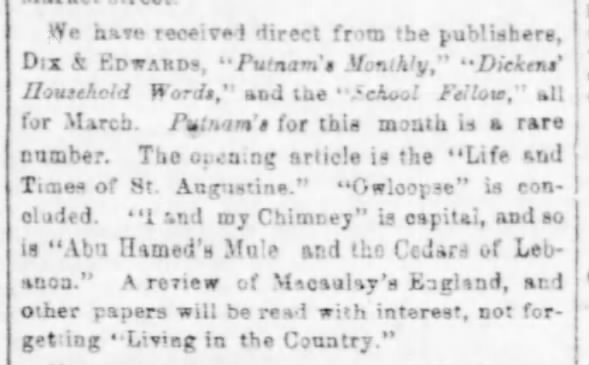
The Pittsburgh Gazette for March 4, 1856 praised "I and my Chimney" as a "capital" piece in "a rare number" of Putnam's.

Tue, Mar 4, 1856 – Page 2 · The Pittsburgh Gazette (Pittsburgh, Pennsylvania) · Newspapers.com
We have received direct from the publishers, DIX & EDWARDS, "Putnam's Monthly," "Dickens' Household Words," and the "School Fellow," all for March. Putnam's for this month is a rare number. The opening article is the "Life and Times of St. Augustine." "Owlcopse" is concluded. "I and my Chimney" is capital, and so is "Abu Hamed's Mule and the Cedars of Lebanon." A review of Macaulay's England, and other papers will be read with interest, not forgetting "Living in the Country." --Pittsburgh Gazette, March 4, 1856. 
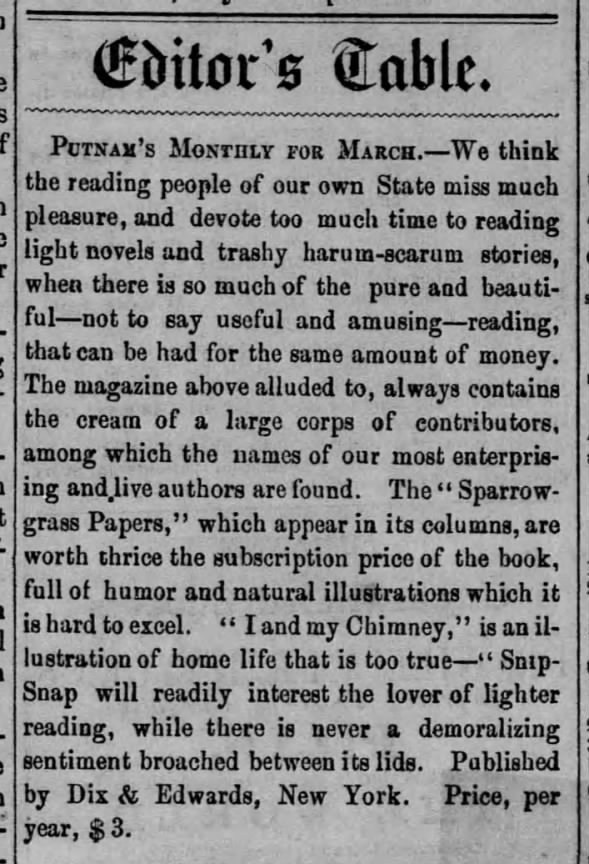
The Montpelier, Vermont Green Mountain Freeman commended Putnam's as a magazine that "always contains the cream of a large corps of contributors, among which the names of our most enterprising and live authors are found." In the March 1856 issue, "I and my Chimney" struck the new editor Sidney S. Boyce as
"an illustration of home life that is too true." --Montpelier, Vermont Green Mountain Freeman, March 6, 1856. 
During the Civil War, Boyce served as Captain in the 77th U. S. Colored Infantry. As reported in the Army & Navy Official Gazette on April 25, 1865, Boyce was tried for illegal use of military property and dismissed.

Thu, Mar 6, 1856 – 3 · Green-Mountain Freeman (Montpelier, Vermont) · Newspapers.com

The Criterion on March 8, 1856 contrasted the "meditative" sketch "I and my Chimney" with the instructively "moral" tale, "Snip-Snap."
"I and my Chimney," and "Snip Snap," are respectively meditative and moral. We should hesitate to pronounce the last a successful effort.  --The Criterion, March 8, 1856
Despite the knock,"Snip-Snap" was popular at the time and frequently reprinted in other newspapers. The New York Times reviewer who thought of Melville's comedic "Chimney" in visual and dramatic terms as a "Callot-like extravaganza" also applauded "Snip-Snap" as "a "charming love-story."

In A History of American Magazines, 1850-1865 Frank Luther Mott describes the short-lived Criterion (1855-6) as
"a New York critical weekly of high class, publishing really careful reviews, with notes on art, drama, and science. It was modeled on the London Athenaeum." 


The Criterion was edited and published in New York by Charles Rudolph Rode (1825-1865) who merged it with the American Publishers' Circular and Literary Gazette.

Another brief mention of "I and my Chimney" appeared in The Country Gentleman for March 13, 1856. This was a weekly agricultural newspaper published in Albany, New York by Luther Tucker. According to Frank Luther Mott in A History of American Magazines, Tucker's editorial assistants at the time were his son Luther H. Tucker and John J. Thomas. Surveying the new issue of Putnam's magazine, one or another editor of the Country Gentleman felt "I and my Chimney" had been narrated "somewhat lugubriously."

Putnam's Monthly for March contains, biographically, an article on the "Life and Character of St. Augustine ;" fictitiously, part third of "Owlcopse;" poetically, "Chester," " My Mission," the "Malakoff Marseillaise" &c.; historically, a review of Macaulay; orientally, the very Arabian tale of "Abu Hamood's Mules;" somewhat lugubriously, "I and my Chimney;" quite ludicrously, further details of Mr. Sparrowgrass' rural experience; very spiritedly, the story "Snip-Snap," and several other readable articles, besides the Editorial notes, criticisms, &c. Dix & Edwards, New-York.
In the Western Reserve Chronicle (Warren, Ohio) for March 12, 1856, editors Comfort A. Adams and George N. Hapgood gave the contents of the March 1856 number with this general endorsement:
"Putnam's Magazine is to the United States, what Blackwood's is to England. It is entirely original, and its articles are marked by independence and vigor of thought."
Western Reserve chronicle. [volume] (Warren, Ohio), 12 March 1856. Chronicling America: Historic American Newspapers. Lib. of Congress. <https://chroniclingamerica.loc.gov/lccn/sn84028385/1856-03-12/ed-1/seq-2/>

Related post 

  • Noticed in North Carolina, "I and My Chimney"
    https://melvilliana.blogspot.com/2026/06/noticed-in-north-carolina-i-and-my.html

Thursday, January 23, 2020

Poem by Olga Hampel Briggs

Of Moby Dick, of Ahab, and of Melville 

"Ahab never thinks; he only feels, feels, feels;
that's tingling enough for mortal man!"
THERE lived (you wrote) a Triton who forsook
Thinking for feeling, tingling; mortal man
He was not, who matched hate with none less than
The Great White Whale; no simpleton, who took
Such foe for wife, for child; yet who could love
(He said himself) tall ships as he loved men.
Though you were slow in speech and thought, your pen
Was held by an archangel when you strove
To tell this tale of terror, struggle, death;
Of puny man, of brittle ship, harpoon
That turned to putty when it struck; of sail
Rent, ribboned, by the gale . . . or by the breath
Of Ahab's enemy . . . whom all men soon
Must meet, must conquer: Moby Dick, White Whale! 
Citation
"Of Moby Dick, of Ahab, and of Melville." New York Herald Tribune [European Edition], 30 Aug. 1951, p. 4. International Herald Tribune Historical Archive, 1887-2013, https://link-gale-com.i.ezproxy.nypl.org/apps/doc/YABLKJ907171398/GDCS?u=nypl&sid=GDCS&xid=e15d2087. Accessed 23 Jan. 2020.

Reprinted in The Lookout for October 1951, page 13:
http://www.seamenschurch-archives.org/sci/archive/files/e02b8ef17b815d9cec04488853a4dae9.pdf

Obituary for Olga Hampel BriggsObituary for Olga Hampel Briggs Thu, Jan 9, 1997 – 6 · Daily Record (Morristown, New Jersey) · Newspapers.com