Showing posts with label Library of Congress. Show all posts

Monday, October 26, 2020

Sterling Allen Brown introducing Slim in Hell

Sterling A. Brown via Kentake Page

The Library of Congress has audio of Sterling Allen Brown reading his poems with comment in the Recording Laboratory, July 9, 1973:

https://www.loc.gov/item/94838831/

Contents 
From Southern road : Odyssey of Big Boy ; Long gone ; Checkers ; After winter ; Sister Lou ; Old man buzzard ; Ma Rainey -- Puttin' on dog -- Sporting Beasley (from Southern road) -- Slim in hell -- Old Lem -- Break of day -- Bitter fruit of the tree -- An old woman remembers -- Ballad of Joe Meek -- Strong men (from Southern road).

Transcribed by me below, Brown's great introduction to Slim in Hell which starts around 31:00:

One of my favorite characters is The Great Liar. In folk life of course the Great Liar is the Mark Twain yarn-spinner. To be called a great liar is a great praise. For instance I'm one of the greatest liars at Howard University, and that would include the President and the Board of Trustees and many of the faculty meetings. Ralph Bunche was a great liar. E. Franklin Frazier was a great liar. I imagine there's some great liars at other schools but I don't know them as well as I do Howard University. I'm sure there's some great liars in Congress. For instance I imagine that Senator Ervin is a great liar. This is an American type and in Negro life it's especially a noticeable type. And so I had a barbershop liar named Slim Greer and that was his actual name. He never lived long enough to sue me for royalties but I did not write this about him.

I wrote this poem in a class at Harvard in Anglo-Saxon where we were reading about Orpheus and Eurydice; now I know that's not an Anglo-Saxon story, but this was a group of stories that scholars prepared for us to learn the language before we started reading Beowulf. Now that's a long introduction. The only thing classical about it is that the dog in it is Cerberus. But I imagine, since Orpheus went to Hell, I imagine that my great tale-teller Slim Greer went to Hell. So I will now give you without any more exegesis or exodus or hell whatever they call it I will now give you Slim in Hell.... 
https://www.loc.gov/item/94838831/?

"Slim in Hell" is in The Collected Poems of Sterling A. Brown, edited by Michael S. Harper; reissued in 2020 by Northwestern University Press with a new foreword by Cornelius Eady and contributions from James Johnson and Sterling Stuckey. 

Harper mentions Brown's expertise on Twain and Melville, and many other literary subjects, about five minutes into this 1994 conversation with Roland Flint on the poetry of Sterling Brown:


At 14:15 Harper reads "Slim in Hell."

Related posts:

Monday, February 10, 2020

Moby-Dick in Sleeper's Boston Journal

Review of Moby-Dick, first three paragraphs in the
Boston Morning Journal - November 18, 1851
Update 02/14/2020: Gary Scharnhorst found the review of Moby Dick in Boston Journal of November 18, 1851 and the "Death Scenes of the Whale" excerpt on November 28, 1851; both items are listed in
Gary Scharnhorst, "Melville Bibliography 1846-1897: A Sheaf of Uncollected Excerpts, Notices, and Reviews" continued from Number 74 in Melville Society Extracts 75 (November 1988), pages 3-8 at 4 and 5. 
Scharnhorst transcribed parts of the Boston Journal review of Moby-Dick, omitting the plot summary with repeated references to the "monomaniac" Captain Ahab. The review of Moby-Dick in John S. Sleeper's Boston Journal is not transcribed or listed in Herman Melville: The Contemporary Reviews, edited by Brian Higgins and Hershel Parker (Cambridge University Press, 1995; paperback 2009).
* * *

My research on Melville's reception in the Boston Journal is ongoing, but I want to pause here and share the favorable review of Moby-Dick in the morning edition of November 18, 1851. Presumably by editor John Sherburne Sleeper (1794-1878), as will be seen. What led me to hunt up this one in the Boston Morning Journal was the mostly negative notice that Richard E. Winslow III discovered in a different Boston newspaper, the Saturday Evening Gazette for December 6, 1851. That later Saturday Evening Gazette item is collected and transcribed at page 102 in Melville Reviews and Notices, Continued, Leviathan, vol. 13 no. 1, 2011, p. 88-115. Project MUSE muse.jhu.edu/article/493025.

The Boston Saturday Evening Gazette, then edited by twenty-five year old William Warland Clapp, Jr., wished Melville had quit while he was ahead, having peaked with the brilliant Typee (1846) and Omoo (1847): "We have read portions of Moby Dick, but fail to discover any marks of freshness, any traces of originality." But here's the clue. With admirable humility and fairness, Clapp went on to acknowledge the contrary opinion of an older and possibly wiser editor:
"The work [Moby-Dick] is highly spoken of by our neighbor of the Journal, a nautical gentleman, and our opinion of its merits may be erroneous. The only way for the reader to decide is by perusing the volume." 
So then, according to Clapp's Saturday Evening Gazette, a "highly" positive take on Moby-Dick had recently graced the Boston Journal. Without needing to name him, Clapp respectfully acknowledged Journal editor John Sherburne Sleeper as the "nautical gentleman" who had endorsed Moby-Dick, apparently in glowing terms.

As confirmed in Appletons' Cyclopaedia of American Biography, Volume 5, Sleeper edited the Boston Journal for twenty years from 1834 to 1854; and before that "was during twenty-two years a sailor and a shipmaster in the merchant service from Boston."

SLEEPER, John Sherburne, author, born in Tyngsboro, Massachusetts, 21 September, 1794; died in Boston Highlands, Massachusetts, 14 November, 1878. He was during twenty-two years a sailor and a shipmaster in the merchant service from Boston. He afterward engaged in journalism, was connected with the New Hampshire "News Letter" at Exeter in 1831-'2, and the Lowell "Daily Journal" in 1833, and was editor of the Boston "Journal" in 1834-'54. He was mayor of Roxbury, Massachusetts, in 1856-'8, and published "Tales of the Ocean "(Boston, 1842); "Salt-Water Bubbles" (1854); "Jack in the Forecastle" (1860); " Mark Rowland, a Tale of the Sea, by Hawser Martingale "(1867); and various addresses. 


One of Sleeper's nautical tales provided a source for White-Jacket, as Howard P. Vincent shows in The Tailoring of Melville's White-Jacket (Northwestern University Press, 1970) pages 150-154. In chapter 67, White-Jacket arraigned at the Mast, the narrator's determination to kill himself and Captain Claret rather than submit to flogging is re-imagined from Sleeper's dramatic passage on the flogging of an impressed Yankee boy in Tales of the Ocean. Melville's White Jacket escapes punishment with help from Jack Chase, and never enacts the desperate murder-suicide that actually happens in Sleeper's account. Published under the pseudonym "Hawser Martingale," Sleeper's "Tales of the Ocean is number 647 in Mary K. Bercaw, Melville's Sources (Northwestern University Press, 1987) page 120.


The Library of Congress has bound volumes of the Boston Morning Journal and Boston Daily Journal, stored offsite at Fort Meade, Maryland. With generous help from Library of Congress experts in the James Madison Memorial Building, I was able to examine volumes in the Newspaper and Current Periodical Reading Room. For major assistance there I am grateful to Amber Paranick, Reference Librarian; and Robin Butterhof, Digital Conversion Specialist.

Boston Morning Journal - November 18, 1851

New Publications. 

... Moby-Dick; or the Whale. By Herman Melville. New York: Harper & Brothers. The appearance of this work has been awaited with much interest. The author of "Omoo," "Typee," &c., has taken a high rank among the writers of the day, and his works have attained considerable popularity, as well in England as in this country.

Moby-Dick is the soubriquet given by whalemen to a white whale of unusual ferocity, and whose exploits form the subject of many a tale of havoc. This whale had been attacked by Captain Ahab of the Pequod, on board of which vessel the scenes of this volume are laid. Captain Ahab came off from the encounter with the loss of a leg. From that hour he became a monomaniac, and lived for revenge. He returned to Nantucket, and dissembling with the cunning of a madman the condition of his mind, again took command of the Pequod for another whaling cruise. When well out to sea, the monomaniac Captain assembled his crew, declared his determination to hunt the white whale to the death, and influenced them also to swear to aid him in his work of revenge. From that hour the Pequod pursued the seemingly hopeless search to all quarters of the world, and in spite of all warnings of evil. The white whale is finally overtaken, but his malice and ferocity proved more than a match for the hatred of Captain Ahab, and a terrible tragedy ends the tale.

The work is a singular mixture of fact and fiction.— The supernatural is interwoven with the matter-of-fact delineations of life on board a whale ship. The descriptions of the various operations of the whalemen are remarkably life like. The chapters upon the whale, for minute description of the characteristics of the different varieties of the leviathan, would do credit to the researches of the most enthusiastic naturalist.
We take a few leaves from this volume for the perusal of our readers. They afford striking illustrations of the descriptive powers of the author. And first we quote a picture of cabin life on board a whale ship— time, the dinner hour. This chapter [34: The Cabin-Table] is a life-like delineation of the social distinctions which exist among the officers of a large ship: 
"It is noon; and Dough-Boy, the steward, thrusting his pale loaf-of-bread face from the cabin-scuttle, announces dinner to his lord and master; who, sitting in the lee quarter-boat, has just been taking an observation of the sun; and is now mutely reckoning the latitude on the smooth, medallion-shaped tablet, reserved for that daily purpose on the upper part of his ivory leg. From his complete inattention to the tidings, you would think that moody Ahab had not heard his menial. But presently, catching hold of the mizen shrouds, he swings himself to the deck, and in an even, unexhilarated voice, saying, 'Dinner, Mr. Starbuck,' disappears into the cabin.

When the last echo of his sultan's step has died away, and Starbuck, the first Emir, has every reason to suppose that he is seated, then Starbuck rouses from his quietude, takes a few turns along the planks, and after a grave peep into the binnacle, says, with some touch of pleasantness, 'Dinner, Mr. Stubb,' and descends the scuttle. The second Emir lounges about the rigging awhile, and then slightly shaking the main brace, to see whether it be all right with that important rope, he likewise takes up the old burden, and with a rapid 'Dinner, Mr. Flask,' follows after his predecessors.

But the third Emir, now seeing himself all alone on the quarter-deck, seems to feel relieved from some curious restraint; for, tipping all sorts of knowing winks in all sorts of directions, and kicking off his shoes, he strikes into a sharp but noiseless squall of a hornpipe right over the Grand Turk's head; and then, by a dexterous sleight, pitching his cap up into the mizentop for a shelf, he goes down rollicking, so far at least as he remains visible from the deck, reversing all other processions, by bringing up the rear with music. But ere stepping into the cabin doorway below, he pauses, ships a new face altogether, and, then, independent, hilarious little Flask enters King Ahab's presence, in the character of Abjectus, or the Slave.

It is not the least among the strange things bred by the intense artificialness of sea-usages, that while in the open air of the deck some officers will, upon provocation, bear themselves boldly and defyingly enough towards their commander; yet, ten to one, let those very officers the next moment go down to their customary dinner in that same commander's cabin, and straightway their inoffensive, not to say deprecatory and humble air towards him, as he sits at the head of the table; this is marvellous, sometimes most comical. Wherefore this difference? A problem? Perhaps not. To have been Belshazzar, King of Babylon; and to have been Belshazzar, not haughtily but courteously, therein certainly must have been some touch of mundane grandeur. But he who in the rightly regal and intelligent spirit presides over his own private dinner-table of invited guests, that man's unchallenged power and dominion of individual influence for the time; that man's royalty of state transcends Belshazzar's, for Belshazzar was not the greatest. Who has but once dined his friends, has tasted what it is to be Caesar. It is a witchery of social czarship which there is no withstanding. Now, if to this consideration you superadd the official supremacy of a ship-master, then, by inference, you will derive the cause of that peculiarity of sea-life just mentioned."
The following we take from a chapter [60: The Line] descriptive of some of the implements used in the capture of whales:
"The whale line is only two thirds of an inch in thickness. At first sight, you would not think it so strong as it really is. By experiment its one and fifty yarns will each suspend a weight of one hundred and twenty pounds; so that the whole rope will bear a strain nearly equal to three tons. In length, the common sperm whale-line measures something over two hundred fathoms. Towards the stern of the boat it is spirally coiled away in the tub, not unlike the worm-pipe of a still though, but so as to form one round, cheese-shaped mass of densely bedded 'sheaves,' or layers of concentric spiralizations, without any hollow but the 'heart,' or minute vertical tube formed at the axis of the cheese. As the least tangle or kink in the coiling would, in running out, infallibly take somebody's arm, leg or entire body off, the utmost precaution is used in stowing the line in its tub. Some harpooneers will consume almost an entire morning in this business, carrying the line high aloft and then reeving it downwards through a block towards the tub, so as in the act of coiling to free it from all possible wrinkles and twists.

In the English boats two tubs are used instead of one; the same line being continuously coiled in both tubs. There is some advantage in this; because these twin tubs being so small they fit more readily into the boat, and do not strain it so much; whereas, the American tub, nearly three feet in diameter and of proportionate depth, makes a rather bulky freight for a craft whose planks are but one half-inch in thickness; for the bottom of the whale-boat is like critical ice, which will bear up a considerable distributed weight, but not very much of a concentrated one. When the painted canvas cover is clapped on the American line-tub, the boat looks as if it were pulling off with a prodigious great wedding cake to present to the whales. 
Both ends of the line are exposed; the lower end terminating in an eye-splice or loop coming up from the bottom against the side of the tub, and hanging over its edge completely disengaged from everything. This arrangement of the lower end is necessary on two accounts. First: In order to facilitate the fastening to it of an additional line from a neighboring boat, in case the stricken whale should sound so deep as to threaten to carry off the entire line originally attached to the harpoon. In these instances, the whale of course is shifted like a mug of ale, as it were, from one boat to the other; though the first boat always hovers at hand to assist its consort. Second: This arrangement is indispensable for common safety's sake; for were the lower end of the line in any way attached to the boat, and were the whale then to run the line out to the end almost in a single, smoking minute as he sometimes does, he would not stop there, for the doomed boat would infallibly be dragged down after him into the profundity of the sea; and in that case no town-crier would ever find her again. 
Before lowering the boat for the chase, the upper end of the line is taken aft from the tub, and passing round the loggerhead there, is again carried forward the entire length of the boat, resting crosswise upon the loom or handle of every man's oar, so that it jogs against his wrist in rowing; and also passing between the men, as they alternately sit at the opposite gunwales, to the leaded chocks or grooves in the extreme pointed prow of the boat, where a wooden pin or skewer the size of a common quill, prevents it from slipping out. From the chocks it hangs in a slight festoon over the bows, and is then passed inside the boat again; and some ten or twenty fathoms (called box-line) being coiled upon the box in the bows, it continues its way to the gunwale still a little further aft, and is then attached to the short-warp—the rope which is immediately connected with the harpoon; but previous to that connexion, the short-warp goes through sundry mystifications too tedious to detail. 
Thus the whale-line folds the whole boat in its complicated coils, twisting and writhing around it in almost every direction. All the oarsmen are involved in its perilous contortions; so that to the timid eye of the landsman, they seem as Indian jugglers, with the deadliest snakes sportively festooning their limbs. Nor can any son of mortal woman, for the first time, seat himself amid those hempen intricacies, and while straining his utmost at the oar, bethink him that at any unknown instant the harpoon may be darted, and all these horrible contortions be put in play like ringed lightnings; he cannot be thus circumstanced without a shudder that makes the very marrow in his bones to quiver in him like a shaken jelly. Yet habit—strange thing! what cannot habit accomplish?' "
We have read many accounts of the chase and capture of the sperm whale, but none so absorbingly interesting, or which have presented so vivid a picture of this exciting event, as the following [from Chapter 61: Stubb Kills a Whale]:
" 'Start her, start her, my men! Don't hurry yourselves; take plenty of time—but start her; start her like thunder-claps, that's all,' cried Stubb, spluttering out the smoke as he spoke. 'Start her, now; give 'em the long and strong stroke, Tashtego. Start her, Tash, my boy—start her, all; but keep cool, keep cool—cucumbers is the word—easy, easy —only start her like grim death and grinning devils, and raise the buried dead perpendicular out of their graves, boys—that's all. Start her!'
'Woo-hoo! Wa-hee!' screamed the Gay-Header in reply, raising some old war-whoop to the skies; as every oarsman in the strained boat involuntarily bounced forward with the one tremendous leading stroke which the eager Indian gave. 
But his wild screams were answered by others quite as wild. 'Kee-hee! Kee-hee!' yelled Daggoo, straining forwards and backwards on his seat, like a pacing tiger in his cage.  
'Ka-la! Koo-loo!' howled Queequeg, as if smacking his lips over a mouthful of Grenadier's steak. And thus with oars and yells the keels cut the sea. Meanwhile, Stubb retaining his place in the van, still encouraged his men to the onset, all the while puffing the smoke from his mouth. Like desperadoes they tugged and they strained, till the welcome cry was heard— 'Stand up, Tashtego!—give it to him!' The harpoon was hurled. 'Stern all!' The oarsmen backed water; the same moment something went hot and hissing along every one of their wrist[s]. It was the magical line. An instant before, Stubb had swiftly caught two additional turns with it round the loggerhead, whence, by reason of its increased rapid circlings, a hempen blue smoke now jetted up and mingled with the steady fumes from his pipe. As the line passed round and round the loggerhead; so also, just before reaching that point, it blisteringly passed through and through both of Stubb's hands, from which the hand-cloths, or squares of quilted canvas sometimes worn at these times, had accidentally dropped. It was like holding an enemy's sharp two-edged sword by the blade, and that enemy all the time striving to wrest it out of your clutch.  
'Wet the line! wet the line!' cried Stubb to the tub oarsman (him seated by the tub) who, snatching off his hat, dashed the sea-water into it. More turns were taken, so that the line began holding its place. The boat now flew through the boiling water like a shark all fins. Stubb and Tashtego here changed places—stem for stern—a staggering business truly in that rocking commotion. 
From the vibrating line extending the entire length of the upper part of the boat, and from its now being more tight than a harpstring, you would have thought the craft had two keels—one cleaving the water, the other the air—as the boat churned on through both opposing elements at once. A continual cascade played at the bows; a ceaseless whirling eddy in her wake; and, at the slightest motion from within, even but of a little finger, the vibrating, cracking craft canted over her spasmodic gunwale into the sea. Thus they rushed; each man with might and main clinging to his seat, to prevent being tossed to the foam; and the tall form of Tashtego at the steering oar crouching almost double, in order to bring down his centre of gravity. Whole Atlantics and Pacifics seemed passed as they shot on their way, till at length the whale somewhat slackened his flight.  
'Haul in—haul in!' cried Stubb to the bowsman! and, facing round towards the whale, all hands began pulling the boat up to him, while yet the boat was being towed on. Soon ranging up by his flank, Stubb, firmly planting his knee in the clumsy cleat, darted dart after dart into the flying fish; at the word of command, the boat alternately sterning out of the way of the whale's horrible wallow, and then ranging up for another fling. 
The red tide now poured from all sides of the monster like brooks down a hill. His tormented body rolled not in brine but in blood, which bubbled and seethed for furlongs behind in their wake. The slanting sun playing upon this crimson pond in the sea, sent back its reflection into every face, so that they all glowed to each other like red men. And all the while, jet after jet of white smoke was agonizingly shot from the spiracle of the whale, and vehement puff after puff from the mouth of the excited headsman; as at every dart, hauling in upon his crooked lance (by the line attached to it), Stubb straightened it again and again, by a few rapid blows against the gunwale, then again and again sent it into the whale.  
'Pull up—pull up!' he now cried to the bowsman, as the waning whale relaxed in his wrath. 'Pull up!—close to!' and the boat ranged along the fish's flank. When reaching far over the bow, Stubb slowly churned his long sharp lance into the fish, and kept it there, carefully churning and churning, as if cautiously seeking to feel after some gold watch that the whale might have swallowed, and which he was fearful of breaking ere he could hook it out. But that gold watch he sought was the innermost life of the fish. And now it is struck; for, starting from his trance into that unspeakable thing called his 'flurry,' the monster horribly wallowed in his blood, overwrapped himself in impenetrable, mad, boiling spray, so that the imperilled craft, instantly dropping astern, had much ado blindly to struggle out from that phrensied twilight into the clear air of the day.  
And now abating in his flurry, the whale once more rolled out into view; surging from side to side; spasmodically dilating and contracting his spout-hole, with sharp, cracking, agonized respirations. At last, gush after gush of clotted red gore, as if it had been the purple lees of red wine, shot into the frighted air; and falling back again, ran dripping down his motionless flanks into the sea. His heart had burst!  
'He's dead, Mr. Stubb,' said Daggoo.  
'Yes; both pipes smoked out!' and withdrawing his own from his mouth, Stubb scattered the dead ashes over the water; and, for a moment, stood thoughtfully eyeing the vast corpse he had made."
There was considerable discussion when the "Typee," of Melville, appeared, whether the scenes therein described were founded on fact, or were all fiction. 
In Moby-Dick, as in Typee, the author figures in the first person, but no one will mistake the strangely wild thread of this story for a veritable history. But the reader will sometimes be puzzled to separate fiction from probability, so skilfully has the author blended the common incidents of a whaleman's life, with the creations of his own fancy. In many respects Moby-Dick is the best of the works of the author, as it certainly is the most instructive. We predict for it, with confidence, an extended popularity. For sale by Redding & Co.
-- Boston Morning Journal, Volume 19, Number 5760. Tuesday morning, November 18, 1851. Page 1, columns 5-6. Library of Congress. Bound volumes, Newspapers, Control # 8218. October-December 1851.

Later in November, another passage from Moby-Dick appeared in the evening edition of the Boston Journal. On Friday evening, November 28, 1851, the Boston Daily Journal reprinted an excerpt from chapter 81 under the heading, "Death Scenes of the Whale." This text had been reprinted elsewhere with the same heading, for example on November 15, 1851 with the first notice of Moby-Dick in The Literary World. In the Boston Daily Journal, the credit line for the "Death Scenes" excerpt read,
"—Herman Melville." 
Boston Daily Journal - November 28, 1851 - vol. 19 no. 5767
Library of Congress. Bound volumes, Control #8217. 
The Boston Daily Journal column with "Death Scenes of the Whale" appeared on the front page of the newspaper, immediately below and alongside the full report of Orville Dewey's eleventh lecture on "The Problem of Human Destiny, Considered in its Bearings on Human Life and Welfare."

Boston Daily Journal - November 28, 1851
page 1, columns 6-7
In January and February 1852, Dewey repeated his Lowell lectures in New York City. Later made into a book, The Problem of Human Destiny (James Miller: New York, 1864). Melville worked over Dewey and his theme of Human Destiny in Pierre; or, The Ambiguities (1852), as Hershel Parker discusses in Herman Melville: A Biography Volume 2, 1851-1891 (Johns Hopkins University Press, 2002), pages 65-7 and 80. 

Related posts:

Monday, February 3, 2020

Fragments from a Writing Desk: A Version of the Leyda Wand, the Review-hunting to...

Hershel Parker posted this about the Leyda Wand eight years ago. Essential when looking at microfilm or original newspapers--like I hope to be doing, later this week.
Fragments from a Writing Desk: A Version of the Leyda Wand, the Review-hunting tool...: Monteiro and I, and Winslow, and Norsworthy and Broderick, mainly, have found reviews since THE CHECKLIST OF MELVILLE REVIEWS, so you won't always know...

Friday, June 29, 2018

Liked in Waterloo, loved in Cadiz: Gansevoort Melville's 1844 Jackson Jubilee speech


Another Melvilliana post
gives the complete text of Gansevoort Melville's magnificent 1844 speech at the Jackson Jubilee in New York City. Newspaper reprintings are accessible online, freely via Chronicling America: Historic American Newspapers, Library of Congress:
In Waterloo, New York, the Seneca Observer (March 27, 1844) liked the literary quality of Gansevoort's oration, commending it as
"a beautiful composition, full of energy and feeling."
The Waterloo notice closes with the climax, Gansevoort's elaborate figure of "the sun of Truth" that overcomes every opposition.

Seneca Observer (Waterloo, New York) - March 27, 1844
via Fulton History
NEW YORK CELEBRATION.-- The celebration of the Jackson Jubilee in New York was truly a splendid affair. Nearly a thousand ladies were present. The oration, by GANSEVOORT MELVILLE, is a production not easily excelled. It is a beautiful composition, full of energy and feeling. We copy its close, and may justly remark, that it contains many passages of equal beauty. Every democrat will respond to these sentiments:
Let us, then, from this moment henceforth, vow to go into this coming Presidential canvass with the stern resolve to do our duty--in the largest and widest sense of the term, and let the consequences take care of themselves. If we do this--if we fight this battle as it should be fought, with honesty, abiding energy, and an enthusiasm tempered by a cool, calm courage, we will triumph. Do this, and even if we fail, we will have no cause for self-accusation. And whatever the result, we have one consolation vouchsafed to us and denied to our opponents; and that is, that the sun of Truth can never set--the mists of prejudice may arise and obscure its rays--the clouds of error intervene and hide its beams--the tempests of faction and party hate shut out its genial and life-bestowing heat; but the mists will arise--the clouds will pass away--the tempest roll on and be forgotten, while the sun, the brighter and dearer for his temporary obscurity, will shine on as he shone of yore--to brighten, to gladden, to vivify and to bless. It is so in the physical world--so in the moral--so in the political.-- Truth can never die. And those political principals which we uphold--in which we live, and for which we are willing to die, will widen and deepen, extend and exist for ever.
Gansevoort's Address made the Demos go crazy in Cadiz. On April 18, 1844 the Cadiz Sentinel printed the whole thing, introduced in terms of truly unqualified praise:

A POLITICAL GEM!

We believe we have never read any thing that pleased us more than the following address, delivered by GANSEVOORT MELVILLE, Esq., in New York, at the great Democratic festival, on the [1]5th ultimo. We publish it in full, because every paragraph is a living stream of glowing eloquence!--Read it--Read it!
In 2017 PBA Galleries (Sale 624 Lot 102 of 253) offered a "rare 1844 political letter" from Herman's older brother Gansevoort Melville to Isaac H. Wright, editor of the Boston Bay State Democrat. Writing on March 9, 1844, Gansevoort declined Wright's invitation to speak at Faneuil Hall, citing his engagement
"to pronounce an address before the Democracy of the city of New York on the 15th inst, the Anniversary of the birthday of Andrew Jackson."

Tuesday, August 22, 2017

Lincoln's lost words: "slavery is a sin"


In the second volume of Abraham Lincoln: A Life, historian Michael Burlingame cites a newspaper clipping of an 1879 letter to the editor of the Chicago Tribune in which Lincoln's friend Herrring Chrisman (1823-1911) recalled the president-elect's determination, early in 1861, to conciliate pro-Union Virginians. The scene that Chrisman wrote about happened in Springfield, Illinois before Lincoln left for Washington, and before the Virginia Secession Convention. Professor Burlingame quotes the part of Chrisman's published reminiscence that detailed specific actions Lincoln would commit to for the sake of preserving the Union, including his promises to enforce the Fugitive Slave Act and "protect slavery" where it legally existed already:
"Tell them I will execute the fugitive slave law better than it has ever been. I can do that. Tell them I will protect slavery in the states where it exists. I can do that. Tell them they shall have all the offices south of Mason's and Dixon's line if they will take them. I will send nobody down there as long as they execute the offices themselves."  --Abraham Lincoln: A Life, Volume 2, page 120
In Lincoln and the Civil War, Professor Burlingame summarizes Lincoln's stand, repeating the key concessions in the order that Chrisman gave them in 1879:
Lincoln evidently believed that if he could frame an inaugural address that was conciliatory enough for Southern Unionists, yet firm enough to satisfy Republican hard-liners, and then show the South by his actions--enforcing the Fugitive Slave Law, not interfering with slavery in the states where it existed, not appointing antislavery zealots to federal posts in the Southern states--that he was no John Brown, then the crisis would pass.  --Lincoln and the Civil War
More recently, Daniel W. Crofts in Lincoln and the Politics of Slavery has referenced Lincoln's vow to "protect slavery," footnoting the source as "an 1879 recollection by H. Chrisman" by way of Burlingame in Abraham Lincoln: A Life, volume 2.

Professor Burlingame does not deal with all of Chrisman's letter. Professor Crofts cites Burlingame for the good evidence of Lincoln's pragmatism, without elaborating on Chrisman's 1879 letter. Crofts does cite important corroborating evidence of Chrisman's role, in letters from H. Chrisman to William C. Rives written in early February 1861, extant among the William Cabel Rives papers in the Library of Congress. Neither historian mentions the "look of unutterable grief" that Chrisman observed on Lincoln's face. According to Chrisman, Lincoln's expression of "mournful sadness" reflected his private expectation of failure in the effort to prevent civil war. Chrisman attributed Lincoln's gloom to his understanding that southerners would not finally abide the restriction of slavery to slave-holding states in the South.


In reporting Lincoln's promises to Virginia Unionists and the anguish they evoked in the president-elect, Chrisman also quoted Lincoln as saying something never attributed to him since:
"slavery is a sin."
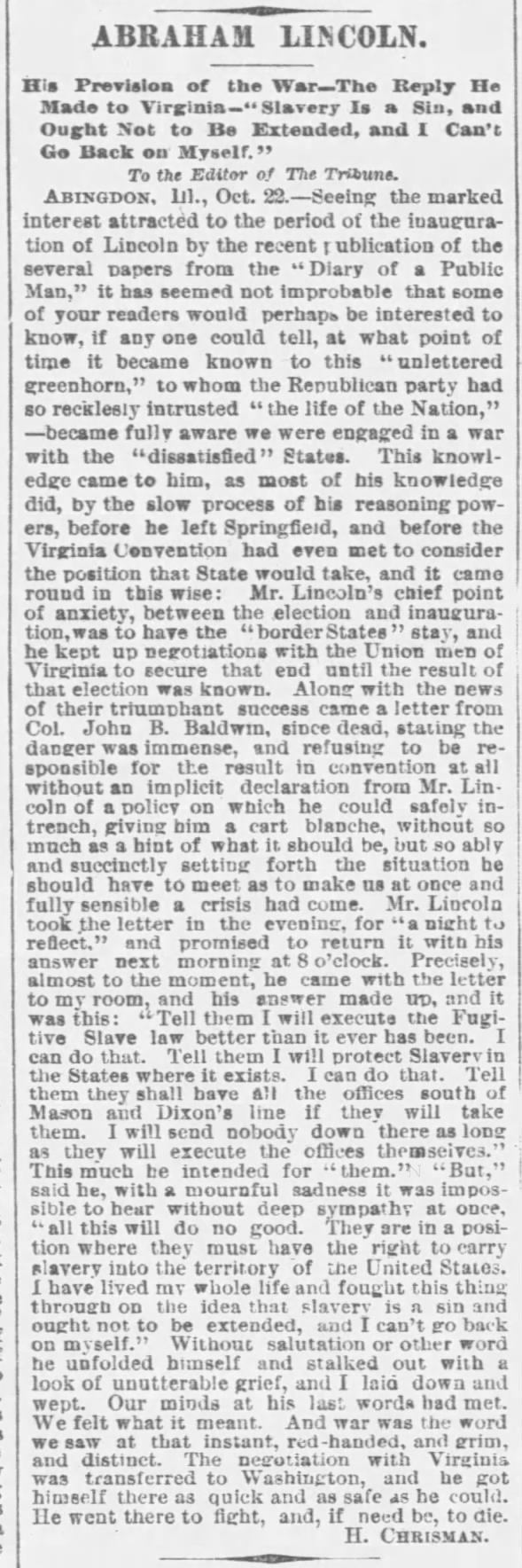
Sat, Oct 25, 1879 – 11 · Chicago Tribune (Chicago, Cook, Illinois, United States of America) · Newspapers.com

ABRAHAM LINCOLN.

His Prevision of the War—The Reply He Made to Virginia—"Slavery Is a Sin, and Ought Not to Be Extended, and I Can't Go Back on Myself."
To the Editor of the Tribune.
ABINGDON, Ill., Oct. 22.—Seeing the marked interest attracted to the period of the inauguration of Lincoln by the recent publication of several papers from the "Diary of a Public Man," it has seemed not improbable that some of your readers would perhaps be interested to know, if any one could tell, at what point of time it became known to this "unlettered greenhorn," to whom the Republican party had so recklessly intrusted "the life of the Nation," —became fully aware we were engaged in a war with the "dissatisfied" States. This knowledge came to him, as most of his knowledge did, by the slow process of his reasoning powers, before he left Springfield, and before the Virginia Convention had even met to consider the position that State would take, and it came round in this wise: Mr. Lincoln's chief point of anxiety, between the election and inauguration, was to have the "border States" stay, and he kept up negotiations with the Union men of Virginia to secure that end until the result of that election was known. Along with the news of their triumphant success came a letter from Col. John B. Baldwin, since dead, stating the danger was immense, and refusing to be responsible for the result in convention at all without an implicit declaration from Mr. Lincoln of a policy on which he could safely intrench, giving him a cart blanche, without so much as a hint of what it should be, but so ably and succinctly setting forth the situation he should have to meet as to make us at once and fully sensible a crisis had come. Mr. Lincoln took the letter in the evening, for "a night to reflect." and promised to return it with his answer next morning at 8 o'clock. Precisely, almost to the moment, he came with the letter to my room, and his answer made up, and it was this: "Tell them I will execute the Fugitive Slave law better than it ever has been. I can do that. Tell them I will protect Slavery in the Sates where it exists. I can do that. Tell them they shall have all the offices south of Mason and Dixon's line if they will take them. I will send nobody down there as long as they will execute the offices themselves." This much he intended for "them." "But," said he, with a mournful sadness it was impossible to hear without deep sympathy at once, "all this will do no good. They are in a position where they must have the right to carry slavery into the territory of the United States. I have lived my whole life and fought this thing through on the idea that slavery is a sin and ought not to be extended, and I can't go back on myself." Without salutation or other word he unfolded himself and stalked out with a look of unutterable grief, and I laid down and wept. Our minds at his last words had met. We felt what it meant. And war was the word we saw at that instant, red-handed, and grim, and distinct. The negotiation with Virginia was transferred to Washington, and he got himself there as quick and as safe as he could. He went there to fight, and, if need be, to die. 
H. CHRISMAN.  --Chicago Tribune, October 25, 1879.
Chrisman's published letter was widely reprinted in contemporary newspapers under the heading "A Reminiscence of Lincoln"; for example in the New York Times on Friday, October 31, 1879; the Daily Saratogian on November 6, 1879, the Cleveland Leader on November 7, 1879, the Staunton Spectator (Staunton, Virginia) on November 11, 1879, and the Philadelphia Inquirer on November 26, 1879. Various reprintings do not always include the writer's published signature, "H. Chrisman," but the ones I have seen all include the statement attributed to Lincoln that "slavery is a sin and ought not to be extended." Below, Chrisman's letter as reprinted in the Staunton Spectator, November 11, 1879; accessible online via Chronicling America, Library of Congress.

Staunton Spectator - November 11, 1879
A different version of Herring Chrisman's 1879 newspaper reminiscence appears in the Memoirs of Lincoln, published in 1930 by Herring's son, William Herring Chrisman, with an editorial note of introduction by John Houston Harrison. According to the son's Foreword, these memoirs were "written in the year 1900, as a family record."  Revisions in this later 1900 account include the addition of descriptive details that locate the scene more particularly in the writer's Springfield hotel room, where Lincoln entered and "sat down upon the bed." Lincoln's "look of unutterable grief" has become "a look of anguish I shall never forget." Regarding enforcement of the Fugitive Slave law, Lincoln in the revised version believes "my people will let me do that," introducing considerations of party and politics that did not qualify the commitment as reported in the 1879 version, "I can do that." In a significant addition, Lincoln's Virginia-born friend now credits their "Southern blood" as the basis of their shared understanding of the inevitability of war.
 "We were both of Southern blood and knew what the South would do."
In the introductory note to the 1930 volume Memoirs of Lincoln, J. Houston Harrison (like Chrisman in the body of his memoirs) seems keen to emphasize not only Lincoln's friendship with Herring Chrisman, but also his kinship as the grandson of Bathsheba Herring. This Bathsheba was the sister of Herring Chrisman's maternal great grandfather:
Through her marriage to Captain Abraham Lincoln, their son Thomas, the President's father, inherited maternal strains of Colonial ancestry among the most prominent in Old Augusta, later Rockingham County, Virginia.--Introduction, Memoirs of Lincoln
The revised version keeps the essential point about Lincoln's non-negotiable stand on the extension of slavery "into the territories," but drops altogether Lincoln's quoted conviction that "slavery is a sin."
That letter was submitted to him as soon as it came to my quarters at the hotel. It was received late at night. He asked to take it for reflection and promised his answer at eight o'clock in the morning. Promptly to the hour he came stalking gloomily in, and without salutation sat down upon the bed and began to deliver himself with great solemnity in this wise: "You may tell them I will protect slavery where it exists; I can do that. You may tell them I will execute the fugitive slave law better than it ever has been; my people will let me do that. You may tell them they shall have all the offices south of Mason's and Dixon's line if they will take them. I will send nobody down there to interfere with them." He then remarked to me personally, and in a tone that pierced me almost like the faint wail of a suffering infant, and with a look of anguish I shall never forget: "But all of that will do no good. They have got themselves to where they might have the right to carry slavery into the territories, and I have lived my whole life and fought this campaign; and I can't go back on myself." Of course we both of us felt, and knew, it meant War. We were both of Southern blood and knew what the South would do. He went as he came, and I wept. Our minds had met. It was the first time either of us had allowed ourselves to look that awful War squarely in the face. He could have seen nobody to consult, and in so vital a matter he would wish to consult only himself.
--Memoirs of Lincoln, by Herring Chrisman
Why did Chrisman omit "slavery is a sin" in revision? Perhaps Chrisman felt he had made an error in 1879 and wanted to correct it in the 1900 version. On reflection he may have thought it a mistake to have made Lincoln utter such a familiar tenet of abolitionism. On the other hand, maybe the deleted quote was accurate but deemed regrettable, in hindsight. Several chapters in Chrisman's Memoirs exude nostalgia for the old South. The new century found Chrisman prone to condone the institution of slavery and even to idealize it. Whatever Lincoln thought, Chrisman by 1900 plainly did not regard slavery as inherently sinful. Thus, both the added emphasis on southern kinship and the deletion of Lincoln's view of slavery as a sin might have been motivated by a revived identification with southern culture and causes by Herring Chrisman himself, or by his son, or possibly by others in the family.

The volume Memoirs of Lincoln as published by his son documents southern alliances throughout, for example when John Houston Harrison points out that Herring Chrisman's brother George Chrisman served as a Major in the Confederate army. More revealingly, the chapter on Vital Causes of Our Civil War develops Chrisman's hopelessly racist and ultra-romantic defense of slavery as ideally practiced in the southern states, before the mania for "expansion" pervaded and doomed the South. Nevertheless, before and after the 1860 election Chrisman the Virginian was also a loyal Unionist with a job to do. As narrated in "The Hope of Saving Virginia" and elsewhere in the Memoirs of Lincoln, Chrisman had to empower pro-Union Virginians and thereby hold off increasingly militant secessionists in his native state, incited by Jefferson Davis. The mission as Chrisman conceived it, and expressed it to Lincoln in that Springfield hotel room, was to "save the Capitol for his inauguration" (Memoirs of Lincoln - page 87) through relentless personal diplomacy (unrewarded and unacknowledged in the public sphere, as he reflected many decades later). In Chrisman's view, his good work of supporting and placating Virginia Unionists over many months, although ultimately ineffective, at least ensured that militants in Richmond would not have the backing to attack Washington by force before the inauguration.

In any case, as far as I can tell, no subsequent version contains the lost words "slavery is a sin" that Herring Chrisman in 1879 attributed to president-elect Lincoln.


Available online via The Library of Congress:

The Abraham Lincoln Papers at the Library of Congress include in the category of "General Correspondence" a letter of support from Herring Chrisman to Abraham Lincoln, received evidently in February 1861. Below, my transcription:
Hon A. Lincoln

Dear Sir

This letter will be handed you by my father. We have sustained a loss by his withdrawal as candidate for the convention. I learn his vote would have been almost unanimous. He goes to tender you his friendly offices with the people of Virginia adopting fully my personal sentiments towards you.

When you visit Virginia you will come to understand the absorbing interest I feel in your personal glory. It is in no idle sense then that I rejoiced in your evident selection of the Father of his Country for your model. The grand secret of his wonderful success seems to be owing to two habits-- First to balance & adjust his powerful judgment like a pair of scales-- 2nd to invite a free discussion or rather a free expression to himself of all shades of opinion from the wise and the good of all parties-- & lastly to follow implicitly his own enlightened judgment under God, regardless of everything personal to himself excepting his honor.

With the happiest reliance as well upon your faculties as your dispositions and with the most earnest prayers for your successful administration and future happiness

I have the honor &c.
Your friend
Herring Cushman
On September 17, 1862 Orville H. Browning wrote Abraham Lincoln, forwarding him an encouraging letter from Herring Chrisman dated September 12, 1862. Here is my transcription of Chrisman's letter to Browning:
St. Augustine - Knox Co.
September 12, 1862
Dear Sir

You seem a little surprised at the generous warmth everywhere manifested by the democrats towards the President. I have watched its steady growth among them and believe it to be very general. It grows out of a personal trust they repose in him that he will preserve the constitution at every hazard. It seems to be his natural prerogative to be popular. He is always most so when he is most like himself. The strong man of the administration among the people in doubtful matters the Cabinet cannot do better than follow his judgment. Like General Jackson in that he seems certain to be endorsed by the people.

He has saved us from anarchy & ruin at home, given us a united North, preserved the government perfect in all its parts & satisfied the world we are still a first rate power.

There are it seems not a few who insist he must hazard all this upon a theory. Some apprehension was felt that he might be misled by this clamor. Hence the general joy over the letter to Greeley-- so calm so cool so gentle yet so firm, it satisfied the Country he was still himself. How much depends upon his life.

Your presence among the people is producing a good effect. Many good people who were being misled will see things more as they are, hereafter. The radical leaders begin already to call themselves administration men, a fact we were in danger of forgetting if indeed they were not themselves. The administration is too strong for them & they know it. Their role will now be support to betray. They will aim to borrow what strength they can from the administration to get votes to control it. My best wishes attend you.

Very truly,
Herring Chrisman
Found on Newspapers.com

Wednesday, March 9, 2016

Carla Peterson: Black Gotham: A Family History

"One of my great finds was here at the Library of Congress, in Frederick Douglass' Paper. If you really want to do your research properly, you have to go to all the archives, all the libraries you can find, because what they have--libraries have many of the same issues, but not always...." (around 29:00)
Brilliant talk by the author of Black Gotham: A Family History, inspiring as ever five years on. University of Maryland Emeritus Professor Carla Peterson is the great granddaughter of distinguished New York pharmacist Philip Augustus White (1823-1891).

Monday, May 11, 2015

Hancock's Charge

Image Credit: Library of Congress
Another year is about gone since the 2014 Memorial Day post on Corps Commander Winfield Scott Hancock. Since then I've looked at some of the many Civil War era images available online in the Library of Congress Prints and Photographs Division. Above, this Currier and Ives print visually reinforces the main point of that earlier post (Hancock not Grant is the "Corps Commander" of Melville's poem in Battle-Pieces), illustrating Hancock's popular credit for leading what Melville in On the Photograph of a Corps Commander calls "Spottsylvania's charge to victory."  
Ay, man is manly. Here you see
The warrior-carriage of the head,
And brave dilation of the frame;
And lighting all, the soul that led
In
Spottsylvania's charge to victory, 
Which justifies his fame.
--On the Photograph of a Corps Commander, first stanza
The full caption of the Currier and Ives print reads:

GLORIOUS CHARGE OF HANCOCK'S DIVISION (2ND) OF THE ARMY OF THE POTOMAC 

At the Battle near Spottsylvania Court House Va., May 12th 1864. 

At midnight Gen’l Hancock changed his position on the extreme right to the left; and at daylight attacked with his accustomed impetuosity, forcing the first, and then the second line of the Rebel works, capturing the whole of Johnson’s Division and part of Early’s, together with Maj. Gen’l E. Johnson, Gen’l. Geo. H. Stewart, and prisoners by the thousands.

The Currier & Ives "Circular for Trade Only" reproduced at The Philadelphia Print Shop lists "Hancock's Charge at Spottsylvania" and "Gen. Hancock on Horseback" among new and current PRINTS FOR THE CAMPAIGN, available wholesale at $6 per 100.

Related posts