"The chief characteristic of Herman Melville's writings is this attempted union of the practical with the ideal." --Henry S. Salt in The Scottish Art Review Volume 2 (November 1889): 186-190 at page 189.
Related post:

Original research and riffs on Herman Melville, authorship, and nineteenth-century American literature.
"The chief characteristic of Herman Melville's writings is this attempted union of the practical with the ideal." --Henry S. Salt in The Scottish Art Review Volume 2 (November 1889): 186-190 at page 189.
 |
| Portrait of Amasa Delano Public domain, via Wikimedia Commons |
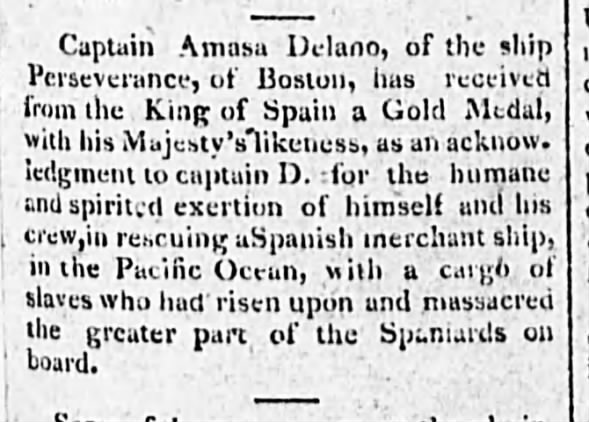 Wed, Sep 2, 1807 – Page 3 · Poughkeepsie Journal (Poughkeepsie, Dutchess, New York, United States of America) · Newspapers.com
Captain Amasa Delano, of the ship Perseverance, of Boston, has received from the King of Spain a Gold Medal, with his Majesty's likeness, as an acknowledgment to captain D. for the humane and spirited exertion of himself and his crew, in rescuing a Spanish merchant ship, in the Pacific Ocean, with a cargo of slaves who had risen upon and massacred the greater part of the Spaniards on board. --Poughkeepsie Journal, September 2, 1807.
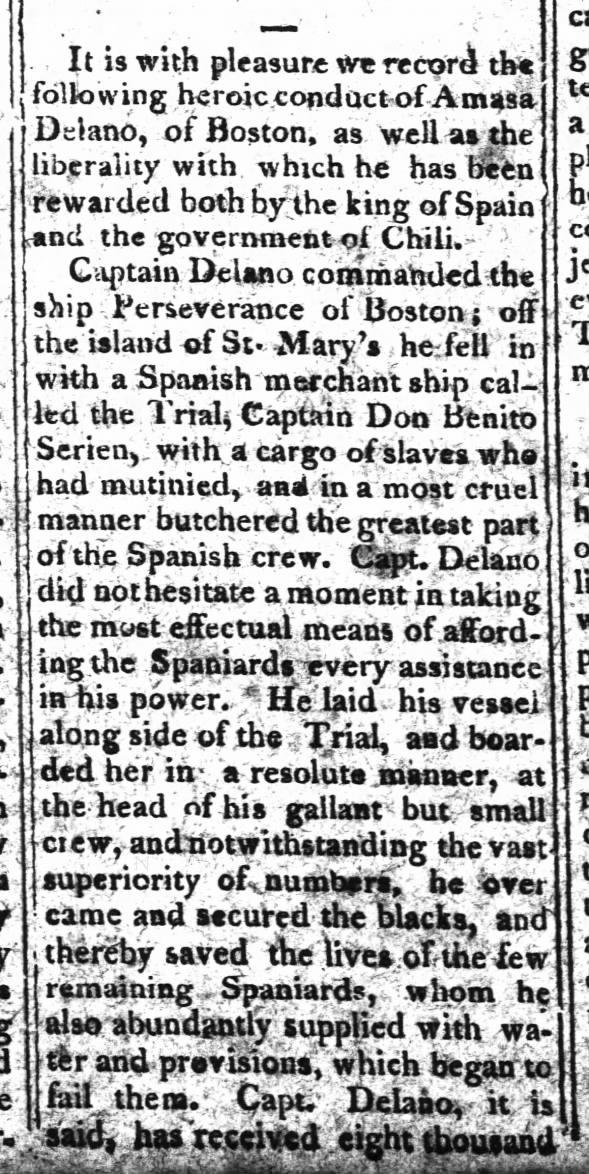 Mon, May 19, 1806 – Page 3 · Weekly Raleigh Register (Raleigh, Wake, North Carolina) · Newspapers.com
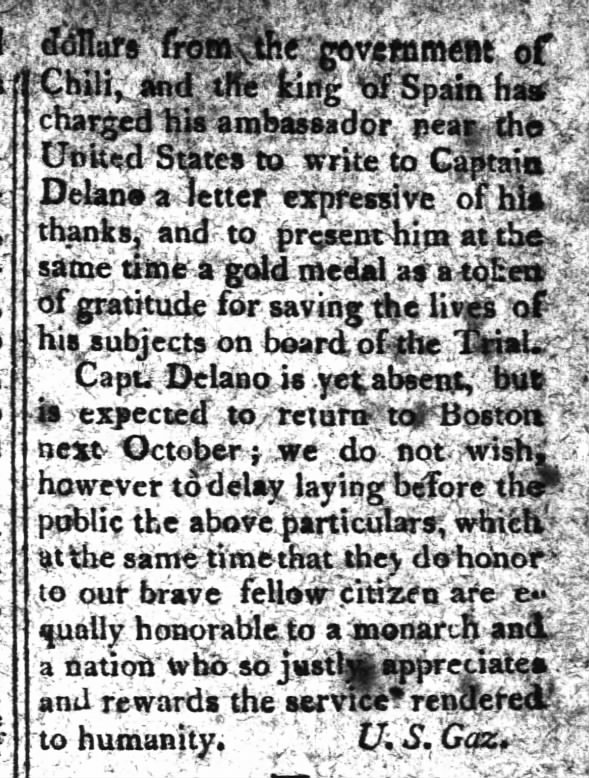 Mon, May 19, 1806 – Page 3 · Weekly Raleigh Register (Raleigh, Wake, North Carolina) · Newspapers.com
It is with pleasure we record the following heroic conduct of Amasa Delano, of Boston, as well as the liberality with which he has been rewarded by the king of Spain and the government of Chili.
Captain Delano commanded the ship Perseverance of Boston; off the island of St. Mary's he fell in with a Spanish merchant ship called the Trial, Captain Don Benito Serien, with a cargo of slaves who had mutinied, and in a most cruel manner butchered the greatest part of the Spanish crew. Capt. Delano did not hesitate a moment in taking the most effectual means of affording the Spaniards every assistance in his power. He laid his vessel along side of the Trial, and boarded her in a resolute manner, at the head of his gallant but small crew, and notwithstanding the vast superiority of numbers, he over came and secured the blacks, and thereby saved the lives of the few remaining Spaniards, whom he also abundantly supplied with water and provisions which began to fail them. Capt. Delano, it is said, has received eight thousand dollars from the government of Chill, and the king of Spain has charged his ambassador near the United States to write to Captain Delano a letter expressive of his thanks, and to present him at the same time a gold medal as a token of gratitude for saving the lives of his subjects on board of the Trial.
Capt. Delano is yet absent, but is expected to return to Boston next October; we do not wish, however to delay laying before the public the above particulars, which at the same time that they do honor to our brave fellow citizen are equally honorable to a monarch and a nation who so justly appreciates and rewards the service rendered to humanity.
U. S. Gaz.The glorifying of Delano in the United States Gazette was protested by a correspondent of Poulson's American Daily Advertiser; transcribed below from the Baltimore Telegraphe and Daily Advertiser of April 28, 1806:
From the American Daily Advertiser.
MR. POULSON,
A correspondent has observed, with surprise, your re-publication (from the Gazette of the United States) of an instance of American bravery, which is trumpeted forth as an act of "humanity," deserving of the "tribute of public gratitude."— What is the story? Stripped of those fascinating epithets, which contribute so much to blind even the eyes of the wise, with the dazzling lustre of heroic prowess. The poor Negroes, otherwise called "a Cargo of Slaves" (mark, no lustre here) on board of a Spanish Merchantman" (mark, again, no infamy here) had risen upon their Oppressors—what do I say—their Murderers: but the strife was yet undecided when a captain Delano, of the ship Perseverance, of Boston, falls in with them — boards the vessel — and reinsates the Spaniards in possession of their cargo of Human Live Stock. For this "gallant" action it is not sufficient that "the Government of Chili" have presented "our brave Fellow-citizen," with 8000 dollars; and that "the King of Spain" has directed his ambassador to honor him with "a gold medal," &c. &c. but the good people of the United States are called upon to join in the "tribute of gratitude" so justly due for this "service rendered to humanity." —
For shame — let slave merchants reward their protectors and tyrants honor the bravery that is prostituted in their cause — but let free-born Americans reprobate the Quixotic valour that saved a handful of White Russians, at the expence of two or three hundred Victims of their insatiable avarice, whose only crime was that of rising upon their Oppressors, to regain that freedom with which God and Nature had endowed them.Delano's 1817 Narrative of Voyages and Travels included a chapter on "the Capture of the Spanish Ship Tryal, at the island of St. Maria; with the Documents relating to that affair."
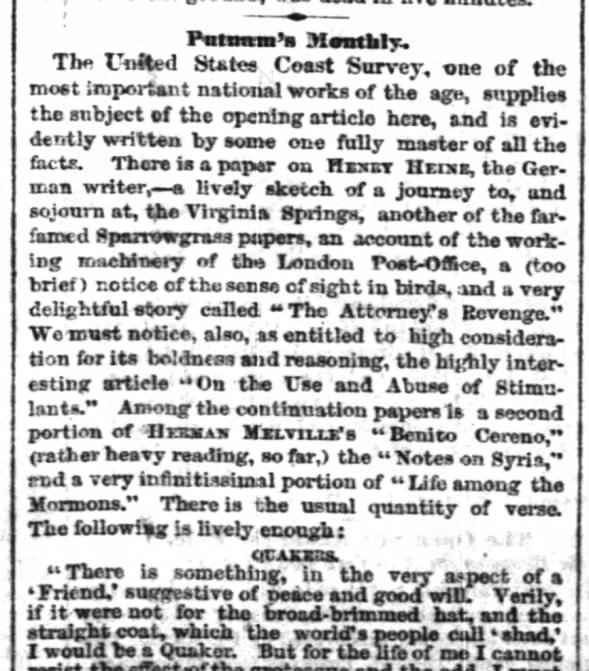 Tue, Oct 30, 1855 – Page 1 · The New York Times (New York, New York, New York, United States of America) · Newspapers.com
"Putnam's Monthly.... Among the continuation papers is a second portion of HERMAN MELVILLE'S "Benito Cereno," (rather heavy reading, so far,)…." --New York Daily Times, October 30, 1855.Benito Cereno in The Piazza Tales (New York: Dix & Edwards, 1856) via Google Books:
The fable of the physical world becomes the fact of the political; and after alternate sunshine and storm, after heavings of the earth which only deepened its roots, and ineffectual blasts of lightning whose lurid threat died in the air, under a sky now raining on it benignant influence, the century-plant of American Independence and popular Government bursts into this magnificent blossom, of a joyful celebration illuminating the land! --Oration by Rev. Richard S. Storrs, here from The Centennial Celebration of American Independence.Like The Blossoming of the Aloe, the 1876 poems transcribed below all feature The Century Plant or American Aloe (Agave, actually) as a figure of America and American independence. The conceit is developed straightforwardly in the first two, satirically in the third.
 |
| Washington, D. C. Capital - May 28, 1876 |
For The Capital
THE CENTURY PLANT.
O, sad is the life of the Century Plant!
It blooms but once in a hundred years.
'Though long and wearily we wait,
Still but for a night its flower appears;
Yes, wearily wait for a hundred years,
And but for a night the flower appears.
"O long expectance; short-lived joy,"
This was our sires' despairing cry.
As through the ages the flower they watched,
They saw it bloom and they saw it die;
They watched the flower as the years went by;
They saw it bloom and they saw it die.
But we have taken the Century Plant
And fixed it firmly in chosen ground,
We have brought the food it loves the best,
The secret of its life have found;
As it firmly stands on chosen ground,
The mystery of its life is found.
We have called the four great winds to blow
And breathe on the plant with tempered air,
And round it rich commingled soils
We've placed with labor and with care:
As it grows in the free and tempered air,
Rich mingled soils its glory share.
The time approaches--nay 'tis now,
In which the flowers should appear,
And thirteen buds are opening wide
Our hopes to fill, our hearts to cheer;
Watch, brothers, watch, the time draws near,
In which the century flowers appear.
We have watched all night, and soon will come
The crisis of the century flower,
And very soon we will know its fate,
And whether this is its dying hour;
Pray, brothers, pray, for the century flower,
May it escape its dying hour!
O, long expected glorious day,
The hour of death is safely past:
Away forever with transient bloom,
The century flower lives at last;
Shout, brothers, shout, for the hour is past,
The century flower lives at last.
'Twas living then, and is living still,
And now has bloomed for a hundred years,
And at times from the fruitful parent stem
A flowret new its head uprears;
Yes, once in a while, in a hundred years,
A bright new flower its head uprears.
And ever will live our century plant,
So wondrous is its rich new birth;
It still will breathe the tempered air
And firmly stand on the mingled earth;
And this is the secret of its birth,
The free, pure air and the mingled earth.
JOHN CRUIKSHANK
 |
| Daily Albany Argus - June 10, 1876 |
The Centennial.
[From New York Journal of Commerce.]
Most of the Centennial poetry that we have seen has been beneath criticism: but the following from a fair contributor to our paper is full of exquisite beauty:
THE CENTURY PLANT.
I.In days of old,
In solitude and silence grew the hour
When God and Nature first beheld unfold
The solitary flower.
Purple as night
Its petals opened in the forest gloom,
And the winds, pausing in the seaward flight,
Inhaled the strange perfume.
The hoary oak
Felt in its branches a responsive thrill,
The eagle from his lonely eyrie spoke,
And all again was still.
II.
Unwritten ages rolled
Into the past, and as each century's bell
Struck the full hour, the blossom would unfold,
With none its tale to tell.
At last the silence ceased.
The desert wilderness a voice had found.
Strange wanderers from the overflowing East,
Sought here a hunting-ground.
The shadow-haunted glades
Echoed the savage song--the warrior cry--
And wild, barbaric worship filled the shades
With awful mystery.
Life warm and new
Through the dull fibres of the tree was shed;
The swelling buds revealed a living hue--
Tinge of the morning red.
III.
Not unblest
The thousand years of silence and of night;
Unto the hidden gardens of the west,
God said, "Let there be light!"
And behold
It blooms again, the latest flower of Time!
In the dark ages who could have foretold
The glory of its prime!
Palmiest days
Of Grecian grandeur or of Roman pride
Saw not their century bloom in such a blaze
Of fame, full-orbed, world-wide.
Heaven, bend low!
From the last lingering gloom our land release!
Let the perfection of the ages blow
White as the plume of Peace!
--Mrs. Frances L. Mace.
BANGOR, May, 1876. --as reprinted in the Albany Argus, June 10, 1876.
 |
| Century Plant - Floral Hall (1876) The Library Company of Philadelphia |
 |
| Portland Oregonian - August 24, 1876 via GenealogyBank |
— 1876 —
A CENTENNIAL COUNTERBLAST.
BY A WRETCHED WESTERN POET, IN THE CITY OF BROTHERLY LOVE, JULY 4TH, 1876, ON HIS WAY
(HICCOUGHING) TO THE STATION-HOUSE.
After three and a half years' service in the treadmill of a newspaper office, involving — ad nauseam — the thousand and one odes of the day, the brass bands and flag displays, the slang of the period, and the general conviviality of the Centennial Year of the Republic: involving, as it were, by imbibition.
I.
I say, damn this clatter! —
That's what's the matter ( hic )
With Hannah!
'Nough to make a man cuss —
This ( hic ) confounded fuss!
This ( hic ) ridiculous muss! —
Gettin' ( hic ) wuss and wuss!
Shoutin'!
Spoutin'!
Singin' hosanna!
Wipin' your chin with a flag ( hic ) of bandana!
Shoot the whole caboodle —
The 'Merican eagle — the Fourth of July—
The Little Hatchet that couldn't lie —
John Hancock and ( hic ) Yankee Doodle!
Shoot the whole Centennial biz ( hic )
From the Big that was to the Little that is!
II.
Bombs bustin' in air ! —
I wish I was deef! —
An' the rockete' red glare ! —
Or blind, I'd as lief! —
An' this sulphurous smell
Would stifle all ( hic ) — Well,
Even the beer
Tastes confoundedly queer!
An' a man cannot touch,
But he's all over ouch!
A man has no sense,
But it's outraged outright! —
No sense? A ( hic ) suggestion — No cents!
Ne'er a red!
Broke — dead!
Busted higher 'an a kite!
Lit out for that Kingdom Come
Where the Rag-baby's eye-teeth are cut ( hic ) chewin' gum!
III.
And what for?
O ( hic ) lor'!
Give us room! give us room!
The American Century Plant's in full bloom!
IV.
The American Century Plant!
I'd like to meet it! —
I've seen the Centennial elephant —
I wonder if he ( hic ) could have eat it!
V.
Where is it? — There's room for conjecture!
What is it? — That's food for a lecture!
Some pumpkins for independence pie? —
An' ( hic ) sass?
Or small potatoes for equality?
Or beans ( hic ) for gas?
Or that buncombe bosh
The reformer's squash?
Or this ( hic ) dead beet? —
I'd like to see't —
This wonderful century plant,
But ( hic ) can't!
However, let's have, if you please,
Some Centennial ( hic ) peas.
VI.
Pull down your vest!— ( hic )
Young man, go west! —
And ( hic ) give us a rest! —
This whole Centennial fuss
Isn't worth a ( hic ) Continental cuss!
And that's the blizzard,
From a to izard,
Of my Centennial ( hic ) blunderbuss!
--"A Centennial Counterblast" in Frank Cowan, Southwestern Pennsylvania in Song and Story (Greensburg, PA, 1878).In 1865, Mary Kellogg Johnson (aka Mrs. M. O. Johnson or M. O. J.) movingly eulogized Abraham Lincoln as The Century-Plant that flowers and dies:
Yes: we who loved thee, watched the blossoming
Of thy life's earnest hour,
Forgetting that is ripening were its fall,—
Lincoln, our Aloe-Flower!
 |
| The Aldine: The Art Journal of America - July 1876 |
What's hereIn "The Blossoming of the Aloe" Augusta von Bubna recalls the fratricidal strife and its horrors as "a fierce south wind that scorched the leaves" of the metaphorical century plant. More hopefully though, this poet represents the Civil War as a pruning-knife instead of the "blighting breeze" it seemed to pessimists. Transcribed from The Aldine: The Art Journal of America (July 1876): 208; HathiTrust Digital Library does not have volume 8, but JSTOR and Melvilliana do.
Half faded: '. . . teen . . six,
The hundred summers run,
Except it be in cicatrix
The aloe—flowers—none.' —
THE BLOSSOMING OF THE ALOE.
July 4th, 1876.
The seed was sown one hundred years ago to-day;
A little band of men stood on their ground
Of noble independence, and looked round
Defiant on the whole wide world. Dismay
Shone on the pallid faces of the crowd,
But not within the stalwart hearts of those
Who, smarting 'neath the tyranny of foes,
Threw off the yoke, and in brave voices loud,
Cried boldly: "Liberty or Death!" And then
The seed took root. 'Twas watered, true, by tears,
And oft with blood: the storms of many years'
Hard struggles told upon its growth; but men
Watched vigilant its slender, tender root,
And when it 'gan to put forth branch on branch,
And grew each year more firm, and free, and stanch,
They whispered hopefully of its first fruit.
Then came a fierce south wind that scorched the leaves
And turned them angry red, as brother's blood;
And all the mighty tree swayed with the feud
Of the great tempest. "'Tis a blighting breeze!"
Cried some. "The century plant is doomed, for ay,
A young Republic's life is that of men
Who fail and falter at three score and ten,
Then shamble feebly, totter on, and — die!"
The nations, watchful, stood afar and cried,
"The ax is at the roots; it can not live!"
When — 'twas the pruning-knife that made it thrive
And knit the roots still closer! Has it died?
Ah, no! The aloe blooms! and here to-day
A great Republic wears its starry crown
More proudly than a monarch on his throne,
While nations come to praise its grand array!
— Augusta von Bubna.
Von Bubna, Augusta. “The Blossoming of the Aloe. July 4th, 1876.” The Aldine, vol. 8, no. 7, 1877, pp. 208–208. JSTOR, JSTOR, www.jstor.org/stable/20635879."The Blossoming of the Aloe" was reprinted from "Aldine for July" in Every Evening (Wilmington, Delaware) on September 7, 1876.
 |
| Joel Munsell, Annals of Albany v. 10 |
"For good reason, then, we regard the Harper edition as the text that Melville wanted published in his lifetime. We have silently corrected obvious printers' errors, but otherwise present the novel as it first appeared in July 1852, which means that there are some inconsistencies.... We have decided not to choose among such variants but to reproduce what the first printing presented." --Robert S. Levine and Cindy Weinstein, A Note on the Text and Annotations in Pierre; or, The Ambiguities (W. W. Norton & Company, 2017), pages xix-xx.

[v]
TABLE OF CONTENTS.
BOOK I.
Page
PIERRE JUST EMERGING FROM HIS TEENS . . . . . 1
LOVE, DELIGHT, AND ALARM . . . . . . . . . 26BOOK II.
THE PRESENTIMENT AND THE VERIFICATION . . . . 56BOOK III.
RETROSPECTIVE . . . . . . . . . . . . . 89BOOK IV.
MISGIVINGS AND PREPARATIVES . . . . . . . . 116BOOK V.
BOOK VI.
ISABEL, AND THE FIRST PART OF THE STORY OF ISABEL 147
vi
CONTENTS.
BOOK VII.
Page
INTERMEDIATE BETWEEN PIERRE'S TWO INTERVIEWS
WITH ISABEL AT THE FARM-HOUSE . . . . . . 173
THE SECOND INTERVIEW, AND THE SECOND PART OFBOOK VIII.
THE STORY OF ISABEL. THEIR IMMEDIATE IMPULSIVE
EFFECT UPON PIERRE . . . . . . . . . . . 194
BOOK IX.
MORE LIGHT, AND THE GLOOM OF THAT LIGHT. MORE
GLOOM, AND THE LIGHT OF THAT GLOOM . . . . 224
THE UNPRECEDENTED FINAL RESOLUTION OF PIERRE . 233BOOK X.
BOOK XI.
HE CROSSES THE RUBICON . . . . . . . . . . 247
BOOK XII.
ISABEL, MRS. GLENDINNING, THE PORTRAIT, AND LUCY 256
BOOK XIII.
THEY DEPART THE MEADOWS . . . . . . . . . 273
vii
CONTENTS.
BOOK XIV.
Page
THE JOURNEY AND THE PAMPHLET . . . . 277
THE COUSINS . . . . . . . . . . . . . 294BOOK XV.
BOOK XVI.
FIRST NIGHT OF THEIR ARRIVAL IN THE CITY . . . 312
BOOK XVII.
YOUNG AMERICA IN LITERATURE . . . . . . . . 333
BOOK XVIII.
PIERRE, AS A JUVENILE AUTHOR, RECONSIDERED . . 350
BOOK XIX.
THE CHURCH OF THE APOSTLES . . . . . . . . 360
BOOK XX.
CHARLIE MILLTHORPE . . . . . . . . . . . 374
BOOK XXI.
PIERRE IMMATURELY ATTEMPTS A MATURE BOOK. TID-
INGS PROM THE MEADOWS. PLINLIMMON . . . . 384
viii
CONTENTS.
BOOK XXII.
Page
THE FLOWER-CURTAIN LIFTED FROM BEFORE A TROPI-
CAL AUTHOR ; WITH SOME REMARKS ON THE TRAN-
SCENDENTAL FLESH-BRUSH PHILOSOPHY . . . . . 402
BOOK XXIII.
A LETTER FOR PIERRE. ISABEL. ARRIVAL OF LUCY'S
EASEL AND TRUNKS AT THE APOSTLES' . . . . . 418
BOOK XXIV.
LUCY AT THE APOSTLES' . . . . . . . . . . 439
BOOK XXV.
LUCY, ISABEL, AND PIERRE. PIERRE AT HIS BOOK.
ENCELADUS . . . . . . . . . . . . . . 450
BOOK XXVI.
A WALK; A FOREIGN PORTRAIT; A SAIL. AND THE
END . . . . . . . . . . . . . . . . 475

Manuscripts and Archives Division, The New York Public Library. "“Hawthorne and his mosses”" The New York Public Library Digital Collections. 1850.
http://digitalcollections.nypl.org/items/23ebb010-184f-0133-f66c-58d385a7bbd0Melville originally wrote:
"Nevertheless, it would argue too illy of my country were this maxim to hold good concerning Nathaniel Hawthorne...."In print the Literary World gave the standard form "ill" for Melville's "illy":
Changed to "ill" in LW...As an adverbial form "illy" was becoming ill regarded....Consulting OED the Northwestern-Newberry editors found usages before Melville's by Jefferson (1785), Southey (1795), Lowell (1848), and Irving (1849).
 |
| New York Commercial Advertiser - September 12, 1846 via GenealogyBank |
We commend to the writer in question, as a fault worthy of his censure, the increasing disposition to make new adverbs by the addition of ly where it is not wanted. In very many of the newspapers we find illy substituted for ill--the writers seeming to imagine that ill is always an adjective, and must be changed to illy where an adverb is required. It is not so. Ill and well are adverbs as well as adjectives--adverbs when used in connection with a verb, adjectives when used when with a noun. Nobody, as yet, says "welly done"--why, then, do we meet with "illy done"? "Well done" and "ill done" are the proper modes of expression. --New York Commercial Advertiser, September 12, 1846
As noted in the Northwestern-Newberry Edition of Israel Potter (page 247), duly cross-referenced in the NN Piazza Tales,
Four of the alterations consist of striking the "y" from "illy" ...Perhaps then Melville would also have wanted to revise the four instances of illy in The Confidence-Man (1857), were there any chance of getting out another edition after the failure of his original publisher, Dix, Edwards & Co.


