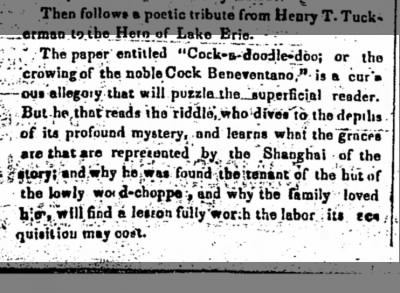
Most newspaper critics who bothered to notice Melville's story of
Israel Potter in Putnam's magazine liked it. Not in Buffalo, however. Reviewing the
January 1855 number of
Putnam's, a reviewer in the Buffalo
Commercial Advertiser used the "interminable" narrative of adventure and exile to illustrate the lackluster content of the whole issue.
... This is the dullest number of all we have had: the articles are not up to the standard of the magazine. As this is eminently an American publication, it has many friends and none of them will be satisfied with any indication of drowsiness; or what is more, and carelessness in its editors or managers. There is hardly an article of any interest in this number. The apparently interminable story, called "Israel Potter," is continued, and is like to continue, for aught that can be seen, for some time to come; it is excessively stupid and the publishers would have done better to have left the space blank. Kill off "Israel," we beg of you, gentlemen, or wind him up forthwith—the trouble of cutting the leaves is not repaid by the matter of the article. Subscribers and publishers will expect a brilliant number in February, to reward them for the defects of this and the last preceding Putnam.— Wake up, gentlemen, or you will fall too far behind to bring up with your vigilant competitors in the race for fame. --Buffalo Commercial Advertiser, December 27, 1854
The year before, the same Buffalo paper unreservedly loved
Putnam's. In a long, glowing review of the November 1853 issue, the first installment of Melville's "Bartleby" received brief but positive mention as one of several "well written, amusing papers," and "admirably told":
"The American Ideal Woman," "The life of a Dog," and "Bartleby, the Scrivener, a tale of Wall street," are all well written, amusing papers. The latter is the first part of a tale and is admirably told." --Buffalo Commercial Advertiser, November 5, 1853
Early in April 1854 the Buffalo
Commercial Advertiser still happily awaited "charming romances" by Herman Melville in the pages of
Putnam's Monthly Magazine:
When Longfellow with his poetry, Melville with his charming romances, Taylor with his knowledge of other lands, and other writers equally as gifted, come to us each month with an offering from the storehouse of their good things--what more can the most fastidious taste hope for or desire? --Buffalo Commercial Advertiser, April 11, 1854
What happened?
Possibly the new hostility to
Putnam's in general and Melville in particular reflects the change in ownership of the Buffalo
Commercial Advertiser that occurred in October 1854.
"... in 1854 the whole establishment was sold to Calvin F. S. Thomas, Solon H. Lathrop and Jedediah H. Lathrop. Theodore N. Parmelee was employed as editor. On the 4th of April, 1857, the plant and business passed again to Mr. Jewett and Doctor Foote, the latter acting as editor." --Our County and Its People ed. Truman C. White
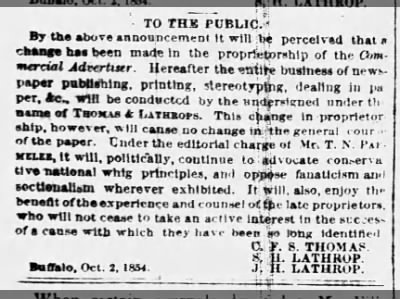
On the other hand, no major change of editorship occurred, since according to the Troy
Daily Whig (October 6, 1854), Thomas Nelson Parmelee had been serving as "working editor" since June 1851, when Thomas Moses Foote left for Albany to run the
Daily Register (Buffalo
Christian Advocate, June 19, 1851):
T. N. PARMELEE, the working editor of the paper for four years past, continues in charge of the paper under the new arrangement. (Troy Daily Whig, October 6, 1854)
Ironically, back when Thomas M. Foote was editor the Buffalo
Commercial Advertiser (July 1, 1846) had saved Herman Melville's reputation for veracity by publishing a letter from his shipmate "Toby" Greene. Foote, as Hershel Parker says in the first volume of
Herman Melville: A Biography (page 435), "knew how to package a story."
Found on Newspapers.com
A few months before the ownership change in 1854, the "political editor" of the Buffalo
Commercial Advertiser (August 4, 1854) hesitated to overstep by offering literary criticism:
"Perhaps it is not within the scope of a political editor's duties to criticise the purely literary contributions to the Magazines…." (August 4, 1854)
It could be that with new proprietors of the
Commercial Advertiser and his newly formalized title of editor (no longer merely "political editor"?), Parmelee felt empowered to speak his mind on literary matters, too. In any case, the first blast at Melville's Israel Potter in the Buffalo
Commercial Advertiser happened on Thomas Nelson Parmelee's watch, only a few months after the sale to Thomas and Lathrops.
The Buffalo
Commercial Advertiser did not mention Melville by name in connection with "Israel Potter." But the hating on "this long batch of twaddle" continued in the notice of
Putnam's for February 1855:
Putnam for February has more merit than the last number. To those who read this magazine as a matter of course, the notice following the last installment of "Israel Potter" will be gratifying. It assures them that this long batch of twaddle which has occupied so much room in many of the late numbers will be concluded in the next issue. Good.
Nobody could have been gladder to see Israel Potter go. After one episode of "Miss Charter," the Buffalo hater dismisses the new series as
another story which promises to be as stupid as "Israel Potter." --Buffalo Commercial Advertiser, January 25, 1855
In January 1855 the Buffalo
Commercial Advertiser devoted two columns headed "Putnam's Monthly—Cursive and Discursive" (January 12, 1855) and "Putnam's Monthly—Cursive and Discursive—Again" (January 16, 1855) to an extended critique of
Putnam's and its editors, George W. Curtis and Parke Godwin. (The newspaper headings mock the "Cursive and Discursive" segments in some of Curtis's "Editorial Notes" for
Putnam's.) No mention of Melville appears in either column. But Melville probably would have agreed with the Buffalo editor's estimation of Curtis:
If we are at liberty to judge from Mr. Curtis's published writings, his attainments are not such as to render him a profound critic; not such as to qualify him for the polemics of literature or art, and not such as to enable him to estimate accurately the relative merits of the literary men of the time.— In turning to the Editorial Notes of Putnam, particularly those which are most evidently from Curtis's pen, the reader will often discover an affectation of knowledge, and a slashing ex cathedra dictum in the place of extensive erudition and deliberative judgment. Curtis in his own proper department is inimitable, but beyond that nos judicibus quite vulnerable.
As for Curtis's colleague at
Putnam's magazine, the Buffalo editor acknowledges Parke Godwin as "a man of solid acquirements and sharp, acrid intellect." Noting Godwin's "ultra radical" politics, the Buffalo
Commercial Advertiser particularly objects to the intrusion in
Putnam's magazine of his "strong bias towards political abolitionism." The second part of the two-part critique helpfully summarizes the chief complaints:
The objections we make to Putnam's Monthly may be summed up substantially as follows:
1st.
It is not mainly a magazine of art and literature—using the latter
word in its primary sense, but it manifests an ambition to exercise
political influence.
2d. Its pages are chiefly occupied by common-place controversy and didactics.
3d. Its editorial columns are blemished by ill considered obiter dicta in the various departments of criticism.
4th.
Its literary merit is of a negative character—its articles as a
general rule exhibit neither obvious faults nor high excellence. --Buffalo Commercial Advertiser, January 25, 1855
Reviewing the March 1855 number of
Putnam's magazine, T. N. Parmelee (unavoidably implicated by the editorial
we) claimed,"We are not alone in our opinion of the steadily decreasing merit of Putnam's Magazine." Once again, Melville's "Israel Potter" served to illustrate the "trash" in
Putnam's:
... The very respectable and influential proprietors of Putnam should strive to change its character, and we beg them to do so, not upon our opinion of its merit, but upon that of other persons learned from the press, and from conversation, which is entitled to respectful consideration. The present number cannot be condemned by wholesale, there is a pretty thing or two in it; but the authors of "Israel Potter," and "Miss Chester," it is hoped will not consider it necessary to inflict upon a suffering public any more trash such as that which we are given to understand is now furnished [finished?]. The sentence announcing the fact, is the most interesting portion of these articles. Thank your stars, reader, and hope better things for the future. --Buffalo Commercial Advertiser, February 27, 1855
The
book version of Israel Potter was published in 1855 by G. P. Putnam & Co. The standard scholarly edition is available via
Northwestern University Press.
As shown above, the Buffalo
Commercial Advertiser under editor Thomas N. Parmelee named "Miss Chester" with "Israel Potter" as especially bad "trash." For the curious, here are links to the two installments of "My Three Conversations with Miss Chester" in the fifth volume of
Putnam's Monthly Magazine (1855):
Who wrote it?
Frederic Beecher Perkins:
- https://archive.org/stream/mythreeconversat00perk
In later years T. N. Parmelee wrote anecdotal sketches for
Harper's titled "Recollections of an Old Stager," and "Desultory Sketches" signed "T. N. P." in
The Galaxy. The
Harper's series included Parmelee's account of the
Somers mutiny from the perspective of an insider in the administration of
John Tyler, published in the April 1873 issue of
Harper's New Monthly Magazine.
Offended by the
treatment of Zachary Taylor in another installment of the
Harper's series (September 1873), one writer in the
United States Army and Navy Journal denounced Parmelee's "Recollections of an
Old Stager" as "more
distinguished for poverty of resource and vulgarity of taste, than for
literary
merit or artistic excellence."
As generally known, Parmelee once had been employed by James Gordon Bennett as Washington correspondent for the New York
Herald. Seldom if ever remembered is Bennett's claim that he fired Parmelee "for his indolence and incompetence," as announced in the New York
Herald on
December 31, 1842.
After Parmelee sued for libel, Bennett elaborated in the
Herald of July 10, 1845:
This Parmelee was for several years in our employment, and was specially engaged as a correspondent at Washington during the first years of Mr. Tyler's administration, and at the Extra Session. His conduct was not satisfactory to us, and we discharged him from our employment. Soon afterwards he obtained an appointment from Mr. Tyler to an Inspectorship on the frontier, which he has since that period enjoyed, unless he has been removed by the present administration, as we have heard stated, and is very likely. Soon after his discharge by us, some most violent and personally abusive articles appeared in a paper published in this city, called the Aurora, long since defunct. These articles brought up the case of Parmelee, and made some direct charges against the proprietor of this paper, which we at the time rebutted, and certainly disproved, by extracts from the letters of Parmelee himself. Out of this defence of our character and reputation, Parmelee undertook, two years and afterwards, to found a civil action for a libel suit, which he soon afterwards abandoned; and now, after a lapse of three years, has obtained an indictment against us before a grand jury who could know nothing of the merits of the case, and were out of the venue, and who ought not, in justice and equity, to have for a moment entertained the complaint.
The indictment has, however, been obtained, and on the trial, we will present a defence, which will certainly be not a little interesting to the public at large. We have in our possession, between sixty and eighty letters, written by Parmelee, in Washington, during the extra, and subsequent session of Congress, which will make developments, relative to this matter, extremely lucid and rich, perfectly satisfactory to us, and to all who may have seen the original statements. In fact, this correspondence, will be, in political developments, what that of Chevalier Wickoff was in the theatrical world, amusing, original, and interesting in the extreme, and perfectly vindicatory of our reputation against the paltry attack of this individual. Enough of the case for the present.
Here is the obituary of Theodore N. Parmelee from the Middletown, Connecticut
Daily Constitution of Monday, July 6, 1874; found in the archives of
Historical Newspapers at GenealogyBank.
DEATH OF THEODORE N. PARMELEE.
Mr. Theodore N. Parmelee, a well-known journalist, died at the Montowese House, Branford, Friday [July 3, 1874], aged 70. He had suffered about a year with an acute chronic disease. The New Haven Register gives the following interesting biography:—
He was born in Durham, Middlesex county, and learned the printing business in the office of the old Middlesex Gazette—of which, at mature age, he became the editor. During the administration of President Van Buren, he became the Washington correspondent of the New York Herald, and perhaps of other metropolitan journals, and was one of the earliest, if not the ablest, of what has since grown to be a powerful class in the country. Of rare conversational powers, pleasant address, and genial manner, he became a favorite with the leading men in Congress, and in office—and during the administration of John Tyler, he was on most intimate terms at the White House. No man whom we have ever met had so extensive a remembrance of men and things at Washington as Mr. Parmelee. Those who have pursued [perused] his very readable articles in Galaxy, Harper's Magazine, etc., within the past five or six years under the head of "Recollections of an Old Stager," will readily believe that, in his demise, the political literature of the country has suffered a great loss. He wielded a graphic and trenchant pen; and when he "bound him to the task," had few equals in force or style of composition. In later life he was connected with the editorial department of the Buffalo (N. Y.) Commercial, and had a thorough knowledge of the men and politics of that state. Later he was associated with the late Hon. Dean Richmond, as friend and secretary, but since the death of that gentleman he has resided in Branford or this city, mainly occupied with his pen.
 |
Daily Constitution (Middletown, Connecticut)
July 6, 1874 |