Showing posts with label The Admiral of the White. Show all posts

Thursday, February 29, 2024

Abridged "Admiral of the White" in the St. Paul SUNDAY PIONEER PRESS

Following up on my discovery that Allen Thorndike Rice arranged for the simultaneous publication of Melville's poem "The Admiral of the White" in multiple U. S. newspapers including the Cincinnati Times-Star, I confirmed this morning that an abridged version of Melville's poem did in fact appear on May 17, 1885 in the Sunday edition of the St. Paul Pioneer Press. The Minnesota Historical Society's Gale Family Library has the relevant issue on microfilm. Parking at the Minnesota History Center in downtown St. Paul (across from our magnificent Cathedral) is still free for library users--but not for long, they tell me. With a reserved reader/printer and kind help from library staff I was able to find and view the right reel during my visit earlier today. 

Many thanks to all at the Gale Family Library, and to John Gretchko for prodding me to go. The long version of Melville's 1885 poem "The Admiral of the White" was later collected in John Marr and Other Sailors (1888), slightly revised and re-titled The Haglets. The Minnesota abridgment of Melville's poem appears on page 17 of the Sunday Pioneer Press along with two prose articles, "Letters of Marque" by Gail Hamilton (the pseudonym of Mary Abigail Dodge) and a tribute to Kingsley by Frederic William Farrar. While I expected to find some version of "The Admiral of the White," I was surprised and of course delighted by the high praise extended in the header, by way of introducing "A Striking Tale in Verse from the Pen of Herman Melville." True, the editor in his enthusiasm does not seem to know or care about Battle-Pieces (1866) and Clarel (1876) and appears to mistake "White" for the name of the doomed ship, but what of that. It's always good to find Melville highly placed in "A Galaxy of Genius," ranking first among other "Eminent Authors."

Sunday Pioneer Press - St. Paul, MN
May 17, 1885
Our shortened St. Paul version of "The Admiral of the White" omits many lines of verse including all of the first two stanzas and part of the third, lines 1-18 of "The Haglets" as printed on pages 218-225 in the 2009 Northwestern-Newberry edition of Melville's Published Poems, edited by Robert C. Ryan, Harrison Hayford, Alma MacDougall Reising and G. Thomas Tanselle. Who supplied the three prose transitions, highlighted in my transcription below, added to fill gaps in the story resulting from editorial deletions? Allen Thorndike Rice? Chief editor Joseph Albert Wheelock himself, or an assistant in the literary department? Probably not the poet, I suppose. None of these clever connectors appears in the differently abridged version printed on the same Sunday in the New York Daily Tribune

From the St. Paul Sunday Pioneer Press of May 17, 1885, page 17:

A GALAXY OF GENIUS.

ORIGINAL CONTRIBUTIONS FROM
EMINENT AUTHORS.

A Striking Tale in Verse from the Pen of Herman Melville—In "Letters of Marque" Gail Hamilton Discusses in Her Own Characteristically Breezy and Independent Fashion a Number of Questions Concerning the Modern Young —Rev. Canon Farrar Contributes an Appreciative Tribute to the Memory of the Late Charles Kingsley.

THE ADMIRAL OF THE WHITE.

BY HERMAN MELVILLE.
[Copyright, 1885, by Thorndyke Rice. All rights reserved.]

The famous author of "Omoo," "Typee" and other widely known books has dropped into poetry, and in this domain of literature displays the same breeziness, the same dash and spirit that characterized his former works. He tells the story of the fate of the gallant crew of the White, wrecked and lost in Southern seas. The admiral has just fought the "arm'd Plate Fleet whose sinking flagship's colors fell," and is now crowding sail ahead to carry the news of his victory.

The eddying waters whirl astern,
The prow, a seedsman, sows the spray;
With bellying sails and buckling spars
The black hull leaves a Milky Way;
Her timbers thrill, her batteries roll,
She reveling speeds exulting with pennon at pole.
 
 
But ah, for standards captive trailed
For all their scutcheoned castles’ pride—
Castilian towers that dominate Spain,
Naples, and either Ind beside;
Those haughty towers, armorial ones,
Rue the salute from the admiral’s dens of guns.
 

* * * * * * * [omitting "Ensigns and arms...conflict sped," lines 31-42]

But out from cloistral gallery dim,
In early night his glance is thrown;
He marks the vague reserve of heaven,
He feels the touch of ocean lone;
Then turns, in frame part undermined,
Nor notes the shadowing wings that fan behind.

There, peaked and gray, three haglets fly,
And follow, follow fast in wake
Where slides the cabin-luster shy,
And sharks from man a glamour take.
Seething along the line of light,
In lane that endless rules the war-ship’s flight.

The storm increases in a terrific furry [fury] and the good ship narrowly escaped being driven on land. 

[omitting "The sea fowl here..."luminous antlers vast," lines 55-90]

In trim betimes they turn from land,
Some shivered sails and spars they stow;
One watch, dismissed, they troll the can.
While loud the billow thumps the bow—
Vies with the fist that smites the board,
Obstreperous at each reveller’s jovial word.
 
 
Of royal oak by storms confirmed,
The tested hull her lineage shows;
Vainly the plungings whelm her prow—
She rallies, rears, she sturdier grows.
Each shot-hole plugged, each storm-sail home,
With batteries housed she rams the watery dome.

* * * * * * * [omitting "Dim seen adrift...eager neighborhood," lines 103-114]

Plumed with a smoke, a confluent sea,
Heaved in a combing pyramid full,
Spent at its climax, in collapse
Down headlong thundering stuns the hull:
The trophy drops; but, reared again,
Shows Mars’ high-altar and contemns the main.

It is midnight of the Old Year. "The Old Year fades, the Old Year dies at sea." During a lull the sailors 

[keeping line 138 but omitting everything else from "Rebuilt it stands..." to "Laced Sleeves round the board," lines 121-137 and 139- 153]
Draw near in heart to keep them warm:
"Sweethearts and wives!" clink, clink, they meet,
And, quaffing, dip in wine their beards of sleet.

"Ay, let the star-light stay withdrawn,
So here her hearth-light memory fling,
So in this wine-light cheer be born,
And honor’s fellowship weld our ring—
Honor, our Admiral’s aim foretold;
A tomb or a trophy,, and lo, ’t is a trophy and gold!"
 
 
But he, a unit, sole in rank,
Apart needs keep his lonely state,
The sentry at his guarded door
Mute as by vault the sculptured Fate;
Belted he sits in drowsy light,
And hatted nods—the Admiral of the White.

He dozes on, unmindful of the present, dreaming of old victories and of rich armadas that he has captured. But the end is at hand.

 [omitting "He dozes, aged with watches...old Armadas drowned," lines 169-192] 
 
Ha—yonder! are they Northern Lights?
Or signals flashed to warn or ward?
Yes, signals lanced in breakers high;
But doom on warning follows hard;
While yet they veer in hope to shun,
They strike! and thumps of hull and heart are one.
  
 
 [omitting "But beating hearts ... lit the magnet's case," lines 199- 210]

Ah, what may live, who mighty swim,
Or boat-crew reach that shore forbid,
Or cable span? Must victors drown—
Perish, even as the vanquished did?
Man keeps from man the stifled moan,
They shouldering stand, yet each in heart how lone.
 
 
Some heaven invoke; but rings of reefs
Prayer and despair alike deride
In dance of breakers forked or peaked.
Pale maniacs of the maddened tide;
While, strenuous yet some end to earn,
The haglets spin; though now no more astern.
Like shuttles hurrying in the looms
Aloft through rigging frayed they ply—
Cross and recross—weave and inweave,
Then lock the web with clinching cry
Over the seas on seas that clasp
The weltering wreck where gurgling ends the gasp.

Ah, for the Plate-Fleet trophy now,
The victor’s voucher, flags and arms;
Never they’ll hang in Abbey old
And take Time’s dust with holier palms;
Nor less content, in liquid night,
Their captor sleeps—the Admiral of the White.

Imbedded deep with shells
And drifted treasure deep,
Forever he sinks deeper in
Unfathomable sleep—
His cannon round him thrown,
His sailors at his feet,
The wizard sea enchanting them
Where never haglets beat.
On nights when meteors play
And light the breakers dance,
The Oreads from the caves
With silvery elves advance;
And up from ocean stream,
And down from heaven far,
The rays that blend in dream
The abysm and the star.

Of the seven scheduled appearances of "The Admiral of the White" announced as forthcoming in the Cincinnati Times-Star for May 14, 1885, three have yet to be verified: 

  1. New York Tribune ✅
  2. Boston Herald ✅
  3. Philadelphia Press
  4. Detroit Post
  5. St. Paul Pioneer-Press ✅ 
  6. Chicago Times
  7. Cincinnati Times-Star  ✅

Still looking to confirm printings of Melville's poem in the Philadelphia Press, Detroit Post, and Chicago Times on or about May 17, 1885.

Related posts:

Tuesday, February 13, 2024

1885 check "endorsed by Herman Melville for deposit"

As previously shown on Melvilliana 
Herman Melville's 1885 poem The Admiral of the White, later printed in John Marr and Other Sailors (1888) as "The Haglets," was syndicated by Allen Thorndike Rice for publication in more newspapers than we knew, including the Cincinnati Times-StarAdmiral of the White appeared in the weekly edition of the Cincinnati Times-Star on May 21, 1885, "Copyrighted by Allen Thorndike Rice."

Today (Happy Mardi Gras y'all 🎉🎉🎉) I stumbled on a documentary record of what might well have been Melville's payment for the poem in the form of a check from "A. Rice" dated May 2, 1885 and "endorsed by Herman Melville for deposit." Said check (no longer extant?) was included as a signed Melville item with "Literary Letters and Manuscripts" in the auction catalog of Anderson Galleries for Sale Number 2298. A brief description appears on page 89 of the Anderson Galleries catalog, Autograph Collection of a Late American Author (New York, 1928). Listed as item #658, the check with Melville's signature was offered in the Third Session on December 4, 1928:

658 MELVILLE (HERMAN). Printed and written D. s., 1 p., oblong 8vo. New York. May 2, 1885. Check by A. Rice endorsed by Herman Melville for deposit. 
https://hdl.handle.net/2027/mdp.39015078674242?urlappend=%3Bseq=531%3Bownerid=13510798895671981-541

Less than two years later, the check resurfaced in the Plaza Art Galleries, Inc. catalog of Noted American and English authors of the last 150 years, in first editions from the library of Philo C. Calhoun. Evidently Bridgeport, Connecticut lawyer and book collector Philo Clarke Calhoun (1889-1964) had acquired the May 2, 1885 letter (at the 1928 Anderson auction?) and stuck it in the front of his highly collectible 1st edition of Moby-Dick, "Rare in any form, and particularly so in BLUE cloth."


Calhoun's first American edition of Moby-Dick is listed #320 in the Plaza Art Galleries catalog for "Public Sale No. 776," held on March 20 and 21, 1930. According to the description on page 44, the date of the attached cheque with Melville's signature is May 2, 1885, same as the date of the check described in the 1928 Anderson Galleries catalog.
"... Affixed to the inner front cover is a cheque dated May 2, 1885; bearing MELVILLE"S SIGNATURE as an endorsement. Melville autograph material is seldom met with."
https://hdl.handle.net/2027/mdp.39015033687156?urlappend=%3Bseq=52%3Bownerid=13510798883686487-56
The 1930 Plaza Art Galleries catalog does not name the issuer of the "cheque" that Melville endorsed, but it bears the identical date and thus would appear to be the same "check" from "A. Rice" described in the 1928 Anderson Galleries catalog. This "A. Rice" I take to be Allen Thorndike Rice who had arranged for the newspaper syndication of Melville's poem "The Admiral of the White" later on in May 1885. 

Allen Thorndike Rice was still paying authors by check in November. On November 29, 1885 Rice wrote a check for 120 dollars to author Harriet Prescott Spofford. Signed "A. T. Rice" and endorsed by Spofford on the back, this item is now in the Abernethy collection at Middlebury College Special Collections & Archives.


So now we at least have some reason to believe Rice paid Melville, and a better idea of when. Who knows how much? Or what happened to the physical check from Rice that Melville endorsed? If you now have or ever happen to see a 1st American edition of Moby-Dick in blue, take a look. 

Related post:

Friday, January 19, 2024

More on Thorndike Rice and his 1885 newspaper syndicate

As shown on Melvilliana, the formerly mysterious appearance of Herman Melville's sea-poem "The Admiral of the White" (revised and re-titled The Haglets in his 1888 collection John Marr and Other Sailors) in multiple newspapers on the same day in May 1885 was enabled by Allen Thorndike Rice (1851-1889) and his pioneering though short-lived newspaper syndicate. 

24 May 1889, Fri Public Weekly Opinion (Chambersburg, Pennsylvania) Newspapers.com

Early in 1885 the Springfield Massachusetts Daily Republican gave interesting and highly relevant details of Thorndike Rice's ambitious scheme for the "simultaneous publication" of non-fiction articles, short stories ("or novelets") and poems "in the Sunday editions" of involved newspapers, "or where a paper has no Sunday edition, in the weekly." Melville's poem "The Admiral of the White" appeared in the Sunday editions of the Boston Herald, St. Paul MN Pioneer Press, and New York Tribune on May 17, 1885; and the weekly edition of the Cincinnati Star-Times on May 21st. 

Found on genealogybank.com and transcribed below.

Springfield Daily Republican 1 of 2
January 5, 1885

Springfield Daily Republican 2 of 2
January 5, 1885

ALLEN THORNDIKE RICE, editor of the North American Review, has taken a very remarkable step in the way of coöperative journalism, as it may be termed. Heretofore its only development beyond "patent outsides"--or insides, as the case might be--has been in the formation of "syndicates" for the simultaneous publication of stories, short and long, in various newspapers throughout the country. Mr. Rice has conceived a scheme of great importance on the same principle, which his possession of a considerable fortune enables him to launch with an assurance of success. This is to enlist in the service of the American newspapers the pens of the most distinguished men of Europe and America, in every department of human interest,--statesmen, publicists, generals, scientists, philosophers, churchmen, jurists, financiers, merchants, manufacturers, poets, novelists. When any event of moment occurs, or any great question springs into immediate importance, Mr Rice will procure from the man best qualified to explain and discuss its significance and its bearings an article upon the subject. When the occasion demands it, the procurement will be made by cable, and the article sent to him at New York by cable, and thence distributed by mail or telegraph, as may be necessary, to the various newspapers that have entered into the arrangement. These newspapers, in several parts of the Union, have each the exclusive copyright of each article for a certain extent of territory, extending over 10 days after publication. The articles will appear in the Sunday editions of the papers, or where a paper has no Sunday edition, in the weekly. The publishing of poems or novelets is, of coursed, governed by the same conditions, but that is of less consequence than the articles. Mr Rice spent a year in Europe principally to secure the eminent contributors to this remarkable scheme, and his list numbers over 300 names. For a single article he will sometimes pay thousands of dollars, and the total expense will therefore be very large, while the expense to each paper will be such as to require a large circulation and advertising patronage to justify. It is another emphatic evidence of the great and constantly increasing domain of the newspaper, which as the universal and continuous medium of information, if in no other character, is becoming the great force of human life in civilized countries. Prince Bismarck does not approve of or trust in the press in his Germany, but when Mr Rice wants his opinion on a great event or a domestic complexity, he will not hesitate to confide it to the press of America.

-- Springfield Daily Republican, January 5, 1885

Related posts:

Thursday, January 18, 2024

Syndicated in Cincinnati, and beyond: Melville's 1885 poem "The Admiral of the White"

Cincinnati Weekly Times-Star - May 21, 1885
Found on newspaperarchive.com

So MACSWELL spilled the beans in Buffalo.

In the latter half of May 1885, as previously revealed here on Melvilliana, a New York City correspondent of the Buffalo Courier named Walter Langdon Russ (1852-1930) aka "Macswell" informed readers of a scheme to get the justly forgotten author Herman Melville Resuscitated by mass-marketing "The Admiral of the White," a mysterious and thrilling sea-tale in verse that Melville would slightly revise and re-title "The Haglets" for private publication in John Marr and Other Sailors (1888). 
Writing from Manhattan on May 21, 1885 Macswell reported having seen Melville's new poem "printed in one of our morning papers last Sunday." As the New York correspondent of the Buffalo Courier understood things, the same poem "was printed at the same time, I believe, in other papers, east and west." Macswell blamed a young, wealthy, and ambitious media mogul for the irritating attempt to rescue Melville from oblivion:
Mr. Thorndyke Rice, the ingenious editor of the North American Review, is, I am told, responsible for his resuscitation.
C. Allen Thorndike Rice March 1883

Turns out, Macswell was right. Charles Allen Thorndike Rice (1851-1889), a pioneer of the press syndicate, evidently had enlisted Melville with other talented writers in a new cultural project to entertain more high-minded readers of popular American periodicals with excellent literary works by the best authors. The innovative manner of mass publication appealed to publishers and authors, too, as mutually beneficial. Ellery Sedgwick explains:

S. S. McClure, Charles Dana, and Thorndike Rice had also begun their syndicates that brought fiction from authors and sold publication rights to newspapers across the country...both the illustrated magazines and the syndicates very significantly increased the dollar value of literature and the potential for making a living by writing it.

Sedgwick, Ellery. “Magazines and the Profession of Authorship in the United States, 1840–1900.” The Papers of the Bibliographical Society of America, vol. 94, no. 3, 2000, pp. 399–425. JSTOR, http://www.jstor.org/stable/24304071. Accessed 18 Jan. 2024.

Samuel Sidney McClure acknowledged Thorndike Rice as a former and at one time formidable rival in the syndicate business:

Of course, as soon as my syndicate began to pay, other syndicates were started. The most powerful of these was started by Allan Thorndyke Rice, editor of the North American Review. My friends and many of the editors I served thought such a competitor would be too much for me. I remember that at this time Miss Sarah Orne Jewett, who wrote for the syndicate and took a friendly interest in my business, wrote me to ask whether I could not form some combination with Mr. Rice to avoid being wiped out. Mr. Rice's syndicate was very strong for a time, but eventually it died out without seriously cutting into my business.
-- My Autobiography (New York, 1914) pages 182-183.

The "morning paper" in which Macswell had seen "The Admiral of the White" must have been the New York Tribune. Melville fans have long known about the Tribune printing of Melville's poem on May 17, 1885, and another, more complete version on the same date in the Boston Herald. The text of Herman Melville's "The Haglets" in John Marr closely follows that of "The Admiral of the White" as previously published in the Boston Herald and, incompletely, in the New York Tribune. Before now only those two newspaper versions of Herman Melville's 1885 poem have been recorded in Melville scholarship. The New York and Boston printings of "The Admiral of the White" are discussed in editorial notes on "The Haglets" for the 2009 Northwestern-Newberry edition of Melville's Published Poems, edited by Robert C. Ryan, Harrison Hayford, Alma MacDougall Reising and G. Thomas Tanselle, at pages 725-726. Both newspaper printings, the Boston Herald version and the "abridged" New York Tribune version, are referenced also in notes on the manuscript version of "The Admiral of the White" (a different poem with the same title) in the back of the Northwestern-Newberry Edition of Billy Budd, Sailor and Other Uncompleted Writings, edited by G. Thomas Tanselle, Harrison Hayford, Hershel Parker, Robert Sandberg and Alma MacDougall Reising, at page 888. 

Only the "complete" Boston Herald and "abridged" New York Tribune versions of "The Admiral of the White" are referenced in Robert Sandberg's "Note on the Texts" for Herman Melville: Complete Poems (Library of America No. 320, 2019) page 930. Edited by Hershel Parker, the LOA edition of Complete Poems has "The Haglets" on pages 677-683 and the uncollected manuscript poem "The Admiral of the White" (which is not the 1885 poem with the same title) on pages 865-866.

A good reading text of Melville's poem "The Haglets" is conveniently accessible online courtesy of poets.org

For explication you can find "The Haglets" helpfully discussed by William H. Shurr in The Mystery of Iniquity (University Press of Kentucky, 1972) at pages 130-134; 

and, more recently, by Peter Riley in "The Fair Poet's Name": Late Poems, Chapter 14 in A New Companion to Herman Melville, edited by Wyn Kelley and Christopher Ohge (Wiley Blackwell, 2022) pages 171-183 at 177.

Long unacknowledged in Melville studies, Allen Thorndike Rice's role in the newspaper syndication of "The Admiral of the White" seems confirmed by the publication of his name as copyright holder in the heading of a previously unknown printing of Melville's poem in the Cincinnati Weekly Times-StarHeadings in both the New York Tribune and Boston Herald versions merely stated "Copyright, 1885," below the title and (in the NY Tribune version) author credit. 

Boston Sunday Herald - May 17, 1885
via genealogybank.com

The Cincinnati version places the copyright statement within brackets, above the title:
[Copyrighted by Allen Thorndike Rice.]

Admiral of the White. 

Cincinnati Weekly Times-Star - May 21, 1885
via newspaperarchive.com

As published on May 21, 1885 in the Weekly Times-Star, the byline further asserts that the original poem was "Written for the Times." Presumably the weekly edition of the Cincinnati Times-Star copied "Admiral of the White" from the Sunday Times where it had appeared according to schedule on Sunday, May 17, 1885, the same day it definitely debuted in New York and Boston. Unfortunately, the Sunday edition is not currently included in the files of the Cincinnati Times-Star at NewspaperArchive. After renewing my subscription there I did find "The Admiral of the White" reprinted on May 21, 1885 in the weekly edition of the Cincinnati Times Star. In terms of length, the Cincinnati text of Admiral of the White matches the complete Boston Herald version, rather than the Tribune abridgment. Some words and expressions (Admiral, Plate Fleet, and Milky Way) in the Cincinnati version are treated as proper nouns with the first letter of each word capitalized, where the Boston Herald version uses all lower case letters, at least early on. Among other minor differences, the Cincinnati version 
  • reads "Laced Sleeves" (as in the New York Tribune version) where the Boston Herald gives "Lace Sleeves"; 
  • does not italicize "A tomb or a trophy" (italicized in the New York and Boston texts); 
  • punctuates "sculptured Fate!" with an exclamation mark; 
  • has "hatted" as in the NY Tribune where Boston Herald reads "hated"; and
  • reads "No less content" where the Boston Herald and New York Tribune both have "Nor less content."

As I found in files of the daily edition (excluding Sunday, as noted above), also via Newspaper Archive, the plan for simultaneous publication in multiple U. S. cities (including the western towns of Chicago, IL and St. Paul, MN) had been explicitly and repeatedly advertised by the Cincinnati Times-Star. On May 14, 1885, for example, the Cincinnati Times-Star announced that "'Admiral of the White,' by Herman Melville" would appear with other "SPECIAL PAPERS" in the Sunday edition of May 17th.

Cincinnati Times-Star
May 14, 1885

SPECIAL PAPERS

In the SUNDAY TIMES-STAR of next Sunday, May 17, will be:

"Admiral of the White," by Herman Melville, author of "Typee, or Life in the Marquesas," "Moby Dick," etc.

"Charles Kingsley," by Canon Farrar.

"A Letter of Marque," by Gail Hamilton.

"The Doctrines of the Flag," by Hon. James H. Gerard.

These papers will be found of especial interest to the better class of newspaper readers. They appear simultaneously in the New York Tribune, Boston Herald, Philadelphia Press, Detroit Post, St. Paul Pioneer-Press, and Chicago Times.

In addition to the special papers, the SUNDAY TIMES-STAR contains all local and telegraphic news and as much general matter as one has time to read. Everything is presented in an attractive and convenient manner, so that the reader who devotes a reasonable time to his paper can be sure that he has not missed any news of great importance.

Price Three Cents.

The advertisement transcribed above lists six newspapers in addition to the Cincinnati Times-Star that were then engaged in Thorndike Rice's newspaper syndicate, apparently, and thus committed to simultaneous publication on Sunday, May 17, 1885 of Melville's "Admiral of the White" and other works "of especial interest to the better class of newspaper readers." The Cincinnati Times or Times-Star would make a seventh, thus:

  1. New York Tribune ✅
  2. Boston Herald ✅
  3. Philadelphia Press
  4. Detroit Post
  5. St. Paul Pioneer-Press ✅ verified 02/29/2024
  6. Chicago Times
  7. Cincinnati Times-Star

Versions of Melville's poem in two of the six newspapers we already knew about, the New York Tribune and Boston Herald, as explained already. That leaves four more to investigate. Well, five if you count the Sunday edition of the Cincinnati Times-Star that I have not yet located. Being in Minnesota, of course I feel duty-bound to begin with the Pioneer Press down in St. Paul. Alas, for the specific date of Sunday, May 17, 1885 our Minnesota Digital Newspaper Hub only gives images from the St. Paul Daily Globe and Minneapolis Daily Tribune. 

Yikes! this could be harder than I thought. Clearly there's plenty more to look for, besides more printings than we knew about of Melville's 1885 poem. For instance, does any correspondence survive between Melville and Allen Thorndike Rice? Did Melville ever formally transfer the copyright for "The Admiral of the White"? Or sign a contract?

Related posts:

Tuesday, February 22, 2022

Melville Resuscitated, 1885

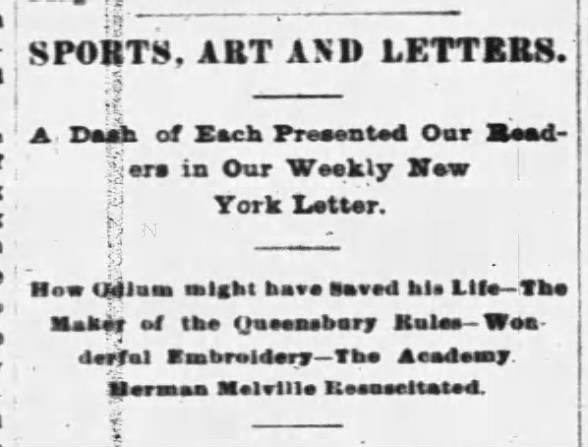
In the mid 1880's Walter Langdon Russ (1852-1930) aka "Macswell" was a New York correspondent of the Buffalo Courier. After the New York Tribune printed Melville's poem "The Admiral of the White" out of the blue, "Macswell" remarked on the weirdness of "Herman Melville Resuscitated" in the weekly New York letter dated May 21st and printed in the Buffalo Courier on Monday, May 25, 1885. 

Macswell is identified as journalist W. L. Russ in Fact, Fancy, and Fable, ed. Henry Frederic Reddall (Chicago, 1892). Another correspondent of the Courier around this time was Daniel Connelly aka "Rapidan," so identified in Initials and Pseudonyms: A Dictionary of Literary Disguises, ed. William Cushing (New York, 1885). There W. L. Russ is listed under two pseudonyms, "Macswell" (page 181) and "Persimmons" (page 228). 

Without further explanation, Macswell credits Charles Allen Thorndike Rice, "ingenious editor of the North American Review," with the "resuscitation" of Melville. The calculation of Melville's age (then nearing 66) is obviously off, unless by "sixty years old" Macswell meant in his sixties. 

25 May 1885, Mon Buffalo Courier (Buffalo, New York) Newspapers.com

SPORTS, ART AND LETTERS.

A Dash of Each Presented Our Readers in Our Weekly
New York Letter.

How Odium might have saved his Life--The Maker of the Queensbury Rules--Wonderful Embroidery--The Academy. Herman Melville Resuscitated.

From Our Own Correspondent. 

... A poem entitled "The Admiral of the White" was printed in one of our morning papers last Sunday and was printed at the same time, I believe, in other papers, east and west. The author of this poem was Herman Melville, who, as an American author, has been lost to sight for many years. The re-appearance of Melville in literature is, one might say, a curious freak of destiny. There is no special reason why he should re-appear, and everyone had come to the conclusion that he had given up serious authorship. If I am not mistaken, he was eulogized at one period as a man of vigorous talent. But he drifted away from the work he had set himself to do, and, since the civil war, he had been a drudge in some office down town. His first volume of verse, published in 1866, was called "Battle Pieces." Some of the verses in that volume were spirited, though most of them were not better than respectable. "The Victor of Antietam," for example, which has been praised with enthusiasm, seems a cold and dull thing. "Sheridan at Cedar Creek" is more genuine, to say the best of it. 
MELVILLE was born in 1819. He is at present, therefore, sixty years old. Mr. Thorndyke Rice, the ingenious editor of the North American Review, is, I am told, responsible for his resuscitation.

... MACSWELL.  -- Buffalo Courier, May 25, 1885.

A compressed version of "The Admiral of the White," expanded and retitled The Haglets in John Marr and Other Sailors (1888), had appeared on page 9 of the Sunday New York Tribune, May 17, 1885. 

New-York tribune. [volume] (New York [N.Y.]), 17 May 1885. Chronicling America: Historic American Newspapers. Library of Congress. <https://chroniclingamerica.loc.gov/lccn/sn83030214/1885-05-17/ed-1/seq-9/>
Also on May 17, 1885, the Boston Herald printed a longer version of "The Admiral of the White, not abridged as in the New York Tribune. The Library of America edition of Herman Melville: Complete Poems, edited by Hershel Parker with a note on the texts by Robert A. Sandberg, has "The Haglets" with all of the poems in John Marr and Other Sailors, as well as the different, uncollected poem also titled The Admiral of the White.

Melville's poem "The Haglets" on poetry.org: