Friday, July 22, 2022

Peter Gansevoort's 1832 address to the Albany Republican Artillery

Albany Republican Artillery, NY State Militia
Regimental Color c. 1809
via New York State Military Museum and Veterans Research Center

As previously shown on Melvilliana, Harold A. Larrabee gave the true setting for Peter Gansevoort's address on the centennial of George Washington's birthday, Elisha Foot's Fort Orange Hotel at 549 South Market street.  
"On that occasion he presented to the Albany Republican Artillery at a dinner in Foot's Fort Orange Hotel a large brass drum, captured from the British at Fort Stanwix by his father, then a colonel."

In his 1934 article for New York History on Herman Melville's Early Years in Albany, Larrabee went on to quote the following "sunburst of rhetoric" near the end of Peter Gansevoort's speech:

The trophy which I present to you, is strongly associated with one of the scenes to which I have alluded, in the glorious struggle for our Independence. Its music was heard in those days of peril; it beat in unison with the war whoop and yell of the merciless savage on the bloody field of Oriskany; it sounded the charge and animated the courage of the enemy at Fort Stanwix; it also sounded his retreat, and was taken from the enemy in the hour of his flight.

On this centennial jubilee, in honor of him, whose monument is in the grateful hearts of a free and intelligent people, I present to you this trophy, as a memorial of that eventful period, when the sun of liberty, in the full effulgence of its glory, irradiated the western hemisphere, and when the first sparks were struck by the fearless asserters of the unalienable rights of man, which enkindled on the altar of freedom, that flame which is gradually illuminating the eastern hemisphere.

The Gansevoort family in Albany apparently kept a close watch on that drum donated in 1832 by Herman Melville's Uncle Peter. In 1877 Melville's cousin, Peter Gansevoort's daughter Catherine (Kate) Gansevoort Lansing procured it for the centennial celebration of the Battle of Oriskany.

... Mr. SEYMOUR exhibited the revolutionary relics. Among these was the brass snare drum, sent up from Albany by Mrs. LANSING. On the brass coat of the drum was the following inscription : 

" Presented by Peter Gansevoort, of the city of Albany, counsellor-at-law, to the Albany Republican Artillery Company, on the 22d February, 1832."

"Taken from the enemy on the 22d Aug., 1777, when the British army under Gen. St. Leger, raised the siege of Fort Stanwix, which fortress had been valiantly defended by the garrison under the command of Colonel Peter Gansevoort for 21 days."  -- The Centennial Celebrations of the State of New York (Albany, 1879) "Oriskany" page 97.
Drum Captured from St Leger - 1777 - Fort Stanwix
Photo via Civil War Badges 

A handwritten version of Peter Gansevoort's address survives in the Gansevoort-Lansing collection of the New York Public Library--in box 150, folder 2 as noted by John Bryant in the first volume of Herman Melville; A Half Known Life (Wiley Blackwell, 2021) on page 129. Peter Gansevoort's address to "Soldier Citizens" of the Republican Artillery was more of a military and after-dinner affair, rather than the main event of the civic procession that Bryant makes it. State Assemblyman Oran G. Otis of Saratoga County was selected to address all "FELLOW CITIZENS!" on George Washington's 100th birthday. The centennial oration by Oran G. Otis was later printed as No. 306 in Documents of the Assembly of the State of New York, 55th session, Volume 4 (Albany, 1832). 

On February 28, 1832 the Albany Argus announced that Peter Gansevoort's "eloquent and pertinent address" would be printed the next day:
The proceedings and toasts of the Albany Republican Artillery, on the 22nd, together with the eloquent and pertinent address of gen. GANSEVOORT, delivered on presenting to the company a brass drum, captured by his ancestor at the siege of Fort Stanwix, and the reply of capt. IGGET, we shall take a pleasure in publishing to-morrow. The toasts, &c. of the "Washington Volunteer Guards," will also appear tomorrow. 
Albany Argus - February 28, 1832

The full text of Peter Gansevoort's address is transcribed below from the Albany Argus on February 29, 1832--where it appears along with related coverage of the various toasts given at "sumptuous dinners" for the Washington Volunteer Guards (front page) and the Albany Republican Artillery (page 2). To clarify, "dinner" here means the midday meal, customarily served around 1 or 2 o'clock in the afternoon. Toasts at the "Long Room" in Crosby's Hotel by the Washington Volunteer Guards are reluctantly omitted, for now. 

BIRTH OF WASHINGTON -- CENTENNIAL ANNIVERSARY

The military and civic procession having been dismissed by a salute of 100 guns from the artillery, and a feu de joie by the infantry, the respective corps sat down to most sumptuous dinners prepared for the occasion—the 89th and 246th regiments at Crosby’s Long Room, and the Albany Republican Artillery at Foot’s Fort Orange Hotel.

WASHINGTON VOLUNTEER GUARDS.

...

ALBANY REPUBLICAN ARTILLERY.


This elegant and well disciplined company, after performing the arduous duties allotted them by the committee of the day, in a manner highly creditable to them as soldiers, celebrated the centennial anniversary, by partaking of a dinner at the “Fort Orange Hotel;” and it is but justice to say, that Mr. Foot, the proprietor of this establishment, furnished the table not only with every thing that heart could wish but in a style corresponding with the glorious occasion. 

The company were honored with the presence of a number of the members of our Legislature and citizens. 

The following toasts were drank, accompanied with martial music.

STANDING TOASTS.

  1. The Centennial Anniversary--Century on century may roll away, yet the name of Washington shall perish but with time.
  2. The Compatriots with Washington, in the cabinet and in the field--The present anniversary calls to memory, the men who "filled the measure of their country's glory."
  3. The President of the United States--Honor unto whom honor is due.
  4. The Vice President and National Legislature--When their labors shall have ceased, the People will weigh their actions in the balance of truth, and pronounce a verdict of approval or condemnation.
  5. The Governor and Lieut. Governor of the State of New-York.
  6. The State of New-York--In war, the sheet anchor of our country--the terror of our enemies--In peace--the friend of Union and dignified asserter of State Rights. 
  7. Internal divisions--however painful political conflicts and political defeats on either side, let all this day remember, that here Liberty dwells, and that this is their country.
  8. The Legislature of New-York--Although divided into parties hostile to each other, when they cast their eyes on the majestic form of Washington, which decorates their Hall, may they remember that he represented in all his public acts, the interests of the people alone.
  9. Internal improvements.--Liberally promoted and in a spirit of patriotism, they are monuments of state and national prosperity.
  10. The Militia--The strong bulwark against King-craft, Priest-craft, and all the crafts of an enemy. It is the impregnable fortress of American freedom.
  11. Church and State--Priest ridden sycophant, and luke warm Americans talk of a union. Patriots and unshaken republicans stand ready with blood and treasure, to prevent the unhallowed bans of matrimony.
  12. The oppressed nations of the earth--Before another century shall have closed, may to each of them be born a Washington, who will rise in his majesty--break asunder the chains that fetter the human mind--and proclaim civil and religious liberty to the world of mankind. 
  13. The Fair Sex--May they frown upon all maccaronis and coxcombs--civil and military; and wed plain, honest, and dignified republicans. 

VOLUNTEERS.

By Capt. Iggett. Gen. Jackson riding on a rail road at the rate of sixty miles per hour--The Albany Republican Artillery volunteer to carry cannon balls, and protect the baggage waggons on the journey.

By Lieut. Strain. John Mills--The mention of his name will cause every member of this republican corps to render his memory a soldier's, a citizen's, and a patriot's respect.

By Lieut. Sears. Washington--The brightest  star in the western hemisphere--there are will o' the wisps that would dim the brilliancy of his glory, but they will sink into the bogs whence they arose, and be remembered no more.

 By James B. Spencer, (of the assembly). The Albany Republican Artillery--While such brave and patriotic troops defend our soil, it will never give bread to a tyrant.

By a guest. The two Albany companies who have deserted their colors--whether their military pride for their own city is enhanced in the eyes of Troyans or Albanians is a moot point.

By Sarg't Strain. Gen. Root--Truly the Root of democracy, from whence springs branches that bear better fruit than enemies to republicanism.

By Lieut. H. Merchant, a guest. The members of the legislature--Their patriotism on this glorious anniversary, is a pledge that as men and as representatives, they love their country.

By John C. Buckabee. The rejection of Martin Van Buren--it will be the ejection of his corrupt and federal opponents from the confidence of a free people. 

By Engineer Hilton. I have known this company in its infancy under the command of Mills, and rejoice that its manhood is covered with republican glory.

By Wm. C. Locherty. The Militia of the 89th and 246th--May they always follow the example of the militia of '76.

By D. Clemishire. The Albany Volunteers and City Guards--Patriotism requires their presence in honor of the day and duty to their country--henceforth let them be called The Flying Guards.

By C. B. Vanderzee. The Cabinet explosion--Like an honest boiling pot--it throws the scum sky high, and retains merit and worth in their proper places.

By Thos. A. Beekman. Church and State--The Christian may peddle his books, and the Jew pray him out of the market in welcome.

By A. F. Van Buskirk. Martin Van Buren--The pride of his native state, and envy of selfish and mad partizans.

By Wm. Simpson, jr. The Drum which we had the honor of receiving from Gen. Gansevoort--May we never receive a drum from less patriotic hands.

By Ab'm Austin. The infamous Slanderers of Washington--This day may they eat the bread of heaviness and drink the waters of bitterness. 

By Mr. H. Yates (a guest). The Albany Republican Artillery--Their principles are not built on sand or Clay hills: they rally round the Hickory tree.

By Corporal Buel. The Man who filled the Measure of his Country's Glory--First in war, first in peace, and first in the hearts of his countrymen.

By Mr. Foot (the host). The American Fair--May they never forget that one of them was the mother of Washington.

By Serjeant Doris. Martin Van Buren--In the firey ordeal the dross will burn away, and he will come out like gold twice refined.

By Engineer Morrell. Washington--The highest compliment we can pay him is, to say that a fanatical priest slandered him.

By Thos. J. Eagleston (Fife Major). Should the alarm of war be sounded upon our shores, and we republican artillerists be summoned to surrender, the answer will be found inscribed upon our drum, in the letters "N. O."!

By James Strain. Peter Gansevoort, esq.--The distinguished donor to the Republican Artillery of one of the trophies of his father's victories--prosperity and honor attend his march through life.

By J. H. Strain. The Memory of Col Peter Gansevoort, the Hero of Fort Stanwix--He would be and was a patriot.

By A. Vanderzee. Gen. Jackson--There is no trouble in extracting all the bullets his enemies can plant in his Herculean frame. 

* * * 

Peter Gansevoort, Jr.
Maria Louisa Wagner, Public domain, via Wikimedia Commons

Next appears the formal address by Peter Gansevoort and the reply of Captain Iggett--both printed, like the preceding toasts, on page 2 of the Daily Albany Argus for February 29, 1832:

The following address was delivered by gen. PETER GANSEVOORT, on the 22d inst., on presenting to the Albany Republican Artillery a Brass Drum, captured by his father, col. PETER GANSEVOORT, at the siege of Fort Stanwix:--

Citizen Soldiers--I present to the officers and privates of the Albany Republican Artillery Company, and to their successors, a trophy of the revolutionary war--a large brass Drum, taken from the enemy on the 22d day of August, 1777, the day on which gen. Barry St. Leger raised the seige of Fort Stanwix. That fortress had been regularly invested by St. Leger's army for twenty-one days, and was, during that time, valiantly and successfully defended by the garrison under the command of Colonel Peter Gansevoort.

The year 1777 forms an important epoch in the annals of our country's glory; the brilliant triumphs of the American arms, during that year, gave liberty and independence to these United States.

The British were in possession of the city of New York, and elated by the successes of the preceding year, opened the northern campaign with the most favorable prospects. Their object was to obtain the command of the river and of the lakes, so as to effect a free communication between the city of New York and the Canadas. Burgoyne, with the main army from Canada, advanced on Lake Champlain, and St. Leger, with a large force, by the way of Lake Ontario. Sir Henry Clinton, with a chosen army, accompanied by a strong armament, from the bay of New York, was forcing his way up Hudson's river, to effect a junction with Burgoyne and St. Leger, at or near this city.

If that junction, so confidently anticipated, had been formed, the hopes of liberty and independence would have been extinguished forever. Burgoyne and St. Leger, with their hordes of Indian allies, would have spread fire and carnage in this fair city of our fathers, and carried devastation into the surrounding country. The union of their forces with those of Sir Henry Clinton, who had stormed and carried Stoney Point and reduced Kingston to ashes, would have brought the combined armies in combination with Sir William Howe, in his bloody conflicts with Washington on the banks of the Delaware. Congress had the second time fled from Philadelphia, and that city had become a British garrison. Washington was obliged to risk a general action, and lost the battle on the Brandywine.

Our affairs were in the most disastrous condition--our army was without money and without clothing; and it is a matter of history, that at the close of the campaign, when Washington marched his army into winter quarters at Valley Forge, they might have been tracked by the blood of their feet, in marching without shoes or stockings on the hard frozen ground.

If at this hour of extremity the union of the British forces had been effected, Washington, the great and the good, would not have been distinguished as the Father and the Saviour of his Country: He, and the other patriots and statesmen of the Revolution, "the giants of those days," would have been branded as traitors and punished as rebels.

How different would have been our condition from that, which, as republican citizens, we now enjoy. How vastly different that of our free and happy and beloved country. But I will not indulge the painful reflection. It is enough to say, that we should not have been permitted, on this day, to celebrate, as freemen, the centennial anniversary of the birth of our illustrious Washington--of him, whose services claim a nation's gratitude; and whose character stands unrivalled before the world, as "the first in war, the first in peace, the first in the hearts of his countrymen."

But, by the aid of Almighty God, who sustained our fathers in the dark days of our country's peril, the union of the British armies was prevented.

The victory obtained by General Stark, at Bennington, and the obstinate and successful resistance made at Fort Stanwix, under the most appalling circumstances, gave a new impulse to the revolution. These brilliant events infused fresh ardor into our troops, animated the drooping spirits of our countrymen, invigorated the hopes of patriotism, and stimulated our army at Saratoga to the most noble daring. The system of evacuating and retreating was abandoned. Our army attacked the enemy in his entrenchments, even on his vantage ground, and forced him to a capitulation.

The triumphant march of Sir Henry Clinton was arrested, and our northern and western frontiers were relieved from the invading armies. This, in the language of history, was the hinge on which the Revolution turned.

The trophy which I present to you, is strongly associated with one of the scenes to which I have alluded, in the glorious struggle for our Independence. Its music was heard in those days of peril; it beat in unison with the war whoop and yell of the merciless savage on the bloody field of Oriskany--it sounded the charge and animated the courage of the enemy at Fort Stanwix;--but, it also sounded his retreat, and was taken from the enemy in the hour of his flight.

On this centennial jubilee, in honor of him, whose monument is in the grateful hearts of a free and intelligent people, I present to you this trophy, as a memorial of that eventful period, when the sun of liberty, in the full effulgence of its glory, irradiated the western hemisphere, and when the first sparks were struck by the fearless asserters of the unalienable rights of man, which enkindled on the altar of freedom, that flame which is gradually illuminating the eastern hemisphere. 

The Albany Republican Artillery Company, were volunteers in the second war of our independence. They were honored with the confidence of the patriotic Tompkins, who in 1813, presented them with two brass six pounders.

To you, the successors of those brave volunteers; to the successors of Mills and Clark, who fell in battle, while gallantly resisting the invasion of a foreign foe, I present this Drum, with the hope, that it has sounded its last retreat; and that when its beat shall call the Albany Republican Artillery Company to arms in the service of their country, they will inscribe on their banner, the deeply rooted sentiment of the soldiers and statesmen of the Revolution--  

We prefer liberty to life, and death to dishonor.

After receiving the Drum, capt. IGGETT replied as follows:--

Sir: In the reception of this inestimable relic of the "times that tried men's souls," rest assured that, to the munificent donor will always be rendered upon the part of the Albany Republican Artillery, a soldier's gratitude and a soldier's respect and remembrance.

Respect to the memory of the noble ancestor of him who has this day presented the trophy that beat the retreat as well as the advance of a hostile invader, who when summoned to surrender Fort Stanwix by a superior and powerful British force, indignantly replied, "that being by the United States entrusted with the charge of the garrison, he was determined to defend it to the last extremity, against all enemies whatever, without any concern for the consequences of doing his duty."

And actuated by the remembrance, sir, that such was the language of an American republican and an American patriot. "When the drum beats to arms," not a citizen soldier belonging to this company will hesitate to pursue the path of duty, and to permit no slave's hostile foot to leave a print upon the shores of our native state, hallowed as it is by being the last resting place of a SCHUYLER, a CLINTON, a GANSEVOORT, a WILLET, a VAN CORTLANDT, and a VAN SCHAICK.

Receiving this drum as we do, sir, from the hands of him who filled the measure of the glory of his native state, permit me to say, upon the part of every man who belongs to the Republican Artillery, that whether in private or in public life, in every member of this corps you will find a freeman who will at all times "render honor unto whom honor is due," and to none other.

-- Albany Argus, February 29, 1832; found on fultonhistory.com.

Update 07/23/2022

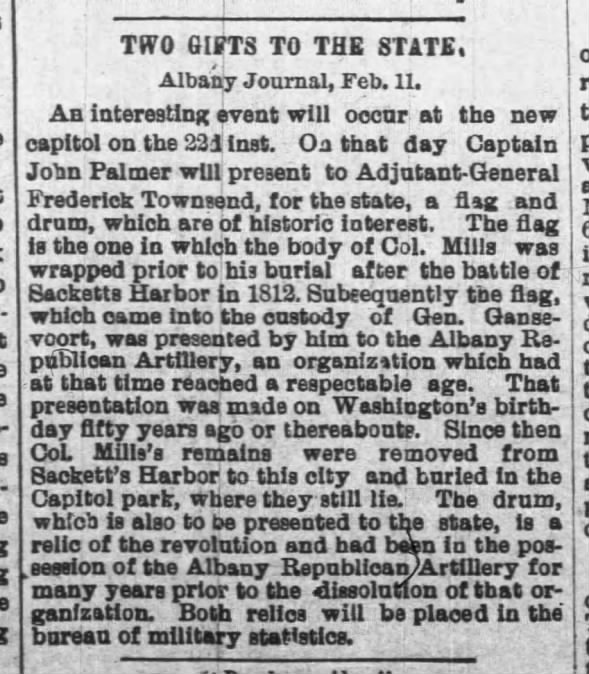
Whatever happened to the trophy-drum once possessed by Herman Melville's grandfather Peter Gansevoort (aka The Hero of Fort Stanwix) and ceremoniously bestowed by the Hero's son, Melville's Uncle Peter Gansevoort, on the Albany Republican Artillery Company? Re-gifted exactly fifty years later to the State of New York, as announced in the Albany Journal on February 11th, reprinted in the Buffalo Weekly Courier on February 15, 1882:

TWO GIFTS TO THE STATE.

Albany Journal, Feb. 11.

"An interesting event will occur at the new capitol on the 22d instant. On that day [February 22, 1882] Captain John Palmer will present to Adjutant-General Frederick Townsend, for the state, a flag and drum which are of historic interest. The flag is the one in which the body of Col. Mills was wrapped prior to his burial after the battle of Sacketts Harbor in 1812. Subsequently the flag, which came into the custody of Gen. Gansevoort, was presented by him to the Albany Republican Artillery, an organization which had at that time reached a respectable age. That presentation was made on Washington's birthday fifty years ago or thereabouts. Since then Col. Mills's remains were removed from Sackett's Harbor to this city and buried in the Capitol park, where they lie still. The drum, which is also to be presented to the state, is a relic of the revolution and had been in the possession of the Albany Republican Artillery for many years prior to the dissolution of that organization. Both relics will be placed in the bureau of military statistics."

The presentation ceremony "in the assembly chamber of the old capitol" was promptly and elaborately reported in the Albany Times for Wednesday Evening, February 22, 1882. In his lengthy public address, Captain Palmer quoted as follows from Peter Gansevoort's address to the Republican Artillery Company, fifty years before: 

"Its music was heard in those days of peril; it beat in unison with the war whoop and yell of the merciless savage on the bloody field of Oriskany--it sounded the charge and animated the courage of the enemy at Fort Stanwix;--but, it also sounded his retreat, and was taken from the enemy in the hour of his flight. To you, the successors of those brave volunteers; to the successors of Mills and Clark, who fell in battle, while gallantly resisting the invasion of a foreign foe, I present this Drum, with the hope, that it has sounded its last retreat; and that when its beat shall call the Albany Republican Artillery company to arms in the service of their country, they will inscribe on their banners the deeply rooted sentiment of the soldiers and statesmen of the revolution: 'We prefer liberty to life, and death to dishonor.' "
Later drum update, August 2022: Found it! On display at the NYS Military Museum in Saratoga Springs...

Related posts:
  • Drum update
    https://melvilliana.blogspot.com/2022/08/drum-update.html

Thursday, July 21, 2022

Centennial of Washington's Birthday in Albany NY

via The New York Public Library Digital Collections

The centennial of George Washington's birthday on February 22, 1832 was celebrated in grand style by the citizens of Albany, New York.  

Great preparations were made in Albany, as well as elsewhere throughout the country, to celebrate the centennial of Washington's birthday in 1832. That day was long a red-letter day in the memory of many of the older inhabitants of the city, of a generation now unhappily extinct. The City Hall was to be decorated in honor of the occasion, and Mr. [John] Meads was chosen to perform the task. He accepted the charge, and the result of his artistic efforts was so pleasing that he was presented with a silver water service, inscribed as follows: Presented by the Managers of the Washington Centennial Ball to Mr. John Meads, in compliment to his taste and classic design for the decoration of the City Hall on the evening of the 22d inst. Albany, February, 1S32. -- Bi-centennial history of Albany (New York, 1886).

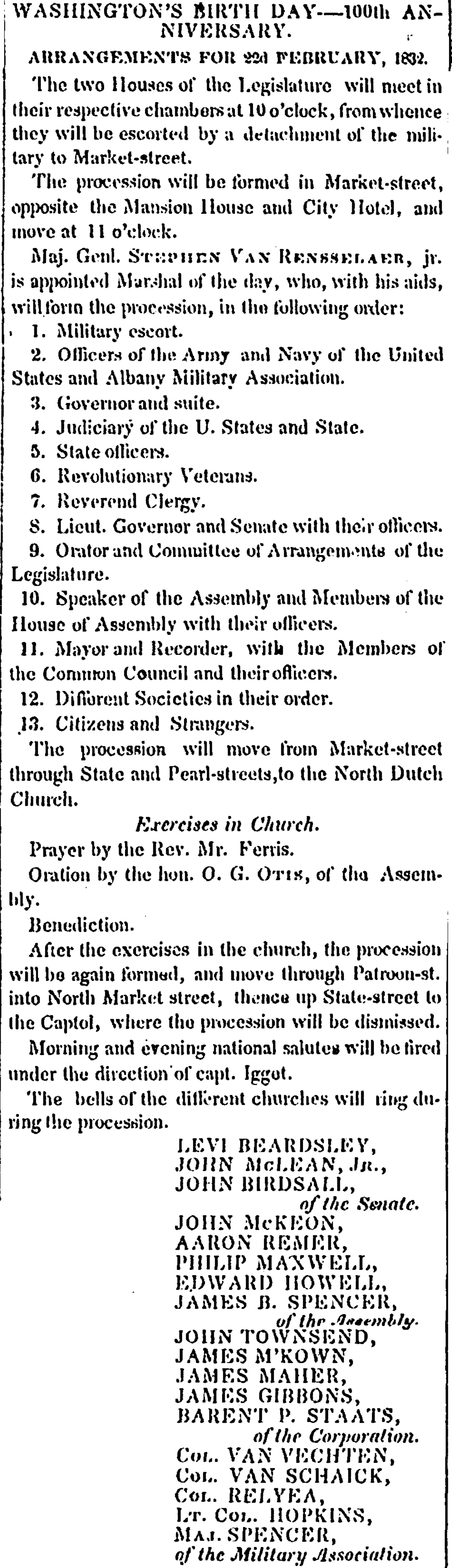
Stephen Van Rensselaer IV, a major general in the state militia and the son of patriarch Stephen Van Rensselaer III, served as marshal for the "high festival" as it was called the Albany Argus of February 28, 1832:

THE BIRTH-DAY CELEBRATION.

The celebration, in this city, of the one hundredth anniversary of the Birth of the Father of his Country, was in all respects suited to the occasion. It was a high festival, in which all participated with a common feeling of gratitude and love of country, and a common veneration for the illustrious man, whose name is identified with the freedom and glory of his country, and with the cause of Liberty all over the world.

A national salute at sunrise announced the commencement of the festivities. At 10 A. M. the two houses of the legislature assembled in their respective chambers, whence, after prayers and the reading of the minutes of the previous day, they proceeded, with their presiding and other officers, under a military escort, to the place of rendezvous opposite the Mansion House and City Hotel in North Market-street. Having been joined here by the governor and suite, judicial and state officers, the mayor, recorder and members of the common council, the several military corps, civic societies, citizens, strangers, &c., the procession was formed agreeably to the published order of arrangement, under the direction of maj. gen. S. Van Rensselaer, jr. who officiated as marshal of the day, assisted by col. J. O. Cole, col. P. V. Shankland, col. C. A. Hopkins and maj. W. Fry, and moved through several streets to the North Dutch Church, which had been politely offered for the exercises of the occasion.

In the church, after an impressive and appropriate prayer by the Rev. Mr. Ferris, an oration was pronounced by the Hon. O. G. OTIS, of the Assembly. Of this eloquent and classic effort, it is not too much to say that it was worthy of the occasion and of the subject, and of the high reputation of the orator; notwithstanding it was prepared and delivered under the effects of severe indisposition. The approbation of the numerous auditory,--for every part of the church was crowded,--was manifested by reiterated bursts of applause, which neither the place nor the occasion could restrain, and which broke out, at the termination, in three distinct rounds. The exercises were concluded by a benediction by the Rev. Dr. Sprague.

The procession being again formed, moved through N. Market and State-streets to the Capitol park, where salutes and a feu de joie were fired, and the procession dismissed.

Owing to some misunderstanding, the military were not out in their usual number; though we should do injustice to such as were present, if we omitted to say that they were so in their usual soldier-like and fine appearance. Among the military corps, was the Washington Volunteer Guards, composed of the officers and privates of the 89th and 246th regiments of infantry, equipped by order of the Governor from the state arsenal, and commanded by cols. Fryer and Osborn. Their voluntary appearance was creditable to them as soldiers and as citizens.

Our respected fellow-citizens, gen. Wendell, Mr. Gregory, Mr. Ryckman, and other venerable survivors of the revolution, the companions of our illustrious countryman, formed a part of the procession.

The societies were in the line, with their appropriate banners and standards. The appearance of the butchers, mounted, with their neat white aprons, was also highly creditable. In the procession also, was a horse, richly caparisoned with military housings, led by two blacks, in Turkish costume. This appropriate addition, was the voluntary act of Mr. James Lawliss, saddler, of Washington street.

In the evening, the contrast between the Capitol, which was illuminated, in every part of it, with great brilliancy; and the studied absence of external light from the City Hall, which, except the dome, presented only a mass of dark marble; was particularly striking. The Museum, the tasteful proportions and location of which render it highly conspicuous, was also brilliantly illuminated; and from the front, above the circular colonade, was exhibited a transparency, representing the full length statue of Washington, by Chantry. The Theatre also, the dwelling-house of col. A. V. Fryer, and several dwellings in North Market-street, were illuminated, and a full length transparency of Washington, exhibited from the former.  --Albany Argus, Tuesday, February 28, 1832.

The centennial ball that night, brilliantly engineered by John Meads, proved to be even more magnificent and memorable than the birthday formalities of the daytime.

March 23. The managers of the Washington centennial ball presented John Meads with a silver pitcher ornamented with an appropriate inscription, and a silver salver having an engraved head of Washington in the centre, as a testimonial of their approbation of the refined taste and architectural skill which he evinced in decorating the City Hall on the 22d of February. The ball of that evening far surpassed any thing of that kind which had ever been witnessed in the city.  -- Joel Munsell, Annals of Albany volume 9 (Albany, 1858).
Albany Argus - February 24, 1832
via GenealogyBank

In the first volume of Herman Melville: A Half Known Life (Wiley Blackwell, 2021) John Bryant imaginatively makes Melville's uncle Peter Gansevoort the center of public attention on George Washington's 100th birthday: 

Rising on a platform above the crowd in Albany on 22 February 1832 was Herman's uncle Peter Gansevoort... In fact, Uncle Peter was not rising on the stage to praise Washington but to recall for the rowdy but suddenly solemn crowd the memory of his father. He was also there to give the city a drum. ... 

... Peter's son Peter was now donating it to Albany's Republican Artillery Company. As Herman's uncle rose to speak, the crowd roared with approval at the gift he was about to bestow....

... Still in mourning for his less distinguished father, Herman was not allowed in public to partake in the celebration that Uncle Peter conducted at the center of town... He did not hear the triumphant roar when his Uncle Peter finished the encomium to his grandfather, "the Hero of Fort Stanwix," router of the British, fighter of Indians, and emblem of the Revolution. (Herman Melville: A Half Known Life, pages 120-123).

The idea that Peter Gansevoort "conducted" the centennial celebration in the heart of Albany is a biographer's fantasy. The featured speaker on George Washington's 100th birthday was not Herman Melville's distinguished uncle but Oran G. Otis of Saratoga County who soldiered on despite his being physically ill. In real life it was State Assemblyman O. G. Otis not Uncle Peter who got appreciative "bursts of applause" in the crowded North Dutch Church. The well-received oration by Oran G. Otis was later printed as No. 306 in Documents of the Assembly of the State of New York, 55th session, Volume 4 (Albany, 1832).

Digitized versions of Volume 4 with the complete centennial speech by Oran G. Otis are accessible online courtesy of HathiTrust Digital Library 

https://hdl.handle.net/2027/mdp.39015036688144?urlappend=%3Bseq=562%3Bownerid=13510798886940651-558 

The First Reformed Dutch Church, built in 1798, in Albany, New York.
UpstateNYer, CC BY-SA 3.0, via Wikimedia Commons

And the imposing presence of New York Governor Enos Thompson Throop "and suite" (along with militia Major General Stephen Van Rensselaer, Jr. the son and namesake of the Last Patroon and a few "venerable survivors of the revolution") must have overshadowed that of any one local politico. Individually, counsellor-at-law Peter Gansevoort performed no official role in the civic procession. 

Writing in the 1930's, Harold Atkins Larrabee accurately described the real historical setting for the address by Peter Gansevoort, whose
family pride, and that "smug and shallow optimism" against which Herman Melville was later to rebel, are best displayed in a speech at the Centennial Anniversary of the birth of George Washington in 1832. On that occasion he presented to the Albany Republican Artillery at a dinner in Foot's Fort Orange Hotel a large brass drum, captured from the British at Fort Stanwix by his father, then a colonel....
Larrabee, Harold A. “HERMAN MELVILLE’S EARLY YEARS IN ALBANY.” New York History 15, no. 2 (1934): 144–59 at 150-1. http://www.jstor.org/stable/23134497.

Peter's audience was comprised of "Citizen Soldiers" from one of several militia units, this one happily assembled for dinner at Elisha Foot's Fort Orange Hotel, located at 549 South Market street.

We published yesterday the toasts of the Washington Volunteer Guards, and the Albany Republican Artillery, on the late Centennial Birthday anniversary. We designed to have said then that they were such as became the reputation of an old and patriotic republican corps, and the public spirit and love of country which animated a portion of our citizens, the bone and muscle of our militia, to volunteer an association for that occasion. The Republican Artillery, founded by a gallant officer, who fell in the late war, bravely fighting for his country—honored by the confidence of Tompkins—and retaining its republican principles and its republican spirit—was surely in its place in doing honor to the illustrious Chief of the Revolution. This elegant and well disciplined company, after performing the arduous duties allotted them by the committee of the day, in a manner highly creditable to them as soldiers, celebrated the centennial anniversary, by partaking of a dinner at the “Fort Orange Hotel;” and it is but justice to say, that Mr. Foot, the proprietor of this establishment, furnished the table not only with every thing that heart could wish but in a style corresponding with the glorious occasion. -- Albany Argus, February 29, 1832

Two different militia groups gathered for dinner afterwards, at different Albany hotels. Here "dinner" means the midday meal, usually served around 1 or 2 o'clock in the afternoon. The Washington Volunteer Guards met in the "Long Room" of Crosby's Hotel, corner of Beaver and South Pearl. Melville's uncle Peter Gansevoort attended the banquet for the Albany Republican Artillery at the Fort Orange Hotel on South Market street, opposite the steamboat landing. Not part of the civic program but more of a military and after-dinner affair, the speech he made when bestowing a British drum captured during the Battle of Oriskany and Siege of Fort Stanwix occurred in between the two main events of the centennial celebration, the morning birthday bash and evening ball. 

Albany Argus - February 28, 1832

"The proceedings and toasts of the Albany Republican Artillery, on the 22nd, together with the eloquent and pertinent address of gen. GANSEVOORT, delivered on presenting to the company a brass drum, captured by his ancestor at the seige of Fort Stanwix, and the reply of capt. IGGET, we shall take a pleasure in publishing to-morrow. The toasts, &c. of the "Washington Volunteer Guards," will also appear tomorrow."  --Albany Argus, February 28, 1832.

Peter Gansevoort's 1832 "address" remains interesting and important for Melville geeks since that same brass drum will show up in Melville's seventh book Pierre; or, The Ambiguities, barely fictionalized:

... Or how think you it would be if every time he [Pierre Glendinning] heard the band of the military company of the village, he should distinctly recognize the peculiar tap of a British kettle-drum also captured by his grandfather in fair fight, and afterwards suitably inscribed on the brass and bestowed upon the Saddle Meadows Artillery Corps?

In 1877 Melville's cousin, Uncle Peter Gansevoort's daughter Catherine (Kate) Gansevoort Lansing procured the drum for the centennial celebration of the Battle of Oriskany:

Mr. SEYMOUR exhibited the revolutionary relics. Among these was the brass snare drum, sent up from Albany by Mrs. LANSING. On the brass coat of the drum was the following inscription : 

" Presented by Peter Gansevoort, of the city of Albany, counsellor-at-law, to the Albany Republican Artillery Company, on the 22d February, 1832."

"Taken from the enemy on the 22d Aug., 1777, when the British army under Gen. St. Leger, raised the siege of Fort Stanwix, which fortress had been valiantly defended by the garrison under the command of Colonel Peter Gansevoort for 21 days."  -- The Centennial Celebrations of the State of New York (Albany, 1879) "Oriskany" page 97.

Where I wonder is the actual captured British kettle drum today? With other donated artifacts in the Smithsonian National Museum of American History? No. Re-gifted to the State of New York in 1882 on Washington's 150th birthday (as promptly and elaborately reported in the Albany Times for Wednesday Evening, February 22, 1882) the trophy-drum today would more likely be found at the New York State Museum in Albany or New York State Military Museum and Veteran's Research Center in Saratoga Springs. Henry Murray in the Hendricks House edition of Pierre only notes "photographs" of such "trophies, belonging once to General Gansevoort" (Herman's grandfather) in the Gansevoort-Lansing Collection of the New York Public Library. 

Drum Update: Found it! On display at the NYS Military Museum in Saratoga Springs:

In another post I hope to transcribe Peter's full speech to the Albany Artillery Company, with associated remarks and toasts from the account in the Argus on February 29, 1832. 

[Done, here: https://melvilliana.blogspot.com/2022/07/peter-gansevoorts-1832-address-to.html]

For now though, let's enjoy the stupendous Centennial Ball at the new City Hall, as described in the Albany Argus on February 28, 1832.

Albany City Hall 1832

CENTENNIAL BALL.

The City Hall, on the evening of the 22d., was the scene of the most splendid and magnificent fête we may venture to say, ever got up in this city, if not in this country. Indeed we have the assurance of several foreign gentlemen who were present, that it has not been surpassed by the more brilliant of the modern pageants in other countries.

The spacious apartments of this vast structure were all thrown open to the festivities of the evening, and thronged with the elite of beauty and fashion. The areas of the second and third floors in the rotunda,--the centre of the building and the centre of attraction,--was devoted to the more immediate business of the occasion, the suites of rooms communicating with it, being used as subordinate. The Common Council chamber and Mayor's court room on the north, served as withdrawing rooms, furnished with sophas, ottomans, candelabras and every convenience for relaxation from the fatigue of the dance. The county court room on the opposite side, was converted into a grand saloon--stretching from one end of the building to the other, and answered the double purpose of a promenade and withdrawing room. On the next floor above were similar suites of rooms opening on the rotunda--the spacious hall on the north, at present occupied by the Academy of Arts,--furnished the managers with abundant space to accommodate their numerous guests at the collation: here also were withdrawing rooms and the green room of the managers.-- The Mayor's and Recorder's room on the basement floor, and that of the Supervisors, served as attiring rooms: the area on the basement was brilliantly lighted and served as a place of concourse for the officers in attendance. 

Nothing could have been more appropriately conceived than the device occupying the arched window, looking down the grand staircase leading from the basement to the principal floor or rotunda. It was the key to the pageant--representing in the centre, a finely wrought column, surmounted by a bust of the "Father of his country"--the trophies of peace and war in either of the subordinate compartments--the plinth inscribed with the name of "Washington," within a laurel wreath, and over the whole was emblazoned the memorable words in which the ardent admiration of Lord Chatham found utterance,--"Clarum et venerabile nomen"! This device arrested attention by the dazzling concentration of light which was brought to bear upon it from innumerable variegated lights, upon the paling of the staircase and on the arch of the window above.-- These last were of a deep purple color, which combined with the yellow light of the lamps to give to the bust an unearthly look, not unaptly representing the apotheosis of the dead.

 A full blaze of light, which threw no shadow, gleamed from a thousand dazzling lamps, and pervaded every part of the rotunda--above, below and out into the withdrawing rooms. Opposite the staircase a powerful and well disciplined band occupied a temporary orchestra, erected in the space at the end of the vista formed by the colonade which enfilades the rotunda from east to west,--and supports the circular gallery on the third floor, opening through a similar gallery above, to the dome in the centre of the hall. The orchestra bore emblazoned on its front the arms of the city; with its supporters on either side, nearly the size of life, overshadowed by the wide-spread wings of our American eagle.--The windows at that end of the rotunda were tastefully decorated, as were also the large mirrors on each side, with civic and military standards arranged saltirewise, after the military fashion, many of them associated honorably with the battle strife of the revolution. The beautifully wrought columns, entwined with a wreath of evergreen, on a scarlet ground, from the scientific and violent contrast of the two colours, were the simplest as well as the most striking and effective of the decorations. Above the doors opening on the rotunda, and in every niche where a bust could be seen to advantage, were placed some of the rarest specimens of antique and modern statuary; the Apollo Belvidere--the Venus de Medicis and the Venus of Canova--Laocoon--Adonis, &c. &c. In the same classical taste were the designs in arabesque which decorated the pannels on the circular galleries and over the entrances into the rotunda on the third floor. The spirited and effective execution of these designs was beyond all praise, as was also the gorgeous coloring of the figures on the floor. Both areas of the rotunda were laid out into magic circles and figures of various kinds, wrought in water colors, and corresponding in size and shape with the different architectural subdivisions of the floor, forming in appearance, over the whole, a rich and beautifully variegated carpeting of the most brilliant dyes. For the skill and science with which these different colours were contrasted and brought out with such effect in the strong light of so many  lamps, and for the arabesques, we are indebted to Mr. Haake, a foreigner, who with the name has also adopted the feelings of an American, and for the general design and arrangement of the decorations, to Mr. John Meads, under the active superintendence of the managers.

The main point of attraction remains yet to be noticed. In the very apex of the dome, was suspended a transparency, sufficiently large to conceal the sky-light, and, in its decorations, the counterpart of the figure on the floor below, hung round with variegated lights that twinkled like stars in the mimic firmament. The subdued light thrown upon the immense vault by this simple device, gave to the whole an effect of distance which was quite magical; an effect which was enhanced by the surpassing brilliancy and vivid distinctness of the triple row of variegated lights on the paling of the circular galleries, set off as they were, by the gorgeous array of parti-coloured stuffs. The grandeur and magnificence of the effect, compared with the simplicity of the conception, were the subject of general remark.

Of the collation prepared under the direction of Mr. Drake, of the American, it is sufficient to say that ample justice was done to the viands on the spot. The tables were loaded with an elegant profusion of every delicacy of the season, faultlessly arranged and served up in the best manner.

 The dancing was prolonged far into the night, and the company separated with a reluctance which spoke with approbation of the exertions of the managers and all concerned in the direction of the festivities. 

Last evening, the decorations being permitted to remain entire, and the whole interior of the Hall being again lighted up, a vast concourse of citizens, thronged the rooms from 6 until 9 o'clock. From eight to ten thousand persons were attracted thither in the course of the evening. -- Albany Argus, February 28, 1832.

George Washington
by James Thomson after Sir Francis Leggatt Chantrey NPG D37877
© National Portrait Gallery, London 

Related posts

  • Drum update
    https://melvilliana.blogspot.com/2022/08/drum-update.html

Monday, July 11, 2022

THAT'S A VERY ACCURATE TELESCOPE!!!😂😂😂


https://rumble.com/c/ilDonaldoTrumpo

Wednesday, July 6, 2022

Four real presidents of the Albany YMA, and one really fake president

In 1830, Herman Melville's father Allan lost his business and moved with the wife and kids from Manhattan to Albany, New York. Allan Melville (often spelled Melvill) died in 1832. When the family could afford tuition, Herman went to the Albany Classical School and Albany Academy. For a while in 1835-7, Herman and his older brother Gansevoort also belonged to the recently established Young Men's Association of Albany. The Albany YMA had been founded in December 1833, with a constitution "signed by about seven hundred and fifty names" as recalled in one 1888 retrospective.

via The New York Public Library Digital Collections
The first real president of the Albany YMA was Albany lawyer Amos Dean (1803-1868), a native of Vermont and later the first president of the University of Iowa
J. T. M. “Amos Dean.” The American Law Register (1852-1891) 16, no. 5 (1868): 257–60. https://doi.org/10.2307/3303185.
After Amos Dean, Robert E. Ward became the second real president of the Albany YMA. Formerly 1st Vice President, Ward succeeded Dean in February 1835. 

As it happened, Ward only served a few months of his presidential term. Suddenly westward bound "for the Territory of Michigan," Ward resigned his position in April 1835 and moved to the village of Berrien, later Berrien Springs. Ward's unexpected departure for Michigan was acknowledged by the executive committee with "thanks for the able, faithful, and impartial manner in which he has discharged the duties of his office as President of the Young Men's Association" (Albany Argus, April 10, 1835). Ward eventually settled in Detroit where he died in 1847.

After Robert E. Ward, the third real president of the Albany Young Men's Association was Charles A. Hopkins (1802? - 1864). As announced in the Albany Argus, the former 2nd Vice President was elected President at a special "meeting of the Executive Committee of the Young Men's Association, held April 11th, 1835."

Albany Argus - April 17, 1835
via GenealogyBank

The following year, Charles A. Hopkins was elected to a regular one-year term of office. The election or more precisely re-election of Hopkins as president of the Young Men's Association was announced in the Albany Argus on February 5, 1836.

Albany Argus - February 5, 1836

When his presidency ended, Hopkins (like Ward before him) headed out for Michigan (Albany Argus, April 18, 1837), though he would relocate to Buffalo NY. "General" Hopkins died there in September 1864, remembered as a distinguished militia officer and model citizen:
"one of our prominent dock merchants, highly honored on account of his  integrity, and greatly esteemed for his many estimable social qualities." -- Buffalo Morning Express, September 30, 1864
In February 1837 John Davis (1807-1847) became the fourth president of the Albany Young Men's Association.

Albany Argus - February 7, 1837

All past presidents of the Albany Young Men's Association to 1886, including the first four, are named in the Bi-centennial history of Albany (New York, 1886) conveniently accessible via Google Books:

https://books.google.com/books?id=WVnVDwAAQBAJ&pg=PA690&dq#v=onepage&q&f=false


There then are your four real presidents. Now for the fake one....

Gansevoort Melville 
via The New York Public Library Digital Collections

As John Bryant tells it 5x in the first volume of Herman Melville: A Half Known Life (Wiley Blackwell, 2021), Herman's brother Gansevoort Melville experienced a meteoric rise to the presidency of the Albany YMA:
"For a three-year period ending with the Panic of 1837, Gansevoort continued his networking at Albany's Young Men's Association, rising swiftly to become the group's president, probably its youngest to date. He was on track to become a paragon of Albany's youth."  (page 247)

"Gansevoort worked on his networking skills in the fur trade and moved up in the YMA's governing structure: he was listed as part of the executive committee that fall; and in January 1836, following in the footsteps of John Bleecker Van Schaick, he was elected president of the organization." (251)

"At 20, his election to the presidency of the Young Men's Association in January came with the honor of his public oration of the Declaration of Independence during Albany's Fourth of July celebrations." (324)

"Gansevoort had completed his term as president of the YMA in December 1836, had overseen the induction of Herman into the association, and had remained on the executive committee; but given the failure of his business, he had withdrawn in 1837. (360) 

"Two years earlier, he had had the honor of reciting the Declaration of Independence as a representative of the Young Men's Association. Once its president, he had now resigned from the group. In his place, Albany's paragon of young manhood, his distant cousin and the scion of a great Albany family, John Bleecker Van Schaick, would step to the podium to read the Declaration."  (384)

Bryant claims that Gansevoort Melville was elected president of the Albany YMA in January 1836. But Gansevoort was never really president of the entire Albany Young Men's Association. In October 1835 Gansevoort did manage to get elected second vice-president of the Debating Society (Always known as the "Young Men's Debating Society," and not to be confused with the upstart Philo Logos Society whose presidents included Charles Van Loon and his later famous rival, Herman Melville.) 

Albany Journal - October 30, 1835
via GenealogyBank
Gansevoort had joined the Debating Society in 1834, introduced by his good friend Alexander W. Bradford. On January 23, 1836, according to meeting minutes reported by Jay Leyda in The Melville Log (volume 1, page 66), Gansevoort was elected "President of the Debating Society in the Young Men's Association." Evidently, Bryant has confused the Debating Society of the YMA with the institution as a whole. Gansevoort's position on the Executive Committee of the YMA in 1835-7 was only held by virtue of his involvement in the Debating Society--where the officers were often the only persons in attendance, according to "Juvinis" in December 1837, writing to the editor of the Albany Evening Journal. Previously transcribed on Melvilliana:
In early 1835 Gansevoort had tried and failed to get elected to the office of Recording Secretary. Just two days after Herman's admission to the YMA on January 29, 1835, his big brother chaired a Saturday night meeting and got himself nominated for Recording Secretary, as announced in the Albany Evening Journal on February 3, 1835:

Albany Journal - February 3, 1835
When the annual election was held on February 3rd, Gansevoort lost out to Daniel Fry,  as reported in the Albany Argus on February 10, 1835: 

Albany Argus - February 10, 1835
via GenealogyBank
Gansevoort Melville's public reading of the Declaration of Independence on July 4, 1836 was indeed well received, as Bryant like every biographer after Leyda indicates. The distinction might seem a little diminished, however, if you admit (Bryant does not) that the annual 4th of July reading of the Declaration traditionally preceded a longer speech, formally delivered by another, preferably more distinguished orator. Thus, at the public celebration by the Young Men's Association of Albany in 1836, Gansevoort merely opened for future YMA President John Davis whose 4th of July oration "was a production creditable as well to the author as to the choice of the Association" (Albany Argus, July 8, 1836).

Albany Argus - July 8, 1836
via GenealogyBank

Moreover, by the time Gansevoort spoke, the good citizens of Albany had already heard the Declaration of Independence read earlier in the day by W. H. Fondey, "in an appropriate and effective manner." Fondey's reading took place during the "numerously attended" main event, "customary exercises at the Pearl-street Methodist Church." Fondey opened for a genuine "pulpit orator" in the Rev. Edward Norris Kirk, whose 4th of July speech was duly praised as "vigorous in style and thought, and eloquent and impressive in the delivery." 


Not only that, it rained all day "with little intermission" (Albany Argus, July 8, 1836). As previously reported on Melvilliana:
After the event the arrangements committee of the Young Men's Association published customary resolutions expressing thanks to all concerned, starting with John Davis:
Resolved, That the members of this committee in behalf of the Association, tender to J. Davis Esq., their thanks for his eloquent and patriotic oration, delivered before the Association.

Resolved, That the thanks of the Association be also tendered to Mr. G. Melville, for the prompt and pleasing manner in which he discharged his duty as reader.

Resolved, That the members of the Albany Sacred Music Fund Society for the deep interest manifested by them, in the prosperity of the Association, and for the skill and taste displayed in their performance, deserve and we heartily tender the sincere thanks and appreciation of the committee. 
Resolved, That the soldier-like and gentlemanly bearing of the Albany Union Guards, was highly creditable to themselves and gratifying to the committee.

Resolved, That the committee are under great obligation to Mr. W. R. Bush, for his active and efficient discharge of the duty of Marshal of the day.

J. H. WILDER, Cha'n.  --Albany Evening Journal, July 6, 1836

Featured speaker John Davis would be elected president of the Albany YMA before their next Fourth of July celebration.  

In spite of his meaningful yet modest success as designated "reader" on Independence Day 1836, Gansevoort Melville could never get elected Recording Secretary of the Young Men's Association in Albany. Not even with brother Herman's help in a possibly rigged election. 

PRESIDENT??? FAKE NEWS!!!!


Sunday, July 3, 2022