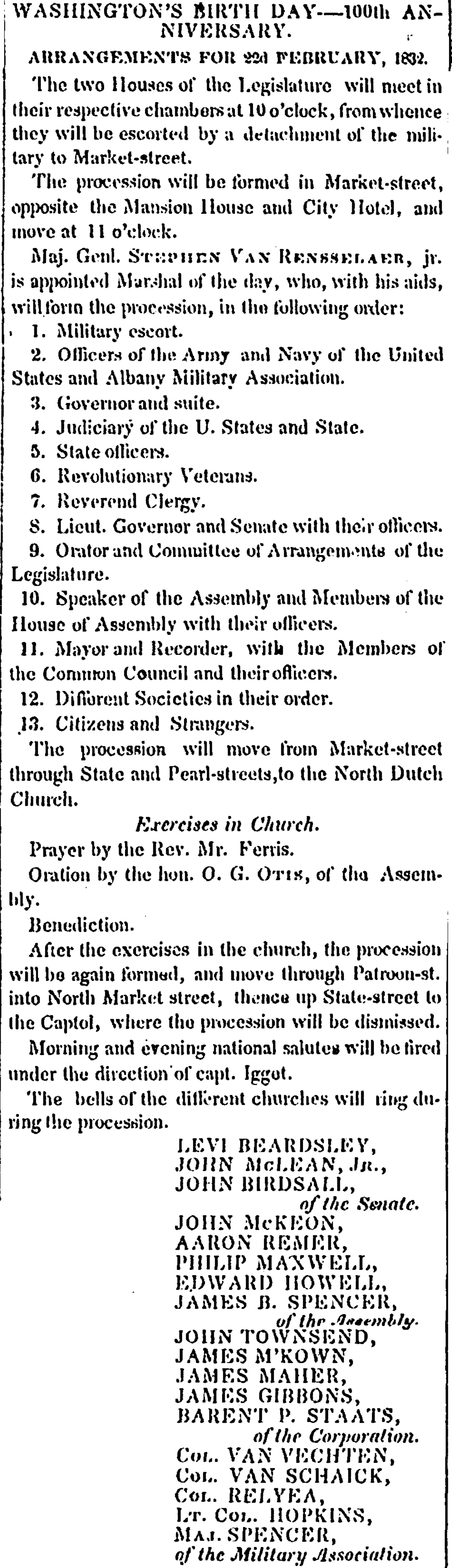
As pointed out in Melvilliana posts on the Centennial of Washington's Birthday and Peter Gansevoort's 1832 address to the Albany Republican Artillery company, New York State Assemblyman Oran G. Otis of Saratoga was selected to give the big speech for the celebration of George Washington's 100th birthday in Albany. Otis spoke at the North Dutch Church after a procession of state and local dignitaries led by Major General Stephen Van Rensselaer IV "who officiated as marshal of the day" (Albany Argus, February 28, 1832). According to newspaper reports the featured speaker had been physically unwell for some time, but Otis soldiered through his well-received performance.
 |
| Albany Argus - February 28, 1832 via GenealogyBank |
"In the church, after an impressive and appropriate prayer by the Rev. Mr. Ferris, an oration was pronounced by the Hon. O. G. OTIS, of the Assembly. Of this eloquent and classic effort, it is not too much to say that it was worthy of the occasion and of the subject, and of the high reputation of the orator; notwithstanding it was prepared and delivered under the effects of severe indisposition. The approbation of the numerous auditory,--for every part of the church was crowded,--was manifested by reiterated bursts of applause, which neither the place nor the occasion could restrain, and which broke out, at the termination, in three distinct rounds. The exercises were concluded by a benediction by the Rev. Dr. Sprague."
-- "The Birth-Day Celebration," Albany Argus, February 28, 1832.
Later printed as No. 306 in Documents of the Assembly of the State of New York, 55th session, Volume 4 (Albany, 1832), the oration by Oran G. Otis is transcribed in full below.

ORATION.
FELLOW-CITIZENS !
We have come together, not to mourn the death of an illustrious individual, but to rejoice, in the opportunity of his birth, the felicity of his life, and the immortality of his fame. His dust has gone to dust, by the common law of our being, but the nobler portion still remains, uninjured by the accidents of mortality, and unimpaired by the lesions of time. The truth of his principles, the power of his name, and the splendor of his career, are still in full life and action, elevating and improving, not only, our condition, but the condition of the world — illustrating not only the dignity of his own character, but that of his species.
The event we celebrate, has had and will have its influence on the general destiny, and not only shall we rejoice, but nations yet unborn, shall bless the hour that gave him to mankind. Strong and fervid as are the feelings of gratitude and admiration which now swell our bosoms in the contemplation of the virtues, the genius, and the achievements of him whom we have met to honor, they are not exclusively ours — millions in other climes not blessed like this, are offering up their love, their homage and their hopes, to the final results of that course, of which he was the great pioneer. And the time will yet come, when all the nations of the earth, in the undisturbed enjoyment of their natural rights, shall hail him as a brother, and bless him as a father.
He was born for the world — not for us merely, but for the family of mankind. The action of his life was laid amidst the scenes of this new discovered land, this remote covert of the world; but the denouements of his career, were to affect the oldest dynasties of the earth, and annihilate their most ancient prescriptions. His efforts were confined to three millions of people — scarcely a fraction of the human race, but the consequences of these efforts were to be acknowledged, in the final emancipation of the world. The fervor of the love for liberty which he excited and controlled, was, like the small lump of leaven, eventually, to pervade the whole mass. Like the sun in the sky, though fixed in its sphere, its effulgence is unstinted, is shed over all, and kindles to life wherever a ray of it rests.
The occurrence of his birth, was appointed to take place, during the embryon of those events, which were to change the face of society and reorganize the world. The political condition of the nations, was well nigh, as peculiar and full of omen at the time of his entrance into life, as their moral, at the advent of Him who was at once the model and the Saviour of the human race. For nearly six thousand years, had the old world in vain essayed the discovery of the true principles of the social compact,— Though like the mysteries of the true religion, they were seen in dim and distant prospect by a favored few; their full revelation was delayed, until the discovery and settlement of this new portion of the world.
In the dreamy abstractions of philosophy, the possible existence of a free community, had been fancied — where good laws might be made by the wisdom of the whole, and enforced by the general consent, — where the only distinctions were those of merit, and the only rewards those of the public esteem, — where the over reaching few might be held in check by the force of law and opinion, and individual freedom be restrained only by the limits of the moral code. But the vision was apparently too beautiful for truth, though too noble for fiction — too remote for experiment, though full of desire. The monitions of the past took away hope from the future, and left only the evils of oppression as a solid expectation to mankind.
Even the advancement of society had not explained the principles or developed the means of liberty. In countries famed for their policy, their prowess and their power, the slavery of ages remained in its strength untouched by the improvements gathering around it. And the towers of despotism rose on their deep and dark foundations among the people, frowning from summits encircled by the blaze of science and the glory of the arts. The natural advantages of the people over their enemies, were made to operate against themselves, and the very power which could have crushed their oppressors was used to enforce their own degradation. The order of nature seemed reversed — the weak ruled the strong — the few overcame the many, and the true possessors of sovereign power truckled to the bauble ensigns of authority, and yielded up their energies, a timid oblation, to the knaves and fools, who luxurated upon their credulity.
The destiny of the world seemed fixed, beyond the hope of better change. So firmly established was the doctrine of passive obedience, and so unquestionably divine the authority to enslave, that saving here and there an intestine commotion, an occasional shaking of their chains, the nations of the earth lay still in their apathy, and tamely submitted to the lash of their oppressors.
It is true, that in a few instances, the general tenor of the history of mankind was broken in upon. High and noble efforts had been made to assert the dignity of our common nature, and shew that man was not necessarily a slave. Greece and Rome successively undertook the experiment, and sought to falsify the experience of all previous time, by exhibiting in their own example, the evidence of their capacity, to govern themselves. For a time the splendor of their course seemed likely to illustrate the destiny of our race. But time eventually proved the fallacy of the means they used for success. The glory of their career was extinguished in their own essential grossness, and the tyrannies which after wards arose, scorned the folly of their attempts, and laughed at the fanaticism which could believe in their practicability. Their light, like that of the borealis, adorned the night, but did not overcome it. Their institutions did not define the difference between liberty and licentiousness, and left alike unguarded, the ambition of their popular chiefs and the aberrations of the popular will. Excess of liberty, vibrated to the extremes of anarchy, and constraint ended in tyranny.
They had not devised a system, where all were the guarantors of the rights of each and each, the guardian of the rights of all — where the interests of the many were protected against the encroachments of the few, and where the welfare of the state was consulted in the happiness of the citizen.
From these ancient times, down to the discovery of this continent, the evidence of whose existence, like that of Atlantis, was only in fable, the history of the world is but one record of its oppressions. One common thrall spread over the nations, and the gilded oppressor, every where sat on the neck of the slave.Passing by the other governments of the old world, we find even that England, who on this point was in advance of her species, had not been able to secure the prize. She had warred with her nobles, dethroned her kings, and bathed her soil in the blood of her children — but in vain. She only triumphed over some of the rougher and more prominent obstacles to her freedom, which the dark crudities of a former age had entailed upon her, leaving an overbearing aristocracy, hereditary offices, a union of church and state, intolerance of religious opinion, and the smothered voice of a disfranchised people, to degrade and curse her institutions.
Such had been the history of mankind, and such its unhappiness, when WASHINGTON was born. But a new era was beginning to dawn — a new order of events was coming upon the world — a new dispensation among the polities of the earth. Never before, had that peculiar conjuncture of affairs existed, to which his birth and life — his genius and his principles — would have been so opportune and so peculiarly conformed. The existence of this continent had then only been known for 240 years. In the Providence of ages, it had been preserved until then, a virgin spot — an unpolluted land — the Bethlehem of the world — free from the arts and the arms, the usages and customs — the trammels and the crimes, by which the old world was enslaved.
Only one hundred and twenty-five years before his birth, was this consecrated spot permitted to the tread of the pioneers of the coming liberties of the world. A glorious band of brothers, of whom all the institutions of the earth were unworthy, seizing their little all, shook the dust from off their feet against persecuting England, and with their wives and children in their arms and their hopes in Heaven, launched their frail bark upon the waves of an uncertain sea. It was a crisis in the destiny of nations. Like the ark of Noah, it bore in its bosom, the elite of the old world and the noble founders of the new. And as their ill-appointed vessel tossed on the wave, and trembled to the gale, how would the hearts of unconscious millions have throbbed, in agony, had they but known that it bore in its bosom the priceless pearl of freedom. For a time, the hope of the world hung trembling on the billow and wavered in the blast. But the steady eye and unblenched heart were there, and favoring Heaven. These dangers were happily overpast, and the foot of the white man — the child of civilization — touched for the first time, these wild, but consecrated shores.
The die was cast — a new order of things began, and the future history of the world was changed.
They had abandoned all to escape oppression — had sacrificed all for the attainment of freedom. But neither was their purpose nor their judgment mistaken. In their new situation, notwithstanding the hardships of an unknown climate — the dangers of a wilderness of savages — the poor extremity of their means, and the want of political organization, they found their condition was improved. They found that their interest and happiness were united, that equal rights were not inconsistent with equal duties, and that the general will secured the general weal. They ascertained the truth and practicability of free principles, by their own experience, and therefore neither doubts of the future, nor precedents of the past, could overcome their convictions. No excess of wealth corrupted their principles — no luxury enfeebled their judgment or enervated their will — no want of the necessaries of life impaired their physical energies, and no successful tyranny made them obsequious to power.
Such were the people and such the morale of their condition, among whom and of whom WASHINGTON was born. He was the master spirit of this condition of society: the embodied representative of the temper and principles of this new organization; and the first true exemplar of the system which secures the freedom of mankind. In no other state of society could he have been produced or sustained. He was alike the consequence of liberty enjoyed and the cause of liberty to come, and the existence of both was concerned in his.It is only one hundred years ago this day, since the occurrence we celebrate was numbered in the calendar of human events. Then we were a colony, a poor, unknown people, scarcely noted in the concerns of nations. The achievements of a century had not then shed their light upon the American name; nor the success of our institutions excited the fear of tyrants, nor won the admiration of mankind. How deeply sensible ought we to be of the wisdom of those designs, the merit of those actions, which have poured such a lustre upon the recent obscurity of our fame. And to whom, under Providence, but Washington and his immortal compeers, are we indebted for those ripe and honorable distinctions, which separate us from the herd of nations. They won the battles that secured our independence; they gave form and impress to all our institutions, and set thereon the seal of immortality. If even now, in the infancy of our existence, these United States were torn from all their strong foundations, and blotted from the earth, the light of their example would shine through all succeeding ages, with a glory above all Greek, all Roman, above all human fame.
In WASHINGTON seemed combined all the elements to constitute a man in the highest meaning of the term. His form was of the finest specimens of manly beauty, and his carriage full of grace and dignity. His constitution, both physical and mental, of the happiest mould. In power of mind he stood at the head of the human intellect. His perception of truth, in the vast and various concerns with which his life was charged, seemed to indicate the intuition of a superior being; the unrivalled accuracy of his judgment was demonstrated in the extraordinary success of his wide and eventful range of action. His brightness was not indeed the glare of the meteor, but the steady light of the sun: it was not the brilliancy of a single act, but the finished series of his life: the combined results of all his action. The uniformity of his character marks the prevalence and constancy and purity of his motives; the high objects he pursued and attained, the morality of the means he used, clearly shew, that right and truth alone, were influential upon him. He knew the power of truth, and felt the strength that came from being right. His was not the cunning that invents and forges means of its own, because it is unable to discover any other mode of success; but the wisdom that, perceiving the true relation of things, avails itself of existing causes, with a certainty of their consequences. Hence the firmness of his resolution and the courage of his temper. Hence he shrunk not in the field of battle or the moral conflict; and conscious of the right, never trembled for the issue. Unlike the desperate few, who have achieved a bad eminence by indiscriminate means, he sought no results which virtue did not sanction; used no appliances which honesty did not advise. His character is unique, and stands alone on an eminence, unapproached — I had almost said inaccessible. Its union of goodness and greatness, of moral beauty and intellectual strength, adorned by services of inappreciable value to the human race, furnishes an instance of the sublime in morals, such as no human example has presented. It has changed the general idea of greatness, and shewn that the most enviable talent must find assistance in the aids of virtue.He was fortunate beyond all the past, in the position which he held in the affairs of the world. The presiding genius at the birth of the first free nation — the daring leader of the first successful struggle for the principles of freedom — the idol of a young nation, yet to increase as the sands of the sea-shore — the grand agitator of the change, yet to come over all the governments of the earth, his fame will increase with ages and the multiplication of his race. He stood at the head of a new country — at the beginning of a new civil polity — at the source and fountain of that stream of liberty which was yet to overflow the earth, and like the deluge of old, to swallow up every vestige of the wrongs which had passed. In the whole range of time, in the wide variety of human affairs, there has been no era so felicitous for his existence as that in which he was born and lived; at no other point, could equal virtue have met with equal success — no other career could have secured the like train and splendor of consequences.
In his life, fortunate and happy above all other example — with out a spot or blemish to mar his private fame, he was covered with glory in his public career; through all the round of action — through all the change and casualty of life, he stood a model and exemplar to the human race. In the purity of his motives, in the nobleness of his designs, and in the extent and success of his course, he stands without a rival or an equal — ornatus Dei.
But he was not alone, in the great contest which he waged for the welfare of mankind. In the dark hour of our cause, a band of brothers gathered round him — such as the world had never seen, and may never see again. The pressure of the time reached every heart, and strengthened every hand. True to the call of WASHINGTON, and the high exigency of the times, obscure and unknown patriots, touched by the spirit of their cause, were roused and rallied to his aid. Of all the remnants of that heroic band that I have ever seen, there were none but had something peculiar in their character, shewing they had studied in the school and triumphed in the field with WASHINGTON. The very fact, that they were reached and acted on by the reasons of such a controversy, proves their nobility. I have always thought the character of the Revolutionary soldier one of unparalleled beauty. He fought not for fame, for he was too humble to expect it; he fought not for money, for he could have supported himself; nor from native turbulence of spirit, for he was a peaceable man at home; nor from envy of superior rank, for he knew little of it and cared less about it. But with a distinct apprehension of the value of personal liberty — with a disbelief in the rights of hereditary power, and a strong opinion that superior merit should alone confer authority, he repelled from principle, the invasion of his just rights; he despised from feeling, the extravagant pretensions which England would enforce; and from unalloyed love of freedom, fought for himself, his country, and the common rights of man. The page of history will record no character so disinterested, so devoted, so firm and so mild, so enthusiastic and yet so rational, so sublime and yet so mere a display of the real dignity of human nature.Of these, Washington was the glorious and unenvied chief and patron. Their love of him was as that of children to a father; amidst the hardships of the camp, the dangers of battle , the alter nations of victory and defeat, and all the vicissitude of a military life, they reposed with most confiding faith in his skill and courage, his power and fortune. The little frailties of their conduct found shelter in the mildness of his virtues; but the outbreakings of vice, their exposure and repression in the firmness of his principles.
Such was his knowledge of the human heart, and his acquaintance with men, that he rarely found himself in error in his choice of agents. He was enabled thus, not only to exert his own energies with success, but to secure the full amount of results from the ability that surrounded him. The leader and the led were touched by a common impulse, and moved on to the accomplishment of a common end. Thus it was in that appalling fight with a veteran nation, boasting of her strength and triumphing in her victories, that we were enabled to withstand the onset which was directed for our destruction.
Without having been bred to the science of war, he assumed the command of our armies, and for seven long years, with every disparity of means, baffled the skill and paralyzed the genius of the most celebrated soldiers. Without experience, he fought like a veteran; nearly without means, he still found resources; and sometimes, almost without an army, he held the enemy at bay by the vigor of his enterprizes. This struggle for the mastery was long held in doubt, but the star of his fortune at length prevailed against the ostent of the times. He conquered, not for fame, but for freedom; not for ambition, but for his country. How well and how greatly, let the present condition of the happy vallies and sunny mountains of freedom make answer.
But not even yet had be filled the full measure of his fame. In the pride of victory, in the flush of success, with a devoted soldiery, accustomed to execute his wishes, instead of stooping to the mean ambition of a tyrant, in ruining his country, to elevate himself, he plucked the warrior's plume from his brow, and cast it with his sword at the feet of his country. Oh ! how mean and little are the names of Alexander, of Cæsar, of Napoleon, when seen in the light of such a deed as this! Instead of being an effort of his virtue, it was its natural result. Instead of being produced by ambition, it sprung from his ordinary sense of duty. What, to the most gifted, had proved an impracticable virtue, was to him, of facile performance. In no act was he governed by the narrowness of private interest. One general feeling of philanthropy seemed to inspire him, and he continually sought the welfare of his country, with a zeal and assiduity he never exhibited for his own. It is true, he could not have enslaved his country, had he cherished the design. The heroic band he led, would sooner have perished than yielded their assent. But in him, they saw the great example of patriot love; from him they caught the spirit which knew no submission, and held all enemies alike who would injure their country.
He retired to private life, unambitious of further distinction, and well pleased to escape the din and turmoil of his former days. In the seclusion of his retreat he cultivated the quiet arts of peace, without a regret for the past or a sigh for the future. But fame found him here. The privacy of his condition did not obscure its glory, and again his country called him to her aid. The freedom we had won by valor must be preserved by wisdom. Though national independence was secured by the revolution, our political organization was imperfect. We had the materials of freedom, but not its system — the power of self-government, without being well aware of the best means of using it. We had achieved the privilege of self-government, but history furnished no precedent to aid in its exercise. And we stood a people, free indeed, but wanting the ascertained means of self-preservation. The sages and soldiers of the revolution, with the illustrious WASHINGTON at their head, again came forward to meet the high exigency; they were successful. In a council combining more experience, more patriotism and more intellectual power than the history of ages could shew, they devised a system of government, unique in its character and original in its design, which has answered the high behests of freedom, and stands a beacon light to all the nations of the earth. A numerous people now repose in peace and happiness beneath its power, encouraging by precept and example the diffusion of the benign principles of liberty.
WASHINGTON, without his own desire, was placed at the head of the new organization, by the voluntary suffrage of the people, and again became charged with the political destiny of his country. His life had been spent in the field, and his achievements were those of a soldier. But such was the nature of the Revolutionary contest, that the most eminent political merit, could alone have given efficiency to the most consummate military skill. — It was a war of opinion — its prosecution and success depended, not upon the coercion of an organized and arbitrary government, but on the voluntary judgment of the people. It was a high school for the civilian as well as the soldier — and admirably was WASHINGTON prepared by it, as well for the duties of the cabinet as the exigencies of the field. He assumed the responsibilities of his new and unprecedented station, and placed himself by the vigor and wisdom of his policy, upon the most enviable heights of political renown. If his success as a military chieftain had won the admiration of the world, his wisdom as a statesman secured its highest applause. Having given an impulse and direction to the untried institutions of his country, which will influence their destiny through all coming time, he voluntarily left the lofty station he had filled, and closed his career amidst the peace and happiness of that country he had assisted to elevate and redeem. The fabric of his character was then completed — then was the model, designed by Heaven for the imitation of mankind, brought to its final perfection. Then was the complete idea of freedom exemplified and explained. The mission for which he was sent, was accomplished — and the wide earth may now rejoice in the eventual fulfillment of those purposes of liberty to which his life was consecrated.
 |
| Boston Liberator - May 12, 1832 - page 76 |
Related posts
- Centennial of Washington's Birthday in Albany NY
https://melvilliana.blogspot.com/2022/07/centennial-of-washingtons-birthday-in.html
- Peter Gansevoort's 1832 address
https://melvilliana.blogspot.com/2022/07/peter-gansevoorts-1832-address-to.html
- Where is the Brass Drum?
https://melvilliana.blogspot.com/2022/07/where-is-brass-drum.html
- Drum update
https://melvilliana.blogspot.com/2022/08/drum-update.html