Showing posts with label Albany Republican Artillery. Show all posts

Sunday, August 28, 2022

Drum update

Christopher Morton, Assistant Curator with the New York State Military Museum & Veterans Research Center has kindly informed me by email that
"the brass drum is safe and sound in the collections of the NYS Military Museum located in Saratoga Springs. The drum is currently on display in the Military Museum’s Revolutionary War exhibition.

The brief description in your letter regarding the drum’s journey is accurate. The Albany Republican Artillery received the drum in 1832 and later donated or transferred it to the Military Museum in 1882. The Military Museum, known at various times as the Bureau of Military Statistics, Bureau of Military Record, etc. can trace its origins to 1863 and is now known as the NYS Military Museum." 
Wonderful news! I'm sincerely grateful for the information as well as the tempting invitation to visit the Museum in Saratoga Springs and "see the drum firsthand."

Related post:

Wednesday, July 27, 2022

Where is the Brass Drum?

Drum Captured from St. Leger - 1777 - Fort Stanwix
Photo via Civil War Badges

Here's a newspaper editor in 1937 asking the same question I did in the post on the centennial of Washington's birthday in Albany New York.

The Knickerbocker Press (Albany, NY) April 2, 1937

WHERE IS THE BRASS DRUM?

THE following is from Munsell's Annals of Albany, Vol. IX, Page 243:
— Feb. 22, 1832  The military celebrated the centennial anniversary of the birth of Washington. The 89th and 246th Regiments sat down to dinner at Crosby's Long Room and the Albany Republican Artillery at Foote's Ft. Orange Hotel. Col. Peter Gansevoort on this occasion presented to the Artillery a large brass drum, a trophy of the Revolution, taken from the British on the 22nd of August, 1777, at Ft. Stanwix by his father, Brig. Gen. Peter Gansevoort.
What became of this brass drum?

Has its identity been lost; is it stowed away in some garret, or like many another historic relic long since has it passed through the scrap heap to oblivion? Does any reader know?

If found, it would be a museum piece of inestimable value. --Albany, NY Knickerbocker Press, April 2, 1937 via fultonhistory.com
Herman Melville's uncle Peter Gansevoort inherited the drum from his father, Melville's maternal grandfather General Peter Gansevoort aka The Hero of Fort Stanwix. Melville's Uncle Peter donated the trophy on Washington's Birthday 1832 to the Albany Republican Artillery Company. Only a little fictionalized, the captured British drum makes an appearance early in Melville's 1852 novel Pierre:
Or how think you it would be with this youthful Pierre, if every day descending to breakfast, he caught sight of an old tattered British banner or two, hanging over an arched window in his hall; and those banners captured by his grandfather, the general, in fair fight? Or how think you it would be if every time he heard the band of the military company of the village, he should distinctly recognize the peculiar tap of a British kettle-drum also captured by his grandfather in fair fight, and afterwards suitably inscribed on the brass and bestowed upon the Saddle-Meadows Artillery Corps?

-- Pierre; Or, The Ambiguities (New York: Harper & Brothers, 1852) page 14.

In 1877 Uncle Peter's daughter, Melville's cousin Catherine (Kate) Gansevoort Lansing managed to procure the real thing, a treasured relic of the Revolution, for display at the centennial celebration of the Battle of Oriskany:

... Mr. SEYMOUR exhibited the revolutionary relics. Among these was the brass snare drum, sent up from Albany by Mrs. LANSING. On the brass coat of the drum was the following inscription :
" Presented by Peter Gansevoort, of the city of Albany, counsellor-at-law, to the Albany Republican Artillery Company, on the 22d February, 1832."
"Taken from the enemy on the 22d Aug., 1777, when the British army under Gen. St. Leger, raised the siege of Fort Stanwix, which fortress had been valiantly defended by the garrison under the command of Colonel Peter Gansevoort for 21 days." 
-- The Centennial Celebrations of the State of New York (Albany, 1879) "Oriskany" page 97. 
Just five years later, this very same brass drum was re-gifted to the State of New York--fittingly on February 22, 1882, George Washington's 150th birthday. Transcribed in part below, the long account of the ceremony published in the Albany Times on Wednesday evening February 22, 1882. 

In his formal address, Captain John Palmer (future Commander-in-Chief of the G. A. R. and New York Secretary of State) appears to say that Peter Gansevoort (1749-1812) the war hero gave the drum to the Albany Republican Artillery. Impossible, of course, since that General Gansevoort, the Hero of Fort Stanwix, had been dead twenty years. In fact, it was the Hero's son Peter Gansevoort (1789-1876) the lawyer and politician who bestowed the drum on George Washington's 100th birthday. Confusingly, the son (Herman Melville's uncle and the dedicatee of Clarel: A Poem and Pilgrimage in the Holy Land) also was respectfully addressed as General by virtue of his service from 1819 to 1821 as Judge Advocate General of the New York State Militia, under Governor DeWitt Clinton.

Albany Times - February 22, 1882

WASHINGTON'S BIRTHDAY


BRILLIANT CELEBRATION IN THIS CITY


Presentation of War Trophies to the State--Eloquent Address by Capt. John Palmer, and Response by Adjt.-Gen. Townsend--Parades, Banquets, Etc.


The fine weather overhead this morning, compensated for the bad condition of the streets and gave token that our citizens were to enjoy a brilliant celebration. From the flag staff on the old capitol, as has been customary for the last seventy-three years floated the star spangled banner. The national colors also floated from the armory of the Washington Continentals, but the halyards and pulley-blocks on many of the flag staffs throughout the city were frozen, which will account for there not having been a more general display of bunting.

Between two and three o'clock this afternoon, Post 5 G. A. R., preceded by the Albany City band, proceeded from their quarters to the city building, where the veteran members of the Albany Republican Artillery were received and escorted to the assembly chamber of the old capitol, where was to take place the presentation of the drum used in the war of the revolution, the flag used in the war of 1812, and the portrait of Col. Mills. On arriving in the chamber, it was found that a large number of people had assembled. An appropriate air was played by the band, and the quartet under the leadership of Prof. St. John sang "Star Spangled Banner;" after which, the Rev. S. M. Williams offered a prayer. Mr. Elias P. Hale then introduced to the audience Capt. John Palmer, who made the presentation speech. 

ADDRESS BY CAPT. JOHN PALMER.

Fellow citizens: We have assembled here to day to present to the state of New York two memorable trophies, long kept in sacred custody by the veteran "Republican Artillery" of this city. The one of these trophies carries our minds back to the time when not only the fate of Albany, but the future of our state and the destines of our young republic hung in the balance, to be decided largely by the valor and endurance of that little band which, at Fort Schuyler, formerly Fort Stanwix, now Rome, held at bay St. Leger with his English troops, Canadian recruits and Indian allies, and finally compelled them to raise the siege and retreat in wild disorder. The other brings us to the second war, where the infant republic again demonstrated its ability to resist the power of England's mighty arm. We are gathered to commit these trophies to the state in order that they may be deposited for safe-keeping with the relics which attest not only the courage of the Union, but demonstrate the ability of a free people to save themselves from internal dissensions as well as from external assaults. The first of these trophies is this drum, which bears the following inscription:
"Taken from the enemy on the 22d day of August, 1777, when the British Army under Gen. St. Leger raised the Siege of Fort Stanwix, which Fortress had been valiantly defended by the garrison, under the command of Colonel Peter Gansevoort, for twenty-one days. John Iggett, Capt.; John F. Strain, 1st Lieut.; Charles Seans, 2d Lieut."
Also the following;
"Presented by Peter Gansevoort of the City of Albany, counsellor at law, to the Albany Republican Artillery Co. on the 22d day of February 1832."
It will thus be seen that just fifty years ago, to-day, the honored Peter Gansevoort, who in his youth was a brave commander in war and who in his maturer years served the people faithfully in the discharge of a variety of public trusts, committed this highly prized trophy to the care of the "Albany Republican Artillery." In his speech on that occasion Gen. Gansevoort said:
"Its music was heard in those days of peril; it beat in unison with the war-whoop and yell of the merciless savage on the bloody field of Oriskany. It sounded the charge and animated the courage of the enemy at Fort Stanwix; but it also sounded his retreat, and was taken from the enemy in the hour of his flight. To you, the successors of those brave volunteers, Mills and Clark, who fell in battle while gallantly resisting the invasion of a foreign foe, I present this drum, with the hope that it has sounded its last retreat, and that when its beat shall call the Albany Republican Artillery company to arms in the service of their country, they will inscribe upon their banners the deeply-rooted sentiments of the soldier and statesman of the revolution, 'We prefer liberty to life, and death to dishonor.' "
We now in turn entrust this relic permanently to the care of the Empire state....

... Adjt. Gen. Townsend received the trophies, and made an appropriate reply.  

RESPONSE BY ADJT.-GEN. TOWNSEND.

Capt. Palmer: Having the supervisory care of the bureau of military statistics, and of the trophies and relics of the rebellion contained therein, I am charged with the official duty of receiving from you, sir, as the organ of the donors, these sacred trophies and relics of the revolution and of the war of 1812. I am deeply sensible of the inadequacy of any words that I may utter in expressing the high appreciation entertained by the state of this generous act, which adds to her collection of the historic mementoes of the patriotism and gallantry of her sons, such stirring evidences of the bloody struggles of other and by-gone days. But I must be permitted nevertheless to thank you, sir, on its behalf and through you, that ancient and honorable company of the Albany Republican Artillery, for this gift, which, while it increases the debt of gratitude the state already owes this company, proclaims afresh in the present members the inherent patriotism of the old organization, and, to whose credit be it said, fitly proves that the memory of their old commander, the gallant Mills, is still green and abiding in their midst....

... All honor then to the memory of the brave and chivalrous Gansevoort, and to the heroic Mills, whose gallant deeds are revived today by the presence of these memorials, silent as the dead heroes they commemorate, yet ever eloquent to kindle anew the eternal fire of patriotism in every American heart. This drum, signalling above the din of battle that famous retreat of St. Leger and his beleaguering force, beat but the reveille that announced the dawn of brighter hopes in rhythmic with the echoes still floating on the air from the bell which, a year before, from Independence Hall, "proclaimed Liberty throughout the land." This blood-stained banner, at once the standard and the battle shroud of the gallant Mills; this painting, which perpetuates the lineaments of this citizen-soldier, who gave up his young life on the altar of his country; these all are, indeed, sacred and memorable relics, which I now appropriately deliver to you, Harrison Clark, a living attestation of the patriotism of later days, and charge you in your capacity as "keeper of the bureau," to see to it that it shall be no fault of yours should they fail to reach remoter generations.

The band then played another patriotic air, and the quartet sang "America," after which the assemblage dispersed. --Albany Times, February 22, 1882; found on fultonhistory.com

Today the "blood-stained banner" of the Albany Republican Artillery, one of the "sacred trophies and relics" committed to the care of the Empire State on George Washington's Birthday 1882, is preserved in the collections of the New York State Military Museum and Veterans Research Center.

Recently I wrote to the Military Museum in Saratoga Springs asking if they know the whereabouts of the British drum also gifted to the State of New York in 1882, along with the regimental color of the Albany Republican Artillery and a portrait of Colonel John Mills. At the public ceremony recounted in the Albany Times of February 22, 1882, Captain John Palmer gave it to Adjutant-General Frederick Townsend who turned it over to the Keeper of the Bureau of Military Statistics, Harrison Clark.

"Where is the brass drum?" Perhaps some record of it may be found with papers of Gettysburg hero Harrison Clark, or documents and holdings connected with the old Bureau of Military Statistics. 

Update - August 25, 2022

Christopher Morton, Assistant Curator with the New York State Military Museum & Veterans Research Center has kindly informed me that
"the brass drum is safe and sound in the collections of the NYS Military Museum located in Saratoga Springs. The drum is currently on display in the Military Museum’s Revolutionary War exhibition.

The brief description in your letter regarding the drum’s journey is accurate. The Albany Republican Artillery received the drum in 1832 and later donated or transferred it to the Military Museum in 1882. The Military Museum, known at various times as the Bureau of Military Statistics, Bureau of Military Record, etc. can trace its origins to 1863 and is now known as the NYS Military Museum." 
Wonderful news! I'm sincerely grateful for the information as well as the kind invitation to visit the Museum in Saratoga Springs and "see the drum firsthand." 

Related posts:

Friday, July 22, 2022

Peter Gansevoort's 1832 address to the Albany Republican Artillery

Albany Republican Artillery, NY State Militia
Regimental Color c. 1809
via New York State Military Museum and Veterans Research Center

As previously shown on Melvilliana, Harold A. Larrabee gave the true setting for Peter Gansevoort's address on the centennial of George Washington's birthday, Elisha Foot's Fort Orange Hotel at 549 South Market street.  
"On that occasion he presented to the Albany Republican Artillery at a dinner in Foot's Fort Orange Hotel a large brass drum, captured from the British at Fort Stanwix by his father, then a colonel."

In his 1934 article for New York History on Herman Melville's Early Years in Albany, Larrabee went on to quote the following "sunburst of rhetoric" near the end of Peter Gansevoort's speech:

The trophy which I present to you, is strongly associated with one of the scenes to which I have alluded, in the glorious struggle for our Independence. Its music was heard in those days of peril; it beat in unison with the war whoop and yell of the merciless savage on the bloody field of Oriskany; it sounded the charge and animated the courage of the enemy at Fort Stanwix; it also sounded his retreat, and was taken from the enemy in the hour of his flight.

On this centennial jubilee, in honor of him, whose monument is in the grateful hearts of a free and intelligent people, I present to you this trophy, as a memorial of that eventful period, when the sun of liberty, in the full effulgence of its glory, irradiated the western hemisphere, and when the first sparks were struck by the fearless asserters of the unalienable rights of man, which enkindled on the altar of freedom, that flame which is gradually illuminating the eastern hemisphere.

The Gansevoort family in Albany apparently kept a close watch on that drum donated in 1832 by Herman Melville's Uncle Peter. In 1877 Melville's cousin, Peter Gansevoort's daughter Catherine (Kate) Gansevoort Lansing procured it for the centennial celebration of the Battle of Oriskany.

... Mr. SEYMOUR exhibited the revolutionary relics. Among these was the brass snare drum, sent up from Albany by Mrs. LANSING. On the brass coat of the drum was the following inscription : 

" Presented by Peter Gansevoort, of the city of Albany, counsellor-at-law, to the Albany Republican Artillery Company, on the 22d February, 1832."

"Taken from the enemy on the 22d Aug., 1777, when the British army under Gen. St. Leger, raised the siege of Fort Stanwix, which fortress had been valiantly defended by the garrison under the command of Colonel Peter Gansevoort for 21 days."  -- The Centennial Celebrations of the State of New York (Albany, 1879) "Oriskany" page 97.
Drum Captured from St Leger - 1777 - Fort Stanwix
Photo via Civil War Badges 

A handwritten version of Peter Gansevoort's address survives in the Gansevoort-Lansing collection of the New York Public Library--in box 150, folder 2 as noted by John Bryant in the first volume of Herman Melville; A Half Known Life (Wiley Blackwell, 2021) on page 129. Peter Gansevoort's address to "Soldier Citizens" of the Republican Artillery was more of a military and after-dinner affair, rather than the main event of the civic procession that Bryant makes it. State Assemblyman Oran G. Otis of Saratoga County was selected to address all "FELLOW CITIZENS!" on George Washington's 100th birthday. The centennial oration by Oran G. Otis was later printed as No. 306 in Documents of the Assembly of the State of New York, 55th session, Volume 4 (Albany, 1832). 

On February 28, 1832 the Albany Argus announced that Peter Gansevoort's "eloquent and pertinent address" would be printed the next day:
The proceedings and toasts of the Albany Republican Artillery, on the 22nd, together with the eloquent and pertinent address of gen. GANSEVOORT, delivered on presenting to the company a brass drum, captured by his ancestor at the siege of Fort Stanwix, and the reply of capt. IGGET, we shall take a pleasure in publishing to-morrow. The toasts, &c. of the "Washington Volunteer Guards," will also appear tomorrow. 
Albany Argus - February 28, 1832

The full text of Peter Gansevoort's address is transcribed below from the Albany Argus on February 29, 1832--where it appears along with related coverage of the various toasts given at "sumptuous dinners" for the Washington Volunteer Guards (front page) and the Albany Republican Artillery (page 2). To clarify, "dinner" here means the midday meal, customarily served around 1 or 2 o'clock in the afternoon. Toasts at the "Long Room" in Crosby's Hotel by the Washington Volunteer Guards are reluctantly omitted, for now. 

BIRTH OF WASHINGTON -- CENTENNIAL ANNIVERSARY

The military and civic procession having been dismissed by a salute of 100 guns from the artillery, and a feu de joie by the infantry, the respective corps sat down to most sumptuous dinners prepared for the occasion—the 89th and 246th regiments at Crosby’s Long Room, and the Albany Republican Artillery at Foot’s Fort Orange Hotel.

WASHINGTON VOLUNTEER GUARDS.

...

ALBANY REPUBLICAN ARTILLERY.


This elegant and well disciplined company, after performing the arduous duties allotted them by the committee of the day, in a manner highly creditable to them as soldiers, celebrated the centennial anniversary, by partaking of a dinner at the “Fort Orange Hotel;” and it is but justice to say, that Mr. Foot, the proprietor of this establishment, furnished the table not only with every thing that heart could wish but in a style corresponding with the glorious occasion. 

The company were honored with the presence of a number of the members of our Legislature and citizens. 

The following toasts were drank, accompanied with martial music.

STANDING TOASTS.

  1. The Centennial Anniversary--Century on century may roll away, yet the name of Washington shall perish but with time.
  2. The Compatriots with Washington, in the cabinet and in the field--The present anniversary calls to memory, the men who "filled the measure of their country's glory."
  3. The President of the United States--Honor unto whom honor is due.
  4. The Vice President and National Legislature--When their labors shall have ceased, the People will weigh their actions in the balance of truth, and pronounce a verdict of approval or condemnation.
  5. The Governor and Lieut. Governor of the State of New-York.
  6. The State of New-York--In war, the sheet anchor of our country--the terror of our enemies--In peace--the friend of Union and dignified asserter of State Rights. 
  7. Internal divisions--however painful political conflicts and political defeats on either side, let all this day remember, that here Liberty dwells, and that this is their country.
  8. The Legislature of New-York--Although divided into parties hostile to each other, when they cast their eyes on the majestic form of Washington, which decorates their Hall, may they remember that he represented in all his public acts, the interests of the people alone.
  9. Internal improvements.--Liberally promoted and in a spirit of patriotism, they are monuments of state and national prosperity.
  10. The Militia--The strong bulwark against King-craft, Priest-craft, and all the crafts of an enemy. It is the impregnable fortress of American freedom.
  11. Church and State--Priest ridden sycophant, and luke warm Americans talk of a union. Patriots and unshaken republicans stand ready with blood and treasure, to prevent the unhallowed bans of matrimony.
  12. The oppressed nations of the earth--Before another century shall have closed, may to each of them be born a Washington, who will rise in his majesty--break asunder the chains that fetter the human mind--and proclaim civil and religious liberty to the world of mankind. 
  13. The Fair Sex--May they frown upon all maccaronis and coxcombs--civil and military; and wed plain, honest, and dignified republicans. 

VOLUNTEERS.

By Capt. Iggett. Gen. Jackson riding on a rail road at the rate of sixty miles per hour--The Albany Republican Artillery volunteer to carry cannon balls, and protect the baggage waggons on the journey.

By Lieut. Strain. John Mills--The mention of his name will cause every member of this republican corps to render his memory a soldier's, a citizen's, and a patriot's respect.

By Lieut. Sears. Washington--The brightest  star in the western hemisphere--there are will o' the wisps that would dim the brilliancy of his glory, but they will sink into the bogs whence they arose, and be remembered no more.

 By James B. Spencer, (of the assembly). The Albany Republican Artillery--While such brave and patriotic troops defend our soil, it will never give bread to a tyrant.

By a guest. The two Albany companies who have deserted their colors--whether their military pride for their own city is enhanced in the eyes of Troyans or Albanians is a moot point.

By Sarg't Strain. Gen. Root--Truly the Root of democracy, from whence springs branches that bear better fruit than enemies to republicanism.

By Lieut. H. Merchant, a guest. The members of the legislature--Their patriotism on this glorious anniversary, is a pledge that as men and as representatives, they love their country.

By John C. Buckabee. The rejection of Martin Van Buren--it will be the ejection of his corrupt and federal opponents from the confidence of a free people. 

By Engineer Hilton. I have known this company in its infancy under the command of Mills, and rejoice that its manhood is covered with republican glory.

By Wm. C. Locherty. The Militia of the 89th and 246th--May they always follow the example of the militia of '76.

By D. Clemishire. The Albany Volunteers and City Guards--Patriotism requires their presence in honor of the day and duty to their country--henceforth let them be called The Flying Guards.

By C. B. Vanderzee. The Cabinet explosion--Like an honest boiling pot--it throws the scum sky high, and retains merit and worth in their proper places.

By Thos. A. Beekman. Church and State--The Christian may peddle his books, and the Jew pray him out of the market in welcome.

By A. F. Van Buskirk. Martin Van Buren--The pride of his native state, and envy of selfish and mad partizans.

By Wm. Simpson, jr. The Drum which we had the honor of receiving from Gen. Gansevoort--May we never receive a drum from less patriotic hands.

By Ab'm Austin. The infamous Slanderers of Washington--This day may they eat the bread of heaviness and drink the waters of bitterness. 

By Mr. H. Yates (a guest). The Albany Republican Artillery--Their principles are not built on sand or Clay hills: they rally round the Hickory tree.

By Corporal Buel. The Man who filled the Measure of his Country's Glory--First in war, first in peace, and first in the hearts of his countrymen.

By Mr. Foot (the host). The American Fair--May they never forget that one of them was the mother of Washington.

By Serjeant Doris. Martin Van Buren--In the firey ordeal the dross will burn away, and he will come out like gold twice refined.

By Engineer Morrell. Washington--The highest compliment we can pay him is, to say that a fanatical priest slandered him.

By Thos. J. Eagleston (Fife Major). Should the alarm of war be sounded upon our shores, and we republican artillerists be summoned to surrender, the answer will be found inscribed upon our drum, in the letters "N. O."!

By James Strain. Peter Gansevoort, esq.--The distinguished donor to the Republican Artillery of one of the trophies of his father's victories--prosperity and honor attend his march through life.

By J. H. Strain. The Memory of Col Peter Gansevoort, the Hero of Fort Stanwix--He would be and was a patriot.

By A. Vanderzee. Gen. Jackson--There is no trouble in extracting all the bullets his enemies can plant in his Herculean frame. 

* * * 

Peter Gansevoort, Jr.
Maria Louisa Wagner, Public domain, via Wikimedia Commons

Next appears the formal address by Peter Gansevoort and the reply of Captain Iggett--both printed, like the preceding toasts, on page 2 of the Daily Albany Argus for February 29, 1832:

The following address was delivered by gen. PETER GANSEVOORT, on the 22d inst., on presenting to the Albany Republican Artillery a Brass Drum, captured by his father, col. PETER GANSEVOORT, at the siege of Fort Stanwix:--

Citizen Soldiers--I present to the officers and privates of the Albany Republican Artillery Company, and to their successors, a trophy of the revolutionary war--a large brass Drum, taken from the enemy on the 22d day of August, 1777, the day on which gen. Barry St. Leger raised the seige of Fort Stanwix. That fortress had been regularly invested by St. Leger's army for twenty-one days, and was, during that time, valiantly and successfully defended by the garrison under the command of Colonel Peter Gansevoort.

The year 1777 forms an important epoch in the annals of our country's glory; the brilliant triumphs of the American arms, during that year, gave liberty and independence to these United States.

The British were in possession of the city of New York, and elated by the successes of the preceding year, opened the northern campaign with the most favorable prospects. Their object was to obtain the command of the river and of the lakes, so as to effect a free communication between the city of New York and the Canadas. Burgoyne, with the main army from Canada, advanced on Lake Champlain, and St. Leger, with a large force, by the way of Lake Ontario. Sir Henry Clinton, with a chosen army, accompanied by a strong armament, from the bay of New York, was forcing his way up Hudson's river, to effect a junction with Burgoyne and St. Leger, at or near this city.

If that junction, so confidently anticipated, had been formed, the hopes of liberty and independence would have been extinguished forever. Burgoyne and St. Leger, with their hordes of Indian allies, would have spread fire and carnage in this fair city of our fathers, and carried devastation into the surrounding country. The union of their forces with those of Sir Henry Clinton, who had stormed and carried Stoney Point and reduced Kingston to ashes, would have brought the combined armies in combination with Sir William Howe, in his bloody conflicts with Washington on the banks of the Delaware. Congress had the second time fled from Philadelphia, and that city had become a British garrison. Washington was obliged to risk a general action, and lost the battle on the Brandywine.

Our affairs were in the most disastrous condition--our army was without money and without clothing; and it is a matter of history, that at the close of the campaign, when Washington marched his army into winter quarters at Valley Forge, they might have been tracked by the blood of their feet, in marching without shoes or stockings on the hard frozen ground.

If at this hour of extremity the union of the British forces had been effected, Washington, the great and the good, would not have been distinguished as the Father and the Saviour of his Country: He, and the other patriots and statesmen of the Revolution, "the giants of those days," would have been branded as traitors and punished as rebels.

How different would have been our condition from that, which, as republican citizens, we now enjoy. How vastly different that of our free and happy and beloved country. But I will not indulge the painful reflection. It is enough to say, that we should not have been permitted, on this day, to celebrate, as freemen, the centennial anniversary of the birth of our illustrious Washington--of him, whose services claim a nation's gratitude; and whose character stands unrivalled before the world, as "the first in war, the first in peace, the first in the hearts of his countrymen."

But, by the aid of Almighty God, who sustained our fathers in the dark days of our country's peril, the union of the British armies was prevented.

The victory obtained by General Stark, at Bennington, and the obstinate and successful resistance made at Fort Stanwix, under the most appalling circumstances, gave a new impulse to the revolution. These brilliant events infused fresh ardor into our troops, animated the drooping spirits of our countrymen, invigorated the hopes of patriotism, and stimulated our army at Saratoga to the most noble daring. The system of evacuating and retreating was abandoned. Our army attacked the enemy in his entrenchments, even on his vantage ground, and forced him to a capitulation.

The triumphant march of Sir Henry Clinton was arrested, and our northern and western frontiers were relieved from the invading armies. This, in the language of history, was the hinge on which the Revolution turned.

The trophy which I present to you, is strongly associated with one of the scenes to which I have alluded, in the glorious struggle for our Independence. Its music was heard in those days of peril; it beat in unison with the war whoop and yell of the merciless savage on the bloody field of Oriskany--it sounded the charge and animated the courage of the enemy at Fort Stanwix;--but, it also sounded his retreat, and was taken from the enemy in the hour of his flight.

On this centennial jubilee, in honor of him, whose monument is in the grateful hearts of a free and intelligent people, I present to you this trophy, as a memorial of that eventful period, when the sun of liberty, in the full effulgence of its glory, irradiated the western hemisphere, and when the first sparks were struck by the fearless asserters of the unalienable rights of man, which enkindled on the altar of freedom, that flame which is gradually illuminating the eastern hemisphere. 

The Albany Republican Artillery Company, were volunteers in the second war of our independence. They were honored with the confidence of the patriotic Tompkins, who in 1813, presented them with two brass six pounders.

To you, the successors of those brave volunteers; to the successors of Mills and Clark, who fell in battle, while gallantly resisting the invasion of a foreign foe, I present this Drum, with the hope, that it has sounded its last retreat; and that when its beat shall call the Albany Republican Artillery Company to arms in the service of their country, they will inscribe on their banner, the deeply rooted sentiment of the soldiers and statesmen of the Revolution--  

We prefer liberty to life, and death to dishonor.

After receiving the Drum, capt. IGGETT replied as follows:--

Sir: In the reception of this inestimable relic of the "times that tried men's souls," rest assured that, to the munificent donor will always be rendered upon the part of the Albany Republican Artillery, a soldier's gratitude and a soldier's respect and remembrance.

Respect to the memory of the noble ancestor of him who has this day presented the trophy that beat the retreat as well as the advance of a hostile invader, who when summoned to surrender Fort Stanwix by a superior and powerful British force, indignantly replied, "that being by the United States entrusted with the charge of the garrison, he was determined to defend it to the last extremity, against all enemies whatever, without any concern for the consequences of doing his duty."

And actuated by the remembrance, sir, that such was the language of an American republican and an American patriot. "When the drum beats to arms," not a citizen soldier belonging to this company will hesitate to pursue the path of duty, and to permit no slave's hostile foot to leave a print upon the shores of our native state, hallowed as it is by being the last resting place of a SCHUYLER, a CLINTON, a GANSEVOORT, a WILLET, a VAN CORTLANDT, and a VAN SCHAICK.

Receiving this drum as we do, sir, from the hands of him who filled the measure of the glory of his native state, permit me to say, upon the part of every man who belongs to the Republican Artillery, that whether in private or in public life, in every member of this corps you will find a freeman who will at all times "render honor unto whom honor is due," and to none other.

-- Albany Argus, February 29, 1832; found on fultonhistory.com.

Update 07/23/2022

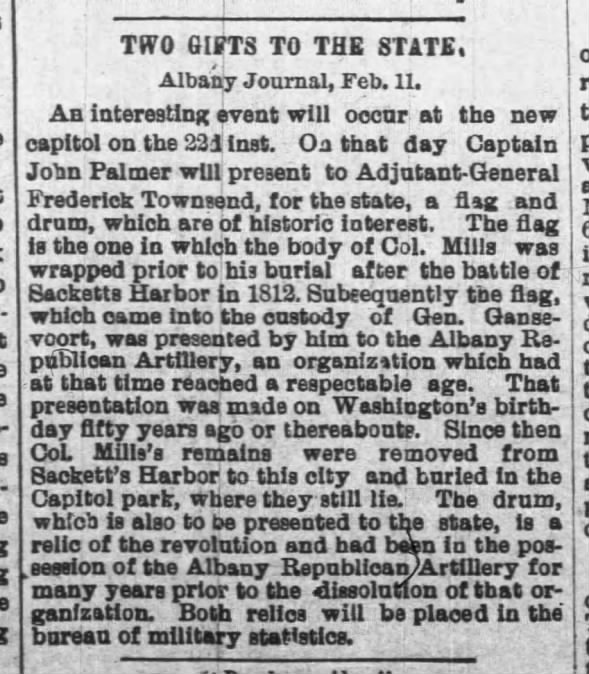
Whatever happened to the trophy-drum once possessed by Herman Melville's grandfather Peter Gansevoort (aka The Hero of Fort Stanwix) and ceremoniously bestowed by the Hero's son, Melville's Uncle Peter Gansevoort, on the Albany Republican Artillery Company? Re-gifted exactly fifty years later to the State of New York, as announced in the Albany Journal on February 11th, reprinted in the Buffalo Weekly Courier on February 15, 1882:

TWO GIFTS TO THE STATE.

Albany Journal, Feb. 11.

"An interesting event will occur at the new capitol on the 22d instant. On that day [February 22, 1882] Captain John Palmer will present to Adjutant-General Frederick Townsend, for the state, a flag and drum which are of historic interest. The flag is the one in which the body of Col. Mills was wrapped prior to his burial after the battle of Sacketts Harbor in 1812. Subsequently the flag, which came into the custody of Gen. Gansevoort, was presented by him to the Albany Republican Artillery, an organization which had at that time reached a respectable age. That presentation was made on Washington's birthday fifty years ago or thereabouts. Since then Col. Mills's remains were removed from Sackett's Harbor to this city and buried in the Capitol park, where they lie still. The drum, which is also to be presented to the state, is a relic of the revolution and had been in the possession of the Albany Republican Artillery for many years prior to the dissolution of that organization. Both relics will be placed in the bureau of military statistics."

The presentation ceremony "in the assembly chamber of the old capitol" was promptly and elaborately reported in the Albany Times for Wednesday Evening, February 22, 1882. In his lengthy public address, Captain Palmer quoted as follows from Peter Gansevoort's address to the Republican Artillery Company, fifty years before: 

"Its music was heard in those days of peril; it beat in unison with the war whoop and yell of the merciless savage on the bloody field of Oriskany--it sounded the charge and animated the courage of the enemy at Fort Stanwix;--but, it also sounded his retreat, and was taken from the enemy in the hour of his flight. To you, the successors of those brave volunteers; to the successors of Mills and Clark, who fell in battle, while gallantly resisting the invasion of a foreign foe, I present this Drum, with the hope, that it has sounded its last retreat; and that when its beat shall call the Albany Republican Artillery company to arms in the service of their country, they will inscribe on their banners the deeply rooted sentiment of the soldiers and statesmen of the revolution: 'We prefer liberty to life, and death to dishonor.' "

Later drum update, August 2022: Found it! On display at the NYS Military Museum in Saratoga Springs...

Related posts:
  • Drum update
    https://melvilliana.blogspot.com/2022/08/drum-update.html