Friday, January 13, 2012

Divine Hafiz

"What could Pierre write of his own on Love or any thing else, that would surpass what divine Hafiz wrote so many long centuries ago?" --Pierre; Or, The Ambiguities

Hither bring the wine, boy! hither bring the wine, boy!
For the season approaches, the season of joy.
Let us frolic and revel 'midst gardens and bowers,
Since the roses now bud, and the season is ours.
Let the vows of repentance religion has made,
Be forgotten, and broken beneath the cool shade:
Let us warble, like nightingales, through the gay grove,
And, imbedded in roses, here nestle in love.
Come, replenish, replenish the goblet with wine,
For of happiness lo! the sweet rose is the sign:
While she ripens and blows, your enjoyments pursue,
For anon she will wither and bid us adieu.
To the shade then where roses embowering twine,
Come, repair, quick repair, with thy friend, and with wine;
Let oblivious enjoyment there banish distress,
Whilst we warble, like nightingales, 'midst the recess.

'Tis from HAFIZ the rose claims her tribute of praise,
Let him prostrate before her his soul in soft lays,
Let him bow down his head to the dust at her shrine,
And in strains like the nightingale's hail her divine.

--verse paraphrase by John Haddon Hindley in Persian Lyrics (London, 1800)


Friday, January 6, 2012

"Pity's Tear," not by Melville

Warren F. Broderick found five poems signed "H" in the Democratic Press and Lansingburgh Advertiser, published by that newspaper in 1838 and 1839. Broderick's article announcing the discovery ("Melville's First Five Poems?," Extracts 92, March 1993) is available in the online archives of Melville Society Extracts. Since Herman Melville did publish two "Fragments from a Writing Desk" sketches in the Democratic Press in 1839, it has seemed reasonable to conjecture that H. Melville may have submitted these "H" poems to his hometown newspaper.


But the first of the five "H" poems, "Pity's Tear," is definitely not by Melville. A search in Google Books reveals the rightful author as Mary Darby Robinson (1758-1800). Robinson's poem Pity's Tear shows up in volume two of The Poetical Works of the Late Mrs. Mary Robinson, 3 vols. (London, 1806) at 254-255. Lansingburgh's "H" could have found Robinson's poem reprinted in the posthumous London collection, or in an American newspaper or literary magazine, for example The Rural Visiter vol. 1 (Burlington, New Jersey) where "Pity's Tear" appeared without attribution in the August 13, 1811 issue.

Update 07/20/2018: "Pity's Tear" appears over the signature of "Sappho" in The Lady's Monthly Museum for September 1801.

Sunday, November 13, 2011

barbarous involation of a transcendental allegory


After further review the word involation looks like a typo or alternate spelling for involution, meaning the "action of involving or enfolding" and "state of being entangled" according to Webster's Complete Dictionary (New York: Harper & Brothers, 1846).

Another find at genealogybank.com which has a good run of the Picayune, with plenty of "New York Correspondence" from "R" and others. Mardi is a great book that will get some respect, one of these days. And we love "R" anyhow for saying "I know not his equal in English literature" after three two-and-a-half books.

The Daily Picayune (New Orleans, LA) August 18, 1849
From the New Orleans Daily Picayune, August 18, 1849
New York Correspondence.
[SPECIAL CORRESPONDENCE OF THE PICAYUNE.]
NEW YORK, August 7, 1849.
… I am glad to see the announcement of a new work in press by the Harpers, of the brilliant but erratic Herman Melville. It is entitled “Redburn, or the Sailor-Boy—Confessions and Reminiscences of a Gentleman’s Son.” Melville is at home on the deck of a vessel, and can tell as good a forecastle story as any tar that ever handled a marlin-spike. He made a blunder in “Mardi,” by winding up his jovial and flashing pictures of the sea in the barbarous involation of a transcendental allegory, in which all truth was intended to be shadowed forth on poetry, philosophy, politics, religion, love, literature, good eating, and what not; but he broke down dead before he got half through the work, and every reader I know of who has tried to finish it, has shared the same fate. But let Melville “fling away ambition” and content himself with spinning a regular yarn, I declare, I know not his equal in English literature. His “Typee” set half the young men in New York and Boston mad after the peerless vision of his Eve-like Fayaway, and if it had not been for the fear of being eaten alive, they would have gone off in a body to the spicy Eden groves of Nukaheva. “Rudburn,” [sic] I think, will beat “Typee,” as reality is often better than romance.

R.

Tuesday, November 8, 2011

Matthew Henry Buckham, a.k.a. "Maherbal"

M. H. Buckham
from The National Cyclopaedia of American Biography
Thanks to the thrilling finish of the first volume (1819-1851) of Hershel Parker's two-volume biography, Melville fans know "Maherbal" as the Berkshire correspondent of the Vermont Journal who reported Melville's curiously formal dinner engagement with Nathaniel Hawthorne in the dining room of a Lenox hotel. From Lenox on January 10, 1852, "Maherbal" wrote to the Windsor, Vermont newspaper:
Not very long ago, the author of the "Scarlet Letter" and the author of "Typee," having, in some unaccountable way, gotten a mutual desire to see one another, as if neither had a home to which he could invite the other, made arrangements in a very formal manner to dine together at a hotel in this village. What a solemn time they must have had, those mighty conjurors in the domain of the imagination, all alone in the dining-room of a hotel!
Richard E. Winslow III found this and other letters from "Maherbal" in microfilm archives of the Vermont Journal. At his blog Fragments from a Writing Desk, Parker recounts years of searching that led to Winslow's exciting discovery. In the same post Parker explains the evidence, chronology, and reasoning behind his depiction of the hotel scene in Volume 1 as the November 1851 "publication party" at which Melville must have presented a copy of his new book Moby-Dick to his "solitary guest," the dedicatee.

"Maherbal" wrote more of Melville in that January 1852 letter, about his reputation for "exclusiveness" in Pittsfield, about the rough treatment Melville received from unruly students in his early career as a schoolteacher. "Maherbal" wrote too of G.P.R. James and other famous Berkshire residents. In one of his earlier letters from Lenox (dated November 29, 1851), "Maherbal" had focused on Hawthorne, giving colorful details and commentary on Hawthorne's physical appearance and notoriously reclusive lifestyle.

So the other day I was playing around in the newspaper archives at genealogybank.com.

Searching for "maherbal" (and maybe "maherbal + vermont") I found three "Letters from England" in the Vermont Journal (September-October 1855), submitted by their old Lenox correspondent "Maherbal," who was now writing from London. No mention of Melville, but another hit for "maherbal" turned up another article in the Vermont Journal from May 25, 1855--not a "Maherbal" letter at all, but an editorial on "America and the Russian War."

In "American and the Russian War" the editor of the Vermont Journal replies to criticism of American newspapers by "Griffith," a foreign correspondent of another Vermont paper, the Burlington Free Press. At the end of the article the Journal editor unmasks (in a friendly way, I take it) this complaining "Griffith":
... Our readers will be interested to know that the correspondent of the Free Press is none other than "MAHERBAL," whose letters in THE JOURNAL from Berkshire county, Mass., a year or two since, attracted so much interest; and the friends of MR. MATTHEW H. BUCKHAM, formerly of Chelsea, and more recently a tutor in the University of Vermont, and may be gratified to learn that he is both "GRIFFITH" and "MAHERBAL." -- Vermont Journal, May 25, 1855
Also accessible via Newspapers.com:
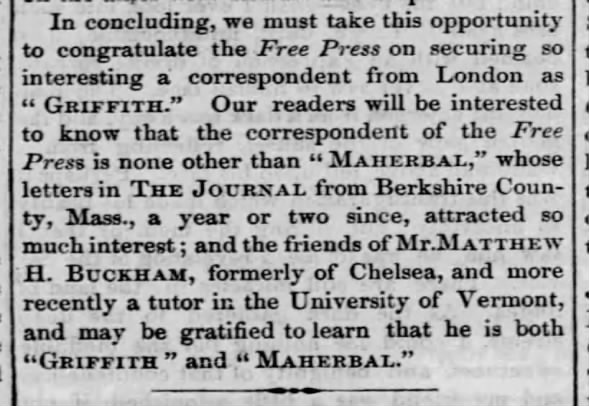
Fri, May 25, 1855 – 2 · Vermont Journal (Windsor, Vermont) · Newspapers.com

Aha! "Maherbal" = Matthew Henry Buckham (1832-1910)
Matthew Henry BUCKHAM, of Burlington [Chittenden County, Vermont], was born 04 July 1832 at Hinckley, Leicestershire, England, son of Rev. James BUCKHAM. He pursued his preparatory studies in the academy at Ellington [Tolland County], Connecticut, and also at a private school in Canada. Entering the University of Vermont in September 1847, he graduated from it in August 1851. He was principal of the Lenox Academy at Lenox [Berkshire County], Massachusetts, from 1851 to 1853. In September 1853 he became tutor of languages in the University of Vermont. In August 1854 he sailed for Europe, spent two years there in travel and study, and returned in 1856 to enter upon a professorship in the University of Vermont. He occupied the chair of Greek in that institution from 1856 to 1871, and also performed the duties of professor of English literature from 1865 to 1871.  --  Men of Vermont
Pittsfield Culturist and Gazette - October 1, 1851
via GenealogyBank
Buckham was nineteen and just out of college when he became principal of the Lenox Academy and began sending letters from Lenox to the Windsor, Vermont newspaper. The Bibliography of Vermont credits Buckham as "one of the authors of a 12mo. volume of about 200 pages, relating to Berkshire County, Mass., published in 1852 or 1853." That would be Taghconic (1852), wherein putative author "Godfey Greylock" (real name Joseph Edward Adams Smith) credits "Mr. BUCKHAM, of Lenox" with two chapters:
10 Lenox and its Scenery
11 Lenox as a Jungle for Literary Lions
Sure enough, chapter 11 of Taghconic contains most of Maherbal's letter dated November 29, 1851 and published in the Vermont Journal on December 12, 1851. The following passage from Taghconic is nearly verbatim from the Journal, but with some interesting changes. For example, where the book version critiques Hawthorne's "unsympathising, morbid spirit," the original letter from "Maherbal" called it "a sort of dreamy, unsympathizing spirit." From Taghconic, chapter 11, by "Mr. Buckham, of Lenox":
Mr. Hawthorne, even for a man of letters, leads a remarkably secluded life. He has a few literary friends with whom he cherishes an intimacy congenial to a mind of such cultivation and sensibility, and a friendship which does honor to his heart, but he shows no disposition to mingle largely in society. This aversion to social intercourse has been remarkable in him during his literary career, and even far back into his youth, if we may credit the accounts of his acquaintances. Not only in his private life, but all through his writings, there seems to breathe an unsympathising, morbid spirit, — a spirit that seems to take a satisfaction in keeping itself aloof from those who are guilty of the foibles which it takes a still greater satisfaction in contemplating. This spirit he could never have inherited from his ancestors, else those progenitors of his, who for so many generations " followed the sea," were a strange set of tars! Perhaps all his better sympathies were chilled in those speculations with his dreamy brethren of the Brook Farm Community; perhaps he and Emerson, enraptured with the mystic perfection of their own fantasies, abjured all communion with this our gross humanity; he certainly could not have had his feelings frozen into hate by contact with the genial and sympathizing intellect of Ellery Channing, or at the warm hearth-stone of Longfellow.
From the letter of "Maherbal" dated November 29, 1851 on "Nathaniel Hawthorne," published in the Vermont Journal on December 12, 1851:
Mr. Hawthorne, even for a man of letters, leads a remarkably secluded life.  He has, doubtless, a few literary friends, with whom he cherishes a friendship congenial to a mind of such cultivation and sensibility, but he shows no disposition to mingle in the highly intellectual society of our village, and even studiously declines any advances which are made towards a familiarity with him on the part of those whose acquaintance he might find ample reason to prize.  This aversion to society has been so remarkable in him during his literary career, at least, and even far back into his youth, if we may credit the accounts of his acquaintances, that it seems to be constitutional with him.  At any rate, a sort of dreamy, unsympathizing spirit, seems to breathe through all his writings, and to manifest itself in various acts of his life, as far back as we have any means of tracing it.  We are sure he could not have inherited it from his ancestors, or else those progenitors of his, who for so many generations “followed the sea,” were a strange set of tars!  Perhaps all his better sympathies were chilled in those speculations with this dreamy brethren of the Brook Farm community—perhaps he and Emerson, in their rapt fantasies, abjured all communion with their fellows of this our gross humanity; he certainly could not have had his feelings frozen into hate by contact with the genial and sympathizing intellect of Ellery Channing, or the warm hearthstone of Longfellow.
Possibly more of Mr. Buckham's letters from Lenox in 1851-1853 will be discovered, either in the Vermont Journal or another Vermont newspaper. As we now know, in 1855 Buckham wrote to the Burlington Free Press under the name "Griffith." It remains to be seen whether the Free Press ever published any communications from a Griffith, or even Maherbal, during Matthew Henry Buckham's tenure as principal of the Lenox Academy.


Bios

  • Prentiss Cutler Dodge, Encyclopedia, Vermont Biography (Burlington, 1912) pages 132-133.
    https://books.google.com/books?id=tt2_3hTQxFMC&pg=PA132&dq#v=onepage&q&f=false

Sunday, November 6, 2011

Melville's prose headnote to "John Marr" and Carleton's Oregon Emigrants

Prairie Scene: Mirage
Alfred Jacob Miller, Public domain, via Wikimedia Commons
A sailor on the prairie. Does it get any lonelier than that? It doesn't help when you're surrounded like Melville's John Marr by unsympathizing farmers. Nice enough people, but no sympathy for sailors or sailor talk:
But the past of John Marr was not the past of these pioneers. Their hands had rested on the plow-tail, his upon the ship's helm. They knew but their own kind and their own usages; to him had been revealed something of the checkered globe. So limited unavoidably was the mental reach, and by consequence the range of sympathy, in this particular band of domestic emigrants, hereditary tillers of the soil, that the ocean, but a hearsay to their fathers, had now through yet deeper inland removal become to themselves little more than a rumor traditional and vague.

They were a staid people; staid through habituation to monotonous hardship; ascetics by necessity not less than through moral bias; nearly all of them sincerely, however narrowly, religious. They were kindly at need, after their fashion; but to a man wonted--as John Marr in his previous homeless sojournings could not but have been--to the free-and-easy tavern-clubs affording cheap recreation of an evening in certain old and comfortable sea-port towns of that time, and yet more familiar with the companionship afloat of the sailors of the same period, something was lacking. That something was geniality, the flower of life springing from some sense of joy in it, more or less. This their lot could not give to these hard-working endurers of the dispiriting malaria,--men to whom a holiday never came,-- and they had too much of uprightness and no art at all or desire to affect what they did not really feel....
Melville's depiction of Illinois "emigrants" in 1838 seems partly inspired by the chapter on "The Oregon Emigrants" in J. Henry Carleton's "Occidental Reminiscences / Farther West," a serialized account of the 1845 dragoon expedition to the Rocky Mountains which ran in the New York Spirit of the Times from December 1845 to May 1846. Happily on fultonhistory.com, Old Fulton NY Post Cards by Tom Tryniski has the very page from the May 16, 1846 Spirit of the Times with  Carleton's take on the "Oregon Emigrants":
Nearly all who have gone to the shores of the Pacific, with a view of making a permanent settlement there, have been born and nurtured in the interior counties of the States lying in the Valley of the Mississippi, and are, therefore, as a class, practical agriculturalists. They may be regarded as a straight-forward, simple, and well-meaning people, and shrewd and thrifty withal; and as having a fair share of good common sense. It is true, in the aggregate they are somewhat deficient in even the primary branches of education, and have but a limited knowledge of the usages of society, and a still narrower, of what is denominated “the world”; but there are many amongst them of creditable attainments, and of talents which in any country would be regarded as respectable. -- J. Henry Carleton, The Oregon Emigrants
Now accessible via EBSCO in the American Antiquarian Society Historical Periodicals Collections, Hobbies, Socialization, and Sport Periodicals, 1775-1889. Citation:
“Farther West; Or, Rough Notes of the Dragoon Campaign to the Rocky Mountains in 1845.” Spirit of The Times, vol. 16, no. 12, May 1846, pp. 139–140. EBSCOhost, search.ebscohost.com/login.aspx?direct=true&db=hss&AN=51416916&site=ehost-live.

Later on Carleton quotes the leader of a pioneer group from Illinois. Back in Illinois the Oregon emigrants had endured regular intervals of illness very much like Melville's Illinois "pioneers":

"...for two or three months every year, we have been, more or less, prostrated with sickness, which in itself not only caused us much suffering, but deprived us of the power of taking a proper care of what we had already accomplished..." 
Carleton's emigrants were unaccustomed to the "usages" of "the world"; Melville adopts the word "usages" and applies it to the plainer pioneer customs, in contrast to the ways of the world or in Melville's phrase, "checkered globe." Melville's phrase "a staid people" compactly paraphrases Carleton's description of the Oregon emigrants as "a straight-forward, simple, and well-meaning people."

Carleton's writings in the New York Spirit of the Times have been edited by Louis Pelzer under the attractive but inaccurate title, The Prairie Logbooks (The Caxton Club, Chicago,1943; and in paperback, University of Nebraska Press, 1983). 


The complete texts have yet to be presented in a modern edition. The original title of Carleton's 1845-1846 series in the Spirit of the Times was "Occidental Reminiscences. Farther West; Or, Rough Notes of the Dragoon Campaign to the Rocky Mountains in 1845." 

Saturday, October 15, 2011

Elizabeth Shaw Melville sighted (mistakenly?)

Update 2: In yet another society page mention, the second wife of Herman Melville's deceased brother Allan appears in connection with a stage performance by Lydia Thompson:
Mrs. Allan Melville, of New York, gave a box party to see Lydia Thompson, on Saturday evening to Senator Fair, Judge and Mrs. MacArthur, Miss Carrie Lathers and Mr. Coleman. After the play a supper was partaken of at Wormley’s.
-- Evening Star, April 5, 1886; found at Genealogy Bank
Lydia Thompson was then appearing in Oxygen, "one of the stupidest burlesques that have ever been placed upon the stage" according to one contemporary critic who nevertheless praised its star as a "true burlesquer":
"She dances with her old agility, sings fairly and is graceful in her acting."
--Washington, D. C. Critic-Record, May 22, 1886
At any rate, this attending and hosting parties in high society was very much in the line of Jane Louise Dempsey Melville. 

Update 1: The newspaper notice lists "Mrs. Herman Melville" among the reception guests, but is that a mistake for "Mrs. Allan Melville," widow of Herman's deceased younger brother?

Certainly Elizabeth Shaw Melville was well connected as the daughter of Judge Shaw, especially in Boston, but those elite names in the New York Graphic society item seem more like social acquaintances of Jane Dempsey Randolph Melville (1824-1890).  And neighbors, maybe? Mrs. Allan Melville's home was still on 35th Street, near to the Townsends' home on 34th where the party for Madame Lucca took place. In the New York Tribune for December 3, 1886, "Mrs. Allan Melville" is listed under the heading "Musical and Dramatic Notes" among subscribers for a "substantial farewell testimonial" to Steve Massett (celebrated "Jeems Pipes" of Pipesville in California).

I meant to follow up on this before now, but forgot about it until seeing this one show up in the gallery of popular posts at Melvilliana.

And in high society.  From the New York Daily Graphic, Friday, May 1, 1874:
PERSONALITIES.
... A very pleasant reception was given by Mrs. John D. Townsend, at her residence in West Thirty-fourth street, on Wednesday evening, in honor of Madame Lucca. Among the guests were Mrs. ex-Judge Roosevelt and daughter, Mr. and Mrs. Lawrence Turnure, Mrs. Herman Melville, and Mrs. John T. Beeckman. The music was by Professor Eben's orchestra, and the floral display is understood to have been very fine. 
Found at Fultonhistory.com
Later, to clarify: Despite the impression created by Google search results, the portrait below is a Guy Little Theatrical Photograph in the V&A collections, of opera singer Pauline Lucca--not Herman Melville's wife! Pauline Lucca (1841-1908) was a "prominent operatic soprano," born in Vienna.  Rivalry with Mathilde Mallinger reportedly motivated her triumphant US tour, 1872-1874. 

Photograph of Pauline Lucca, late 19th c. Guy Little Collection 
Copyright: © Victoria and Albert Museum, London

Mrs. John D. Townsend was Elizabeth A. Delano Swan Townsend, the former Miss Delano Swan of Boston.  Her husband was the "well-known criminal lawyer" John Drake Townsend (1835-1896).  Townsend wrote the posthumously published indictment of Tammany Hall, New York in Bondage (1901).  Both Townsends made the news for their support of women's suffrage.

"Mrs. ex-Judge Roosevelt" is probably the former Cornelia Van Ness,  "for many years queen in the leading society of New York" and wife of then ex-Judge James John Roosevelt (1795-1875).  Appleton's Cyclopaedia acknowledges her "good service in organizing hospital and charitable associations for the aid of the National troops during the civil war" and later support of New York charities.

Lawrence Turnure at his death in 1899 was "one of the best-known bankers of New York."  Mrs. Lawrence Turnure was the former Jane Redfield.

Mrs. John T. Beeckman and her husband are unknown to me at this point.  Connected with the old Albany Beeckmans?

Looks like Eben's Orchestra kept busy playing at all kinds of New York social events...

Thursday, October 13, 2011

Enceladus

Manitou Stone in Newbury, MA
Image Credit: Mary Gage via Stone Structures of North America
"No more now you sideways followed the sad pasture's skirt, but took your way adown the long declivity, fronting the mystic height. In mid field again you paused among the recumbent sphinx-like shapes thrown off from the rocky steep. You paused; fixed by a form defiant, a form of awfulness. You saw Enceladus the Titan, the most potent of all the giants, writhing from out the imprisoning earth;—turbaned with upborn moss he writhed; still, though armless, resisting with his whole striving trunk, the Pelion and the Ossa hurled back at him;—turbaned with upborn moss he writhed; still turning his unconquerable front toward that majestic mount eternally in vain assailed by him, and which, when it had stormed him off, had heaved his undoffable incubus upon him, and deridingly left him there to bay out his ineffectual howl...."
"Not unworthy to be compared with that leaden Titan, wherewith the art of Marsy and the broad-flung pride of Bourbon enriched the enchanted gardens of Versailles;—and from whose still twisted mouth for sixty feet the waters yet upgush, in elemental rivalry with those Etna flames, of old asserted to be the malicious breath of the borne-down giant;—not unworthy to be compared with that leaden demi-god—piled with costly rocks, and with one bent wrenching knee protruding from the broken bronze;—not unworthy to be compared with that bold trophy of high art, this American Enceladus, wrought by the vigorous hand of Nature's self, it did go further than compare;—it did far surpass that fine figure molded by the inferior skill of man. Marsy gave arms to the eternally defenseless; but Nature, more truthful, performed an amputation, and left the impotent Titan without one serviceable ball-and-socket above the thigh."
Pierre
(1852), 470-471