Showing posts with label Maherbal. Show all posts

Tuesday, April 1, 2014

Melville at a New York cafe, after bumping into John Godfrey Saxe (July 27, 1846)

Halleck in Central Park
Update2: Uh, if this is from the Charleston Evening News, then hey! maybe it's by Thomas Low Nichols writing as "Observer."  Parker in Melville Biography: An Inside Narrative (149-52) credits Kendall Spillman and Patricia Cline Cohen with finding regular letters from Nichols, "two or three letters a week" in 1846, to the Charleston Evening News. Nichols is the cat who advised Gansevoort to take the manuscript of Typee to London for publication there.

Hershel Parker likes to talk about special correspondents of nineteenth-century newspapers, how important they were as news gatherers and reporters, and yet how frequently they get overlooked, still, as sources of biography and cultural history.  The premier example in Parker's biography is the story of Melville and Hawthorne together at the hotel in Lenox, nobly retold from facts and hints in a letter by "Maherbal" to a Vermont newspaper. That's at the close of Volume 1. You can read more about the hunt for Maherbal in Melville Biography: An Inside Narrative. There also Parker reveals that before he got sidetracked, he
"longed at some indefinite time to write a book about special correspondents of American newspapers before the Civil War." (Parker, Inside Narrative)
Here's something else for that unwritten work, from the New York correspondent of a Virginia newspaper (if I have this right), the Richmond Evening News. Update: or is the source a South Carolina newspaper, the Charleston Evening News? The writer's identity is a current mystery, the re-printing below from the August 5, 1846 Alexandria [Virginia] Gazette lacks even a pseudonym. It remains to be determined, if this NY correspondent was "special" enough ever to have a pen name, and regular appearances in the Richmond newspaper. Well, we did figure out finally who Maherbal was, and Proteus, so maybe we can chase down this guy too.

Wow, look! Herman Melville with the author of Progress: a Satirical Poem at a Manhattan cafe on Monday, July 27, 1846. Among the New York literati, briefly at least in the company of poets and one yet-to-be-named journalist with a weakness for French dancers and phrases. Not a Virginian?

LETTER FROM NEW YORK.

Correspondence of the Evening News.

NEW YORK, JULY 28, 1846.

Just as I had concluded my too hasty letter, yesterday, for the brevity of which I beg to apologise, there was handed me a letter of introduction, which commended, to my courtesies, the bearer, and one paragraph of which I take leave to transcribe. "He is a lawyer by profession: a wit and poet by force of genius; and a good fellow by nature. His most conspicuous faults are, that he is a strong locofoco and an incorrigible punster. If you can tolerate such serious vices I have no doubt that you will find his acquaintance an agreeable one." The gentleman thus introduced to me, was a six foot tall, and otherwise conspicuous Vermonter, dressed a la green mountains; or, as we sometimes say, in a mountainous fashion. He came from and belongs to the very north-west corner of that verdant State, where Lake Champlain joins the Canada line. But I found him all that my letter described him, and something more. He is a literary protege of Oliver Wendell Holmes, our first comic poet, and John Saxe will be, if he is not now, the second. In fact, his business in New York at this moment is to publish, what I think the critics will pronounce the best satire that has appeared in--say twenty years. 
http://myweb.wvnet.edu/~jelkins/lp-2001/saxe.html
With the advent of my humorous and poetical Vermonter commenced one of those days which a man cannot avoid noticing as remarkable. Certainly, in a month before, I had not run against and almost stumbled over so many literary celebrities. The first man we met was Clark the Editor of the Knickerbocker, happy in having just finished the last revise of his August num­ber, and ready to burst with all the good jokes he had bottled up, like Champaigne, in his Editor's Table. He was quite overflowing with the good humor which sparkles in the pages of his particular department. Contracting to meet at Niblo's in the evening, we parted, and turning a corner with my Vermont poet, we ran against the author of Typee, Mr. Herman Melville. 
He had just returned from Buffalo, where he had been to see his ci devant companion in the Marquesas. There, alive and well, and not eaten up by the savages, was the veritable Toby, the companion of his sufferings, and for whose fate he had entertained so many apprehensions.
Toby saw the first notice of "Typee," in the New York Evangelist. He went directly to a bookseller in Buffalo, and asked, "Have you got Typee?" "No! we have had it, but they are all sold."

"Have you read it?"

"Oh! yes, it is a charming book."

"Does it say anything of the author having a companion in Typee?"

"Toby, yes; to be sure. Here was Toby, who disappeared mysteriously, and was eaten up by the amiable cannibals."

"Not a bit of it,"--said the querist, "I am Toby!"

"You?  Well, I declare, you do answer the description. Are you really? How did you get away, then?"

I don't know all the conversation, but it became noised round that the lost Toby was found. The ladies flocked to see him. They begged locks of his glossy ringlets--the daguerreotypers took portraits of him; in short he was a lion.
Richard Tobias Greene
Melville, as I said, went to see him, and has given his adventures in escaping from Typee, as a sequel of the second edition.
While sitting with my two lions in the Cafe, who should come in but a brace of poets, beside, of whom we had been talking an instant before. They were Fitz Green Halleck and William Wallace. Of the former, as a literary man, I need not speak; the latter is still young, under thirty, but for two years past has made long strides towards the highest rank in literature, and has written verses which seem as likely to live as any which are produced at the present day. 
http://digital.lib.lehigh.edu/pfaffs/p138/
Melville, who I am sure never wrote a stanza or a couplet in his life, is a modest, and personally not a very remarkable man, but our three poets have strong peculiarities, the younger ones especially.

Mr. Halleck, born in the State of Connecticut, has the quiet tone and dignified bearing of an English Lord. Brought up in a democratic and puritan community, the friend of Drake, the companion of Bryant, the author of Marco Bozzaris, he is a monarchist and high tory in his politics, and a Roman Catholic in religion. These, at all events, are the opinions he maintains in conversation, and I have no reason to doubt his sincerity.

But my young friends, my other pair or poets, are quite the reverse of all this. They talk loudly, and extravagantly--they repeat their own verses--they make no pretense of a modest opinion of their merits--they are both Democrats, of the most radical kind, and though one is all humor, and the other all sublimity, it was wonder­ful to see how much they resembled each other.

We were fated to meet celebrities--in passing out we encountered Tuckerman, powerfully moustached, and evidently thinking of his "Thoughts on the Poets." Then McG-----, an Irish literateur, with English predilections so strong, that the highest compliment he was known to pay an American book, was, that it read as if written by an Englishman!

Before getting a block up Broadway towards Niblo's, we met Haas, the most skillful of Daguerreotype artists, formerly lithographer to the Government, walking arm in arm with Professor Mapes, who is distinguished as a sculptor, musician, poet, engineer, chemist, agriculturist, and I know not what beside--the only successful man of universal genius I ever met; quite an oracle, and an admirable Critchton!

At Niblo's was a full and brilliant House, with the Mayor sitting in the centre of the pit, and Mademoiselle Blangy, the prettiest dancer we have had, if not the greatest, danced La Sylphide, so as put the whole audience into a state of mild extacy. It was quite ravishing, and if this danseuse makes the Southern tour next winter, you are to be congratulated.
 (Alexandria Gazette, Wednesday, August 5, 1846; found at genealogybank.com)

Apparently Melville stayed back at the cafe. Tuckerman his eventual friend was on his way in, was this their first meeting? Perhaps they merely happened to be in the same place at the same time. From the sound of it, the Author of Typee and new sequel did not walk up Broadway with Saxe and company to catch Mlle. Hermine Blangy at Niblo's. Or did he?

Tuesday, November 8, 2011

Matthew Henry Buckham, a.k.a. "Maherbal"

M. H. Buckham
from The National Cyclopaedia of American Biography
Thanks to the thrilling finish of the first volume (1819-1851) of Hershel Parker's two-volume biography, Melville fans know "Maherbal" as the Berkshire correspondent of the Vermont Journal who reported Melville's curiously formal dinner engagement with Nathaniel Hawthorne in the dining room of a Lenox hotel. From Lenox on January 10, 1852, "Maherbal" wrote to the Windsor, Vermont newspaper:
Not very long ago, the author of the "Scarlet Letter" and the author of "Typee," having, in some unaccountable way, gotten a mutual desire to see one another, as if neither had a home to which he could invite the other, made arrangements in a very formal manner to dine together at a hotel in this village. What a solemn time they must have had, those mighty conjurors in the domain of the imagination, all alone in the dining-room of a hotel!
Richard E. Winslow III found this and other letters from "Maherbal" in microfilm archives of the Vermont Journal. At his blog Fragments from a Writing Desk, Parker recounts years of searching that led to Winslow's exciting discovery. In the same post Parker explains the evidence, chronology, and reasoning behind his depiction of the hotel scene in Volume 1 as the November 1851 "publication party" at which Melville must have presented a copy of his new book Moby-Dick to his "solitary guest," the dedicatee.

"Maherbal" wrote more of Melville in that January 1852 letter, about his reputation for "exclusiveness" in Pittsfield, about the rough treatment Melville received from unruly students in his early career as a schoolteacher. "Maherbal" wrote too of G.P.R. James and other famous Berkshire residents. In one of his earlier letters from Lenox (dated November 29, 1851), "Maherbal" had focused on Hawthorne, giving colorful details and commentary on Hawthorne's physical appearance and notoriously reclusive lifestyle.

So the other day I was playing around in the newspaper archives at genealogybank.com.

Searching for "maherbal" (and maybe "maherbal + vermont") I found three "Letters from England" in the Vermont Journal (September-October 1855), submitted by their old Lenox correspondent "Maherbal," who was now writing from London. No mention of Melville, but another hit for "maherbal" turned up another article in the Vermont Journal from May 25, 1855--not a "Maherbal" letter at all, but an editorial on "America and the Russian War."

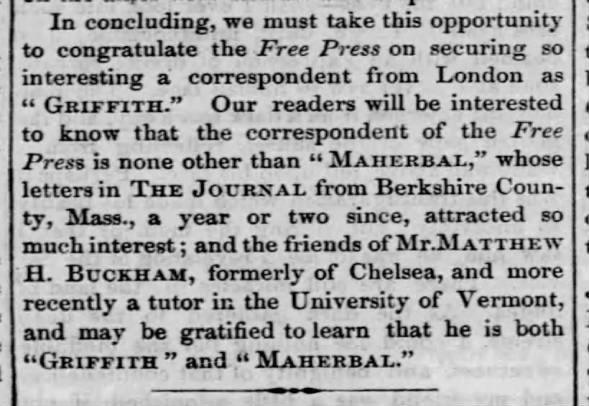
In "American and the Russian War" the editor of the Vermont Journal replies to criticism of American newspapers by "Griffith," a foreign correspondent of another Vermont paper, the Burlington Free Press. At the end of the article the Journal editor unmasks (in a friendly way, I take it) this complaining "Griffith":
... Our readers will be interested to know that the correspondent of the Free Press is none other than "MAHERBAL," whose letters in THE JOURNAL from Berkshire county, Mass., a year or two since, attracted so much interest; and the friends of MR. MATTHEW H. BUCKHAM, formerly of Chelsea, and more recently a tutor in the University of Vermont, and may be gratified to learn that he is both "GRIFFITH" and "MAHERBAL." -- Vermont Journal, May 25, 1855
Also accessible via Newspapers.com:

Fri, May 25, 1855 – 2 · Vermont Journal (Windsor, Vermont) · Newspapers.com

Aha! "Maherbal" = Matthew Henry Buckham (1832-1910)
Matthew Henry BUCKHAM, of Burlington [Chittenden County, Vermont], was born 04 July 1832 at Hinckley, Leicestershire, England, son of Rev. James BUCKHAM. He pursued his preparatory studies in the academy at Ellington [Tolland County], Connecticut, and also at a private school in Canada. Entering the University of Vermont in September 1847, he graduated from it in August 1851. He was principal of the Lenox Academy at Lenox [Berkshire County], Massachusetts, from 1851 to 1853. In September 1853 he became tutor of languages in the University of Vermont. In August 1854 he sailed for Europe, spent two years there in travel and study, and returned in 1856 to enter upon a professorship in the University of Vermont. He occupied the chair of Greek in that institution from 1856 to 1871, and also performed the duties of professor of English literature from 1865 to 1871.  --  Men of Vermont
Pittsfield Culturist and Gazette - October 1, 1851
via GenealogyBank
Buckham was nineteen and just out of college when he became principal of the Lenox Academy and began sending letters from Lenox to the Windsor, Vermont newspaper. The Bibliography of Vermont credits Buckham as "one of the authors of a 12mo. volume of about 200 pages, relating to Berkshire County, Mass., published in 1852 or 1853." That would be Taghconic (1852), wherein putative author "Godfey Greylock" (real name Joseph Edward Adams Smith) credits "Mr. BUCKHAM, of Lenox" with two chapters:
10 Lenox and its Scenery
11 Lenox as a Jungle for Literary Lions
Sure enough, chapter 11 of Taghconic contains most of Maherbal's letter dated November 29, 1851 and published in the Vermont Journal on December 12, 1851. The following passage from Taghconic is nearly verbatim from the Journal, but with some interesting changes. For example, where the book version critiques Hawthorne's "unsympathising, morbid spirit," the original letter from "Maherbal" called it "a sort of dreamy, unsympathizing spirit." From Taghconic, chapter 11, by "Mr. Buckham, of Lenox":
Mr. Hawthorne, even for a man of letters, leads a remarkably secluded life. He has a few literary friends with whom he cherishes an intimacy congenial to a mind of such cultivation and sensibility, and a friendship which does honor to his heart, but he shows no disposition to mingle largely in society. This aversion to social intercourse has been remarkable in him during his literary career, and even far back into his youth, if we may credit the accounts of his acquaintances. Not only in his private life, but all through his writings, there seems to breathe an unsympathising, morbid spirit, — a spirit that seems to take a satisfaction in keeping itself aloof from those who are guilty of the foibles which it takes a still greater satisfaction in contemplating. This spirit he could never have inherited from his ancestors, else those progenitors of his, who for so many generations " followed the sea," were a strange set of tars! Perhaps all his better sympathies were chilled in those speculations with his dreamy brethren of the Brook Farm Community; perhaps he and Emerson, enraptured with the mystic perfection of their own fantasies, abjured all communion with this our gross humanity; he certainly could not have had his feelings frozen into hate by contact with the genial and sympathizing intellect of Ellery Channing, or at the warm hearth-stone of Longfellow.
From the letter of "Maherbal" dated November 29, 1851 on "Nathaniel Hawthorne," published in the Vermont Journal on December 12, 1851:
Mr. Hawthorne, even for a man of letters, leads a remarkably secluded life.  He has, doubtless, a few literary friends, with whom he cherishes a friendship congenial to a mind of such cultivation and sensibility, but he shows no disposition to mingle in the highly intellectual society of our village, and even studiously declines any advances which are made towards a familiarity with him on the part of those whose acquaintance he might find ample reason to prize.  This aversion to society has been so remarkable in him during his literary career, at least, and even far back into his youth, if we may credit the accounts of his acquaintances, that it seems to be constitutional with him.  At any rate, a sort of dreamy, unsympathizing spirit, seems to breathe through all his writings, and to manifest itself in various acts of his life, as far back as we have any means of tracing it.  We are sure he could not have inherited it from his ancestors, or else those progenitors of his, who for so many generations “followed the sea,” were a strange set of tars!  Perhaps all his better sympathies were chilled in those speculations with this dreamy brethren of the Brook Farm community—perhaps he and Emerson, in their rapt fantasies, abjured all communion with their fellows of this our gross humanity; he certainly could not have had his feelings frozen into hate by contact with the genial and sympathizing intellect of Ellery Channing, or the warm hearthstone of Longfellow.
Possibly more of Mr. Buckham's letters from Lenox in 1851-1853 will be discovered, either in the Vermont Journal or another Vermont newspaper. As we now know, in 1855 Buckham wrote to the Burlington Free Press under the name "Griffith." It remains to be seen whether the Free Press ever published any communications from a Griffith, or even Maherbal, during Matthew Henry Buckham's tenure as principal of the Lenox Academy.


Bios

  • Prentiss Cutler Dodge, Encyclopedia, Vermont Biography (Burlington, 1912) pages 132-133.
    https://books.google.com/books?id=tt2_3hTQxFMC&pg=PA132&dq#v=onepage&q&f=false