Showing posts with label Blackwood's Magazine. Show all posts

Thursday, August 26, 2021

More hooting at Blackwood on Omoo

The "most talked about" and "much hooted-at" review of Omoo in Blackwood's Edinburgh Magazine, as Hershel Parker frames it in Herman Melville: A Biography Volume 1, 1819-1851 (Johns Hopkins University Press, 1996) at pages 520 and 533, elicited more editorial hooting in the New York True Sun for June 30, 1847. The True Sun, founded by rebellious exiles from the New York Sun, had favorably noticed Omoo on May 1, 1847; this earlier notice of Omoo is reprinted in Herman Melville: The Contemporary Reviews, edited by Brian Higgins and Hershel Parker (Cambridge University Press, 1995) at page 98. Transcribed below, the later commentary in The True Sun on the "book-worm sagacity" and British "superciliousness" exemplified in Blackwood's review of Omoo is not previously recorded in Melville scholarship. 

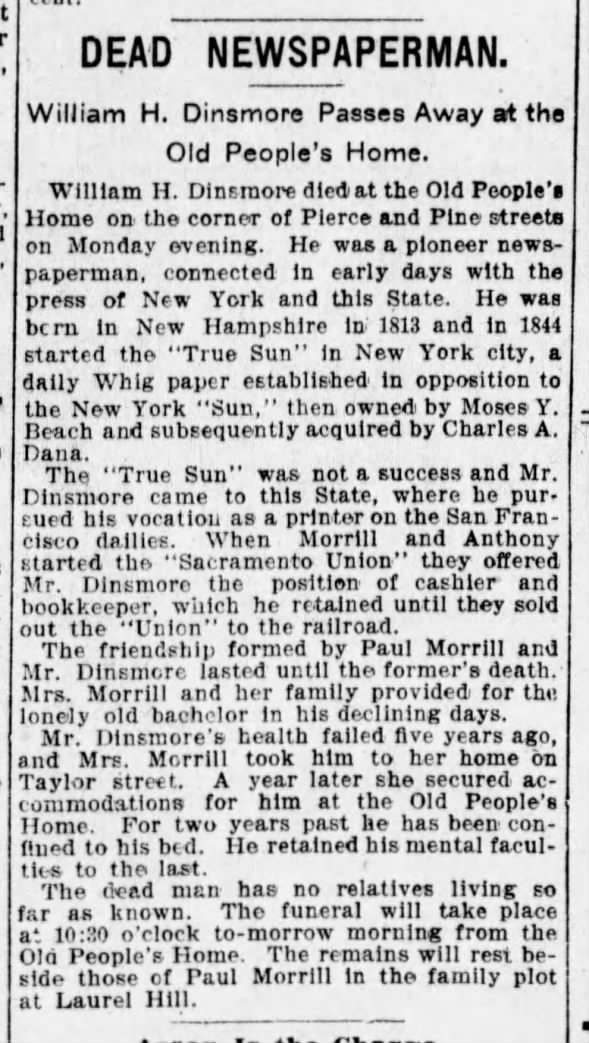
The True Sun was then owned and edited by William H. Dinsmore and Paul Morrill. What most amused these and other journalists in New York State (along with family and friends of the author) was the British reviewer's suspicion that "Herman Melville" might be a fake name. 

YANKEE BOOKS AND ENGLISH CRITICS.— The question “who reads an American book?” seems to have been solved of late, and even Blackwood confesses the “soft impeachment.” The last number of that celebrated periodical has not only condescended to notice favorably the two books of Herman Melville, Esq., Typee and Omoo, but to give its readers some extracts. The venerable Reviewer is, however, evidently puzzled to account for the fact that what it calls an “excellent” book, “quite first rate,” should have been written by an American, and that American a sailor. The first difficulty encountered in the matter, seems to be to understand what a sailor is. It is assumed off hand, that the hands in an American vessel are on a par with the miserable outcasts that the state of society in England exudes into the forecastles of English vessels. If such were the case, Mr. Ricardo would never have asked for a Parliamentary committee to inquire into the causes of the superiority of American over English shipping, nor would that committee have elicited evidence to the fact that it was owing to the “superior class of men in American ships.” A large portion of the young seamen in United States vessels, are well educated and “gentlemanly” youths, whose interest, enterprise, and love of adventure carry them to sea. We remember some years since, a young gentleman in an eastern city, guilty of some youthful folly, was, on a consultation of friends, to be sent to sea as a punishment. His employer, an old and experienced merchant, objected: “It is,” said he, “with the utmost difficulty that our sons can now be kept out of the forecastle, and if their desires are to be gratified in consequence of misdemeanors, not a clerk will be left in the computing houses. Send him rather on a farm.” This was wisdom. There are very few wealthy merchants and eminent men, who have not, at some period of their lives, experienced
"—How hard it is to climb
Up a slushed topmast, in the summer time.”
All this is utterly incomprehensible to English aristocratic notions; and Mr. Melville was one of them it appears, and his adventures resulted in the volumes, the excellence of which throw doubt in English minds upon the identity of the author. The wonderful book-worm sagacity of Blackwood stumbles over the name “Herman Melville,” and the more readily, that an old novel fans the suspicion:
“Our misgivings begin with the title page, ‘Lovel or Belville,’ says the laird of Monkbarns, "are just the names which youngsters are apt to assume on such occasions, and Herman Melville sounds to us vastly like the harmonious and carefully selected appellation of an imaginary hero of romance.”

“Of the existence of ‘Uncle Gansevoort of Gansevoort, Saratoga county,’ we are wholly incredulous,” “until certificates of his corporality shall set down the gentleman with the Dutch patronymic as a member of an imaginary clan."
This is a specimon of what is called “knowing too much.” John Bull is not to be “done” by any such humbug as calling sailors “Herman Melville.” We wonder, however, that such an astonishing acuteness did not stumble over the name of “Gansevoort Melville,” United States Secretary of Legation to the Court of St. James, and as Eddie O’Chiltreee remarked of Monkbarns, “put that and that together,” and “smell a rat.” Considering the usual superciliousness of English writers in regard to American affairs, it is not to be wondered that the acute critic should be surprised at a “Dutch patronymic” among a people exclusively Dutch descendants, nor that the fame of Herman Gansevoort, Esq. Should not have penetrated into the obscurity of an English editorial sanctum. The facts are, however, calculated to increase the astonishment of bewildered Blackwood. Herman Gansevoort, Esq. Has clearly divided his name between his nephews, the brothers Melville, of whom Gansevoort represented his country at the Court of Victoria. The other, while pursuing his adventures as a sailor, earned that literary reputation which has led to the question of his identity.

In all this the English reviewers, when they have studied out the facts so as to comprehend them, will have a most practical lesson upon American character and the working of republican institutions. All ranks and grades of society are open to the resistless enterprise and untiring genius of the American character, and it is very unsafe when a boy is seen going into the forecastle of an American vessel as a “green hand,” to predict anything in relation to him. In the case of an English boy under similar circumstances in England, you may safely assert that he is taking up his abode for life—that he is to live a miserable and oppressed being and die in poverty and want. Of the American you may feel confident that he is only seeking an outlet for the fire within, and that because he begins by “slushing a topmast,” “furling a royal” or “taking in the slack of the topsail halyard,” it is by no means safe to aver that he will not speedily astonish the literati of Europe in the line of their own occupations; that he will not revolutionize the first country he lands in, or suddenly turn up member of Congress from some western State. All these practical effects of republican energy and genius, English writers and politicians have yet to “get through their hair.”

-- The True Sun (New York, NY) June 30, 1847; found on Genealogy Bank. 

Titled "Pacific Rovings" the review of Omoo appeared in Blackwood's Edinburgh Magazine for June 1847 at pages 754-767; reprinted in Littell's Living Age on July 24, 1847.

07 Mar 1900, Wed The San Francisco Examiner (San Francisco, California) Newspapers.com

Sunday, February 25, 2018

1826 letter from Gansevoort Melvill to his mother

Months before treating his high school assembly to Marco Bozzaris, young Gansevoort Melville (born December 6, 1815 so not yet 11) declaimed another romance of Greek resistance in the more domestic but hardly less formal setting of a fashionable children's party. Now forgotten, the Byronic verse tale of Duke Phranza, the Regicide had recently appeared, unattributed, in the March 1826 issue of Blackwood's Magazine. Gansevoort's mother, who would host her own lavish children's party in February 1827, wanted to know all about it. Hence this letter of October 6, 1826 from Gansevoort Melvill (later Melville) to his mother, transcribed herein from the original in the Gansevoort-Lansing collection, Manuscripts and Archives Division, The New York Public Library.

Gansevoort's turn to perform came after various embarrassments: a tray of muffins overturned in his lap, and "Mrs. Palmer" superintended a kissing game, "Pillows and Keys," in which the kids were unwilling to participate.

When called on, as Herman's older brother reports to their mother Maria Gansevoort Melvill on October 6, 1826, Gansevoort "spoke Duke Phranza" (spelled Phransa?) and perhaps three other pieces:
"A Lady on the field of Battle and Lawrence's Elegy, and O sacred truth."
Gansevoort does not say what other children recited, if anything. William Gilman in Melville's Early Life and Redburn (page 32) assumes they must have spoken as well, and reads Gansevoort's 1826 list of titles as a kind of program describing what others performed. "O sacred truth" probably refers to Thomas Campbell's lines on the Fall of Warsaw or Battle of Warsaw. This poem appears under the heading Pleasures of Hope in the first edition of An Essay on Elocution: With Elucidatory Passages from Various Authors, edited by John Hanbury Dwyer (Cincinnati, Ohio, 1824).


Many years later Gansevoort made numerous notes from a later edition of Dwyer in his 1837 Index Rerum, as Hershel Parker details in Melville: The Making of the Poet (Northwestern University Press, 2008), pages 47-49. In the 1828 edition of Dwyer's Elocution cited by Parker, Campbell's poem beginning "Oh! sacred Truth!" is titled The Sacking of Prague.

Lawrence's Elegy may have commemorated naval hero James Lawrence, famous for his undaunted command, "Don't give up the ship." More specifically, the piece in question might have been the Elegy in Remembrance of James Lawrence, Esquire, printed in 1813 and circulated as a broadside.

via Library of Congress

ELEGY, 

IN REMEMBRANCE OF 

JAMES LAWRENCE, ESQUIRE: 

(LATE COMMANDER OF THE UNITED STATES' FRIGATE CHESAPEAKE.)


    SPIRIT of Sympathy! from Heaven descend!
A Nation weeps! Columbia mourns a friend.
Hush'd be the sound of Pleasure's thrilling lyre—
Quench'd be the flame of Passion's glowing fire;
Let shouts of victory for laurels won,
Give place to grief, for LAWRENCE, Valour's son.
To Warrior who was e'er his country's pride,
Has for that country, bravely, nobly died.
O! ne'er to man did bounteous Heaven impart
A purer spirit, a more generous heart:
And in THAT HEART did Nature sweetly blend,
The fearless Hero, and the faithful Friend.

   Low in the dust now lies that godlike form;
Cold is that hand, which in the battle-storm,
With dauntless courage held the faithful blade,
And deeds of Spartan valour there display'd.
As some fond mother who bewails her child,
And vents her grief in mournful accents wild;
So look'd Columbia's Genius when stern Death,
Relentless Tyrant, snatch'd her fav'rite's breath.

“Ah! me,” she cried, “would Heaven no longer save
“My much-lov'd Hero from the silent grave?
“Could not my prayers one little respite gain?
“Were all my tears and supplications vain?
“Must men like HIM be cropp'd in manhood's bloom,
“To fill the dreary ‘forest of the tomb?’
“Scarce had his glorious, bright career begun,
“Ere from its stellar height declin'd his sun.
“Yet long his virtues shall maintain their sway,
“And fire the Heroes of the future day.”  
   Now from the regions of Eternal Light,
To where thy soul has wing'd its joyful flight,
Witness the tears that for thy loss do flow,
Behold a nation whelm'd in silent woe:
The pearly drops which tremble in each eye,
Shall sooth thy spirit 'thron'd above the sky.

Blest Shade! Farewell! thy memory, ever dear,
Oft shall receive fair Freedom's holy tear;
In each fond heart shall live thy peerless name,
And THERE shall rise thy MONUMENTS OF FAME.
This tribute would have been deeply appreciated if young "Master Perry" were any relation to the Hero of Lake Erie, whose son and namesake Oliver Hazard Perry, Jr. was born in 1815, like Gansevoort Melville. As noted by Laurie Robertson Laurent in A Traveling Life (Chapter 1 in A Companion to Herman Melville, ed. Wyn Kelley, Wiley Blackwell, 2006), Gansevoort's parents Maria Gansevoort and Allan Melvill first met in 1813 at a ball for Oliver Hazard Perry.

The piece that Gansevoort calls "A Lady on the field of Battle" sounds very like the title of a poem by Felicia Hemans. But "Woman on the Field of Battle" first appeared over the signature "F. H." in the November 1827 issue of Blackwood's Edinburgh Magazine. Therefore nobody at Mrs. Palmer's tea party could have recited this poem in October 1826. Here's another candidate: A Lady shot on the Field of Battle by American poet Samuel Woodworth. In February 1821 a Mr. Picket recited "A Lady shot..." as part of a benefit concert for Woodworth, held at Washington Hall in New York City.


The manuscript letter transcribed below is held by The New York Public Library in the Gansevoort-Lansing collection, Manuscripts & Archives Division, Call # MssCol 1109. Melville Family Papers, Box 308: Melvill, Gansevoort 1826-1845.
New York. Oct 6th 1826

Dear Mother

I hope you are all well as we are. You wished me to tell you about my visit to Mrs. Palmer's. James Palmer told me to be there at 5 O-Clock in the afternoon, but Papa said that was too early, but at half past four James called for me and I went. The weather was very bad, I was there first. James called for all of them and they came in the following order, Livingston Rutgers, and Edward. William Rutherford, and Betsey, Thomas, also not forgetting Robin. Miss Slidell and Miss Perry and James walked in arm in arm, when we all got seated the Girls took the Sofa. Mrs. Palmer came in with a dignified mien all dressed in black as her light form bounded oer the floor. She seated herself beside the Girls, then introduced the Girls to the boys, there sits Master Gansevoort Melvill of Bleecker Street, and so on to the whole company. Then began the entertainment. Margaret showed us some drawing books when they were done with Some Muffins were handed round to us. as soon as the plate came to me The Muffins were emptied into my lap in wild disorder. I was frightened, and the company screamed. after they were fairly on the plate again I took one.

Then we played Pillows and Keys. You must kneel before the one You want to kiss you, and you must ring the Keys 3 times and if it is a boy he must kiss the one you kneel to, and if a Girl the one she kneels to must kiss her. no one would take it, Mrs Palmer took the Pillow and Keys and rung ten times, and cried come kiss me, no one would kiss her, and she said Old Maids may ring 100 times but they never get kissed. after that they handed the tea and Cake round, Master Ed Rutgers is very fond of Margaret Palmer, and the Cakes being in the shape of a heart took one, went up to her and putting his hand upon the Cake and the Cake upon his heart, cried out My Heart, after that we played Pawns danced and and sung. Mrs Palmer called on me to speak, and I spoke Duke Phranza, A Lady on the field of Battle and Lawrence's Elegy, and O sacred truth, at 9 o'clock Ann called for me the rain pouring down in torrents. I spent  a very pleasant evening there. Ann told me to tell you to come home as soon as possible. We all join in love to you Grandmama Aunt Mary and Uncle Peter and Cousins

Your Affectionate Son
Gansevoort Melvill

PS  Tell Cris that I do not forget her
--Gansevoort Melvill to Maria Melvill, October 6, 1826. Gansevoort-Lansing collection, Manuscripts and Archives Division, The New York Public Library.