Like some other contemporary reviews of Mardi (London Athenaeum; Boston Post), the review in the Buffalo Daily Courier alludes to the old joke about the extremely rare "man who read The Monikins." The point was, Melville's indulgent allegory is about as tedious and overblown as Cooper's worst fiction. Unreadable, to most men. Indeed, the man who read Melville's Mardi would almost have to be a woman. This, all kidding aside, strikes me as the Buffalo critic's keenest insight.
Melville's chapters in Volume 2 on the south of Vivienza receive special attention, and rebuke. At least one other reviewer (in The
Southern Quarterly Review) likewise complained about the satire of
John C. Calhoun. The Buffalo critic equally dislikes Melville's satirical portrait in
Mardi of Democratic Senator
William Allen of Ohio as the "lunatic" legislator Alanno of Hio-Hio. The anti-slavery theme of the Vivenza section provokes a strong attack on Melville's perceived views there as
"ultra and offensive abolition doctrines."
Not in
Herman Melville: The Contemporary Reviews and only recently available online at
Newspapers.com. I found this review of
Mardi with a trove of Melville notices in the Buffalo
Daily Courier, searching exclusively for Melville items added in the past 1 month.
The Buffalo
Daily Courier in 1848 was edited by William A. Seaver, published by Seaver and Robert D. Foy.
"But in 1849 the whole establishment was bought by W. A. Seaver, who became both publisher and editor for the next few years." --A History of Buffalo
Seaver formerly edited the Batavia
Spirit of the Times. After the Civil War (1868-1883), he superintended the popular "Editor's Drawer" in
Harper's Magazine. Seaver died on January 7, 1883.
 |
| Springfield Republican - April 13, 1874 |
Transcribed below from the Buffalo
Daily Courier, April 21, 1849, via
Newspapers.com:
Mardi and a Voyage Thither. By Herman Melville. New York; Harper & Brothers. 2 Vols. 12 mo. pp 365 and 387.
When this young and talented author burst upon the world with his romantic narrations of "Typee" and "Omoo" and opened up to the admiring gaze of his thousands of readers the previous hidden scenes of Polynesian life, presenting in all their gorgeousness of coloring and freshness of design the dreamy and sensual beauties of a land untrodden by the foot of poet or painter, men read and admired, and while they did not scruple to doubt, were still grateful for the repast thus refreshingly spread before them. Many are there of those old guests, upon whose palates still lingers the fruity flavor of that banquet, who will be tempted again to taste, but who are doomed to find, beneath this fair exterior, a core and heart of ashes.
It were hard to discover without carefully reading the book over and over again, what the writer would be at, and we therefore predict that it will be quietly stowed away in that wallet
"———Which Time has ever at his back,
Wherein he puts alms for oblivion,"
without its latent and hidden meaning becoming public. Hereafter the man who read "Mardi" and he, whom the world has so long sought in vain, he of the "Monnikins," shall equally divide its reverent admiration.
That an allegory is intended in these two volumes of an hundred and ninety-five chapters is tolerably clear, but beyond that we have not dared to go in our investigations. Story, aside from that contained in the first half of the first volume, there is none, nor have we been able to discover, beneath the mass of verbiage and incoherency that succeeds, any revelations of new truths, any clearer expoundings of old ones. A few flings at the recent French Revolution, a chapter or two of ultra and offensive abolition doctrines, with personal attacks upon Mr. Calhoun, and Mr. Allen, member of Congress from Ohio, we noticed from their prominence, as also considerable adulation of England mixed with a little necessary but mild sarcasm upon her treatment of her starving spinners and reapers. Indeed the book is evidently made for English consumption, and there, if anywhere, will be found the ambitious man—or more probably, woman—destined to that singular fame we have mentioned.
"Mardi" opens on board a ship, cruising in the vicinity of the Equator, in search of the Sperm Whale. Three years of unsuccessful voyaging have induced the Captain to abandon the pursuit and the "Arcturion's" course is altered for the northern seas, with the intention of securing a cargo of Right-whale oil. Not fancying a sojourn in those hyperborean regions, our author, a foremast hand on board, ventures to remonstrate with his commander upon this infraction of the articles binding both, and demands to be put on shore.— The Captain, however, while he admits the cogency of the arguments advanced, intimates that in this case right must make slight concessions to might, and, in effect, that the remonstrant must accompany him on his arctic voyage, but so far exceeds to his inferior's wishes as to grant him permission to leave the ship if he can, "saying which, he walked into his cabin, like Caesar into his tent."
Our gentleman, who is determined not to go to Kamschatka, now begins to cast about for means by which to gratify his desire to remain in the tropics. Ruminating upon this subject at the masthead, a parlous fine place for quiet cogitation, he hits upon a plan, or rather selects the only one which is at all feasible, one which, though it may appear a bagatelle to an adventurous sailor, is not without its spice of peril to a landsman. He will steal one of the four boats suspended from the davits, and, in that frail bark, make good his passage to some westerly isles he wots of, distant many hundreds, or it may be thousands of leagues from the then position of the ship: preferring to take the chances of a favorable reception among the natives there, to trusting his person—rendered somewhat effeminate by a long sojourn under the vertical rays of an equatorial sun—among the icebergs of Bhering's Straits. Accordingly, as it seems desirable that he shall not undertake this grand project single handed, he communicates it to a mess-mate named "Jarl," a native of the isle of Skye, which indomitable Norseman, after revolving the matter thoroughly in his mind, consents to make one of the boating party. The details of this preparation are given, in rather a Censorish manner, being intended doubtless, as memoranda for the use of future adventurers, and viewed in that light, extremely likely to be useful. At last, all is ready, and at twelve o'clock, of a dark night, the two deserters embark on board the ticklish craft.
“All ready, Jarl?"
“Ready.”
“A man overboard!” I shouted at the top of my compass; and like lightning the cords slid through our blistering hands, and with a tremendous shock the boat bounded on the sea's back. One mad sheer and plunge, one terrible strain on the tackles as we sunk in the trough of the waves, tugged upon by the towing breaker, and our knives severed the tackle ropes—we hazarded not unhooking the blocks— our oars were out, and the good boat headed round, with prow to leeward.
“Man overboard!” was now shouted from stem to stern. And directly we heard the confused tramping and shouting of the sailors, as they rushed from their dreams into the almost inscrutable darkness.
“Man overboard! Man overboard!” My heart smote me as the human cry of horror came out of the black vaulted night.
“Down helm!''' was soon heard from the chief mate. “Back the main-yard! Quick to the boats! How's this? One down already? Well done! Hold on, then, those other boats!'''
Meanwhile several seamen were shouting as they strained at the braces.
“Cut! cut all! Lower away! lower away!” impatiently cried the sailors, who already had leaped into the boats.
“Heave the ship to, and hold fast every thing,” cried the captain, apparently just springing to the deck. “One boat's enough. Steward! show a light there from the mizzen-top. Boat ahoy!—Have you got that man?"
No reply. The voice came out of a cloud; the ship dimly showing like a ghost. We had desisted from rowing, and hand over hand were now hauling in upon the rope attached to the breaker, which we soon lifted into the boat, instantly resuming our oars.
“Pull! pull, men! and save him!" again shouted the captain.
“Ay, ay, sir,” answered Jarl instinctively, “pulling as hard as ever we can, sir."
And pull we did, till nothing could be heard from the ship but a confused tumult; and, ever and anon, the hoarse shout of the captain, too distant to be understood.
We now set our sail to a light air; and right into the darkness, and dead to leeward, we rowed and sailed till morning dawned.
The events following immediately upon this hegira are sufficiently interesting to give earnest for the future; how, for sixteen days, they continued to steer for the west, without seeing land or sail; how, on the night of the last day they fell in with, and took possession of a brigantine, at first supposed to be abandoned, but found, the next morning to be navigated by a one armed islander and his wife, between whom there existed a conjugal coolness that had led to their inhabiting one the cabin and the other the forecastle of the vessel; how, after cruising for some days in this craft, they were compelled by disasters maratime, again to take to the whale-boat, now incumbered by the additional presence of the ill matched pair of savages; how, after more days of cruising without any very distinct purpose, beyond that of saving their lives, they fall in with a remarkable floating chapel, manned by an old priest and fourteen neophytes, his sons, on their way to solemnizing some devotional rite, and accompanied by a light-complexioned, golden-haired girl, whose role in the ceremony consists in being burned; how, moved thereunto by the dictates of humanity, they killed the old priest, carried his craft by boarding and made off with the maiden; how the memory of Fayaway was outraged by the author's falling intensely in love with the prize, which sentiment he supposed to be reciprocated; how they finally arrived at Mardi and being received as demi-gods, and bearing their honors meekly, were forthwith installed in clover;—all this is well told, and will amply repay the perusal, but here the interest ceases, and from this point on, with occasional glimpses of light, the reader flounders in a slough of despond, getting deeper and deeper as he proceeds, until he is fain to give up the task in despair. The rest of the book is so unlike this introduction and the previous works of the author that we can almost believe it to be from a different pen.
Between gigs in Sandusky, Ohio, Melville's old shipmate Richard T. Greene reportedly enjoyed a brief connection with the Buffalo
Daily Courier.
Found on Newspapers.com
Evidently Greene's tenure as "local" editor lasted only a couple of weeks:
Found on Newspapers.com
As previously documented in
Herman Melville's Whaling Years (Appendix 1, page 213):
"... in March 1855 he accepted a position as an editor of the Buffalo Daily Courier, a position that lasted about two weeks."
Reprinted in
Herman Melville's Whaling Years, the 1892 obituary in the Chicago
News Record (August 25, 1892) is vaguer on the timing of Greene's association with the Buffalo
Daily Courier. If Greene ever contributed to the Buffalo
Daily Courier in the early 1850's, he might (conceivably, I mean) be responsible for the bubbly reception of
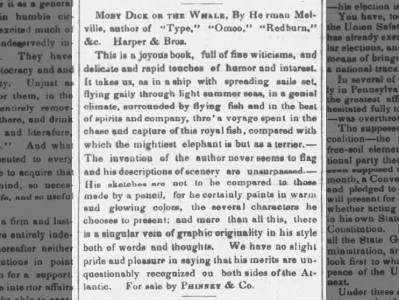
Moby-Dick published on November 22, 1851. Forthcoming soon, hopefully in the next post. Whoever wrote it, the short, cheery notice of
Moby-Dick in the Buffalo
Daily Courier is obviously in a different vein than the pointed and partisan criticism of
Mardi. Criticism of
Mardi by editor and staunch Democrat William A. Seaver?
"William A. Seaver, equally apt with pen and scissors, writes away with a graceful vigor and a pungent fluency on politics, persons and miscellany. His articles mark the studious reader and thinker, and have a relish of a well stored library at his elbow. He is one of the neatest paragraphers in the Union.
--Buffalo Commercial Advertiser, July 31, 1851
More on the long literary career of William A. Seaver, from the memorial tribute published in
Harper's Weekly, January 20, 1883:
WILLIAM A. SEAVER.
MR. WILLIAM A. SEAVER, whose sudden death on the 7th instant was a surprise and shock to all his friends, was born in Albany, New York, March 10, 1815. His parents removed to Batavia while he was in his infancy, and there he was brought up and educated. His first venture of any importance was in connection with the Buffalo Courier, of which he was for several years the editor;
MR. SEAVER came to New York more than twenty years ago, and occupied himself with literary pursuits. He was at one time editor of a Church journal in this city, and correspondent for several newspapers in the South and West. In 1868 he was placed in charge of the“ Editor’s Drawer,” in HARPER'S MAGAZINE, a position for which he was well qualified by his acquaintance with men, his position in society, and his rare aptitude as a raconteur. The “ Drawer" is literally what the name implies. When this department was first projected, in the summer of 1851, the clippings and contributions intended for it were thrown into a drawer of a certain desk, and this circumstance suggested the name. The same method has been pursued ever since that time. The contributions for this department of the MAGAZINE, which come from every part of the country, are still deposited in the drawer, whence the editor takes them and culls his selections. Many of the contributions are merely crude suggestions, and MR. SEAVER displayed fine tact in editing, condensing, or enlarging them. For many years MR. SEAVER also conducted the “ Personal" departments in HARPER'S BAZAR and HARPER'S WEEKLY, the latter until the last week of his life. On the Wednesday preceding his death his “copy“ came to the office, written in his usual clear and remarkably neat hand, and the editor, glancing over the familiar MS., had little thought that it was the last he should receive from his long-time associate.
MR. SEAVER was for some years President of the Adriatic Fire-insurance Company, of this city, and was also a member of the New York bar. He belonged to the Union Club, where his presence was always welcome, for his genial social qualities and his inexhaustible fund of anecdote and story. He resided in a pleasant cottage at Mount Vernon, where he had gathered an extensive and well-selected library. The cause of his death was acute pneumonia.