Thursday, December 15, 2016

Keith Huntress on Henry Cheever's review of Typee in the New York Evangelist

All I ever wanted to do was read books and talk about them. --Keith Huntress
Found on Newspapers.com

Randall Cluff does some neat detective work in his March 2001 Leviathan article on Henry Cheever's review of Typee, but Keith Huntress (1913-1990) first proposed Henry T. Cheever as the "H. C." who wrote the critical notice Typee published on April 9, 1846 in the New York Evangelist. Professor Huntress identified Henry Cheever in 1971 as the most likely author of the memorably negative review:
Henry Cheever's first contact with Melville was apparently a review of Typee which was published in the Evangelist April 9, 1846. This review is cited by both Jay Leyda and Hugh Hetherington. Leyda guessed that the review was written by George B. Cheever, but Hetherington states that the initials "H.C." were appended, and those initials, plus Henry Cheever's known connection with the Evangelist, plus his almost unique qualifications for reviewing a book about a whaleman in the South Seas, make it virtually certain that he was the author. --Keith Huntress, Melville, Henry Cheever, and "The Lee Shore" in The New England Quarterly 44.3 (September 1971): 470.
Citing additional notices in the Evangelist of Omoo, White-Jacket, Moby-Dick, and Israel Potter, Keith Huntress goes on to raise the
"strong possibility that Henry Cheever wrote all the reviews of Melville's work that appeared in the Evangelist."  --Melville, Henry Cheever, and "The Lee Shore" - page 472
The main point of his 1971 article in The New England Quarterly is to argue for Cheever's The Whale and His Captors as the source of Melville's "Lee Shore" conceit in Moby-Dick. In the June 2016 issue of Leviathan, Robert J. O'Hara cites Keith Huntress and his claim for Cheever while arguing for a more immediate source of Melville's theme and figurative language in Thomas Hood's poem The Lee Shore.

Below, some links to Melville-related publications by Keith Huntress. The first three items are listed by Mary K. Bercaw in the Scholarship section of Melville's Sources (Northwestern University Press, 1987) numbers 154, 156, and 510.
2016 has turned out to be a mighty fine year in which to remember Keith Huntress, pioneer in the study of Melville's sources and old school Cubs fan.


Tuesday, December 13, 2016

Against masquerades at Stanwix Hall

"Sad business, this holding out against having a good time. Life is a pic-nic en costume; one must take a part, assume a character, stand ready in a sensible way to play the fool. To come in plain clothes, with a long face, as a wiseacre, only makes one a discomfort to himself, and a blot upon the scene. Like your jug of cold water among the wineflasks, it leaves you unelated among the elated ones. No, no. This austerity won't do." --The Confidence-Man: His Masquerade
Right around the time that Herman Melville came back to Albany after a stint as rural schoolmaster, one local newspaper published a diatribe against costume balls or masquerades, specifically masquerades at Stanwix Hall. Melville was about to get himself elected as president of the Philo Logos debate club and would soon secure a room for club business in Stanwix Hall. The editorial blast at masquerades was practically guaranteed to get young Melville's attention by invoking the ghost of his grandfather Peter Gansevoort as a war hero and patriot, "one of the gallant fathers of our ancient city." Not only that, the call to more serious and socially responsible enterprises amid the "fiery ordeal of bankruptcy and distress" had an intensely personal application to the unfortunate Melville family, distressed yet again in April 1837 when Herman's brother Gansevoort filed for bankruptcy.

Formal balls regularly took place at Stanwix Hall, hosted by such reputable organizations as the Odd Fellows, Albany Burgesses Corps, Van Rensselaer Guards, and Albany Republican Artillery. The crusading Albany editor does not go for plays or circuses either, but his particular target seems to be the more exotic, foreign style of "fancy ball." Mr. William Whale operated the Dancing Academy at Stanwix Hall and might have been the unnamed villain who allegedly wanted to import masquerades to Albany. In October 1837 Mr. Whale had represented his European influences as a clear benefit, advertising "every facility through foreign correspondents of obtaining all the new and fashionable dances, music, etc. as introduced in London and Paris" (Albany Evening Journal, October 8, 1837). That same year Mr. Whale's "Fancy Dress and Masquerade Ball" had to be postponed from January to February, "in consequence of the necessary preparations" (Albany Argus, January 31, 1837). The following year Mr. Whale defied his puritanical newspaper critic with the announcement of "his 8th annual GRAND FANCY BALL" taking place at Stanwix Hall on March 28, 1838.

In August 1850 Herman Melville dressed up as a Turk for a costume ball hosted by Sarah Morewood, soon to be his Berkshire neighbor. The "Princess of Pic Nic," Cornelius Mathews called her. "Fairy Belt." Sarah Morewood also hosted outdoor "fancy dress" parties, often linked in Melville criticism with those philosophical remarks on life as "a pic-nic en costume" in The Confidence-Man. Masquerade is the last word and titular theme of Melville's novel. Masks and disguises receive plenty of critical attention, of course, but how about dancing? The Evangelist offers a contemporary view of the masquerade as foreign, degenerate, and threatening. This brand of dance is to be suppressed as morally dangerous public conduct. Considering the case for Melville's shape-shifting confidence man as the Devil variously disguised, it's also suggestive to find the engineer of masquerades exposed in Melville's Albany as Satan, the "Arch Apostate":
"A masquerade is but the apple of Eden in another shape; for the Arch Apostate well knows how to dish up his temptations in all possible shapes, from an apple in the bowers of paradise to a midnight coterie in Stanwix Hall...."
Under the head of "Christian Morals," the editorial against "Masquerades" was reprinted from an unnamed "Albany Paper" in the New York Evangelist on January 20, 1838. The Evangelist is where Melville would receive stinging criticisms for his first book, including the association of Typee with corrupt and corrupting "theatres, opera-dancers, and voluptuous prints" in London.
The New York Evangelist - January 20, 1838
1 of 2

The New York Evangelist - January 20, 1838
2 of 2

CHRISTIAN MORALS.

MASQUERADES.

We believe that every editor of a newspaper, or any other periodical, ought to show himself a watchful guardian of the laws of morality and religion; always, however, with that due deference to the opinions of others, which both modesty and decorum require. Under this impression it grieves us to behold an attempt making to introduce MASQUERADES into this city. These pernicious institutions have been for ages, in Europe, the hot-beds of every species of vice and wickedness. They are peculiarly calculated to give full scope to the most vicious propensities, the vilest corruptions, of our nature. It may be considered by some, perhaps, as a hard sentence; but it is our honest conviction, that masquerades are the direct offspring of that Arch Apostate, who was turned out of heaven for his treason to the Almighty. We believe it to be a moral impossibility for young people to attend these exhibitions steadily and at the same time preserve their virtue; and if they cannot be attended steadily with safety, then the very first step is a dangerous one. They are, like the theatre, among the surest path-ways to ruin, both temporal and eternal, of all who visit them. But one thing is certain, they cannot be supported without the aid of the female sex: and we shall, we trust, most wofully mistake the character of the female population of Albany, if they be found to encourage these devices of the worst enemy of the human race. A masquerade is but the apple of Eden in another shape; for the Arch Apostate well knows how to dish up his temptations in all possible shapes, from an apple in the bowers of paradise to a midnight coterie in Stanwix Hall—a name associated with the heroic achievements of our gallant fathers, and especially with those of one of the gallant fathers of our ancient city. We venture to assert, that could the shade of PETER GANSEVOORT look down upon the noble structure which bears a name so nearly allied to his fame as a patriot, and a virtuous citizen, it would frown indignantly upon every attempt to plant the standard of vice and immorality within those walls consecrated to the memory of his virtues as a citizen, and his valor as a hero of the revolution. Once more, we repeat it, this vile innovation upon our ancient simple manners, and republican and Christian virtues, cannot succeed without female countenance—and where, we ask, is the virtuous mother who will consent, or the virtuous daughter who will ask for consent, to participate in such scenes as masquerades have ever given birth to. We hope, for the honor of the female sex—for the honor of our city—and for the character of our common country, and the stability of its civil and religious institutions, that those who may have projected the foul amusement to which we allude, may pause and reflect upon its evil consequences; in which case, we are satisfied they will give it up as a pernicious design. Is it not, indeed, remarkable, that human beings—rational beings—immortal beings—should delight in frivolous, to say nothing of vicious amusements?

Independent of many other reasons that might be given, the present state of our country is such as to require both serious reflection and serious conduct, on the part of every citizen who feels an interest in her prosperity and happiness. Internally, she is going through a terrible if not a fiery ordeal, of bankruptcy and distress; and externally on one border she is herself engaged in savage warfare; and on another, though beyond her own limits, a dreadful civil war is raging, whose consequences, as they may bear upon her safety, no human being can foresee. With the flames of a national and savage war raging on one side of her and those of a civil war on the other, we repeat it, this is no time for revelry, licentiousness or levity of any kind. If any of our citizens have money to spare, let them look to the thousands of shivering and starving poor, with whom our cities are every where crowded, and will continue to be so through the winter. How many thousands of honest mechanics are now out of employment? And which is the best course for our youth to pursue—to spend their money in such frivolous and vicious pursuits as those of masquerades, theatres and circusses, or bestow it upon the unfortunate? If we blame Nero for fiddling and dancing over the burning ruins of his capital, can we commend those who would now laugh over the calamities which press upon their country, or the other calamities with which she seems to be threatened? We trust that every virtuous and patriotic citizen—and especially every true Republican and Christian—will look seriously to these things, and prevent, if possible, the youth under their care from running into the paths of perdition; and their country from adopting institutions which have grown out of the corruptions of Europe, and the dark designs of her tyrants and oppressors. —Albany Paper.
--New York Evangelist, January 20, 1838
In mid January 1846, Mrs. Edward Satterlee hosted a surpassingly elegant costume ball at Yates Mansion in Albany. Herman Melville's uncle Peter came to that Fancy Ball dressed in the costume of his own father, General Peter Gansevoort:
"Gen. G——t of Albany excited even more than usual attention and respect, by appearing in the uniform of his brave father, the Hero of Fort Stanwix."  --The Fancy Ball


Related post:

Sunday, December 11, 2016

Advance notice of Redburn in the New York Tribune

New York Daily Tribune - August 7, 1849
HERMAN MELVILLE.—This unrivaled fancy-glass spinner of sea stories has just ready for the press a new work entitled "Redburn—his First Voyage: being the Sailor-Boy Confessions and Reminiscences of the Son of a Gentleman." It will appear simultaneously from the press of the Harpers and Bentley in London. We have no manner of doubt that this work of our talented townsman will revive the old fascination of 'Typee,' and we shall wait for its appearance impatiently. 
--New York Daily Tribune - August 7, 1849; Library of Congress via Chronicling America: Historic American Newspapers.
Related post:

Saturday, December 10, 2016

Mitchell, Melville, and real Havanas in the New Orleans Daily Creole


From the New Orleans Daily Creole, December 10, 1856; found in the online Newspaper Archives at Genealogy Bank:
JUST THE THING.— "Ik Marvel," with his feet upon the mantel-piece, discussing the so-called glories of a bachelor's life with his touchy maiden aunt, with his brain swung into a half reverie by the semi-narcotic influence of a real Havana, gives us a glowing picture of a man content with all the world and "the rest of mankind." Happy Donald Mitchell! Herman Melville in his quiet valley of Typee was not happier. And the aromatic fumes of a cigar did all this—literally puffed away the sadness incident to human life! 
We had a trial of this yesterday. A box of real Havanas, such as Gen. Concha would praise, and, puffing, praise again, was laid upon our table. They were from the importing house of E. J. Hart & Co., Tchoupitoulas street. Knocking the ashes from the end, we looked into the consuming red, and thought that even in an editor's life there was occasionally a bright spot, after all.
Published by J. M. Weymouth, the New Orleans Daily Creole began in June 1856 and only lasted a year or so. On WorldCat and Chronicling America, The Daily Creole is still identified as an African-American newspaper--erroneously, as Thomas J. Davis noted in his contribution on "Louisiana" for 
The Black Press in the South, 1865-1979, edited by Henry Louis Suggs. The persistent "African-American" listing is also questioned by Armistead S. Pride and Clint C. Wilson in A History of the Black Press. The main cause for which the Daily Creole strove was the electoral agenda of the "American Party," the so-called Native-American or Know-Nothing Party backing former president Millard Fillmore against Buchanan and Frémont in the 1856 presidential election. Irish newsboys allegedly refused to carry the Daily Creole ("The Creole and the Newsboys," Daily Creole, August 5, 1856).

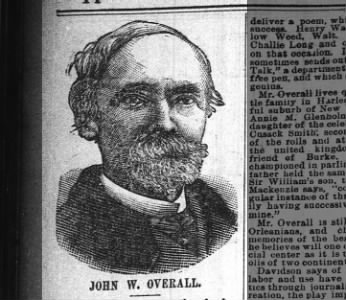
Reportedly, Virginia native John Wilford Overall served as editor of the short-lived Daily Creole. Those dreamy references to Ik Marvel and Melville in "Just the Thing" (transcribed above) indicate a poetic temperament and New York sensibility, both of which seem consistent with Overall as poet and eventually, after the Civil War, literary editor of the New York Sunday Mercury. Ignorant of Overall's postwar career in New York City, James Ryder Randall remembered him in New Orleans as a rival journalist and poet with "a vast ambition for literary fame" (Baltimore Sun - July 28, 1907).

On November 10, 1859, John W. Overall participated in the grand Schiller Festival in New Orleans, celebrating the centennial anniversary of Schiller's birthday. The New Orleans True Delta which Overall by then edited printed the whole of his speech at Odd Fellows' Hall. J. W. Overall delivered his remarks after the opening address in German by J. K. Gutheim. At one point in his enthusiastic tribute to Schiller, Overall paraphrased the segment in Melville's Typee on The Birds of the Valley:
In the bright, green islands of the Marquesas, brilliant-hued birds float like fragments of rainbows flashing in sunshine. But the birds, full-winged and sharp-beaked, transverse the amber-colored air with songless throats.

The New World but comparatively a few years back was like the lonely, yet beautiful Marquisan Islands. There were no sweet singers in all its Israel. Statesmen and heroes were her's, but the children of song who "marry them to immortality," built not the "lofty rhyme."  --New Orleans Daily True Delta, November 13, 1859
The New Orleans Delta also published the "Schiller Festival" speech by John W. Overall, along with the comment that
"Mr. Overall's address is especially marked by glowing imagery, imaginative thought, striking phrase, and fervid application of his subject."  --New Orleans Delta, November 13, 1859
In the New Orleans Sunday Delta a couple of years before, this same bit on the birds of Typee valley had flavored the unsigned rant on the supposed "Literary Subordinacy of the South." As shown in a previous post on Melville in the Sunday Delta, the writer there compared southern readers to Melville's "voluptuous and indolent Typees." The 1857 paraphrase is very close to Overall's 1859 paraphrase of the same passage in Typee:
"... birds with brilliant wings, flashing in the sun, fly noiselessly in the air, beautiful to look upon, yet songless as death."  --"Paragraphs for the Times," New Orleans Sunday Delta, June 21, 1857 
Both paraphrases of Melville use the words "brilliant," "flashing," and "songless." Both associate Melville with an atmosphere that is "amber-colored."

So then. John W. Overall wrote for all these New Orleans newspapers: the Daily Creole in 1856-7; the Sunday Delta in 1857-8; and the True Delta in 1859. Possibly the Melville mentions during those years are all his. I guess he was more of a Typee fan than a Melville fan. Another day I'll have to look for any Melville items in the New York Sunday Mercury during John W. Overall's tenure as literary editor there.


Related post:

Thursday, December 8, 2016

Notice of Battle-Pieces in The Congregationalist

The Congregationalist [Boston] - November 2, 1866
The Congregationalist was a Boston weekly newspaper edited by Henry Martyn Dexter. From The Congregationalist for Friday, November 2, 1866, published under the heading "Literary Review":
In Battle Pieces and Aspects of the War, Herman Melville gives to the public a collection of poems dedicated to the memory of the three hundred thousand who in the war for the maintenance of the Union, fell devotedly under the flag of their fathers. The poems are very unequal in merit, and cover a wide range of subjects, but all pertain strictly to the rebellion. The author in a supplement indulges in some general reflections on reconstruction which are in the main just: he evidently believes in the cultivation of kind feelings between the two sections of the country, and deprecates all action which has a tendency to perpetuate ill will. We think he carries this too far, and we do not fully agree with him when he says that "those unfraternal denunciations, continued through years, and which at last inflamed to deeds that ended in bloodshed, were reciprocal; and that, had the preponderating strength, and the prospect of its unlimited increase lain on the other side, on ours might have lain those actions which now, in our late opponents we stigmatize under the name of Rebellion."  --found in the online Newspaper Archives at Genealogy Bank
 

Most "Melville" items in this newspaper naturally refer to the Anglican preacher, the Rev. Henry Melville. Here's another, later reference in The Congregationalist to Herman Melville:
GOSSIP.
Literature has its ups and downs. A few years since Herman Melville was a popular author. His "Typee" and "Omoo" were the "tit-bits" of the circulating library. Now he is a clerk in that tomb of forgotten authors, the New York Custom House. --The Congregationalist, January 23, 1873

Melville in the Richmond Examiner and Boston Chronotype

Poe scholar Burton R. Pollin found an intriguing review-essay on Melville's work through Redburn in the Richmond Examiner (November 23, 1849), possibly by editor John Moncure Daniel (1825-1865). The Examiner review is transcribed in Burton R. Pollin, "Melville in Richmond, Figaro! and Elsewhere," Melville Society Extracts 89 - June 1992.

Evaluating Typee and Omoo as reality-based "fables," the Richmond journalist alludes to similar experiences of his own sailor brother and applauds Melville's skill at romancing fact.
A brother of the writer was once a sailor in this very portion of the Pacific, like Melville was ill treated and left his ship for the savages. He wandered for a time on one of the identical isles mentioned in these works. From his lips we have heard "yarns" very like Melville's. The author of Typee has interwoven a good deal of truth with much more fiction. He has embellished his adventures till they are probably as much like the tame realities as a marble statue is like its model in clay.
Attributing the unsigned review to Daniel, Professor Pollin thought this sailor brother must be Frederick S. Daniel. But Frederick was born in 1837 which does not allow much time for sailing, wandering, and returning to tell about it. JMD had five brothers. Oldest was Travers, born in 1827. Did Travers or any of Daniel's younger brothers ever sail the South Seas, really?

More famously, Edgar Allan Poe had an older and influential brother named William Henry Leonard Poe who maybe sailed to the West Indies, South America, the Mediterranean and Russia. According to Oscar Penn Fitzgerald, Poe wrote occasionally for the Richmond Examiner under Daniel and was supposed to become literary editor. To the same effect, Frederick S. Daniel recalled of Poe that "at the time of his death he was under an engagement to furnish literary articles to its editor." The long quote from Locksley Hall in the Examiner article on Melville perhaps indicates at least the influence of Poe, who in his Richmond lecture had extolled Tennyson as "the noblest poet that ever lived." But Poe never made it back to Richmond after leaving in late September. He died in Baltimore on October 7, 1849, about seven weeks before the notice of Redburn appeared in the Examiner.

Collaborators with Daniel on the Examiner when the Melville article was published in November 1849 included Patrick Henry Aylett (1825-1870) and Robert William Hughes (1821-1901). Did either of them have a sailor brother?

Also in the June 1992 issue of Extracts, Kent P. Ljungquist presents a remarkable review of Mardi in the Boston Daily Chronotype for May 10, 1849, "one of the longest and most appreciative discussions of Mardi published during Melville's lifetime." This exceptionally positive review was reprinted in the Weekly Chronotype on May 19, 1849. Robert K. Wallace makes good use of the Chronotype review in Douglass and Melville: Anchored Together in Neighborly Style. However, for the most part the Richmond Examiner and Boston Chronotype reviews remain tucked away in the (unsearchable?) archives of Extracts, out of the critical and scholarly mix.

Melville scholars need a central, searchable online database of Melville reviews and notices. The finest model I know of is The Walt Whitman Archive, edited by Ed Folsom and Kenneth M. Price. Print resources obviously have many virtues including permanence, or the illusion thereof. But print fossilizes error. Digital resources are better able to adapt, expand, and correct. Making a strength of changeability, The Whitman Archive uses a Change Log on Blogger to communicate additions and corrections to the Archive. They're on Facebook and Twitter, too.

Monday, December 5, 2016

James McAdams on Melville's Bohemians

I'm only catching up to this excellent, enlightening article by James McAdams in Connotations 25.1 on Melville's Pierre and the "Church of the Bohemians." The city sections of Pierre project, as stated in the Abstract, "a nascent cultural movement fully developed by the 1860s in the figures of Walt Whitman and the patrons of Pfaff's Saloon." At Melville's "Church of the Apostles," Pierre himself emerges
as an American Bohemian, a starving artist writing his "comprehensive compacted work" in the garret of an abandoned church whose other tenants offers a varied portrait of a nascent, and previously unexplored, American Bohemia.  --James McAdams