
Original research and riffs on Herman Melville, authorship, and nineteenth-century American literature.
Saturday, July 1, 2023
Melvilliana: Fourth of July Romance
Melvilliana: Fourth of July Romance: From the New York Atlas , July 2, 1854; found at GenealogyBank : A NEW ROMANCE BY TYPEE MELVILLE.-- The July number of Putnam's M...


Monday, June 19, 2023
Melvilliana: Lincoln's solemn vow
Melvilliana: Lincoln's solemn vow: The first reading of the Emancipation Proclamation before the cabinet Painted by F.B. Carpenter / engraved by A.H. Ritchie via Library of...
Tuesday, June 13, 2023
Melvilliana: Elizabeth S Melville, Happy 201st Birthday!!!
Links below to earlier posts on Melvilliana in honor of Herman's wife Elizabeth Shaw Melville, born his day 201 years ago on June 13, 1822:
- Melvilliana: Elizabeth S Melville, Happy 198th Birthday: Today is the birthday of Herman Melville's wife Elizabeth S. Melville aka Lizzie, born Elizabeth Knapp Shaw in Boston on June 13...
Sunday, May 28, 2023
Where is Melville?
 |
| A Man of the Sandwich Islands, with his Helmet © National Maritime Museum, Greenwich, London |
Disappointed with Kiana: A Tradition of Hawaii (1857) by James Jackson Jarves, one contemporary reviewer complained that "Romance plainly is not Mr. Jarves' forte" and wondered,
"Where is Melville?"
Surely the author of Typee, Omoo, and Mardi would have made a more entertaining story out of the same Polynesian material.
A newspaper clipping of the 1857 Kiana review was kept by the Melville family and eventually deposited at Harvard. I'm guessing it's still there:
- G. News clippings and other. Herman Melville papers, MS Am 188-188.6, MS Am 188. Houghton Library. https://id.lib.harvard.edu/ead/c/hou00338c00597/catalog Accessed May 28, 2023.
Jay Leyda put it in The Melville Log Volume 2 on page [583]:

Cited in the back of Volume 2 as "clipping, HCL-M" = "Papers & library of the Melville family, Harvard College Library."
Leyda got the place (Boston) right, along with the correct month (September) and year (1857) of the newspaper clipping. For those who care about such things, I'm happy to supply the missing name and date of the newspaper in which this interesting query appeared. Transcribed below, from the Boston Daily Traveller of September 14, 1857:
 |
| Boston Daily Traveller - September 14, 1857 |
Mr. Jarves' well known books--Parisian and Italian Sights--led us to look with favor upon anything coming from his pen. We are sorry to be disappointed in KIANA, a Tradition of Hawaii, just published by Munroe & Co. Romance plainly is not Mr. Jarves' forte. He had a charming subject, susceptible of the highest style of treatment in this difficult province of fiction. There is a tradition among the people of the Sandwich Islands, that during the reign of Kiana, eighteen generations of kings previous to Kamehameha I., a white priest came among them with an idol and a new god, lived with them long, and dying, left a reputation for goodness that was green in the memories of the Hawaiians three centuries later. The date of this tradition synchronizes with that of the loss of two vessels sent by Cortez upon an exploring expedition to California. Mr. Jarves supposes the possible identity of the white strangers of Hawaii with the missing adventurers of Cortez, and from this fertile source derives the materials for his story.
With such a beginning one might look for a romance equal to Mayo's Kaloolah or Melville's Omoo and Typee. The field is illimitable, the colors of every hue, and the license ample, only the skill of the romancer was wanting. It is a pity so good a piece of canvass should be spoiled. Where is Melville? Will he not leave the mazes of Pierre or the Ambiguities, and the eccentricities of the Confidence Man, and with some such charming tradition as this bring back the days and the delights of beautiful Fayaway, or take us voyaging to another Mardi. -- Boston Daily Traveller, September 14, 1857.
Emily Dickinson's friend Samuel Bowles of the Springfield, Mass. Republican had served as editor of the Boston Traveller since April 1857. In Springfield, Bowles was formerly assisted by Melville's "friendly critic" Josiah Gilbert Holland, so identified by Jay Leyda:
- Leyda, Jay. “Another Friendly Critic for Melville.” The New England Quarterly, vol. 27, no. 2, 1954, pp. 243–49. JSTOR, https://doi.org/10.2307/362806. Accessed 28 May 2023.
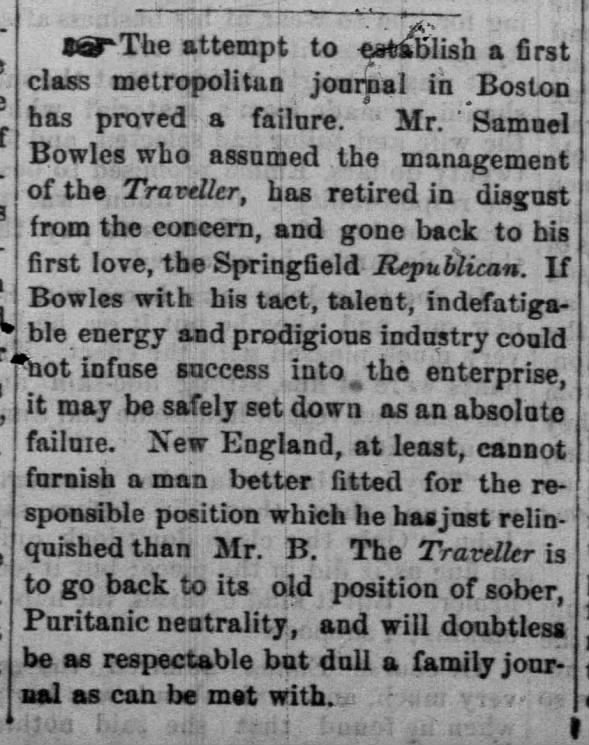
The departure of Samuel Bowles as editor of the Traveller was announced on September 10th in the Boston Evening Transcript. Possibly the Kiana review on September 14, 1857 was one of the last literary pieces that Bowles contributed or supervised as editor of the Boston Traveller.
Where is Melville?
In the Boston Traveller Bowles or somebody wondered, "Where is Melville?" We might be able to answer the question, now that we know the date on which it appeared in print. Where WAS Herman Melville on September 14, 1857? Back home in Pittsfield, Mass., brainstorming lecture topics, as he revealed the next day in a letter to George W. Curtis:
-- I have been trying to scratch my brains for a Lecture. What is a good, earnest subject? "Daily progress of man towards a state of intellectual & moral perfection, as evidenced in history of 5th Avenue & 5 Points."Even better, brainstorming lecture topics and satirizing utopian schemes of famous communists after reading Robert Owen:
By the wondrous and, hitherto, mysterious organic construction of man and woman, the adults of the first generation that shall acquire a practical knowledge of their own powers to re-form the matured character of each individual, will be enabled, almost to re-create the character of succeeding generations; to re-create it by training each individual from birth, by a new and very superior arrangement of external circumstances, to have a sound physical constitution, to have superior dispositions, habits and manners, to have much valuable knowledge, and to make a daily progress towards physical, intellectual and moral perfection.
-- Robert Owen, The Book of the New Moral World (London, 1836) page 103.
 |
| Robert Owen, Esq. via NYPL Digital Collections |
Melville's words and phrasing, specifically the stipulation of "daily progress" in the march "towards" a condition of "intellectual and moral perfection" are Robert Owen's in The Book of the New Moral World (London, 1836). "Subjects: Communism" as catalogued by HathiTrust Digital Library.
As it turned out, the real lecture Melville composed on Statues in Rome was delivered in Boston on December 2, 1857 and reported the next evening in the Boston Evening Traveller. Traces of Melville's epistolary parody of Owen linger in his reference to the utopian "scheme of Fourier" that had yet to dissolve the need for a whole code of laws against criminal conduct.
Related posts
- Melville's friendly critic at the Springfield Republican
https://melvilliana.blogspot.com/2014/08/melvilles-friendly-critic-at.html
- Melville's anti-communist math
https://melvilliana.blogspot.com/2021/08/2-2-4-melvilles-anti-communist-math.html
- Melville on Justinian and Juvenal, remembered in Minnesota
https://melvilliana.blogspot.com/2021/08/melville-on-justinian-and-juvenal.html
- Can art not life make the ideal?
https://melvilliana.blogspot.com/2015/02/can-art-not-life-make-ideal-herman.html
Friday, May 26, 2023
New York Dispatch, review of ISRAEL POTTER
This item is not collected in Herman Melville: The Contemporary Reviews, edited by Brian Higgins and Hershel Parker (Cambridge University Press, 1995; and 2009 in paperback). Contemporary Reviews gives two notices from the New York Dispatch, of The Piazza Tales on pages 477-8 and The Confidence-Man on pages 487-8.
 |
| New York Dispatch - April 22, 1855 via Genealogy Bank |
New Publications.
"ISRAEL POTTER." -- His fifty years of Exile,
by Herman Melville, Author of "Omoo" and "Typee," &c.
New York: Putnam & Co., 10 Park Place.
This last production from the pen of the author of "Typee," has been published in serial form in "Putnam's Magazine," where its monthly appearance has been looked for anxiously by the readers of that excellent periodical. It is the fanciful autobiography of a revolutionary soldier who spent his life in the unrequited service of his country. The celebrated naval hero, Captain Paul Jones, figures almost as prominently in the novel as does the hero himself--also Benjamin Franklin and others of the men of the Revolution. The tale is well told, the dialogue lively, and the incidents well strung together. In some respects this is the best of Herman Melville's works. It is more artistically finished than his former romances, and does not deal quite so luxuriantly in the marvellous, although the adventures of the Exile are wonderful enough to satisfy the most eager lovers of excitement. But we miss in this work the charming freshness which pervades every chapter of Mr. Melville's tales of the Pacific Ocean. He deals here in stern reality more than poetic beauty. As a tale of the Revolution, however, "Israel Potter" is second only to Cooper's Revolutionary novels, and it far surpasses those which have since flooded the country. Herman Melville knows his ground, and hence a thorough unity pervades the work. All who have read "Fifty years of Exile," as it passed through the pages of Putnam, will be desirous to procure the book complete; and those who have not heretofore read it have a rich treat in store. The book is very neatly got up.
-- New York Dispatch, April 22, 1855.
- Sunday Dispatch, super friendly notices of TYPEE and OMOO
https://melvilliana.blogspot.com/2022/01/sunday-dispatch-super-friendly-notices.html
- Sunday Dispatch review of MARDI
https://melvilliana.blogspot.com/2022/01/sunday-dispatch-review-of-mardi.html
- Dispatch notice of BATTLE-PIECES
https://melvilliana.blogspot.com/2022/01/dispatch-notice-of-battle-pieces.html
Wednesday, May 24, 2023
Augusta Melville, letter to Allan Melville, May 16th 1851
Here below is my transcription of Augusta Melville's letter to her brother Allan Melville in New York City, written on May 16, 1851 at the Van Rensselaer Manor House
in Albany, New York. As she informs Allan, Augusta had been there for at least two weeks ("a long fortnight"), visiting and
socializing with Albany relatives--2nd cousin Catherine "Kate" Van
Rensselaer, for one, a younger sister of Augusta's close friend Cornelia
"Nilly" Van Rensselaer Thayer.
Augusta's own home at the time was her brother Herman Melville's Arrowhead farm in Berkshire County, Massachusetts. While she was away in the month of May 1851, Herman was busy doing or supervising repairs and improvements to the farmhouse.
"The whole place will have been so much improved by the time of my return, that I expect hardly to recognize it."
Before she left to rejuvenate in Albany, Augusta had been working hard as Herman's copyist, tasked with turning her brother's scribblings into a legible manuscript for the printer. To Allan, in passing, Augusta made what has to be the earliest comment on record by any reader of Moby-Dick, five months in advance of its publication in England as The Whale:
"So you had a flying visit from Herman? When does he make the longer one? That book of his, will create a great interest, I think. It is very fine. By the way, have you seen Willis' Hurry-Graphs?"
Believing Herman's new book to be nearly finished and ready for the press, Augusta predicted it would "create a great interest." After praising the Whale in manuscript as "very fine," Augusta went on to commend Hurry-Graphs; Or, Sketches of Scenery, Celebrities and Society by Nathaniel Parker Willis (where "Herman Melville, with his cigar and his Spanish eyes" is mentioned at the start of the chapter on Lieut. Wise, Author of Los Gringos); and in a postscript, Jane Bouverie by Catherine Sinclair.
Augusta Melville's letter to Allan Melville on May 16, 1851 is now at Arrowhead, donated by Anna Waller Morewood (1905-1994). Hershel Parker quoted it for the first time in "New Melville Documents and Sub-Intentioned Death," Chapter 17 in Suicidology: Essays in Honor of Edwin Shneidman (Jason Aronson Inc., 1993) pages 289-298 at 291. Generous excerpts are given in Parker's Herman Melville: A Biography Volume 1, 1819-1851 (Johns Hopkins University Press, 1996) on pages 840 and 867. However, a complete transcription has not been published before now.
Dave Laczak, senior technician with the Local History Department of the Berkshire Athenaeum, helpfully directed me to the present location of Augusta's letter. At the Berkshire County Historical Society at Herman Melville's Arrowhead, assistance with obtaining scanned images was kindly provided by Lesley Herzberg, Executive Director; and Erin Hunt, Curator. I am sincerely grateful for their guidance. Mistakes are all mine.
 |
| Van Rensselaer Manor-House via NYPL Digital Collections |
Manor House
May 16th 1851
My dearest brother,
The letter you promised, has not yet made its appearance — & here I have been a long fortnight. But it is not too late yet, do not imagine that I have given up now all thoughts of receiving it, by no manner of means. I shall continue to expect it by each morning's mail, just as I have been doing ever since I came. I have only heard from home once, but I hope to have a letter tomorrow. They are all so busy there, that I suppose they dont feel as if they could spare the time to write often. The whole place will have been so much improved by the time of my return, that I expect hardly to recognize it. No doubt you have had letters since the date of mine & know just how far they have progressed. How I long to have everything in beautiful order, & you & Sophia & the children there enjoying the country air. Give my very warmest love to Sophia, & try to impress upon her mind the fact, that the receipt of a few lines from her, would afford me the highest satisfaction. I hope to hear that she feels stronger, & is no longer troubled with that wearisome pain in the back. Those arms, I trust, measure a little more in circumference, & those poor wrists are not quite so thin. I can imagine what a delicately slender appearance they present draped in the fashionable undersleeve. How much I should like to see that little Florence, & my darling little Maria. They will have grown almost out of my remembrance. Kisses by the dozen for them both; & a speedy transportation of them to Arrowhead.
May 16th 1851
My dearest brother,
The letter you promised, has not yet made its appearance — & here I have been a long fortnight. But it is not too late yet, do not imagine that I have given up now all thoughts of receiving it, by no manner of means. I shall continue to expect it by each morning's mail, just as I have been doing ever since I came. I have only heard from home once, but I hope to have a letter tomorrow. They are all so busy there, that I suppose they dont feel as if they could spare the time to write often. The whole place will have been so much improved by the time of my return, that I expect hardly to recognize it. No doubt you have had letters since the date of mine & know just how far they have progressed. How I long to have everything in beautiful order, & you & Sophia & the children there enjoying the country air. Give my very warmest love to Sophia, & try to impress upon her mind the fact, that the receipt of a few lines from her, would afford me the highest satisfaction. I hope to hear that she feels stronger, & is no longer troubled with that wearisome pain in the back. Those arms, I trust, measure a little more in circumference, & those poor wrists are not quite so thin. I can imagine what a delicately slender appearance they present draped in the fashionable undersleeve. How much I should like to see that little Florence, & my darling little Maria. They will have grown almost out of my remembrance. Kisses by the dozen for them both; & a speedy transportation of them to Arrowhead.
[page 2:]
And now I must try to gather all the Albany news for you, & tell you something of my visit thus far. The first week I was here, the weather was exceedingly unpleasant. Nothing but a succession of violent showers, so we were kept almost prisoners, I believe I was only out of the house twice. For the past six or seven days, however, it has been very delightful, just cool enough to be pleasant with the exception of one sultry day, when the thermometer stood at 80. We have been out driving a good deal, & had a good deal of company to dinner. I have only passed one day out, and that was at Aunt Susan's, yesterday. They are all very polite there — Uncle, excessively so. What will you say to his calling to see me with Aunt Susan last week, & then to his inviting me to drive with him to Troy to call upon General & Mrs Wool, to whom, it would give him much pleasure to introduce me! —he said.
 |
| General John Ellis Wool Photo portrait by Matthew Brady via Library of Congress |
Then too, they have really pressed me to make them a visit, when my visit here is over. This however I have declined doing, as I shall then be anxious to return home. Last evening, he again showered upon me his civilities, & ended by taking me to a grand Vocal & Instrumental Concert, which was given at Van Vechten Hall. Aunt Susan did not accompany us, as she is in mourning for Mr. Westerlo. By the way Mrs Westerlo & her daughters have almost determined upon removing to New York. Their annuity of $1500 a year died with Mr Westerlo, & the Van Rensselaer heirs have given them the house they occupy, which as it is upon such a valuable lot, they can dispose of to advantage. Some say it is will bring $16000; some $20,000. Did you know that Uncle had sold Grandmamma's house to Mr Delavan? Aunt Susan told me of it this morning, & said that he had received $13000 for it. Speaking of property makes me think of what an advantageous sale, Mr Van Rensselaer has lately made. They are to introduce the Tivoli water into the city, for which privilege, & the necessary
[page 3:]
land for the Reservoirs, the city have paid him 150 000 dollars. That has enabled him to pay up those heavy debts, & remove many of his anxieties arising from the anti-rent troubles. Then too, he has been engaged for some time in filling up the his low lands bordering on the river & converting them into lumber yards & docks — which rent to such advantage, that this past year, they brought him in $30,000. All these little particulars, I have treasured up in my memory, thinking they might interest you. Such things generally pass immediately out of my mind. They are making preparations to alter the patroon's bridge, so as to place it more on a direct line with the Troy road.—
A few days since, Kate Van Rensselaer & I took a long drive up on the new Albany-plank-road, went as far as Newtonville. We were with Mr and Mrs Sherman, in their beautiful open English Carriage. It was very pleasant. By the way, do you know that Mr Sherman has accepted the cashiership of a new private Bank about to be offered in New York, & is to lease his beautiful place this fall? To think of that, now, just when he has everything in such beautiful order. We were up there a few days ago to see a very magnificent Magnolia which was in bloom — over two hundred and fifty flowers upon it at one time, & as I walked round the grounds, I could not help thinking what a pity it was. Mr Duncan, of Providence, is to give the capital of this bank, $2000,000, & Mr Sherman puts in $100,000.
 |
| Albany Evening Journal - May 7, 1851 via Genealogy Bank |
[page 4:]
has almost entirely lost the use of her right hand (I never knew that,) & is very much depressed. You must go there very soon then & let us know how she is. Uncle Peter, did not even know that she had been ill, until the day I passed there. Henry & Kitty have both grown very much — Henry wants only an inch or two of Uncle's heighth. By the way, they have lost one of their neighbors—Judge Bronson who has removed to New York. Mr Thayer has just been passing a couple of days with us, he brought me an invitation to return with him to Boston, & make Cornelia a visit — but I shall defer that to some other time. We are expecting Justine home from Baltimore this afternoon. Her father went for her on Monday. She has been suffering from a most alarming cough, & the physicians recommended her taking a little trip to the South — so she availed herself of that opportunity to visit Margaret in her new home. Bayard returns from Scotland some time next month. He has finished at the University, & is now to go in business. They speak of putting him with Mr Thayer.
They are all well at the Van Vechtens. Mr Van Vechten's health is so much improved that he is able to take a drive every day, & attends church. The use of his hand however, is still denied him. There is some talk of Cuyler's going to Europe. He is more of an exquisite than ever. I met him at the Concert, the other evening. Judge Hurlbut, is passing a fortnight at his place in the country. Kate misses him very much. He has given up all business & is now a gentleman of leisure. Mr Van Vechten's attack was viewed, I believe, as a warning. Cousin Hetty Ten Eycke has given up her house, & removed, with her furniture to Whitehall, where she is to live. Leonard is there — but the other boys are scattered. Anthony boards at the Mansion House, & practices law. But everyone says he is worth nothing. Jacob is in California, Clinton in Mr Corning's store, & Cuyler at Paige's Furnace.
Picture Credit: Courtesy of the Berkshire County Historical Society, Pittsfield, MA. www.berkshirehistory.org
 |
| Detail, page 4 of 4. Augusta Melville, letter to Allan Melville, 16 May 1851. Courtesy of the Berkshire County Historical Society, Pittsfield, MA |
So you had a flying visit from Herman? When does he make the longer one? That book of his, will create a great interest, I think. It is very fine. By the way, have you seen Willis' Hurry-Graphs? Mr Sherman, says there is a capital portraiture of Wise in it? He has been visiting him. Next month, he expects a visit from another author, Mr Mitchell of the "Reveries of a Bachelor." Ask Sophia to read them, they are so interesting. Did you see by the papers that Mrs Harmanus Bleecker is married to Mr Coster at Amsterdam. She is expected back in one of the early steamers. How is Mrs Charles. Tell her not to despair of receiving an answer to her letter. I will write before I leave Albany. I wrote Mary Blatchford a few days since. Now show a grateful heart & answer this voluminous letter by as voluminous a one. lovingly your sister.
[P.S. top of page 1:]
My love to Mrs Thurston & every member of the family. Remember me to both of the Elizas. Has Sophia, read "Jane Bouverie" — It is beautifully written. Miss Sinclair is the author. Remember me kindly to Mr & Mrs Duyckinck. Mr J. R. wanted me to go with him to Baltimore. How pleasant it must be in New York now. Tell Sophia Mrs Bigelow (Miss Poultney) has a little son, a month old. But perhaps she knows it. Now I believe I have told you everything that I can think of. Cousin Maggie Wynkoop sent her love. The Taylors asked about you all.
My love to Mrs Thurston & every member of the family. Remember me to both of the Elizas. Has Sophia, read "Jane Bouverie" — It is beautifully written. Miss Sinclair is the author. Remember me kindly to Mr & Mrs Duyckinck. Mr J. R. wanted me to go with him to Baltimore. How pleasant it must be in New York now. Tell Sophia Mrs Bigelow (Miss Poultney) has a little son, a month old. But perhaps she knows it. Now I believe I have told you everything that I can think of. Cousin Maggie Wynkoop sent her love. The Taylors asked about you all.
* * *
Related posts:
- General and gentle readers
https://melvilliana.blogspot.com/2023/05/general-and-gentle-readers.html
- Mid-to-late May maybe
https://melvilliana.blogspot.com/2023/10/mid-to-late-may-maybe.html
- Robert Craighead's third-story rooms on Fulton street
https://melvilliana.blogspot.com/2023/10/robert-craigheads-third-story-rooms-on.html
Subscribe to:
Posts (Atom)