Sunday, December 17, 2017

Birth announcements, 1853

More than one newspaper in western Massachusetts indulged in a joke about authorship as a kind of fatherhood when announcing the birth on May 22, 1853 of Herman Melville's daughter Elizabeth "Bessie" Melville. The first item below is one I had not seen before, from the Franklin Democrat (May 30, 1853) courtesy of Fulton History

Franklin Democrat [Greenfield, Massachusetts] May 30, 1853

BORN.

...
In Pittsfield, 22d, a daughter to Herman Melville, the well-known author of several literary, not physiological works.
Greenfield native Joseph Hussey Sprague edited and published the Franklin Democrat from 1852 to 1854.

As reported by Jay Leyda in Another Friendly Critic for Melville, this earlier notice of Melville's "new work" in the Springfield Republican for May 28, 1853 (page 2):

Springfield Republican - May 28, 1853
 refers to this birth announcement on the same page, different column:

Springfield Republican - May 28, 1853
Related posts:

Saturday, December 16, 2017

Number 18

As MacDonald P. Jackson demonstrates at the tail end of Who Wrote "The Night Before Christmas"? (Appendix III, pages 173-4), the broadsheet of "A Visit from St Nicholas" published by the Troy Sentinel and now owned by the great Museum of the City of New York served as the printer's copy for "Visit" in the 1844 volume, Poems by Clement C. Moore.

N. Tuttle. Account of a visit from St. Nicholas, or Santa Claus.
Museum of the City of New York. 54.331.17
Jackson documents numerous and distinctive textual features of the 1830 broadsheet that appear in the 1844 book version, as well as handwritten changes made by Moore himself, including the notable correction or revision of "Blixem" to "Blitzen."

Additional evidence, not cited by Jackson, supports his finding that Moore used the Sentinel broadsheet in 1844 when preparing "Visit" for republication by Bartlett & Welford. As still faintly visible, a faded or penciled "X" indicates deletion of all prefatory matter including the heading "A Gift for Christmas" and the delightful engraving by Myron King. At the very top of the page, above the ornamental, arabesque border in color, another direction for the printer can be seen, apparently also in pencil or faded ink: "Nu 18" or "No 18." Can this abbreviated "Number 18" refer to the Christmas poem? Yes, absolutely: counting down in the table of contents for Moore's 1844 Poems, A Visit from St. Nicholas is the eighteenth piece in the book. Voila!


TABLE OF CONTENTS.
  1. A Trip to Saratoga
  2. To My Children, with my Portrait
  3. To THE Fashionable part of my Young Countrywomen
  4. The Mischievous Muse — Translation,
  5. Lines written after a Fall of Snow
  6. To Young Ladies who attended Philosophical Lectures
  7. On seeing my Name written in the sand of the sea-shore
  8. On Cowper the poet
  9. To Petrosa
  10.  Translation of an Ode of Metastasio
  11.  A Song
  12. Old Dobbin
  13.  Apology for not accepting an Invitation to A Ball
  14.  Answer to the above, by Mr. Bard
  15. Translation of a chorus in Aeschylus
  16. Lines accompanying some Balls sent to a Fragment Fair
  17. To a Lady
  18. A visit from St. Nicholas
  19. From a Husband to his Wife
  20. Lines by my late Wife, written in an Album....

Monday, December 11, 2017

Book reviews in manuscript at NYPL, digitized and online

Melville's review (published as Mr. Parkmans' Tour) of The California and Oregon Trail - manuscript page 6
The New York Public Library Digital Collections
Newly available in the New York Public Library Digital Collections are five of Herman Melville's published book reviews in manuscript, filed in the Duyckinck family papers with Literary Correspondence of Evert A. and George L. Duyckinck under the subheading "Literary Manuscripts." Four of these are manuscript copies for the printer in Melville's handwriting; one ("Hawthorne and His Mosses") is a fair copy made by his wife Elizabeth with numerous, in places extensive revisions in Melville's hand.
  1. Review of Browne's Etchings of a Whaling Cruise
    1847
  2. Review of The California and Oregon Trail
    1849
  3. Review of Cooper's The Sea Lions
    1849 - Note from Melville to Duyckinck attached, 1 page. 
  4. A Thought on Book Binding
    1850 - review of the revised edition of The Red Rover by James Fenimore Cooper. 
  5. Hawthorne and His Mosses
    1850 - review of Mosses from an Old Manse by Nathaniel Hawthorne. 
Wonderful! It's one thing to know, as the dependable Northwestern-Newberry edition of The Piazza Tales and Other Prose Pieces told us thirty years ago, that Melville wrote the fair copy of "Mr. Parkman's Tour" on the back of legal forms "intended for use in cases involving debts," but now (if you're so inclined) you can see the other side for yourself.

Review of Parkman's Oregon Trail - manuscript page 1, verso
The New York Public Library Digital Collections

More substantively, you could look into manuscript page 2 of Melville's review-essay "Hawthorne and His Mosses" (in his wife's handwriting with Herman's revisions) and catch Melville exchanging the solemnity and alliterative punch of "the God in his glance" for the blander "heaven in his glance." Either way Melville verges on comparing Hawthorne to Jesus Christ, but the revision somehow makes the implied likeness sound less provocative. Well, that bit also made a graphic appearance in the editorial notes for the Northwestern-Newberry edition (see page 663), which offered generous helpings of reproductions and excerpts from the manuscript of "Hawthorne and his Mosses."

Without corresponding images to consult, descriptive lists of "Manuscript Alterations" can be discouraging and, depending on how long they are, even scary. Different things will stand out and invite further study now that readers can examine the digitized images online. For instance, a couple of corrections that Elizabeth herself made to the "Mosses" essay on manuscript leaf 6 strike me now as remarkable and perhaps worth a closer look, being suggestive of an unexpected word choice by her husband.

"Hawthorne and his Mosses" - manuscript page 6
The New York Public Library Digital Collections
Copying the passage about  Hawthorne's "Old Apple-Dealer," Elizabeth evidently had trouble reading Herman's word touches, twice:
But he has still other apples, not quite so ruddy, though full as ripe;—apples, that have been left to wither on the tree, after the pleasant autumn gathering is past. The sketch of "The Old Apple-Dealer" is conceived in the subtlest spirit of sadness; he whose "subdued and nerveless boyhood prefigured his abortive prime, which, likewise, contained within itself the prophecy and image of his lean and torpid age." Such touches as are in this piece cannot proceed from any common heart. They argue such a depth of tenderness, such a boundless sympathy with all forms of being, such an omnipresent love, that we must needs say that this Hawthorne is here almost alone in his generation,—at least, in the artistic manifestation of these things. Still more. Such touches as these,—and many, very many similar ones, all through his chapters—furnish clues whereby we enter a little way into the intricate, profound heart where they originated. --The Literary World-August 17, 1850
Apparently, Herman Melville's two "touches" were unexpected and hard to decipher in his copyist's crabbed exemplar. She made them "tones" in the first case, then "words" in the second. Very good guesses, both wrong. Later, she corrected her misreadings:
 "Such tones touches as are in this piece cannot proceed from any common heart."
"Such words touches as these...."
In the context of the "Mosses" essay and elsewhere, Melville's word touches evokes the visual arts of drawing, painting, engraving (and tattooing), and sculpture. By "touches" Melville in part means or implies the strokes of a brush, pen, pencil, chisel, or implements of etching. Parallels may be found in Typee (A Professor of the Fine Arts) and Moby-Dick (Of the Monstrous Pictures of Whales):
In the vignettes and other embellishments of some ancient books you will at times meet with very curious touches at the whale, where all manner of spouts, jets d’eau, hot springs and cold, Saratoga and Baden-Baden, come bubbling up from his unexhausted brain. --Moby-Dick in Pictures
Examples occur also in Melville's magazine fictions Benito Cereno (Babo's "impromptu touches" as barber reveal, on multiple levels, "the hand of a master.") and "The Bell-Tower":


 "But the figures, they are not yet without their faults. They need some touches yet."
"... it was surmised that the mechanician must then have hurried to the bell, to give his final touches to its sculpture." --Putnam's Magazine 6 - August 1855; collected in The Piazza Tales (New York: Dix & Edwards, 1856).
More intriguingly, both usages in the "Mosses" essay occur in close proximity with the word heart. Touches by a gifted writer or visual artist be said to impart beauty to a "sketch," and also to reveal something of the of the artist's interior makeup and feelings--whatever qualities of spirit or soul may be conveyed by the complicated "heart." Decades later in Clarel (1876) Melville poetically speaks of aqua-fortis "touches" in engravings by Giovanni Battista Piranesi. There Melville reads Piranesi's Imaginary Prisons figuratively, as emblems of "labyrinths" in the human "heart."

This canto "Prelusive" on Piranisi feels crucial to Melville's art, and naturally elicits extended discussions in Melville criticism. Samuel Otter calls it
 The "Heart" of Clarel. -- "How Clarel Works" in A Companion to Herman Melville, ed. Wyn Kelley (Wiley-Blackwell, 2015), page 476.
In The Mystery of Iniquity (University Press of Kentucky, 1972), William H. Shurr similarly concentrated on the passage about "touches bitten in the steel / By aqua-fortis," quoting Melville's reference to the process of "biting in," of etching with acid:
The reader must focus his attention upon these etchings and their import. One has the sense of being at one of the centers of the poem, forced by the author not to miss the point:
Dwell on those etchings in the night,
Those touches bitten in the steel
By aqua-fortis, till ye feel
The Pauline text in gray of light;
Turn hither then and read aright. [Clarel Part 2, Canto 35]
So then, sympathetic readers find "touches" at the heart of Herman Melville's Clarel, and here we graphically see them at the heart of "Hawthorne and His Mosses," too--courtesy of Elizabeth Shaw Melville and The New York Public Library Digital Collections.

Related posts:

Saturday, December 9, 2017

Autograph note signed

Here you go, the perfect stocking-stuffer for that eccentric and hard-to-please Melville obsessive on your Christmas shopping list. A guest pass signed by Herman Melville is offered in Sotheby's upcoming auction of Fine Books & Manuscripts.

Catalogue Note


This pass was presumably issued for a lecture Melville delivered to the Mechanic Apprentices’ Library Association in Boston in 1859, this being the only lecture he is known to have given on the last day of January. Titled "The South Seas," it explored the author's experiences there, which had served as the inspiration for his first two books, Typee and Omoo.
http://www.sothebys.com/en/auctions/ecatalogue/2017/fine-books-manuscripts-n09658/lot.236.html
This item was already known from catalogues of previous auctions. A transcription appears on page 333 in the 1993 Northwestern-Newberry edition of Melville's Correspondence, edited by Lynn Horth.

Wednesday, December 6, 2017

Clement C. Moore, My Reasons for Loving (poem by Catherine Elizabeth Taylor)

Poem by Eliza Moore in Mary Moore Sherman's Recollections of Clement C. Moore (1906)
via William & Mary Libraries

Clement C. Moore
MY REASONS FOR LOVING.

You ask me why I love him?
    I’ll tell the reason true:
Because he said so often
    With fervour “I love you.”

I loved him, yes, I loved him
    Because he told his flame
With such a skilled variety
    And whispered “Je vous aime.”

Because so sweetly tender
   As any swain on Arno,
In crowded streets he’d woo me,
   With Petrarch’s own “Vi amo.”

Because whenever coldly
    I’d answer him “Ah, no,”
He’d all my coldness banish
    By faltering “Te amo.”

Because when belles surrounded
    He’d still address to me
The words of love and learning,
    And sigh “Philea se.”

Because his English, French,
    Italian, Latin, Greek,
He crowned with noble Hebrew
    And dulcet “Ahobotick.”

Moore's wife Catherine Elizabeth Taylor ("Eliza" in the family circle) composed these quatrains which were transcribed by Mary Moore Sherman and printed in the beautiful volume titled Recollections of Clement C. Moore, author of "A Visit from St. Nicholas" (New York: Knickerbocker Press, 1906). Available online from the Nancy H. Marshall collection in the William & Mary Digital Archive:
"Includes 2 poems by Clement C Moore, including "A Visit from St. Nicholas." Part of the Nancy H. Marshall Night before Christmas collection. Swem Library copy includes and undated letter about the book by Margaret N. C. Bradley, niece of the author."
https://wm.primo.exlibrisgroup.com/permalink/01COWM_INST/g9pr7p/alma991004057749703196


The second poem by Clement C. Moore in this volume of Recollections by his granddaughter is the lovely snow poem, Lines Written after a Snow-storm


Related post

Monday, December 4, 2017

A Visit from St Nicholas in The National Gazette

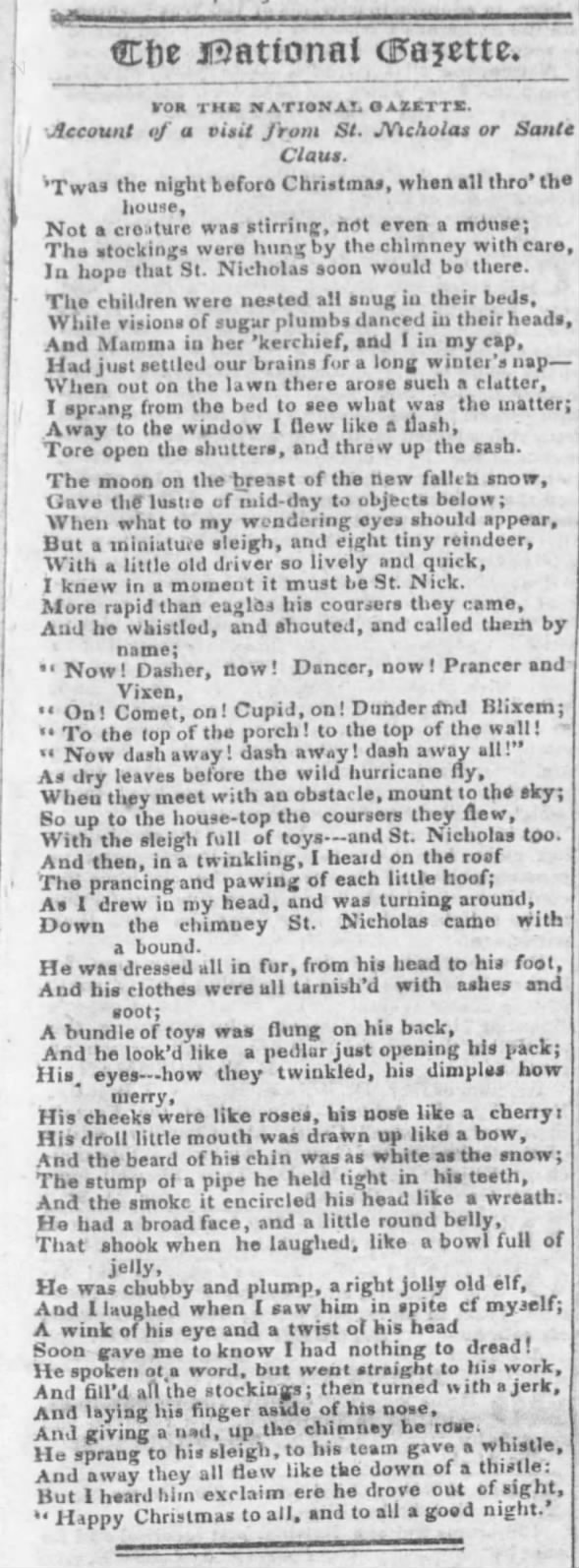
Here is an early, anonymous reprinting of Clement C. Moore's "A Visit from St. Nicholas," published in The National Gazette and Literary Register [Philadelphia, Pennsylvania] on December 24, 1827.
On page 2 of the Christmas Eve issue, the editor of The National Gazette explained the decision to publish the Christmas poem on page 1 as follows:
"We do not know whether the verses in our first page be original or not. They possess merit and appropriateness, however; and are consequently entitled to the place which they occupy."  --National Gazette, December 24, 1827
Mon, Dec 24, 1827 – 1 · The National Gazette (Philadelphia, Pennsylvania) · Newspapers.com

FOR THE NATIONAL GAZETTE.

Account of a visit from St Nicholas or Sante Claus

Twas the night before Christmas, when all thro' the house,
Not a creature was stirring, not even a mouse;
The stockings were hung by the chimney with care,
In hope that St. Nicholas soon would be there.
The children were nested all snug in their beds,
While visions of sugar plumbs danced in their heads,
And Mamma in her 'kerchief, and I in my cap,
Had just settled our brains for a long winter's nap —
When out on the lawn there arose such a clatter,
I sprang from the bed to see what was the matter;
Away to the window I flew like a flash,
Tore open the shutters, and threw up the sash.
The moon on the breast of the new fallen snow,
Gave the lustre of mid-day to objects below;
When what to my wondering eyes should appear,
But a miniature sleigh, and eight tiny reindeer,
With a little old driver so lively and quick,
I knew in a moment it must be St. Nick.
More rapid than eagles his coursers they came,
And he whistled, and shouted, and called them by name ;
“Now, Dasher, now! Dancer, now! Prancer and Vixen,
“On! Comet, on! Cupid, on! Dunder and Blixem;
“To the top of the porch! to the top of the wall!
“Now dash away! dash away! dash away all!”
As dry leaves before the wild hurricane fly,
When they meet with an obstacle, mount to the sky;
So up to the house-top the coursers they flew,
With a sleigh full of toys—and St. Nicholas too.
And then, in a twinkling, I heard on the roof,
The prancing and pawing of each little hoof;
As I drew in my head, and was turning around,
Down the chimney St. Nicholas came with a bound:
He was dressed all in fur, from his head to his foot,
And his clothes were all tarnish’d with ashes and soot;
A bundle of toys was flung on his back,
And he look'd like a pedlar just opening his pack;
His eyes—how they twinkled! his dimples how merry,
His cheeks were like roses, his nose like a cherry;
His droll little mouth was drawn up like a bow,
And the beard of his chin was as white as the snow;
The stump of a pipe he held tight in his teeth,
And the smoke it encircled his lead like a wreath.
He had a broad face, and a little round belly,
That shook when he laughed, like a bowl full of jelly,
He was chubby and plump, a right jolly old elf,
And I laugh’d when I saw him in spite of myself;
A wink of his eye and a twist of his head
Soon gave me to know I had nothing to dread!
He spoken ot a word, but went straight to his work,
And fill'd all the stockings, then turned with a jerk,
And laying his finger aside of his nose,
And giving a nod, up the chimney he rose.
He sprang to his sleigh, to his team, gave a whistle,
And away they all flew like the down of a thistle:
But I heard him exclaim ere he drove out of sight—
"Happy Christmas to all, and to all a good night."
As in The Casket for February 1826, the National Gazette printed "nested" instead of "nestled" in the fifth line. (Other readings in The Casket are not reproduced here, for instance the reindeer names"Dunter and Blixen." The National Gazette gives "Dunder and Blixem," as found in the earliest printing of the Christmas poem in the Troy Sentinel on December 23, 1823.) Some newspapers, for example the Poughkeepsie Journal on January 16, 1828, explicitly credited "The National Gazette" when reprinting the 1827 version transcribed above.

Francis P. Lee on Clement C. Moore's authorship of The Night Before Christmas

Link below for update with new info posted 02/07/2025

Another reason to love footnotes--not that we need one here at Melvilliana. As documented in a footnote to chapter 4 of Stephen Nissenbaum's The Battle for Christmas, Sandra D. Hayslette found an early reference to Clement C. Moore's authorship of "A Visit from St. Nicholas," aka "The Night Before Christmas," in the manuscript diary of Francis Prioleau Lee (1814-1847). While a student at General Theological Seminary in New York, Francis P. Lee described a holiday fair in Morristown, New Jersey on New Year's Eve, 1833 1834! that
"was held...under the auspices of a figure called St. Nicholas who was robed in fur, and dressed according to the description of Prof. Moore in his poem. --quoted by Stephen Nissenbaum in The Battle For Christmas, fn 85, page 345.
The footnote by Nissenbaum locates the diary of Francis P. Lee "in the archives of the General Theological Seminary."
  • http://library.gts.edu/special-collections/
However, the online finding aid for the Francis P. Lee Papers, 1727-1930 (Mss. 65 L51 and Acc. 2011.285) at the Special Collections Research Center, Swem Library, College of William and Mary. indicates that the William & Mary library now holds both the private journal and a transcription. Specifically, these items are held with Series 2: Acc. 2011.285 Addition, 1827-1933 in Box 11, Folders 2 and 3.

Preferred Citation
Francis P. Lee Papers, Manuscripts and Rare Books Department, Swem Library, College of William and Mary. 
[http://ead.lib.virginia.edu/vivaxtf/view?docId=wm/viw00064.xml]
Unless there are two diaries, this here looks like the one referenced in The Battle for Christmas:
Folder 2: Francis P. Lee Diary, 1833-1835
Rev. Lee died young in Mobile, Alabama during the epidemic of yellow fever there on September 11, 1847. Below, the obituary of Francis Prioleau Lee that appeared in the Protestant Churchman on November 27, 1847: 


One of the victims of the recent epidemic at Mobile, was the REV. FRANCIS PRIOLEAU LEE, rector of Christ Church, in that city. We had hoped that, ere this, a proper obituary notice would have appeared in our columns, from the hand of one more competent than ourselves to sketch his character, and record those Christian virtues which shed peculiar brightness over the closing years of his life and ministry. It was our lot to be intimately associated with Mr. Lee, during the whole course of study and preparation for the sacred ministry, in the General Theological Seminary. His talents commanded the respect and admiration of his instructors and fellow-students, and gave high promise of usefulness to the Church, while his frank, manly, generous disposition, sanctified by deep but unaffected piety, won and retained for him the unqualified confidence and warm affection of his friends. Although, through the whole course of his ministry, he had approved himself an active and zealous servant of Christ, in the great work which His Church has been commissioned to perform, his faithfulness and self-devotion were most conspicuous in the last years of his life. On his removal to Mobile, the influence of his piety, energy, and eloquence, were distinctly felt in a larger sphere of labor than any to which he had hitherto been called. He was appointed, we believe, as one of the delegates from the Diocese of Alabama to the late General Convention, and was only prevented from attending it by the determination not to desert his post during the fatal epidemic which prevailed in his parish, and to which he fell a victim on the 11th of September, at the age of thirty-three. "He died," says a contemporary journal, quoted in the Churchman, "as he had lived, faithfully discharging the duties of a zealous and devoted pastor. While visiting the sick, and imparting the consolations of religion to the dying, he himself contracted the fatal disease, which terminated his useful life; thus, in the midst of his pious and self-sacrificing labors, he fell a martyr, as did his divine Master, to the good of others. 'Let me die the death of the righteous, and let my last end be like his.'"

Faith lifts the tearful eye from the grave that contains his dust, to those heavenly regions where the faithful rest in glory. "Blessed are the dead who die in the Lord."

"Listen! it is no dream: th' apostle's trump
Gives earnest of th' Archangel's--calmly now
Our hearts yet beating high
To that victorious lay;
Most like a warrior to the martial dirge
Of a true comrade, in the grave we trust
Our treasure for a while;
And if a tear steal down,
If human anguish o'er the shaded brow
Pass shuddering, and at our brother's name
Once and again the thought
Comes sadly, "He is gone;
THOU who canst change the heart and raise the dead,
As thou art by to soothe our parting hour,
Prepare us all to meet
With him before thy throne."
-- Protestant Churchman, November 27, 1847.

Related post