Fri, Jan 16, 1824 – 2 · The Charleston Mercury, and Morning Advertiser (Charleston, South Carolina) · Newspapers.com
The anonymous lines were reprinted the following year on Christmas Eve, still with "nested" and "Dunder and Blixem." The original prose intro by Troy editor Orville L. Holley has been dropped in the 1825 version, shown below, but the expanded title incorporates Holley's helpful identification of St. Nicholas as "Sante Claus," thus:
ACCOUNTOf a visit from St. Nicholas or Sante Claus.
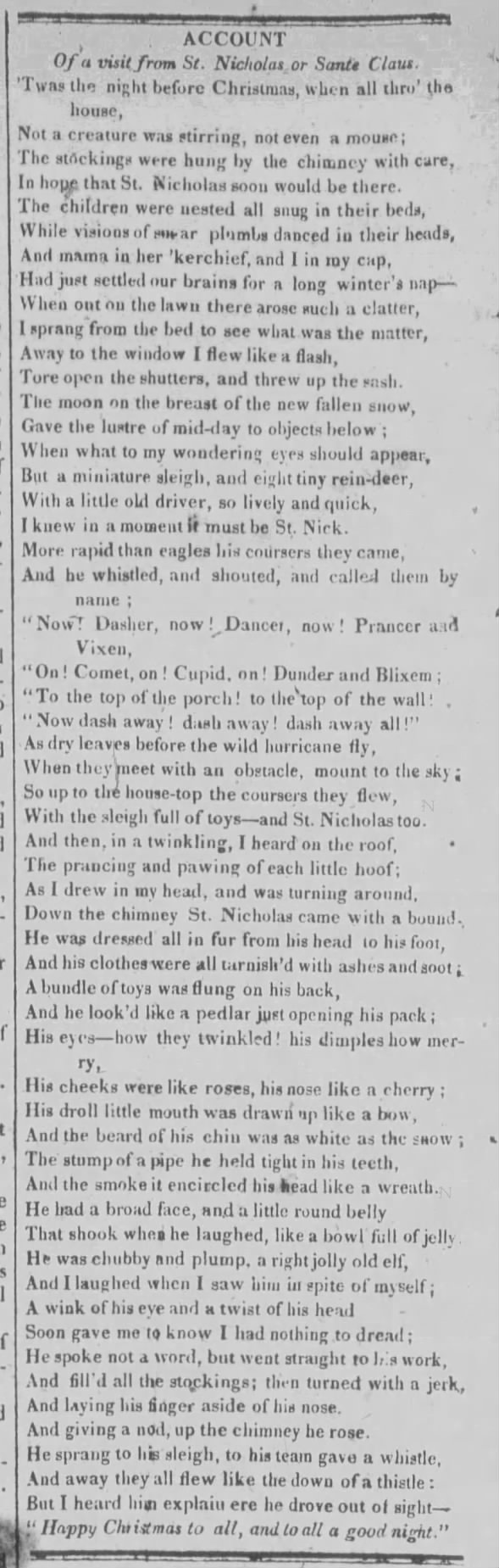 Sat, Dec 24, 1825 – 2 · The Charleston Mercury (Charleston, South Carolina) · Newspapers.com\
The same reading of "nested" instead of "nestled" occurs in the version of "Visit" published on December 26, 1826 in the Leesburg, Virginia Genius of Liberty. The Leesburg newspaper reprinted the Christmas poem "from the Charleston Mercury," under the same title that the Mercury had presented on Christmas Eve, 1825. However, the 1826 Genius of Liberty version gives the form "Blixen" where the Charleston Mercury in 1824 and 1825 had printed "Blixem." Likewise, the text of the still anonymous poem in the Lexington, Kentucky Reporter for January 23, 1826 also credits "the Charleston Mercury" and prints "Dunder and Blixen," along with "nested."
Another even earlier reprinting of "Visit" from the Charleston Mercury appears in the Washington, D.C. National Intelligencer for January 2, 1826. As in the Kentucky Reporter, the National Intelligencer text is headed "Christmas Times" and includes the variant forms "nested"; "Blixen"; and singular "hope" instead of "hopes" in the fourth line. Oddly, in the next-to-last line, the December 1825 Charleston Mercury version has Santa Claus "explain" rather than "exclaim" his parting benediction. The 1826 reprintings "from the Charleston Mercury" in the National Intelligencer, Kentucky Reporter, and Leesburg Genius of Liberty all exhibit the usual verb, exclaim.
 |
| Washington Daily National Intelligencer January 2, 1826 via GenealogyBank |
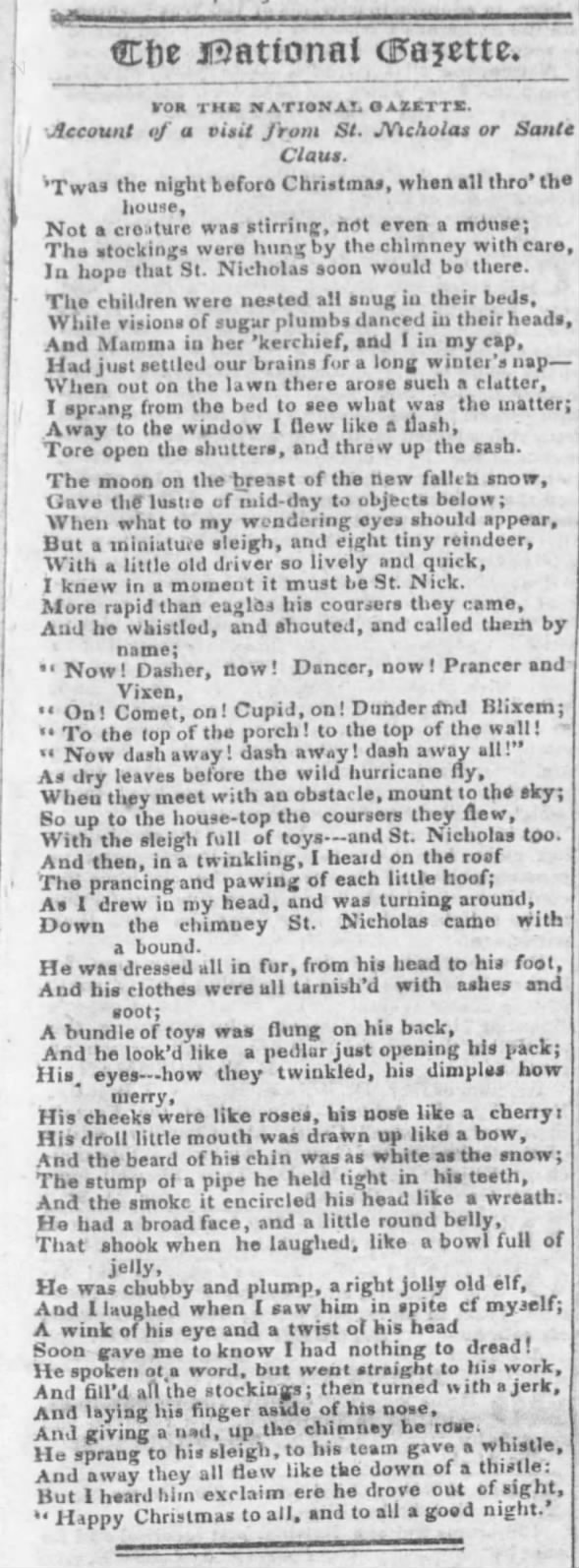
The influential printing in The National Gazette (Philadelphia, PA) on December 24, 1827 follows the 1825 Charleston printing in keeping "Blixem," as well as in the phrasing of the title and the printing of "hope" for "hopes"; and "nested" for "nestled." But the speaker in the National Gazette version hears Santa "exclaim," not "explain," before driving off.
A different, untitled version was submitted "FOR THE MERCURY" and published in the Charleston Mercury on December 25, 1829. In the 1829 version, shown below, the "Children were nestled" not "nested" as in the earlier Charleston printings. Dunder is still Dunder, but Blixem has become Blixen. And St. Nick in 1829 wishes all a Merry Christmas, instead of a Happy one.
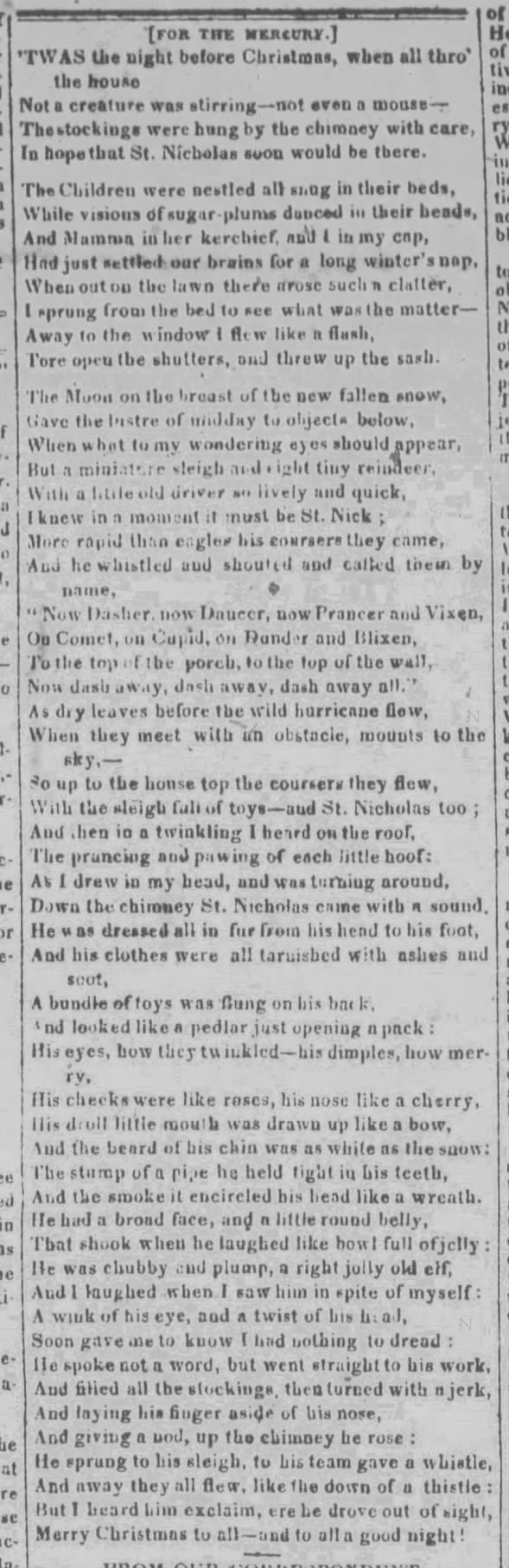 Fri, Dec 25, 1829 – 2 · The Charleston Mercury (Charleston, South Carolina) · Newspapers.com
Editor Orville L. Holley did not know who wrote "A Visit from St. Nicholas" when he first published it in the Troy Sentinel on December 23, 1823. In January 1829, however, Holley would confidently allude to New York scholar and seminary professor Clement C. Moore as the author. Later, and still without naming Moore directly, Holley revealed in print that he had learned the author's identity only a few months after publishing the merry Christmas lines. Moore himself finally acknowledged his authorship in 1837 by submitting "A Visit from St Nicholas" with three other poems of his for publication in The New-York Book of Poetry. Moore is also credited with authorship of "A Visit from St. Nicholas in two important 1840 anthologies of American poetry, The Poets of America, edited by John Keese; and Selections from the American Poets, edited by William Cullen Bryant.
Early in 1844, a false attribution in the Washington National Intelligencer on Christmas Day 1843 prompted Moore to contact ex-publisher Norman Tuttle in Troy, and to state his claim openly and directly in a letter to his good friend Charles King, then editor of the New York American. On March 1, 1844 King published Moore's claim, really the confession of an embarrassed academic and bereaved husband and father, that he wrote the Christmas lines
"not for publication, but to amuse my children." --Clement C. Moore, letter to Charles King dated February 27, 1844; published March 1, 1844 in the New York American.Moore subsequently included A Visit from St. Nicholas aka 'Twas the Night Before Christmas in his 1844 volume Poems.
Related posts:
- Now, Dasher! in 1826
https://melvilliana.blogspot.com/2019/12/now-dasher-in-1826.html
- Genius of Liberty, 1826 reprinting of A Visit from St Nicholas
https://melvilliana.blogspot.com/2019/12/genius-of-liberty-1826-reprinting-of.html
- First printing of A Visit from St Nicholas
https://melvilliana.blogspot.com/2019/04/first-printing-of-visit-from-st-nicholas.html
- Lines written after a snow-storm, 1824 and 1844 versions
https://melvilliana.blogspot.com/2019/04/lines-written-after-snow-storm-by.html