Saturday, August 5, 2017

BATTLE-PIECES in Rochester

Here are two of the earliest published notices of Melville's Battle-Pieces anywhere. Both items found in the online archives of New York newspapers at Fulton History.

In the first edition of Battle-Pieces the second line of "The Portent" reads "Slowly swaying" not "Slowly swinging" as printed in the Rochester Evening Express on August 27, 1866.

Rochester Evening Express - August 27, 1866

New Books.

BATTLE PIECES AND ASPECTS OF THE WAR, by Herman Melville, author of "Typee," "Omoo," "Redburn," "Mardi," "Moby Dick," "Whitejacket," &c. New York: Harper & Bros.

But little has been heard, of late, from the author of those very attractive novels, "Typee," &c. We have here a volume of poems of the war, "Battle Pieces," dedicated to the "memory of the Three Hundred Thousand who in the war for the maintenance of the Union, fell devotedly under the flag of their fathers." The author says that "with few exceptions, the pieces in this volume originated in an impulse imparted by the fall of Richmond." The opening piece is
THE PORTENT, 1859.
Hanging from the beam,
   Slowly swinging (such the law),
Gaunt the shadow on your green
       Shenandoah!
The cut is on the crown
       (Lo! John Brown),
And the stabs shall heal no more.
Hidden in the cap
   Is the anguish none can draw;
So your future veils its face,
       Shenandoah!
But the streaming beard is shown
       (Weird John Brown),
Meteor of the war.
The pieces are good, so far as we have read and of the right loyal and honest sentiment. For sale by Dewey.
Below, another early notice of Melville's Battle-Pieces in Rochester, this one published in the Daily Union and Advertiser on August 28, 1866:

Rochester Daily Union & Advertiser - August 28, 1866

NEW BOOKS.— Harper & Bros. have published the following: 

BATTLE PIECES AND ASPECTS OF THE WAR.— By Herman Melville. This is a volume of nearly three hundred pages filled with poetry relating to the battles and stirring events of the late civil war. The fame of the great commanders is celebrated in song, and the noted engagements are described in verse, all done in a creditable manner. Those who participated in the great battles or marched to the command of the great Generals will find much in this to prize. 


Battle-Pieces in The New York Sun

The New York Sun - December 7, 1866
  
BATTLE PIECES AND ASPECTS OF THE WAR. Poems, by Herman Melville. Published by Harper Bros., New York.
Mr. Melville has already a fair reputation as a poet and graceful writer, and this volume will meet a kind reception. The author has chosen themes for rhyme that would perhaps read better in prose — especially if written in his own easy, pleasing style. As descriptions of scenes and events, the book will doubtless prove one of much interest to thousands who participated in some of the many battles that form the staple of the author's praise and song. As poetry, there are few, if any, pieces that can be ranked above mediocrity. While throughout the whole volume there runs an unmistakable sentiment of true patriotism, Mr. Melville is yet liberal in his views, and generous enough to praise the virtues of his country's enemies. 

Moby-Dick in the Buffalo Daily Courier


Buffalo Daily Courier - Saturday, November 22, 1851
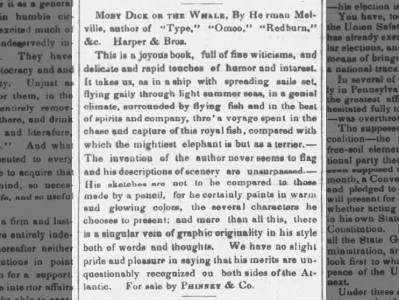
MOBY DICK OR THE WHALE. By Herman Melville, author of "Type[e]," "Omoo," "Redburn," &c. Harper & Bros.

This is a joyous book, full of fine witicisms, and delicate and rapid touches of humor and interest. It takes us, as in a ship with spreading sails set, flying gaily through light summer seas, in a genial climate, surrounded by flying fish and in the best of spirits and company, thro' a voyage spent in the chase and capture of this royal fish, compared with which the mightiest elephant is but as a terrier.— The invention of the author never seems to flag and his descriptions of scenery are unsurpassed.— His sketches are not to be compared to those made by a pencil, for he certainly paints in warm and glowing colors, the several characters he chooses to present; and more than all this, there is a singular vein of graphic originality in his style both of words and thoughts. We have no slight pride and pleasure in saying that his merits are unquestionably recognized on both sides of the Atlantic. For sale by PHINNEY & CO.
Related post

Friday, August 4, 2017

Mardi in the Buffalo Daily Courier

Found on Newspapers.com

Like some other contemporary reviews of Mardi (London Athenaeum; Boston Post), the review in the Buffalo Daily Courier alludes to the old joke about the extremely rare "man who read The Monikins." The point was, Melville's indulgent allegory is about as tedious and overblown as Cooper's worst fiction. Unreadable, to most men. Indeed, the man who read Melville's Mardi would almost have to be a woman. This, all kidding aside, strikes me as the Buffalo critic's keenest insight.

Melville's chapters in Volume 2 on the south of Vivienza receive special attention, and rebuke. At least one other reviewer (in The Southern Quarterly Review) likewise complained about the satire of John C. Calhoun. The Buffalo critic equally dislikes Melville's satirical portrait in Mardi of Democratic Senator William Allen of Ohio as the "lunatic" legislator Alanno of Hio-Hio. The anti-slavery theme of the Vivenza section provokes a strong attack on Melville's perceived views there as
"ultra and offensive abolition doctrines."
Not in Herman Melville: The Contemporary Reviews and only recently available online at Newspapers.com.  I found this review of Mardi with a trove of Melville notices in the Buffalo Daily Courier, searching exclusively for Melville items added in the past 1 month.


The Buffalo Daily Courier in 1848 was edited by William A. Seaver, published by Seaver and Robert D. Foy.
"But in 1849 the whole establishment was bought by W. A. Seaver, who became both publisher and editor for the next few years." --A History of Buffalo
Seaver formerly edited the Batavia Spirit of the Times. After the Civil War (1868-1883), he superintended the popular "Editor's Drawer" in Harper's Magazine. Seaver died on January 7, 1883.

Springfield Republican - April 13, 1874
Transcribed below from the Buffalo Daily Courier, April 21, 1849, via Newspapers.com:
Mardi and a Voyage Thither. By Herman Melville. New York; Harper & Brothers. 2 Vols. 12 mo. pp 365 and 387. 
When this young and talented author burst upon the world with his romantic narrations of "Typee" and "Omoo" and opened up to the admiring gaze of his thousands of readers the previous hidden scenes of Polynesian life, presenting in all their gorgeousness of coloring and freshness of design the dreamy and sensual beauties of a land untrodden by the foot of poet or painter, men read and admired, and while they did not scruple to doubt, were still grateful for the repast thus refreshingly spread before them. Many are there of those old guests, upon whose palates still lingers the fruity flavor of that banquet, who will be tempted again to taste, but who are doomed to find, beneath this fair exterior, a core and heart of ashes. 
It were hard to discover without carefully reading the book over and over again, what the writer would be at, and we therefore predict that it will be quietly stowed away in that wallet
"———Which Time has ever at his back,
Wherein he puts alms for oblivion,"
without its latent and hidden meaning becoming public. Hereafter the man who read "Mardi" and he, whom the world has so long sought in vain, he of the "Monnikins," shall equally divide its reverent admiration.

That an allegory is intended in these two volumes of an hundred and ninety-five chapters is tolerably clear, but beyond that we have not dared to go in our investigations. Story, aside from that contained in the first half of the first volume, there is none, nor have we been able to discover, beneath the mass of verbiage and incoherency that succeeds, any revelations of new truths, any clearer expoundings of old ones. A few flings at the recent French Revolution, a chapter or two of ultra and offensive abolition doctrines, with personal attacks upon Mr. Calhoun, and Mr. Allen, member of Congress from Ohio, we noticed from their prominence, as also considerable adulation of England mixed with a little necessary but mild sarcasm upon her treatment of her starving spinners and reapers. Indeed the book is evidently made for English consumption, and there, if anywhere, will be found the ambitious man—or more probably, woman—destined to that singular fame we have mentioned.

"Mardi" opens on board a ship, cruising in the vicinity of the Equator, in search of the Sperm Whale. Three years of unsuccessful voyaging have induced the Captain to abandon the pursuit and the "Arcturion's" course is altered for the northern seas, with the intention of securing a cargo of Right-whale oil. Not fancying a sojourn in those hyperborean regions, our author, a foremast hand on board, ventures to remonstrate with his commander upon this infraction of the articles binding both, and demands to be put on shore.— The Captain, however, while he admits the cogency of the arguments advanced, intimates that in this case right must make slight concessions to might, and, in effect, that the remonstrant must accompany him on his arctic voyage, but so far exceeds to his inferior's wishes as to grant him permission to leave the ship if he can, "saying which, he walked into his cabin, like Caesar into his tent."

Our gentleman, who is determined not to go to Kamschatka, now begins to cast about for means by which to gratify his desire to remain in the tropics. Ruminating upon this subject at the masthead, a parlous fine place for quiet cogitation, he hits upon a plan, or rather selects the only one which is at all feasible, one which, though it may appear a bagatelle to an adventurous sailor, is not without its spice of peril to a landsman. He will steal one of the four boats suspended from the davits, and, in that frail bark, make good his passage to some westerly isles he wots of, distant many hundreds, or it may be thousands of leagues from the then position of the ship: preferring to take the chances of a favorable reception among the natives there, to trusting his person—rendered somewhat effeminate by a long sojourn under the vertical rays of an equatorial sun—among the icebergs of Bhering's Straits. Accordingly, as it seems desirable that he shall not undertake this grand project single handed, he communicates it to a mess-mate named "Jarl," a native of the isle of Skye, which indomitable Norseman, after revolving the matter thoroughly in his mind, consents to make one of the boating party. The details of this preparation are given, in rather a Censorish manner, being intended doubtless, as memoranda for the use of future adventurers, and viewed in that light, extremely likely to be useful. At last, all is ready, and at twelve o'clock, of a dark night, the two deserters embark on board the ticklish craft.
“All ready, Jarl?" 
“Ready.” 
“A man overboard!” I shouted at the top of my compass; and like lightning the cords slid through our blistering hands, and with a tremendous shock the boat bounded on the sea's back. One mad sheer and plunge, one terrible strain on the tackles as we sunk in the trough of the waves, tugged upon by the towing breaker, and our knives severed the tackle ropes—we hazarded not unhooking the blocks— our oars were out, and the good boat headed round, with prow to leeward. 
“Man overboard!” was now shouted from stem to stern. And directly we heard the confused tramping and shouting of the sailors, as they rushed from their dreams into the almost inscrutable darkness. 
“Man overboard! Man overboard!” My heart smote me as the human cry of horror came out of the black vaulted night. 
“Down helm!''' was soon heard from the chief mate. “Back the main-yard! Quick to the boats! How's this? One down already? Well done! Hold on, then, those other boats!''' 
Meanwhile several seamen were shouting as they strained at the braces. 
“Cut! cut all! Lower away! lower away!” impatiently cried the sailors, who already had leaped into the boats.

“Heave the ship to, and hold fast every thing,” cried the captain, apparently just springing to the deck. “One boat's enough. Steward! show a light there from the mizzen-top. Boat ahoy!—Have you got that man?" 
No reply. The voice came out of a cloud; the ship dimly showing like a ghost. We had desisted from rowing, and hand over hand were now hauling in upon the rope attached to the breaker, which we soon lifted into the boat, instantly resuming our oars. 
“Pull! pull, men! and save him!" again shouted the captain. 
“Ay, ay, sir,” answered Jarl instinctively, “pulling as hard as ever we can, sir." 
And pull we did, till nothing could be heard from the ship but a confused tumult; and, ever and anon, the hoarse shout of the captain, too distant to be understood. 
We now set our sail to a light air; and right into the darkness, and dead to leeward, we rowed and sailed till morning dawned.
The events following immediately upon this hegira are sufficiently interesting to give earnest for the future; how, for sixteen days, they continued to steer for the west, without seeing land or sail; how, on the night of the last day they fell in with, and took possession of a brigantine, at first supposed to be abandoned, but found, the next morning to be navigated by a one armed islander and his wife, between whom there existed a conjugal coolness that had led to their inhabiting one the cabin and the other the forecastle of the vessel; how, after cruising for some days in this craft, they were compelled by disasters maratime, again to take to the whale-boat, now incumbered by the additional presence of the ill matched pair of savages; how, after more days of cruising without any very distinct purpose, beyond that of saving their lives, they fall in with a remarkable floating chapel, manned by an old priest and fourteen neophytes, his sons, on their way to solemnizing some devotional rite, and accompanied by a light-complexioned, golden-haired girl, whose role in the ceremony consists in being burned; how, moved thereunto by the dictates of humanity, they killed the old priest, carried his craft by boarding and made off with the maiden; how the memory of Fayaway was outraged by the author's falling intensely in love with the prize, which sentiment he supposed to be reciprocated; how they finally arrived at Mardi and being received as demi-gods, and bearing their honors meekly, were forthwith installed in clover;—all this is well told, and will amply repay the perusal, but here the interest ceases, and from this point on, with occasional glimpses of light, the reader flounders in a slough of despond, getting deeper and deeper as he proceeds, until he is fain to give up the task in despair. The rest of the book is so unlike this introduction and the previous works of the author that we can almost believe it to be from a different pen.
Between gigs in Sandusky, Ohio, Melville's old shipmate Richard T. Greene reportedly enjoyed a brief connection with the Buffalo Daily Courier.

Found on Newspapers.com

Evidently Greene's tenure as "local" editor lasted only a couple of weeks:

Found on Newspapers.com

As previously documented in Herman Melville's Whaling Years (Appendix 1, page 213):
"... in March 1855 he accepted a position as an editor of the Buffalo Daily Courier, a position that lasted about two weeks." 
Reprinted in Herman Melville's Whaling Years, the 1892 obituary in the Chicago News Record (August 25, 1892) is vaguer on the timing of Greene's association with the Buffalo Daily Courier. If Greene ever contributed to the Buffalo Daily Courier in the early 1850's, he might (conceivably, I mean) be responsible for the bubbly reception of Moby-Dick published on November 22, 1851. Forthcoming soon, hopefully in the next post. Whoever wrote it, the short, cheery notice of Moby-Dick in the Buffalo Daily Courier is obviously in a different vein than the pointed and partisan criticism of Mardi. Criticism of Mardi by editor and staunch Democrat William A. Seaver?
"William A. Seaver, equally apt with pen and scissors, writes away with a graceful vigor and a pungent fluency on politics, persons and miscellany. His articles mark the studious reader and thinker, and have a relish of a well stored library at his elbow. He is one of the neatest paragraphers in the Union. 
--Buffalo Commercial Advertiser, July 31, 1851
More on the long literary career of William A. Seaver, from the memorial tribute published in Harper's Weekly, January 20, 1883:
WILLIAM A. SEAVER.

MR. WILLIAM A. SEAVER, whose sudden death on the 7th instant was a surprise and shock to all his friends, was born in Albany, New York, March 10, 1815. His parents removed to Batavia while he was in his infancy, and there he was brought up and educated. His first venture of any importance was in connection with the Buffalo Courier, of which he was for several years the editor; 
MR. SEAVER came to New York more than twenty years ago, and occupied himself with literary pursuits. He was at one time editor of a Church journal in this city, and correspondent for several newspapers in the South and West. In 1868 he was placed in charge of the“ Editor’s Drawer,” in HARPER'S MAGAZINE, a position for which he was well qualified by his acquaintance with men, his position in society, and his rare aptitude as a raconteur. The “ Drawer" is literally what the name implies. When this department was first projected, in the summer of 1851, the clippings and contributions intended for it were thrown into a drawer of a certain desk, and this circumstance suggested the name. The same method has been pursued ever since that time. The contributions for this department of the MAGAZINE, which come from every part of the country, are still deposited in the drawer, whence the editor takes them and culls his selections. Many of the contributions are merely crude suggestions, and MR. SEAVER displayed fine tact in editing, condensing, or enlarging them. For many years MR. SEAVER also conducted the “ Personal" departments in HARPER'S BAZAR and HARPER'S WEEKLY, the latter until the last week of his life. On the Wednesday preceding his death his “copy“ came to the office, written in his usual clear and remarkably neat hand, and the editor, glancing over the familiar MS., had little thought that it was the last he should receive from his long-time associate. 
MR. SEAVER was for some years President of the Adriatic Fire-insurance Company, of this city, and was also a member of the New York bar. He belonged to the Union Club, where his presence was always welcome, for his genial social qualities and his inexhaustible fund of anecdote and story. He resided in a pleasant cottage at Mount Vernon, where he had gathered an extensive and well-selected library. The cause of his death was acute pneumonia.

Thursday, August 3, 2017

Fidelius on Melville and "the fowl mania"


Here's another mention of Herman Melville by "Fidelius," a New York correspondent of the Boston Evening Transcript. From the "Second Edition" of the Boston Evening Transcript, April 24, 1855; found in the online archives of Historical Newspapers at Genealogy Bank.
[Correspondence of the Transcript]
NEW YORK, April 23d, 1855.

Dear Transcript: Several of the principal hotels have raised their prices within a few days; and the discourse about New York expensiveness is revived. The sober fact is, that there is no city in the world where so much money is unsatisfactorily spent as here. I heard a gentleman fresh from Paris, say, the other day, that a parlor and bedroom, for a fortnight, at the Astor, cost him as much as four times the same amount of accommodation for his family at Maurice's. Strange that in a country where there is an abundance of space, an ample field to produce provisions, and few local monopolies, it costs so much to live in a most unsatisfactory manner!

Willis was in town a few days ago, with little trace of invalidism about him,--so much for keeping up a good heart, living in the country, and avoiding drugs!


At a dinner party last week, the conversation turned upon the fowl mania, recently developed in this country; one gentleman referred to the popular engravings of Shangai monstrosities, another to Burnham's book on the hen-fever, and a third to Melville's story in Harper, of "Cock-a-doodle;" "yes," observed another, better versed in cotton than literature, "the thing seems to be getting into books fast; I saw one advertised the other day, called 'Wolfert's Roost,' another Shanghai work, I suppose." The best of the joke was that Irving was at the table, and within ear-shot.

You will be glad to know that the accident which happened to Washington Irving last week is not so serious as at first reported. He remained unconscious only during a few moments after his fall, and now suffers only from the jar, having been able to correct his proof sheets, as usual, a day or two past. James Russell Lowell has been here, and looks all the better for his western trip. The National Magazine for May has some excellent wood cuts of statuary, an able article on "The Opium Trade in the East," and a timely one on Irving's last work; a "Sunbeam" is made to reveal its wonder-working power, and the "Pyramids" are described and pictured.... FIDELIUS
Boston Evening Transcript - April 24, 1855
Originating in correspondence of the Boston Evening Transcript, the anecdote of "fowl mania" and the merchant's gaffe at dinner with Washington Irving got to be a popular one in the spring of 1855. The "fowl mania" anecdote (including the reference to Melville's well-remembered story in the December 1853 issue of Harper's) was reprinted many times, for example:
  • Buffalo Daily Courier, April 27, 1855
Found on Newspapers.com
  • Buffalo Commercial Advertiser, April 30, 1855
  • Troy Daily Whig, April 28, 1855 
  • Albany Argus, May 3, 1855
  • Brooklyn Evening Star, May 16, 1855
  • Lafayette [Indiana] Daily Journal, May 17, 1855
  • Vermont Phoenix [Brattleboro, Vermont], May 12, 1855
  • Louisville Daily Courier, May 22, 1855
  • Springfield [Massachusetts] Republican, May 25, 1855
  • Weekly Racine [Wisconsin] Advocate, June 13, 1855
Wolfert's Roost (1855) - William Vinson via AbeBooks
Related post:

Wednesday, August 2, 2017

Typee in the London Nautical Magazine, and United States Nautical Magazine

The Nautical Magazine - May 1846
NARRATIVE OF A FOUR MONTHS' RESIDENCE among the Natives of the Marquesas Islands, or a Peep at Polynesian Life, by Herman Melville. Murray, London, 1846. 
One of the merriest and unpretending little books that we have seen for a long time. It is a tale of real life throughout, abounds in adventure, and gives such "a peep at Polynesian" existence as will convey a tolerably correct idea of the characteristic traits of the inhabitants of the Pacific Islands. We could not help snatching a leaf from its pages that introduces the tale, from the style of which, a good opinion may be formed of the work.  --The Nautical Magazine (May 1846).
The extracted "leaf" is the first chapter of Melville's first book, taken from the London edition and reprinted under the heading A Leaf from the Marquesas. Founded in 1832 and long edited by A. B. Becher, The Nautical Magazine and Naval Chronicle was a monthly journal for "professional seafarers" in both the Merchant and Royal Navy, "with a focus on the merchant marine" (Cambridge Library Collection).

The American edition of Melville's first book had already been noticed in the United States Nautical Magazine (April 1846), edited by T. Augustus Craven and John K. Duer. Looking this one up in Herman Melville: The Contemporary Reviews (pages 8-9), I see the United States Nautical Magazine there has the implied distinction of publishing the first American review of Herman Melville's first book. However, Contemporary Reviews gives the wrong month of publication. The review of Typee appeared in the April 1846 issue of the United States Nautical Magazine, not March 1846 as stated in Contemporary Reviews.


So the earliest known U. S. review of Typee is the one by Evert A. Duyckinck, published on March 18, 1846 in the New York Morning News (transcribed in Contemporary Reviews on pages 17-18).

More about naval officer and editor T. Augustus Craven from The Encyclopedia Americana:
CRAVEN, Tunis Augustus Macdonough,
American naval officer: b. Portsmouth, N. H., 11 Jan. 1813; d. 5 Aug. 1864. He entered the navy in 1829; in 1857 surveyed the Isthmus of Darien; coasted about Cuba to intercept slave ships, and in the Civil War had part in preventing the capture of the fort on Key West. Given the rank of commander, he joined Farragut's fleet off Mobile, commanding the monitor Tecumseh. In the battle of Mobile Bay the Tecumseh was sunk by running upon a torpedo, and Craven and almost all his crew lost their lives.
The Tecumseh! Melville would memorialize commander and crew of that fated ship in the poem from Battle-Pieces (1866) titled  The Battle for the Bay:
And quiet far below the wave
   Where never cheers shall move their sleep,
Some who did boldly, nobly earn them, lie—
   Charmed children of the deep.
But decks that now are in the seed,
   And cannon yet within the mine,
   Shall thrill the deeper, gun and pine,
Because of the Tecumseh's glorious deed.
In 1843 John King Duer edited a collection of "nautical tales and sea sketches" titled The Nautilus and published in association with Park Benjamin's New World. Among the tales presented in The Nautilus was a long narrative of the real-life Somers mutiny that Duer did not write, according to the New World, although as the only named editor he was sometimes credited with its authorship.
We improve this occasion to state, that Mr. Duer is not responsible for the account of the Somers Mutiny, which was added without consultation with him on the subject. It was thought better not to apply to Mr. Duer, since it is a subject of extreme delicacy for one connected as he is with the service. The narrative, however, was written by a gentleman of high literary abilities, who is thoroughly conversant with the facts of the case, since he has attended the Court of Inquiry daily, during its somewhat prolonged session. --The New World, January 14, 1843
More links:
  • A Leaf from the Marquesas in the Nautical Magazine and Naval Chronicle for May 1846, courtesy of Hathi Trust Digital Library. 

Tuesday, August 1, 2017

Welcome to Washington Irving's world

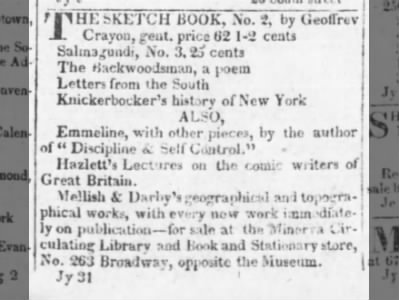
August 1, 1819 was a Sunday, so there was no Evening Post in New York City on the day Herman Melville was born. Ads on Saturday and Monday show what the Minerva Circulating Library and Book and Stationary store had for sale at 263 Broadway.

New York Evening Post - Monday, August 2, 1819
Topping the list, a new number of The Sketch Book by Washington Irving, writing as "Geoffrey Crayon." Still in England, Irving in 1819-1820 shipped his chapters or "numbers" of The Sketch Book to New York for publication in the United States. (Some were reprinted in the London Literary Gazette.)


Contents of Number One, published May 15, 1819: 
The Author's Account of Himself
The Voyage
Roscoe
The Wife
Rip Van Winkle 
Contents of Number Two, published in July 1819: 
English Writers on America
Rural Life in England
The Broken Heart
The Art of Book Making
In his 1859 lecture on Travel, Melville approvingly paraphrased from Irving's chapter "The Voyage," first published in the year of Melville's birth:
One must not anticipate unalloyed pleasure. Pleasure, pain and profit are all to be received from travel. As Washington Irving has remarked, the sea-voyage, with its excitements, its discomforts, and its enforced self-discipline, is a good preparation for foreign travel.  --Melville's Lecture on Travel
Everyone knows about Rip Van Winkle. Herman Melville would remake Irving's popular legend in "Rip Van Winkle's Lilac," part of the manuscript prose and poetry collection (posthumously published) titled Weeds and Wildings. Not so well known today is Irving's investigation into "The Art of Book Making." What Irving uncovered at the British Library and amusingly described was the practice by "predatory authors" of stealing material from old books to manufacture new ones.
Being now in possession of the secret, I sat down in a corner, and watched the process, of this book manufactory. I noticed one lean, bilious looking wight, who sought none but the most worm-eaten volumes, printed in black letter. He was evidently constructing some work of profound erudition, that would be purchased by every man who wished to be thought learned, placed upon a conspicuous shelf of his library, or laid open upon his table; but never read. I observed him, now and then, draw a large fragment of biscuit out of his pocket, and gnaw; whether it was his dinner, or whether he was endeavouring to keep off that exhaustion of the stomach, produced by much pondering over dry works, I leave to harder students than myself to determine.
There was one old getleman in bright coloured clothes, with a chirping, gossipping, expression of countenance, who had all the appearance of an author on good terms with his bookseller. After considering him attentively, I recognised in him a diligent getter up of miscellaneous works, that bustled off well with the trade. I was curious to see how he manufactured his wares. He made more stir and show of business than any of the others; dipping into various books, fluttering over the leaves of manuscripts, taking a morsel out of one, a morsel out of another, “line upon line, precept upon precept, here a little and there a little.” The contents of his book seemed to be as heterogeneous as those of the witches' cauldron in Macbeth. It was here a finger and there a thumb, toe of, frog and blind worm’s sting, with his own gossip poured in like “baboon's blood,” to make the medley “slab and good.
After all, thought I, may not this pilfering disposition be implanted in authors for wise purposes; may it not be the way in which providence has taken care that the seeds of knowledge and wisdom shall be preserved from age to age, in spite of the inevitable decay of the works in which they were first produced. We see that nature has wisely, though whimsically, provided for the conveyance of seeds from clime to clime, in the maws of certain birds; so that animals, which, in themselves, are little better than carrion, and apparently the lawless plunderers of the orchard and the cornfield, are, in fact, nature's carriers to disperse and perpetuate her blessings. In like manner, the beauties and fine thoughts of ancient and obsolete writers, are caught up by these flights of predatory authors, and cast forth, again to flourish and bear fruit in a remote and distant tract of time. Many of their works, also, undergo a kind of metempsychosis, and spring up under new forms. What was formerly a ponderous history, revives in the shape of a romance—an old legend changes into a modern play—and a sober philosophical treatise furnishes the body for a whole series of bouncing and sparkling essays. Thus it is in the clearing of our American woodlands; where we burn down a forest of stately pines, a progeny of dwarf oaks start up in their place; and we never see the prostrate trunk of a tree, mouldering into soil, but it gives birth to a whole tribe of fungi. 
Let us not, then, lament over the decay and oblivion into which ancient writers descend; they do but submit to the great law of nature, which declares that all sublunary shapes of matter shall be limited in their duration, but which decrees also, that their elements shall never perish. Generation after generation, both in animal and vegetable life, passes away, but the vital principle is transmitted to their posterity, and the species continues to flourish. Thus, also, do authors beget authors, and having produced a numerous progeny, in a good old age they sleep with their fathers, that is to say, with the authors who preceded them—and from whom they had stolen.
 --Washington Irving on The Art of Book Making
"The Art of Book Making" was reprinted with the review of Irving's Sketch Book in The London Literary Gazette for April 8, 1820.

Pitching Omoo, his second book, Melville wrote his publisher John Murray in July 1846 that
"A little experience in this art of book-craft has done wonders."  --The Letters of Herman Melville
Melville evidently meant that his new manuscript would look better and be much closer to finished than were the messy and insufficient pages of Typee. Omoo would not need significant rewriting, padding, expurgating or editorial fixing. Irving's sense of book-making as stealing remains in play, nevertheless. In Omoo Melville creatively adapted numerous scenes from William Ellis and other writers on the South Seas. Hendricks House editors Harrison Hayford and Walter Blair aptly call Melville's way with other people's words, "dramatizing." On occasion Melville dramatized "spectacularly" from his source in Polynesian Researches, as when he describes night fishing by torch-light in Chapter 70, Life at Loohooloo.

Two days after Herman Melville's birth, the Evening Post extensively reviewed the second number of Irving's Sketch Book.

Found on Newspapers.com
"The literary ambition of Mr. I. aims simply at a flute accompaniment, in our national concert of authors, leaving to the more aspiring the management of louder instruments. We gladly perceive, that he never suffers himself to be allured from his natural character, by a pompous display of his subject, or by an attempt to plunge his readers into the unfathomable depths of learning and research...."  
In closing, the reviewer (Henry Brevoort, so identified by Ralph M. Aderman in Critical Essays on Washington Irving) picks up on Irving's expose of authors and book-making, hoping that Irving will not imitate the practice he witnessed in the British Library, but carry on in his own modest and distinctively charming way.
We reverence the cause of true science; nor would we be understood to scoff at its unaffected votaries; but no one knows, who has not essayed the task, how cheaply an author may decorate his pages with the scattered fragments of learning, lying so invitingly at his mercy, in the multitudinous transactions and encyclopedias of our times. Our author has found out the art of book-making; he has traced to their fountain head, those muddy rills of knowledge that sometimes spread themselves even in America. It is not impossible, therefore, that in the future numbers of his work, he may avoid the labor of writing from the resources of his own mind, by compiling the present state of the Catholic question—the vast results of polar expeditions; or, peradventure, strike out some new geological hypothesis which shall reject the vulgar agency of fire or water. In such ambitious speculations, we fear, the admirers of his fine genius, might seek in vain for his sportive humor; his nice discrimination of character; his romantic associations of thought and language; his pure and affecting morality, and all the nameless graces of style, so appropriate to the captivating path of literature he has chosen to pursue.
 --New York Evening Post, August 3, 1819
Evert Duyckinck was right on many levels when he wrote in his diary that Melville
"models his writing evidently a great deal on Washington Irving...."   --Melville in His Own Time, edited by Steven Olsen-Smith
For further study...

In Melville and Repose, John Bryant devotes a whole chapter to The Example of Irving. There Bryant specifically discusses the influence of Salmagundi, and Knickerbocker's History of New York, both of which made the short list of works for sale at the Minerva Circulating Library, along with the new number of The Sketch Book.


Rarely mentioned in Melville criticism are the two works by Irving's good friend and literary collaborator James Kirke Paulding, sandwiched in the Minerva ad between Salmagundi No. 3 and Irving's History of New York. Below, links to some digitized volumes that are available online.
Related post: