Monday, May 15, 2023

General and gentle readers

If Melville's lost "love letters" to Nathaniel Hawthorne should ever turn up (in manuscript, I mean, the actual, physical documents we only know because family members transcribed them for publication in the 19th century), I would first run for the one written on "a rainy morning" in May 1851 to confirm or disprove my hunch that Melville charged Hawthorne with disturbing the peace of "gentle" not "general" readers. I'm talking about that great "Dollars damn me" letter formerly and tentatively dated June1? but assigned to early May 1851 by Hershel Parker in the first volume of Herman Melville: A Biography (Johns Hopkins University Press, 1996) pages 840-841. 

In the 21st century Parker dared some prominent Melville critics either to accept or challenge his moving it ahead to early May; see Melville Biography: An Inside Narrative (Northwestern University Press, 2012) pages 239-240. Since then the bad influence of fact-averse "critics without information" has only gotten worse. In this particular case, however, the underlying problem was that Parker had never clearly or sufficiently explained his reasoning. Given the chance to nail it in the 2nd and 3rd Norton Critical Edition of Moby-Dick (page 566) he said it was "complicated" and mistakenly gave the wrong year ("May 16, 1850" instead of 1851) when footnoting the crucial letter from Augusta to Allan Melville that justified the earlier date. To make everybody happy (except Neo-Communists, obviously), I will belatedly attempt to do what Parker asked back in 2012, and re-scrutinize the evidence for his re-dating of the "dollars damn me" letter. To that end I hope to obtain a photocopy or scan of Augusta's letter, currently at Arrowhead. When/if successful I will transcribe what I can and report back. 

Update: done

https://melvilliana.blogspot.com/2023/05/augusta-melville-letter-to-allan.html

and done!

https://melvilliana.blogspot.com/2023/10/mid-to-late-may-maybe.html

Meanwhile, here is a possible emendation to mull over in the wonderful letter dated "[early May] 1851" in The Divine Magnet: Herman Melville's Letters to Nathaniel Hawthorne, edited by Mark Niemeyer (Orison Books, 2016). My proposed revision (also begun, like Melville's epistle, on a rainy morning in May): instead of " 'general readers' " make it " 'gentle readers' " but keep the phrase enclosed in quotation marks. 

Granted, the difference might not be so compelling or meaningful as the universally accepted correction of "revere" to "reverse." Observing how the world laughs at truth and truth tellers (mocked in our time as conspiracy theorists), Melville flipped (reversed not revered) the legendary laughter-test of Lord Shaftesbury, wherein truth reveals itself by withstanding ridicule. 

About a different subject, the disturbing effects of Hawthorne's darkest fictions on his audience, here is what Melville had to say as transcribed and first printed in 1884 by Julian Hawthorne:

By the way, in the last “ Dollar Magazine " I read “The Unpardonable Sin.” He was a sad fellow, that Ethan Brand. I have no doubt you are by this time responsible for many a shake and tremor of the tribe of “general readers.

--  Hawthorne and His Wife (Boston, 1884) page 404.

Melville found "Ethan Brand" in the May 1851 issue of  Holden's Dollar Magazine. The title character is one of Hawthorne's more devilish mad-scientist types, a psycho lime kiln operator who has abused others and made himself crazy in searching obsessively for "The Unpardonable Sin," instead of properly monitoring his own heart. With horror stories like that, Hawthorne stood accused by Melville of causing extreme discomfort in his readers. 

The extent to which the figurative shakes and tremors alleged by Melville are also supposed to indicate real mental and physical distress remains unclear, at least to me. For a visual image of the darkness that might impart "many a shake and tremor," literally or metaphorically, to any kind of reader, general or gentle, you have only to look at the frightening 1851 illustration,

"a frontispiece by Darley representing a wild figure with up-stretched arms, silhouetted against a mighty flame on the brow of a precipice."
--Katharine Lee Bates, Intro to The Snow Image and Other Twice-Told Tales (New York, 1899 and 1902).

Unchallenged before now, the expression "general readers" has been taken to mean ordinary or common, often with express or implied disparagement of skimmers as opposed to divers. The former stick to familiar but deceptive surfaces while the latter, eagle-eyed readers like you, me, and Melville, brave unknown and often unknowable depths of things. Already in Mardi (1849) William Charvat found symptoms of Melville's downright hostility "to the general reader, and to the world." 

Charvat, William. “Melville and the Common Reader.” Studies in Bibliography, vol. 12, 1959, pages 41–57 at page 49. JSTOR, http://www.jstor.org/stable/40371255.
Accessed 15 May 2023.

In Charvat's influential view the "tribe of general readers" means those "who would not tolerate the unpleasant truth" but might be tricked by disguised "profundities," artfully hidden "under a pleasant or sensational narrative surface" (page 52). 

With more attention to context, as Charlene Avallone pointed out in the late 1980's, Melville's expression "general readers" may be understood to designate readers of magazines.
Avallone, Charlene. “Calculations for Popularity: Melville’s Pierre and Holden’s Dollar Magazine.” Nineteenth-Century Literature, vol. 43, no. 1, 1988, pages 82–110. JSTOR, https://doi.org/10.2307/3044982. Accessed 15 May 2023.
 
Which is to say, most everyone. Although Avallone adopts the term general readers throughout, her excellent case for the familiarity of magazine readers with wildly sensational matter effectively undercuts Melville's reported claim that "the tribe of 'general readers' " would somehow have been distressed by provocative content in Hawthorne's magazine fictions. 
 
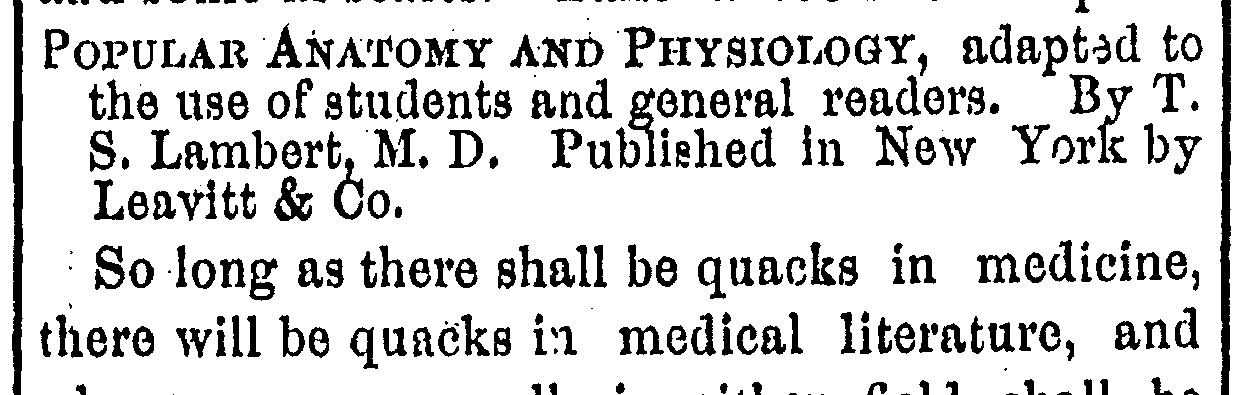
In usages at mid century, when Melville was writing to Hawthorne, the term general readers usually denotes readers either of periodical literature (magazines and newspapers) or works of non-fiction, for example textbooks of history and popular science, say Anatomy and Physiology. 
 
Springfield, Mass. Republican - April 28, 1851
Concerning the longer phrase "tribe of general readers," Melville's usage as transcribed by Julian Hawthorne in 1884 is the only one published in 19th century works accessible via Google Books and HathiTrust Digital Library. Zero hits before 1900 outside of Melville's letter to Hawthorne. 

 
On the other hand, searching in the same databases for "tribe of gentle readers" yields two results in British sources, each occurring in a piece of literary criticism. First, from the cutting review of The Spirit of Discovery, or, The Conquest of Ocean in the July 1805 number of The Edinburgh Review:

SOME years ago, Mr Bowles presented the public with a collection of sonnets and short poems. The reception it met with was not unfavourable, especially from that tribe of gentle readers to whom every running stream recals the memory of joys that are past, and every rustling leaf gives sad anticipation of coming sorrow.

 https://hdl.handle.net/2027/inu.30000093204141?urlappend=%3Bseq=325%3Bownerid=13510798895677775-329

And second, from "Canons of Criticism" by "L." in The Monthly Magazine for November 1827:
... Law, physic, divinity, and politics are precisely on the same footing; and so, too, are music, and painting, and coach-building, and tailoring (male and female), porter-brewing, and the manufacture of polonies and sausages. To betray these secrets would not only be treason to the craft, but would deprive the whole tribe of gentle readers of seven-eighths of their pleasure. What would they say to a Marplot who should come on the stage and tell the audience, “ these jewels are paste”—“this robe calico, and not silk”—and this terrible irruption nothing in the world but a pennyworth of gunpowder and nitrate of strontian?” I would never sit in the same boat (as Horace says) with such a man: so do not look for it at my hands.

https://hdl.handle.netn/2027/umn.31951000903300n?urlappend=%3Bseq=490%3Bownerid=13510798902549127-552

The first-listed instance of the phrase tribe of gentle readers in the Edinburgh Review for July 1805 is most interesting for negative criticism of the attempt at epic poetry by William L. Bowles, satirized by Byron as "harmonious Bowles" in English Bards and Scotch Reviewers. A footnote in many editions of Byron's poem directs readers to the April 1805 notice of Strangford's Camoëns in same volume with the essay on Bowles. One way or another, Melville could have encountered the sonnet loving "tribe of gentle readers" in Volume 6 of the Edinburgh Review and remembered it when writing to Hawthorne in May 1851.

As printed in 1884 the phrase "general readers" in Melville's letter is enclosed in quotation marks. Melville could be quoting magazine advertisements there, but the comprehensive sense of "general readers" would seem to render the quotation marks gratuitous. Arguably, the class of gentle readers might be regarded as narrower, more exclusive or refined, and therefore more deserving of quotation marks--whether used straightforwardly, or ironically employed as scare quotes

Hawthorne and his mosses - NYPL Digital Collections

In Hawthorne and His Mosses Melville put the word gentle in quotation marks when comparing Hawthorne to Edmund Spenser, author of The Faerie Queene:

"when Spencer was alive, he was thought of very much as Hawthorne is now,--was generally esteemed accounted just such a "gentle" harmless man.

Generally accounted by general readers, presumably. Melville's phrasing as printed in the Literary World on August 24, 1850 nicely anticipates his epistolary reference in May of the following year to "general readers." Even so, in "Hawthorne and His Mosses" the word gentle is what got the scare quotes. In similar fashion, perhaps, when inditing the May 1851 letter Melville might have conflated general and gentle readers--in his head, whichever word his hand finally wrote. Well! If Hawthorne can be generally regarded as "gentle," then I guess his readers can, too.

Related posts

Thursday, May 11, 2023

All I want is a good listener


New essay on Substack, excerpt below...

Inspired by recent encounters with Hawthorne, in particular by their heady and hearty barn-talk that March, Melville might have found a way to get the gist of their stimulating conversations into print. Echoes of Melville’s letters in the opening installment of “Scenes Beyond the Western Border” lead me to suspect it may be haunted by Hawthorne. At any rate, coincidence or no, the narrator of “Scenes Beyond the Western Border” talks to the reader like Melville talked in letters to Hawthorne. Here’s one example from the first of Melville’s Agatha letters to Hawthorne dated August 13, 1852.24

In this example, wording and structure of the Captain’s pledge to do most of the talking for his singular reader match the “and if / why I” construction in Melville's 1852 letter to Hawthorne (emphasis mine):

“… and if you are absolutely dumb, why I will sometimes answer for you.”

And if I thought I could do it well as you, why, I should not let you have it.”

https://archive.org/details/in.ernet.dli.2015.84865/page/n197/mode/2up

Introducing likely topics of conversation, the Captain sounds quite like Melville when promising a good time to his invited guest:

MELVILLE

“Hark— There is some excellent Montado Sherry awaiting you & some most potent Port. We will have mulled wine with wisdom, & buttered toast with story-telling & crack jokes & bottles from morning till night.”
Letter to Nathaniel Hawthorne, 29 January? 1851; emphasis mine.

CAPTAIN

We will talk on all subjects, from the shape of a horse-shoe to that of the slipper of the last favorite—say the 'divine Fanny,’ from great battles, or Napier's splendid pictures of such, down to the obscurest point of the squad drill—from buffalo bulls to elfin sprites.”
Scenes Beyond the Western Border, June 1851
25

These elaborate invites are similarly themed and structured. Each presents an inventory of delightful activities in store for the recipient, each inventory being divided in three main parts. Melville’s three groupings of promised events are separated by three ampersands; the Captain’s by the word from, used thrice. The invitation in each case extends to just one person: Melville to Hawthorne, the Captain to his Imaginary Friend the reader. The plural “We” brings together speaker and singular reader as joint enjoyers of good times ahead, chiefly to be spent in stimulating conversation....

https://open.substack.com/pub/melvilliana/p/all-i-want-is-a-good-listener?r=n51cr&utm_campaign=post&utm_medium=web

Friday, April 28, 2023

Oliver G. Hillard, art lover

After Herman Melville's death on September 28, 1891 the New York Times (October 6, 1891) printed a memorial tribute in the form of a letter to the editor signed "O. G. H." Obviously a well-informed acquaintance of the deceased, "O. G. H." remembered Melville as "the man of culture, the congenial companion, and the honestest and manliest of all earthly friends." 

Minus the original and laughable heading The Late Hiram Melville, the Times letter was reprinted in The Critic Volume 16 on October 17, 1891 (alongside the earlier notice of Melville's death headed "Herman Melville / The Passing of Mr. Melville's Popularity") as "A LETTER TO THE Times FROM ONE WHO KNEW HIM." Google-digitized images from the 1891 Critic volume with the reprinted letter from "O. G. H." are accessible online courtesy of HathiTrust Digital Library

The Critic editors appear less knowledgeable than "O. G. H." in their appended fact-check of his first paragraph. The editors claimed that Melville's first book was never "offered to or declined by the American publishers," but Melville's friend knew the truth. As verified in the "Recollections of Frederick Saunders," the Harper brothers initially declined Typee in manuscript since "it was impossible that it could be true and therefore was without real value." So quoted by Hershel Parker in Melville Biography: An Inside Narrative (Northwestern University Press, 2012) page 147; Parker adds the testimony of Melville's niece Charlotte Hoadley who believed the Harpers' early rejection of Typee "embittered his whole life."

Melville's sincere friend and admirer "O. G. H." has been identified as O. G. Hillard in Jay Leyda's Melville Log; and Oliver Greene Hillard in Melville in His Own Time (University of Iowa Press, 2015), edited by Steven Olsen-Smith, where Hillard's communication is given in full on pages 182-183. To begin to remedy the death of biographical facts lamented by Olsen-Smith, obituaries from New York and Boston newspapers are transcribed below.

New York Tribune - August 8, 1903
<https://chroniclingamerica.loc.gov/lccn/sn83030214/1903-08-08/ed-1/seq-9/>

 OBITUARY.

OLIVER G. HILLARD

Oliver G. Hillard, fr many years identified with Wall Street interests, died on Thursday in his home, No. 217 East Seventeenth-st., from septic pneumonia, in his eighty-first year. The funeral will take place to-morrow afternoon at the home of W. A. White, No. 158 Columbia Heights, Brooklyn. Mr. Hillard was enjoying excellent health when, on Thursday of last week, he was struck by a Broadway car. He was not knocked down, but was badly bruised, and recently pneumonia set in. His health for many years had been so vigorous that he never wore an overcoat in the coldest weather.

Mr. Hillard came of an old Boston family. He left Boston in early manhood for New-York, and for forty years had been connected with an office in Wall-st. He retired from business about fifteen years ago. He was a bachelor, and a man of quiet, art loving tastes. Among artists he enjoyed a large acquaintance, and collected many paintings, which he prized highly.

Mr. Hillard was a brother of the late George Stillman Hillard, the writer of school books and the law partner of Charles Sumner. He leaves a brother, James Otis Hillard, a banker, of Boston, and three nieces--Mrs. W. A. White, of Columbia Heights; Mrs. R. H. Loines, of Garden Place, Brooklyn; and Mrs. Winslow Bell, of Poughkeepsie.

A confirmed bachelor and art lover with known connections on Wall Street, Oliver G. Hillard (1823-1903) was a brother of Hawthorne's old friend and benefactor George Stillman Hillard.

09 Aug 1903, Sun The Boston Globe (Boston, Massachusetts) Newspapers.com

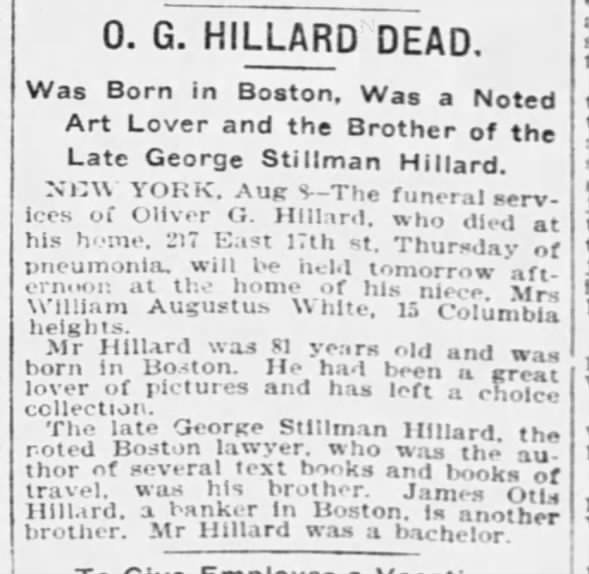
O. G. HILLARD DEAD.

Was Born in Boston, Was a Noted Art Lover
and the Brother of the
Late George Stillman Hillard.

NEW YORK, Aug 8-- The funeral services of Oliver G. Hillard, who died at his home, 217 East 17th st. Thursday of pneumonia, will be held tomorrow afternoon at the home of his niece, Mrs. William Augustus White, 15 Columbia heights.

Mr Hillard was 81 years old and was born in Boston. He had been a great lover of pictures and has left a choice collection.

The late George Stillman Hillard, the noted Boston lawyer, who was the author of several textbooks and books of travel, was his brother. James Otis Hillard, a banker in Boston, is another brother. Mr. Hillard was a bachelor.

-- Boston Globe, August 9, 1903.

What happened to Hillard's "choice collection"? Sold at auction by Silo's Art Galleries on March 9 and 10, 1905. As advertised in the New York Herald on March 7, 1905 the sale conducted by auctioneers James Patrick Silo and Augustus W. Clarke would include 

by order of the executrix

ESTATE OF O. G. HILLARD, DECEASED,
MANY IMPORTANT PAINTINGS
BY ANCIENT AND MODERN MASTERS.

Thursday, April 27, 2023

Whitman and "Marquesan Melville" in the ALBANY ARGUS

Johannes Hevelius (28 January 1611 – 28 January 1687)
Scanned by Torsten Bronger, 4 April 2003., Public domain, via Wikimedia Commons.
But a week or so ago there passed from earth a strong, virile and poetic mind that met nothing but contempt in America for years.

Notwithstanding the borrowed title "Marquesan Melville," the 1892 article transcribed herein begins with high praise for the late Walt Whitman as "a strong, virile and poetic mind." (Whitman died on March 26, 1892; Herman Melville passed the year before on September 28, 1891.) Previously unrecorded? Not in the Walt Whitman Archive, anyhow. This dual tribute to Whitman and Melville appeared on page 4 of the Albany NY Argus for Sunday morning, April 10, 1892. As indicated in the article, the heading and extensive quotations are taken from Henry S. Salt's long, lavish memorial of "Marquesan Melville" in the March 1892 issue of The Gentleman's Magazine

Herman Melville, despite embarrassing nationwide neglect of his writings, was "a man well known personally" in the Albany area. Nonetheless, criticism of Melville's supposedly ruinous descent into transcendentalism and mysticism follows Salt on "Marquesan Melville." Also from Salt, the cite of John Marr and Other Sailors as privately printed "story" and the closing quotation from Robert Buchanan's poem Socrates in Camden

But the comparison of Melville to The Farthing Poet Richard Hengist Horne, author of Orion: An Epic Poem, seems different and distinctive. Elizabeth Shaw Melville gave Herman's copy of Horne's Exposition of the False Medium and Barriers Excluding Men of Genius to Edmund Clarence Stedman. With markings by Horne and Melville, whereabouts unknown; Horne's Exposition is Sealts Number 284 in the catalog at Melville's Marginalia Online. Number 285 is a volume of three tragedies by Horne, owned by Stedman and borrowed by Melville. Shared interest in Whitman and Horne suggests that E. C. Stedman might have written or otherwise influenced the writing of "Marquesan Melville" as revisited in the Albany Argus.

MARQUESAN MELVILLE.

It is generally conceded that leading traits in the American character are self-esteem and assertiveness. One of the reasons the race has advanced so rapidly and now holds such high place is because of its thorough belief and confidence in itself. We know that our institutions are admirable, and that our natural resources are unlimited. We are certain that our destiny is as grand as that of any of the sons of man. We feel that our past stands in need of no apology. We are tenacious of our repute in the arts and sciences, and proclaim upon the housetops the undying fame of our writers. These general facts standing unchallenged, it is very peculiar that a single one of our master-minds should lack full recognition and appreciation in his own country. But a week or so ago there passed from earth a strong, virile and poetic mind that met nothing but contempt in America for years. It is true that at the last we were shamed into a tardy acceptance of the splendid gifts of Walt Whitman by the generous encouragement of the English people. Without attempting to understand the charm of his utterances, we admitted his genius and soothed his dying bed with sympathy. There were laid upon his bier some eloquent tributes from his countrymen, but these were rather the outpourings of love and sympathy than critical appreciation. It was England that recognized that a strong and original singer had left the earthly choir.

A case very similar to this was that of Herman Melville, a man well known personally in this vicinity. The difference between the two was that Melville had a measure of transient popularity during his early productive period, while at his death he was almost completely forgotten. His very name was unknown to the younger generation of American readers, and the rather perfunctory tributes in a few newspapers, when he died a number of months ago, were read with a mild interest not unmixed with astonishment. Here, again, England had an eye for genius when we were blind. It will surprise many here, even among those who would be critical, to learn that Robert Buchanan classes him as "the one great imaginative writer fit to stand shoulder to shoulder with Whitman on that continent," and that William Morris, Theodore Watts, Robert Louis Stevenson and W. Clark Russell, enroll themselves among the number of his enthusiastic admirers. It may be doubted whether the name of Melville is included among those that figure in the handbooks of American literature. it is certain, at any rate, that he has no following of readers here.

It is not to our credit that the first critical estimate of Melville should appear in England, and yet such is the case. Mr. Henry S. Salt writes an appreciative, discriminating and sympathetic sketch of the writer in the Gentleman's Magazine. He makes no allusion to the fact that Melville was so sadly lacking in appreciation from his own countrymen, and his article has a ring of triumphant admiration with no trace of apology nor pleading. It is impossible to summarize Mr. Salt's estimate, but we can quote a few detached passages. He declares that Melville was a genuine child of nature, a sort of nautical George Borrow, to whom he likens him more than once. Of "Typee," his masterpiece, he says: "Alike in the calm beauty of its descriptive passages and in the intense vividness of its character sketches, it was, and is, and must ever be, a most powerful and fascinating work--indeed, I think I speak within the mark in saying that nothing better of its kind is to be found in English literature, so firm and clear is it in outline, yet so dreamily suggestive in the dim, mystic atmosphere which pervades it." Then turning to his later work, Mr. Melville [rather, Mr. Salt] says: "As 'Typee' is the best production of the earlier and simpler phase of Melville's authorship, so undoubtedly is 'The Whale' the crown and glory of the later phase; less shapely and artistic than 'Typee,' it far surpasses it in immensity of scope and triumphant energy of execution. It is in 'The Whale' that we see Melville casting to the winds all conventional restrictions, and rioting in the prodigality of his imaginative vigor. It is the supreme production of a master mind; let no one presume to pass judgment on American literature until he has read, and re-read, and wonderingly pondered the three mighty volumes of 'The Whale.'"

One more brief quotation may be permitted: "His narratives are as racy and vigorous as those of Defoe, or Smollett, or Marryat; his character sketches are such as only a man of keen observation and as keen a sense of humor could have realized and depicted."

The man was well nigh as interesting as the author. Herman Melville, who, by the way, was a relative of leading Albany families, resided for years in Pittsfield. Here he was the near neighbor of Hawthorne, whose home was at  Lenox. He soon became a transcendentalist, and his beliefs strongly colored his writings. We have noted above the change between his earlier works, as exemplified in "Typee," and his later, as shown in "The Whale." As the mood grew upon him, his style became turgid and his books were filled with mysticism. It was the death blow to his popularity, and the fickleness of the public reacted strongly upon his nature. He became almost a recluse. He would do nothing to keep his name before the public, and in a spirit akin to that which led Hengist Horne to issue his grand epic "Orion" at a farthing, he limited one of the most beautiful of his later stories to twenty-five copies.

It is pleasant to know that the widow of the novelist has just sold the copyrights of her husband's works to an enterprising publisher, and that new editions of them all are to be brought out in America and England. An opportunity will be given us to atone for our neglect of this genius, of whom Buchanan, in his tribute to Whitman, wrote--

"The sea compelling man,
Before whose wand Leviathan
Rose hoary-white upon the deep,
With awful sounds that stirred its sleep;
Melville, whose magic drew Typee,
Radiant as Venus, from the sea."

-- Albany Argus, April 10, 1892. Found on fultonhistory.com; images are also accessible courtesy of New York State Library via NYS Historic Newspapers.

Wednesday, April 26, 2023

Revolutionary Reminiscence by "M."

Marinus Willett via The Met

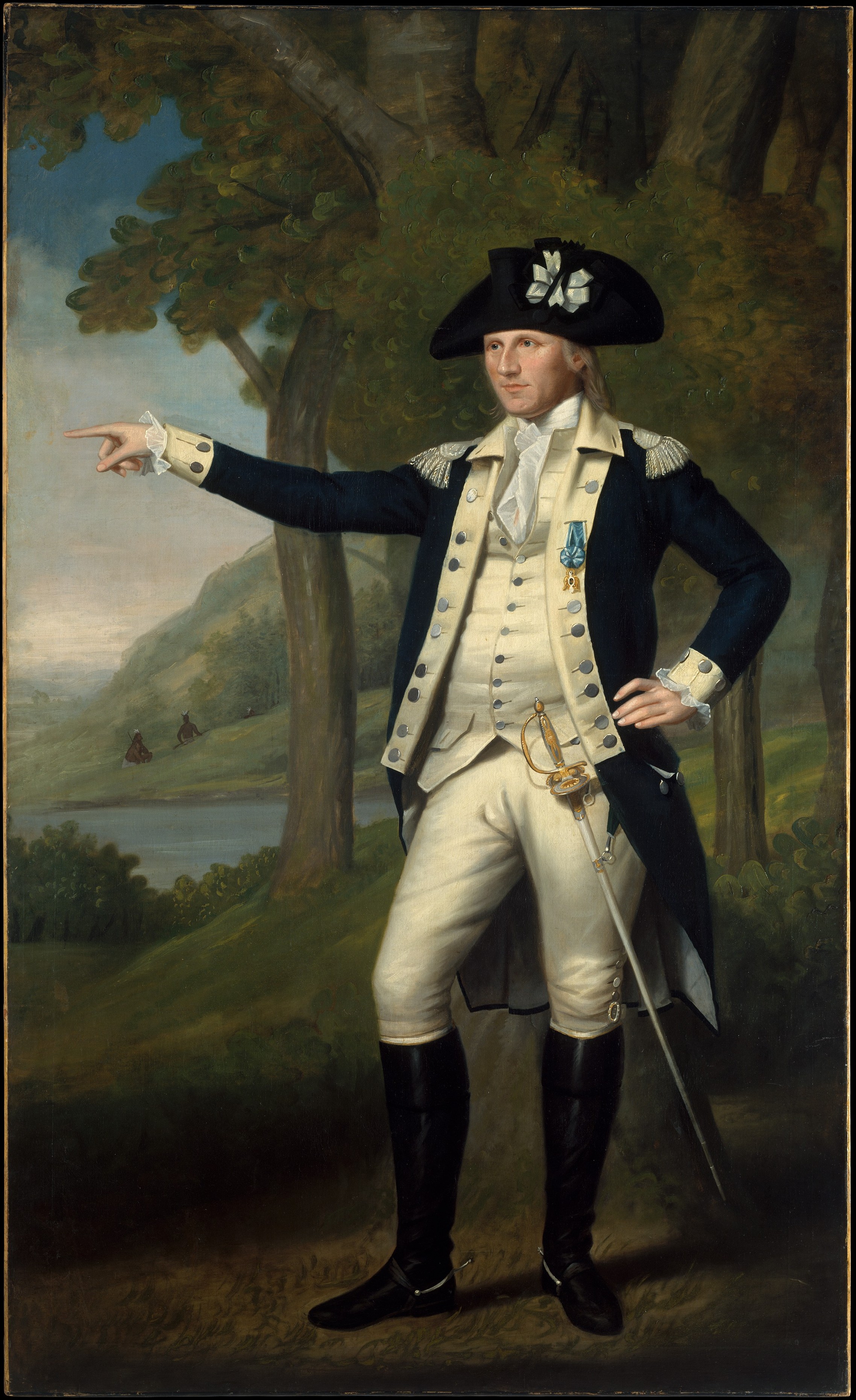
The following "Revolutionary Reminiscence" of Washington's Last Expedition tells of a brave officer facing amputation of his severely frostbitten legs. As dramatically related by "M.," the story has two heroes: the suffering warrior and the "humane Indian" who rescued him "from the amputating knife of a surgeon." The sympathetic and resourceful Indian is not named. His grateful patient was Captain Alexander Thompson (1759-1809). Then Lieutenant Thompson marched in February 1783 under Colonel Marinus Willett during the ill-fated Expedition to Oswego. Signed "M.," the "Revolutionary Reminiscence" first appeared in the Army and Navy Chronicle on March 26, 1840. Reprinted elsewhere, often without credit to any source or author, as in the Boston Weekly Magazine for Saturday, April 10, 1840 and Boston Recorder on September 11, 1840. Copied with credit "From the Army and Navy Chronicle" (including the subscribed initial "M.") in the New York Christian Intelligencer on May 16, 1840. 

REVOLUTIONARY REMINISCENCE.

In the winter of 1783, the father of the late Lieut. Colonel A. R. THOMPSON, (who fell in Florida at the head of his regiment, 25th Dec., 1837,) then a Lieutenant in the army of the Revolution, accompanied a detachment under Colonel WILLETT, with a view to surprise Fort Oswego, which was at that time in the occupation of the British. The treachery of their Indian guide, however, who led them a circuitous and roundabout way, caused, eventually, a failure in the enterprise, much to the chagrin and vexation of the American party.

The weather was excessively cold, the men and officers but poorly clad; but the soldier's duty oft compels him not only to forego the comforts of home and civilized life, but to endure summer's parching heat, and winter's piercing blast. The state of the country, also, at that period forbade repose or inactivity, while a foot of its soil was in the possession of the enemy. The deception practised by the guide, had protracted their journey, and consequently caused the endurance of much physical suffering, from the length of the route and intensity of the weather. Many of the men had their fingers, toes and ears, badly bitten by the frost. Lieutenant THOMPSON had both of his feet so severely frozen, that when the detachment arrived at the camp, he was in such a state that the surgeon in attendance deemed it necessary, in order to save his life, to amputate both his legs. Sad and heavily fell this decision upon the ears of poor THOMPSON, who, full of military ardor and zeal in his country's cause, was anxious to devote all his energies to assist in emancipating her from the tyranny of despotic power; but here he was in the vigor of youth, having entered the list with the brave and patriotic, to be rendered helpless and maimed for the rest of his life, (if he should survive the operation,) not by an honorable loss of limb in battle, from the ball of a warlike enemy, but from the amputating knife of a surgeon. The thought was painful in the extreme, and he almost wept at the prospect.

"Can nothing be done, Doctor, to save these limbs?" said the youthful officer, as he cast a look of the deepest inquiry at the surgeon, and continued, "they have not yet done half their duty. Cannot you save them, that I may yet serve my country, and participate in the honor of assisting throughout the struggle, and in consummating her entire freedom from the British yoke?"

"I can see no alternative," replied the doctor, as he bound around the ligature above the knee; "it is impossible to save them."

"Then may God give me grace to submit," said the lieutenant, placing his hand over his eyes and pressing his burning brow; and I must be sent home," he continued in soliloquy, "crippled in the service, but not in the field."

He was in this situation, with a few of his military friends around him, whose countenances bore the expression of the sympathy they felt for their beloved associate, and sad too, were his own reflections; but he summoned resolution to undergo the painful operation. At this crisis, a groupe had gathered around the tent, anxious to know the result. Among them was a friendly Indian who, hearing them say a man's legs were to be cut off, he turned, and raising the curtain, passed into the tent. Stepping up, he laid his hand upon the uplifted knife, just in the act of being used: "No!" said he, "that handsome young warrior shall not die! I will cure him!"

The surgeon said it was "impossible! that unless amputation was speedily performed, death from mortification must ensue."

"Halt! doctor," said Thompson, as his eyes turned quickly upon the Indian; "let him try, I would almost as soon die as lose my legs, now when they are so much needed as at the present."

"Let him, let him try," echoed the voices of all present; and the doctor laid down his knife and reluctantly submitted. Come, my good fellow, said they, save these legs, and you shall have a splendid rifle, and be constituted a chief.

The Indian threw off his blanket, commenced by removing the bandages, and by using friction, fomentations, poultices, &c. &c., succeeded in restoring circulation; and finally, after the patient had suffered much pain and anxiety, he recovered the use of his limbs, and was soon able to "report for duty.” 

The joy and gratitude of the young officer was unbounded; he generously rewarded the humane Indian, and often in after times, when marching in pursuit of the enemy, would he look down at his feet and bless the memory of the red man, who, under God, had been the means of saving his limbs, and perhaps his life. Mr. THOMPSON continued to serve throughout the war, with honor and reputation; and at the close of it was brevetted a Captain for his faithful and gallant conduct. 

M.

-- Army and Navy Chronicle, March 26, 1840.
https://hdl.handle.net/2027/hvd.32044097894786?urlappend=%3Bseq=211%3Bownerid=27021597765398891-221

In family correspondence, Captain Thompson himself disclosed the fact of his dangerous frostbite and hopes of recovery--without, however, describing any particulars of his successful treatment:

"We had one hundred and thirty bit with the frost, some very dangerously. I am myself one of the unfortunate number, but by frequent application I have made, my feet are much better and I flatter myself will soon be well."

-- Letter to Brother dated February 24, 1783 as transcribed in "Two Expeditions To Fort Ontario in 1783; Colonel Willett For War; Captain Thompson, For Peace" (Presented by Mr. Anthony Slosek, January 17, 1956) 19th publication of the Oswego County Historical Society, pages 1-16 at 16.

As mentioned early in the "Revolutionary Reminiscence" by "M." Captain Thompson was the father of Lt. Col. Alexander Ramsay Thompson, killed in Battle of Okeechobee during the Second Seminole War in Florida. Captain Alexander Thompson (1759-1809):

"served in the artillery during the Revolutionary war, was retained as captain in the peace establishment, and attached in 1794 to the artillery and engineer corps, and after his discharge in 1802 till his death, 28 Sept., 1809, was military store-keeper at West Point." 

-- Appleton's Cyclopaedia of American Biography

More on Capt. Thompson from The Ancestry and Descendants of John Alexander Thompson Nexsen, compiled and arranged by Samuel Emory Rogers (1925) page 16:

Colonel Thompson was the son of Captain Alexander Thompson, (1759‑1809), who enlisted for the American Revolutionary struggle at the age of eighteen in the Artillery Regiment of Colonel John Lamb. He was soon promoted to Captain of Artillery and later served as Captain of Engineers. He drew the plans for the siege of York town, which plans hang under his portrait in the United States Military Academy at West Point. He entered New York with the victorious American troops and was selected by General Washington to bear the dispatches to the frontier forts at Oswego, Niagara, and Detroit, ordering cessation of hostilities. At the close of the Revolution his company was the only company of the American army not disbanded. On October 1, 1787, Captain Alexander Thompson was promoted to First Major in Lieutenant-Colonel Sebastian Baum's Artillery. He resigned his commission as Major on October 9, 1793 in order to accept appointment as Commissary of Ordnance at West Point at the foundation of the Military Academy, which post he held until his death. He is buried at the Military Academy at West Point.