
Original research and riffs on Herman Melville, authorship, and nineteenth-century American literature.
Monday, September 27, 2021


Saturday, September 25, 2021
Bartleby in Burlington
From the Iowa State Gazette of December 7, 1853; found on NewspaperArchive:

The Iowa State Gazette was at this time a Democratic weekly newspaper, published every Wednesday. Since 1851 the State Gazette had been edited by Dr. Harvey, remembered as "an eminent citizen of Burlington" and "a man of intelligence and convictions" in one early History of Des Moines County, Iowa.Putnam's Monthly.
The December number of this valuable publication has been laid upon our table by a friend, and we are led to to the opinion after a hasty perusal of its contents, that its wide spread and rapidly increasing popularity, may be attributed to the superior reading matter contained in its pages. In this number is concluded "Bartleby, the Scrivener," which is a very interesting account of a strange being who occupied a corner in a Lawyer's office in the city of New York—and illustrates how strangely some strange men may live in the great city of Gotham. Bartleby always would "prefer not to"—and in this respect resembles some persons we know of not a thousand miles from here. "Wensley" is another interesting article concluded in this number, and to those who have read the former numbers the conclusion will be delightful. There are many other ably written and very interesting articles in this number, too numerous for us to name, but suffice for the present to say that this work is well worthy the liberal support of a reading people. It has not, like too many others, established its character with pictures, and only resorts to that fashion when science and art require an elegant illustration. When our January number arrives we will give it a more extensive review. --Burlington, Iowa State Gazette, December 7, 1853.
As ID'd by Frank Luther Mott, Edmund Quincy wrote the serial novel Wensley. Subtitled A Story Without A Moral, Quincy's "Wensley" originally appeared in Volume 2 of Putnam's Monthly Magazine, fourteen chapters in six installments:
- July 1853, chapters 1-3
- August 1853, chapters 4-6
- September 1853, chapters 7-8
- October 1853, chapter 9
- November 1853, chapters 10-11
- December 1853, chapters 12-14; immediately followed by the conclusion of
- Bartleby, the Scrivener, A Story of Wall-Street
Friday, September 24, 2021
Sketches from Melville's ENCANTADAS reprinted in 19th century newspapers
 |
| Bidwell's Bar, Butte County. Henry Rust Mighels, 1856 via California State Library |
No known manuscript, and no later printing in Melville's lifetime.
Turns out, however, there were later printings of some Encantadas sketches in Melville's lifetime. For one, all of the Hunilla sketch was reprinted from Putnam's magazine in a California gold-mining newspaper, as Melvilliana has discovered at no little expense, after renewing our lapsed subscription to NewspaperArchive. Under the major heading "The Story," the pathetic tale of Hunilla appeared in the Butte Record (Bidwell, Butte County, California) on Saturday, October 27, 1855.
Bidwell Bar (or Bidwell's Bar) was the first of the great mining camps that were settled in Feather River country of Central California. -- Western Mining History
As in Putnam's, the Bidwell, California reprinting is titled "NORFOLK ISLE AND THE CHOLA WIDOW." Also as in Putnam's, "Norfolk Isle" begins with uncredited epigraphs that Melville adapted from Spenser's The Faerie Queene and the Mynstrelles Songe in Chatterton's Ælla. Not included, the extra epigraph from Dirge in Cymbeline by William Collins that Melville would add in the book version.
Butte Record (Bidwell, Butte County, Calif.)
October 27, 1855

The Encantadas, or Enchanted Isles.(GALLAPAGOS.)THE ISLES AT LARGE.
In added parentheses, this San Francisco version of Sketch First helpfully locates Melville's Encantadas among the "Gallapagos" islands. Melville's pseudonym Salvator R. Tarnmoor (used at the start of each installment in the magazine series but not in the book version) has been omitted in the Chronicle reprinting. At the end of the sketch, the Chronicle credits Putnam's without naming any author.
 |
| San Francisco California Chronicle April 13, 1854 |
 |
| Susquehanna Register (Montrose, Pennsylvania) March 9, 1854 |
Thursday, September 23, 2021
Newburyport notice of THE CONFIDENCE-MAN
This item is reprinted on page 498 in Herman Melville: The Contemporary Reviews, edited by Brian Higgins and Hershel Parker (Cambridge University Press, 1995; paperback 2009).

The Confidence Man His Masquerade By Herman Melville New York, Dix, Edwards & Co. For sale by M O Hall.
Mr Melville is a writer of no ordinary talent. His former works were read with an interest that sharpened the appetite for almost anything his pen might indite. Though the "Confidence Man" is a book exhibiting close observations of human nature and a judicious and careful estimate of human virtues and frailties, we cannot accord to it the interest possessed by his less pretentious stories. It differs materially in manner from his other books, and lacks in geniality. Its philosophy is of a character that perhaps calls for too much exertion to fully enjoy, and the agents used in presenting it are of a class that seem to forbid an acquaintance.--
However, many would regard the book more favorably, and undoubtedly award to it high praise.
-- Newburyport, Massachusetts Daily Herald, April 22, 1857; now accessible with newly added titles on NewspaperArchive.
Also available in Digital Archives of the Newburyport Public Library:
The Newburyport Daily Herald was then edited by George J. L. Colby and Joseph B. Morss. According to his obituary in the Boston Globe (December 1, 1890), Colby once was employed "in the Salem custom house with Nathaniel Hawthorne." The 1890 obit identifies Colby as "principal editorial writer" for the Daily Herald "down to 1869."
- Newburyport MA Daily Herald, notice of THE PIAZZA TALES
https://melvilliana.blogspot.com/2021/09/newburyport-daily-herald-notice-of.html
Newburyport Daily Herald, notice of THE PIAZZA TALES

The Piazza Tales. By Herman Melville. New York Dix & Edwards. For sale by Moulton & Clark.
Mr Melville is a writer who never fails in giving his readers a good entertainment. In the present instance he has given us a series of magical sketches, which bear the marks of a skilful pencil. Among the pleasant characters in this group, the two first are most pleasing to us; and particularly do we admire that of Bartleby, so incomprehensibly mysterious, and so indefatigable in his attachments. The old Conveyancer has our gratitude for his forbearance, which so fully developed the characteristics of the scriviner. We know of no pleasanter way of spending a few hours, than in devoting them to a perusal of The Piazza Tales.
-- Newburyport MA Daily Herald, June 2, 1856.
By "characters" the reviewer means something like "sketches," taking the word character in the old fashioned sense of
An account, description, or representation of any thing, exhibiting its qualities and the circumstances affecting it. -- Webster's American Dictionary of the English Language.
The "old Conveyancer" is the narrator of Bartleby, the "elderly" lawyer employed in better days as "a conveyancer and title hunter, and drawer-up of recondite documents of all sorts."
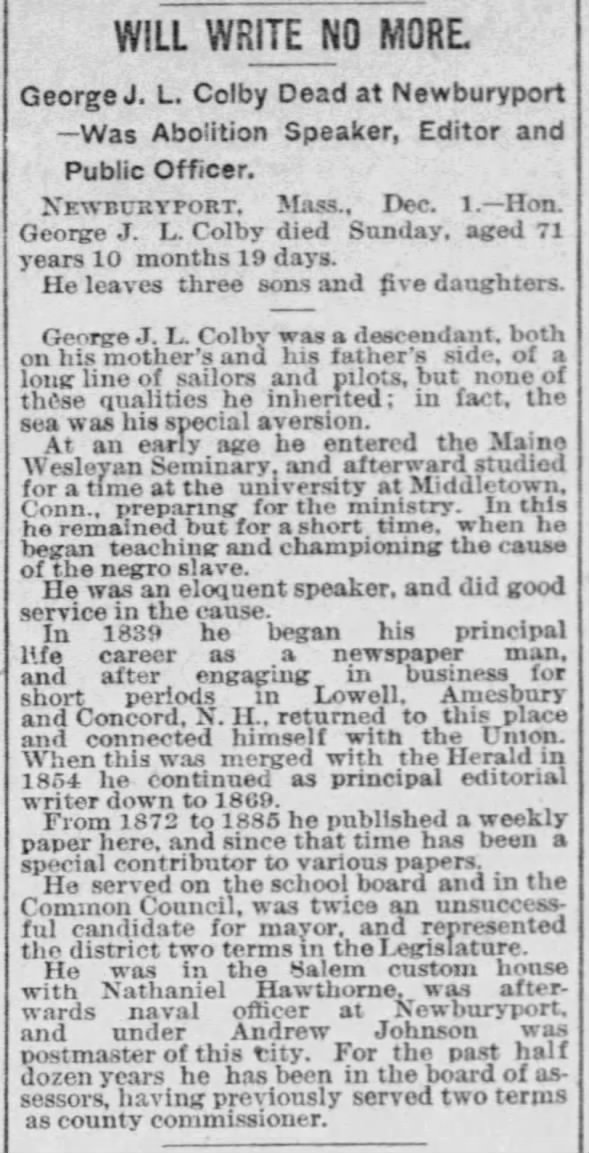 01 Dec 1890, Mon The Boston Globe (Boston, Massachusetts) Newspapers.com
Related post:
- Newburyport notice of THE CONFIDENCE-MAN
https://melvilliana.blogspot.com/2021/09/newburyport-notice-of-confidence-man.html