Monday, January 29, 2018

More newspaper reprintings of Melville's chapters on Ethan Allen in captivity

In the "Historical Note" for the Northwestern-Newberry Edition of Israel Potter, Walter E. Bezanson mentions two nineteenth-century printings of "Ethan Allen's Captivity," compiled from two chapters (21 and 22) in Melville's story of Israel Potter that originally appeared in the February 1855 issue of Putnam's magazine and were duly incorporated in the 1855 book version. One reprinting, in the Western Literary Messenger for September 1855, had been cited by Jay Leyda in volume 2 of The Melville Log. Another reprinting, from the New York Leader of June 8, 1856, was listed by Steven Mailloux and Hershel Parker in the pamphlet Checklist (Melville Society, 1975), later revised by Kevin J. Hayes and Hershel Parker in their Checklist of Melville Reviews (Northwestern University Press, 1991).

Putnam's Monthly Magazine - February 1855
Titled "Ethan Allen's Captivity" or in later reprintings, "Ethan Allen in Captivity," newspaper texts reverse the sequence of chapters as given in Putnam's magazine and the book version. The first three paragraphs come from Melville's chapter 22. More or less abridged, depending on the version, these opening paragraphs lifted from chapter 22 now serve to introduce the matter of chapter 21, highlighted by Ethan Allen's witty and chivalrous dialogue with visiting ladies--the "comic courtship," as Bezanson terms it, being Melville's invention. In compressing the introductory paragraphs some of the later items titled "Ethan Allen in Captivity" delete Melville's characterization of Ethan Allen as sociable "Pagan" and "Roman." Of those found so far, all newspaper reprintings qualify the sentence in which Melville denies the influence of Ethan Allen's New England roots on his personality. Melville wrote:
Though born in New England, he exhibited no trace of her character. --Putnam's magazine, February 1855; and Israel Potter: His Fifty Years of Exile (New York: G. P. Putnam and Co., 1855)

To which the newspaper versions unfailingly add,
 "except that his heart beat wildly for his country's freedom."
Washington, D. C. Evening Star - May 20, 1856
For a bridge back to the matter of chapter 21, newspaper reprintings employ the following sentence, or something like it, which does not appear either in the magazine or book versions of Melville's Israel Potter:
"Israel Potter, an exiled Englishman, while strolling around Pendennis Castle, where Allen was confined, chanced to hear him in one of his outbursts of indignation and madness, of which the following is a specimen...."
Israel Potter was of course American, not "an exiled Englishman" as stated in many nineteenth-century reprintings, for example in the Wellsborough, Pennsylvania Agitator, and the Western Literary Messenger. With specific reference to the Western Literary Messenger version, Alide Cagidemetrio points out the "exiled Englishman" bit as a "rare, historically humorous twist" (Fictions of the Past: Hawthorne & Melville, University of Massachusetts Press, 1992, page 113). But however ironic in effect, the turning of Melville's unfortunate war hero into "an exiled Englishman" was not unique and did not originate in the Western Literary Messenger, as will be seen. And some reprintings quietly corrected the error, making Israel Potter "an exiled American."

The "Ethan Allen" extract from Melville's story of "Israel Potter" in Putnam's magazine enjoyed a wider circulation in contemporary newspapers than previously recognized. Below are listed additional reprintings, not cited in the Northwestern-Newberry Edition of Israel Potter. "P" indicates that Melville's descriptor "Pagan" or "pagan" has been retained; EE = "exiled Englishman" in reference to Israel Potter; EA = "exile (or "exiled") American."
  • The Agitator (Wellsborough, Pennsylvania), May 3, 1855. P, EE.
From Putnam's Magazine
ETHAN ALLEN'S CAPTIVITY.
A TRUE AMERICAN STORY OF THRILLING INTEREST.
Found on Newspapers.com

Saturday, January 27, 2018

Another jokey birth announcement

Here's one more like those identified in the earlier post on 1853 birth announcements.

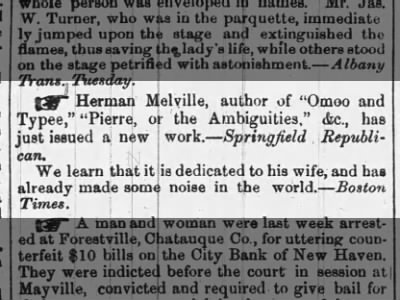
Same year, same baby girl (Bessie Melville, born May 22nd) but involving different newspapers in Boston and Buffalo. The original Springfield notice has been abbreviated for the sake of another joke, contributed by the Boston Times and reprinted in the Buffalo Morning Express on June 2, 1853:


Herman Melville, author of "Omoo and Typee," "Pierre, or the Ambiguities," &c., has just issued a new work.—Springfield Republican.

     We learn that it is dedicated to his wife, and has already made some noise in the world.—Boston Times. 
Related post:

Friday, January 26, 2018

Different versions for sure. Different manuscripts too?

The version of "Poor Man's Pudding and Rich Man's Crumbs" that appeared in the August 1854 issue of The Western Literary Messenger shares many textual features with the printing of Melville's paired sketches in the Concord, New Hampshire Independent Democrat (June 29, 1854). How many? A lot more than I first realized. Before now I never bothered to read the Western Literary Messenger text closely, assuming it to have been reprinted straight from the June 1854 issue of Harper's magazine. Finding Melville's paired sketches in the Concord Independent Democrat (edited by George Gilman Fogg) made me look again at the known reprintings, in the Western Literary Messenger and also the Salem Register for June 19, 1854. The Salem Register version basically follows the text in Harper's. Not so for the later printings in Concord and Buffalo--which agree with each other in most of the places where they differ from the Harper's and the Salem printings.

The lists below identify many (not all) of the textual features that distinguish the Concord (C) and Buffalo (B) versions of "Poor Man's Pudding and Rich Man's Crumbs" from the printings in Harper's (H) and Salem (S).
ABBREVIATIONS
  • H = Harper's magazine, June 1854
  • S = Salem Register, June 19, 1854
  • C = Concord [New Hampshire] Independent Democrat, June 29, 1854
  • B = [Buffalo, New York] Western Literary Messenger, August 1854
Where B departs from C the differences are mostly typos, mostly in B, for example: "mirrily" for "merrily" in "merrily dream of"; "Nw" for "No" in "No, said William, rising."; "haoked" for "hacked" in "hacked crust"; "in fouoled" for "is fouled"; "rack" for "reek"; and the misspelling "prooceed."

Of the numerous departures from the Harper's text that C and B share, some would appear, possibly, to reflect a manuscript exemplar at some stage of transmission, rather than or in addition to a printed one. The conjectured manuscript behind C and B was probably difficult to read in places, hence misreadings such as "earnestly" and "earnestness" for "enthusiastically" and "enthusiasm"; "thrice" for "trice"; and "magnificence" for "magnificoes." Not only that, the conjectured manuscript may have differed significantly in places from the printer's copy used by Harper's magazine. The availability of an alternate manuscript or manuscript stage might explain some of the more remarkable and suggestive variants in C and B, in particular:
  • "thro' kind Nature"; "thro'" for "through" being a characteristic spelling for Melville in manuscript.
  • extra dashes, again characteristic of Melville's narrative style. 
  • the expression "once in awhile" in the Concord version ("once in a while" in the Buffalo Western Literary Messenger) seems hard to account for, unlikely to be merely a mistaken reading or careless transcription of "sometimes."
Harper's magazine - June 1854
Concord Independent Democrat - June 29, 1854
  • friend Blandmour, "friend" being unexampled in the Harper's text.
  • "tho't" abbreviating "thought" in CB replaces "mused" in the Harper's text. The difference appears to reflect either an illegible exemplar, or a different base-text. ("Thought I" occurs repeatedly in Melville's published writings, including short stories Bartleby and Cock-a-doodle-doo!--don't know yet about this contracted form, "tho't".)
You find rare wisdom in the woods, tho't I.  -- Concord Independent Democrat; and Buffalo Western Literary Messenger
You find rare wisdom in the woods, mused I. --Harper's magazine
Concord Independent Democrat - June 29, 1854
  •  gulph, which Melville uses elsewhere, for instance in Moby-Dick chapter 3, "the Cape Horn measure, which you may gulph down for a shilling."
Western Literary Messenger - August 1854
Listed below are textual features shared by the Concord and Buffalo versions that distinguish them from the first known printing in Harper's magazine (June 1854), and the early reprinting from Harper's in the Salem Register (June 19, 1854).

POOR MAN'S PUDDING
  1. "earnestly" in CB replaces "enthusiastically" in HS
  2. no hyphens in CB for these: farm yard; spring snow; snow fleece; all bountiful; rain water; receipt book; wash tub; infirm looking; half rotten; heart trouble; washing day; picked up; dinner time; window sills; chimney shelf; stock still; maple sugar; good enough; up stairs; grindstone....
  3. "earnestness" (CB) for "enthusiasm" (HS)
  4. "Blandmour" in CB not "dear Blandmour"; 2x at least.  Thus: "...I presume, Blandmour" (but see the reverse below, #22: "dear Blandmour" for Blandmour).
  5. "winter" singular not "winters" in "long, long winter here"
  6. "itself" not italicized in "winter's snow itself"
  7. long dash after "dear Blandmour—"; likewise dash not semicolon after "bodily harms"; dash after "poor man's house."; dash not semicolon after "give up the point altogether"; dash after "many autumns.—" dash after "aspect of the room.—" dash after "long way sir—"; after shavings away"; dash after "footfall was heard—"
  8. "ever" not "never" in "Did you ever hear of the Poor Man's Eye-water?"
  9. "there is" not conracted in "there is 'Poor Man's Plaster'"..."
  10. "feed" not fe'ed as in "feed physician" (capitalized "Physician" in B, but "physician" in C)
  11. Go on, go on (repeated expression in BC where HS have "Go on." once only.
  12. "thro' kind Nature" abbreviated form, instead of "through kind Nature"
  13. semicolon within parenthesis "for the benefit of my health;)"
  14. no parentheses around "for the snow had thawed"
  15. "1 o'clock meal" numeral in CB where HS versions spell out "one o'clock"
  16. no dashes setting off "unobservantly" (emended to "unobservedly" in the Northwestern-Newberry edition): "unobservantly as I could"
  17. CB have no comma after "old" in "old and constitutionally damp."
  18. "blue eyes" plural in CB instead of "blue eye" in "soft, sad blue eye"; B has "her soft, and blue eyes" giving "and" instead of "sad"; C has "her soft, sad blue eyes"
  19. CB have lowercase m's and t in "Poor man's matches" and "Poor man's tinder"
  20. CB use question mark instead of period: "Ah, what they call 'Poor Man's Pudding,' I suppose you mean?"
  21. "We" not italicized in "We do not call it so, sir...."; "must" not italicized in "must take all my meals at home"
  22. Added "dear" in CB, "what dear Blandmour would have said" instead of "what Blandmour would have said"
  23. "thrice" in CB for trice, "in a thrice"
  24. CB have "friend Blandmour" instead of "Blandmour"
  25. "But you don't eat pork" (CB) instead of "But you don't eat of the pork!"  (HS)
  26. extra "a" "with a sly significance" in CB, not "with sly significance" as in HS
  27. "I am off" in CB instead of "I'm off."
  28. Poor man, lowercase 'm' in CB where HS have "Poor Man"
  29. "But once in a while his man gives me a Sunday ride." (CB, with "awhile" as one word in C)
    "But sometimes his man gives me a Sunday ride." (HS)
  30. "friend Blandmour" in CB instead of just "Blandmour" as in HS
  31. "our wedding-day, sir" in CB instead of "the wedding-day, sir" as in HS
  32. same reversed and misplaced parenthesis in CB, thus: "(and the soft, blue, beautiful eyes turned into two well-springs, ("
  33. "self-upbraiding" singular in CB, instead of "self-upbraidings" as in HS
  34. "bade the dame good-bye" in CB, good-bye instead of "good-by" as in HS
  35. "ill-ventilated cold" in CB, mistake for "well-ventilated cold" in HS
  36. "ruddy children" in CB, not "ruddy little children" as in HS
  37. "tho't" not "mused" in CB, thus: "tho't I" instead of "mused I" (HS)
 RICH MAN'S CRUMBS
  1. "George and Prince Regent" not "George the Prince Regent."
  2. traveller (CB) not traveler (HS)
  3. past tense "forgot exactly what" (CB) instead of "forget exactly what" (HS)
  4. past tense came, "I came to roam and see" (CB) instead of "I come but to roam and see." (HS)
  5. exclamation mark (CB) not question mark in "I hope you have not on your drawing-room suit!"
  6. "a civil, as well as a civil guide" (CB) instead of "a civic, as well as civil guide" (HS)
  7. was (CB) not were in "just the same as if I was pressed by a mob of cannibals...."
  8. "; in the country it softens" (clause instead of new sentence: "In the country it softens." (HS)
  9. dash in CB instead of semicolon, thus "not a sword—I know not"
  10. Frederick William in CB not Frederic William (HS)
  11. "mob of magnificence" (CB) instead of "mob of magnificoes"
  12. "no windows" in CB instead of "No windows...." (HS)
  13. splendid "everywhere" (one word in CB) instead of "every where" (two words in HS)
  14. "pine tables" no hyphen in CB; sidewalk in CB not side-walk
  15. "dined of that" in CB instead of "dined off that" (HS)
  16.  "one broad gulph" in CB for "one broad gulp"
  17. minus two "ands" in CB, thus: "Emperors, prince-regents, kings, and field-marshalls" instead of "Emperors, and prince-regents, and kings, and field-marshals...."
  18. ...plain beef and bread; so the leavings are accordingly.—" (CB)
    ...plain beef and bread. So the leavings are according. (HS)
  19. "red-gowned official near the board": near in CB instead of "nigh the board" (HS)
  20. "me" italicized only once in CB, not twice as in HS.
  21. "See!" with exclamation mark in CB, not "See?"
  22. "not only stands your hat away"; "away" in CB, not "awry" as in HS.
  23. added dash (no semicolon) in "an unfortunate friend--a simple spectator"; same in "You faint.--Ho!"
  24. "banquets of kings" with lower case nouns in CB, not capitalized as in HS, "Banquets of Kings"; typo in C only, "bonquets"
  25. CB have "mouthfulls" in "unsatisfying mouthfulls of disembowelled pasties...."; not "mouthfuls" as in HS.
  26. "answered my back" in CB, mistake for "answered my beck"
  27. "defined all tumblings and tearings" in CB; mistake for "defied all tumblings and tearings" (HS)
  28. "Good-bye" in CB for "Good-by" in HS.
  29. "addressing the driver on the box" set off by commas in CB, not dashes as in HS.

Related post


Thursday, January 25, 2018

Notice of The Town-Ho's Story, Newark Daily Advertiser

The Town-Ho's Story first appeared in the October 1851 issue of Harper's New Monthly Magazine, offered as an extract from Herman Melville's forthcoming novel The Whale (as the British edition was titled). The Town-Ho narrative forms chapter 54 in the American edition of Moby-Dick.

Reviewing Harper's for October, the Newark Daily Advertiser on September 29, 1851 alluded to "The Town-Ho's Story" and the forthcoming Whale, both favorably:

Newark Daily Advertiser - September 29, 1851
via GenealogyBank
"We are glad to have a foretaste of the fine dish which Herman Mellville is soon to offer us, and we venture to predict, that our friends will not shrink from going the whole WHALE (which is the title of the note from which this extract is taken) as soon as they have the chance."
Edited by Samuel Jackson Gardner, the father of Melville's friend Augustus Kinsley Gardner.

Related posts:

Notice of Pierre in the Troy Daily Whig

Troy Daily Whig - August 9, 1852 via Fulton History
Following my own advice about searching for "Mellville" led to this one, from the Troy Daily Whig of August 9, 1852. Not transcribed in Herman Melville: The Contemporary Reviews, ed. Brian Higgins and Hershel Parker, but cited there in the "Checklist of Additional Reviews" on page 452.

New Work by Mellville.


PIERRE OR THE AMBIGUITIES.--This book is by Mellville, the author of Typee, a narrative well known to the public, and a great favorite with a large portion of it. He dedicates his work to "Greylock's most excellent Majesty," that noble old mountain, that bears aloft the heavens on its Atlantian shoulders, and divides midway, Berkshire Co.--a wall of rock between the disjointed spurs of the Green Mountains. WILLARD has the book.
The Troy Daily Whig was then owned and edited by Charles David Brigham (1819-1894) who later became celebrated for Civil War journalism. As discussed by Paul Starobin in Madness Rules the Hour, Brigham reported from Charleston in 1860 for the New York Tribune.
"In 1862 Brigham reported one of the major stories of the war in a twenty-two-page telegram to the Tribune recounting the battle of the ironclads Monitor and Merrimac at Hampton Roads."  --Historical Dictionary of War Journalism, ed. Mitchel P. Roth (Greenwood Press, 1997) page 40.
In 1864 as editor of the Pittsburgh Commercial Brigham
made himself famous in the newspaper world by securing news of the battle of the Wilderness twenty-four hours before any other editor. His correspondent hastened from the battle-field on the second day of the engagement, chartered a ferry-boat for $2,700 to carry him to the nearest telegraph station, and telegraphed the details of the conflict before New York newspapers knew that the armies had met. --The National Cyclopaedia of American Biography

Moby-Dick in Oswego

Oswego Commercial Times - Wednesday, November 26, 1851
via Fulton History
From the Oswego Daily Commercial Times, November 26, 1851 (then owned and published by James N. Brown); found online in the great and growing archives of historical newspapers from New York State and elsewhere at Fulton History.
MOBY-DICK, or the Whale. By Herman Mellville.--Persons who are fond of reading marvelous fish stories, this book will be welcome. It is written with considerable spirit, and abounds in wit and humor. 
Fulton History is a magnificent resource for all sorts of research, worthy of generous support. Contact info:
Thomas M. Tryniski
309 South 4th Street
Fulton New York 13069
tryniski@fultonhistory.com
Sometimes you have to look for MELLVILLE with four L's.

Wednesday, January 24, 2018

Fake News from the Mediterranean

Some few weeks after the execution, among other matters under the head of News from the Mediterranean, there appeared in a naval chronicle of the time, an authorised weekly publication, an account of the affair. It was doubtless for the most part written in good faith, tho' the medium, partly rumor, through which the facts must have reached the writer, served to deflect and in part falsify them. The account was as follows:--
"On the tenth of the last month a deplorable occurrence took place on board H. M. S. Indomitable. John Claggart, the ship's maaster-at-arms, discovering that some sort of plot was being hatched incipient among an inferior section of the ship's company, and that the plotter ringleader was one William Budd; a foretopman he, Claggart in the act of arraigning the man before the Captain was vindictively stabbed to the heart by the suddenly drawn sheath-knife of Budd.

The deed and the implement employed, sufficiently suggest that tho' mustered into the service under an English name the assassin was no Englishman, but one of those aliens adopting English names cognomens whom the present extraordinary necessities of the service have caused to be admitted into it in considerable numbers.

The enormity of the crime and the extreme depravity of the criminal, appear the greater in view of the character of the victim, a middle-aged man eminently respectable, safe and and discreet, belonging to that minor official grade, the petty-officers, upon whom, as His Majesty's navy upon which, as are none know better than the commissioned officers gentlemen, the efficiency of His Majesty's navy so considerably largely depends.--the petty officers. His function was a an onerous and responsible one, at once onerous & thankless, and his fidelity in it the more greater because of the peculiar earnestness of his strong patriotic loyal impulse that signalisesing him trait in him. greater because of his strong patriotic impulse. In this instance as in so many other instances in these days, the example of this character of this unfortunate man signally refutes, if refutation were needed, that peevish saying attributed to the late Dr. Johnson, that patriotism is the last refuge of a scoundrel.

The criminal paid the penalty of his crime. The promptitude of the example punishment has proved salutary. Nothing amiss is now apprehended aboard H. M. S. Indomitable."
The above appearing in a publication now long ago superannuated and forgotten is all that stands hitherto has stood in authoritative human record up to the present time to attest what manner of men respectively were John Claggart and Billy Budd. 
--Herman Melville, transcribed from digital images of Billy Budd in manuscript. available online courtesy of Harvard Library. <http://nrs.harvard.edu/urn-3:FHCL.Hough:4686413> Melville, Herman, 1819-1891. Herman Melville papers, 1761-1964. Billy Budd. A.Ms.; [n.p., n.d.]. MS Am 188 (363). Houghton Library, Harvard University, Cambridge, Mass. Houghton Library, Harvard University. Accessed 24 January 2018.
pages with links:

340 (seq. 773): http://nrs.harvard.edu/urn-3:FHCL.Hough:4686413?n=773

341 (seq. 775): http://nrs.harvard.edu/urn-3:FHCL.Hough:4686413?n=775

342 (seq. 777): http://nrs.harvard.edu/urn-3:FHCL.Hough:4686413?n=777

343 (seq. 779): http://nrs.harvard.edu/urn-3:FHCL.Hough:4686413?n=779

344 (seq. 781): http://nrs.harvard.edu/urn-3:FHCL.Hough:4686413?n=781
The best version in print appears in the hefty new Northwestern-Newberrry Edition of Billy Budd, Sailor and Other Uncompleted Writings. Edited by Harrison Hayford, Alma A. MacDougall, Robert A. Sandberg, and G. Thomas Tanselle, Historical Note by Hershel Parker. Net weight 3.2 lbs as I learned the other morning after stepping on the scale absentmindedly, book in hand. For one thing I was looking to see what the editors made of Melville's incomprehensible word in the cancelled bit after the passage transcribed above.
Here ends a story not unwarranted by what sometimes happens in this in *^$)@%(#&!
world of ours--Innocence and infamy, spiritual depravity and fair repute
Some print versions make the uncertain word(s) incomprehensible, as in "this incomprehensible world of ours." In the appended "Transcription of Billy Budd, Sailor" (page 540) the Northwestern-Newberry editors leave it "undeciphered." However, the "Discussions" section (page 433) reports three previous suggestions:
  • incongruous
  • incomprehensible
  • incompetent
If you want to play this game at home, here's the link again to manuscript page 344 (seq. 781) with that famously hard word:
And here's another try at the "News from the Mediterranean" chapter--same text as above, but now omitting cancelled words for easier reading:
Some few weeks after the execution, among other matters under the head of News from the Mediterranean, there appeared in a naval chronicle of the time, an authorised weekly publication, an account of the affair. It was doubtless for the most part written in good faith, tho' the medium, partly rumor, through which the facts must have reached the writer, served to deflect and in part falsify them. The account was as follows:--
"On the tenth of the last month a deplorable occurrence took place on board H. M. S. Indomitable. John Claggart, the ship's maaster-at-arms, discovering that some sort of plot was incipient among an inferior section of the ship's company, and that the ringleader was one William Budd; he, Claggart in the act of arraigning the man before the Captain was vindictively stabbed to the heart by the suddenly drawn sheath-knife of Budd.

The deed and the implement employed, sufficiently suggest that tho' mustered into the service under an English name the assassin was no Englishman, but one of those aliens adopting English cognomens whom the present extraordinary necessities of the service have caused to be admitted into it in considerable numbers.

The enormity of the crime and the extreme depravity of the criminal, appear the greater in view of the character of the victim, a middle-aged man respectable and discreet, belonging to that minor official grade, the petty-officers, upon whom, as none know better than the commissioned gentlemen, the efficiency of His Majesty's navy so largely depends. His function was a responsible one, at once onerous & thankless, and his fidelity in it the greater because of his strong patriotic impulse. In this instance as in so many other instances in these days, the character of this unfortunate man signally refutes, if refutation were needed, that peevish saying attributed to the late Dr. Johnson, that patriotism is the last refuge of a scoundrel.

The criminal paid the penalty of his crime. The promptitude of the punishment has proved salutary. Nothing amiss is now apprehended aboard H. M. S. Indomitable."
The above appearing in a publication now long ago superannuated and forgotten is all that hitherto has stood in human record to attest what manner of men respectively were John Claggart and Billy Budd.

 More links