Monday, May 25, 2015

The Percy Anecdotes

It's there on the first page of the 1837 Catalogue of Books in the Library of the Young Men's Association of the City of Albany:
1037 Anecdotes, Percy's
and again on page 24, listed first under "P":
1037 PERCY Anecdotes
without however any further identifying information as to volume number. Percy Anecdotes appeared in a series of volumes, No. 15 of which in the 20-volume London edition features anecdotes of
Shipwreck — Travelling.
I'm guessing the Albany Library catalog also listed one or more of these volumes, let's check. Yes, ten volumes! No details about contents are given, but see there on page 59:
1501 Percy Anecdotes, 10v.
Percy? One expert (the Mad Librarian?) at Rooke Books names names of the real compilers:
"Supposedly written by Sholto and Reuben Percy, brothers of the Benedictine monastery of Mount Benger the Anecdotes are in fact penned by Sir John Byerley and Thomas Byerley"
Sir John Byerly was Sholto? No, another description by the same shop indicates that
 "Reuben Percy was Byerley, and Sholto Percy was Joseph Clinton Robertson." --Rooke Books / Home of the Mad Librarian
 Another source says Reuben Percy was Joseph Clinton Robertson.

Other way around, according to the Dictionary of National Biography: "Reuben Percy was Thomas Byerley, and Sholto Percy was Joseph Clinton Robertson, who died in 1852." Hmmm. As for the title,
The name of the collection of anecdotes was taken, not from the popularity of the 'Percy Reliques,' but from the Percy coffee-house in Rathbone Place, where Byerley and Robertson were accustomed to talk over their joint work.  --1886 DNB
 1909 DNB entry for Joseph Clinton Robertson
What a treasure trove for any reader, especially one who also writes, and more especially Melville with his notoriously allusive style and characteristic pose (as I read somewhere) of universal learning. If you encountered this, say in Albany or anywhere...

 SHIPWRECK.

DANGERS AT SEA.

The celebrated Tasso and his friend Manso, with Scipio Belprato, Manso's brother-in-law, were one day in a summer-house which commanded a full prospect of the sea, agitated at the moment by a furious storm. Belprato observed,"that he was astonished at the rashness and folly of men who would expose themselves to the rage of so merciless an element, where such numbers had suffered shipwreck." "And yet," said Tasso, "we every night go without fear to bed,where so many die every hour. Believe me, death will find us in all parts; and those places that appear the least exposed are not always the most secure from his attacks." —An Italian version of an old fable, but not on that account the less apposite. --The Percy Anecdotes, vol 15
you might be at your writing desk in Pittsfield, Mass. and come up with this:
But why say more? All men live enveloped in whale-lines. All are born with halters round their necks; but it is only when caught in the swift, sudden turn of death, that mortals realize the silent, subtle, ever-present perils of life. And if you be a philosopher, though seated in the whale-boat, you would not at heart feel one whit more of terror, than though seated before your evening fire with a poker, and not a harpoon, by your side.
--Moby-Dick, The Line
The Percy Anecdotes, Volume 15 in the 1826 Cumberland edition at Hathi Trust, digitized from the volume at Princeton:


Links to the Harper Revised American edition in one volume:

--Percy Anecdotes, 1845 Harper & Brothers Revised ed.

--1847 Harper & Brothers Revised edition at NYPL

Monday, May 11, 2015

Hancock's Charge

Image Credit: Library of Congress
Another year is about gone since the 2014 Memorial Day post on Corps Commander Winfield Scott Hancock. Since then I've looked at some of the many Civil War era images available online in the Library of Congress Prints and Photographs Division. Above, this Currier and Ives print visually reinforces the main point of that earlier post (Hancock not Grant is the "Corps Commander" of Melville's poem in Battle-Pieces), illustrating Hancock's popular credit for leading what Melville in On the Photograph of a Corps Commander calls "Spottsylvania's charge to victory."  
Ay, man is manly. Here you see
The warrior-carriage of the head,
And brave dilation of the frame;
And lighting all, the soul that led
In
Spottsylvania's charge to victory, 
Which justifies his fame.
--On the Photograph of a Corps Commander, first stanza
The full caption of the Currier and Ives print reads:

GLORIOUS CHARGE OF HANCOCK'S DIVISION (2ND) OF THE ARMY OF THE POTOMAC 

At the Battle near Spottsylvania Court House Va., May 12th 1864. 

At midnight Gen’l Hancock changed his position on the extreme right to the left; and at daylight attacked with his accustomed impetuosity, forcing the first, and then the second line of the Rebel works, capturing the whole of Johnson’s Division and part of Early’s, together with Maj. Gen’l E. Johnson, Gen’l. Geo. H. Stewart, and prisoners by the thousands.

The Currier & Ives "Circular for Trade Only" reproduced at The Philadelphia Print Shop lists "Hancock's Charge at Spottsylvania" and "Gen. Hancock on Horseback" among new and current PRINTS FOR THE CAMPAIGN, available wholesale at $6 per 100.

Related posts

Tuesday, April 28, 2015

Favorable notices of Gansevoort Melville and Herman Melville's books in the Richmond Enquirer

Thomas Ritchie, Jr. via Find A Grave
Some years back the head-note to Melville Reviews and Notices, Continued in Leviathan predicted new finds in southern newspapers should anyone bother to look:
Previous research has largely, though by no means exclusively, focused on archives from New York, Boston, and the northeastern United States. Relatively neglected southern and western newspapers and periodicals, and foreign publications as well, in print and online archives, seem especially likely to yield important discoveries in the future.

Citation: Norsworthy, Scott. "Melville Reviews and Notices, Continued." Leviathan, vol. 13 no. 1, 2011, p. 88-115. Project MUSE, https://muse.jhu.edu/article/493025.

Now that Genealogy Bank has old issues of Virginia newspapers in their database there's really no excuse for not starting.

What emerges from online searches in the Richmond Enquirer is a pattern of favorable mentions of Gansevoort Melville and unaffected praise for books by Gansevoort's younger brother Herman Melville.


Mastheads of the Daily Richmond Enquirer after May 1845 list William F. and Thomas Ritchie, Jr. as co-editors. Thomas Ritchie, Jr. and William Foushee Ritchie were sons of Enquirer founder, old Thomas Ritchie. As chronicled in the Editor and Publisher and Journalist 12.2:
In May, 1845, Ritchie left the Enquirer after forty-one years of service, and went to Washington to take the chief editorial management of the Union, the official organ of President Polk. 
Just before his retirement from the Enquirer in 1843, two sons. William F. and Thomas Ritchie, Jr., had been associated in the management of the paper. On the departure of his father for the National Capital, William F. Ritchie became its editor.
Another version of editorial changes at the Richmond Enquirer, from The Virginia Magazine of History and Biography:
On March 4, 1843, his sons William F. and Thomas Ritchie, Jr., were admitted into partnership, and the firm of publishers became Thomas Ritchie and Sons. 
On March 19, 1845, the publication of a daily edition called the Daily Richmond Enquirer was commenced, and on May 9th of the same year Thomas Ritchie retired after editing the Enquirer for forty-one years. The editors and owners were then William F. and Thomas Ritchie, Jr. The files of the paper from 1845 to 1860 are not among those in the State Library; but it is known that during this period it was owned and edited by the two Ritchie brothers.
The Richmond Ritchies were associated with Gansevoort Melville as active Democrats and fellow supporters of James K. Polk in the 1844 presidential campaign. The elder Thomas Ritchie, "Father" Ritchie is the "Napoleon of the press" who presided over dinner at the Exchange Hotel in Richmond on March 12, 1845 with John C. Calhoun, General Lamar, and Gansevoort Melville.

On August 5, 1844 the Richmond Enquirer reprinted the supportive column on Gansevoort from the New York Evening Mirror, backing the able new Secretary of Legation at London with special reference to the distinction of his "double revolutionary descent":

Richmond [Virginia] Enquirer, August 5, 1844
via Genealogy Bank
On Friday, June 5, 1846 the Daily Richmond Enquirer gave notice of Gansevoort's untimely passing by remembering him as "a gentleman of talents and high worth":
We are pained to learn by the last steamer, that Gansevoort Melville, Esq., of New York American Secretary of Legation at London, died in that city on the 12th ult., after an illness of three weeks. He was a gentleman of talents and high worth.
On Saturday, July 4, 1846 the Enquirer copied the item from the Albany Argus reporting THE FUNERAL OF GANSEVOORT MELVILLE.

The favorable notice on June 29, 1846 by the Daily Richmond Enquirer of Herman Melville's first book Typee was lengthened by numerous excerpts from excellent reviews in other newspapers and magazines:
“Typee,” or a Residence in the Marquesas Islands.

This work, which we have read with great gratification, bids fair to acquire a most enviable popularity. It is truly a sort of New Robinson Crusoe. Its free, dashing style, and entertaining narratives and descriptions, render it at once novel and instructive. It is from the pen of Mr. Hermann Melville, of New York, a brother of Gansevoort Melville, our late accomplished and much lamented Secretary of Legation at London.

We subjoin some of the favorable opinions which this book has won in other quarters. We are proud to see that the literary genius of America is beginning to be appreciated in the Old World:

“A book full of fresh and richly colored matter. Mr. Melville’s manner is New World all over.”— [London Athenæum.

“A book of great curiosity; striking in the style of composition, many of the incidents but require us to call the savages celestials, to suppose Mr. Melville to have dropped from the clouds, instead of ‘bolting’ from the skipper Vangs, and to fancy some Ovidian graces added to the narrative in order to become scenes of classical mythology.”— [London Spectator.

“This is really a very curious book. The happy valley of our dear old Rasselas was not a more romantic or enchanting scene.” [London Examiner.

“This is a most entertaining and refreshing book. The picture drawn of Polynesian life and scenery is incomparably the most forcible and vivid that as ever been laid before the public. The writer of this narrative, though filling the post of a common sailor, is certainly no common man. His clear, lively and pointed style, the skillful management of his descriptive, the philosophical reflections and sentimental apostrophes scattered plentifully through the work, are the production of a man of letters.” [London Critic.

“These adventures are very entertaining.” [Tait’s Edinburgh Mag.

“There is no lack of incident or novelty, and he who commences the perusal of Mr.; Melville’s narrative will scarcely fail to complete it.” [London Eclectic Review.

“The scenes depicted are novel—the descriptions fresh. It is full of marvelous adventure, perilous journeyings and glowing pincillings [sic] of savage life and scenery, which possess a charm calculated to rivet the reader’s attention as strongly and continuously as De Foe’s Robinson Crusoe. There are so many passages and pages full of curious information, that our only difficulty is to abridge our extracts.” [Simmons’ Colonial Magazine.

“One of the most delightful narratives of adventure ever published. From the first line in the first page to the last in the last, interest, information, and the most genial freshness of description pervade the whole volume. Every chapter has its separate picture and every picture is glowing with life. Throughout it there are snatches of drollery that are irresistibly comic, and sometimes reflections of the most unstrained and winning pathos. We can cordially recommend the book as a most choice and delightful one: if we could possibly squeeze all its pages into a single column, we would prove its excellence by transcribing the entire work.” [London Sun.

“Since the joyous moment when we first read Robinson Crusoe, and believed it all, and wondered all the more because we believed, we have not met with so bewitching a work as this narrative of Herman Melville’s.”— [John Bull.

“The style is racy and pointed, and there is a romantic interest thrown around the adventures which to most readers will be highly charming.” [American Review.

“Those who love to roam and revel in a life purely unconventional, though only in imagination, may be gratified by following the guidance of Mr. Melville. He writes of what he has seen con amore, and his pen riots in describing the felicity of the Typees.”—[Graham’s Magazine.
"This has all the elements of a popular book—novelty, and originality of style and matter, and deep interest from first to last. Few can read without a thrill the glowing pictures of scenery and luxuriant nature, the festivities and amusements, the heathenish rites and sacrifices, and battles of these beautiful islands.” [Hunt’s Merchant’s Magazine.

“The adventures are of a youth in the romantic islands of the Pacific Ocean, among a strange race of beings, whose manners and modes of life are by no means familiar to us.” 
“The scenes described with peculiar animation and vivacity, are of a description that must task the credulity of most plain matter of fact people; yet they are without doubt faithfully sketched, and afford evidence of ‘how little half the world knows how the other half lives.’ The volumes are of the most amusing and interesting description.” [Democratic Review.
--Daily Richmond [Virginia] Enquirer, Monday morning, June 29, 1846; found in the online Newspaper Archives at Genealogy Bank
With a similar endorsement of the young author as representative of a growing national literature, Melville's next book Omoo also received highly favorable treatment in the Richmond Enquirer:
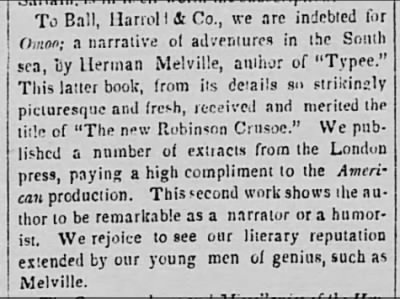
Richmond Enquirer, July 2, 1847
To Ball, Harrold & Co., we are indebted for Omoo; a narrative of adventures in the South sea, by Herman Melville, author of “Typee.” This latter book, from its details so strikingly picturesque and fresh, received and merited the title of “The new Robinson Crusoe.” We published a number of extracts from the London press, paying a high compliment to the American production. This second work shows the author to be remarkable as a narrator or a humorist. We rejoice to see our literary reputation extended by our young men of genius, such as Melville.
-- Daily Richmond [Virginia] Enquirer, Thursday, July 1, 1847; reprinted the next morning, Friday, July 2, 1847. Available online via the Newspaper Archives at Genealogy Bank; and now Newspapers.com
For Mardi, the "Checklist of Additional Reviews" in Herman Melville: The Contemporary Reviews, ed. Brian Higgins and Hershel Parker, gives the date of one notice by the "Richmond Enquirer, 11 May 1849."

Here is the brief take on Mardi from the Enquirer, May 11, 1849 under the heading NEW WORKS:
Mardi, and a voyage thither—a romance of Polynesian adventure, in two volumes; by Herman Melville, author of the popular “Typee.”—Same publishers [Harper & Brothers].

As two narratives of voyages in the Pacific, published by the author, had been received with incredulity, he determined to write a fiction, supposing that, vice versa, the fiction might be taken as a verity. It abounds in very spirited and graceful sketches of land and ocean, of the pursuit of the whale, &c. 
 --found in the online Newspaper Archives at Genealogy Bank
Wonderful to say, The 19th Century Rare Book & Photograph Shop is offering the volumes of Mardi owned by long-time editor of the Richmond Enquirer Thomas Ritchie "with his signature, and with his son’s later inscription":
Provenance: Thomas Ritchie (1778-1854), with his signature, and with his son’s later inscription. One of the leading American journalists of the first half of the nineteenth century, Ritchie was the longtime editor and publisher of the Richmond Enquirer, which Thomas Jefferson hailed as “the best [newspaper] that is published or has ever been published in America.” Letters to Ritchie from Herman Melville’s brother Gansevoort are in the Ritchie papers at William & Mary.
A fine and tight set. Out of my league unfortunately, but it would be nice to learn something more about that later inscription--by Thomas Ritchie's son, meaning who? Thomas Ritchie, Jr. or William Foushee Ritchie?

Another place to look for favorable Melville mentions is the Richmond Examiner, edited by John M. Daniel (not W. F. Ritchie). Burton R. Pollin found a good one in Daniel's review of Redburn in the Examiner for November 23, 1849, transcribed in Melville Society Extracts 89 - June 1992. And I guess now we ought to look harder at the Washington Daily Union under the editorship of old Thomas Ritchie.

Monday, April 27, 2015

Gansevoort Melville in Richmond, Virginia--dining with Calhoun, Lamar, and Thomas Ritchie

J. C. Calhoun via NYPL Digital Collections

The developing story here is Thomas Ritchie, "Democratic editor of the Richmond Enquirer from 1804 to 1845, and of the Washington Daily Union from 1845 until 1851." As indicated in the Melvilliana post on Favorable Melville notices, old Ritchie's sons Thomas Ritchie, Jr. and William Foushee Ritchie succeeded their father in the editorship of the Richmond Enquirer. While I break to savor Carl R. Osthaus's chapter on The Editorial Career of Thomas Ritchie in Partisans of the Southern Press, go ahead and enjoy this item placing Gansevoort (with Ritchie, as evident from the New York Herald letter from "John Jones," also quoted below) in the company of John Caldwell Calhoun and General Lamar (Mirabeau Buonaparte Lamar).

In March 1845 Calhoun was passing through Richmond on his way home to South Carolina, staying at the Exchange Hotel. While in Richmond he invited Gansevoort Melville and Lamar for dinner, a more private affair in lieu of the grand public dinner which he formally declined. Calhoun had just completed his year-long service as Secretary of State. Gansevoort's younger brother Herman was close to starting his first book, Typee (1846). In his third book Mardi (1849) Herman would lampoon Calhoun as the cadaverous politician Nulli. In Subversive Genealogy, Michael Paul Rogin finds in the pro-slavery politics of Calhoun a model for Ahab's monomania.

Image Credit: World of Edgar Allan Poe
Gansevoort's dinner with Ritchie, Calhoun, and Lamar at the Exchange Hotel in Richmond took place on Wednesday, March 12, 1845. From the Richmond Enquirer, March 17, 1845:

MR. CALHOUN.

The distinguished and retiring statesman—“retiring from the field of his fame”—(as the first toast in his honor called him)—had a small but agreeable dinner with a few of his friends on Wednesday last, and declined the honor of a public dinner, as the following correspondence shows. There were at the table, as guests, General Lamar of Texas, Gansevoort Mellville, Esq., of New York, the eloquent and accomplished champion who distinguished himself at various points of the late campaign, &c, &c. Mr. Calhoun is rapidly improving in his health, and is returning from Washington with the most liberal feelings towards the present Administration. He left Richmond on Thursday, having been waited upon by several persons.  --Richmond [Virginia] Enquirer, Monday, March 17, 1845; found in the online Newspaper Archives at Genealogy Bank.

Portrait of General Mirabeau B. Lamar / Image Credit:
Texas State Library and Archives Commission
As noted in the Melvilliana post Tall after all,
Gansevoort's presence in Richmond is happily confirmed by correspondent "John Jones" in a letter to the editor of the New York Weekly Herald, dated March 13, 1845 and published March 15, 1845:
"Mr. Melville, the tall democratic spouter, par excellence, from your city, is also here, probably looking up political influence for some valuable appointment for services rendered. Should he be disappointed, it would be a pity, as he is pretty much of the opinion, I understand, that Mr. Polk could not have been elected had it not been for his disinterested exertions during the canvass—Nous verrons."
In the first part of his letter to the Herald editor, John Jones reveals a bit more about the dinner for Calhoun. The presiding "Napoleon of the press" is Thomas Ritchie, editor of the Richmond Enquirer:
DEAR BENNETT—
What can I communicate, that can possibly interest the readers of the Herald, from this dull quarter of the globe, except mere matter of fact? I will attempt to give you a few items, by way of killing an hour.

First. Mr. Caloun created a little stir among his friends here, by staying over one day on his way South, which was taken advantage of by giving him a private and recherchĂ© dinner, at the Exchange, by about twenty of his most ardent friends, the Napoleon of the press in these “diggings” being invited to preside, with Mr. Calhoun on his right, and Gerneral Lamar (of Texas) on his left. Some excellent toasts and sentiments were given, and the party separated at an early hour, to attend a select party at R. G. Scott’s, where the evening was spent in the most convivial manner by a set of as choice spirits as can well be congregated together in this region.   
--New York Weekly Herald, March 15, 1845
Thomas Ritchie
via The Library of Virginia
It's unthinkable that Gansevoort did not make one of those eloquent toasts to Calhoun. Ooh that would be fun to find in a Richmond paper.

UPDATE: No toasts located so far, but I did find news of Calhoun's informal dinner with friends at the Exchange Hotel, published in the Richmond Enquirer on the day after:

Richmond Enquirer, March 13, 1845
William & Mary, Earl Gregg Swem Library, Special Collections Database lists two letters from Gansevoort in London to Thomas Ritchie, filed with the Ritchie-Harrison Papers. In Gansevoort Melville's 1846 London Journal, ed. Hershel Parker, Gansevoort mentions his writing to Ritchie on January 3, 1846. As he regularly did for friends and family, Gansevoort also sent newspapers to Ritchie in February and early March 1846. Parker correctly identifies Ritchie as editor of the Washington Union without noting Ritchie's ties to Richmond.

First American Edition of Mardi by Herman Melville
Owned by Thomas Ritchie (1778-1854), with his signature
19th Century Rare Book & Photograph Shop

Melville "remarkable as a narrator or a humorist": notice of Omoo in the Richmond Enquirer

Photo Credit: L. W. Currey, Inc.

To Ball, Harrold & Co., we are indebted for Omoo; a narrative of adventures in the South sea, by Herman Melville, author of “Typee.” This latter book, from its details so strikingly picturesque and fresh, received and merited the title of “The new Robinson Crusoe.” We published a number of extracts from the London press, paying a high compliment to the American production. This second work shows the author to be remarkable as a narrator or a humorist. We rejoice to see our literary reputation extended by our young men of genius, such as Melville.
-- Daily Richmond [Virginia] Enquirer, Thursday, July 1, 1847; reprinted the next morning, Friday, July 2, 1847. Both items found in the Newspaper Archives at Genealogy Bank

Update: For more on Melville in the Daily Richmond Enquirer see related posts on

Dan Schneider Video Interview #10: On Herman Melville- Pt 2

Dan Schneider Video Interview #10: On Herman Melville- Pt 1