
 |
| Rural Traveler Resting under a Tree Color engraving from a work by Howard Pyle via Bridgeman Images |
Writing in April 1851, Herman Melville compared independent souls like his friend and then Berkshire neighbor Nathaniel Hawthorne to savvy travelers in Europe who pack light and may therefore cross all sorts of borders with enviable ease, carrying "nothing but a carpet-bag":
There is the grand truth about Nathaniel Hawthorne. He says NO! in thunder; but the Devil himself cannot make him say yes. For all men who say yes, lie; and all men who say no,— why, they are in the happy condition of judicious, unincumbered travellers in Europe; they cross the frontiers into Eternity with nothing but a carpet-bag, — that is to say, the Ego. Whereas those yes-gentry, they travel with heaps of baggage, and, damn them ! they will never get through the Custom House.
-- transcribed by Julian Hawthorne in Nathaniel Hawthorne and his Wife (Boston, 1884); this letter is tentatively dated April 16, 1851 in the Northwestern-Newberry edition of Melville's Correspondence, edited by Lynn Horth.
About the much-discussed "NO! in thunder" part, interested readers are invited to check out two previous Melvilliana posts
both cited in the fine 2019 essay by Jonathan A. Cook on religious motifs in the aforementioned letter and others from Melville to Hawthorne.
Cook, Jonathan A. “‘AN ENDLESS SERMON’: RELIGIOUS MOTIFS IN MELVILLE’S LETTERS TO HAWTHORNE.” Religion & Literature, vol. 51, no. 2, 2019, pp. 1–22. JSTOR, https://www.jstor.org/stable/27099109. Accessed 1 Apr. 2023.
Here I want to highlight a breezy newspaper piece, frequently reprinted in 1846-1851, that similarly exalts the humble carpet-bag not only for its practical virtues but also as a figure of rare "independence" and "unencumbered bachelorhood." Originally titled "The Philosophy of a Little Carpet-Bag," the piece first appeared in the Glasgow, Scotland Citizen and was influentially reprinted in Chambers's Edinburgh Journal for Saturday, July 18, 1846
https://books.google.com/books?id=QbYCAAAAIAAJ&pg=RA2-PA48&dq#v=onepage&q&f=false
and Littell's Living Age Vol. 11 No. 126 on October 10, 1846. Google-digitized images from Volume 11 of Littell's Living Age in multiple libraries including Rutgers University are accessible online courtesy of HathiTrust Digital Library:
Echoing the anonymous Scot, perhaps accidentally, Melville praised the "unencumbered" mode of
traveling light in Europe--only Melville spelled it "unincumbered" according to
Hawthorne's son Julian. The same spelling occurs in Melville's Journals, ed. Howard C. Horsford with Lynn Horth (Northwestern University Press and The Newberry Library, 1989). In December 1849 Melville had decided "to travel into Germany entirely unincumbered" and therefore checked his luggage in Brussels:
"I left my carpet bag -- or rather portmanteau at the hotel."
With no carpet-bag Melville traveled even lighter than Ishmael, as John M. J. Gretchko points out in Chapter 2 of his comprehensive and beautifully illustrated study of Moby-Dick as "a tale told in the stars," Piercing the Perceptual Threshold of Herman Melville: Moving-Dick, A Heavenly Metaphor of Creativity (Falk and Bright Publishers, 2022). According to Fraser's Magazine, "three pieces" were usual for gentlemen traveling abroad: "portmanteau, hat-case, and carpet-bag." I imagined that Melville could not do without the customary carpet-bag, but Gretchko is right about Melville's ultra-light style of travel. In November 1849 Melville only packed one "little portmanteau," the piece he had "bought in London" specifically "for travelling on the Continent" (Journals, Northwestern-Newberry Edition, page 30).
.png) |
| New York Evangelist- July 16, 1846 - page 4 via Genealogy Bank |
American newspapers were quick to grab the Glasgow article on Carpet-Bag Philosophy. It ran in the New York Evangelist on July 16, 1846 under the compressed heading, "The Little Carpet-bag," with one added sentence of editorial introduction:
"There is some poetry, some prose, and no little philosophy, in the idea and conveniences of a little carpet-bag."
The same issue of the New York Evangelist contained a second negative review of Melville's first book Typee, largely excerpted from William Oland Bourne's hit piece in the Christian Parlor Magazine. "Typee: the Traducers of Mission" appeared on page 2 of the Evangelist for July 16, 1846; "The Little Carpet-bag" on page 4.
 |
| New York Evangelist - July 16, 1846 - page 2 |
If he missed "Little Carpet-bag" there in the New York Evangelist, the author of Typee could have found it in a lot of other places, then or later.
American versions include reprintings in the Boston Evening Transcript on August 18 and December 14, 1846; Troy NY Daily Whig on August 21, 1846; and the Berkshire County Whig on September 30, 1847. A later run in New York periodicals happened a month or so before Melville's "nothing but a carpet-bag" letter to Hawthorne of April 16, 1851.
 l l |
| Philadelphia PA Sunday Dispatch - April 6, 1851 via Genealogy Bank |
Later appearances of "THE PHILOSOPHY OF A LITTLE CARPET-BAG" in several NY papers (and elsewhere, under various titles including "Carpet Bag Philosophy" in the Philadelphia Sunday Dispatch for April 6, 1851) may be indebted to the reprinting on February 22, 1851 in the New York Literary World:
- The Literary World Vol 8 No. 212 - February 22, 1851
- Buffalo Courier - March 5, 1851
- Buffalo Morning Express - March 6, 1851
- Rochester Daily American - March 13, 1851
- Oswego Daily Palladium - March 19, 1851
- Albany Evening Journal - March 29, 1851
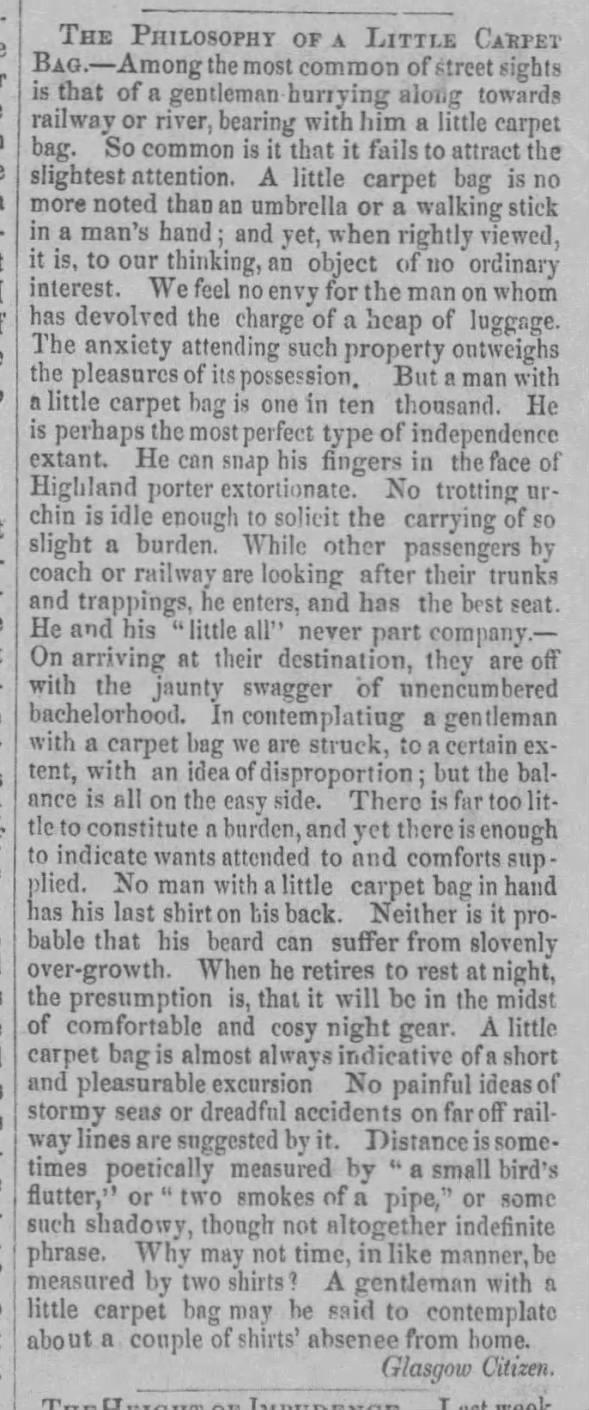 03 Apr 1851, Thu The Brattleboro' Eagle (Brattleboro, Vermont) Newspapers.com
"The Philosophy of a Little Carpet-Bag" is transcribed below from Chambers's Edinburgh Journal Volume 6 (July-December 1846); conveniently accessible online courtesy of HathiTrust Digital Library.
THE PHILOSOPHY OF A LITTLE CARPET-BAG.
Among the most common of street sights, is that of a gentleman hurrying along towards railway or river, bearing with him a little carpet-bag. So common it is, that it fails to attract the slightest attention. A little carpet-bag is no more noted than an umbrella or walking-stick in a man's hand; and yet, when rightly viewed, it is, to our thinking, an object of no ordinary interest. We feel no envy for the man on whom has devolved the charge of a heap of luggage. The anxiety attending such property outweighs the pleasure of its possession. But a man with a little carpet-bag is one in ten thousand. He is perhaps the most perfect type of independence extant. He can snap his fingers in the face of Highland porter extortionate. No trotting urchin is idle enough to solicit the carrying of so slight a burden. While other passengers, by coach or railway, are looking after their trunks and trappings, he enters, and has the best seat. He and his 'little all' never part company. On arriving at their destination, they are off with the jaunty swagger of unencumbered bachelorhood! In contemplating a gentleman with a carpet-bag, we are struck, to a certain extent, with an idea of disproportion; but the balance is all on the easy side. There is far too little to constitute a burden, and yet there is enough to indicate wants attended to, and comforts supplied. No man with a little carpet-bag in hand has his last shirt on his back. Neither is it probable that his beard can suffer from slovenly overgrowth. When he retires to rest at night, the presumption is, that it will be in the midst of comfortable and cozy night-gear. A little carpet-bag is almost always indicative of a short and pleasurable excursion. No painful ideas of stormy seas or dreadful accidents on far-off railway lines are suggested by it. Distance is sometimes poetically measured by 'a small bird's flutter,' or 'two smokes of a pipe,' or some such shadowy, though not altogether indefinite phrase. Why may not time, in like manner, be measured by two shirts? A gentleman with a little carpet-bag may be said to contemplate about a couple of shirts' absence from home. -- Glasgow Citizen.
-- Chambers's Edinburgh Journal for Saturday July 18, 1846.
The recycling of Carpet-Bag Philosophy in 1851 by American periodicals including the New York Literary World might explain why Melville had carpet-bags on his mind in that April 1851 letter to Hawthorne--and Moby-Dick, too. Melville did not finish writing his sixth book until summertime; the first American edition of Moby-Dick was available for sale in Albany bookstores by November 12, 1851.
Chapter 2: The Carpet-Bag starts with the news of Ishmael's comically light packing for a whaling voyage of 3-4 years:

"I stuffed a shirt or two into my old carpet-bag, tucked it under my arm, and started for Cape Horn and the Pacific."
Coincidentally or deliberately, the title and contents humorously recall "The Philosophy of a Little Carpet-Bag," reprinted in The Literary World back on February 22, 1851. Making a virtue of necessity, Ishmael faithfully adhered to the Scottish Carpet-Bag Philosophy, acting as if he expected "a short and pleasurable excursion" with "no painful ideas of stormy seas or dreadful accidents."
Obviously, our antebellum carpet-bag and easy-going philosophy thereof are not for low-minded Carpet-baggers. Reader, would you like a bag for your carpet-bag? Here you go...
https://hdl.handle.net/2027/umn.31951000734920k?urlappend=%3Bseq=13%3Bownerid=13510798902438398-19
Turns out
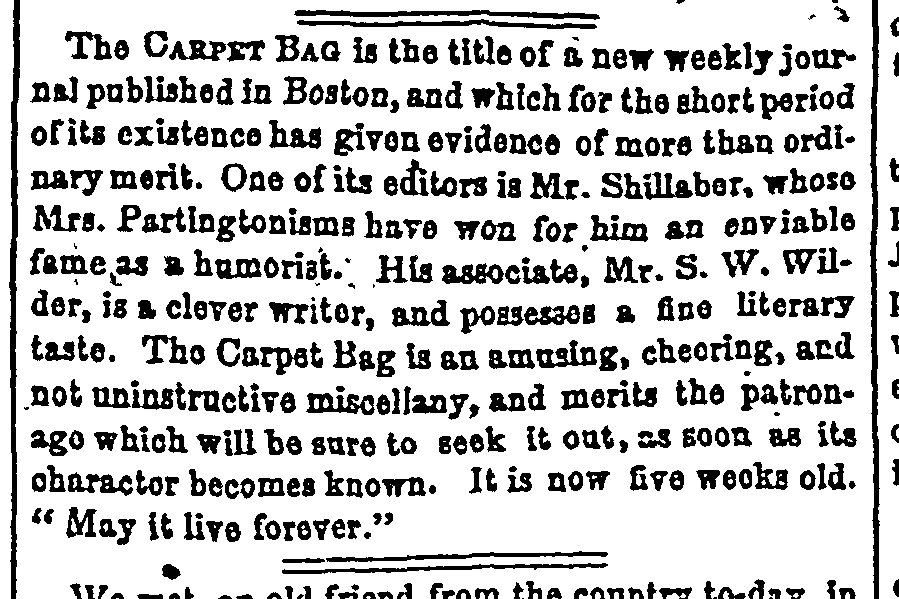
THE PHILOSOPHY OF THE CARPET-BAG IS IN THE CARPET-BAG
for the week ending March 29, 1851.

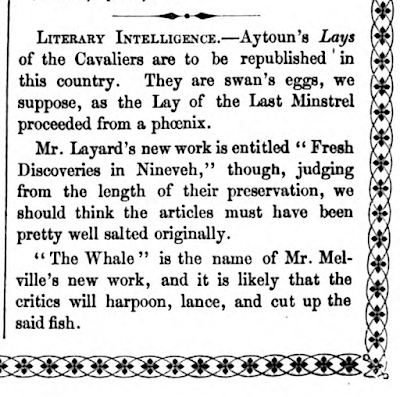
- The WHALE in THE CARPET BAG
https://melvilliana.blogspot.com/2023/03/the-whale-in-carpet-bag.html





.jpg)