Saturday, January 25, 2020

1856 comments on "I and my Chimney" in Putnam's

Balli di Sfessania. Etching by Jacques Callot. Frontispiece, 1622
via RISD Museum
As George Monteiro discovered, the New York Times for March 7, 1856 depicted Herman Melville's magazine story "I and my Chimney" as "a Caliot-like extravaganza." This item is transcribed in Herman Melville: Fugitive References (1845-1922), Resources for American Literary Study Volume 33 (2008; AMS Press, 2010) pages 19-93 at 34.
New York Daily Times - March 7, 1856
What looks like "Caliot" in digital versions of the original article should read Callot, alluding to Jacques Callot the French graphic artist. Callot was famous for innovative "caprices" and "extravaganzas" featuring a comic and grotesque style of caricature.

Callot's themes, as explicated in the RISD Museum guide for the 2011 exhibit, Jacques Callot and the Baroque Print:
"In Callot’s theatrical world of princes, paupers, dancers, and dwarves, virtue and evil coexist. Its inhabitants pursue peaceful or frivolous pleasures in one moment only to be confronted with — or perpetrate — torturous death in the next. Callot’s stage-like compositions might distance us from direct emotional confrontation, but they emphasize life as a performance: one in which humankind’s edifying qualities exist alongside the ridiculous and grotesque."
Callot's name had already appeared at least one time in Melville criticism, several years before the 1856 reference in the New York Times. While blasting Pierre (1852) in the American Whig Review, G. W. Peck described one of the scenes with Isabel and her guitar as a "night piece" presented "somewhat after the manner of Callot." It's interesting to think also of "Chimney" and other short fictions by Herman Melville as "stage-like compositions" after Jacques Callot.

Below are additional contemporary responses to "I and my Chimney" as first published in Putnam's Monthly Magazine for March 1856. These brief comments appear in favorable newspaper reviews of Putnam's for March 1856. None identifies Melville or any particular writer for Putnam's. 

Without naming the author, the New York Evening Mirror (March 11, 1856) called Melville's contribution to the March 1856 issue
a quaint story, entitled "I and my Chimney," illustrating the inexorable spirit of conservatism.
New York Evening Mirror - March 11, 1856
via GenealogyBank
The Evening Mirror was then edited and published by Hiram Fuller. 

Hartford, CT Religious Journal - March 6, 1856
"Among the lighter articles" in the latest issue of Putnam's, the Hartford Religious Journal (March 6, 1856) praised "I and My Chimney" as "a quaint piece of humor."

The Pittsburgh Gazette for March 4, 1856 praised "I and my Chimney" as a "capital" piece in "a rare number" of Putnam's.
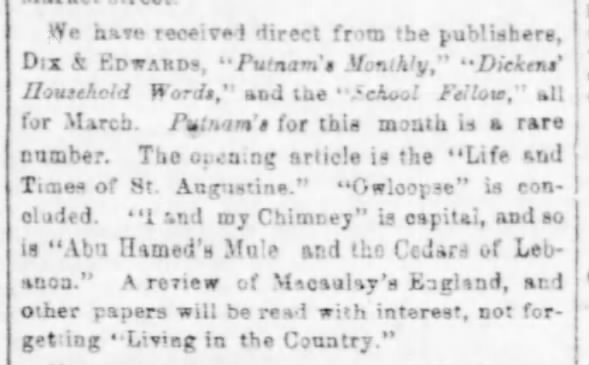
Tue, Mar 4, 1856 – Page 2 · The Pittsburgh Gazette (Pittsburgh, Pennsylvania) · Newspapers.com
We have received direct from the publishers, DIX & EDWARDS, "Putnam's Monthly," "Dickens' Household Words," and the "School Fellow," all for March. Putnam's for this month is a rare number. The opening article is the "Life and Times of St. Augustine." "Owlcopse" is concluded. "I and my Chimney" is capital, and so is "Abu Hamed's Mule and the Cedars of Lebanon." A review of Macaulay's England, and other papers will be read with interest, not forgetting "Living in the Country." --Pittsburgh Gazette, March 4, 1856. 
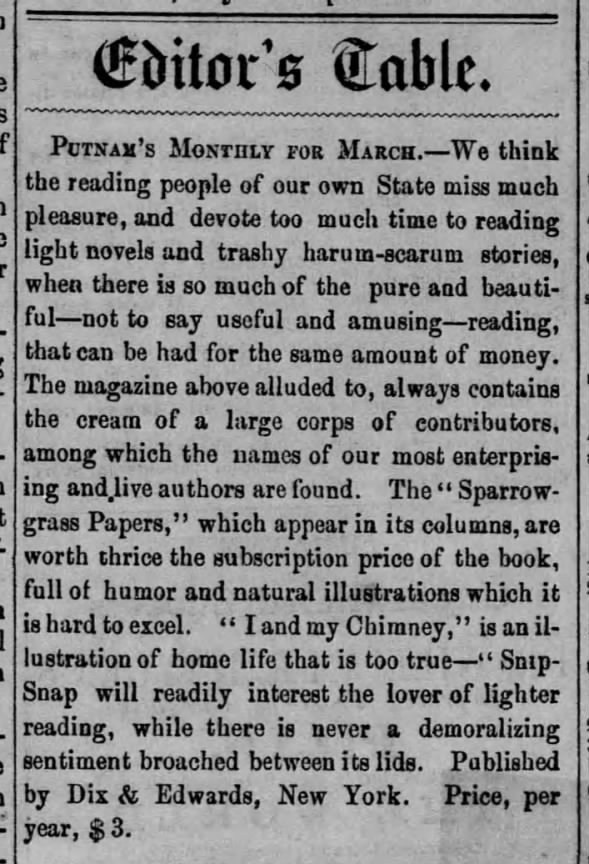
The Montpelier, Vermont Green Mountain Freeman commended Putnam's as a magazine that "always contains the cream of a large corps of contributors, among which the names of our most enterprising and live authors are found." In the March 1856 issue, "I and my Chimney" struck the new editor Sidney S. Boyce as
"an illustration of home life that is too true." --Montpelier, Vermont Green Mountain Freeman, March 6, 1856. 
During the Civil War, Boyce served as Captain in the 77th U. S. Colored Infantry. As reported in the Army & Navy Official Gazette on April 25, 1865, Boyce was tried for illegal use of military property and dismissed.

Thu, Mar 6, 1856 – 3 · Green-Mountain Freeman (Montpelier, Vermont) · Newspapers.com

The Criterion on March 8, 1856 contrasted the "meditative" sketch "I and my Chimney" with the instructively "moral" tale, "Snip-Snap."
"I and my Chimney," and "Snip Snap," are respectively meditative and moral. We should hesitate to pronounce the last a successful effort.  --The Criterion, March 8, 1856
Despite the knock,"Snip-Snap" was popular at the time and frequently reprinted in other newspapers. The New York Times reviewer who thought of Melville's comedic "Chimney" in visual and dramatic terms as a "Callot-like extravaganza" also applauded "Snip-Snap" as "a "charming love-story."

In A History of American Magazines, 1850-1865 Frank Luther Mott describes the short-lived Criterion (1855-6) as
"a New York critical weekly of high class, publishing really careful reviews, with notes on art, drama, and science. It was modeled on the London Athenaeum." 


The Criterion was edited and published in New York by Charles Rudolph Rode (1825-1865) who merged it with the American Publishers' Circular and Literary Gazette.

Another brief mention of "I and my Chimney" appeared in The Country Gentleman for March 13, 1856. This was a weekly agricultural newspaper published in Albany, New York by Luther Tucker. According to Frank Luther Mott in A History of American Magazines, Tucker's editorial assistants at the time were his son Luther H. Tucker and John J. Thomas. Surveying the new issue of Putnam's magazine, one or another editor of the Country Gentleman felt "I and my Chimney" had been narrated "somewhat lugubriously."

Putnam's Monthly for March contains, biographically, an article on the "Life and Character of St. Augustine ;" fictitiously, part third of "Owlcopse;" poetically, "Chester," " My Mission," the "Malakoff Marseillaise" &c.; historically, a review of Macaulay; orientally, the very Arabian tale of "Abu Hamood's Mules;" somewhat lugubriously, "I and my Chimney;" quite ludicrously, further details of Mr. Sparrowgrass' rural experience; very spiritedly, the story "Snip-Snap," and several other readable articles, besides the Editorial notes, criticisms, &c. Dix & Edwards, New-York.
In the Western Reserve Chronicle (Warren, Ohio) for March 12, 1856, editors Comfort A. Adams and George N. Hapgood gave the contents of the March 1856 number with this general endorsement:
"Putnam's Magazine is to the United States, what Blackwood's is to England. It is entirely original, and its articles are marked by independence and vigor of thought."
Western Reserve chronicle. [volume] (Warren, Ohio), 12 March 1856. Chronicling America: Historic American Newspapers. Lib. of Congress. <https://chroniclingamerica.loc.gov/lccn/sn84028385/1856-03-12/ed-1/seq-2/>

Related post 

  • Noticed in North Carolina, "I and My Chimney"
    https://melvilliana.blogspot.com/2026/06/noticed-in-north-carolina-i-and-my.html

Thursday, January 23, 2020

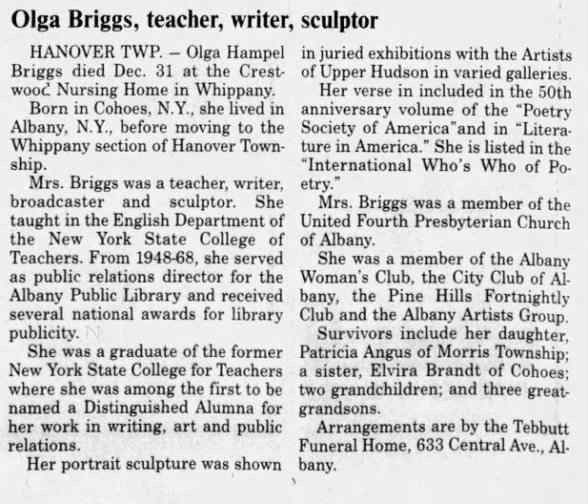
Poem by Olga Hampel Briggs

Of Moby Dick, of Ahab, and of Melville 

"Ahab never thinks; he only feels, feels, feels;
that's tingling enough for mortal man!"
THERE lived (you wrote) a Triton who forsook
Thinking for feeling, tingling; mortal man
He was not, who matched hate with none less than
The Great White Whale; no simpleton, who took
Such foe for wife, for child; yet who could love
(He said himself) tall ships as he loved men.
Though you were slow in speech and thought, your pen
Was held by an archangel when you strove
To tell this tale of terror, struggle, death;
Of puny man, of brittle ship, harpoon
That turned to putty when it struck; of sail
Rent, ribboned, by the gale . . . or by the breath
Of Ahab's enemy . . . whom all men soon
Must meet, must conquer: Moby Dick, White Whale! 
Citation
"Of Moby Dick, of Ahab, and of Melville." New York Herald Tribune [European Edition], 30 Aug. 1951, p. 4. International Herald Tribune Historical Archive, 1887-2013, https://link-gale-com.i.ezproxy.nypl.org/apps/doc/YABLKJ907171398/GDCS?u=nypl&sid=GDCS&xid=e15d2087. Accessed 23 Jan. 2020.

Reprinted in The Lookout for October 1951, page 13:
http://www.seamenschurch-archives.org/sci/archive/files/e02b8ef17b815d9cec04488853a4dae9.pdf

Obituary for Olga Hampel BriggsObituary for Olga Hampel Briggs Thu, Jan 9, 1997 – 6 · Daily Record (Morristown, New Jersey) · Newspapers.com

Tuesday, January 21, 2020

Moby-Dick Centennial Essays, 1953

Edited for the Melville Society, with an introduction by Tyrus Hillway and Luther S. Mansfield.

Update

Digitized by the Internet Archive in 2024
Contents
  • Introduction 
  • In nomine diaboli / Henry A. Murray 
  • A preface to Moby-Dick / Tyrus Hillway 
  • Moby-Dick: work of art / Walter E. Bezanson 
  • The image of society in Moby-Dick / Henry Nash Smith
  • Fatalism in Moby-Dick / Ernest E. Leisy 
  • Early reviews of Moby-Dick / Hugh W. Hetherington 
  • Melville and transcendentalism / Perry Miller
  • Melville and Hawthorne / Randall Stewart
  • Melville and Nantucket / Wilson L. Heflin 
  • Notes on the Authors 

Monday, January 13, 2020

J. J. Woodward's Moby-Dick

Army Surgeon Joseph Janvier Woodward, M. D.
via U. S. National Library of Medicine
The David M. Rubenstein Rare Book & Manuscript Library, Duke University has the first American edition of Moby-Dick, or, The Whale, digitized by Internet Archive
https://archive.org/details/mobydickorwhale01melv/page/144
and also available online courtesy of HathiTrust Digital Library

The Rubenstein copy of the first American edition of Moby-Dick was donated by Richard and Nancy Riess. The descriptive entry for this volume notes, along with the tipped-in autograph of the author,
"the ownership signatures of J.J. Woodward and B.W. Huxley and the pencil initials W.D.C." 

Evidently this copy of Moby-Dick was owned (and possibly annotated) by Joseph Janvier Woodward (1833-1884), the distinguished Philadelphia surgeon and pioneering pathologist.
https://www.nlm.nih.gov/exhibition/visibleproofs/galleries/technologies/photomicrography_image_8.html
Woodward has been credited with the invention of photomicrography:
https://www.archivesofpathology.org/doi/full/10.1043/1543-2165%282005%29129%5B1313%3ASPITEO%5D2.0.CO%3B2
The physician J. J. Woodward was the son of Joseph Janvier Woodward (1798-1878). The initials "W. D. C." may belong with the signature--I guess they might stand for Washington, District of Columbia where Woodward after May 19, 1862 lived while working in the Surgeon General's Office. As an undergraduate J. J. Woodward wrote Ada: A Tale, published in 1852 under the pseudonym "Janvier."
https://books.google.com/books?id=Bnk7AQAAMAAJ&pg=PA1&dq#v=onepage&q&f=false
For comparison with the signature in the Duke Moby-Dick, here are two similar looking autographs of the noted army surgeon and pathologist J. J. Woodward:
J. J. Woodward, 1865 autograph
via Smithsonian Institution
National Museum of American History

J. J. Woodward, 1881 signature via Ira & Larry Goldberg

"As a scientific investigator and thinker his especial characteristics were the incessant labor which he devoted to the subjects on which he was engaged and his desire to obtain his data at first hand as far as possible. His turn of mind was essentially that of a critic, and his first impulse on hearing of any alleged new fact or observation relating to matters in which he was interested was to doubt, and to attempt to verify it for himself."  --1885 Memoir of Joseph Janvier Woodward, 1833-1884 by J. S. Billings.
Woodward on Modern Philosophical Conceptions of Life:
https://hdl.handle.net/2027/mdp.39015005378834
Profile in The Bulletin of the U. S. Army Medical Department No. 48 (April 1939):
https://books.google.com/books?id=EFKgAAAAMAAJ&pg=PA105&lpg#v=onepage&q&f=false
Possibly Dr. Woodward was the reader of the Duke Moby-Dick who decided to "Skip" chapter 32, Cetology.


Other chapters with pencil markings include The Mast-Head, Monkey-Rope, Try-Works, Doubloon,  Dying Whale and Whale Watch; and The Candles.

In pen, one reader underscored the narrator Ishmael's lament in The Funeral over the gruesome spectacle of the whale's floating corpse under attack from sharks and scavenging seabirds:
Oh, horrible vultureism of earth!
Sat, Aug 23, 1884 – Page 2 · Evening Star (Washington, District of Columbia) · Newspapers.com
The physical book, call number PS2384 .M6 1851, is kept in the Vault. Here is the digitized version, conveniently accessible online via the great Internet Archive:


Wednesday, January 8, 2020

Edward Wakefield on The Whale and Whaling

Edward Wakefield (1774-1854) surveyed the progress of cetology in a four part series on "The Whale and Whaling," published 1844-5 in Peter Lund Simmonds's Colonial Magazine and Foreign Miscellany. In addition to the classic studies by French naturalists, Wakefield relied on and extensively quoted from more recent books by Thomas Beale and William Scoresby Jr. Another of Wakefield's acknowledged authorities was Ernst Dieffenbach. As reported in January 2013 on Antipodean Footnotes, the Dunedin City Library has Wakefield's annotated copy of the two-volume Travels in New Zealand (London, 1843):
"The sections most heavily marked up are Dieffenbach's general remarks (with attention paid mainly to New Zealand's natural resources), and his chapters on whales and whalers, geological features, Māori customs and language, and the nature and impact of disease on Māori. Nearly all of Wakefield's annotations do not comment on the text or record his thoughts about it, but serve rather as handy reference points to paragraphs or sentences of particular interest." --Antipodean Footnotes
http://antipodeanfootnotes.blogspot.com/2013/01/edward-wakefields-annotated-copy-of.html
Four installments of "The Whale and Whaling" by Edward Wakefield are accessible online via Google Books; and also courtesy of HathiTrust Digital Library:
  • No. 1.— Its Chronological History. Simmonds's Colonial Magazine and Foreign Miscellany Volume 2 (July 1844) pages 325-342.

    https://books.google.com/books?id=Fx_oKbNjfTwC&pg=PA325&lpg#v=onepage&q&f=false
also available courtesy of HathiTrust Digital Library: 
https://hdl.handle.net/2027/mdp.39015062938249?urlappend=%3Bseq=344
Another item in the last number of this volume gives news of "Renewed French Aggression at Tahiti--Imprisonment and Banishment of the British Consul." (Pritchard, mentioned in Typee, chapter 3 with the anecdote about his courageous wife.)
  • No. 2.— Its Natural History. Simmonds's Colonial Magazine and Foreign Miscellany Volume 3 (September-December 1844) pages 49-72.

    https://books.google.com/books?id=4aQNAAAAQAAJ&pg=PA49&lpg=PA49&dq#v=onepage&q&f=false
https://hdl.handle.net/2027/mdp.39015062938231?urlappend=%3Bseq=62
  • Essay 3.— The Natural History of Other Whales. Simmonds's Colonial Magazine and Foreign Miscellany Volume 3 (September-December 1844) pages 336-357.

    https://books.google.com/books?id=4aQNAAAAQAAJ&pg=PA336&lpg=PA336&dq#v=onepage&q&f=false
https://hdl.handle.net/2027/mdp.39015062938231?urlappend=%3Bseq=352
https://books.google.com/books?id=6qQNAAAAQAAJ&pg=PA140&dq#v=onepage&q&f=false
https://hdl.handle.net/2027/mdp.39015062938223?urlappend=%3Bseq=162
 At the end of "Essay 4" Wakefield looks forward to another installment which I have not found:
"The next Essay will be an account of the catching of the Whale, by both shore-parties, and ships built and equipped expressly for the purpose."  
Volume 9 (September-December 1846) of P. L. Simmonds's Colonial Magazine and Foreign Miscellany contains an article "By the Editor" on The Whale-Fisheries of Great Britain and the United States, compared, at pages 471-489.

Wednesday, January 1, 2020

2020 Moby-Dick Marathon Livestream


Starts Saturday, January 4 at 11:30 am – Sunday, January 5 at 1:00 pm EST

Above via Internet Archive; the digitized version of the 1851 first American edition of Moby-Dick; or, The Whale by Herman Melville at the David M. Rubenstein Rare Book & Manuscript Library, Duke University; also accessible online courtesy of HathiTrust Digital Library.

Happy New Year!

Monday, December 30, 2019

Cetology in the Encyclopaedia Britannica and Brewster's Edinburgh Encylopaedia

Fig. 4. Spermaceti Whale. CETOLOGY. Plate 134
in Brewster's Edinburgh Encyclopaedia Vol. 5, First American Edition (Philadelphia, 1832).
For the Cetology chapter in Moby-Dick; or, The Whale, Herman Melville had more accurate and up-to-date sources than old editions of Encyclopædia Britannica. Lots of Melville's literary appropriations from the writings of Beale and Bennett and Scoresby are documented in The Trying-Out of Moby-Dick by Howard P. Vincent; and in the notes to the 1952 Hendricks House Moby-Dick that Vincent edited with Luther S. Mansfield. Rounding out the Big Five of Melville's favorite whale-books were more recent firsthand narratives by J. Ross Browne and Henry T. Cheever. In addition, Melville also borrowed extensively from the WHALES entry in The Penny Cyclopædia, as Kendra H. Gaines shows in Melville Society Extracts Number 29, January 1977, pages 6-12.


The Penny Cyclopædia referenced the systematizing efforts of various distinguished naturalists without actually calling their kind of work cetology. Earlier in the 19th century, two encyclopedias that did call it "Cetology" were the Encyclopaedia Britannica and Brewster's Edinburgh Encyclopaedia. Volume 5 in successive editions (4th, 5th, 6th) of Encyclopaedia Britannica contains a long, illustrated treatise titled "Cetology" on pages 327-360. Notes in the back of the great Northwestern-Newberry Edition of Moby-Dick; or, The Whale, edited by Harrison Hayford, Hershel Parker, and G. Thomas Tanselle (Evanston and Chicago: Northwestern University Press and The Newberry Library, 1988) page 857 refer to the treatise on Cetology in the 4th edition of Encyclopædia Britannica as "the article on whales."

But the first entry for "WHALE" in Volume 20 tells you to consult the treatise on Cetology in Volume 5:
See BALÆNA and PHYSETER, CETOLOGY Index.
In Volume 5 of Encylopaedia Britannica 4th ed. (Edinburgh, 1810), the first of two engravings that accompany the treatise on Cetology is PLATE CXL = Plate 140, labeled "CETOLOGY."
https://hdl.handle.net/2027/umn.31951002451535v?urlappend=%3Bseq=386
This Cetology engraving illustrates each of the four classes of "cetaceous fishes" (as classified in the main text after Linnaeus, by number and placement of teeth) with one representative figure. Stacked vertically, the figures from top to bottom show a large whalebone or Greenland whale; narwhal or unicorn fish; large sperm whale; and grampus. 


The huge "Greenland whale" (so-called, in the main text and "Explanation of Plates") or "Balaena Mysticetus" at the top of the CETOLOGY plate looks much the largest of the four kinds. Its dominating size and placement agree with the old-school cetology that Ishmael will overthrow by granting first place to the sperm whale:
This is Charing Cross; hear ye! good people all,— the Greenland whale is deposed,— the great sperm whale now reigneth! -- Moby-Dick, Cetology
The immediate textual prompt for Ishmael's mock proclamation was a bit in Thomas Beale's Natural History of the Sperm Whale that represents the Greenland Whale as royalty, metaphorically speaking: "the public voice has long enthroned him as monarch of the deep." Vincent makes the connection to Beale in The Trying-Out of Moby-Dick at page 132. Steven Olsen-Smith examines this and other borrowings in the "Introduction to Melville's Marginalia in Thomas Beale's The Natural History of the Sperm Whale," at Melville's Marginalia Online.

The CETOLOGY engraving in the Encyclopaedia Britannica visually reinforces the older idea of the Greenland Whale as "monarch of the deep."


Noah Webster's 1849 American Dictionary of the English Language defines CETOLOGY as
"The doctrine or natural history of cetaceous animals."

Webster even recognizes the CETOLOGIST, "One who is versed in the natural history of the whale and its kindred animals." Still, when Melville appropriated it, the word cetology could also evoke models of scientific discourse that were already outdated. Readers looking up CETOLOGY in the Seventh Edition of Encyclopaedia Britannica, Volume 6 (Edinburgh, 1842) get redirected to Volume 14: "See MAMMALIA." There, on pages 183-191, "Great-headed whales" conclude the treatment of "Cetacea," the final section in James Wilson's new contribution on the Natural History of Quadrupeds and Whales.

Again, cetology as cetology does not appear in Melville's invaluable source-article in the Penny Cyclopaedia. Beale only employs the word once, when quoting Scoresby in one of four epigraphs at the front. Melville managed to incorporate all four in the Cetology chapter of Moby-Dick. So William Scoresby Jr. happily accepted cetology as the right name for his discipline, aiming to improve it. Indeed, in the second volume of An Account of the Arctic Regions (Edinburgh, 1820) at page 111, Scoresby helpfully footnoted the article "Cetology" in the Encyclopaedia Britannica, 4th edition.

With Scoresby Melville embraces the word cetology and for fun, adopts the style and some elements of its antiquated practice. The joke of course is how Melville's narrator arranges whales like books according to their size, turning cetology into bibliography. The largest whales are FOLIOS in Ishmael's library system of taxonomy. Sperm Whale and Greenland Whale aka "Right Whale" form Chapters 1 and 2 of the same folio-size Book. Ishmael's Chapter 2 whale embodies the popular mix-up of different species, especially the confusion of the North Atlantic right whale or Eubalaena glacialis and Bowhead whale or Balaena mysticetus.


The Encyclopaedia Britannica article on "Cetology" is not listed in the searchable "Online Catalog of Books and Documents Owned, Borrowed and Consulted by Herman Melville" at Melville's Marginalia Online. Maybe he saw it somewhere, maybe not. One place Encyclopaedia Britannica would have been available to Melville was the New-York Society Library. The NYSL Supplementary Catalogue for 1841 lists the 6th edition only. The 1850 Alphabetical and Analytical Catalogue of the New York Society Library lists four different editions of Encyclopædia Britannica, including the 6th and 7th, as well as the six-volume Supplement to the 4th, 5th, and 6th editions.


Scoresby in his Account of the Arctic Regions formally cited "Cetology" from Encyclopaedia Britannica. As noted in the catalog at Melville's Marginalia Online, in 1850-1851 Melville borrowed this and another work by Scoresby, Journal of a Voyage to the Northern Whale-fishery (Sealts Numbers 450 and 451), from the New York Society Library.


If he ever looked into the Encyclopaedia Britannica article that Scoresby footnoted, Melville might have found a hint for his book-based system of classification in the way "Cetology" takes the form of discrete "Chapters":
In the following treatise, we propose to lay before our readers, 1st, The Classification and Natural History of Cetaceous Fishes; 2d, Their Anatomy and Physiology. And lastly, the History of the Whale Fishery as an object of trade. These shall be the subjects of three Chapters. -- Cetology, Encyclopædia Britannica Fourth Edition, Vol. 5, page 328.

As Jeff Loveland points out, Cetology was one of seven "new treatises dealing with animals" in the fourth edition of the Encyclopaedia Britannica, along with Conchology, Erpetology, Helminthology, Ichthyology, Mammalia, and Ophiology, "evidently imitating the zoological categories of the conemporary Encyclopédie méthodique." See Loveland on Unifying Knowledge and Dividing Disciplines: The Development of Treatises in the "Encyclopaedia Britannica" in Book History Vol. 9 (2006), pages 57-87 at page 75. <https://www.jstor.org/stable/30227385>  Ichthyology and other zoological treatises in the 4th edition of Encyclopaedia Britannica also were constructed in chapters, like books.

As promoted in the Encyclopaedia Britannica, the old and wonderfully loose category of "cetaceous fishes" accords well with Ishmael's definition of the whale as
 "a spouting fish with a horizontal tail."
To aid further study, here are links to successive editions of Encyclopaedia Britannica with the treatise on "Cetology" in Volume 5:
Google-digitized volumes of Encyclopaedia Britannica held by the New York Public Library and University of Michigan are accessible online courtesy of HathiTrust Digital Library.

Another nineteenth-century encyclopedia with a major article on "Cetology" was David Brewster's Edinburgh Encyclopædia, Volume 5 (Edinburgh, 1830), pages 676-694. Conspicuously, right at the start, the term "Cetaceous Animals" (not fishes) describes "the last order of the class MAMMALIA." Cetology is defined as "that department of Zoology, which treats of the structure, economy, and history of cetaceous animals, or of whales...."
https://books.google.com/booksid=IPpMAQAAMAAJ&pg=PA676&dq#v=onepage&q&f=false
The index in Volume 1 to "Authors of the Principal Articles in The Edinburgh Encyclopædia" identifies Josiah Kirby as author of the Cetology treatise there. In Volume 1 of Encyclopædia Britannica, 4th edition (Edinburgh, 1810), "Dr. Kirby, and Dr. Brewster of Edinburgh" had received credit along with general editor James Millar and Lockhart Muirhead for unspecified "articles in the various branches of Natural History."


The Edinburgh Encyclopaedia, Volume 5 (Edinburgh, 1830) is Google-digitized and available online courtesy of  HathiTrust Digital Library. Illustrated with two plates of engravings, located between pages numbered 688 and 689 in the University of Michigan volume.
  • https://hdl.handle.net/2027/mdp.39015082314470?urlappend=%3Bseq=736
The Albany Young Men's Association, the library owned a set of the Edinburgh Encyclopaedia, listed in the 1837 Catalogue of Books as
1002 ENCYCLOPAEDIA, Brewster's, 33 vols. 
When Herman Melville joined the YMA in January 1835, their set of Brewster's Edinburgh Encyclopedia was incomplete. However, Volume 5 was not among the missing numbers that were advertised as wanted by the Young Men's Association (Albany Argus, January 9, 1835).

Albany Argus - January 9, 1835 via GenealogyBank
The YMA Catalogue of Books for 1848 lists an incomplete set of the American edition, number 4061 under "Dictionaries and Encyclopedias."

A complete set in twenty-one volumes of David Brewster's New Edinburgh Encyclopaedia (Philadelphia, 1832) was available at the New York Society Library when Herman Melville belonged, according to the 1850 Alphabetical and Analytical Catalogue.


In the First American Edition (Philadelphia, 1832) of Brewster's Edinburgh Encyclopaedia, Volume 5 contains the "Cetology" article on pages 555-573:
  • https://hdl.handle.net/2027/osu.32435028241479?urlappend=%3Bseq=564
Two plates of engravings appear in the back of the same volume:
  • https://hdl.handle.net/2027/osu.32435028241479?urlappend=%3Bseq=876
  • https://hdl.handle.net/2027/osu.32435028241479?urlappend=%3Bseq=878 
Despite the displacement of "Cetology" in the 7th and later editions of Encyclopædia Britannica, aspiring cetologists like Ishmael in Moby-Dick still had oceans of room to investigate whales:

Let it be borne in mind by the rising race, that in relation to the cetaceous tribes, an enterprising naturalist of accurate habits, well versed in the recorded observations of his predecessors, and at the same time inclined to original investigation, has still before him a vast, and in several of its departments, an almost unexamined field.  --James Wilson on "Mammalia" in the Seventh Edition of The Encylopaedia Britannica (Edinburgh, 1842) Volume 14, page 191. Here signed "T." designating zoologist James Wilson in the alphabetical Table of Signatures. Signed "J. W." in the Eighth Edition (Edinburgh, 1857).

Further reading, A to Z: