Wednesday, June 14, 2017

Lines Written on Reading a Celebrated Infidel Book

The reprinting of this pseudonymous poem (taking "Melville" as a nom de plume) in the Boston Recorder enables me to improve my earlier transcription with the correct reading "stoic sage" in the third line of the first stanza. Whoever wrote it, the speaker's bout with unbelief presents the quintessential Melvillean quandary. The figure of the stoic as a model of cold philosophical comfort adds a favorite device of Melville's to the familiar theme. The stoic figure seems all the more Melvillean when contrasted, as here in these 1838 "Lines," with the consoling promise of heaven. In Melville's religious epic Clarel (1876), the Anglican priest Derwent will invoke "The Stoic" to argue the same point in dialogue with the divinity student Clarel:
What if some camp on crags austere
The Stoic held ere Gospel cheer ?
There may the common herd abide,
Having dreamed of heaven? Nay, and can you?
--Herman Melville, Clarel 3.21 - In Confidence
First published in the Christian Watchman on March 2, 1838, the poetic "Lines" signed "Melville" were reprinted in the Boston Recorder for March 9, 1838. "Melville" also contributed the six-part essay on Missions to the Western Indians that appeared in the Christian Watchman between November 10, 1837 and July 13, 1838.

POETRY.
For the Watchman. 

LINES
WRITTEN ON READING A CELEBRATED INFIDEL BOOK. 
Well, be it thus;— renounce the page
   Which tells of brighter worlds on high;
Then rest content, as stoic sage,
   In gloomy doubt, to grope and die.
Shut out the light which shines from heaven;
   To boastful creed of reason keep;
Say brutish life to men is given,
   And death is but eternal sleep.

But leave thy neighbor’s spirit free,
   Nor, with rash hand, the hope destroy,—
Blest hope of immortality,
   Which all dilates the heart with joy;
Nor wake the peaceful dreamer thou,
   The bitter dregs of life to taste:
If vain the hopes which bind us now,
   O, let the sweet delusion last! 
If life a false speck can be shown,
   The ocean of eternity
Up from its heaving depth has thrown;
   If hapless man may never see
Aught when this anxious being dies,
   But sink to nothingness again,
As on the earth he shuts his eyes,
   O, let him wish and hope till then!

Go to the mother, as she gives
   Her first-born to the arms of death;—
How sinks her heart, which anguish rives
   Its chords to mark the final breath!
And wilt thou soothe her frenzied thought,
   With words of cold philosophy;
Or say the infant soul is nought,
   As her’s, anon, shall surely be?

Away, away, a voice within
   Gives thy vain sophistry the lie;
It pleads for that which is,—hath been,—
   And, all divine, can never die.
Hope, reason, Scripture,—all proclaim,
   To virtue’s ear, a nobler rest:
‘Tis writ, in characters of flame,
   On ev’ry heart, in ev’ry breast.

The holy light of day; the sun,
   Bright image of the Lord Supreme;
The clouds, the viewless wind; in one,
   All things which vast or lovely seem;
The hoary earth, the deep blue sea,
   Each with ecstatic life replete;
The thin, free air, o'er land and sea,
   Where nature’s subtler wonders meet;—
The sombre majesty of night,
   As o’er the pensive mind it steals;
The calm, bright moon, whose silver light
   In vain the fleecy cloud conceals;
The stars, so eloquent, which seem
   Of silent consciousness possest,
Which active fancy well might deem
   Kind heralds of the heavenly rest. 
Speak to the soul, and wake its glow,
   While the far-vault of heaven on high
Wide echoes to the deep below
   Its soft and sacred minstrelsy.
All mind, the universe, where’er
   A thought has ranged, or science trod,
With voice united, all declare
   A Spirit, and that Spirit’s God.     
MELVILLE.

Sunday, June 11, 2017

Moby-Dick in the Buffalo Commercial Advertiser


Found on Newspapers.com

Much but not all of the Buffalo review is borrowed from the review of Moby-Dick in the New York Commercial Advertiser on November 28, 1851. The earlier review in the New York Commercial Advertiser is reprinted on page 388 in Herman Melville: The Contemporary Reviews, ed. Brian Higgins and Hershel Parker (Cambridge University Press, 1995).

From the Buffalo Commercial Advertiser, December 3, 1851:

New Publications.

MOBY DICK, or the Whale. By HERMAN MELVILLE.—
New York: HARPER & BROTHERS.

This is an extraordinary book, neither good, nor wholly bad—as was said of Rob Roy, it is "o'er bad for blessing, and o'er good for banning." We have never partaken of the intense admiration excited in many quarters by the productions of MELVILLE. At the same time we cheerfully accord to him unusual merits of a certain kind. He has fine descriptive powers, when applied to natural scenery and stirring events; but in the delineation of character, he utterly fails. There is not a being of this earth in the book before us.— If any such creatures exist, they are to be found on some other planet. But in the course of his wild, incoherent, and impossible story, we presume he has let us into all the realities of the whale-fishery, more minutely and with greater fidelity than has ever before been done by any author, living or dead. We think the moral effect of all his writings is decidedly pernicious. There is a vein of sneering sarcasm, directed against all things which we are taught to reverence, running through his work like the rogue's yarn through the rigging of the British navy. In Moby Dick, he makes his hero, "a good Christian—born and bred in the bosom of the infallible Presbyterian Church," unite with a Polynesian in worshipping and offering incense to an idol, and in this connection virtually questions the authenticity of the first commandment. The book is a strange jumble of "fact, fiction and philosophy, composed in a style which combines the peculiarities of CARLYLE, MARRYATT and LAMB. Moby Dick is an old white whale, of extraordinary magnitude and malignity, and he escapes with impunity from so many attacks, that the superstitious whalemen believe him to be a sort of supernatural creature. Capt. AHAB, in one of these attacks, is struck by the monster's tail, and loses a leg. Thus maimed, he devotes his life to revenge, and pursues Moby Dick through divers seas, making frequent assaults upon him, but always without success. In the last encounter, the infuriated whale rushes headlong against the Pequod, the ship in which Capt. AHAB sails, and all the crew perish, except one ISHMAEL, who survives to tell the story."

Sold by GEO. H. DERBY & CO.

Moby-Dick in Pittsburgh


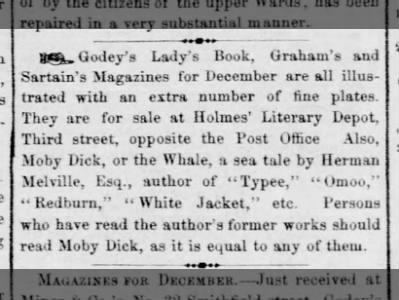
Godey's Lady's Book, Graham's and Sartain's Magazines for December are all illustrated with an extra number of fine plates. They are for sale at Holmes' Literary Depot, Third street, opposite the Post Office. Also, Moby Dick, or the Whale, a sea tale by Herman Melville, Esq., author of "Typee," "Omoo," "Redburn," "White Jacket," etc. Persons who have read the author's former works should read Moby Dick, as it is equal to any of them.  --Pittsburgh Daily Post, November 18, 1851

Friday, June 9, 2017

Charles Rockwell on "that precocious chap Melville"

Navy chaplain and Congregational minister Charles Rockwell mentioned Herman Melville in the fourth and final installment of "Western Travel," a series of newspaper sketches published in the Boston Recorder in July and August 1846. Rockwell was the author of the two-volume work, Sketches of Foreign Travel, and Life at Sea (Boston, 1842). Volume 2 ends with two long chapters on the Navy of the United States, conveying a chaplain's perspective with a good deal of first-hand information about life on board a man-of-war. Charles Rockwell co-dedicated Sketches of Foreign Travel, and Life at Sea to Ralph Emerson and his cousin and Yale classmate Julius Rockwell (who was later a good friend to Herman Melville, in Pittsfield).

Charles Rockwell's "Western Travel" series ran in the Boston Recorder as follows:
  • No. I. - Boston Recorder, July 9, 1846
  • No. II - Boston Recorder, July 16, 1846
  • No. III - Boston Recorder, July 23, 1846
  • No. IV - Boston Recorder, August 6, 1846
From the Boston Recorder, August 6, 1846, under the heading "Western Travel.--No. IV":
In returning from Michigan, I left Detroit in the steamer Rochester. It was one of the old, slow class of high pressure boats, with its breathing pipe thorough which it was constantly wheezing and gasping as it went along, like a horse with the asthma, or an overstuffed alderman. The captain was a Nantucket man, who preferred a steamer on the Lakes, to a three masted Blubber Hunter around Cape Horn. Another of these Nantucket captains was with us when on our way to Michigan. He is now a farmer at Ann Arbor, in that State. His past life has been a very eventful one in the way of shipwrecks, imprisonment, &c., and he had twice amputated limbs of those who sailed with him with perfect success. After listening to the tale of his adventures at sea, and as a dweller in distant lands and a consular agent of our government at the Sandwich Islands, I said to him, "Captain, why don't you publish an account of your life?" "I would" said he, "if I could write as well as you can." "Well," I replied, "if you will furnish me the materials, I will write your life and we will divide the profits." "Agreed," said he, and so in due time the public may hope to be entertained with the life and adventures of Capt. T., by the author of Foreign Travel and Life at Sea, in which Robinson Crusoe will live again, and that precocious chap Melville, author of Typee, will receive his deserts, as Capt. T. was familiar with him, his movements and character when he was in the Pacific.
It would be nice to identify the ex-whaleman who according to Rockwell knew, or knew of Herman Melville in the Pacific--not so very long ago, as Rockwell is writing this in 1846. Let's see... some other native of Nantucket, not the captain of the steamer Rochester, but a different Nantucket whaleman. Formerly "a consular agent of our government at the Sandwich Islands," and "now a farmer at Ann Arbor." Who is "Capt. T."?

Thursday, June 8, 2017

MELVILLE on William Bebb's 1846 campaign rally in Akron, Ohio

First published in the Cleveland Plain Dealer on June 15, 1846 and transcribed below, this juicy critique of a Whig rally for gubernatorial candidate William Bebb in Akron, Ohio takes the form of a letter to editor Joseph W. Gray signed "Melville." Bebb won the election and would serve one term as Ohio's 19th governor. The partisan report from "Melville" is dated June 13, 1846 and gives the place of writing as Western Reserve College in Hudson, Ohio. 

Herman Melville wrote his Uncle Peter Gansevoort from Lansingburgh the same day, June 13, 1846, on which the Ohio letter is dated. I don't know how he could have been in two places nearly five hundred miles apart at once, but this "Melville" who writes of deluded Millerites, Bob Acre's valor, a dancing elephant, Aesop's Ass, a notably "stretchy" conscience, and "grandiloquent presages" sounds, well, remarkably like Herman Melville.

For instance, Ohio Melville compares attempts at humor by Thomas Ewing to "an elephant essaying the dance of a harlequin." Herman Melville made a very similar comparison in an erased annotation to Book 6 of Milton's Paradise Lost. As reported in the June 2015 Leviathan by Peter Norberg and Steven Olsen-Smith in consultation with Dennis Marnon, Melville wrote:
"These two brigades [of] artillerymen, in their heavy maneuvers, suggest the idea of a couple of Siam elephants essaying to dance the Polka."  --Newly Recovered Erased Annotations in Melville's Marginalia to Milton's Poetical Works
Both Melvilles use the dancing elephant as an image of incongruity, and both use the word essaying. At Melville's Marginalia Online you can see Melville's recovered annotation (via the enhanced image feature), and all the other markings in Melville's two-volume set of The Poetical Works of John Milton.

Hudson, Ohio Melville writes of the dull Whig meeting that:
"A general indifference and coldness seemed to pervade all"
while Herman Melville had just written to Gansevoort (deceased) that
"A military arder pervades all ranks."  --Correspondence, ed. Lynn Horth - page 40
At the Akron rally Bebb "manfully stood his ground" in a downpour, while his auditors were rapidly "dispersing." In a scene yet to be written from Herman Melville's next book, Omoo, the drunken first mate Jermin "stood his ground manfully" against murderous sailors until "they dispersed."

In Lansingburgh, Herman Melville was dealing with the sudden loss of his older brother Gansevoort Melville, who had died on May 12, 1846 in London. On behalf of the grieving family, Herman had the duty of writing James Buchanan (Secretary of State), William L. Marcy (Secretary of War), and even President Polk himself for the necessary financial support to settle Gansevoort's affairs and bring home his body. Hershel Parker gives a full account of Gansevoort's death and the impact on Herman in the first volume of Herman Melville: A Biography (see especially pages 424-5).

The Whig rally for William Bebb that Ohio "Melville" describes took place in Akron on Friday, June 12, 1846. Did Herman Melville ever visit anybody at Western Reserve College, now Case Western Reserve University, in Hudson, Ohio? By any chance, could Herman Melville actually have been in Akron, Ohio with a "companion" on June 12, 1846? Or, how about Allan Melville? Where was he?

Update 6/10/2017: Paying more attention to the heading, the likeliest Melville might be found in the roll of students at Case Western College. Among 1847 graduates listed in A Register of the Graduates of Western Reserve College is one Luther Melville Oviatt.


At the 1846 graduation exercises, Luther Melville Oviatt spoke on "The Literature of the Day." At his own graduation ceremony the next summer (August 1847), Luther Melville Oviatt gave the Valedictory Address, with an oration titled "The Progress of Human Rights." Soon thereafter he was hired as a schoolteacher. By 1850 he was Principal of Prospect St. school in Cleveland. In 1869, Luther M. Oviatt would become the first librarian of the Public School Library, later the Cleveland Public Library.
Luther Melville Oviatt (1821-1889)
via Cleveland Metropolitan School District
The Hudson correspondent appears to have been in Ohio for some weeks, long enough to have seen "grandiloquent" advance notices of the Akron stop by William Bebb: 
"More than two weeks ago, huge placards, flaunting in all the magnificence of letters six inches long or less, announced, in grandiloquent language, preparations for a Mass Meeting, at Akron, of the citizens of Summit county...."
The letter from "Melville" (Luther Melville Oviatt, probably) on the Whig rally in Akron first appeared in the June 15, 1846 issue of the Cleveland Plain Dealer, the Democratic newspaper founded and edited by Joseph William Gray. Melville's letter to the editor "Mr. Gray" was reprinted in the Weekly Plain Dealer on June 17, 1846.

Cleveland Plain Dealer - June 15, 1846
found in the Archives of Historical Newspapers at GenealogyBank.com


Whig "Mass Meeting" at Akron. 

W. R. COLLEGE, HUDSON,
SUMMIT CO., June 13, 1846.
MR. GRAY:— Perhaps some random notes from this benighted region of Whiggery may not be wholly devoid of interest, amid the more exciting topic of Mexican campaigning. This seems a sore subject for the Whigs to meddle with, since, with the experience of the Past before them, they feel assured that, should they openly condemn the prosecution of a war forced upon us by Mexican bravado and arrogance, the indignation of the people would descend with crushing weight upon their heads, and annihilate their hopes of prospective power.

More than two weeks ago, huge placards, flaunting in all the magnificence of letters six inches long or less, announced, in grandiloquent language, preparations for a Mass Meeting, at Akron, of the citizens of Summit county, at which individuals of no less importance that "Solitude" EWING, of scrip memory, WILLIAM BEBB, Coon candidate for Governor, and other "distinguished speakers," not of sufficient importance to merit naming beside Ewing and Bebb, were expected to be present. Strenuous efforts were made by leading Whigs in the various townships in the county to induce a general attendance, in order, I imagine, that the imposing array, the "pomp and circumstance," might infuse foreboding terror into the hearts of the "Locos." Well, the day arrived; the air was kind and genial; and there was naught, save lack of inclination, to prevent a general attendance of the "mass" of Whigs of Summit. Ewing was programmed to appear in the performance at 10 o'clock A. M.; but, at that time, none of the Stumpers had appeared, and a number of zealous Coons set out to usher them en route from Massillon. Their advent seemed an object of as much anxiety to some, who feared lest the projected fandango should result in a failure, as did that of a mightier personage to the Millerites of the same place but a short time since. However, to their great relief, the cavalcade at last appeared. I did not see it when it arrived, or I should give you a description of its appearance. I, credulous "Loco," had imagined there would be at least some slight demonstration—a roar from a 6 pounder, or at least a shout to hail the advent of men whom I had supposed they "delighted to honor," as erst in the days of '40. But no! their enthusiasm had, like Bob Acre's valor, oozed out of their fingers' ends; and if there was any token of exultation at their arrival, it never reached my ears. It was far more like a funeral procession, I must imagine, than anything else, for I came into the main street of Akron, and seeing it full of men intent upon their several occupations, I supposed that Ewing, Bebb, & Co., had not yet arrived; but seeing certain stragglers wending their lonely way to the east, myself and my companion followed, and after a walk of half a mile came upon the "stumping" ground. I first caught sight of Seabury Ford elevated upon a stand four feet high, making strange gestures and stranger remarks and explanations upon the Tax Law. It was a hard subject for him; he endeavored to deal in sophisms in illustrating the manner in which Farmers and Bankers were taxed, but not being skillful in metaphysical reasoning, involved himself in absurdities; and finally, with an expression of face that might be interpreted into "this is a nut that the Devil may crack," vacated the stand, when the meeting was adjourned till half past one, when it was announced that Thos. Ewing would hold forth. There were not on the ground more than three hundred, all told. A general indifference and coldness seemed to pervade all. 
At the appointed time, "Solitude" took the stand. He is rather unprepossessing in appearance, owing to his small, half closed eyes, bald on the top of his head, with a face somewhat full. His subject was "The Tariff." Worn out and frittered into rags by the spouting of magniloquent Whig orators and the labored essays of Greely and the mimic tribe who howl in unison when their master gives the token, it receives no new light from the dull, prosy speech of Ewing. He endeavored to raise a laugh from the crowd at some of his miserable witticisms, but his efforts were a burlesque on the ludicrous—about as easy as an elephant essaying the dance of a harlequin, or as the Ass, in Aesop, imitating the sportive antics of the kitten. His mind dwells on the past. He is emphatically one of the "Old Hunkers" of the Whig party—one who has fed at the public crib when Whiggery was in the ascendant, till he fancies that he has a right, like the daughters of the Horse Leech, to cry continually, "give, give." He flatters himself that the country cannot dispense with his services—that he shall yet be invested with power. Yet, while the voice of the Revolutionary patriots, of the widows and orphans who suffered by his unholy chicanery in the scrip speculations cry out against him, I trust that we shall never see him elevated to dignities he is unworthy to obtain. He spoke two hours or more, and to my mind performed marvelously in the form of the "disappointed politician." 
Bebb next took the stand, and to my utter amazement at his versatility, in five minutes launched headlong into a dozen different themes, hitting at random, both in remark and gesture, upon every thing,—Texas, Mexico, Presidential measures, alleged duplicity in the Administration, defeat of the people's will in the Baltimore Convention, coalition between Polk and Southern members, Ohio Tax Law, etc etc. His manner struck me as that of a fawning politician, who will "crook the pliant hinges of the knee, that thrift may follow fawning." I saw him at a private house, subsequent to the "speechifying," bowing, scraping and curvetting to those introduced in rather an undignified manner. He had not spoken more than ten minutes, when a shower came up and instantly there was hurry, confusion, and dispersing. Bebb, however, manfully stood his ground, resolved to "say his say" though waterspouts descended.

The rain, however, was not very severe, and a portion remained for about three-quarters of an hour, when they adjourned, most of them "pretty considerably soaked." Auditor Wood was on the platform, but if he had desired it, had no opportunity to evince his talent for "stumping." The whole number of auditors could not, I think, by any stretch of the imagination, exceed 800. My own opinion is that it was less than that number. Whigs, with consciences like india rubber, actually declare there were two thousand on the ground! But no man, without a particle of prejudice, could estimate the number, including all who lounged about the cake and beer stands, 250 higher than I have done. About 150 ladies were present, a part of whom, with a perseverance worthy of all credit had it been otherwise directed, remained till the close and with dripping bonnets and soiled dresses wended their cheerless route homewards. I myself did not hear Bebb through, as to me the rain was at variance with comfort, but went to the village and noted the comers-in, whose doleful countenances attested the penance they had undergone in endeavoring by their presence to prop a sinking cause.

Thus ended this day ushered in with such grandiloquent presages, whose result was mortification and disappointment to Summit County Whiggery. As for the Democrats, they merely laughed in their sleeves at the paltry subterfuges to which the Whigs resort to "keep up appearances." The Democracy of Summit are firm, and though outnumbered by the deluded votaries of Alfred Kelley humbuggery, will present an unyielding front to the enemy; and, though defeated, shrink not, but "push on the column," till, like the gallant Perry, they can shout—"We have met the enemy, and they are ours!" Fear not for the Democracy of Summit.
Sincerely yours, MELVILLE.

Re-printings of 1853 Pittsfield news that "Herman Melville has gone to New York to superintend the issue of a new work."

As Gary Scharnhorst reported in Melville Society Extracts 75 (November 1988), news of Melville's working trip to New York in June 1853 originally appeared in the Springfield Republican on June 11, 1853. Melville's "new work" sounds like a book, probably the one his mother had said (in a letter to her brother Peter Gansevoort on April 20, 1853) was nearly ready for the press. Later the same year, in November 1853, Herman alluded to his having been "prevented from printing" it in New York. The only work in progress we know about for sure is the Agatha project, which Hershel Parker logically relates to the working title "Isle of the Cross," mentioned twice in family letters from Herman Melville's cousin Priscilla to his sister Augusta.

I have a different view, admittedly conjectural and based on just nothing in the way of satisfying documentary evidence. Inspired by what strikes me as unusually strong internal evidence, I've long been holding out for a project of re-writing by Melville called "Fragments of Military Life," the working title of the book that Philip St. George Cooke eventually published as Scenes and Adventures in the Army. Both parts of Scenes and Adventures were previously published in the Southern Literary Messenger, and the 1851-3 series Scenes Beyond the Western Border which became Part II would be concluded in the August 1853 issue. Hypothetically, the job of "superintending" that project would have meant providing Harper & Brothers with printed copies of the magazine installments, much in the same way that, a few years later, Melville did publish the book version of Israel Potter. Either the Harpers' lawyers or then Lt. Colonel Cooke himself might have "prevented" Melville from publishing a ghost-written or ghost-edited narrative of western travel that did not properly credit the well-known, highly regarded cavalry officer whose journals supplied most of the raw material.

Well, that Christmas business chastened me all over again. It's always been hard to voyage chartless, with no external evidence anywhere in the historical record linking Melville and the wandering dragoon, Philip St George Cooke. The revived claim for Henry Livingston's authorship of "A Visit from St. Nicholas" perfectly exemplifies how wrong one can go without reliable facts.

For the record, here is the original notice that Scharnhorst found in the Springfield Republican, June 11, 1853. Images of this and the following items are available in the online archives of Historical Newspapers at Genealogy Bank.
:
Springfield Republican / June 11, 1853
"Herman Melville has gone to New York to superintend the issue of a new work."
Four days later the Pittsfield news was reprinted verbatim in the Boston Weekly Messenger (June 15, 1853):

Boston Weekly Messenger / June 15, 1853
The Franklin Democrat [Greenfield, Massachusetts], June 20, 1853 reprinted the same Melville item under the head of "LOCAL INTELLIGENCE. / BERKSHIRE COUNTY.":
"Herman Melville has gone to New York to superintend the issue of a new work."
In early July the news from Pittsfield about Melville's trip to New York showed up in the Boston Flag of our Union (July 2, 1853) under the heading, "Editorial Inkdrops":


Boston Flag of our Union / July 2, 1853

First installment of Scenes Beyond the Western Border
Southern Literary Messenger - June 1851

Related post: