Showing posts with label Debating Societies. Show all posts

Friday, March 6, 2015

Philo Logos Society in 1837: debate and elections

From the Albany Evening Journal, Wednesday, January 4, 1837:

PUBLIC DEBATE.

The quarterly public debate of the Young Men’s Philologos Society will take place Jan 5th 1837, in the Chapel of the Albany Female Seminary, in Division st. commencing at half past [?] P. M.

Question— “Will the present republican form of government probably exist in the United States for a half century to come?”

The citizens generally are invited to attend.

By order. CHAS VAN LOON, Pres’t.
Wm. Lincoln, Sec’ty.
Found in the online newspaper archives at Fulton History: Albany NY Evening Journal 1837 -0614. Subsequently, this notice of thanks in the Albany Evening Journal, Saturday, January 7, 1837:
A CARD.—The young men of Philologos Society, tender their thanks to the Rev. J. N. Garfield, Principal of the Seminary, for the gratuitous use of the chapel of that institution on the occasion of their public debate.

--Fulton History archives: Albany NY Evening Journal 1837 -0623
Election news from the Albany Evening Journal, Saturday, April 29, 1837:
At the annual election of the Young Men’s Philologos Society, holden April 8th, 1837, the following gentlemen were duly elected officers for the ensuing year:

Charles Van Loon, President.
Abraham Burke, 1st Vice President.
[S?]. A. Phelps, 2d Vice President.
Wm. Lincoln, Recording Secretary.
Jacob A. Lansing, Corresponding Secretary.
Roswell Steele, Treasurer. 
--Found in the online newspaper archives at Fulton History: Albany NY Evening Journal 1837 -1014
Herman Melville was elected President of the Philo Logos Society on February 9, 1838, as announced in the Albany Evening Journal on February 13, 1838.

Related posts

Philo Logos Society announces debate on the abolition of slavery (October 20, 1836)

Albany Evening Journal - Thursday, October 20, 1836

Found in Tom Tryniski's online newspaper archives at fultonhistory.com and transcribed below:

DEBATE.— The question, “ought Slavery to be immediately abolished in the United States,” will this evening be discussed by the members of the Young Men’s Philo Logos Society, in the Lecture Room of the Green street Baptist church. commencing at 7 precisely. All who feel an interest are invited to attend.
N. B. The members of the society are requested to meet at their hall at half past six.
By order. CHAS. VAN LOON, Pres’t.
V. B. Lockrow, Sec’ry.

***

 Related posts

Philo Logos Society in the Albany Evening Journal, October 1836

Well how about this! The Philo Logos Society debates the abolition of slavery. From the Albany Evening Journal, Thursday, October 20, 1836:
DEBATE.—The question, “ought Slavery to be immediately abolished in the United States,” will this evening be discussed by the members of the Young Men’s Philo Logos Society, in the Lecture Room of the Green street Baptist church. commencing at 7 precisely. All who feel an interest are invited to attend.
N. B. The members of the society are requested to meet at their hall at half past six.
By order. CHAS. VAN LOON, Pres’t.
V. B. Lockrow, Sec’ty.
This cache of 1836 material offers a different glimpse into the early history of the Philo Logos Society, before the Microscope fireworks between Melville and Van Loon. Above, a previously unknown question for debate by the Philo Logos lads. Below, Van Loon identifies the friendly critic Heroditus as "an eminent Lawyer." But who is "Philologist"?

From the Albany Evening Journal, Friday, October 21, 1836:
Mr. Editor—Having learned that some Lawyers of Eminence, and Linguists of distinction, have taken the liberty of questioning the accuracy of the term and even of ridiculing the name by which our Society is known, (Philologos) we very respectfully tender those Gentlemen the invitation, to call at our Debating Room and examine the same: if more convenient through this print. PHILOLOGISTS.
Further correspondence about the Philo Logos Society from Albany Evening Journal, Thursday, October 27, 1836:

FOR THE EVENING JOURNAL.

Mr. Editor—Please insert the following letters giving the result of an examination proposed by us, (thro’ the Journal) into the accuracy and propriety of the name by which our Society is known. The letter signed Heroditus is from the pen of an eminent Lawyer. 
Done by order of
CHAS. VAN LOON, President.
V. B. Lockrow, Secretary.
——
I was very well pleased to notice by the Journal of yesterday, that some young men of spirit, desirous of improving in that much neglected branch of study, extemporaneous debate, had formed themselves into a society for that purpose. But allow me to suggest to you, that you made a ridiculous mistake in giving a name to your society, to wit: Philo Logos. The object of your society I suppose to be, improvement in general debate. Now Philology applies to, and strictly means the science of words or of the construction of language, as the derivation of words, and the forming of those words into sentences &c., which you will find upon examination. At any rate, Philo Logos would not be correct as you use it, for thus, it is neither correct Greek, nor English. If you intend to form an English word, it should have been Philologean, but Philo Logos means nothing at all as you use it, for it is not correct Greek, and has no meaning, if you are at all acquainted with the Greek, (which I very much doubt.) You must be aware of this, if you think one moment.— Philologos in Greek, is a substantive, but you use it as an adjective. Philo Logos Society, the Philo and Logos should neither be thus separated. It is ridiculous in the extreme, to write a Greek word a Greek adjective, (if you had one) to an English substantive. Philologian would be good English. If you must have Greek, then call your association “Koinonia Philologian,” but Philomathian would be much better.

HERODITUS.

The above was written before I saw your communication in the Evening Journal; but I confess I don’t understand what you mean by calling at your Debating Room, “and examining the same.” Examine what? The word or the Society?  H.
—— 
ALBANY, Oct. 24, 1836.

Sir—Your epistle has been received, and although you are most egregiously mistaken in relation to the world Philologos, we are obliged to you, believing, from its tenor, that your motives in writing it were good. The object of our society is, as you suppose, “Improvement in general debate;” and this is precisely the import of its name.

Philology, you inform us, “applies to and strictly means the science of words, or of the construction of words.” Philology, according to most English Lexicographers, is applied to the science of words: but according to the Greek, from whence it has its origin, it is applied to and strictly means the study of speaking and debating, (“studium descrendi.”) But, “Philologos, as you use it, means nothing at all.” To this we need only reply, consult your Lexicon, and you will at once acknowledge the following to be correct:— “Philologos, (from Philos, fond, and Logos, discourse,) fond of discussion or argument.” In a Lexicon, as ancient as fifteen hundred, (probably the first compiled) the word is defined: “Sermonis vel studii amator, loquax, eloquentiae studio sua Plato unde Philologia, literarum amor.” You will be satisfied, too, from the definition, that the word may without impropriety be used as an adjective. As to its being “ridiculous in the extreme to write a Greek adjective to an English substantive,” we reply, that the practice is common at our Colleges, and is mentioned by the best Linguists, as is also the practice of writing the words (Philo Logos) as we do separately. The first name you recommend (Koinonia Philologian) would certainly be proper; and even more proper than Philomathian, as the former specifies what is to be learned, or what we love to learn; and the latter does not.

We do not pretend that the name of our Society is original with us; a Society of the same name, at one of the first Literary Institutions in the western part of this State has been in operation for several years; the Greek Professor at which institution is, perhaps, as well acquainted with the language as even Heroditus himself.—

Pardon us for having written the article in the Journal of Thursday, in a style beyond your comprehension. But since you have confessed with the characteristic modesty of your letter, that it was so, we will endeavor to simplify.— The article you allude to was an invitation to call at our debating room and examine into the accuracy of that which was questioned, viz: the word Philologos. We should feel honored, however, by a visit from so extraordinary a Critic.

PHILOLOGIST. 

-- Albany Evening Journal, Thursday, October 27, 1836. Found in the online newspaper archives of Tom Tryniski at fultonhistory.com
Herman Melville was elected President of the Philo Logos Society on February 9, 1838, as announced in the Albany Evening Journal on February 13, 1838. 

"Juvinis" urges support for debating society of the Albany Young Men's Association, December 1837

For, happily in this our favored land, no mitred priesthood, nor titled nobility, or gowned lawyers, are self-constituted pilots of our noble ship the Republic....

The democratic flourish is very much in Gansevoort's line, though his continued involvement with theYoung Men's Association seems doubtful: Gansevoort, a former president of the YMA debating society (Hershel Parker, Herman Melville: A Biography V1.104), had resigned from the Executive Committee in April 1837 after his business went bankrupt (Parker, V1.113). Following the example of "Juvinis," Herman Melville would endorse the same YMA debating society (not Philo Logos) in his final letter as "Philologean" to the editor of The Albany Microscope, published March 31, 1838.

So the debating society season ran from November to April 1st.

Albany Evening Journal - December 22, 1837
via GenealogyBank

FOR THE EVENING JOURNAL.

Mr. EDITOR—Permit me, through your columns, to call the attention of the Young Men of Albany to one, and that not the least important of the means of improvement extended to them by the Young Men’s Association; and one which they have shamefully neglected. I mean the Debating Society which, by the rules of the association, holds a meeting in the Lecture room once in each week from the first of November to the first of April. The exercises of the debating Society are by no means exclusively for the Professions which make public speaking their almost daily occupation. For, happily in this our favored land, no mitred priesthood, nor titled nobility, or gowned lawyers, are self-constituted pilots of our noble ship the Republic; but here the merchant, the lawyer, the physician, the mechanic, and every other honest man is privileged—nay, bound, so far as circumstances will permit, to exert his influence, not only in the primary meetings, but in the legislative halls of his country. The study of books, attendance upon lectures, and habits of though and observation may partially qualify him for these duties of an American citizen; but unless he acquire by practice a confidence and a habit of arrangement and perspicuity which will enable him to deliver the result of his study and observation to his fellow citizens in a manner that shall not compel them to exchange attention to his subject for feelings of pity and perhaps contempt for the man who presumes to waste their time by attempting to address them, his days of study and nights of thought will only serve to aggravate his confusion. I therefore beg young men in future to show that they value their privileges, and will exercise them; and not suffer the officers of the Debating Society to hold their formal meetings—with scarce none but themselves in attendance, which has too frequently been the case. 
Every member of the association has a right to become a member of the Debating Society by signing the list in possession of the Secretary; and all members, both regular and honorary, have a right to attend its meetings. And permit me to suggest that the presence of the honorary members, who have leisure, might serve to stimulate the exertions of the debators. The meetings for this and the coming week will be on Friday evening, after then on Thursday. Yours truly,

JUVINIS.
--Albany Evening Journal, Friday, December 22, 1837

For some advertised subjects of discussion by the YMA Debating Society in 1837-8, see the previous post on questions for debate in Melville's Albany.

Related posts

Thursday, March 5, 2015

Questions for Debate in Melville's Albany, 1837-8

Albany Evening Journal - February 2, 1838

Herman Melville resided with his family in Albany, New York from 1830 to 1838. Early in 1838 Melville got himself elected as president of an Albany debate club then calling itself "Philo Logos." Published letters full of high-sounding snark, mostly to and from Charles Van Loon (1819-1847), indicate Herman Melville's brief but intense period of involvement with the debate club, reportedly starting in 1837. These Philo Logos letters are collected in the Northwestern-Newberry edition of Melville's Correspondence.

As pointed out a few years back on Hershel Parker's blog, published 1858 recollections by newspaper editor William J. Moses supply additional details. Thanks to Fulton History archives (the legible parts) anyone can see that Moses remembered Philo Logos as a club of two dominant antagonists, Van Loon and Melville:
"they being a tight match for each other, and delighting in nothing more than in being pitted against each other in intellectual combat."
--Auburn [New York] Daily American, January 4, 1858; found at Fulton History.

Moses freely admitted to having been stumped when Melville asked him to define "Philo Logos." Searching Fulton History for "Philo Logos" also gets you to the Albany Evening Journal for October 27, 1836, where then "President" Charles Van Loon submits an earlier 1836 exchange of letters on that tendentious topic of the meaning of Philo Logos. Critic "HERODITUS" (said to be a lawyer) judged Philo Logos ungrammatical and meaningless, and specifically recommended the term Philologean as an intelligible alternative. In the reply dated October 24, 1836, the writer signed "PHILOLOGIST" defends Philo Logos as traditional and grammatically sound. This published (but previously unknown?) 1836 exchange complements the 1858 recollections of William J. Moses in supplying background for Melville's Philologos correspondence, including his long-known use of the pseudonym "Philologean" / "Philologian."

Herman Melville like his older brother Gansevoort belonged for a time to the Albany Young Men's Association, but Philo Logos was a kind of upstart, intended apparently to rival the older and more formally organized debating society of the YMA. Before 1840 the YMA debating society met in the Association rooms at Knickerbocker Hall, which "then stood on Broadway between Maiden Lane and State Street" (Young Men's Association). Philo Logos met in Stanwix Hall.

Image Credit: drinkdrank

The Northwestern-Newberry Correspondence volume seems mistaken in a headnote equating the two debating societies (18). Herman Melville's final published letter in the Albany Microscope of March 31, 1838 (headed YOUNG MEN'S ASSOCIATION) only promotes the unnamed debating society of the Albany Young Men's Association and never names the Philo Logos Society.

Before now, the only known question for debate by Philo Logos was the definition of Philo Logos. A few more topics for debate by the Philologos Society are uncovered in Melvilliana posts on the Philo Logos Society in 1837 and Philo Logos Society debate on abolition of slavery. As it happens, however, the debating society affiliated with the Albany Young Men's Association (not Philo Logos) advertised some wonderfully appealing and controversial questions for debate during the period of Melville's known involvement with Philo Logos. Presumably Herman would have been interested in these questions even if he did not participate in or attend the actual YMA debates:

"Should the administration of oaths be abolished?" -- Albany Argus, January 16, 1837
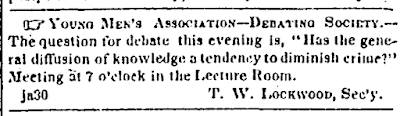
Albany Argus - January 31, 1837

"YOUNG MEN'S ASSOCIATION--DEBATING SOCIETY.--
The question for debate this evening is, "Has the general diffusion of knowledge a tendency to diminish crime?" Meeting at 7 o'clock in the Lecture Room.
T. W. LOCKWOOD, Sec'y. -- Albany Argus for Tuesday, January 31, 1837

"Ought the Elective Franchise to be restricted to property qualifications?"
--Albany Argus, December 7, 1837

"Should capital punishment be abolished?"
-- Albany Argus, Thursday, December 14, 1837

Albany Evening Journal - December 22, 1837
“Is the mind of woman of equal capacity with that of man?” --Albany Evening Journal, Friday, December 22, 1837

"Have the public laws of the U. States been, and are they beneficial to the country?" -- Albany Evening Journal, December 29, 1837

"Should Representatives be bound by the will of their Constituents?"  --Albany Evening Journal, January 11, 1838
“Should the benefits of the copyright law be extended to foreign authors?” --Albany Evening Journal, Thursday, January 18, 1838
"Are prose works of fiction beneficial?” --Albany Evening Journal, February 1, 1838
"Does an individual on entering into society, surrender any of his natural rights?"
--Albany Argus, February 22, 1838
“Is the removal of the Indians beyond the Mississippi by the U. S. Government, politic or just?” --Albany Argus, April 12, 1838
"Was the banishment of Napoleon by the allied powers justifiable?" --Albany Evening Journal, Thursday, April 26, 1838

Herman Melville was elected President of the Philo Logos Society on February 9, 1838, as announced in the Albany Evening Journal on February 13, 1838. By the end of March he was urging support for the debating society of the Young Men's Association. For an earlier letter with the same aim of endorsing the YMA debating society, see the Melvilliana post on the December 1837 letter by Juvinis. 

Albany, New York: Broadway from Maiden Lane, 1863
Image Credit: new york heritage

Related posts