
Original research and riffs on Herman Melville, authorship, and nineteenth-century American literature.
Monday, November 29, 2021


Saturday, November 27, 2021
Thursday, November 25, 2021
1844 ALBION review of POEMS by Clement C. Moore
 |
| New York Albion - August 17, 1844 via genealogybank.com |
POEMS,
By Clement C. Moore, L. L. D. Bartlett and Welford, New York, 1844.
Here we have a volume of poems, produced by the publisher in the London style. The luxury of broad margin, fine paper, clear and beautiful type, attract the attention like any aristocratic-looking volume from the other side of the Atlantic. Indeed we thought it of English birth, until we saw the name of Wm. Van Norden, Printer. It is, in a word, a genuine specimen of good book printing, as far distant from the paltry cheap, as it is from the flimsy gew gaws now so frequently put forth to catch the eye and the penny.
The poems are from the pen of a gentleman, well known and highly esteemed in this community, who in a chaste and well written preface addressed to his children, assigns his reasons for giving his little volume to the reading world. We extract from this preface the following passages, recommending them to writers generally.
Of the poetic merits of the work we need only say, that the sentiments are chaste and moral, the versification smooth and accurate, and that the tendency of the whole is, to purify and soften the taste and to cultivate the moral perception of the reader.
We present two or three extracts:--
I do not pay my readers so ill a compliment as to offer the contents of this volume to their view as the mere amusements of my idle hours ; effusions thrown off without care or meditation, as though the refuse of my thoughts were good enough for them. On the contrary, some of the pieces have cost me much time and thought; and I have composed them all as carefully and correctly as I could.
I wish you to bear in mind that nothing which may appear severe or sarcastic in this collection, is pointed at any individual. When vice or absurdity is held up to view, it is the fault, and not any particular person that is pointed at.
LINESSENT WITH A BUNCH OF FLOWERS TO A FRIEND — MARCH, 1842.
There is a language giv'n to flowers,
By which a lover may impart
The bitter anguish that devours,
Or extacy that swells his heart.
And all the feelings of the breast,
Between the extremes of bliss and wo,
By tender flow'rets are exprest,
Or plants that in the wild wood grow.
These new-cull'd blossoms which I send,
With breath so sweet and tints so gay,
I truly know not, my kind friend,
In Flora's language what they say ;
Nor which one hue I should select,
Nor how they all should be combin'd,
That at a glance, you might detect
The true emotions of my mind.
But, as the rainbow's varied hues,
If mingled in proportions right,
All their distinctive radiance lose,
And only show unspotted white,
Thus, into one I would combine
These colors that so various gleam,
And bid this offering only shine
With friendship's pure and tranquil beam.
Fill'd as thou art with attic fire,
ANSWER TO THE PRECEDING.—BY MR. P. HONE.And skill'd in classic lore divine,Not yet content, woulds't thou aspireIn Flora's gorgeous wreath to shine ?Woulds't thou in language of the roseLessons of wisdom seek t'impart,Or in the violet's breath discloseThe feelings of a generous heart ?
Come as thou wilt, my warm regardAnd welcome, shall thy steps attend;Scholar, musician, florist, bard —More dear to me than all, as friend.Bring flow'rs and poesy, a goodly store,Like Dickens' Oliver, I ask for Moore.
TO MY DAUGHTER,ON HER MARRIAGE — 1826 [1836].
For you, my Margaret dear, I have no art
To sing a jocund hymeneal strain ;
What rises strong and deep within the heart
Must ever have some touch, at least, of pain.
Nor know I that the bird of merriest lay
Gives happiest omen in the bridal hour ;
That gaudy flowers, with brilliant tints and gay,
May best adorn the sacred nuptial bower.
But think me not of mind morose and sad,
Where naught but sullen censure finds abode,
If, in the midst of voices blithe and glad,
I greet you with a song of graver mode.
The glow on pleasure's cheek, it is not this
That always tells where heartfelt joys appear;
The hidden wellsprings of our purest bliss
Are oft betoken'd by the gushing tear.
I am not like the parent bird that tries
To lure its young one from the fostering home ;
That gladly sees its new-fledg'd offspring rise
On outspread wing, in distant shades to roam :
Yet I were form'd in Nature's sternest mood,
Did not my inmost soul with you rejoice.
To see your lot amid the wise and good,
The gentlest friends, the husband of your choice.
Mysterious bond, that kindred souls unites !
Great law of nature hallowed from above !
Bless'd remnant of lost Eden's pure delights!
The sum of all our bliss — connubial love !
Oh, holy flame ! seraphic influence mild !
Sweet incense, kindled by celestial ray !
For ever warm the bosom of my child,
And gently soothe her through life's rugged way !
And you, my child, while yet your life is strong,
While in the calm of peace your thoughts repose,
Prepare for ills that to our state belong,
And arm you to contend with numerous foes.
For many ills unseen beset us round,
And many foes within ourselves we raise.
What sudden checks in smoothest paths are found !
How few and fleeting are our golden days !
At Hymen's altar when we plight our truth,
For better and for worse, we thoughtless say;
We dream of only good ; the heart of youth
Drives ev'ry fear of distant ills away.
Till death do part, how gaily we repeat
When joy and health are in their prime and strength:
Life is a vista then whose borders meet ;
So endless, to our fancy, seems its length.
But oh ! how soon we pass this endless track,
That, like perspective art, deludes our view :
And, when we turn and on our path look back,
How short the distance ! and our steps how few !
Trust not the gilded mists and clouds that rise
Where flattering Hope and fickle Fancy reign ;
But turn from these, and seek with anxious eyes
The clear bright atmosphere of Truth's domain.
Ascend, full oft, her highest vantage ground,
And look beyond the circuit of this earth.
Review the things its narrow limits bound ;
And, with her guidance, learn to scan their worth.
Nor think that with relentless stern regard
She frowns on all our fleeting pleasures here.
Believe me, no true joys by her are marr'd,
But, in her light, more lovely they appear.
And now, while youth and health are in their bloom,
Why should you dread to look beyond this state ?
The traveller's pleasure knows no boding gloom
Because the charms of home his steps await.
Thus, like the compass, shall your tranquil soul,
With one wish'd haven steady in its view,
Though tempests rage and threat'ning billows roll,
Rest even-pois'd, and point for ever true.
 |
| New York American - October 6, 1835 |
The third poem transcribed above from the New York Albion of August 17, 1844 addresses Clement C. Moore's oldest daughter Margaret after her marriage on October 5, 1835 to John Doughty Ogden (1804-1887). Her father's sober expectation of "sudden checks in smoothest paths" proved true, too soon, when Margaret Elliot Moore Ogden passed away in April 1845, age 29.
Sunday, November 21, 2021
COSMOS aka William Carey Richards on ISRAEL POTTER
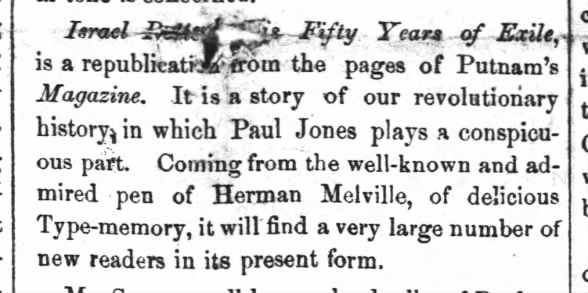
Israel Potter: His Fifty Years of Exile, is a republication from the pages of Putnam's Magazine. It is a story of our revolutionary history, in which Paul Jones plays a conspicuous part. Coming from the well-known and admired pen of Herman Melville, of delicious Type-memory, it will find a very large number of new readers in its present form.--Southern Weekly Post, March 24, 1855.
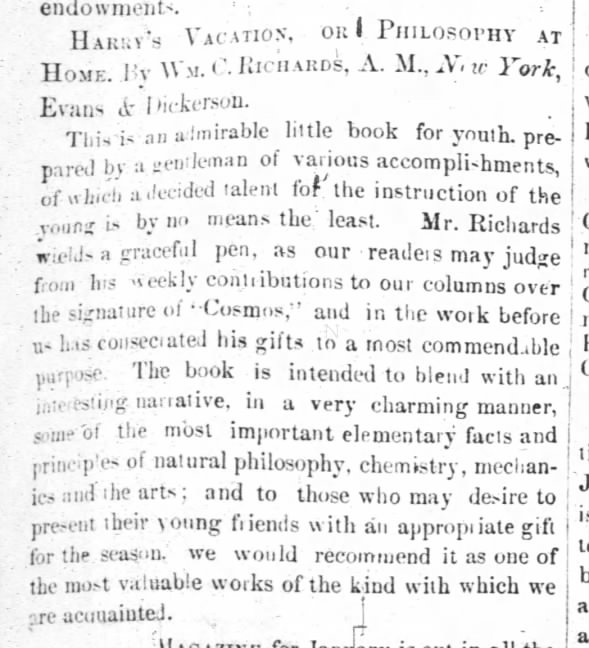 23 Dec 1854, Sat Southern Weekly Post (Raleigh, North Carolina) Newspapers.com
"This is an admirable little book for youth, prepared by a gentleman of various accomplishments, of which a decided talent for the instruction of youth is by no means the least. Mr. Richards wields a graceful pen, as our readers may judge from his weekly contributions to our columns over the signature of "Cosmos," and in the work before us has consecrated his gifts to a most commendable purpose...."
-- Southern Weekly Post, December 23, 1854.
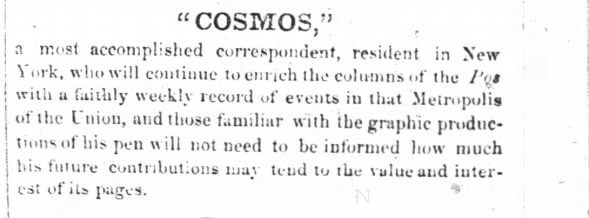
Born in London, William Carey Richards left England for the United States at the age of thirteen with his parents and siblings. The family resided in Hudson, New York for several years before moving south to Maryland and then further south to Georgia. As editor of Richards' Weekly Gazette, Richards favorably reviewed Mardi and Redburn. For the friendly reception of these and other of Melville's writings in Athens, Georgia and later Charleston, South Carolina, see the posts linked below:
- William Carey Richards on Mardi
https://melvilliana.blogspot.com/2019/05/william-carey-richards-on-mardi-and.html
- Redburn in Richards' Weekly Gazette
https://melvilliana.blogspot.com/2019/05/redburn-in-richards-weekly-gazette.html
- "Hawthorne and His Mosses" in the Southern Literary Gazette
https://melvilliana.blogspot.com/2019/05/charleston-reprinting-of-hawthorne-and.html
Wednesday, November 17, 2021
Montreal Visit from St Nicholas, 1826
"A Visit from St. Nicholas" was reprinted in the Montreal Gazette on January 4, 1826, with a helpful preface explaining the American Santa Claus to Canadians.
Amongst the Dutch Americans, St. Nicholas, or, as he is familiarly called, Sainte Claus, is a Christmas visitor, highly esteemed by the juvenile branches of families, who never fail to court the attention of the Saint, by placing their stockings, to receive such donations as this free-hearted patron of good children may in his bounty be pleased to bestow. This innocent superstition is, however, not confined to the Dutch settlers--the children of their neighbours hold the cake-bestowing Saint in equal veneration. Nor is his fame unknown in these Provinces, although he is not often seen, his gingerbread visiting-cards afford his urchin votaries a certain evidence that, whilst they slept, he has paid his annual Christmas call. We leave it to antiquaries to determine his Saintship's origin; and whether the donations made in his name originated in the distribution of sweetmeats and cakes at the Vatican at Rome, on Christmas-eve, or is a remnant of some earlier superstition. Be that as it may, we present the following picture of his garb and equipage, as it has been sketched by an American poet, who was fortunate enough to obtain a glimpse of the jolly old elf.
This item is not listed in Nancy H. Marshall, The Night Before Christmas, A Descriptive Bibliography of Clement Clarke Moore's Immortal Poem (Oak Knoll Press, 2002). With interesting exceptions, the text of the still-anonymous poem mostly follows the first printing in the Troy Sentinel on December 23, 1823. Dunder remains Dunder, for example, but Blixem has been re-christened Blixen. Also, the whole roll of reindeer names has been metrically improved by rearranging commas and exclamation marks:
“Now, Dasher! now, Dancer! now Prancer and Vixen!
“On, Comet! on, Cupid! on, Dunder! and Blixen...."
Extending to Comet and company in the second line of the couplet, the revisions to punctuation marks around reindeer names in the Montreal Gazette are even more thorough than similar changes in the Charleston Mercury and other 1826 versions. For more on those, check out the earlier post
https://melvilliana.blogspot.com/2019/12/now-dasher-in-1826.html
Another interesting difference is the addition of "which" as a relative pronoun in the distinctive heroic simile that here in this early Canadian version begins
As dry leaves which before the wild hurricane fly.
The 1823 Troy Sentinel version did not supply any word between "leaves" and "before":
As dry leaves before the wild hurricane fly.
Adding "which" makes a regular anapest "which before" in the second metrical foot. In the same line as corrected or revised in the 1844 collection Poems by Clement C. Moore, "that" replaces "which":
Santa smokes like a chimney wherever he goes, obviously. But here the é with the acute accent, unique to the Montreal Gazette version, tells readers how to sayAs dry leaves that before the wild hurricane fly.
"the smoke it éncircled his head like a wreath"in the province of Quebec.
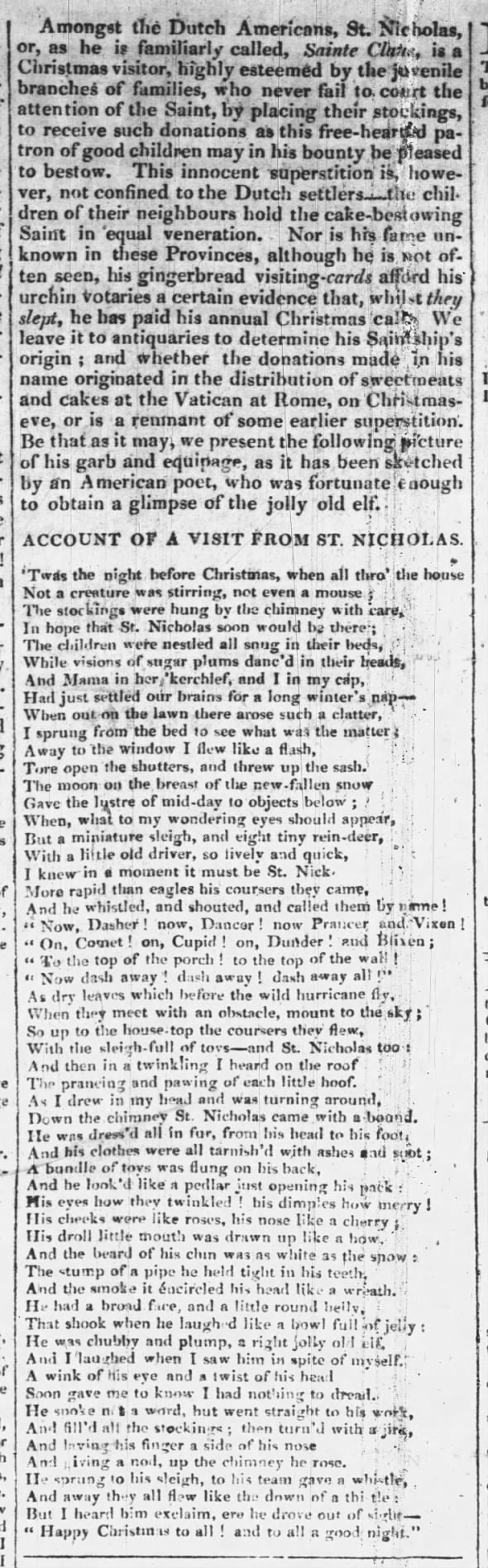 04 Jan 1826, Wed Montreal Gazette (Montreal, Quebec, Canada) Newspapers.com
ACCOUNT OF A VISIT FROM ST. NICHOLAS.
’Twas the night before Christmas, when all thro’ the house
Not a creature was stirring, not even a mouse;
The stockings were hung by the chimney with care,
In hope that St. Nicholas soon would be there;
The children were nestled all snug in their beds,
While visions of sugar plums danc’d in their heads,
And Mama in her ’kerchief, and I in my cap,
Had just settled our brains for a long winter’s nap—
When out on the lawn there arose such a clatter,
I sprung from the bed to see what was the matter;
Away to the window I flew like a flash,
Tore open the shutters, and threw up the sash.
The moon on the breast of the new-fallen snow
Gave the lustre of mid-day to objects below;
When, what to my wondering eyes should appear,
But a miniature sleigh, and eight tiny rein-deer,
With a little old driver, so lively and quick,
I knew in a moment it must be St. Nick.
More rapid than eagles his coursers they came,
And he whistled, and shouted, and called them by name!
“Now, Dasher! now, Dancer! now Prancer and Vixen!
“On, Comet! on, Cupid! on, Dunder! and Blixen;
“To the top of the porch! to the top of the wall!
“Now dash away! dash away! dash away all!”
As dry leaves which before the wild hurricane fly,
When they meet with an obstacle, mount to the sky;
So up to the house-top the coursers they flew,
With the sleigh full of toys—and St. Nicholas too:
And then in a twinkling I heard on the roof
The prancing and pawing of each little hoof.
As I drew in my head, and was turning around,
Down the chimney St. Nicholas came with a bound.
He was dress’d all in fur, from his head to his foot,
And his clothes were all tarnish’d with ashes and soot;
A bundle of toys was flung on his back,
And he look’d like a pedlar just opening his pack:
His eyes how they twinkled! his dimples how merry!
His cheeks were like roses, his nose like a cherry;
His droll little mouth was drawn up like a bow,
And the beard of his chin was as white as the snow;
The stump of a pipe he held tight in his teeth,
And the smoke it éncircled his head like a wreath.
He had a broad face, and a little round belly
That shook when he laughed like a bowl full of jelly:
He was chubby and plump, a right jolly old elf,
And I laughed when I saw him in spite of myself.
A wink of his eye and a twist of his head
Soon gave me to know I had nothing to dread.
He spoke not a word, but went straight to his work,
And fill’d all the stockings; then turn’d with a jirk,
And laying his finger a side of his nose
And giving a nod, up the chimney he rose.
He sprung to his sleigh, to his team gave a whistle,
And away they all flew like the down of a thistle:
But I heard him exclaim, ere he drove out of sight—
"Happy Christmas to all ! and to all a good night."
-- Montreal Gazette, January 4, 1826.
Monday, November 15, 2021
1857 Night before Christmas
Illustrated by Jacob A. Dallas (1825-1857) and published in the January 1857 number of Mrs Stephens' New Monthly magazine.
 |
| Mrs. Stephens' Illustrated New Monthly Vol. 2 - January 1857 |