Tuesday, October 23, 2012

Gansevoort speaks at "grand supper" for Governor Bouck


From the Albany Argus, Friday, June 21, 1844

GOV. BOUCK IN THE CITY OF NEW YORK

Correspondence of the Argus
New-York, June 15th, 1844
 
… On Wednesday night, the proscribed watchmen and other democrats in the 11th ward, the headquarters of the New York Democracy, returning as it does 1200 democratic majority, invited the Governor to a grand supper. Some three hundred sat down to a table most sumptuously spread by Mr. Waring, the proprietor. Among the invited guests were his Excellency, the Hon. B. F. Butler, Ald. Purdy, L. B. Shepherd, Wm. McMurray, Gansevoort Melville, and others—by all of whom soul-stirring speeches and sentiments were given….

In honor of the Governor’s arrival, the 11th ward cannon was brought out, and alternated its thunder with the softer strains of a most excellent band of music.
MR. MELVILLE, in the course of his remarks, said “The people had tried the ‘old white horse.’ They had found him a good courser, they were going to put him on the track again, and when he once had his feet upon it, he was sure to go right through.” This was received with most hearty and repeated cheers. -- GenealogyBank.com
The New York Tribune, June 20, 1844, was quick to print this scornful reply (to an earlier printing of the report):
The Albany Argus thinks that in the late Eleventh Ward supper given to the ‘Old White Horse’ by the ’rank and file’ of this city, Mr. Master-in-Chancery McMurray officiated as ‘rank’ and Mr. Examiner-in-Chancery Melville as ‘file.’  Very likely.  They are two ‘nice men for a small party.’  -- Fultonhistory.com

Thursday, October 18, 2012

Sheriff's Sale in Albany, NY

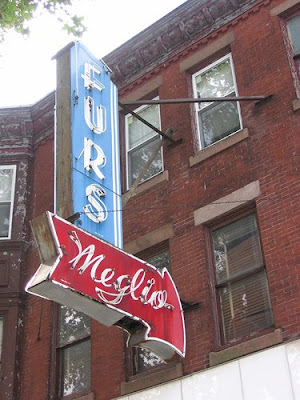
Herman Melville was already on his way to Liverpool aboard the merchant ship St. Lawrence. His mother and family now made their home in Lansingburgh. From the Albany Evening Journal, Tuesday, June 11, 1839:
SHERIFF’S SALE.—By virtue of an execution issued out of the Supreme Court of the state of New York, to me directed and delivered, I have seized and taken all the right, title, interest and estate which Maria G. Melville had on the first day of May, 1837, or which she may since have acquired, of, in and to all that certain lot of ground known as lot No. 29, in the fifth ward of the city of Albany, bounded on Carroll street, between Spencer and Lumber Streets, with the buildings thereon, lately occupied by Chase & Smith as a fur factory; said lot is 38 feet front on Carroll street and 95 feet 6 inches in depth; and also two vacant lots, being part of the yard connected with the said factory, each of said lots being 24 feet in width, and each being upwards of 100 feet in depth, which I shall sell at public auction at the Mansion House, in the city of Albany, on the 27th day of June next, at 10 o’clock in the forenoon of that day. 
Dated Albany, May 16, 1839.

ANGUS McDUFFIE, late Sheriff
By JOHN D. LIVINGSTON, Dep.  (Accessible on fultonhistory.com and GenealogyBank)
Later notices in the Albany Evening Journal, for example September 9, 1839, announce postponement of auction:
"The sale of the above property is postponed until the 1st day of November next, at the same hour and place above mentioned. –Dated June 27, 1839.  MICHAEL ARTCHER, Sheriff"
The auction was again delayed until the 7th of February, 1840, as announced in the Evening Journal on Wednesday, February 5, 1840.

a bankrupt furrier


In April 1837 Gansevoort Melville lost his fur business. Two items from the Albany Evening Journal, Monday April 24, 1837:
FURS, by order of the sheriff.—DAVIS & JONES will sell on Tuesday next, at 12 o'clock N at the Auction Room, the stock in trade of a Furrier.
TO LET.  The buildings on Dean st. between State and Hudson sts.  in the rear of the store of the subscriber, recently occupied as a hat manufactory by G. Melville and is well calculated for that or any other manufacturing purposes.  Possession given immediately. 
LYON, CHESEBRO & Co.
No. 364 South Market st.  -- GenealogyBank

Monday, August 13, 2012

My Dear Upton

For a finer and prior treatment of the matter herein, please see Richard Colles Johnson, "A New Melville Letter" in Melville Society Extracts 112 (March 1998) at pages 10-11, 

now counted also in the important update by John M. J. Gretchko:

"Twenty-three Melville Letters That Have Appeared Since 1993: An Addendum to the Correspondence Volume." Leviathan, vol. 26 no. 1, 2024, p. 66-82. Project MUSE, https://doi.org/10.1353/lvn.2024.a925511.
* * *
In 1996, three years after publication of the Northwestern-Newberry edition of Melville's Correspondence, this item showed up at Swann Auction Galleries, Lot 526:
- Melville, Herman. Autograph Letter Signed to "My Dear Upton.' 2 pages on single 12mo sheet with integral blank leaf; slight fold marks glue residue on verso of blank leaf. Np, 29 May late 1840s] E7000-10000 'I was very much gratified by your note & its friendly spirit & cordiality. I am much pleased that Omoo has afforded you entertainment - the more so, as with-out flattery I might instance yourself as being in corrected in Melville's hand from 11 as one of those quarters where praise is desirable. I presume that before this you are quite at home in your new residence up town, where I promise myself great pleasure in calling upon you when next in New York. I beg you to, present my compliments to Mrs. Upton and Believe me Very sincerely yours Herman Melville. May 29th.'  --Artfact
Late 1840's?  We can do better than that, let's say

1847

just after publication of Omoo in April and before Herman's marriage to Elizabeth Shaw in August.

My Dear Upton?

Best candidate I can find would be New York attorney and expert in maritime law,
Francis H. Upton (1814-1876).

One 1850 New York City Directory gives Upton's business address as 72 Wall Street.  Trow's New York City Directory for 1856 gives also Upton's home address, "89 W. 36th."  Francis Henry Upton went on to write A Treatise on the Law of Trade Marks (Albany, 1860); and The Law of Nations Affecting Commerce During War (New York, 1861).

Upton is listed as a contributor to volume 16 of Hunt's Merchants' Magazine (1847) where Melville's Omoo recieved a brief but favorable notice in the June 1847 number.  Upton, listed as "Counselloor at Law, late of New Orleans, now of New York" wrote a series for Hunt's on the "Law of Debtor and Creditor in Louisiana."  Very likely Upton's association with Hunt's or another publication informs Melville's allusion to "one of those quarters where praise is desirable."  Melville understandably deemed it desirable as author of a new book to have a friend writing for one of the magazines.


A "Francis H. Upton" is named in some of the Upton Family Papers now held at the Peabody Essex Museum in Upton's birthplace of Salem, Massachusetts.  Well I don't suppose there's another letter from Herman Melville in that one envelope, but maybe somebody should check anyway, just in case. 

Francis Henry Upton was a son of Samuel Upton and Rebecca Allen Pierce. On September 1, 1836 FHU married Sarah Foster Carr. Francis and Sarah had two children, Francis Carr Upton and Sarah Carr Upton. Wheelock Samuel Upton and Charles Horace Upton were brothers of Francis Henry Upton. Sadly, during the Civil War Francis Henry Upton was "stricken with paralysis" while arguing a case in New York.
"He afterward lived in Europe and is now in Washington, paralyzed in both body and mind, having never recovered his faculties, and is supported by his wife and daughter."
--The Upton Memorial

Monday, August 6, 2012

Admiration (Byron's) for His (Samuel Rogers's) Genius

Samuel Rogers (1763-1855)
In case you were wondering...

The wording in Melville's dedication of Moby-Dick to Nathaniel Hawthorne
"IN TOKEN
OF MY ADMIRATION FOR HIS GENIUS"
 is strictly traditional.  The nearest and best known model has to be Bryon's 1813 dedication of
The Giaour:
TO
SAMUEL ROGERS, ESQ.

AS A SLIGHT BUT MOST SINCERE TOKEN
OF ADMIRATION OF HIS GENIUS;

RESPECT FOR HIS CHARACTER,
AND GRATITUDE FOR HIS FRIENDSHIP;

THIS PRODUCTION IS INSCRIBED BY

HIS OBLIGED 
AND AFFECTIONATE SERVANT,

BYRON. 

Wednesday, August 1, 2012

Happy Happy Birthday

"Travel to a large and generous nature is as a new birth. Its legitimate tendency is to teach profound personal humility, while it enlarges the sphere of comprehensive benevolence till it includes the whole human race."
--From Herman Melville's 1859-1860 lecture on "Traveling: Its Pleasures, Pains, and Profits" as reconstructed by Merton M. Sealts, Jr., in Melville as Lecturer (Cambridge, Massachusetts: Harvard University Press, 1957).

Monday, July 23, 2012

Rev. Edward Taylor on board the steamer Mohegan, 1840


In our last we caught the New York Spectator in November 1839 proposing to name the newest steamboat on Long Island Sound, The Pequod. And we learned too, this same steamer would be christened instead, the Mohegan. The following summer, one likely original of Melville's Father Mapple was sighted on board this same Mohegan. Still on everybody's mind was the tragic destruction of the steamer Lexington on January 13, 1840.
Correspondence of the N. Y. Express.
BOSTON, July 2nd

INTERESTING INCIDENT ON BOARD THE MOHEGAN.

Among a numerous company of passengers on board the steamer MOHEGAN, Capt. Vanderbilt, from New York to Providence, on the evening of the 1st inst. was the Rev. Mr. Taylor, the Seamen’s friend and preacher in Boston.  Many of the passengers were much interested in having pointed out to them the spot where the ill-fated Lexington was burnt some few months since, when a whole hecatomb of victims were sacrificed to the destroying elements of fire and water.  Mr. Taylor was invited by some of the passengers to address them as the Mohegan passed over this never to be forgotten spot.  With the permission of the captain, the request was granted.  I listened in common with a great many others, with deep interest to the extemporaneous discourse made by the pious and eloquent preacher.  The evening, hour, the place, the reflections naturally arising from hearing from one whose home had been so long upon the deep,—the acquaintance of the preacher, with many who had made their graves beneath the “deep waters of the [dark] blue sea,”—all the associations of the place and the occasion, made the scene one of peculiar interest.— 
 
The discourse was brief, simple and affecting.  No attempt was made to excite the hearer, but an appropriate commentary was made upon the words of the Apostle Paul,— “For me to die is gain.”  The preacher spoke enthusiastically of his fondness for the sea,—a delight which had grown up with him from childhood, and which rather increased than diminished as he grew in years.  His language and figures and illustrations were at times beautifully eloquent and descriptive.  He spoke of the lamented FOLLEN with deep feeling and respect.  Though differing widely in opinion, he believed him to be a model of a man; always modest, affable, affectionate, pious, he was a man he loved; he was a brother in his religious attachments.  His body rested beneath the boat, among the sea-weeds of the ocean, but his spirit had ascended to God who gave it.  For him to die was gain, and so he hoped of many who received at an unseemly hour the summons of death.


The allusions to the sailors and to the ocean, to the voyage of life, to the mariner’s home, to the return to the objects of affection left behind after an absence of years—to the grandeur of the sea, the Maker of the Ocean, awakened a sensation which no man but a son of “Old Ocean,” could have called up.—  As the boat passed over these hallowed and beautiful waters, and all was still, save the voice of this man of God, who has done as much good in his day and generation as any uninspired man ever did, I could but think of the appropriate lines of Dimond.

“On a bed of green sea flowers thy limbs shall be laid,
         Around thy bones red coral shall grow,
Of thy fair yellow locks threads of amber be made,
       And every part suit to this mansion below.

No tomb shall ere plead to remembrance for thee,
       Or redeem power or fame from the merciless surge,
But the white foam of waves shall thy winding sheet be,
       And winds in the midnight of winter thy dirge.”

The winter’s night was the time of the sacrifice, and the poor victims, without a tomb-stone, but not without remembrance,
                     “lie where pearls lie deep.
They were the beloved of all,
But none o’er their lone grave may weep.”
Yours, &c. 

E.   
As reprinted from the New York Daily Express (July 4, 1840) in the Albany Evening Journal, Monday, July 6, 1840; and Schenectady Cabinet, July 14, 1840.
Update 7/08/2015. The signature of the Boston correspondent might possibly be the upper case sigma Î£, and not "E" as I first thought. (Well, looking again it does look like "E" in both the Albany and Schenectady versions.) One Boston correspondent known to have written over the pseudonym Sigma is Lucius Manlius Sargent. Sargent's activism in the temperance movement befits the writer's tone and approving treatment of Father Taylor in reporting this "Interesting Incident on Board the Mohegan."  Found at Fulton History, the article as it originally appeared in the New York Daily Express:

New York Daily Express (July 4, 1840)

Related post