Showing posts with label Walt McDougall. Show all posts

Tuesday, July 15, 2014

NUDE ART IN NEW YORK (Matt Morgan's "living statues" at Theatre Comique, 1875)

Cleopatra before Caesar / Jean-Léon Gérôme, 1866
From the Cleveland Leader of Thursday, December 16, 1875, crediting the New York World (December 9, 1875) where the original (and longer) version appeared on December 9, 1875 under the heading "THE 'LIVING PICTURES' / What the Y. M. C. A. Object to at the Comique / MATT MORGAN DRAWS A DISTINCTION BETWEEN ART AND INDENCENCY." Both items are accessible online in the archives of Historical Newspapers at GenealogyBank.

NUDE ART IN NEW YORK.

The Scenes at the Theater Comique

N. Y. World, Dec. 9
The following letter was the other day received at the World office:
“MR. EDITOR: Are public theatricals and unlimited license synonymous terms? If so, I can comprehend why Matt Morgan thrusts upon the public his nude and suggestive figures daily and nightly. 
Please reply through your columns, or give this an insertion in your valuable journal, and oblige

AN OLD SUBSCRIBER.
At a question so intricate as one pertaining to license, limited or unlimited, and in view of the recent action of the authorities, it was deemed best to dispatch a trusty reporter with instructions to inquire rigidly into the matter. One who had visited the Jardin Mabille, had attended trials of repute, and yawned at the “Black Crook” in all its original splendor, and fallen asleep over the impassioned strains of the “Timblale d’Argent,” was selected as a person capable of doing equal justice to unalloyed art and decency. It being a day of matinees, this reporter hastened yesterday afternoon to the seat of the present alleged immorality, the Theatre Comique, and making known his business, was politely shown to the office of Mr. Matt Morgan.
“I have come,” began the reporter, “to inquire, in the interest of public morals, whether your exhibition at this house, or that particular portion of your exhibition styled the ‘beautiful pictures,’ is—er?”

“No, it isn’t.”

“Oh! Well, is it—er?”

“No, it is not.”

“Umph! Well, then, what is it?”

“It’s an attempt (and here Mr. Morgan gathered himself upon his toes) to educate the American mind.”

“To educate the—“

“American mind, sir.”

“And is—er—nudity essential to the education of the American mind, Mr. Morgan?”

“Parbleu! It’s ‘nudity,’ always ‘nudity.’ Sir, have you an esthetic instinct? Would you see Cleopatra in the presence of the mighty Caesar decked out with a panier and pinback? Would you have Diana and her nymphs clad in gray flannel bloomers? Could you expect Phryne to appear before the Tribunal in a costume of Worth’s latest design?”

Here Mr. Morgan paused for breath, and the reporter entered the theatre to discriminate for himself. After enduring the eccentricities of numerous negro and Celtic characters for the space of an hour, the curtain at last rose upon the first of the “beautiful classic pictures.” “Cleopatra before Caesar.” To any one familiar with the original painting, it is but necessary to say that an exact counterpart was given to flesh and blood; to others it may be described as a tall symmetrical woman standing before the representative Caesar, clad in so fine and superior an article of flesh-colored silk and illusion lace mingled in the same mysterious way. Roughly estimating it, about seven-tenths of Cleopatra’s divine figure was exposed to public scrutiny. Surrounding the whole a broad frame was placed, while a suitable back-ground, painted by Matt Morgan, gave the whole a good deal of the appearance of mere paint and canvas. To the strains of Strauss the second picture was unveiled, entitled “The Shower of Gold.” On an Oriental divan reclined a Circassian blonde, whose sole raiment was a blue silk parasol held at a comfortable distance above her head by an African slave. Around about the divan in graceful postures clustered other females, each of whom exhibited a degree of pink skin tights commensurate with the size of her person. In surveying this work of art it was a matter of some perplexity to reconcile the picture with Mr. Morgan’s statement that he has “added to the drapery of the figures considerably.” Since his difficulty with the authorities. Another picture was the “Slave Merchant,” and still another “Diana and her Nymphs Surprised.”
Diana and her Nymphs surprised by Satyrs / Peter Paul Rubens, 1638-40
“Now, sir,” said Mr. Morgan briskly, as the reporter wended his way from the art gallery, “you have seen the performance; do you see anything immoral or indecent in it?” Without waiting for a reply, the artist relieved the embarrassment by continuing: “Of course you don’t; and I intend to exhibit these pictures as long and as often as I choose. Diana in a bathing suit, or Cleopatra in a crinoline! Bah? It’s shocking, and no-where but in the prurient mind of the Young Men’s Christian Association would the idea be tolerated.”
And you wonder why I would rather live in the 19th century? Not just for Morgan's classical tableaux at Theatre Comique, but also for the glorious newspapers with writing like this.
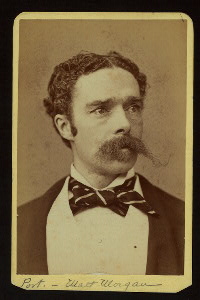

Matt Morgan Digital ID: th-37995. New York Public Library
We're only showing what Matt Morgan was about in the years when Melville and Walt Whitman most likely visited his New York studio. For the record, the story so far:


Looks like McDougall's references to Walt Whitman in the Mercury and This is the Life! might be new all around, to Whitman studies as well as Melville studies. Also a new discovery, Matt Morgan's offer in April 1876 to host a benefit performance for Whitman at the Lyceum Theater.

Related posts at melvilliana:

Monday, July 14, 2014

Trying to date Walt McDougall's encounter with Melville at Matt Morgan's studio

1874-1877 I'm thinking is the time frame. How so? Well, McDougall specifically names NY Graphic colleague Charles Frohman as one of the people he saw that one afternoon he went to Morgan's studio with Newark painter John Bolles. Frohman's tenure at the New York Daily Graphic was brief, lasting only from 1874 to 1877. Frohman (1860-1915) was only 14 years old in 1874. He worked in the circulation or advertising department "all day." Then
At night he sold tickets in the box office of Hooley's Theatre, Brooklyn.
--Who's who on the Stage
http://gayinfluence.blogspot.com/2012/02/charles-frohman.html

Also named is Walt Whitman, who as shown at the Walt Whitman Archive was contributing poems for the Daily Graphic in 1873 and 1874.

http://americanart.si.edu/collections/search/artwork/?id=6781

So the overlap for Frohman and Whitman at the Daily Graphic is 1874, which (if that's the right year) would make McDougall what, 16 years old at the time. 

But wait. Marion Harland needs to be home in Newark with her minister husband. Wikipedia says she relocated to Europe in 1873-1875, for her health. Damn! Let's make sure of that. Marion Harland's autobiography puts it this way: she finally got to Europe 21 years after her husband promised her a trip back in 1855, which would put the start of the trip October 15, 1876. They sailed for New York in late September, two years later.

http://pvhn2.wordpress.com/1800-2/mary-virginia-hawes-terhune/

This Free Dictionary entry for her son Albert Payson Terhune confirms from somewhere the dates as 1876-78. Seems that Edward Payson Terhune, Marion Harland's minister husband, 
  was the American chaplain at Rome, Italy, in 1876-1877. Free Dictionary
 (citing Appleton's Encyclopaedia)
And look, after Europe the family settled in Springfield, Massachusetts. So ha! we're back to 1874 as the only year in which Walt McDougall could have invited Melville home in Newark to meet his neighbor Marion Harland, and on the same day also have seen Charles Frohman of the Daily Graphic and Daily Graphic contributor Walt Whitman at Morgan's studio.

Next step: dip into Hershel Parker's biography, Volume 2, and find out what Melville was doing in 1874. Writing poetry, as Lizzie nervously revealed to the family in Boston, at Thanksgiving (777-8).

Later: Not sure if Whitman was on the scene in 1875 also.  For now, let's make it 1874-1875 to be safe.

Still later:  In 1876 Matt Morgan led efforts to relieve Walt Whitman in his widely publicized illness and alleged financial distress:
“Matt. Morgan, who is now trying to run the Lyceum in Fourteenth street as a vaudeville theatre, proposes to give a benefit to Walt. Whitman.” --Albany Evening Times, Friday, April 7, 1876; found at Old Fulton NY Post Cards
Morgan made his offer in a letter to the New York World, as reported in the Cincinnati Commercial Tribune:
A MATINEE benefit for Walt Whitman has been offered by Matt Morgan of the Lyceum Theater in New York, who has written a note to the editor of the World, making the offer, as follows
"Believing that my illustrious fellow countryman, Robert Buchanan, (making the necessary allowances for his poetical exaggerations) has struck the right cord in his allusions alike to the merits and the needs of Walt Whitman, fully appreciating Mr Whitman's services alike in the cause of literature and humanity, and sincerely believing that the heart of the great American people in general, and of the New York public in particular, will be quick to respond generously in the extremity of one of the most original writers and best men in the country, I feel myself honored in taking this opportunity of hereby offering my theater and my company for any matinee performance for the benefit of Mr Walt Whitman, to be given at such date as any of his authorized friends may designate.”
--Monday, April 10, 1876; found in the Newspaper Archives at Genealogy Bank
 Related posts at melvilliana;

Walt McDougall in the American Mercury


Check out this earlier and different version of Walt McDougall's encounter with Herman Melville at Matt Morgan's studio. Turns out that McDougall's 1926 book This is the Life! incorporated material that McDougall had previously published in H. L. Mencken's American Mercury. This is the Life! is dedicated to Mencken.

From McDougall's article, "Memories of a Cartoonist" in The American Mercury (March 1925):
An endeavor to list all the rivals that were set up to Puck and Judge would be barren of interest, for, with the exception of Life, they were shortlived. But each of them was a bow of promise to peripatetic artists while it lasted. Farthest back in my memory is the Tomahawk, started by Matt Morgan, a dashing, brilliant English artist whose studio was the resort of nearly all of the illustrators and writers of the day. There I first saw Walt Whitman, on my only visit to the place in company with John Bolles, a Newark painter. That afternoon there came, too, Thomas Wüst, a distinguished German cartoonist, Hopkins and Miranda, and Charles Frohman, then in charge of the distribution of the Daily Graphic, William H. Shelton, famous for his escape from a Confederate prison, and the dapper Gray Parker, with others no less distinguished but unknown to the two obscure Newarkers.
In the centre of the studio was parked a new washtub half-full of claret punch, which, it seemed, was a permanent adjunct of the apartment and gave me an exaggerated idea of Morgan’s affluence. His weekly was several grades above the other comic papers of the time, but it soon died and he returned to London. John Hyde, another Englishman and a good draughtsman who used to make the alluring front pages for the Police Gazette, wherein almost fabulously beautiful legs were always prominent, was present and I was informed that there was much jealousy between the two Britishers. There I also met Herman Melville, author of “Typee,” and invited him out to Newark to meet Marion Harland, wife of our minister, who lived a few doors from us. Under the influence of the punch he accepted my invitation, but never came. I met him frequently afterward, as I did Walt Whitman, lounging along Park Row, a rather moody, sulky man, I imagined, but now I think he was simply shy.

That gathering was somewhat different from the daily assembly of chess players in my father’s rather shabby studio three floors up in Broad street, Newark…. (264-5)
Compare the later version of McDougall's encounter with Melville, from This is the Life!:  
I had almost forgotten to mention among them one whom for many years I did not properly appreciate, Herman Melville, the author of “Typee,” and whom I very often encountered, as I did Walt Whitman, lounging along Park Row, a rather moody, sullen man, I thought, but now I imagine that he was shy. Under the influence of the punch, perhaps, I invited Melville to our house, to meet Marion Harland, and he accepted the invitation graciously enough but he never came.
In revision, McDougall adds the reflection that he "did not properly appreciate" Melville, then and "for many years" afterward. Instead of "sulky," McDougall in the book version says he thought Melville "sullen." And in the 1925 magazine version, McDougall helpfully explained his connection to Marion Harland, a link left mysterious in the 1926 book version. Only in the earlier magazine version do we learn: the famous author was a Newark neighbor of the McDougall family and the wife of their minister (Edward Payson Terhune, Google further informs).

Hey, what about this? We were already mesmerized by that washtub of punch. So far gone as to speculate about Melville's (not uncharacteristically) "warming up" with it at Matt Morgan's studio. Now we find that McDougall blabbed it outright in the 1925 American Mercury. In the magazine version, McDougall stated clearly, without qualification, that Melville was "under the influence" when he accepted McDougall's invitation to come to Newark and meet Marion Harland.
Under the influence of the punch he accepted my invitation, but never came.
But in the book version McDougall re-imagines the scene. Now, with some qualification ("perhaps"), he generously attributes any sort of elevated behavior to himself only:
Under the influence of the punch, perhaps, I invited Melville to our house, to meet Marion Harland, and he accepted the invitation graciously enough but he never came.
Somebody was high, but who is ambiguous, now that we have two different versions to consider.

Miscellaneous extras:
  • Walt McDougall must have heard a few stories from his friend Julian Hawthorne about Melville. McDougall on Hawthorne: 
Bill Nye and Julian Hawthorne, alike in soul, devoid of affection or conceit, diffident, shy of strangers yet alike compelled to meet them with a pretense of geniality secretly abhorrent, made my room their daily lounging place…. Hawthorne would describe a new dish so vividly that the hungry Nye would suggest that we adjourn to Hash and Crook’s restaurant in the Times Building and sample it at his expense. Hawthorne told me that once, when a boy, he found fourteen pies in his mother’s pantry and ate them all.

He was low-voiced, with a strong partiality for the supernatural; a man, who, with less education, might have been a spiritualist. I fancy that he found in the flippancy of Nye’s and my conversation a sort of mental anaesthetic. I have never known two such manly, gentle, undefiled souls, yet both were overwhelmed by heart-breaking disasters. Nye’s career was meteoric; Hawthorne’s lasted thirty years. Both are already dim memories, mere names. --Pictures in the Papers, American Mercury (September 1925): 72-3. Also (revised) in This is the Life!
Related melvilliana posts:

Sunday, July 13, 2014

Matt Morgan on Broadway

1872 revival of Black Crook
poster by Matt Morgan
Image credit: Marin Theatre Company on Pinterest

Update: For another version by Walt McDougall of his social encounter with Melville at Matt Morgan's studio, see Walt McDougall in the American Mercury.

Reading Richard Scully on Matthew Somerville Morgan gives me a different idea of why artists and poets including Herman Melville might have visited Morgan's New York studio in the 1870's. Walt McDougall placed his encounter there with Melville in the context of Morgan's fame as cartoonist and co-founder of the London Tomahawk, and McDougall's own youthful semi-employment with American comic weeklies like Puck and Judge. But as Scully makes clear, Morgan just then was already turning, or rather returning, from caricature to theater and scene painting. Update: And duh! I see now that the book version of McDougall's reminiscence names "actors" among the daily crowd at Morgan's studio, along with illustrators and poets. The earlier magazine version had not specified actors or poets, describing the regular visitors as "nearly all of the illustrators and writers of the day."

Billy Rose Theater Division, The New York Public Library
"Matt Morgan" The New York Public Library Digital Collections
Various of Morgan's theatrical productions in this period were regarded as scandalous in the usual moralizing quarters--which complaints of course must have been very good for business. The NY Spirit of the Times delighted to entice readers with provocative descriptions of shows at Niblo's. The following notice, printed when Black Crook had just segued into a new revue called The Naiad Queen, mentions all three ladies pictured above in the Black Crook poster by Matt Morgan:
... Mlle. Sassi's performance with the anaconda excites wonder of many kinds and degrees. Miss Kate Santley looks as pretty as she can, and Miss Jennie Lee is pretty, piquant, and a general favorite. Consequences—crowded houses and overflowing tills.
(Spirit of the Times, March 2, 1872; found at Old Fulton NY Post Cards)
I'm guessing Morgan's allegorical paintings and controversial "living art pictures" or tableaux vivant would probably have interested Melville more at that point in his life (in his mid fifties) than Morgan's political cartoons.

In the early 1870's, Morgan worked on revivals of the musical "Black Crook," contributing allegorical paintings of 
five temptations and a moving tableau called “Immortality." They show how a young Venetian student, who has just graduated at college, is tempted by a character, in Mephistophelian guise, with wine, wealth, woman, power, and fortune in war. He resists all these temptations, and the moving tableau shows how he is borne aloft to heaven by twenty angels as a reward for his adherence to virtue. The paintings are masterly in effect and beautiful in detail. (New York Times, July 14, 1873)
Then, as Scully reports, in 1875 Morgan
inaugurated one of the most controversial entertainments of the day -- "Mr Matt Morgan's Magnificent Classical Tableaux" -- comprising a series of tableaux vivant of well-known works of art, and "enacted" by "A Corps of Ladies of Unrivalled Beauty...especially engaged to carry out the Artist's ideas" (Theatre Comique Program, 1875, Nov. 15). For propriety's sake, the ladies were clad in flesh-colored body stockings whenever they were called upon to model Classical nudes, in a style reminiscent of the Pantomime fairies of Morgan's London days. Including reconstructions of Botticelli's "Birth of Venus," Rubens's "Diana and Her Nymphs, Surprised," Emile Jean Horace Vernet's "The Slave Merchant," and Jean-Léon Gérôme's "Phryne Before the Tribunal," the show was advertised and critiqued on the basis of its artistic merits. --Sex, Art, and the Victorian Cartoonist p314
http://en.wikipedia.org/wiki/Phryne

The controversy over Morgan's shows recycled the old debate about Hiram Powers and The Greek Slave. In New York, Morgan publicly defended his work in court against charges of immorality. The case, as freely and lightly summarized in the Sacramento Daily Union, would investigate the tension between "Art and Public Morals":
Mr. Matt. Morgan is an artist, and was at one time employed on Frank Leslie's Weekly Illustrated Paper. Then he undertook to manage the Theatre Comique, and his artistic disposition led him to present the public with a new kind of entertainment, called for the nonce " living classic pictures." The idea is to represent classic pictures, fables, etc., by living persons properly (or improperly) costumed; and Mr. Morgan's conception of the public taste has led him to select those "pictures" in which the beauties of the female form are exhibited under the most free and untrammeled conditions. For example, he displayed "Cleopatra before Caesar;" and as everybody knows that Cleopatra, when unrolled from her tapestry on that occasion was, as Tennyson says of Lady Godiva, "clothed on[ly] in loveliness," and in very little else, the representative of the Egyptian Queen was necessarily restricted to a complete suit of tight-fitting pink silk induements. Another picture was "The Shower of Gold," in which a Circassian Danae reposed upon a divan, modestly shaded by a blue silk parasol in the hands of an attendant — "only this and nothing more." Now the Young Men's Christian Association have declared that the "classic pictures "at the Theatre Comique are indecent, and have, through the valiant Anthony Comstock, haled Mr. Morgan before the magistrates. The manager on his part is indignant. He says that he has aimed to instruct the New York people in the beauties of Art; that he has been furnishing them with purely classic representations; that it would be absurd to put Cleopatra in crinoline and corsets; that Danae never could have worn a pin-back; and that, as Bulwer would undoubtedly have remarked under similar circumstances, the True is the Beautiful, and the Beautiful is the Good. Meantime the public watch the contest with bated breath, possibly reflecting that after the class of dramatic spectacles which has held the boards during the past decade without active interference on the part of Young Men's Christian Associations, and while Art in the form of such pictures as the "Andromeda" is welcomed to the most public exhibitions, it is a rather delicate operation to draw the line sharply upon Mr. Morgan's "classic" pictures" or, as they would be called in Paris, his poses plastiques. --Sacramento Daily Union, 18 December 1875 

This (1872-1877) was prime time to see Matt Morgan at work. He successfully defended the charge of indecency in New York, although the next year in Louisville, police would shut down the show.

Richard Scully, again:
Having pushed the boundaries of acceptable entertainment, Morgan did not return his attention to the semi-scandalous after 1877, instead turning his not inconsiderable skill to more mundane, commercial forms of art. --Sex, Art, and the Victorian Cartoonist p320
Well we already knew Melville liked to visit artists in their studios. Douglas Robillard points out that when traveling abroad,
"Melville made a point of visiting, or attempting to visit, American artists who were living and working in Italy." --Melville and the Visual Arts, p27
In March 1857 Melville had visited the studio of sculptor Hiram Powers, a "plain man" and "Fine specimen of an American" as Melville described him in his journal.
"... to spend an hour or two with Hiram Powers in Florence was to have a tutorial in aesthetics."  --Hershel Parker, Herman Melville V2, p492
Upon his return from Europe and the Holy Land, the first professional thing Melville did was lecture on classical art. Statues in Rome! At Matt Morgan's New York studio, Melville (though legendarily shy and taciturn until warmed up) might have found congenial company, and glimpses perhaps of classically themed art in progress. And for properly warming up, that washtub of claret punch.

Related posts at melvilliana:

Saturday, July 12, 2014

Walt McDougall remembers Melville (and Whitman), at Matt Morgan's studio and "lounging along Park Row"


For an earlier version by Walt McDougall of his social encounter with Melville at Matt Morgan's studio, see Walt McDougall in the American Mercury

For more thoughts on Melville at Morgan's studio see Matt Morgan on Broadway.

Graphic artist Walt McDougall (1858-1938), as quoted in the newspaper review by George Currie:
“Herman Melville, whom I often encountered, as I did Walt Whitman, lounging along Park Row, a rather moody, sullen man, I thought, but now I imagine that he was shy.”
(Brooklyn Daily Eagle, Sunday, February 21, 1926)
Found some great photos of Walt McDougall on Facebook.


Then, taking the hint in the Brooklyn Daily Eagle, I grabbed McDougall's 1926 book This is the Life! in the Hathi Trust Digital Library. Goodness!

<

Recalling old colleagues in chapter three (Living by One's Wits), McDougall reaches way way back to the humor magazine Tomahawk, illustrated by Matt Morgan. McDougall seems to make this Tomahawk a New York affair. He also mentions contributing occasionally to Puck (not Punch), launched in New York on September 27, 1876.  
Puck started as a German-language weekly but an English version appeared the following year in March, 1877.  --Delaware Art Museum
Was the old London Tomahawk (1867-1870) revived by Morgan in New York, some time in the later 1870's? Or perhaps McDougall is misremembering Morgan's association in New York with Frank Leslie’s Illustrated Newspaper and (even more likely) Frank Leslie’s Budget of Fun.
Leslie hired Morgan in August 1870 to replace the late William Newman (died July 1870). --Yesterday's Papers
In any case, the reminiscence is clearly tied to Matthew Somerville Morgan and Morgan's New York studio, where McDougall claims to have seen Melville one afternoon among a host of others:
Farthest back in my memory is the Tomahawk, started by Matt Morgan, a dashing, handsome Englishman of the Herbert Standing type, whose studio was the daily resort of many of the illustrators, poets and actors of the time. There I first saw Walt Whitman on my only visit to the place with John Bolles, a Newarker. That afternoon there came Thomas [Theodore] Wüst, Hopkins and [Fernando] Miranda, with Charles Frohman, then circulation manager for the Graphic, William H. Shelton, famous for his escape from a Southern prison, and the dapper Gray Parker, then on Harper’s staff, with others no less distinguished but quite unknown to the two obscure Newarkers.
I had almost forgotten to mention among them one whom for many years I did not properly appreciate, Herman Melville, the author of “Typee,” and whom I very often encountered, as I did Walt Whitman, lounging along Park Row, a rather moody, sullen man, I thought, but now I imagine that he was shy. Under the influence of the punch, perhaps, I invited Melville to our house, to meet Marion Harland, and he accepted the invitation graciously enough but he never came.

I remember that both Bolles and I thought the conversation nothing much for such distinguished company, for we were both, no doubt, looking for pyrotechnics. We agreed that we had heard much more brilliant talk right in my own home. I thought Whitman a domineering old windbag who couldn’t keep his tobacco out of his splendid white whiskers, but when I grew up I came to like him very much, and Horace Traubel, whom I knew very well after I went to live in Philadelphia, while he was still a bank clerk, told me that the old poet often urged him to bring me over, but I knew that the secret of his liking was the fact that I was the only man he knew who, like himself, chewed Mayflower tobacco, long since an extinct brand.
In the center of Morgan’s studio was parked a new washtub half filled with claret punch, which, it seemed, was a permanent adjunct of the apartment and which gave me an exalted idea of the owner’s affluence. I remember seeing a similar punch bowl when a child on the occasion of a big baseball game, and, much later, on the dedication, or whatever it was, of Grant’s Tomb. 
The Tomahawk was several degrees above the other comic papers in many respects, but it soon died and Morgan returned to London.... (This is the Life! 64-66)
Update: For historical background, check out these books available online:
William Murrell, A History of American Graphic Humor (1865-1938);
F. Weitenkampf, American Graphic Art;
J. Brander Matthews on The Comic Periodical Literature of the United States, in Vol. 7 of The American Bibliopolist (1875): 199-201;

and wow! the great recent study by Richard Scully, "Sex, Art, and the Victorian Cartoonist: Matthew Somerville Morgan in Victorian Britain and America," International Journal of Comic Art 13.1 (Spring 2011): 291-325.

Matt Morgan Digital ID: th-37995. New York Public Library
Update 2: More on Matt Morgan, from the Twentieth Century Biographical Dictionary of Notable Americans:
MORGAN, Matthew Somerville, artist, was born in London, England, April 27, 1839; son of Matthew and Mary (Somerville) Morgan, both of whom were actors. He was a scene painter in Princess's theatre, London, for a time, and later artist and correspondent of the Illustrated London News in Rome, Italy. He studied art in Paris, Italy and Spain; made a journey into Africa by the French Algeria route in 1858, and served as war correspondent of the Illustrated London News during the Austro-Italian war in 1859. He was proprietor and joint editor of the London Tomahawk, a comic paper, and made a series of cartoons ridiculing the royal family. He was one of the founders of London Fun, and was the principal scene painter at Covent Garden during the run of Italian opera, 1867-69. He came to the United States in 1870 as cartoonist and caricaturist for Frank Leslie's Illustrated Newspaper. He was manager of a theatrical poster lithographic establishment at Cincinnati, Ohio, 1880-85, and organized in Cincinnati the Matt Morgan Art Pottery company in 1883, and the Cincinnati Art Students' league. He returned to New York city and opened a studio as a scene painter and illustrator. He painted pictures for Roman Catholic churches, several panoramic views of the civil war, exhibited in Cincinnati in 1886, and at the time of his death was finishing scenery for Madison Square Garden, New York. He contributed to the exhibitions of the Water-Color society. He published American War Cartoons (1874). He died in New York city, June 2, 1890.
--vol 7, ed. Rossiter Johnson
So most of Morgan's work "as cartoonist and caricaturist" in America falls within the decade of the 1870's. He returned to New York in the late 1880's, but by then was professionally engaged in a different sphere, "as a scene painter and illustrator." As the reference to Charles Frohman indicates, McDougall's encounter with Melville coincides with his early career at the New York Graphic. Frohman worked in the circulation department at the Graphic from 1874-1877 (Charles Frohman: Manager and Man). Another reason for dating the reminiscence to some time in the mid to late 1870's, when McDougall was about twenty, give or take a couple of years.

McDougall says he found enough courage in the tub of punch at Morgan's to invite Melville home to meet Marion Harland. And Melville accepted but never showed.

http://www.lva.virginia.gov/public/vawomen/2006/terhune.htm

But what does McDougall mean, "lounging along Park Row"?

Related posts at melvilliana: