Sunday, September 30, 2018

1852 letter in the Panama Star--signed "Herman Melville"?

Harper's New Monthly Magazine - January 1859
It took five years to build The Panama Railroad, starting in 1850. Thousands of people died of malaria and cholera and other horrors:
"It was a hard road to build. The tropical fevers slaughtered the laborers by wholesale. It is a popular saying, that every railroad tie from Panama to Aspinwall rests upon a corpse. It ought to be a substantial road, being so well provided with sleepers—eternal ones and otherwise."  --Letter from Mark Twain in the Chicago Republican (August 23, 1868).
Construction of the entire line was not completed until 1855, but an 1852 item in the London Athenaeum (August 7, 1852) references a letter about "the first trip" on a completed segment, signed "Herman Melville." According to The Athenaeum, "the author of 'Omoo" endorsed the project and expected it to be finished sooner than it actually was.

Every now and then it is convenient for our readers that we should present in a few words and at one view a general idea of the progress of railway extension—this extension being one of the most powerful agents of peace, social prosperity, intellectual interchange, and civilization generally. Most important perhaps of all the iron ways now in course of construction is that at the isthmus which separates the ocean over which Columbus sailed from that which Nunez discovered. All other railways are local and provincial—this is of universal interest. A letter from Herman Melville, printed in the Panama Star, describes the first trip made on a portion of this line—that is, as far as the crossing of the river opposite San Pablo. The works, according to report, proceed without interruption; and the author of ‘Omoo’ expresses an opinion that they will be completed in about a year from this date.— --The Athenaeum, August 7, 1852.
Herman Melville was then in Pittsfield, not Panama. Melville's friend Robert Tomes did go to Panama, and did write about the new railroad--but not until 1855, after its completion.


Melville got Tomes's book (Sealts Number 528 in the catalog at Melville's Marginalia Online) as soon as it came out. Among various international themes that might have appealed to the poet in Melville as suitable for versifying, Hershel Parker has already suggested the Panama Railroad, without reference to anything in the Panama Star:
"Melville could have written with some confidence about the epic construction of the Panama Railroad with its uncountable sacrifice of human life, since he could have relied on his copy of the chronicle of that achievement written by his old friend Robert Tomes...." --Melville: The Making of the Poet; also the Historical Note in Herman Melville's Published Poems (Northwestern University and The Newberry Library, 2009).
Sailing to San Francisco with his brother on The Meteor, Melville wrote of Panama and the railroad in a letter to his son Malcolm:
"When we get to San-Francisco, I shall put this letter in the post office there, and you will get it in about 25 days afterwards. It will go in a steamer to a place called Panama, on the Isthmus of Darien (get out your map, & find it) then it will cross the Isthmus by rail road to Aspinwall or Chagres on the Gulf of Mexico; there, another steamer will take it, which steamer, after touching at Havanna in Cuba for coals, will go direct to New York; and there, it will go to the Post Office, and so, get to Pittsfield."  --Melville's Correspondence, edited by Lynn Horth (Northwestern University Press and The Newberry Library, 1993), page 349.
Melville himself rode the train across the Isthmus in November 1860, on his return trip from San Fransisco via Panama. He departed from Aspinwall on the steamship North Star, arriving in New York City on November 13, 1860. The New York Commercial Advertiser for November 14, 1860 identifies "Mr. Melville" and some of his more privileged companions including then Lieutenant Chauncey McKeever of the United States Army, traveling with his unnamed "servant"; and Lieutenant Robert MacFeely with "lady and servant." Like Melville and a number of their fellow travelers on the North Star, army officers McKeever and MacFeely had also made the trip from San Francisco to Panama aboard the Cortes.

New York Commercial Advertiser - November 14, 1860
If the 1852 account in the Panama Star was first-hand, the letter-writer was presumably an admirer using "Herman Melville" as a pseudonym. I have not found the letter as printed in the Panama Star, and I don't know who wrote it, really.

Only a guess:

In July 1852 American soldiers with the 4th Infantry (including the regiment of then Quartermaster Ulysses S. Grant) rode the train as far as it went, just to the Chagres River at Barbacoas. They and "300 civilian passengers" had arrived at Colón (formerly Aspinwall) on the steamship Ohio, as related by Aexander Saunders in his Short History of the Panama Railroad. Maybe "Herman Melville" was a soldier or sailor or other passenger on the Ohio.

Readex, a Division of Newsbank has the Panama Star in its database of Latin American newspapers, and Wilson Library at the University of Minnesota carries Newsbank/Readex, so I drove south to the Minneapolis campus this morning and checked. Alas, complete runs of the tri-weekly newspaper (published in Panama City on Tuesdays, Thursdays, and Saturdays) for the year 1852 are only available via Readex in November and December. Nothing at all in June, July, and August 1852.

Herman C. Melville! Update 10/02/2018:

Lansingburgh Historical Society trustee and webmaster Christopher K. Philippo has discovered and kindly forwarded earlier British notices of an 1852 communication to the Panama Star from "Herman C. Melville," some of which specifically cite the Panama Star of July 6, 1852. Apparently the Athenaeum found the Panama Railroad item in a London newspaper and erroneously transformed "Herman C. Melville" into the author of Omoo.

From the London Express, August 2, 1852 (page 2 column 6):

THE WEST INDIA, PACIFIC, AND MEXICAN MAILS.

...
Regarding the progress of the Isthmus Railway, the Panama Star of July 6 has the following:
From Mr. Herman C. Melville we learn, that the rail way cars made their first trip to the crossing of the river opposite San Pablo, on Sunday, the 4th inst., where the employées of the company did due honour both to the day and the occasion. Every week brings the railway nearer to us, and we may confidently expect to find the road, judging from present appearances, completed to this city before the expiration of the contract, August, 1853.
London Express - August 2, 1852
via NewspaperArchive
Reprinted in the London Daily News, August 3, 1852. Also in the Taunton Courier and Western Advertiser [Somerset, England] August 4, 1852: 4 cols 2-3; and Leicestershire Mercury [England] August 7, 1852: 2 col 1.

Sunday, September 9, 2018

Not Mary Elizabeth Frye

Here's something different, though not entirely out of place, I hope, considering the number and relative popularity of Melvilliana posts on authorship questions. 
As my article in the September 2018 issue of Notes and Queries demonstrates, the consoling poem known as "Do Not Stand At My Grave and Weep" was originally written by Kansas native Clare Harner (1909-1977) and published under the title "Immortality" in the December 1934 issue of The Gypsy. Clare Harner became Clare Harner Lyon after her marriage in 1943 to Sergeant David Haines Lyon, USMC (as reported in the April 1946 Key of Kappa Kappa Gamma).

Clare Harner

The ubiquity of attributions to Mary Elizabeth Frye (1905-2004) in print and online formats, calls to mind the persistence with which the quote "We cannot live for ourselves alone...." has been falsely attributed (by Hillary Rodham Clinton and Garrison Keillor, for example) to Herman Melville. 
On the internet right now, attributions of Clare Harner's "Immortality" to Mary Elizabeth Frye are sometimes accompanied by photographs wrongly supposed to represent the "Baltimore housewife and florist."
 https://www.poemhunter.com/mary-elizabeth-frye/
Newspaper columnist Richard K. Shull first attributed the poem to "Mrs. Mary Frye" in a story for The Indianapolis News (June 9, 1983). As portrayed by Shull, however, the admirable Mrs. Frye sounds more like a copyist than composer. And the extended version presented by Shull as "her original text" is certainly not the "modern definitive version" of "Do not stand at my grave and weep" given in the London Times obituary of Mary E. Frye.

Of two pictures most often identified by internet sources as Mary Elizabeth Frye of Baltimore, neither actually depicts the person claimed. Though intended to represent Mary Elizabeth Frye the homespun poet of "Do not stand at/by my grave and weep," these pictures are in fact photographs of other women, namely:
  1. Mary Frye of Dallas, Texas; and
  2. Mary Elizabeth Switzer
Mary Frye of Dallas has long been a leader in the home decor business.
"She is an active industry advocate, speaker and panelist at home furnishings seminars and conferences. A strong supporter of networking and a believer in servant leadership, she is dedicated to the mission of fostering connections to grow careers and build lasting relationships." --WithIt 2011 Professional Conference brochure
As president of Home Furnishings Independents Association in 2010, Mary Frye won the Chairman's Appreciation Award. The 2010 announcement of her award was accompanied by a smart, business-style photograph that has since been misidentified as a portrait of Mary Elizabeth Frye the reputed author of "Do Not Stand At My Grave and Weep."

Mary Frye
via Furniture Today
This Mary Frye continues to excel in her field, recently winning a 2018 WOW Award for Mentoring. For an updated photo see Mary Frye on LinkedIn.

Another image misidentified online as Mary Elizabeth Frye of Baltimore is in fact a portrait of Mary Elizabeth Switzer (1900-1971), the distinguished government administrator and influential advocate of expanded services for persons with disabilities.

Mary Elizabeth Switzer (1900-1971)
via Smithsonian Institution
More about Mary Elizabeth Switzer:

Sunday, August 19, 2018

Battle-Pieces in Gold Hill, Nevada

From the Gold Hill Daily News (Gold Hill, Nevada), October 1, 1866; found at GenealogyBank.

Gold Hill [Nevada] Daily News - October 1, 1866
The author of "Pypee," "Omoo," "Pierre" and "Moby Dick" has a reputation on both sides of the Atlantic as a writer of strange novels, but it is a new thing for him to appear as the author of a volume of poems. As such, however, he has ventured to come before the public with a beautifully-printed volume entitled "Battle-Pieces and Aspects of the War," published by the Harpers. We have had barely time to give the book a hasty glance, but are satisfied that it is of a far different character from that of the most of the published "poetry of the war," which has been entailed on us along with the national debt and other afflictions.
When this notice of Melville's Battle-Pieces appeared, publisher Philip Lynch was also "sole editor" of the Gold Hill Daily News. (Alfred Doten came on as associate editor the next year, in November 1867.)
"According to the Nevada historian Myron Angel, under Lynch the Gold Hill Daily News gained a reputation as 'the best-printed [paper] of any on the Pacific Coast.'"
--Nevada Digital Newspaper Project
Mark Twain gave his Sandwich Islands lecture in Gold Hill on November 10, 1866, and afterwards endured a famous hold-up, perpetrated by his friends.

Gold Hill Daily News (Gold Hill, Nevada) - November 10, 1866
via GenealogyBank

Wednesday, August 15, 2018

To Daniel Shepherd

TO DANIEL SHEPHERD

Come, Shepherd, come and visit me:
Come, we'll make it A[r]cady:
Come, if but for charity.
Sure, with such a pastoral name,
Thee the city should not claim.
Come, then, Shepherd, come away,
Thy sheep in bordering pastures stray.
Come, Daniel, come and visit me:
I'm lost in many a quandary:
I've dreamed, like Bab’lon’s Majesty:
Prophet, come expound for me. —
I dreamed I saw a laurel grove,
Claimed for his by the bird of love,
Who, elate with such dominion,
Oft cuffed the boughs with haughty pinion.
Indignantly the trees complain,
Accusing his afflictive reign.
Their plaints the chivalry excite
Of chanticleers, a plucky host:
They battle with the bird of light.
Beaten, he wings his northward flight,
No more his laurel realm to boast,
Where now, to crow, the cocks alight,
And — break down all the branches quite!
Such a weight of friendship pure
The grateful trees could not endure.
This dream, it still disturbeth me:
Seer, foreshows it Italy?
But other visions stir my head;
No poet-problems, fancy-fed —
Domestic prose of board and bed.
I marvel oft how guest unwined
Will to this farm-house be resigned.
Not a pint of ruby claret
     Cooleth in our cellar-bin;
And ripening in our sultry garret,
     Otard glows no flask within.
(Claret and otard here I name
Because each is your fav’rite flame:
Placed ’tween the two decanters, you,
Like Alexander, your dear charmers view,
And both so fair you find, you neither can eschew: —
That’s what they call an Alexandrine; }
Don’t you think it very damn’d fine?  }
— Brackets serve to fence this prattle,
Pound for episodic cattle. —
I said that me the Fates do cripple
In matter of a wholesome ‘tipple” —
Now, is it for oft cursing gold,
     For lucre vile,
The Hags do thus from me withhold
     Sweet Bacchus’ smile?
Smile, that like other smiles as mellow,
Not often greets Truth’s simple fellow: —
For why? Not his the magic dollar?
You should know, you Wall-Street scholar! —
Of Bourbon that is rather new
I brag a fat black bottle or two. —
Shepherd, is this such Mountain-Dew
As one might fitly offer you?
Yet if cold water will content ye
My word, of that ye shall have plenty.
Thanks to late floods, our spring, it brims, —
Will’t mind a crush * of goblet-rims?
I've told some doubts that sadly pose me:
Come then now straight resolve me.
Come, these matters sagely read,
Daniel, of the prophet breed.
Daniel Shepherd, come and rove —
     Freely rove the fairy dells;
The one the Housatonic clove,
     And that where genial friendship dwells.

Pittsfield July 6th 1859
 [--Herman Melville, as first published in Willard Thorp, Herman Melville: Representative Selections (American Book Company, 1938), pages 346-8.]
*The MS. may read “a crunch.” [Thorp's note.]
Where Thorp reads "bird of love," the 1993 Northwestern-Newberry Edition of Melville's Correspondence edited by Lynn Horth has "bird of Jove." Of old the Roman Eagle, as in Dante:
... Never fire,
With so swift motion, forth a stormy cloud
Leap'd downward from the welkin's furthest bound,
As I beheld the bird of Jove descend
Down through the tree; and, as he rush'd, the rind
Disparting crush beneath him; buds much more,
And leaflets.
--Purgatory Canto 32, trans. Henry Francis Cary (not marked in Melville's copy of The Vision, accessible via Melville's Marginalia Online).
But here in the poem "To Daniel Shepherd," Melville's "bird of Jove" signifies the Austrian Empire with its adopted symbol of the double-headed eagle, as as Dennis Berthold points out in American Risorgimento (Columbus, OH: Ohio State University Press, 2009), page 190.


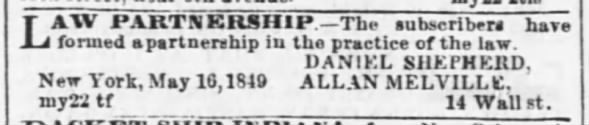
According to the memorial at Find A Grave, Daniel Shepherd (1820-1870) was born on July 22, 1820 and died on the same day and month fifty years later. Thorp says that Shepherd returned to Saratoga Springs, New York in 1861. Confirmed, along with the coincidence of Shepherd's death on "his fiftieth birthday," by the obituary published in The Saratogian on Thursday, July 28, 1870.

The Saratogian (Saratoga Springs, New York) - July 28, 1870

Death of Daniel Shepherd.

It is our sad duty to record the death of DANIEL SHEPHERD, Esq., of this village, which occurred on Friday morning—his fiftieth birthday. Mr. Shepherd was a native of this county, a son of Hon. William Shepherd of Clifton Park, and inherited superior ability. He was a graduate of Union College, and distinguished for his literary attainments. After his graduation he came to this village, and studied law with Hon. W. A. Beach, and subsequently became connected with him in the practice of his profession. About this time he married Miss Mary R. White, a step-daughter of Dr. John Clarke, of the Congress Spring, and soon after formed a co-partnership with Hon. Chesseldon Ellis, of Waterford, at the close of that gentleman's career in Congress, and they removed to New York to engage in the legal profession. He resided in New York, continuing his legal practice, something less than fifteen years, and returned to Saratoga in the spring of 1861, since which time he has lived among us.

Mr. Shepherd was no ordinary man. His abilities were of a high order. He was a fine scholar, and a learned and able lawyer; but his tastes and culture were more distinctly literary than professional, and his energies were largely devoted to literary work. He was a successful writer of newspaper stories, and achieved considerable distinction as the author of a work entitled "Saratoga; a tale of 1787," in which he delineated frontier life with a masterly hand. He possessed a fine personal presence, was eminently social and genial in his nature, and with his bright and polished intellect he combined advantages which few young men possess in so high degree. But unfortunately, while in New York, he embarked in business enterprises that failed to realize his expectations, and involved him in difficulties, which proved too much for his sensitive nature, exerting a depressing influence upon his mind, and he has been almost entirely withdrawn from active life since his return to Saratoga. He has left a wife and four children (three sons and a daughter,) and a large number of relatives and personal friends, to mourn his death.
--The Saratogian (Saratoga Springs, New York), July 28, 1870 via Fulton History.
The Harvard copy of Saratoga: A Story of 1787 by Allan Melville's law partner and Herman's friend Daniel Shepherd is accessible online via Google Books:
  • https://books.google.com/books?id=s1wUAAAAYAAJ
This particular volume was inscribed by the author to S. D. Tillman. Also available online courtesy of HathiTrust Digital Library.

Another Google-digitized volume, this one evidently from Stanford, is accessible via The Internet Archive:

Tuesday, August 14, 2018

Willard Thorp's Herman Melville: Representative Selections


A treasure-trove of Melville's writings and Melville scholarship, valuable as ever eighty years on, and now more accessible than ever since getting Google-digitized. First published by the American Book Company in 1938, Willard Thorp's Melville offers a generous selection of poetry as well as prose, including the first publication of Melville's 1859 poem To Daniel Shepherd.

At least one copy (from University of California) is available online courtesy of
and another from Digital Library of India via
  • The Internet Archive
    https://archive.org/stream/in.ernet.dli.2015.182829/2015.182829.Herman-Melville-Representative-Selectionswith-Introduction

Sunday, August 12, 2018

Confidence-Man in Nashville

From The Nashville Patriot of May 9, 1857; found at GenealogyBank among newspapers added "within 3 months":

Nashville Patriot - May 9, 1857
THE CONFIDENCE-MAN; His Masquerade. By HERMAN MELVILLE, author of 'Piazza Tales,' 'Omoo,' 'Typee,' etc. New York: Dix, Edwards & Co.

The announcement of a new book from the pen of Herman Melville, is sufficient to attract attention. To those who have read Typee, and Omoo, no book authorized by Melville, can escape a reading. The subject of this work the "Confidence-man" is somewhat out of his usual vein. The scenes are taken from aboard a Mississippi steamer, and includes men and things as they occur and appear between St. Louis and New Orleans. It preserves a fine interest throughout.
As indicated on the masthead, The Nashville Patriot was then edited by William Henry Smith and  Ira P. Jones.

Saturday, August 11, 2018

Poems by Herman Melville

Five "Poems by Herman Melville" were posthumously reprinted from Timoleon (1891) in The Century Volume 44 (May 1892) on pages 104-105. Arthur Stedman selected Melville's poems "Art," "Monody," "The Night-March," "The Weaver," and "Lamia's Song," presenting them with reference to both John Marr and Other Sailors and Timoleon as "the last fruit off an old tree." Stedman's 1892 collection receives brief mention in the Northwestern-Newberry Edition of Melville's Published Poems, in the editorial notes on "Monody." Previously cited also by Howard Vincent in Collected Poems and Merton M. Sealts, Jr. in The Early Lives of Melville (page 54), but little discussed in Melville scholarship. The Contents section gives them collectively as "POEMS" under "Poetry" and names "Herman Melville" as the author. 


Arthur Stedman receives due credit for the Introduction.
POEMS BY HERMAN MELVILLE.

[THE death of Herman Melville, which took place in New York soon after midnight on the morning of September 28, 1891, was the signal for an outpouring of articles on the life and writings of an author whose vogue had temporarily subsided, partly through his own self-seclusion. Melville has rightly been called the pioneer of South Sea romance, and his "Typee " and "Omoo" gained an international reputation at an earlier date than the writings of Lowell, although both authors were born in the same year—1819. These books, with "Moby-Dick; or, the White Whale," soon became classics of American literature, and are likely to remain such. They have been continuously in print in England, and new American editions are now in course of publication. Melville's art of casting a glamour over scenes and incidents in the South Pacific, witnessed and experienced by himself, has not been exceeded even by Pierre Loti. The Civil War first turned his attention to lyrical writing, and many of his "Battle-Pieces and Aspects of the War" (1866) obtained a wide circulation. Near the close of his life he had printed for private distribution a few copies of two little books of miscellaneous poems, the last fruit off an old tree, entitled "John Marr and Other Sailors" and "Timoleon." From these volumes the following pieces have been selected.

Arthur Stedman.]


ART.

IN placid hours well pleased we dream
Of many a brave, unbodied scheme;
But form to lend, pulsed life create,
What unlike things must meet and mate:
A flame to melt, a wind to freeze;
Sad patience, joyous energies;
Humility, yet pride and scorn;
Instinct and study; love and hate;
Audacity, reverence. These must mate
And fuse with Jacob's mystic heart,
To wrestle with the angel—Art.

MONODY.

TO have known him, to have loved him,
       After loneness long;
And then to be estranged in life,
       And neither in the wrong;
And now for Death to set his seal —
       Ease me, a little ease, my song!
By wintry hills his hermit-mound
       The sheeted snow-drifts drape,
And houseless there the snowbird flits
       Beneath the fir-trees' crape:
Glazed now with ice the cloistral vine
       That hid the shyest grape.

THE NIGHT-MARCH.

WITH banners furled, and clarions mute,
   An Army passes in the night;
And beaming spears and helms salute
   The dark with bright.

In silence deep the legions stream,
   With open ranks, in order true;
Over boundless plains they stream and gleam —
   No chief in view!

Afar in twinkling distance lost
   (So legends tell) he lonely wends,
And back through all that shining host
   His mandate sends.

THE WEAVER.

FOR years within a mud-built room
   For Arva's shrine he weaves the shawl,
Lone wight, and at a lonely loom,
   His busy shadow on the wall.

The face is pinched, the form is bent,
   No pastime knows he, nor the wine;
Recluse he lives, and abstinent,
   Who weaves for Arva's shrine.

LAMIA'S SONG.

DESCEND, descend!
       Pleasant the downward way,
From your lonely Alp
With the wintry scalp
To our myrtles in valleys of May.
       Wend then, wend!
Mountaineer, descend!
And more than a wreath shall repay.
       Come — ah, come!
With the cataracts come,
That hymn as they roam,
How pleasant the downward way!

Herman Melville.


A few years later the Kansas City Star reprinted "Monody" (October 16, 1894); "The Night March" (November 14, 1894); and "Art" (May 17, 1895).

Kansas City Star - October 16, 1894
via GenealogyBank
Numerous digitized copies of The Century Volume 44 with "Poems by Herman Melville" are now available courtesy of HathiTrust Digital Library, including