Wednesday, April 6, 2016

Huybertie Lansing Pruyn Hamlin (1873-1964) remembers Melville

Huybertje Lansing Pruyn Hamlin. 1900 miniature by
Charlotte Burt Kirkham (1856-1933), Public domain, via
Wikimedia Commons
"Roving Reporter" Cecil R. Roseberry (aka Tip Roseberry) worked the Melville beat for the Albany Times-Union. I found his 1952 story with the reminiscence of Mrs. Hamlin in the online archives of historic newspapers at Fulton History.

Transcribed below from the article titled "Mrs. Hamlin Knew Melville" by Tip Roseberry, published in the the Albany Times-Union on Thursday, April 17, 1952:
One of the few surviving people in the world who remember Melville in the flesh is Mrs. Charles S. Hamlin, of 352 State St., a remarkable woman who, in her eighties, can conjure up in sharp outline everything that ever happened to her. 
She was a girl of eight or nine: one of the Pruyn sisters, of the old Dutch aristocracy with which Melville also was connected—when she met the great man during one of his latter-day visits to Albany. The things that stuck in her memory were his heavy beard and the story he told her about the Boston Tea Party. 
MELVILLE, WHOSE brief day as a popular author had waxed and waned, and who was now living in obscurity in New York as a customs inspector, was a first cousin of Mr. Abraham Lansing (last of the Gansevoorts) and it was at her elegant home—where the White Tower hamburg stand now is on Washington Ave.—that Huybertie Pruyn (Mrs. Hamlin) had her only meeting with the genius who wrote “Moby-Dick.” 
“Mother and I were on our way home to Elk St. one day, walking down Washington, when mother decided to stop in and pay a call on Aunt Kitty Lansing.” (They called her that, although she was actually a distant cousin.) 
“The maid showed us into the east parlor, and there was this bearded man sitting next to Aunt Kitty. Mother exclaimed: ‘Why, Herman, I didn’t expect to see you.’ He greeted her as ‘Anna,’ and we joined them by the fire. 
“Uncle Abe Lansing was just pouring some madeira. When the glasses were around, Uncle Abe lifted his and proposed a toast: 'To Herman Melville’s next book’.”
Melville asked the little girl, “What are you studying at school?” and she replied, “Paul Revere’s Ride.” 
“That is very interesting,” Melville said. “If you come to my house in New York I will show you a bottle with some tea-leaves in it. The tea came from the Boston Tea Party. You see my grandfather, Thomas Melville, was one of the ‘Indians’ who dumped the tea. He wouldn’t tell my grandmother where he had been. But when she cleaned his clothes, she found tea-leaves in the pockets and cuffs. She put the tea in a bottle and kept it.”

Huybertie had no conception of who Melville was until they were walking home. “Then mother told me that Herman was a very curious character. She said: “He has written a great book, and now it is forgotten. I wonder if it ever will be revived’.”
Madeira Malvasia 1882 via vivino
Mrs. Huybertie Pruyn Hamlin was born in Albany on April 8, 1873, so 8 or 9 years after would place her reminiscence around 1881-1882. Melville's next published book was the 1888 volume of poetry and prose titled John Marr and other Sailors.
Huybertie Pruyn in 1879, with Aunt Kitty and Uncle Abe Lansing
Albany Evening News / Tuesday, June 15, 1937

Hershel Parker in the second volume of Herman Melville: A Biography, 1851-1891 (Johns Hopkins University Press, 2002) at page 870 names Huybertie Pruyn as the author of An Albany Girlhood (posthumously published) and "an eyewitness" in July 1885 to the burial of Herman's sister Frances Priscilla Melville. The memorial page at Find A Grave has this interesting information about Huybertje Lansing Pruyn Hamlin (giving her birth year 1878--definitely an error for 1873):
Socialite, philanthropist and civic activist. Her first name is also sometimes spelled as "Huybertie". Her father died several months before she was born into a member of one of New York's most prominent families, the Pruyns (rhymes with "shines"). She was also a descendant of Woodbury Langdon, a Member of the Continental Congress. She was also related to many other prominent Albany-area families, including the Parkers, the Cornings, and the Lansings. In 1898 she married Charles Sumner Hamlin, the first Chairman of the Federal Reserve. She was also the author of an autobiographical work, "Memories of an Albany Girlhood" (also published as "An Albany Girlhood").
-- Find A Grave - Huybertje Lansing Pruyn Hamlin
Albany Times-Union / Sunday, April 26, 1942

Tuesday, April 5, 2016

Herman Melville of Albany

Image Credit: The New York History Blog
Plenty of fractured facts and missing information here. For instance, the Times-Union reporter imagines that Typee (1846) did not get written until 1850 or so, in Albany. There's no mention of Lansingburgh where Melville's family moved in 1838. And there's nothing about Pierre, say, or Israel Potter. Nevertheless, the writer (a sailor?) evinces a true appreciation for Melville and his writings--martial poetry as well as nautical prose. Fascinating claims include the believable one about Melville's books being essential to the library of every ship. Or how about this: Melville in the early 1860's "could frequently be seen on the streets and in the resorts of Albany." Which "resorts" does the writer have in mind, I wonder...
"About the time of the Civil War Herman Melville could frequently be seen on the streets and in the resorts of Albany. He was better known then as the writer of soul stirring war lyrics than as the author of the famous books of the sea."
This closing reference to local knowledge of Battle-Pieces reminds me of the comment in the Troy Daily Whig, where the reviewer there recalled that
"Mr. M’s muse was heard with great pleasure many times during the late war."
From the Albany [New York] Times-Union, Tuesday, August 5, 1919; found in the online newspaper archives at Fulton History:

Herman Melville of Albany.

Herman Melville who may fairly be classed as an Albanian, would have been over one hundred years old if he had lived till to-day. He was born August 1, 1819. 
Few people of the present generation ever heard of him, but half century ago his name was almost as familiar as that of his friend Hawthorne. 
He was born in New York City, but was brought to Albany when a baby, and lived here throughout his childhood days. He got his education in the schools of Albany and his early impressions were from associations here. He was an Albany boy up to the time that the death of his parents threw him on his own resources and he became a boy of the big world. He started out on his career from the Albany dock shipping on a sail craft to New York. On this craft began the real education which made him the greatest writer of marine stories of his days. From New York he shipped a barque for Liverpool and thence on a whale ship to the Pacific. His observations and experience contributed to the stock of knowledge that was to be the source of efforts in years to come. He was a sprightly, capable, self reliant young fellow. Being badly treated on ship board he stood it all without inviting further trouble by resentment or insubordination. Escaping when opportunity offered, he fell in with the cannibals of the South Sea Islands and gathered the experience there that enabled him to write “Typee,” a most charming story of adventure by sea. And so this Albany boy went on with adventure after adventure, fitting himself with stories of knowledge to be used when the time came to “write it all up,” for he had in constant mind the determination to give the world the benefit of his sea experience, and come back to Albany the home of his youth and do his literary work. 
Around 1850 when still a young man, but with a wealth of material, he came back to the scene of his early struggles. Fifteen years had made great changes in his home city. Many of his companions had moved away and some of the older folks had died; but he settled down and went to work. Here he wrote “Typee,” he story of his stay among the cannibals. In it he takes his readers into the happy valley of the islanders, over cliffs precipitous and waterfalls, and through almost impenetrable ravines. He pictures days of lounging, and dances of the Calabash girls crowned with flowers, cocoanuts and breadfruit, with restful siestas, and he paints it all with the radiance and entrancing blue and green of the South Sea Islands. 
This work he did in Albany; but love and friendship caused him to remove to Pittsfield, Mass., after the success of “Typee” had been assured. He fell in love with and married the daughter of Judge Lemuel Shaw of Massachusetts, and became very friendly with Hawthorne, then in the height of his success. These two incidents caused Albany to lose her gifted son, but he was close enough to make frequent trips and to have the benefit of her libraries and the friendship of her people. 
And Melville went on with his successful literary work, giving the world “Omoo,” “Moby Dick,” “White Jacket,” “Redburn,” “Mardi,” and several others, all stories of the sea and of the adventures of seafaring life. 
“Moby Dick,” dedicated to Hawthorne, was his most important work and certainly the most popular with the sailor men who never tired of hearing thrilling adventures. Stories of the brave days of whaling were told by him as they were never told before, and can never be told again. 
Melville wrote with thrilling force and beauty, and painted his scenes with the graphic hand of a real artist. His books were read by landsmen and sailors alike, but it was in the men of the sea familiar with the thrills he infused that they found their greatest admirers. And in the old days of the sailing ship every craft carried a library of its own, and the sailor who could read entertained those who could not. A ‘fore the mast’ hand on reaching port bemoaned the hardships of the voyage by saying “fifteen days of calm, plenty of books but nary a reader in the crew.” 
Every ship that rode the waves carried the books of Melville as an important part of its equipment, and every sailor felt an intimate friendship for the characters he so beautifully portrayed.

About the time of the Civil War Herman Melville could frequently be seen on the streets and in the resorts of Albany. He was better known then as the writer of soul stirring war lyrics than as the author of the famous books of the sea. –Albany Times-Union, Tuesday, August 5, 1919

Friday, April 1, 2016

Wednesday, March 30, 2016

Mrs. Melville in the 1840 census, Lansingburgh

Ancestry has the 1840 federal census for Lansingburgh, New York with the household of Herman Melville's mother listed in due order after that of her neighbor and landlord William Knickerbacker. Census day was June 1, 1840. Seven other persons (numbered, not identified by name) dwell with Mrs. Melville, named as head of family with three males and four other females. Altogether, the 1840 census records eight persons, including the head of family.


"Enumerators of the 1840 census were asked to include the following categories in the census: name of head of household, number of free white males and females, number of other free persons, names of slave owners and number of slaves, number of foreigners, and town or district and county of residence."
No one in the household is listed as employed. Apparently the census taker caught Herman Melville at home in Lansingburgh on June 1, 1840--just a few days before his trip west with Eli James M. Fly. The year before, Melville had sailed to Liverpool. He signed on for a whaling voyage in December 1840.

William H. Gilman looks at the 1840 census somewhere in Melville's Early Life and Redburn. I think he used it to figure out which of the two Knickerbacker properties was rented by Herman Melville's mother. While we're waiting to confirm what Gilman has to say, let's look at the age groups to see who might have been counted where. Hershel Parker notes in Herman Melville: A Biography V1.134 that Rosey (employed as Mrs. Melville's only servant) left the year before, in June 1839.
Male1 age 10-14 --that would be the youngest son Tom, b. 1830
2 age 20-29 --Herman, not quite 21, and Gansevoort (home sick?), 24; teenager Allan (b. 1823) was then living in Albany.
Female1 age 5-9  --hmm, who's this youngster?
1 age 10-14  --Frances, b. 1827
1 age 15-19  --Augusta, b. 1821; or Catherine, b. 1825.
1 age 20-29  --Helen, b. 1817
1 age 40-49  --has to be Herman's mother, the head of family Maria Gansevoort Melville. Born 1791, so she just made it in the under-50 category.
Related melvilliana post:

Sunday, March 27, 2016

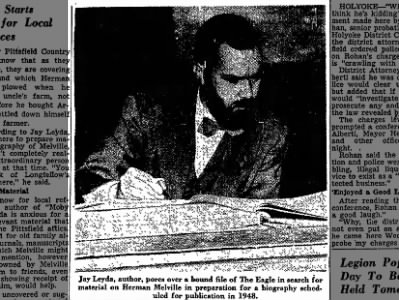
Jay Leyda, Biographer


A friendly view of Jay Leyda at work on The Melville Log ran with the photo above in the Berkshire Eagle, May 16, 1947. Headline:

Have You Any Material On Melville?
Jay Leyda, Biographer, Can Use It

... Any material uncovered or suggestions as to where material might be found may be brought tomorrow before 1 or next week to the basement of the circulation department of The Eagle, where Mr. Leyda is doing research among old volumes of the newspaper. He would like to examine any material uncovered, and possibly purchase it, if the owner is willing.... 
...This week’s research through City Hall records turned up information on a school reform committee which in 1837 came to the conclusion that “our schools are not so good and useful as they ought to be or as they can be.” The committee was headed by Thomas Melvill, Herman’s uncle. (A minor family crisis developed around the argument whether to have the “e” in the family name, the Pittsfield branch keeping with the Scottish influence and Herman’s family assuming the more elegant English ending.) The reform committee said the prime reason was the deficiency of competent teachers, because of which, “our own offspring lack the bread of knowledge.” That was in the spring of the year. By fall, Herman Melville, then 19, was installed as teacher in the Sykes district school here.

Found on Newspapers.com

Fragments from a Writing Desk: 1912 Report of a Conversation Melville had with C....

Hershel Parker's fine find (linked below) is another printing of the 1912 article by E. J. Edwards which circulated under different headings in different newspapers. The Raleigh News and Observer (February 8, 1912) published it under the heading, "The Classic that Inspired a Famous Romance." George Monteiro in Resources for American Literary Study Volume 33 (2008; AMS Press, 2010) cites the same article from the Columbia, South Carolina newspaper The State, published there as "Dana's Book and 'Typee,'" also on February 8, 1912. Professor Monteiro's large 2008 inventory of Fugitive References only excerpts the first paragraph, without mentioning Briggs or anything of  Briggs's Melville anecdote as reported by Edwards.

Fragments from a Writing Desk: 1912 Report of a Conversation Melville had with C....: There is plenty of evidence that young EJE knew CFB well. presumably in the early or mid 1870s. So the story could be true, in substance,...

Found on Newspapers.com

Related post: