Showing posts with label Stonewall Jackson. Show all posts

Saturday, August 19, 2017

John Williamson Palmer


From the sketch of John Williamson Palmer and his literary career in Current Literature, Volume 24 (August 1898):

Dr. Palmer has always regarded Herman Melville, author of Typee and Omoo, with peculiar admiration and affection, and is still in cordial sympathy with his "aloofness," his shyness of literary clubs and coteries. Speaking of so-called "brilliant" men of letters, he says, "In forty years' acquaintance with American writers, beginning with N. P. Willis, I have known but one genuinely and spontaneously 'brilliant' personality, and that was William Henry Hurlburt, of Putnam's Monthly in 1855."
Herman Melville and Palmer both contributed to Putnam's Monthly Magazine in the 1850's, Palmer during the latter half of the decade. In 1856 their books also were being published by Dix, Edwards & Co. For Melville, Dix and Edwards published The Piazza Tales (1856) and then The Confidence-Man (1857). In 1856 Dix and Edwards issued Palmer's The Golden Dagon; Or, Up and Down the Irrawaddi. On October 11, 1856 Melville gave a copy of The Golden Dagon to his brother Allan (see the catalog entry for Sealts Number 396.2 at Melville's Marginalia Online).

The one extant letter from Melville to J. W. Palmer (dated March 23, 1889) is held by the University of Virginia Library, with other manuscript Papers of Herman Melville. It's printed in The Letters of Herman Melville and also the Northwestern-Newberry edition of Herman Melville's Correspondence.  In reply to Palmer's "friendly note" and gift of books, Melville says his wife Elizabeth had been reading aloud to him from "Up & Down the Irrawaddy." He probably forgot that he had given the first edition to Allan thirty-plus years before.


J. W. Palmer's brother was another physician and world-traveler, the distinguished navy surgeon James Croxall Palmer.

Links to some works by John Williamson Palmer that are accessible online:

Friday, August 18, 2017

Battle-Pieces in the Detroit Free Press

Henry N. Walker
1854 portrait by Alvah Bradish via Detroit Institute of Arts
Henry Nelson Walker was owner and editor of the Detroit Free Press when this unsigned review of Battle-Pieces appeared on September 2, 1866.
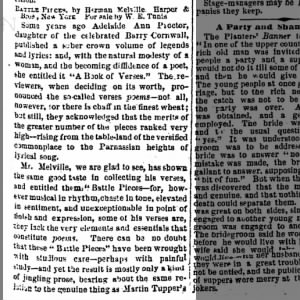
BATTLE PIECES, by Herman Melville. Harper & Bros, New York. For sale by W. E. Tunis.

Some years ago Adelaide Ann Proctor, daughter of the celebrated Barry Cornwall, published a sober crown volume of legends and lyrics: and, with the natural modesty of a woman, and the becoming diffidence of a poet, she entitled it "A Book of Verses." The reviewers, when deciding on its worth, pronounced the so-called verses poems—not all, however, for there is chaff in the finest wheat; but still, they acknowledged that the merits of the greater number of the pieces ranked very high—rising from the table-land of the versified commonplace to the Parnassian heights of lyrical song.

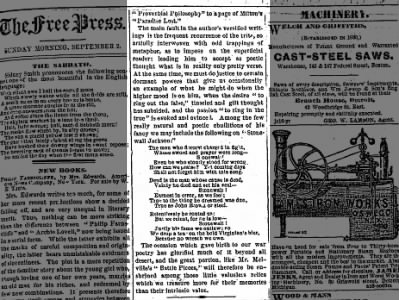
Mr. Melville, we are glad to see, has shown the same good taste in collecting his verses, and entitled them, "Battle Pieces—for, however musical in rhythm, chaste in tone, elevated in sentiment, and unexceptionable in point of polish and expression, some of his verses are, they lack the very elements and essentials that constitute poems. There can be no doubt that these "Battle Pieces" have been wrought with studious care—perhaps with painful study—and yet the result is mostly only a kind of jingling prose, bearing about the same relation to the genuine thing as Martin Tupper's "Proverbial Philosophy" to a page of Milton's "Paradise Lost."

The main fault in the author's versified writings is the frequent recurrence of the trite, so artfully interwoven with odd trappings of metaphor, as to impose on the superficial reader: leading him to accept as poetic thought what is in reality only pretty verse. At the same time, we must do justice to certain dormant powers that give us occasionally an example of what he might do when the higher mood is on him, when the desire to "ring out the false," tinseled and gilt thought has subsided, and the passion "to ring in the true" is evoked and evinced. Among the few really natural and poetic ebullitions of his fancy we may include the following on "Stonewall Jackson:"
The man who fiercest charged in fight,
    Whose sword and prayer were long—
                              Stonewall!
   Even he who stoutly stood for wrong.
How can we praise? Yet coming days
   Shall not forget him with this song.

Dead is the man whose cause is dead,
   Vainly he died and set his seal—
                              Stonewall!
   Earnest in error, as we feel;
True to the thing he dreamed was due,
   True as John Brown or steel.

Relentlessly he routed us:
   But we relent, for he is low—
                              Stonewall!
   Justly his fame we outlaw; so
We drop a tear on the bold Virginian's bier,
   Because no wreath we owe.
The occasion which gave birth to our war poetry has glorified much of it beyond all desert, and the great portion, like Mr. Melville's "Battle Pieces," will therefore be enshrined among those little valueless relics which we treasure more for their memories than their intrinsic value.

Review of Melville's Battle-Pieces (1 of 2)
Review of Battle-Pieces (2 of2)

Sunday, August 13, 2017

Melville's "noble lines to Stonewall Jackson" in the Buffalo Commercial Advertiser

Stonewall Jackson, sketch from life
via The New York Public Library Digital Collections
BATTLE PIECES AND ASPECTS OF THE WAR BY HERMAN MELVILLE. New York: Harper & Brothers. For sale by Breed, Butler & Co. 
Those who are fond of Melville's writings, and they are many, will doubtless desire to possess his poems. They are suggested by events of the late war, and are generally descriptive. We have but little space for criticism or quotation, but cannot refrain from giving two stanzas from his noble lines to Stonewall Jackson:
But who shall hymn the Roman heart?
   A stoic he, but even more;
The iron will and lion thew
   Were strong to inflict as to endure:
       Who like him could stand or pursue?
       His fate the fatalist followed through;
       In all his great soul found to do
          Stonewall followed his star.
*          *          *          *
O, much of doubt in after days
   Shall cling, as now, to the war
Of the right and the wrong they'll still debate
   Puzzled by Stonewall's star:
      "Fortune went with the North elate"
      "Aye, but the South had Stonewall's weight
      And he fell in the South's vain war."
--Buffalo Commercial Advertiser, September 11, 1866
The notice of Battle-Pieces transcribed above appeared in the Buffalo Commercial Advertiser on September 11, 1866. At that time the Buffalo Commercial Advertiser was edited and published by James Newson Matthews and James D. Warren. But Matthews was then in Dublin, getting ready to sail home after the European vacation that he narrated in editorial correspondence for the Commercial Advertiser, published in book form as My Holiday: How I Spent It (Buffalo and New York, 1867). The brief notice of Battle-Pieces may have been written by Warren, later a model of the "stalwart" Republican.

Found on Newspapers.com