Showing posts with label Sophia Hawthorne. Show all posts

Tuesday, May 21, 2019

Elizabeth Manning Hawthorne and the mislaid MOBY-DICK

Sophia Hawthorne autograph letter signed to Annie Adams Fields, [March 1863]

This March 1863 item is from the extensive Sophia Hawthorne correspondence with James and Annie Fields, 1851-1904 (MS C.1.11), held by the Boston Public Library and now accessible online via Digital Commonwealth:

Writing from Concord, Sophia Hawthorne wants Annie Fields to express mail some blue braid and black ribbon from Boston. While she's at it, perhaps Annie would check at Ticknor & Fields ("the establishment on the corner of School & Washington Streets") for a mislaid copy of Moby-Dick, one that Nathaniel Hawthorne's sister had tried to send them care of Nathaniel's Boston publishers.
Tuesday.

My dearest Annie

I was very glad of your note and of the carte blanche it gives me about the visit. I am just now in a great haste as my workman is to take this to the mail and so I cannot say any thing in proper reply to your spring song. But I am going to ask you to buy something from me, as the walking is now good.
I want very much two pieces of blue worsted braid, such as is plaited upon dresses. It comes, I think, about three quarters of an inch wide on pieces of twelve yards length. Then I want some black velvet ribbon of about the same width. I must have a whole piece of the velvet. I believe it is eighteen yards in length.
I am scribbling on my knee with velocity. Will the angelic Michael take them (if you can buy them) to Adams' Express, dear Annie.

As to "Moby Dick," Miss Hawthorne, the sister of Mr Hawthorne, says she sent it months ago to the establishment on the corner of School & Washington Streets directed to us. I thought it might be among laid aside packages. 
If I trouble you too much, do not heed my note. 
Ever your loving friend, 
S. Hawthorne.
Without mentioning Melville or Moby-Dick, Randall Stewart gives the context of Sophia Peabody Hawthorne's 1863 reference in The Hawthornes at the Wayside, 1860-1864 in The Bulletin of the Boston Public Library (September 1944), page 278:
The generous friendship of Mr. and Mrs. Fields for the Hawthornes was shown not only in their hospitality but in their gifts and the performance of commissions in Boston. Among the gifts acknowledged with due thankfulness in the letters under review were "an exquisite looking book," "your very kind present of bananas," a "rich package," "Mr. Hawthorne's works beautifully bound," and oysters and ale. Many errands were requested of Mrs. Fields or her husband. Among the articles procured through their good offices were "braid or sewing silk of the color I enclose," "the cloth for our Saques," "brocatelle," "two pieces of blue worsted braid," "some black velvet ribbon," two pieces of vellum for Julian, a hat with "a quite moderate crown" for Rose, and "a first rate Silver Hunter's watch" and "a black iron short chain" for Julian. Altogether, the gifts and the errands — the latter especially — attest strongly to an extraordinary devotion.
Nathaniel Hawthorne's sister Maria Louisa died in 1852, so "Miss Hawthorne" who mailed Moby-Dick (after borrowing it, presumably--and reading, or re-reading?) to the Hawthornes care of Ticknor & Fields must be his older sister "Ebe," the brilliant and "enigmatic" Elizabeth Manning Hawthorne (1802-1883).

The range of Elizabeth Manning Hawthorne's reading in the early 1860's is partly revealed in letters published by Cecile Anne de Rocher in Elizabeth Manning Hawthorne: A Life in Letters (University of Alabama Press, 2006). Specific works mentioned there include Elsie Venner by Oliver Wendell Holmes, Romola by George Eliot, John Halifax, Gentleman by Dinah Maria Mulock, and Great Expectations by Charles Dickens along with serialized fiction by Reade, Trollope, and Thackeray. Referenced works of nonfiction include volumes by Ruskin, Napier's History of the War in the Peninsula; and Olmsted's Journey in the Seaboard Slave States.

Looking further I see in de Rocher's Elizabeth Manning Hawthorne: The Complete Letters (PhD Dissertation, Georgia State University, 2001) that Elizabeth does mention Moby-Dick in a letter to Una Hawthorne from Salem on December 5, 1862:
I know that Moby Dick was on the list of books which your Mamma has; but the list was of the books which I selected. I took most of them home with me in a basket, in which I also returned them; but a good deal of space was occupied by the "Literary World," a periodical about the size of the Athenaeum, so that all the books would not go in, and some were sent to me, but several of those on the list were not sent. I ought at the time, to have taken down the names of those I did not receive. I cannot now remember what they were. But I will endeavor to get "Moby Dick." Mrs. Dike has some books that can perhaps be exchanged for it when we can send to Boston. I have enquired for it in the bookstores here, but could not get it. (175)
[UC Berkeley, Bancroft Library, Hawthorne Family Papers (BANC MSS 72/236 z). Papers of Julian Hawthorne, Ctn 2, Folder 14, include the transcription of Elizabeth's December 5, 1862 letter to Una with "Copies of letters to Una Hawthorne from her aunt, Elizabeth M. Hawthorne, Dec. 9, 1861-Jan. 2, 1870 (also available on microfilm (BANC FILM 72/236, reel 4)."]

I'm not sure how to read the December 1862 reference by Elizabeth Manning Hawthorne, without Una Hawthorne's side of the correspondence. It sounds like Una (eighteen years old in 1862) either recommended Moby-Dick or asked for it back. Now Una's aunt Elizabeth can't find it, and half suspects she never received it. Ironically, one or more volumes of The Literary World had crowded out Moby-Dick in Elizabeth's basket of borrowed books. Nevertheless, since Una asked about it (for whatever reason), Elizabeth promises: "I will endeavor to get "Moby Dick." By March 1863, Sophia Hawthorne thinks Elizabeth somehow found and "directed" it to the Hawthornes, care of Ticknor and Fields.


On Friday, November 7, 1862, still in Pittsfield, Herman Melville was seriously injured after being thrown from his wagon. While Melville recovered, and progressed with the sale of Arrowhead, Nathaniel Hawthorne's daughter, sister, and wife were looking for Moby-Dick and having some trouble finding it.
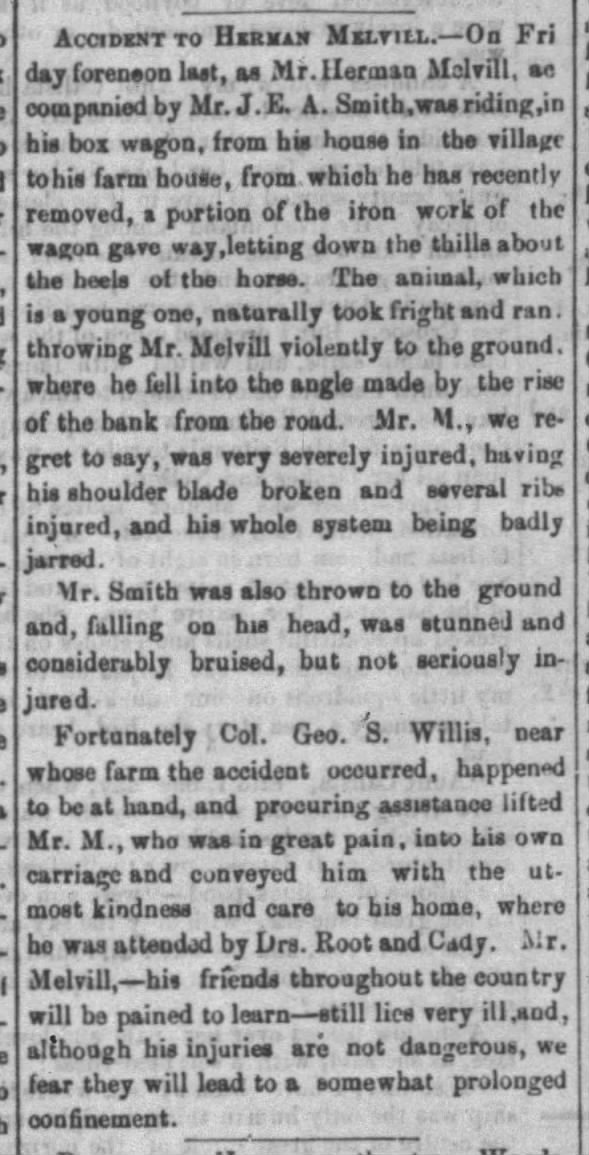
Thu, Nov 13, 1862 – 2 · The Berkshire County Eagle (Pittsfield, Massachusetts) · Newspapers.com

Thursday, February 23, 2017

Sophia Hawthorne's view of Melville: "free, brave & manly"

Sophia Hawthorne, September 4, 1850 letter to her mother Elizabeth [Palmer] Peabody
via The New York Public Library Digital Collections
In Herman Melville: A Biography (V1.773) Hershel Parker calls this "by all odds  the fullest such description of Melville known to exist." Most recently, Sophia Hawthorne's physical description of Herman Melville in 1850 has been reprinted in Melville in His Own Time, edited by Steven Olsen-Smith. Now you can see online what Sophia Hawthorne wrote in manuscript, courtesy of The New York Public Library Digital Collections. 
To day Mr Hawthorne & Mr Melville have gone to dine at Pittsfield. Mr. Tappan took them in his carriage.... This would have been no particular courtesy in some persons, but for this shy dear, who particularly did not wish, for some reason to be introduced to Mr Melville, it was very pretty. I have no doubt he will be repaid by finding Mr Melville a very different man from what he imagines - & very agreeable & entertaining - We find him so - a man with a true warm heart & a soul & an intellect - with life to his finger-tips - earnest, sincere & reverent, very tender & modest - And I am not sure that he is not a very great man - but I have not quite decided upon my own opinion. I should say I am not quite sure that I do not think him a very great man - for my opinion is of course as far as possible from settling the matter. He has very keen perceptive power, but what astonishes me is that his eyes are not large & deep. He seems to see every thing very accurately & how he can do so with his small eyes, I cannot tell. They are not keen eyes, either, but quite undistinguished in every way. His nose is straight & rather handsome, his mouth expressive of sensibility & emotion. He is tall & erect with an air free, brave & manly. When conversing, he is full of gesture & force, & loses himself in his subject. There is no grace nor polish. Once in a while his animation gives place to a singularly quiet expression out of these eyes, to which I have objected--an indrawn, dim look, but which at the same time makes you feel - that he is at that instant taking deepest note of what is before him. It is a strange, lazy glance, but with a power in it quite unique. He does not seem to penetrate through you, but to take you into himself. I saw him look at Una so yesterday several times.

He says it is Mr Mathews who is writing in the Literary World the visit to Berkshire. Mr Mathews calls Mr. Hawthorne "Mr. Noble Melancholy" in the next number of the paper. You know what you read was the Introduction only. It is singular how many people insist that Mr. Hawthorne is gloomy, since he is not. He is pensive perhaps - as all contemplative persons must be, especially when as in him "a great heart is the household fire of a grand intellect" (to quote his own words).
From the Henry W. and Albert A. Berg Collection of English and American Literature, The New York Public Library. "Peabody, Elizabeth [Palmer], mother, ALS to. Sep. 4, 1850." The New York Public Library Digital Collections. 1850. http://digitalcollections.nypl.org/items/ce433d10-852c-0131-589e-58d385a7bbd0


Wednesday, February 8, 2017

Sophia Hawthorne and St Nicolas to Una, 1852

This 1852 letter to Una Hawthorne is filed with outgoing correspondence in the Sophia Peabody Hawthorne collection of papers, Call number Berg Coll MSS Hawthorne, S, Manuscripts and Archives Division, The New York Public Library. Digitized images are available online via NYPL Digital Collections. Among other things Sophia Hawthorne's letter to Una shows that even as late as 1852, children may rightfully expect presents from St Nick on New Year's Day, after his annual visit on New Year's Eve.


Conjecture: perhaps originally, or in some early draft version, Clement C. Moore's holiday classic began "'Twas the night before New Year...." and ended with St. Nick's wishing "Happy New Year to all...." (The New-York Mirror for January 2, 1841 printed "New Year" for Christmas in both places.)
Taking good advantage of the window for parental instruction, Sophia Hawthorne asks that Una be nice to Julian, even when he's being a brat. So then, let's cut Clement C. Moore some slack and not misread his earlier verses on St. Nick, the loving manuscript poem From Saint Nicholas, as the sorry production of a mean Grinch of a father. Back then good children got gifts from St. Nicholas on New Year's Day--not too far off in Moore's early "From Saint Nicholas" poem to his daughter, and only hours away in Sophia Hawthorne's 1852 letter.

Julian and Una Hawthorne, c. 1850.
Boston Athenaeum via streetsofsalem
My darling Una,

St Nicolas says he cannot put any of his presents into your funny long stocking, & so he asks me to write you a note & put it in, that you may not be disappointed; for he is a very kind old gentleman. So as it is the end of the old year, & in a few hours the new year will begin, I will say a few words of loving counsel.

I hope you will enter upon the new year with a resolution to be kind to Julian. You lose a great deal of happiness, & deprive Julian of a great deal of happiness by not being always patient & gentle & kind to him. He has a heart very large & full of rich love, & if you would not push it back with frowning looks & harsh words, it would flow towards you & be a river of life & joy for you. When he teases or troubles you, try to ask him not to do so with a sweet voice, & I think he will stop in a moment.

Perhaps he will not at first, because he is in the habit of hearing you speak roughly; but soon he will find you are different. In the bible it says "A soft answer turneth away wrath." I wish I could write you a longer note for I have a great deal to say to my darling first-born but I cannot think very well to night of any thing but dear suffering Grandmamma.

Good night. St Nicolas asked me if I could not tell him of a better place than these miserable stockings for his presents, & I told him to look about him & he took a fancy to the fisher-boy, & has run off with him. When you are bathed & dressed you must find him & see what the old gentleman has done. Your loving Mamma.
--Henry W. and Albert A. Berg Collection of English and American Literature, The New York Public Library. "Hawthorne, Una, ALS to. [1852]" The New York Public Library Digital Collections. 1852. http://digitalcollections.nypl.org/items/08f59400-1c86-0131-9562-58d385a7b928
Image Credit: MCNY Blog
From Saint Nicholas
What! My sweet little Sis, in bed all alone;
No light in your room! And your nursy too gone!
And you, like a good child, are quietly lying,
While some naughty ones would be fretting or crying?
Well, for this you must have something pretty, my dear;
And, I hope, will deserve a reward too next year.
But, speaking of crying, I'm sorry to say
Your screeches and screams, so loud ev'ry day,
Were near driving me and my goodies away.
Good children I always give good things in plenty;
How sad to have left your stocking quite empty:
But you are beginning so nicely to spell,
And, in going to bed, behave always so well,
That, although I too oft see the tear in your eye,
I cannot resolve to pass you quite by.
I hope, when I come here again the next year,
I shall not see even the sign of a tear.
And then, if you get back your sweet pleasant looks,
And do as you're bid, I will leave you some books,
Some toys, or perhaps what you still may like better,
And then too may write you a prettier letter.
At present, my dear, I must bid you good bye;
Now, do as you're bid; and, remember, don't cry.
--Clement C. Moore

Related post:

Friday, June 12, 2015

Sophia Hawthorne and Melville's Emersonian "fluid consciousness"


Update on "mush of concession." Sophia Hawthorne's other reported use of quotation marks when describing Melville to her sister in May 1851 is for the phrase, "mush of concession." Here again, as with the quoted expression, "fluid consciousness," Sophia Hawthorne's quotation marks signal a reference to the words of Ralph Waldo Emerson--this time from Emerson's essay on Friendship:
I hate, where I looked for a manly furtherance, or at least a manly resistance, to find a mush of concession. Better be a nettle in the side of your friend than his echo. The condition which high friendship demands is ability to do without it. 
She was saying that her husband's friend Melville could disagree in conversation, "for there is never a 'mush of concession' in him" (quoted in the NN edition of Melville's Correspondence).

Still later, 6/14/2015: So in Sophia Hawthorne's view, Melville does have what Emerson admired as "fluid consciousness"; does not have what Emerson reviled as "mush of concession." Her vocabulary reflects long saturation in Emerson, "deep in Emerson's thrall" already when Hawthorne and then Sophia Peabody met, as Larry J. Reynolds characterizes the state of her admiration back then (Hawthorne and Emerson in "The Old Manse.") Writing in the generation before Reynolds's, Henry G. Fairbanks didn't mind saying
 "In the presence of Ralph Waldo Emerson she [Sophia Peabody] behaved like a transcendental bobby-soxer." --Hawthorne and the Vanishing Venus
Considering how well known is Emerson's large and complicated influence on both Hawthornes, and how many chapters and essays we have about Melville and Emerson, it feels strange not to find more in Melville criticism about Sophia's describing Melville in specifically Emersonian terms. Looking for one discussion or even a glancing mention, I did find James McIntosh (quoted below) all over it. Whew! In Melville and Emerson's Rainbow Merton Sealts gives a page or so to Sophia's admiration for Emerson, without reference to Sophia's May 7, 1851 letter to her sister Elizabeth Peabody. (Eleanor Melville Metcalf in Herman Melville: Cycle and Epicycle, p106, gives the date of Sophia Hawthorne's letter as October 2, 1851. It's at NYPL in the Berg Collection.) Sealts I guess would have assumed Emerson's influence pretty much everywhere. And other scholars versed in Emerson, perhaps. Too obvious to mention with respect to "fluid consciousness" and "mush of concession"?
---

Of course I ordered Melville in His Own Time, the new collection of nineteenth-century writing about Melville edited by Steven Olsen-Smith. You probably know Melville scholar Olsen-Smith already as architect of the world class Melville's Marginalia Online. While I'm waiting for rush delivery to the prairie, Google Books has the entertaining and aggravating preview function to fool with.

Nice to see this, John Bryant contributes a provocative Foreword which has me wondering about a couple of things before the book is out of the box. When I really should be packing for Tokyo. It's about the letter Melville wrote to Hawthorne in April 1851, praising the just published House of the Seven Gables, and Sophia Hawthorne's appreciative comments about that letter and the "fluid consciousness" of its author their neighbor Herman Melville. One day I'll get around to posting something about "Hawthorne: A Problem." Right now I can't help obsessing over the penultimate sentence in this forward not to say froward Foreword:
We do not know what exactly Sophia Hawthorne means by “fluid consciousness” or why she puts it in quotation marks.  --John Bryant, Foreword to Melville in His Own Time
Granting we could argue all night about exactly what Sophia means by the quoted expression, Professor Bryant has it half right. But those quotation marks signal and bracket a quotation which in theory should be discover-able. Especially nowadays in this our glorious globalized digitized 21st Century. OK wait, I get it: this must be one of those master-teacher's tricks to start the class thinking critically. Extra credit for the first kid to Google it!!!

In my book--well, blog--James McIntosh should get EXTRA-extra credit for figuring out long before Google that Sophia Hawthorne was characterizing Melville in identifiably Emersonian terms.
In the spring of 1851, perhaps at the height of Melville’s and Hawthorne’s friendship for each other, Sophia Hawthorne wrote of her intriguing neighbor, “Melville’s fresh, sincere, glowing mind…is in a state of 'fluid consciousness,’ & to Mr. Hawthorne speaks his innermost about GOD, the Devil, & Life if so be he can get at the Truth for he is a boy in opinion—having settled nothing yet.” …When she lights on the words “fluid consciousness,” she describes a characteristic of his mind that pervades not only his fiction but all his writings of the period. The phrase, I surmise, is adapted from Emerson, who wrote, “Nature is not fixed but fluid” as well as “there are no fixtures to man, if we appeal to consciousness”; and it is suggestive that she would draw on Emerson to describe Melville. Emerson too takes uncertainty amid the breakdown of traditional belief as the condition for his endeavor, and glories in the fluidity of mind available to self-emancipated young Americans. --James McIntosh, The Mariner's Multiple Quest in New Essays on Moby-Dick, ed. Richard H. Brodhead, 23-4.
The statements by Emerson that McIntosh cites are from Emerson's famous 1836 work Nature ("not fixed but fluid"), and the First Series essay on Circles ("no fixtures to man, if we appeal to consciousness"). McIntosh correctly identifies Emerson as Sophia Hawthorne's referent, without realizing that her phrase "fluid consciousness" is in fact directly quoted (rather than "adapted") from a different essay by Emerson on Spiritual Laws:
The simplicity of the universe is very different from the simplicity of a machine. He who sees moral nature out and out, and thoroughly knows how knowledge is acquired and character formed, is a pedant. The simplicity of nature is not that which may easily be read, but is inexhaustible. The last analysis can no wise be made. We judge of a man's wisdom by his hope, knowing that the perception of the inexhaustibleness of nature is an immortal youth. The wild fertility of nature is felt in comparing our rigid names and reputations with our fluid consciousness. We pass in the world for sects and schools, for erudition and piety, and we are all the time jejune babes.  --Spiritual Laws 
Wild fertility! Emerson's idea of "fluid consciousness" is unstoppable biological life, opposed to formal, artificial social conventions. Don't worry I won't pretend to know really what he's talking about, but somehow Emerson associates this inner fluidity of thought and being with "wild fertility" and "the perception of inexhaustibleness in nature" which is to say "immortal youth." That's probably why Sophia Hawthorne called Melville "a boy in opinion." She seems also to have been recasting Emerson's ideas and language when praising the then-unknown author of Hawthorne and His Mosses to Evert Duyckinck, saying of Melville: "The freshness of primeval nature is in that man."

So Melville's mind is fresh and fluid with natural sap, what keeps things (trees, plants, thoughts, writings) green and growing. Yes, I'm thinking we'd better call in a biologist. Or a philosopher, at least. In his great green essay on Beauty in Nature, Michael Popejoy thus paraphrases Emerson:
In nature we observe growth and development in living things, contrasted with the static or deteriorating state of the vast majority of that which is man-made. --Michael Popejoy
You can see Ralph Waldo Emerson's phrase "fluid consciousness" in his "Spiritual Laws" essay at Melville's Marginalia Online, on page 123 in Melville's edition of Emerson's Essays, First Series,

Image Credit: Brain Abundance

Monday, August 15, 2011

snugged in the arms of Thorvaldsen's Night

Rest therefore, free from all despite,
Snugged in the arms of comfortable night.

These concluding lines of Herman Melville's poem Immolated picture the poetic effusions of youth as metaphorical children, somehow sacrificed yet safe and secure in the embrace of maternal night. Melville's vivid image is borrowed from the popular allegorical depiction of Night as a winged female figure, in flight with her twin children Sleep and Death. 

Night. Samuel Amsler after Bertel Thorvaldsen
© The Trustees of the British Museum

In Melville's time this image of Night was everywhere, reproduced frequently in sculpture, paintings, prints, plates, coins, and jewelry. Nearly all popular versions of the image derive from the 1815 marble relief Night, with Her Children Sleep and Death by Danish-Icelandic artist Bertel Thorvaldsen (1770-1844).

Yes in those days Thorvaldsen's Night was all over the place, even Nathaniel Hawthorne's bed. Sketched there on the headboard by his wife Sophia, according to Julia Ward Howe:


I might almost say that the first time I saw Nathaniel Hawthorne I did not see him. The occasion was a summer Sunday in the forties (1845 I think) on which I had driven out to Concord with Dr. Howe, to spend the day with Mr. and Mrs. Horace Mann. These friends were then established for the summer in a farmhouse immediately adjoining the "Old Manse" from which the lovely "Mosses" were dated. This had then been for some years the residence of the Hawthomes, and I, like many others, had heard with great interest the romantic story of their first establishment there. Rich in friends and in public esteem, they had but a small portion of worldly goods to bestow upon each other. The outlay for the bride's outfit and furniture had corresponded with the limitation of their circumstances. But Mrs. Hawthorne's artistic gifts had enabled her to adorn her house with the beauties which money can only command at second-hand, but which genius can produce at will. The furniture of her bedroom had been made, by her order, of plain wood painted in the creamy color which is now so much in vogue. Upon this background she had drawn in India-ink a number of beautiful designs. At the head of her bedstead was outlined Thorwaldsen's " Night;" at its foot, his " Morning." The wash-stand bore the device of Venus rising from the Sea, copied from Flaxman, and on chairs were drawn his Muses. So much as this I knew by hearsay, but was not the less anxious to verify by sight. I was very glad, therefore, when Mrs. Mann proposed that we should visit her sister.* --The Critic 1.12 - June 18, 1881