
 |
| Sophia Hawthorne autograph letter signed to Annie Adams Fields, [March 1863] |
This March 1863 item is from the extensive Sophia Hawthorne correspondence with James and Annie Fields, 1851-1904 (MS C.1.11), held by the Boston Public Library and now accessible online via Digital Commonwealth:
Tuesday.
My dearest Annie
I was very glad of your note and of the carte blanche it gives me about the visit. I am just now in a great haste as my workman is to take this to the mail and so I cannot say any thing in proper reply to your spring song. But I am going to ask you to buy something from me, as the walking is now good.
I want very much two pieces of blue worsted braid, such as is plaited upon dresses. It comes, I think, about three quarters of an inch wide on pieces of twelve yards length. Then I want some black velvet ribbon of about the same width. I must have a whole piece of the velvet. I believe it is eighteen yards in length.
I am scribbling on my knee with velocity. Will the angelic Michael take them (if you can buy them) to Adams' Express, dear Annie.
As to "Moby Dick," Miss Hawthorne, the sister of Mr Hawthorne, says she sent it months ago to the establishment on the corner of School & Washington Streets directed to us. I thought it might be among laid aside packages.
If I trouble you too much, do not heed my note.
Ever your loving friend,
S. Hawthorne.
Nathaniel Hawthorne's sister Maria Louisa died in 1852, so "Miss Hawthorne" who mailed Moby-Dick (after borrowing it, presumably--and reading, or re-reading?) to the Hawthornes care of Ticknor & Fields must be his older sister "Ebe," the brilliant and "enigmatic" Elizabeth Manning Hawthorne (1802-1883).The generous friendship of Mr. and Mrs. Fields for the Hawthornes was shown not only in their hospitality but in their gifts and the performance of commissions in Boston. Among the gifts acknowledged with due thankfulness in the letters under review were "an exquisite looking book," "your very kind present of bananas," a "rich package," "Mr. Hawthorne's works beautifully bound," and oysters and ale. Many errands were requested of Mrs. Fields or her husband. Among the articles procured through their good offices were "braid or sewing silk of the color I enclose," "the cloth for our Saques," "brocatelle," "two pieces of blue worsted braid," "some black velvet ribbon," two pieces of vellum for Julian, a hat with "a quite moderate crown" for Rose, and "a first rate Silver Hunter's watch" and "a black iron short chain" for Julian. Altogether, the gifts and the errands — the latter especially — attest strongly to an extraordinary devotion.
The range of Elizabeth Manning Hawthorne's reading in the early 1860's is partly revealed in letters published by Cecile Anne de Rocher in Elizabeth Manning Hawthorne: A Life in Letters (University of Alabama Press, 2006). Specific works mentioned there include Elsie Venner by Oliver Wendell Holmes, Romola by George Eliot, John Halifax, Gentleman by Dinah Maria Mulock, and Great Expectations by Charles Dickens along with serialized fiction by Reade, Trollope, and Thackeray. Referenced works of nonfiction include volumes by Ruskin, Napier's History of the War in the Peninsula; and Olmsted's Journey in the Seaboard Slave States.
Looking further I see in de Rocher's Elizabeth Manning Hawthorne: The Complete Letters (PhD Dissertation, Georgia State University, 2001) that Elizabeth does mention Moby-Dick in a letter to Una Hawthorne from Salem on December 5, 1862:
I know that Moby Dick was on the list of books which your Mamma has; but the list was of the books which I selected. I took most of them home with me in a basket, in which I also returned them; but a good deal of space was occupied by the "Literary World," a periodical about the size of the Athenaeum, so that all the books would not go in, and some were sent to me, but several of those on the list were not sent. I ought at the time, to have taken down the names of those I did not receive. I cannot now remember what they were. But I will endeavor to get "Moby Dick." Mrs. Dike has some books that can perhaps be exchanged for it when we can send to Boston. I have enquired for it in the bookstores here, but could not get it. (175)[UC Berkeley, Bancroft Library, Hawthorne Family Papers (BANC MSS 72/236 z). Papers of Julian Hawthorne, Ctn 2, Folder 14, include the transcription of Elizabeth's December 5, 1862 letter to Una with "Copies of letters to Una Hawthorne from her aunt, Elizabeth M. Hawthorne, Dec. 9, 1861-Jan. 2, 1870 (also available on microfilm (BANC FILM 72/236, reel 4)."]
I'm not sure how to read the December 1862 reference by Elizabeth Manning Hawthorne, without Una Hawthorne's side of the correspondence. It sounds like Una (eighteen years old in 1862) either recommended Moby-Dick or asked for it back. Now Una's aunt Elizabeth can't find it, and half suspects she never received it. Ironically, one or more volumes of The Literary World had crowded out Moby-Dick in Elizabeth's basket of borrowed books. Nevertheless, since Una asked about it (for whatever reason), Elizabeth promises: "I will endeavor to get "Moby Dick." By March 1863, Sophia Hawthorne thinks Elizabeth somehow found and "directed" it to the Hawthornes, care of Ticknor and Fields.
On Friday, November 7, 1862, still in Pittsfield, Herman Melville was seriously injured after being thrown from his wagon. While Melville recovered, and progressed with the sale of Arrowhead, Nathaniel Hawthorne's daughter, sister, and wife were looking for Moby-Dick and having some trouble finding it.
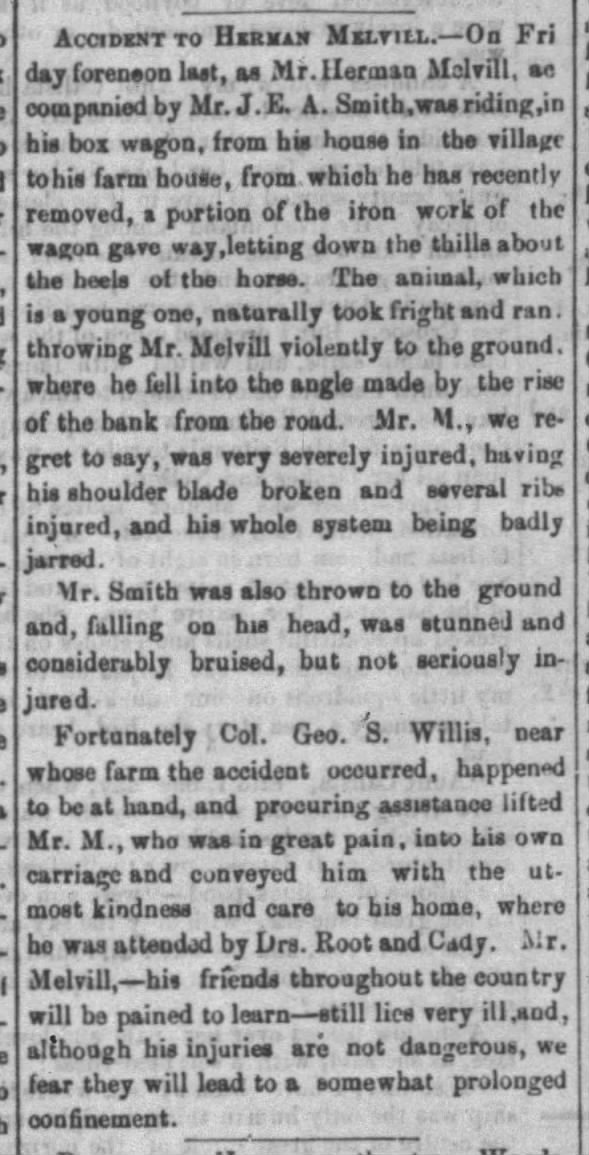 Thu, Nov 13, 1862 – 2 · The Berkshire County Eagle (Pittsfield, Massachusetts) · Newspapers.com


