
Showing posts with label Leesburg Virginia Genius of Liberty. Show all posts

Sunday, December 1, 2019

Charleston Mercury, early printings of A Visit from St Nicholas

Just in time for the holidays, Newspapers.com has added loads of new pages from the Charleston Mercury to their great and growing online archive. The Mercury was founded and edited in Charleston, South Carolina by Henry Laurens Pinckney. From the trove of digital mages only added in the past three months, here are three early printings of "A Visit from St. Nicholas" in the Charleston Mercury: on January 16, 1824; December 24, 1825; and December 25, 1829. The earliest two versions have the sweet-dreaming children "nested" instead of "nestled" in their beds, but retain the reindeer names "Dunder and Blixem" as in the original first printing in the Troy Sentinel on December 23, 1823. As in the Sentinel, the verses appear anonymously in each version.

Fri, Jan 16, 1824 – 2 · The Charleston Mercury, and Morning Advertiser (Charleston, South Carolina) · Newspapers.com
The anonymous lines were reprinted the following year on Christmas Eve, still with "nested" and "Dunder and Blixem." The original prose intro by Troy editor Orville L. Holley has been dropped in the 1825 version, shown below, but the expanded title incorporates Holley's helpful identification of  St. Nicholas as "Sante Claus," thus:
ACCOUNT 
Of a visit from St. Nicholas or Sante Claus.
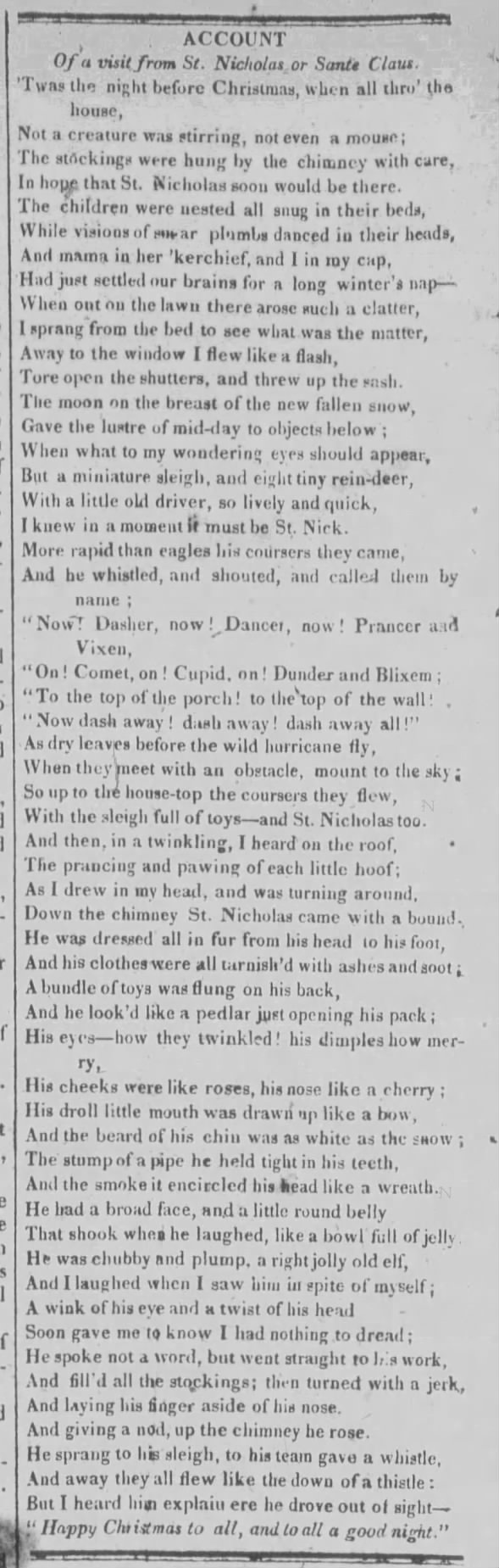
Sat, Dec 24, 1825 – 2 · The Charleston Mercury (Charleston, South Carolina) · Newspapers.com\
The same reading of "nested" instead of "nestled" occurs in the version of "Visit" published on December 26, 1826 in the Leesburg, Virginia Genius of Liberty. The Leesburg newspaper reprinted the Christmas poem "from the Charleston Mercury," under the same title that the Mercury had presented on Christmas Eve, 1825. However, the 1826 Genius of Liberty version gives the form "Blixen" where the Charleston Mercury in 1824 and 1825 had printed "Blixem." Likewise, the text of the still anonymous poem in the Lexington, Kentucky Reporter for January 23, 1826 also credits "the Charleston Mercury" and prints "Dunder and Blixen," along with "nested."

Another even earlier reprinting of "Visit" from the Charleston Mercury appears in the Washington, D.C. National Intelligencer for January 2, 1826. As in the Kentucky Reporter, the National Intelligencer text is headed "Christmas Times" and includes the variant forms "nested"; "Blixen"; and singular "hope" instead of "hopes" in the fourth line. Oddly, in the next-to-last line, the December 1825 Charleston Mercury version has Santa Claus "explain" rather than "exclaim" his parting benediction. The 1826 reprintings "from the Charleston Mercury" in the National Intelligencer, Kentucky Reporter, and Leesburg Genius of Liberty all exhibit the usual verb, exclaim.

Washington Daily National Intelligencer 
January 2, 1826 via GenealogyBank
At present, no digital images are available on Newspapers.com for the Charleston Mercury in the month of January, 1826. Eventually another version of "A Visit from St. Nicholas" may turn up in the Mercury on or about New Year's Day 1826--one headed "Christmas Times," perhaps, with the distinctive variants "hope," "nested," and "Blixen."

The influential printing in The National Gazette (Philadelphia, PA) on December 24, 1827 follows the 1825 Charleston printing in keeping "Blixem," as well as in the phrasing of the title and the printing of "hope" for "hopes"; and "nested" for "nestled." But the speaker in the National Gazette version hears Santa "exclaim," not "explain," before driving off.

A different, untitled version was submitted "FOR THE MERCURY" and published in the Charleston Mercury on December 25, 1829. In the 1829 version, shown below, the "Children were nestled" not "nested" as in the earlier Charleston printings. Dunder is still Dunder, but Blixem has become Blixen. And St. Nick in 1829 wishes all a Merry Christmas, instead of a Happy one.
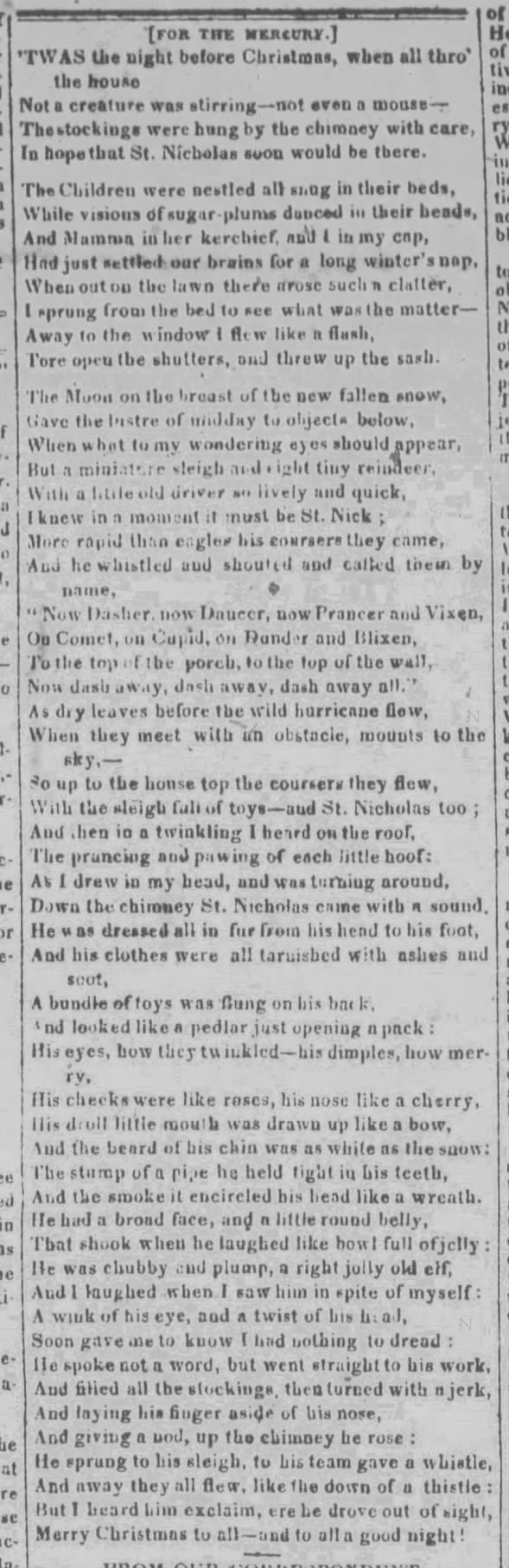
Fri, Dec 25, 1829 – 2 · The Charleston Mercury (Charleston, South Carolina) · Newspapers.com
Editor Orville L. Holley did not know who wrote "A Visit from St. Nicholas" when he first published it in the Troy Sentinel on December 23, 1823. In January 1829, however, Holley would confidently allude to New York scholar and seminary professor Clement C. Moore as the author. Later, and still without naming Moore directly, Holley revealed in print that he had learned the author's identity only a few months after publishing the merry Christmas lines. Moore himself finally acknowledged his authorship in 1837 by submitting "A Visit from St Nicholas" with three other poems of his for publication in The New-York Book of Poetry. Moore is also credited with authorship of "A Visit from St. Nicholas in two important 1840 anthologies of American poetry, The Poets of America, edited by John Keese; and Selections from the American Poets, edited by William Cullen Bryant.

Early in 1844, a false attribution in the Washington National Intelligencer on Christmas Day 1843 prompted Moore to contact ex-publisher Norman Tuttle in Troy, and to state his claim openly and directly in a letter to his good friend Charles King, then editor of the New York American. On March 1, 1844 King published Moore's claim, really the confession of an embarrassed academic and bereaved husband and father, that he wrote the Christmas lines
"not for publication, but to amuse my children."  --Clement C. Moore, letter to Charles King dated February 27, 1844; published March 1, 1844 in the New York American.
Moore subsequently included A Visit from St. Nicholas aka 'Twas the Night Before Christmas in his 1844 volume Poems.


Related posts:

Genius of Liberty, 1826 reprinting of A Visit from St Nicholas from the Charleston Mercury

In brackets, The Genius of Liberty (Leesburg, Virginia) acknowledges "the Charleston Mercury" as its source for the holiday piece titled, as in the Charleston, South Carolina Mercury of December 25, 1825, "Account of a visit from St. Nicholas, or Sante Claus." The Genius of Liberty was then owned by Brook Watson Sower (1784-1864). The borrowed holiday verses appear below an original paragraph of introduction (by Sower?) explaining the Christmas Eve custom of hanging up stockings for Santa or "Sante Claus" to fill overnight "with nuts, raisins, apples, cakes, toys, &c. &c."

The text of "A Visit from St.Nicholas" is transcribed below from the Leesburg VA Genius of Liberty, December 26, 1826. Also reprinted there on December 26, 1835, with minor changes in punctuation. Like the Charleston Mercury, both versions print "nested" for "nestled" in the fifth line. However, where the earliest Charleston Mercury versions in 1824 and 1825 read "Dunder and Blixem," following the first printing of the Christmas poem in the Troy Sentinel, Sower's Genius of Liberty has "Dunder and Blixen." Images of both the 1826 and 1835 printings of "A Visit from St. Nicholas" in the Genius of Liberty are accessible online via Virginia Chronicle: Digital Newspaper Archive.

Genius of Liberty (Leesburg, VA) December 26, 1826
via Virginia Chronicle

THE RECESS.

As these are holiday times, the following piece is quite appropriate to the season. But as many readers may not be acquainted with the attributes and province of ST NICHOLAS, or SANTE CLAUS, it may not be amiss to remark, that in some families, in different parts of the country, it is customary on the eve before Christmas, for the children, on retiring to bed, to hang up their stockings round and about the chimney, and it is the province of SANTE CLAUS, on such occasions, to fill them before morning, with nuts, raisins, apples, cakes, toys, &c. &c. We know not whence the custom is derived, farther than that the saint, or patron deity, is of German extraction, and generally, we believe, dispenses his favours accordingly -- In the morning of life, when the gilded visions of childhood enchained the affections, we remember to have hailed the approach of this festive season, as well in anticipation of the munificence of SANTE CLAUS, as of other festivities. That period, though long since past, is still grateful to the recollection; and, if ever deception deserved the appellation of pious fraud, it would seem to be when ministering to the sum of infantine happiness.-- [Gen. Lib. 
 [From the Charleston Mercury]
Account of a visit from St. Nicholas, or Sante Claus.
’TWAS the night before Christmas, when all thro’ the house,
Not a creature was stirring, not even a mouse;
The stockings were hung by the chimney with care,
In hope that St. Nicholas soon would be there.
The children were nested all snug in their beds,
While visions of sugar plums danced in their heads,
And Mamma in her ’kerchief, and I in my cap,
Had just settled our brains for a long winter’s nap —
When out on the lawn there arose such a clatter,
I sprang from the bed to see what was the matter,
Away to the window I flew like a flash,
Tore open the shutters, and threw up the sash.
The moon on the breast of the new fallen snow,
Gave the lustre of mid-day to objects below;
When, what to my wondering eyes should appear,
But a miniature sleigh, and eight tiny rein-deer,
With a little old driver, so lively and quick,
I knew in a moment it must be St. Nick.
More rapid than eagles his coursers they came,
And he whistled, and shouted, and call’d them by name;
“Now, Dasher! now, Dancer! now, Prancer! and Vixen.
“On! Comet, on! Cupid, on! Dunder and Blixen;
“To the top of the porch! to the top of the wall!
“Now dash away! dash away! dash away all!”
As dry leaves before the wild hurricane fly,
When they meet with an obstacle mount to the sky;
So up to the house-top the coursers they flew,
With the sleigh full of Toys—and St. Nicholas too.
And then, in a twinkling, I heard on the roof,
The prancing and pawing of each little hoof;
As I drew in my head, and was turning around,
Down the chimney St. Nicholas came with a bound.
He was dressed all in fur, from his head to his foot,
And his clothes were all tarnished with ashes and soot;
A bundle of toys was flung on his back,
And he look’d like a pedlar just opening his pack;
His eyes—how they twinkled! his dimples, how merry,
His cheeks were like roses, his nose like a cherry;
His droll little mouth was drawn up like a bow,
And the beard of his chin was as white as the snow;
The stump of a pipe he held tight in his teeth,
And the smoke it encircled his head like a wreath.
He had a broad face, and a little round belly,
That shook, when he laughed, like a bowl full of jelly.
He was chubby and plump, a right jolly old elf,
And I laughed when I saw him, in spite of myself;
A wink of his eye, and a twist of his head,
Soon gave me to know I had nothing to dread;
He spoke not a word, but went straight to his work,
And fill’d all the stockings; then turned, with a jerk,
And laying his finger aside of his nose,
And giving a nod, up the chimney he rose.
He sprang to his sleigh, to his team gave a whistle,
And away they all flew like the down of a thistle:
But I heard him exclaim, ere he drove out of sight—
"Happy Christmas to all, and to all a good night."

Related posts: