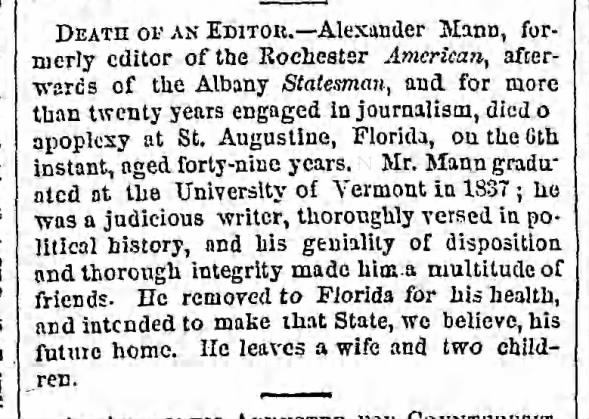
To start with, here's another favorable notice of Moby-Dick, not previously transcribed or collected in Herman Melville: The Contemporary Reviews, edited by Brian Higgins and Hershel Parker (Cambridge University Press, 1995; paperback 2009). This item is not listed in Kevin J. Hayes and Hershel Parker, Checklist of Melville Reviews (Northwestern University Press, 1991); revised from the 1975 Checklist by Steven Mailloux and Hershel Parker.
MOBY DICK; OR THE WHALE. By HERMAN MELVILLE, author of Typee, Omoo, Redburn, Mardi, White Jacket, &c., Harper and Brothers.
This is a book all about whales. It gives descriptions of the Leviathan of the deep, the mode of catching them, and the life of those who go down in ships from New Bedford to the South seas, whale hunting. The reading public will find "Moby Dick" one of the pleasantest volumes issued from the press this year. For sale by Wm. Alling.
--Rochester, New York Daily American, Thursday, November 20, 1851.
The Rochester Daily American was then owned and edited by Alexander Mann and Daniel Lee. I'm adding their brief notice of Moby-Dick on November 20, 1851 to the Melvilliana census
surely the completest list you will find of contemporary reviews of Moby-Dick, or The Whale.
On the following day, Friday, November 21, 1851, the Daily American reprinted all of chapter 85, The Fountain under the heading, "The Whale's Fountain." This Fountain "extract" from Moby-Dick was commended in another column as "exceedingly readable":
MOBY DICK.— An exceedingly readable extract from this new work of HERMAN MELVILLE, (noticed by us yesterday,) will be found in another Part of this paper. --Rochester NY Daily American, November 21, 1851.
The same extract from chapter 85 of Moby-Dick had previously appeared in the Troy Daily Whig (November 15, 1851) and other New York periodicals. As in the Troy reprinting, the first paragraph features an intriguing variant in the month that Ishmael gives when supposedly identifying the precise time and date of his writing: both newspaper versions make it "October" 16, 1851 where the first American edition has "December."
From Herman Melville's New Work— "Mobey Dick".
The Whale's Fountain.
That for six thousand years—and no one knows how many millions of ages before—the great whales should have been spouting all over the sea, and sprinkling and mistifying the gardens of the deep, as with so many sprinkling or mistifying pots; and that for some centuries back, thousands of hunters should have been close by the fountain of the whale, watching these sprinklings and spoutings—that all this should be, and yet, that down to this blessed minute (fifteen and a quarter minutes past one o'clock P. M., of this sixteenth day of October, A. D., 1851,) it should still remain a problem, whether these spoutings are, after all, really water, or nothing but vapor—this is surely a noteworthy thing.... --Rochester NY Daily American, November 21, 1851.
Ahab's Arithmetic: The Mathematics of Moby-Dick: In this article we explore mathematical allusions in Herman Melville’s novel Moby-Dick. We argue that both the quantity and sophistication of these allusions are evidence for Melville’s high level of mathematical knowledge and ability. We discuss some of the most compelling mathematical imagery, as well as giving background on the several mathematicians and mathematics books mentioned in the novel. We also include some biographical details supporting the assertion that Melville had an unusually good mathematical education.
"Perhaps the most important use of mathematics in the narrative is as a symbol for rationality.... Rationality has limitations, but rejecting it completely, as Ahab does when he ceases his mathematical calculations, is, for Ishmael/Melville, a sure sign of madness."
Hart, S. B. "Ahab's Arithmetic: The Mathematics of Moby-Dick," Journal of Humanistic Mathematics, Volume 11 Issue 1 (January 2021), pages 4-32 at page 30. DOI: 10.5642/jhummath.202101.03 . Available at: https://scholarship.claremont.edu/jhm/vol11/iss1/3
As shown in our last, the Boston version of Herman Melville's 1857-8 lecture on Roman statues was remembered in Minnesota decades later. The Sunday edition of Harlan P. Hall's St. Paul Globe ("Between Ourselves," July 11, 1880) quoted from it and, without naming Melville directly, attributed his reported words to "one of our finest minds."
Transcribed below, the original report of Melville's lecture as printed in the Boston Daily Evening Bee on December 3, 1857. This, with minor variations, is the same text printed the same day in the Boston Daily Courier.
LECTURE ON THE STATUARY OF ROME.-- The novelty of the lecture room this week was the appearance, last evening at Tremont Temple, before the Mercantile Library Association, of Herman Melville, Esq., a gentleman of decided position in American literature, and the author of several unquestionably original and eccentric works. ... recently taken to the lecture field, his appearance in our city was looked upon as an "event" ranging up to a "sensation" point. Accordingly, a large and distinguished character-dotted audience was present. The subject was "The Statuary of Rome." He began by a description of the gate of St. John and its colossal figures. From this he proceeded to describe the most celebrated statuary in the Eternal City. In viewing, said he, the statues and busts of Demosthenes, Titus, Socrates, Cæsar, Seneca, Nero, and others, we feel a sense of reality not to be given by history; and although we are at first startled by some of them from our preconceived opinions, yet we seldom, on reflection, fail to concede the general likeness to that which the historian has furnished us. The analysis of the marble coincides with the historian's analysis of the man.
The statue which most of all in the Vatican excites the admiration of all visitors, is the Apollo. Few speak, or even whisper, when they enter the cabinet where it stands. If one were to try to convey some adequate notion, other than artistic, of a statue which so signally lifts the imaginations of men, he might hint that it gives a kind of visible response to that class of human aspirations which, according to Faith, cannot be truly gratified, except in another world. It is infinitely grander than the Venus di Medici, in Florence, for while she is lovely, he is divine. Not the least, perhaps, among those causes which make the Roman museums so impressive, is their tranquil air. In chambers befitting stand the images of gods, while in the statues of men, even the vilest, what was corruptible in their originals, here in pure marble puts on incorruption. In the Roman Vatican and the Washington Patent Office the respective characteristics of the ancients and moderns stand contrasted.
But is the locomotive as grand an object as the Laocoon? Does it attest this hurried intelligence? We moderns did invent the printing press, but from the ancients we have the best thoughts that it circulate? As the Roman arch enters into and sustains our best architecture, does not her spirit still animate and support whatever is soundest in societies and States? Or shall the scheme of Fourier supplant the code of Justinian, only when the novels of Dickens silence the satires of Juvenal? If the Colliseum express the durability of Roman ideas, what does the Crystal Palace express? Will the glass of the one bide the hail storms of eighteen centuries as well as the travertine of the other?
— When falls the Colliseum, Rome shall fall; And when Rome falls, the world!
The lecture, though quite able, and delivered with considerable enthusiasm, excited but little applause. It was, however, listened to with complimentary attention, though extended beyond the time usually devoted to these lectures.
The lecture next Wednesday evening, will be delivered by Geo. Wm. Curtis, Esq., of New York.
-- Boston Daily Evening Bee, December 3, 1857; found on genealogybank.com
In print, reconstructions of Melville's three lectures including the first one on Roman statuary are available in the 1987 Northwestern-Newberry Edition of Melville's The Piazza Tales and Other Prose Pieces, 1839-1860, Volume 9 in the scholarly edition of The Writings of Herman Melville, edited by G. Thomas Tanselle, Harrison Hayford and Hershel Parker.
Herman Melville was born 202 years ago on August 1, 1819, a Sunday just like today.
Here's a surprising find with a suitably philosophical theme, perhaps, to contemplate on Melville's birthday. Decades after Herman Melville's 1857-8 lecture on Statues in Rome, a journalist in St. Paul, Minnesota quoted from it in a regular Sunday newspaper column called "Between Ourselves." Evidently the columnist in the St. Paul Sunday Globe (not editor Harlan Page Hall?) had before him an old newspaper with a summary of Melville's lecture. In graphic and occasionally gruesome detail, the Minnesota journalist described and reflected on modern methods of preserving the dead, and contrasted different results of "ancient and modern undertaking." In this context, the main point of quoting from the "Statues in Rome" lecture was to affirm with Melville the enduring value of ancient wisdom and culture.
Harlan Page Hall of St. Paul. Owner of "The Globe" newspaper.
Without naming Melville or identifying any source, the Minnesota writer quoted a newspaper account of Melville's 1857-8 lecture and attributed Melville's words to "one of our finest minds."
A Vision of Death as Done up in Style by the Undertaker.
Undertaking in its present finish and popular acceptance is one of the awful discoveries of our time. To be buried now-a-days requires a peculiar preparation which is so involved and in many instances so artistic in handling as to be professional to a dead certainty. Mortuary millinery is of a composite and graded variety. There are show windows filled with the kickshaws and gauds of the grave. In passing by them you note the tucks, ruches, gloves, wreaths, and even the cozily padded coffins where they are to be displayed. There are, then, regular fashions for the final lay-out, but there is a savage irony in the knowledge that the wearer can have no voice—no choice in the selection.
Becoming or unbecoming there is no disapprobation, and only the survivors can borrow any satisfaction from the experiment and expense.
One of our finest minds says:
“In the Roman Vatican and the Washington patent office the respective characteristics of the ancients and moderns stand contrasted. * * * We moderns did invent the printing press, but from the ancients have we not the best thoughts that it circulates. As the Roman arch enters into and sustains our best architecture does not her spirit still animate and support whatever is soundest in societies and States? Or shall the scheme of Fourier supplant the code of Justinian, only when the novels of Dickens silence the satires of Juvenal? If the coliseum express the durability of Roman ideas, what does the Crystal Palace express? Will the glass of the one bide the hail storms of eighteen centuries, as well as the travertine of the other?”
And he might add a final comparison about the difference between ancient and modern undertaking—as visible in the mummy—and the thing in the “conserver” of latter-day invention. We may brag of our civilization as much as we will—but those old Egyptian fellows are still far ahead of us in preserving the dead. Indeed, so admirably have they succeeded, that specimens of their skill are visible to-day after thousands of years, a little brown, and time-worn, perhaps, yet convincing of high art in the business.
A peculiar literature embalms them too, like Horace Smith’s ode to a mummy, and Theophile Gautier’s romance of a mummy—together with efforts of lesser writers. Think you Horace Smith could have been inspired to pen that remarkable poem, if his subject had been kept in a “conserver,” the face covered with a cloth dipped in some carbolic acid preparation, until the features were accentuated into the varied expressions Bret Harte commemorates in his well known sketch of the “Popular Undertaker?” Of course not....
Editor Harlan P. Hall was "a political and journalistic maverick who hailed from Ohio" according to Herbert Y. Weber in The Story of the St. Paul Globe.
Weber, Herbert Y. “The Story of the St. Paul Globe.” Minnesota History, vol. 39, no. 8, 1965, pp. 327–334. JSTOR, www.jstor.org/stable/20177786. Accessed 1 Aug. 2021.
Ravenna, Portage county to be exact, in Northeast Ohio. Hall's father was a newspaperman, too. In Ohio Melville had lectured on Roman statues in Cleveland (January 11, 1858); Cincinnati (February 2, 1858); and Chillicothe (February 3, 1858); as documented in the editorial appendix of The Piazza Tales and Other Prose Pieces, 1839-1860 (Northwestern University Press and The Newberry Library, 1987), edited by Harrison Hayford, Alma A. MacDougall, G. Thomas Tanselle and others, at pages 723-4. But the text of the quotation in Hall's St. Paul Globe is nearly identical to that presented in the Boston Daily Courier and the Boston Daily Evening Bee, both on December 3, 1857 (the day after Melville's lecture there). Did the Sunday edition of the St. Paul Globe employ a literary editor or regular contributor in the early 1880's with Boston connections? Who wrote the remarkably literary column "Between Ourselves" in the early 1880's for the St. Paul SundayGlobe?