Showing posts with label Nashville. Show all posts

Saturday, December 31, 2016

Democracy as the "heaven-born spirit of progress" in Gansevoort Melville's Nashville speech

Speaking of Gansevoort Melville and The Young Hickory Banner, that partisan weekly edited by Thomas Low Nichols gave a more correct version of the "Dying Douglass" passage from Gansevoort's Nashville speech than did many other newspapers.

In his rousing finish, Gansevoort identified the Democratic cause with the "heaven-born spirit of progress." I don't know how the passage read originally in the Nashville Union. Being a friend of the orator, Nichols presumably has a good exemplar with the correct "heaven-born spirit," not "heaven-spirit" as printed in, for example, the Albany Argus.
The Young Hickory Banner - September 28, 1844
THE DYING DOUGLASS.—The Nahsville Union gives the following happy and brilliant passage from Mr. Gansevoort Melville's speech at the great mass meeting [August 15, 1844] at that place.

After having dwelt at considerable length upon other topics of discussion, Mr. Melville, in the course of his speech, emphatically repelled the idea which the Whigs of Tennessee are so laborious in inculcating, that Mr. Van Buren is giving but a cold and insincere support to the nominations of Polk and Dallas; and after demonstrating the warm desire which he feels for the success of the Democratic candidates, spoke at length of the career, character and elevated position of Martin Van Buren, in terms which drew from the auditors oft-repeated and enthusiastic responses. In speaking of the magnanimity of Mr. Van Buren’s latest public act, his letter to the New York committee, Mr. Melville said:—
And here let us take from the simple page of history an illustration of kindred heroism. During the long and bloody warfare which existed between the English and Scotch for several centuries, many well-contested and glorious actions were fought, but none better contested or more glorious than the battle of Otterbourne, which took place in the latter part of the fourteenth century. The opposing forces were well matched in point of numbers, bravery, and discipline, and each headed by a leader of acknowledged prowess. The English rallied under the banner of the princely house of Percy, which on that field was represented well by the pride and hope of his ancient lineage, gallant Harry Percy—the Harry Hotspur of Shakespeare. The Scotch swarmed around a standard that bore aloft a bloody heart, the well known badge of the haughty Douglass. James, earl of Douglass, a chieftain worthy of his heroic name, led them to the encounter. Thus equal in numbers, courage, and generalship, the battle raged for several hours, and the event was yet uncertain. The Scottish leader, in the hope of deciding the contest, gave the signal for a general charge, and, sword in hand and spur on heel, he led it gallantly. While waving his arm to his troops to invite them onward, an arrow pierced his heart. He fell from his saddle. His chiefs thronged around him. Death was perceptible on his brow. Everything near and dear to him was flitting from his grasp. His vast baronial estates, feudal honors, military fame, wife, children and friends, were to him as naught. They claimed not one single memory. He thought not of himself—his thoughts were all his country’s. But one idea occupied his mind and concentrated all his being. The life blood was oozing from his side—he felt it not. The hand of death was upon him—he heeded it not. His chiefs had raised him from the ground. Opening his glazing eyes, he said:— "I am dying. There is a tradition in our family that a dead Douglass shall win a field; and I trust that it may this day be accomplished. Advance my standard—shout my war-cry and avenge my fall." They left him there to die. They did as they were directed. They charged upon the enemy with the hurricane-charge of men determined to do or die. The enemy that heretofore had maintained their ground gave way, and were driven before that charge as the chaff before the wind. The result was no longer doubtful—the victory was most decisive. Hotspur and his brother were taken prisoners. Henry Clay is the Harry Hostpur of the Whig party. (Here the speaker was broken in upon with a shout from tens of thousands of voices, that seemed to rend the very heavens.)
Mr. Melville proceeded. In this historical reminiscence let him read his fate. We have lost our favorite leader, but we remember his parting words. And in November, 1844, there will be another charge akin to that of Otterbourne—a charge of the labor and manhood of the land—the iron legions that never quail—the serried phalanx of the unterrified democracy. The result of that charge is easily foreseen; for in obedience to that great universal law of nature which bids the weaker give way to the stronger, Henry Clay and his cohorts, struggle as they may, must go down before it. That onslaught of the united Democratic forces, in November next, will close the chequered political life of the great Kentucky statesman—will seal the fate of the modern Hotspur—herald the advent of the rising star of Tennessee, and vindicate the supremacy of that heaven-born spirit of progress, love, and truth, which is one and identical with true democracy. (The cheering that followed Mr. Melville’s speech, and attended its delivery at intervals, throughout, was long, loud and enthusiastic.)
Related posts:

Thomas Low Nichols on Gansevoort Melville

Tom was a long, lank specimen of the male gender, a ready and unscrupulous writer, whose pen was at the service of any person and for any purpose. --Fun and Fancy in Old New York
As an ambitious New York journalist, Thomas Low Nichols (1815-1901) founded the Young Hickory Banner to back James K. Polk and the "Young Democracy" in the 1844 presidential campaign. According to Bertha-Monica Stearns, Nichols
"wrote almost every article in the paper, a weekly, which ran from August 10 until the election in November." --Two Forgotten Reformers
Nichols was the same age as his fellow-democrat Gansevoort Melville, Herman's older brother. Looking back after twenty years Nichols remembered Gansevoort as
"a young and ardent politician, whom I had met often on the stump in the recent political campaign."  --Forty Years of American Life
After the 1844 election, as related also in Forty Years of American Life, Nichols read "Typee" in manuscript and advised Gansevoort to get it published in London. Nichols became acquainted with Herman, too:
I met Herman Melville often, after I read "Typee," both before and subsequent to its publication. He was a simple-hearted, enthusiastic, gentlemanly sailor, or sailorlike gentleman. His subsequent works have been marked by certain eccentricities, but have, on the whole, sustained the promise of his maiden production.
The second edition of Forty Years, published in 1874, omits the sentence conveying a mild and innocently ironic criticism of "eccentricities" in Melville's maturer works. The revised 1874 description of Herman Melville reads:
"He was a simple-hearted, enthusiastic man of genius, who wrote with the consciousness of an impelling force, and with great power and beauty."
As Hershel Parker discusses in Melville Biography: An Inside Narrative, Nichols gave additional details of his early encounters with Melville and Melville's South Sea narratives in published correspondence with the Charleston Evening News.

And, in a letter to Alonzo Lewis, Mary Gove Nichols mentioned Herman Melville as a friend and occasional visitor around 1850, as Jean Silver-Isenstadt relates in Shameless: The Visionary Life of Mary Gove Nichols.

Here are two endorsements of Gansevoort that Thomas Low Nichols published in his weekly newspaper before the 1844 election, and before Herman's return on board the frigate United States.

 From the Young Hickory Banner, August 10, 1844:

Young Hickory Banner - August 10, 1844
Few have distinguished themselves more than GANSEVOORT MELVILLE, Esq., one of the ablest orators of our young Democracy. On the birthday of Andrew Jackson, he opened the campaign with a noble oration at the Broadway Tabernacle. We have alluded elsewhere to his spirit-stirring speech at the great ratification meeting in the Park. He has addressed mass meetings in the interior of New York and in northern Pennsylvania, with the most distinguished approbation. That admirable democratic paper, the Honesdale Herald, says that no public speaker who ever visited them, has done so much for the good of the cause and his own popularity as Mr. Melville. We hope to hear of him in half of the States of the Union before the end of this campaign.

We have a host besides, many of whom we may have occasion to notice hereafter.
At the end of August, the Young Hickory Banner gave notice of Gansevoort's acclaimed performance at the Nashville convention, highlighted by the widely reprinted Dying Douglass passage.

We are delighted to see that our friend GANZEVOORT MELVILLE, Esq. acquitted himself so nobly at Camp Hickory. The Young Democracy of New York need not ask for a better representative. The sneers of the Whig papers in this city are appreciated.
--Young Hickory Banner, August 31, 1844
The Whig sneers that Nichols gamely "appreciated" seemed mean enough in New York City. In Syracuse they turned vicious once the editor of the Bugle Blast stopped playing around:

The Honorable Gansevoort Melville is advertised to speak in Wayne county, at a loco foco meeting. Honors must be dog cheap, when bestowed upon such trash. --Bugle Blast [Syracuse, New York], September 7, 1844
Related post:

Monday, September 26, 2016

Warm Nashville reception for Mardi

Mr. William Wales, editor of the Nashville Banner
1847 miniature by John Wood Dodge via Tennessee Portrait Project
... "Omoo" sublimated
From the Republican Banner and Nashville Whig, April 28, 1849; found in the online Historical Newspapers at Newspapers.com [issue there is mis-labeled The Tennessean]. Edited by William Wales, also "a poet, writer and co-editor of the South Western Monthly, a Nashville magazine published in 1852" as noted at the wonderful Tennessee Portrait Project, developed by the National Society of Colonial Dames of America in Tennessee (NSCDA-TN).
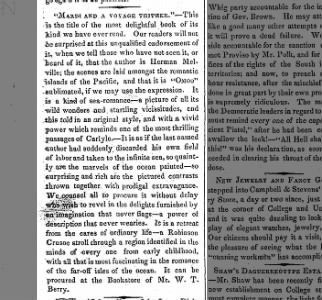
"MARDI AND A VOYAGE THITHER."— This is the title of the most delightful book of its kind we have ever read. Our readers will not be surprised at this unqualified endorsement of it, when we tell those who have not seen it, or heard of it, that the author is Herman Melville; the scenes are laid amongst the romantic islands of the Pacific, and that it is "Omoo" sublimated, if we may use the expression. It is a kind of sea-romance—a picture of all its wild wonders and startling vicissitudes, and this told in an original style, and with a vivid power which reminds one of the most thrilling passages of Carlyle.— It is as if the last named author had suddenly discarded his own field of labor and taken to the infinite sea, so quaintly are the marvels of the ocean painted—so surprising and rich are the pictured contrasts thrown together with prodigal extravagance. We counsel all to procure it without delay who wish to revel in the delights furnished by an imagination that never flags—a power of description that never wearies. It is a retreat from the cares of ordinary life—a Robinson Crusoe stroll through a region identified in the minds of every one from early childhood, with all that is most fascinating in the romance of the far-off isles of the ocean. It can be procured at the Bookstore of Mr. W. T. Berry.


Melville's Mardi warmly received in Nashville

Nashville notice of The Confidence-Man

THE CONFIDENCE-MAN; His Masquerade. By HERMAN MELVILLE, author of "Piazza Tales," "Omoo," "Typee," etc. New York: Dix, Edwards & Co.
The announcement of a new book from the pen of Herman Melville, is sufficient to attract attention. To those who have read Typee, and Omoo, no book authorized by Melville, can escape a reading. The subject of this work the "Confidence-man" is somewhat out of his usual vein. The scenes are taken from aboard a Mississippi steamer, and includes men and things as they occur and appear between St. Louis and New Orleans. It preserves a fine interest throughout.
--Daily Nashville Patriot - May 9, 1857
Found at the fine Library of Congress site Chronicling America: Historic American Newspapers.

Thursday, July 9, 2015

Gansevoort Melville in Nashville, "The Dying Douglass" passage

The Battle of Chevy Chase by Edward Bird
Image Credit: The Douglas Archive
Henry Clay is a Whig Harry Hotspur in Gansevoort Melville's wild and romantic allegory. Martin Van Buren, modestly deferring to Polk in the 1844 presidential campaign, is represented as James, 2nd Earl of Douglas, heroically dying on the field of battle at Otterburn (Chevy Chase in English ballads). As Michael Paul Rogin reads the extravagant rhetoric of Herman Melville's older brother, Gansevoort
"glorified a Scottish rebel, not a loyal English prince. His Dying Douglass figure of speech not only killed Van Buren in the name of saving him; it also identified the Democratic party with usurpation."  --Subversive Genealogy
Here is the full "Dying Douglass" excerpt from the Albany Argus (September 25, 1844); found in the amazing newspaper archives at Fulton History:


Albany Argus (September 25, 1844)

Transcript

THE DYING DOUGLASS.

The last Nashville Union gives the following happy and brilliant passage from GANSEVOORT MELVILLE’S speech at the great Mass Meeting [August 15, 1844] at that place: 
After having dwelt at considerable length upon other topics of discussion, Mr. Melville, in the course of his speech, emphatically repelled the idea which the Whigs of Tennessee are so laborious in inculcating, that Mr. Van Buren is giving but a cold and insincere support to the nomination of Polk and Dallas, and after demonstrating the warm desire which he feels for the success of the Democratic candidates, spoke at length of the career, character and elevated position of Martin Van Buren in terms which drew from the auditors oft repeated and enthusiastic responses. In speaking of the magnanimity of Mr. Van Buren’s latest public act, his letter to the New York committee, Mr. Melville said: 
And here let us take from the simple page of history an illustration of kindred heroism. During the long and bloody warfare which existed between the English and Scotch for several centuries, many well contested and glorious actions were fought, but none better contested or more glorious than the battle of Otterbourne, which took place in the latter part of the fourteenth century. The opposing forces were well matched in point of numbers, bravery and discipline, and each headed by a leader of acknowledged prowess. The English rallied under the banner of the princely house of Percy, which, on that field, was represented well by the pride and hope of his ancient lineage, gallant Harry Percy—the Harry Hotspur of Shakespeare. The Scotch swarmed around a standard that bore aloft a bloody heart, the well known badge of haughty Douglass.—James, Earl of Douglass, a chieftain worthy of his heroic name, led them to the encounter. Thus equal in numbers, courage, and generalship, the battle raged for several hours, and the event was yet uncertain. The Scottish leader, in the hope of deciding the contest, gave the signal for a general charge, and, sword in hand and spur on heel, he led it gallantly. While waving his arm to his troops to invite them onward, an arrow pierced his heart. He fell from his saddle. His chiefs thronged around him. Death was perceptible on his brow. Everything near and dear to him was flitting from his grasp. His vast baronial estates, feudal honors, military fame, wife, children and friends, were to him as naught. They claimed not one single memory. He thought not of himself—his thoughts were all his country’s. But one idea occupied his mind and concentrated all his being. The life blood was oozing from his side—he felt it not. The hand of death was upon him—he heeded it not. His chiefs had raised him from the ground. Opening his glazing eyes he said: 
"I am dying. There is a tradition in our family that a dead Douglass shall win a field; and I trust that it may this day be accomplished. Advance my standard—shout my war cry and avenge my fall."
They left him there to die. They did as they were directed. They charged upon the enemy with the hurricane charge of men determined to do or die. The enemy that heretofore had maintained their ground gave way, and were driven before that charge as the chaff before the wind. The result was no longer doubtful—the victory was most decisive. Hotspur and his brother were taken prisoners. HENRY CLAY is the HARRY HOTSPUR of the whig party. (Here the speaker was broken in upon with a shout from tens of thousands of voices, that seemed to rend the very heavens.)
Mr. Melville proceeded. In this historical reminiscence let him read his fate. We have lost our favorite leader, but we remember his parting words. And in November, 1844, there will be another charge akin to that of Otterbourne—a charge of the labour and manhood of the land—the Iron legions that never quail—the serried phalanx of the unterrified democracy. The result of that charge is easily foreseen; for [i]n obedience to that great universal law of nature which bids the weaker give way to the stronger, Henry Clay and his cohorts, struggle as they may, must go down before it. That onslaught of the united democratic forces, in November next, will close the chequered political life of the great Kentucky statesman—will seal the fate of the modern Hotspur—herald the advent of the rising star of Tennessee, and vindicate the supremacy of that heaven-[born] spirit of progress, love and truth, which is one and identical with true democracy. (The cheering that followed Mr. Melville’s speech, and attended its delivery at intervals, throughout, was long, loud and enthusiastic.)
Grand Democratic Banner
via Library of Congress
Related posts: