Herman Melville's Works.
The new path struck out by Melville in Typee and Omoo has led to a wide and brilliant fame in a short space of time. Few of the younger American authors are more extensively read or more universally admired. His pictures of primitive social life in the islands of the South Sea possess an irresistible charm. The works devoted to this subject are redolent of the spicy fragrance of the native forests, and glow with the splendid lights of a tropical sky. In his other productions, comic humor is admirably blended with powerful description, grave reflection, and exciting narrative. Surpassed in originality by no recent writer in literature, his works form an epoch in its progress, and are indispensable in every library. --Harper & Brothers' Book-List, 1855
The Harpers continued to offer
Moby-Dick (1851) and
Pierre (1852)
during the latter 1850's. In
Capital Letters: Authorship in the Antebellum Literary Market (University of Iowa Press, 2009), David Dowling (page 158) cites the 1855
Harper & Brothers' Book-List as evidence of a restrictive genre classification that boxed Melville's writings in "Voyages and Travels." But the same 1855 table ("Index of Subjects and Works Relating to Them") also places "Melville's works" with those of Bulwer and Dickens in the category of "Fiction" (xiv), while itemizing his first six books (
Omoo first) under "Voyages and Travels" (viii).

And
Pierre is the first named of Melville's works in the index presented in the back of the 1855 Harpers'
Book-List.

The Table of Contents for the 1859
Harper & Brothers' List of Publications assigns "Melville's works" to the
category of "Novels" (page xvii) as well as "Travel and Adventure" (xxii). Only
Omoo appears in the "South Seas" category (xx). The "
Index Arranged Under Authors' Names" in the back of the 1859 Harpers'
List now gives "Melville's works" without specifying any particular title.
Of course, Melville's three books of fiction after
Pierre could
never have been promoted by the Harpers under any genre.
Israel Potter
(1855) was published by G. P. Putnam & Co.; both
The Piazza Tales (1856) and
The Confidence-Man (1857) were issued by the doomed firm of Dix & Edwards.
In May 1855 Harper & Brothers promoted all seven of their books by Herman Melville, not excluding
Pierre, in booklist-based newspaper ads for "Herman Melville's Works." This one appeared in the New York
Morning Courier on May 29, 1855:
Evidently the Harpers were happy to capitalize (if they could) on Melville's newfound success as a magazinist, as well as the early popularity of
Typee. In 1860 Melville wanted "a decent publisher" for his completed but never published book of poems--not the Harpers, he specified in detailed
memoranda for his brother Allan. Nevertheless, Harper & Brothers in 1866 did publish
Battle-Pieces and Aspects of the War, Melville's collection of Civil War poems. Five of the poems in
Battle-Pieces also appeared in
Harper's New Monthly Magazine.

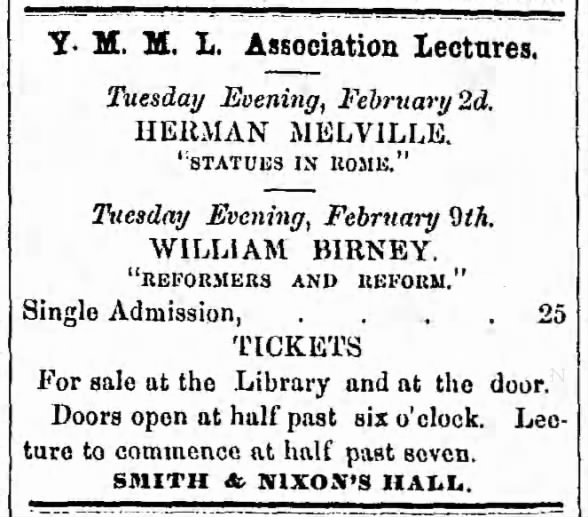 Fri, Jan 29, 1858 – P238 · The American Israelite (Cincinnati, Ohio) · Newspapers.com


