Sunday, December 1, 2019

Genius of Liberty, 1826 reprinting of A Visit from St Nicholas from the Charleston Mercury

In brackets, The Genius of Liberty (Leesburg, Virginia) acknowledges "the Charleston Mercury" as its source for the holiday piece titled, as in the Charleston, South Carolina Mercury of December 25, 1825, "Account of a visit from St. Nicholas, or Sante Claus." The Genius of Liberty was then owned by Brook Watson Sower (1784-1864). The borrowed holiday verses appear below an original paragraph of introduction (by Sower?) explaining the Christmas Eve custom of hanging up stockings for Santa or "Sante Claus" to fill overnight "with nuts, raisins, apples, cakes, toys, &c. &c."

The text of "A Visit from St.Nicholas" is transcribed below from the Leesburg VA Genius of Liberty, December 26, 1826. Also reprinted there on December 26, 1835, with minor changes in punctuation. Like the Charleston Mercury, both versions print "nested" for "nestled" in the fifth line. However, where the earliest Charleston Mercury versions in 1824 and 1825 read "Dunder and Blixem," following the first printing of the Christmas poem in the Troy Sentinel, Sower's Genius of Liberty has "Dunder and Blixen." Images of both the 1826 and 1835 printings of "A Visit from St. Nicholas" in the Genius of Liberty are accessible online via Virginia Chronicle: Digital Newspaper Archive.

Genius of Liberty (Leesburg, VA) December 26, 1826
via Virginia Chronicle

THE RECESS.

As these are holiday times, the following piece is quite appropriate to the season. But as many readers may not be acquainted with the attributes and province of ST NICHOLAS, or SANTE CLAUS, it may not be amiss to remark, that in some families, in different parts of the country, it is customary on the eve before Christmas, for the children, on retiring to bed, to hang up their stockings round and about the chimney, and it is the province of SANTE CLAUS, on such occasions, to fill them before morning, with nuts, raisins, apples, cakes, toys, &c. &c. We know not whence the custom is derived, farther than that the saint, or patron deity, is of German extraction, and generally, we believe, dispenses his favours accordingly -- In the morning of life, when the gilded visions of childhood enchained the affections, we remember to have hailed the approach of this festive season, as well in anticipation of the munificence of SANTE CLAUS, as of other festivities. That period, though long since past, is still grateful to the recollection; and, if ever deception deserved the appellation of pious fraud, it would seem to be when ministering to the sum of infantine happiness.-- [Gen. Lib. 
 [From the Charleston Mercury]
Account of a visit from St. Nicholas, or Sante Claus.
’TWAS the night before Christmas, when all thro’ the house,
Not a creature was stirring, not even a mouse;
The stockings were hung by the chimney with care,
In hope that St. Nicholas soon would be there.
The children were nested all snug in their beds,
While visions of sugar plums danced in their heads,
And Mamma in her ’kerchief, and I in my cap,
Had just settled our brains for a long winter’s nap —
When out on the lawn there arose such a clatter,
I sprang from the bed to see what was the matter,
Away to the window I flew like a flash,
Tore open the shutters, and threw up the sash.
The moon on the breast of the new fallen snow,
Gave the lustre of mid-day to objects below;
When, what to my wondering eyes should appear,
But a miniature sleigh, and eight tiny rein-deer,
With a little old driver, so lively and quick,
I knew in a moment it must be St. Nick.
More rapid than eagles his coursers they came,
And he whistled, and shouted, and call’d them by name;
“Now, Dasher! now, Dancer! now, Prancer! and Vixen.
“On! Comet, on! Cupid, on! Dunder and Blixen;
“To the top of the porch! to the top of the wall!
“Now dash away! dash away! dash away all!”
As dry leaves before the wild hurricane fly,
When they meet with an obstacle mount to the sky;
So up to the house-top the coursers they flew,
With the sleigh full of Toys—and St. Nicholas too.
And then, in a twinkling, I heard on the roof,
The prancing and pawing of each little hoof;
As I drew in my head, and was turning around,
Down the chimney St. Nicholas came with a bound.
He was dressed all in fur, from his head to his foot,
And his clothes were all tarnished with ashes and soot;
A bundle of toys was flung on his back,
And he look’d like a pedlar just opening his pack;
His eyes—how they twinkled! his dimples, how merry,
His cheeks were like roses, his nose like a cherry;
His droll little mouth was drawn up like a bow,
And the beard of his chin was as white as the snow;
The stump of a pipe he held tight in his teeth,
And the smoke it encircled his head like a wreath.
He had a broad face, and a little round belly,
That shook, when he laughed, like a bowl full of jelly.
He was chubby and plump, a right jolly old elf,
And I laughed when I saw him, in spite of myself;
A wink of his eye, and a twist of his head,
Soon gave me to know I had nothing to dread;
He spoke not a word, but went straight to his work,
And fill’d all the stockings; then turned, with a jerk,
And laying his finger aside of his nose,
And giving a nod, up the chimney he rose.
He sprang to his sleigh, to his team gave a whistle,
And away they all flew like the down of a thistle:
But I heard him exclaim, ere he drove out of sight—
"Happy Christmas to all, and to all a good night."

Related posts:

Friday, November 29, 2019

Whale's Fountain in the Troy Daily Whig

Troy NY Daily Whig - November 13, 1851 via FultonHistory
This brief notice of Moby-Dick from the Troy Daily Whig is included in the Checklist of Additional Reviews but not transcribed in Herman Melville: The Contemporary Reviews, edited by Brian Higgins and Hershel Parker (Cambridge University Press, 1995; paperback 2009) page 416. Found in Tom Tryniski's great archive of old New York newspapers on fultonhistory.com:
MOBY DICK; OR THE WHALE. BY HARMAN MELVILE. HARPER & BROTHERS.
The author of "Typee" and "Omoo" is an indefatigable as well as popular writer. The reading public (and that in this country comprises almost every body) had hardly ceased its expressions of admiration for "White Jackett" and its predecessors, when it is presented by the same author with a thick octavo volume of some 650 pages characterized by all that clearness and depth of observation, quaintness, and originality, which have served to give his previous productions such wide popularity. From a hasty glance at its pages, we predict that "Moby Dick" will be universally regarded as "Melville's best."  [WM. H. YOUNG, 216 River-st.
According to the masthead, the Troy Daily Whig was then owned and edited by Charles David Brigham (1819-1894).


Two days later, the Troy Daily Whig reprinted all of chapter 85, The Fountain under the heading "The Whale's Fountain. / From Herman Melville's New Work -- 'Moby-Dick.' "
Troy NY Daily Whig - November 15, 1851 via via FultonHistory

The Whale's Fountain. 

From Herman Melville's New Work — "Moby Dick."
That for six thousand years—and no one knows how many millions of ages before—the great whales should have been spouting all over the sea, and sprinkling and mistifying the gardens of the deep, as with so many sprinkling or mistifying pots; and that for some centuries back, thousands of hunters should have been close by the fountain of the whale, watching these sprinklings and spoutings—that all this should be, and yet, that down to this blessed minute (fifteen and a quarter minutes past one o'clock P. M. of this sixteenth day of October, A. D. 1851,) it should still remain a problem, whether these spoutings are, after all, really water, or nothing but vapor—this is surely a noteworthy thing.
The first paragraph features an intriguing variant in the month that Melville's narrator Ishmael gives when supposedly identifying the precise time of his writing on "this sixteenth day of December, A. D. 1851" in the first American edition, "1850" in Bentley's London edition. Published on November 15, 1851, the Troy Daily Whig version reads "October" instead of "December." The choice of "October" avoids the potential objection that Melville's narrator could not be writing the sentence a month after publication of the Harper edition. But the neat fix in the Daily Whig conveys a jolt of super-immediacy to contemporary readers that Melville might not have intended--unless the fix was somehow authorial, rather than strictly editorial. Another solution of the same textual problem would be to follow the British edition here, keeping "December" but emending "1851" to "1850," as in the 1988 Northwestern-Newberry Edition of Moby-Dick or The Whale.

The Buffalo, NY Western Literary Messenger version gives the same title, "The Whale's Fountain," and same credit line, "From Herman Melville's New Work—'Moby-Dick.'" Although published in February 1852, this text also reads "October" where the first British and American editions have "December."

Perhaps Western Literary Messenger editor Jesse Clement copied "The Whale's Fountain" from Charles D. Brigham's newspaper the Troy Daily Whig. Alternatively, both the Buffalo and Troy versions of chapter 85 in Moby-Dick with "October" instead of "December" could derive from a common exemplar.

Jamestown NY Journal - January 2, 1852 via NYS Historic Newspapers

Additional newspaper reprintings of "The Whale's Fountain" with the "October" variant:
  • Rochester Daily American (Rochester, New York) November 21, 1851
Rochester NY Daily American - November 21, 1851
via genealogybank.com

  • Jamestown Journal (Jamestown, NY), January 2, 1852
  • Northern New York Journal (Watertown, NY), January 14, 1852 
Below, "The Whale's Fountain" as it appeared in the Troy Daily Whig for November 15, 1851; found on fultonhistory.com.

"The Whale's Fountain."
Troy Daily Whig, Nov. 15, 1851, 1 of 2
"The Whale's Fountain." 2 of 2

Related posts:

Wednesday, November 27, 2019

Steamboats Chancellor Livingston and Connecticut

Steamship Chancellor Livingston. 1822 by Richard Varick DeWitt (1800-1868).
Image Credit: Albany Institute of History and Art
The steamboat Chancellor Livingston was under the command of popular river captain Joab Center (1777-1857) when Herman Melville, age 4, rode it to Albany on August 20, 1823:
Allan Melvill's diary:   
Left New York with Mrs. Melvill, five children, Miss Adams & Nurse in the Steam Boat Chancellor Livingston at 4 P M -  
August 21     Arrived at Albany at 11 A M  --as quoted by Jay Leyda in The Melville Log, 2 vols. (New York: Harcourt, Brace and Company, 1951) volume 1, page 15.
Allan Melvill's actual diary is held with Correspondence and miscellaneous manuscripts in the Herman Melville Papers at Houghton Library, Harvard. Citation:
Melville, Allan, 1782-1832.Diary. A.Ms.s.(variously); [v.p.] 1800-1831., 1800-1831. Herman Melville papers, MS Am 188-188.6, MS Am 188, (118). Houghton Library, Harvard College Library. https://id.lib.harvard.edu/ead/c/hou00338c00127/catalog Accessed November 27, 2019
New York National Advocate - August 19, 1823 via GenealogyBank
 In August 1823 the five children of Allan and Maria Gansevoort, were
  • Gansevoort, age 7 (b. December 6, 1815)
  • Helen, 6 (b. August 4, 1817)
  • Augusta, almost 2 (b. August 24, 1821)
  • Herman, 4 (b. August 1, 1819)
  • Allan, 4 months (b. April 7, 1823)
(Catherine/Kate was born on May 21, 1825;  Frances Priscilla/Fanny on August 26, 1827; and Thomas/Tom on January 24, 1830.)

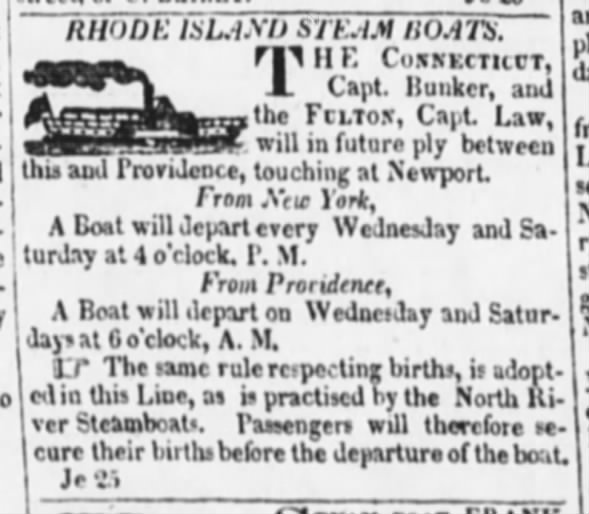
The summer before (August 7, 1822), Herman and family left New York for Providence on the steamboat Connecticut, then commanded by Captain Elihu S. Bunker (1772-1847).

Tue, Aug 6, 1822 – Page 4 · The Evening Post (New York, New York) · Newspapers.com
After a night at Sanford Horton's Globe Tavern aka Golden Ball Inn on the corner of Benefit and South Court Streets they proceeded on to Boston "in a private Carriage" for a long visit with Herman's grandfather Thomas Melvill and family (Melville Log Vol 1, page 11).

Golden Ball Inn, Providence RI via Library of Congress
What Allan Melvill called "Horton's Tavern" in his diary was formerly Chappotin's Tavern, refurbished and re-opened as the Globe Tavern in June 1822 by Sanford Horton.

Rhode Island American - June 28, 1822, page 2
via GenealogyBank
Rhode Island American - June 28, 1822, page 3
via GenealogyBank
On the 1823 trip to Albany, "Miss Adams" was the new family governess hired in late December 1822, as Hershel Parker recounts in Herman Melville: A Biography Volume 1, 1819-1851 (Johns Hopkins University Press, 1996) pages 26-27.

More facts about the steamboat Chancellor Livingston can be found with the drawing by Samuel Ward Stanton in American Steam Vessels (New York, 1895). Accessible online courtesy of HathiTrust Digital Library:

CHANCELLOR LIVINGSTON
https://hdl.handle.net/2027/mdp.39015018442189?urlappend=%3Bseq=24

Related post:

Monday, November 25, 2019

Swiftsure drawing by Samuel Ward Stanton

SWIFTSURE 1825, pencil drawing by Samuel Ward Stanton (1870-1912)
in American Steam Vessels series no. 5, Steamboats of the River Hudson
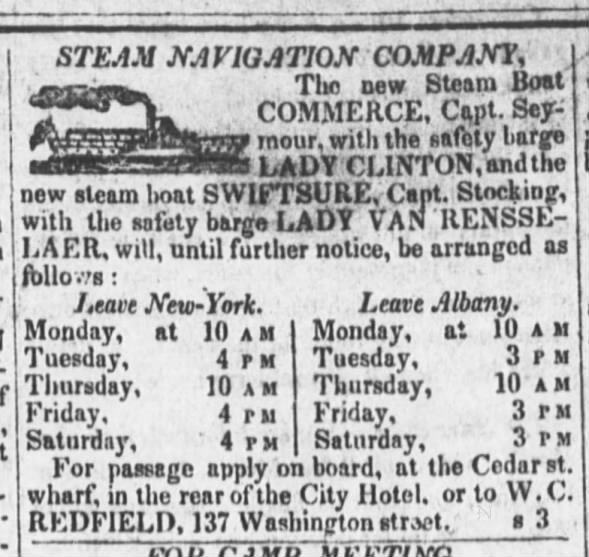
Number 5 in the American Steam Vessels series (Meriden Gravure Company, 1962-5) of drawings by marine artist and historian Samuel Ward Stanton (1870-1912) is titled Steamboats of the River Hudson. Published by Stanton's daughter Elizabeth Stanton Anderson, this pamphlet edition reproduces some early work not found in American Steam Vessels (New York, 1895), including the rare pencil drawing of the Swiftsure in 1825, towing the "safety barge" Lady Van Rensselaer.

Numbers 1-5 in the American Steam Vessels series of drawings by Samuel Ward Stanton are collected in one volume at the University of Michigan Library, now Google-digitized and accessible online courtesy of HathiTrust Digital Library.

Pertinent history of the Swiftsure is given under Stanton's picture of the "SWIFTSURE 1825 pulling safety barge LADY VAN RENSSELAER":
Built at Brooklyn, N. Y., wood, 265 tons, by C. Bergh for A. Van Santvoord's Steam Navigation Co. for route between New York and Albany. SWIFTSURE and COMMERCE usually had in tow, for those afraid of steamboats, so-called safety barges connected to them by swivelled platforms over which passengers could walk. Practice discontinued after 1829 due to resulting slowness, and barges converted for freight. SWIFTSURE abandoned in 1856. -- Steamboats of the River Hudson, American Steam Vessels series no. 5 (Meriden Gravure Company, 1965). 
Tue, Sep 6, 1825 – Page 1 · The Evening Post (New York, New York) · Newspapers.com
Samuel Ward Stanton died at sea on April 12, 1912 in the Titanic disaster. Stanton's early Swiftsure drawing did not appear in American Steam Vessels. His model is not identified exactly, but in the 1895 Preface Stanton avowed that his illustrations were all "drawn from reliable sources" such as "early prints, lithographs, drawings and paintings, mostly in the possession of private parties or steamboat companies." Also acknowledging his use of old newspapers and hand-bills, Stanton further specified that he had drawn
the United States from a wood cut that appeared in the New York Evening Post, of June 23, 1821; the Constitution from a wood cut on a hand-bill of 1826, and the Albany, 1839, is likewise from a wood cut.
For representations of some early Hudson River steamboats including the Commerce, DeWitt Clinton, and Highlander, Stanton credited "the pictures of Mr. James Bard, a gentleman who began this class of work before 1830."

Highlander (1835 steamboat)

Shown above via Wikimedia Commons, the image of the steamboat Highlander from American Steam Vessels by Samuel Ward Stanton is also accessible online courtesy of HathiTrust Digital Library
  • https://hdl.handle.net/2027/mdp.39015018442189?urlappend=%3Bseq=48
and Google Books
  • https://books.google.com/books?id=lQ8fAQAAMAAJ&pg=PA44&lpg=PA44&dq#v=onepage&q&f=false
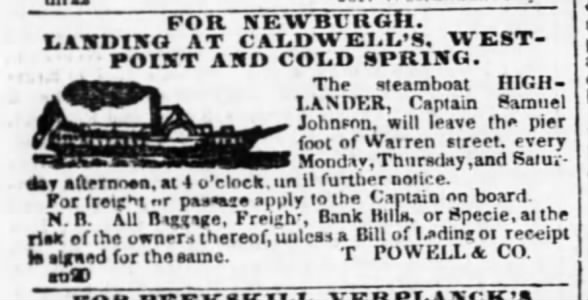
Stanton describes the Highlander, built in 1835 for the Hudson River, as 
"one of the best boats on the river when she first came out, as well as one of the fastest. She ran on the Newburgh and New York line until the Thomas Powell appeared, 1846. She was then used as an excursion boat."  --American Steam Vessels
Wed, Oct 9, 1839 – Page 4 · The Evening Post (New York, New York) · Newspapers.com
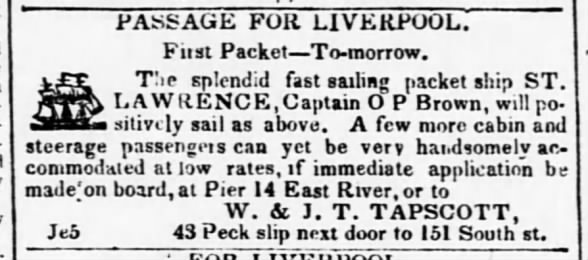
In Redburn (1849) Herman Melville gave the name "Highlander" to the merchant vessel that takes the green hero Wellingborough Redburn across the Atlantic and back. The Highlander in Redburn is a fictionalized version of the real St. Lawrence which did in fact sail to Liverpool in June 1839 with Herman Melville on board. Melville shipped as an inexperienced "boy," although he would celebrate his 20th birthday in Liverpool, waiting to sail home. As William H. Gilman reported in Melville's Liverpool Trip, Modern Language Notes Vol. 61, No. 8 (December 1946) pages 543-547, the crew list of the St. Lawrence had Herman Melville enrolled under the name "Norman Melville."

Wed, Jun 5, 1839 – Page 3 · The Evening Post (New York, New York) · Newspapers.com
Related posts:

Saturday, November 23, 2019

Captain Hart L. Murray

Here's more about Hart Leverett Murray (1798-1887), captain of the Swiftsure when that Hudson River steamboat brought Allan Melvill and his son Herman (age 11) up to Albany from NYC in October 1830. Towing the Melvill family's furniture on the freight barge Ontario, as demonstrated in the previous post on the Swiftsure Line in 1830.

From William B. Murray, The Descendants of Jonathan Murray (Peoria, Illinois, 1950) pages 89-90:
HART  L. MURRAY 
Son of Jesse b 9 Nov. 1798 in Essex, Conn. d 7 May 1887 in Deep River, Middlesex Co. Conn. m 25 Sept. 1823 to Temperance H. Brockway b 19 Oct. 1798 d 26 May 1898. Lived in Essex, Conn. & Albany, N.Y. 
Children
i Leverett Wendell b 1 June 1829 d 6 Apt 1889
ii Angenora Manuella b 24 Jan,1834 d 29 Oct. 1927 m John L. Brownell
Starting in 1824 as Capt of the Hudson River steamboat 'Swiftsure' he continued to be a popular captain of the Hudson River boats for 27 yrs, contemporaneous with Alfred Vantvoord, Isaac Newton and Dean Richmond. He was appointed Harbor Master of the Port of New York by Gov Morgan in 1860 and retired from active life in 1867. He was a resident of Albany for 28 yrs, and earnest anti-slavery man and a member of the Baptist church for more than 60 years; a devoted husband and valued citizen. 
In Albany, Murray lived at 60 Westerlo Street. That's according to Joel Munsell's Albany Annual Register for 1849-50 where his name "Murray H L" appears in the alphabetized list of fifteen Albany "Skippers." Same address for "skipper" Murray in the 1853-4 Albany City Directory. In Brooklyn Hart L. Murray resided at 12 Cheever Place.

Tue, May 17, 1887 – Page 1 · The Brooklyn Daily Eagle (Brooklyn, New York) · Newspapers.com

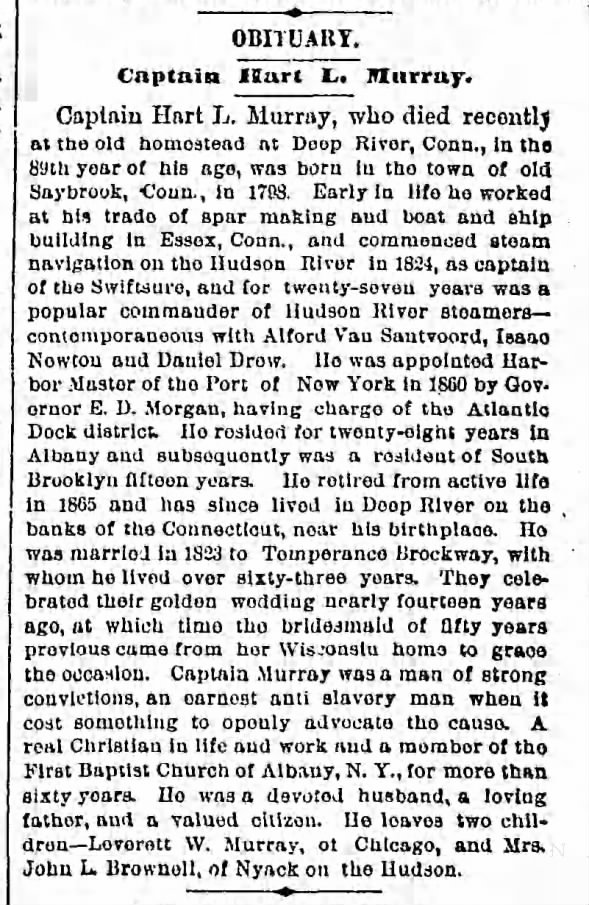
OBITUARY.
Captain Hart L. Murray.

Captain Hart L. Murray, who died recently at the old homestead at Deep River, Conn., in the 89th year of his age, was born in the town of old Saybrook, Conn., in 1798. Early in life he worked at his trade of spar making and boat and ship building in Essex, Conn., and commenced steam navigation on the Hudson River in 1824, as captain of the Swiftsure, and for twenty-seven years was a popular commander of Hudson River steamers--contemporaneous with Alford Van Santvoord, Isaac Newton and Daniel Drew. He was appointed Harbor Master of the Port of New York in 1860 by Governor E. D. Morgan, having charge of the Atlantic Dock district. He resided for twenty-eight years in Albany and subsequently was a resident of South Brooklyn fifteen years. He retired from active life in 1865 and has since lived in Deep River on the banks of the Connecticut, near his birthplace. He was married in 1823 to Temperance Brockway, with whom he lived over sixty-three years. They celebrated their golden wedding nearly fourteen years ago, at which time the bridesmaid of fifty years previous came from her Wisconsin home to grace the occasion. Captain Murray was a man of strong convictions, an earnest anti slavery man when it cost something to openly advocate the cause. A real Christian in life and work and a member of the First Baptist Church of Albany, N. Y., for more than sixty years. He was a devoted husband, a loving father, and a valued citizen. He leaves two children--Leverett W. Murray, of Chicago, and Mrs. John L. Brownell, of Nyack on the Hudson. --Brooklyn Daily Eagle, May 17, 1887. 
Related post:

Thursday, November 21, 2019

Swiftsure Line in 1830

As shown below, the Melvill family's furniture was on the freight barge Ontario, then part of the Swiftsure Line, and therefore must have gone to Albany on the same trip in October 1830 that Allan Melvill and his son Herman made together aboard the SWIFTSURE. The furniture went last with Herman and his father, not with Herman's brother Gansevoort and their mother, as biographers have mistakenly thought.
New York Commercial Advertiser - Saturday, October 9, 1830
via GenealogyBank
This Swiftsure was the Albany boat that Allan Melvill and his son Herman, age 11, took in October 1830 when the family had to leave New York City for good, after the failure of Allan's importing business. Household furniture went on the freight barge Ontario, as Herman's father recorded in his diary. For a transcription, see Jay Leyda, The Melville Log Vol. 1 (Harcourt, Brace and Company, 1951) page 45. From Leyda's Log, here are two relevant entries in the year 1830:
NEW YORK October 9 Allan Melville's diary:
Left New York with Herman in the Swiftsure (our Furniture being on board the Ontario Tow Boat, Mrs. Melvill & Gansevoort having gone up the preceding eve[nin]g) -- detained all night at Cortlandt St Dock by a severe Storm
October 10     at 7 A M left the Dock
Allan Melvill's actual diary is held with Correspondence and miscellaneous manuscripts in the Herman Melville Papers at Houghton Library, Harvard. Citation:
Melville, Allan, 1782-1832.Diary. A.Ms.s.(variously); [v.p.] 1800-1831., 1800-1831. Herman Melville papers, MS Am 188-188.6, MS Am 188, (118). Houghton Library, Harvard College Library. https://id.lib.harvard.edu/ead/c/hou00338c00127/catalog Accessed November 27, 2019
According to Allan Melvill, Herman's mother and brother Gansevoort had left for Albany the night before. As shown below, when Allan made note of "our Furniture being on board the Ontario" he meant now, with him and Herman, rather than the previous evening with his wife and oldest son. The Swiftsure was supposed to leave at 5 p.m. on Saturday, October 9th but a "severe storm" delayed its scheduled departure. So Herman and his father did not actually leave Cortlandt street until the next morning, as Hershel Parker relates in the great opening chapter of Herman Melville: A Biography Volume 1, 1819-1851 (Johns Hopkins University Press, 1996).

From the New York Commercial Advertiser for Saturday, October 9, 1830:
 FOR ALBANY.
   The steamboat SWIFTSURE, Captain Murray, will leave the foot of Courtlandt street, THIS AFTERNOON, at 5 o'clock.
   For passage, apply on board, or to
W. C. REDFIELD, 82 Courtlandt st.
TOW-BOATS FOR ALBANY -- (Swiftsure Line.)
   The freight barge Ontario, will leave the foot of Courtlandt-street, and the Atlantic, the foot of Broad-street This Afternoon at 5 o'clock.
   For freight, apply on board, or to
A. VAN SANTVOORD, 82 Courtlandt st.
In Chapter 1 of Melville's Early Life and Redburn (New York University Press, 1951), William H. Gilman acknowledges the "violent storm" and "comfortless night at the Courtlandt Street dock" but still has Allan and son Herman moving "quickly up the Hudson" on October 9, the scheduled date of departure, instead of October 10, the actual date. Parker in his expansive treatment gives the correct departure date, October 10, 1830. Regular days of departure from New York City to Albany were then Wednesdays and Saturdays. From Albany, the Swiftsure regularly left for New York City on Tuesdays and Fridays.

As the ad below from the Commerical Advertiser of Friday, October 8, 1830 shows, the steamboat Swiftsure and barge Ontario both were scheduled to leave "Tomorrow Afternoon" (Saturday, October 9th) from "the foot of Courtlandt street." Together, necessarily.

New York Commercial Advertiser - Friday, October 8, 1830
The Swiftsure could not have left New York City on the 8th because it was still in Albany. Below, the ad in the Albany Argus on Friday, October 8th, showing the scheduled departure of the steamboat Swiftsure at 9 a.m., "from the foot of State st."

Albany Argus - Friday, October 8, 1830 via FultonHistory
SWIFTSURE LINE -- TOW-BOATS.
THE steambt SWIFTSURE, capt. H. L. Murray, will leave the Pier, from the foot of State-st. THIS MORNING, at 9 o'clock, with freight barges.
For freight or passage apply on board, or at the office of the subscriber. 
CHARLES COATES, Agent.
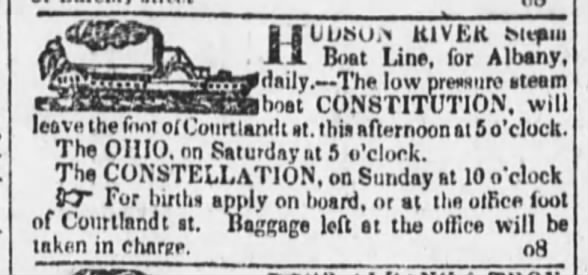
Allan Melvill wrote in his diary that his wife and son Gansevoort had "gone up the preceding eve[nin]g" to Albany, which both Gilman and Parker take to mean by boat, with the furniture. But the particular barge that Melville's father referenced only left on Saturday. There was no departure of the Ontario or Swiftsure for Albany the preceding evening. (And Swiftsure Line freight barges that left New York for Albany on Wednesday, October 6th were named the Albany and Superior.) Possibly Allan was confused after the long delay. If so, then Maria Gansevoort Melvill and her son Gansevoort could have departed for Albany on the Swiftsure Line three evenings previous, on Wednesday, October 6, 1830. If Allan got their departure date right, however, then his wife and Gansevoort had "gone up" to Albany the night before on a different passenger line (not affiliated with the Ontario). For example, the Hudson River Line offered passenger trips from the Cortlandt Street dock to Albany every day at 5 p.m., and Sundays at 10 a.m.

Robert J. Vandewater, The Tourist, Or Pocket Manual for Travellers (New York, 1830)
Maybe Herman's mother Maria and older brother Gansevoort took the "low pressure steamboat CONSTITUTION," which did leave for Albany at 5 p.m. on Friday, October 8, 1830.

Fri, Oct 8, 1830 – Page 3 · The Evening Post (New York, New York) · Newspapers.com

In any case, the Melvill family's furniture was on the freight boat Ontario, then part of the Swiftsure Line, and therefore must have gone to Albany on the same trip that Allan Melvill and his son Herman made together, aboard the Swiftsure.

Albany Evening Journal - November 11, 1830 via FultonHistory
TRANSPORTATION.

THE SWIFTSURE LINE of TOW-BOATS will continue to receive property at Albany and New-York to forward on the river in other direction by the freight boats Atlantic, Superior, New-York, Albany, Ontario, Niagara, Detroit and Inspector; two of which, towed by a powerful Steam-boat, will leave New-York at 5 o'clock P. M. on Wednesday and Saturday, and two will leave Albany at 9 o' clock A. M. on Tuesday and Friday of each week, leaving at each place boats for the reception of property.

Merchandize, produce, carriages, horses, cattle, and almost every description of live stock, will be forwarded with safety and expedition.

For freight or passage apply to the Agents,

CHARLES COATES, at Albany, and
A. VAN SANTVOORD, 82 Cortland-st New York.  -- Albany Evening Journal, November 11, 1830
The manner of towing is helpfully explained by George Matteson in Tugboats of New York: An Illustrated History (New York University Press, 2005) pages 31-32:
In its earliest form, towing was done by lashing the barges to both sides of the steamer and proceeding as a unit. ... the earliest Hudson River tows were made up of only two barges specifically designed to accommodate the size, horse power, and turning ability of a specific steamboat--the Swiftsure and its stable of custom-built barges, for example...."
Under command of Captain Stocking, the new steamboat Swiftsure debuted on the Hudson in July 1826 as towing boat for the Lady Van Rensselaer, one of two new "safety barges." The Swiftsure operated under Captain Hart Leverett Murray at least until 1840 when a new boiler exploded. Four deaths were reported in the steamboat accident on October 5th, 1840, near Castleton.

Related posts:

Tuesday, November 19, 2019