Friday, December 7, 2018

Livingston cousin T. W. C. Moore

T. W. C. Moore (1794-1872)
Detail from New York, the interior of the Park Theatre, 1822 by John Searle
 via The New York Public Library Digital Collections
In Who Wrote "The Night Before Christmas"? (page 184, footnote 5) MacDonald P. Jackson backs up his sympathetic treatment of Livingston lore in chapter 20 by quoting Mary Van Deusen on the family tie between Henry Livingston, Jr. and his first cousin Judith Livingston, wife of John Moore.
"Having a connection of both families traveling south to act as a governess in a Moore-connected household isn't that absurd. Henry Livingston's first cousin and next door neighbor was Judith Livingston, who was married to John Moore, the brother of Clement Moore's uncle. In 1815, their daughter Lydia was married to a student of Moore's, Rev. William Henry Hart, and the couple moved to Virginia."
--Mary Van Deusen, "The Livingstons' Governess Story"; quoted by MacDonald P. Jackson in Who Wrote, page 184.
  • http://www.henrylivingston.com/xmas/arguments.htm
On a "Timeline" of authorship findings, Ms. Van Deusen has placed her discovery of the connection to the Moore family in the year 2001
  •  http://www.henrylivingston.com/xmas/summary.htm
 and elsewhere explains:
"I knew that Henry's first cousin, Judith Livingston, lived near Henry and was married to John Moore. I just had no idea who John Moore was."
http://www.henrylivingston.com/slideshow/epilog/epilog-6stevespainting.htm
No idea who John Moore was? Melvilliana can help with that: father of T. W. C. Moore (1794-1872), as previously disclosed in the Key witness letter post:
  • http://melvilliana.blogspot.com/2018/02/key-witness-letter-by-livingston-cousin.html
Here I'm repeating the main point of that earlier and rather roundabout post. Besides being the parents of Lydia (mother of Frances Livingston Hart Butler), John Moore and Judith (Livingston) Moore were also parents of Thomas William Channing Moore: the same T. W. C. Moore who personally interviewed Clement C. Moore in 1862 and got the retired seminary professor and poet, age 82, to write out "The Night Before Christmas" one more time for The New-York Historical Society and posterity.

T. W. C. Moore was a first cousin, once removed of Henry Livingston Jr., since Henry and TWC's mother Judith were first cousins (their fathers Henry Sr. and James were brothers). Livingston cousin T. W. C. Moore maintained close ties with his nieces including Lydia's daughter Frances, who married Rev. Butler's son Clement Moore Butler. (Frances's sister-in-law was Troy resident Harriet Butler, named in later reports as copyist of "A Visit from St Nicholas.") In his 1858 will, T. W. C. Moore thoughtfully and generously remembered many nephews and nieces including four "daughters of my late sister Lydia" whom he appointed as "residuary Legatees." To Frances he gave two thousand dollars and
"all my Italian books & pamphlets - all my loose engravings & prints - also a Landscape (No. 8.) by Dan Huntington." --Will of T. W. C. Moore via Ancestry.com [Wills, Vol 0212-0213, 1872-1873 in New York, Wills and Probate Records, 1659-1999].

The will reveals also that T. W. C. Moore owned a copy by Daniel Huntington of his mother Judith's 1812 portrait, which he gave to another niece, Elizabeth Elliot Hart Coleman. The original portrait of Judith Livingston Moore was then in the possession of TWC's younger brother Francis Childs Moore, aka F. C. Moore.

As a serious art collector and "genuine antiquarian" (so described in Martha J. Lamb's History of the City of New York), Thomas W. C. Moore made it his business to learn about the provenance of valuable artifacts and to pass along relevant information to archivists. Gifts from T. W. C. Moore to family members, libraries, and museums were typically accompanied by manuscript notes in which he had carefully recorded relevant facts for the historical record.


He made a project of accurately identifying himself and other New Yorkers portrayed in John Searle's painting New York, the interior of the Park Theatre, 1822.


To support another effort of archival preservation, TWC Moore told what he knew about the authorship of "The Night Before Christmas" in his 1862 cover letter to the Librarian of the New-York Historical Society, forwarded with Clement C. Moore's holograph copy. The manuscript Christmas poem and TWC's letter are both extant in the collections of The New-York Historical Society.
  • http://bobcat.library.nyu.edu/primo-explore/fulldisplay?docid=nyu_aleph000690235&context=L&vid=NYHS&search_scope=nyhs&tab=nyhs&lang=en_US
Considering T. W. C. Moore's demonstrably close relationship with his niece Frances Livingston Hart Butler, it seems reasonable to suppose that he knew Frances's unmarried sister-in-law Harriet Butler and learned either directly from Harriet or indirectly from Frances exactly how Clement C. Moore's "A Visit from St. Nicholas" got from Moore's home in Chelsea to Troy. Writing in 1862, Frances's uncle T. W. C. Moore gave credit for copying the poem to two women, without identifying either by name. Later reports name Harriet Butler as one of the original copyists, possibly reflecting unrecoverable oral testimony. The other may have been Sarah Sackett, named by Norman Tuttle, publisher of the Troy Sentinel, as the person who gave a copy of "Visit' in 1823 to editor Orville L. Holley. In 1862, T. W. C. Moore communicated his personal knowledge of the poem's transmission--gained independently of the author, most likely through the family connection he loyally maintained with his niece Frances. For information about the poem's original composition, T. W. C. Moore talked directly with the author.

English majors have no excuse, but some partisans in the Livingston camp will always believe that Henry Livingston, Jr. composed "The Night Before Christmas." For Livingston descendants who might want a more historically grounded holiday hero, I give you "Old Cousin Tom," Thomas William Channing Moore.
"Old Cousin Tom," we were wont to call him. What a stream of memories, sweet childish memories, his name evokes! Can we forget him who never forgot his juvenile kindred, but made glad their hearts, not once but always, when his travels brought him to old Virginia. His portrait appears in the picture of the interior of the Park Theatre in the History of New York City, in the library of the Penn. Hist. Society. He spent much time in genealogical research and was a steadfast friend of Fitz-Greene HALLECK. Peace to his ashes! --David Moore Hall, Six centuries of the Moores of Fawley, Berkshire, England and their descendants amid the titled and untitled aristocracy of Great Britain and America (Richmond, Virginia, 1904) via RootsWeb
Your Cousin Tom not only coaxed one more holograph copy of "The Night Before Christmas" from its author Clement C. Moore, he also solved the longstanding mystery of its transmission. Cousin Tom bequeathed to all of us the inside story of how "The Night Before Christmas" found its way to the Troy Sentinel, sharing details personally known to him through close ties to the family of his beloved niece Frances Livingston Hart Butler. Thus, no need for the "Livingston Governess" theory of transmission, whereby a hypothetical governess supposedly brought a hypothetical manuscript copy of "A Visit from St. Nicholas" from Poughkeepsie to Richmond. Cousin Tom himself made frequent trips south to visit kinfolk in Old Virginia. With intimate connections to Poughkeepsie (where his cousin Cornelia Billings had married Randall S. Street, a close friend of Henry Livingston, Jr; their son William I. Street formally witnessed T. W. C. Moore's 1858 will) and Manhattan, Cousin Tom could have told his adoring Richmond relatives all about "The Night Before Christmas" and who wrote it.

Here again is the earliest known Livingston witness letter, decisively affirming Clement C. Moore's authorship of "A Visit from St. Nicholas" aka "The Night Before Christmas." Addressed to the Librarian of the Historical Society, the letter from T. W. C. Moore was first published in The New York Historical Society Quarterly Bulletin 2.4 (January 1919) pages 111-115.


73 East 12th St.
New York, March 15th 1862.
Geo. H. Moore Esqr
Librarian of The New-York Historical Society:
Dear Sir:
I have the pleasure to inform you that Doctor Clement C. Moore has been so kind as to comply with my request (made at your suggestion) to furnish, for the Archives of our Society, an Autograph Copy of his justly celebrated "Visit from St. Nicholas." I now enclose it to you.—

I hardly need call your attention to the distinctness and beauty of his hand writing:—very remarkable, considering his advanced age, (he completed his 82d year in July last) and his much impaired eye sight.

These lines were composed for his two daughters, as a Christmas present, about 40 years ago.—They were copied by a relative of Dr. Moores in her Album, from which a copy was made by a friend of hers, from Troy, and, much to the surprise of the Author, were published (for the first time) in a Newspaper of that city.—

In an interview that I had yesterday with Dr. Moore, he told me that a portly, rubicund, Dutchman, living in the neighbourhood of his fathers country seat, Chelsea, suggested to him the idea of making St. Nicholas the hero of this "Christmas piece" for his children.
I remain, very resp[ectfull]y Your ob[edien]t s[ervan]t

T. W. C. Moore


Listed in WorldCat from the library catalog of the New-York Historical Society as A Visit from St. Nicholas: Holograph; currently held in Mss Collection, BV Moore, Clement, Non-circulating.
Holograph manuscript, dated March 13, 1862, of Clement C. Moore's "A visit from St. Nicholas," originally composed ca. 1822 and written out by the author on this occasion at the suggestion of librarian George H. Moore of the New-York Historical who wished to add a holograph copy of the poem to the Society's library collection. The three page manuscript is accompanied by a cover letter addressed to George Moore by Thomas W. C. Moore presenting the enclosed manuscript and briefly discussing the circumstances of the poem's original composition forty years earlier. --New-York Historical Society, catalog summary via BobCat
https://library.nyu.edu/persistent/lcn/nyu_aleph000690235?institution=NYU&persistent 
Fitz-Greene Halleck (1790-1867) by Henry Inman
New-York Historical Society - Bequest of Thomas W. C. Moore
Related posts:
  • Key witness letter
    http://melvilliana.blogspot.com/2018/02/key-witness-letter-by-livingston-cousin.html

Saturday, December 1, 2018

Early publisher's notices of Typee, reprinted in Virginia by Edgar Snowden

Wiley & Putnam's Literary News-Letter (March 1846) page 17
via HathiTrust Digital Library
Shown below, two Virginia items announce the first British and American editions of Melville's Typee. Both notices are naturally favorable, being reprinted from Wiley & Putnam's Literary News-Letter in one column of the Alexandria Gazette and Virginia Advertiser on March 7, 1846; found at GenealogyBank among articles added "within 1 month."

The Gazette was an important Whig newspaper then owned and edited by Edgar Snowden (1810-1875). In the 1844 presidential campaign, Snowden had campaigned hard for Henry Clay, against Gansevoort Melville's man. Polk was now President, but Snowden did not hold it against Gansevoort's literary brother.

Alexandria Gazette and Virginia Advertiser - March 7, 1846
via GenealogyBank
Mr. Murray will bring out simultaneously with the New York edition, a curious and very interesting book, called "Typee; or A Peep at Polynesian Life," being a narrative of a residence at the Marquesas, by Herman Melville, of New York. This is no fiction, but a veritable picture of life among the cannibals, from actual observation; and the narrative is worthy of Robinson Crusoe in style and in interest, with the additional advantage of being a simple record of facts...
... In the “Library of American Books,” a work of great novelty will be immediately issued—simultaneously with its publication by Murray, in London—entitled “TYPEE: a Peep at Polynesian Life; during a Four Months' Residence in a valley of the Marquesas, with notices of the French occupation of Tahiti and the provisional cession of the Sandwich Islands to Lord Paulett. By HERMAN MELVILLE.”
Again, Snowden did not write the friendly notices but only copied them along with other items of "Literary Intelligence" including mentions of "Hood's Serious Poems" and Hawthorne's forthcoming "Mosses from an Old Manse." So far, however, I have not found another verbatim reprinting of the particular news about Herman Melville's first book in the March 1846 number of Wiley & Putnam's Literary News-Letter. Alright, nearly verbatim. In copying the notice of Murray's London edition, the Gazette omitted the interesting reference by the original writer to "the one hundred pages I have read."

Harold W. Hurst calls Edgar Snowden "a serious literary critic" in Alexandria on the Potomac: The Portrait of an Antebellum Community (University Press of America, 1991), page 77:
The Gazette also lent enthusiastic support to the city's artistic and intellectual endeavors. No activity at the Library Society or Lyceum was too insignificant to warrant its patronage. The paper's columns carried sermons, poems, book reviews, and drama criticism alongside its lengthy reports of shipping, railroad, and industrial activities. Snowden was, indeed, a serious literary critic who devoted considerable space to reviews of works by Charles Dickens, Washington Irving, Robert Burns and other authors.
The 1954 bio by Carrol H. Quenzel is scarce, but accessible online courtesy of HathiTrust Digital Library.

Monday, November 26, 2018

The Trial Before Christmas


In this 2014 mock trial, attorney Jack Casey opened for the Livingston side with splendid readings from Frost, Chaucer, and Bob Dylan.

Moore's lawyer E. Stewart Jones Jr. said many fine things as well, including this at 21:30:
"Mr Casey has spent so much time in his legal career, in Albany with the state legislature, that he's mastered the art of historical revision."
Elvis showed up, and Santas with saxes. Alas, the evidence of Moore's published letter to the editor of the New York American (March 1, 1844) was not available at the time of this trial. (Found in January 2017, in microfilm of the New-York American at NYPL: *ZY 86-140 Reel 17, Mar 1-Dec 28, 1844). In this 1844 letter Moore reveals that he personally gave "A Visit from St Nicholas" with several other poems to the publisher of The New-York Book of Poetry in 1837. Here it is again, for the record.

New York American - March 1, 1844
LINES TO ST. NICHOLAS.--The following note from our friend C. C. Moore, the author of those lines which every child among us delights to hear, about Christmas, and which parents with not less delight recite, brings to our notice, one of the boldest acts of plagiarism of which we have any recollection. We ask the National Intelligencer to have the goodness to insert Mr. Moore's note--and if possible to elucidate the mistake, if such it be, or fraud attempted in respect of such well known lines. 
New York, Feb. 27, 1844 
Dear Sir--My attention was, a few days ago, directed to the following communication, which appears in the National Intelligencer of the 25th of December last.
"Washington, Dec. 22d, 1843.

Gentlemen--
The enclosed lines were written by Joseph Wood, artist, for the National Intelligencer, and published in that paper in 1827 or 1828, as you may perceive from your files. By republishing them, as the composition of Mr. Wood you will gratify one who has now few sources of pleasure left. Perhaps you may comply with this request, if it be only for 'auld lang syne.'" 
The above is printed immediately over some lines, describing a visit from St. Nicholas, which I wrote many years ago, I think somewhere between 1823 and 1824, not for publication, but to amuse my children. They, however, found their way, to my great surprise, in the Troy Sentinel: nor did I know, until lately, how they got there. When "The New York Book" was about to be published, I was applied to for some contribution to the work. Accordingly, I gave the publisher several pieces, among which was the "Visit from St. Nicholas." It was printed under my name, and has frequently since been republished, in your paper among others, with my name attached to it.  
Under these circumstances, I feel it incumbent on me not to remain silent, while so bold a claim, as the above quoted, is laid to my literary property, however small the intrinsic value of that property may be. 
The New York Book was published in 1827 [1837]. 
Yours, truly and respectfully,   
CLEMENT C. MOORE
Chas. King, Esq.
Related posts:

Sunday, November 25, 2018

Stephen Nissenbaum on The Battle For Christmas

Here's a holiday gem via Mt. Mansfield Community TV and the Internet Archive:
"A presentation by Stephen Nissenbaum sponsored by the Underhill Historical Society at the Deborah Rawson Memorial Library on 12-7-2016."

At 41:10:
Now if I can get back quickly to the poem "The Night Before Christmas": it is, in a very strange way, about a household invasion. I mean, because this guy comes in uninvited. He's doing in fact exactly what Wassailers would threaten to do. Coming uninvited into your house.

And if you think about the way the poem is structured, the whole first part of it is about the narrator—the narrator’s surprise at being awakened out of bed—lots of noise, lots of bright lights. In this reading of the poem the key line is that when St. Nicholas finally appears
A wink of his eye and a [twist] of his head,
Soon gave me to know I had nothing to dread….
That whole first part of the poem is about the fear, the anxiety the narrator seems to have. And what he learns, and this is the brilliance of the poem, and really of the new ritual, is that this household invader is coming to give rather than to take. Moore wrote this I think as part of this attempt to transform the whole set of cultural rituals in ways that both kept the poor out and retained most of the structure of the older rituals.
As well known in these parts Professor Nissenbaum is the distinguished author of
and online, the great essay at Common-Place

Friday, November 16, 2018

Ahab Beckons: Reserve your Bethel spot & Reader slot!

Ahab Beckons: Reserve your Bethel spot & Reader slot!: Registration is open for readers at the Moby-Dick Marathon, the Portuguese Marathon, and the Children's Marathon. You can also enter...

Monday, November 12, 2018

Omoo in Hudson, New York

This brief notice of Melville's Omoo appeared on May 6, 1847 in The Columbia Washingtonian, a weekly newspaper published in Hudson, New York by the local Temperance society and still edited by Warren Rockwell (1787-1866). "May 5" on the masthead is an error for May 6, a Thursday.

OMOO: a Narrative of Adventures in the South Seas. By Herman Melville, author of "Typee." Harper & Brothers, publishers.

This is an interesting and valuable work, in two volumes. It is a narrative of the adventures of the author among the Islands of the South Seas, during a whaling voyage and a residence of three months on the Islands of Tahiti and Imeo. For Sale at Wynkoop's.  --Columbia Washingtonian - May 6, 1847 via NYS Historic Newspapers.

Saturday, November 10, 2018

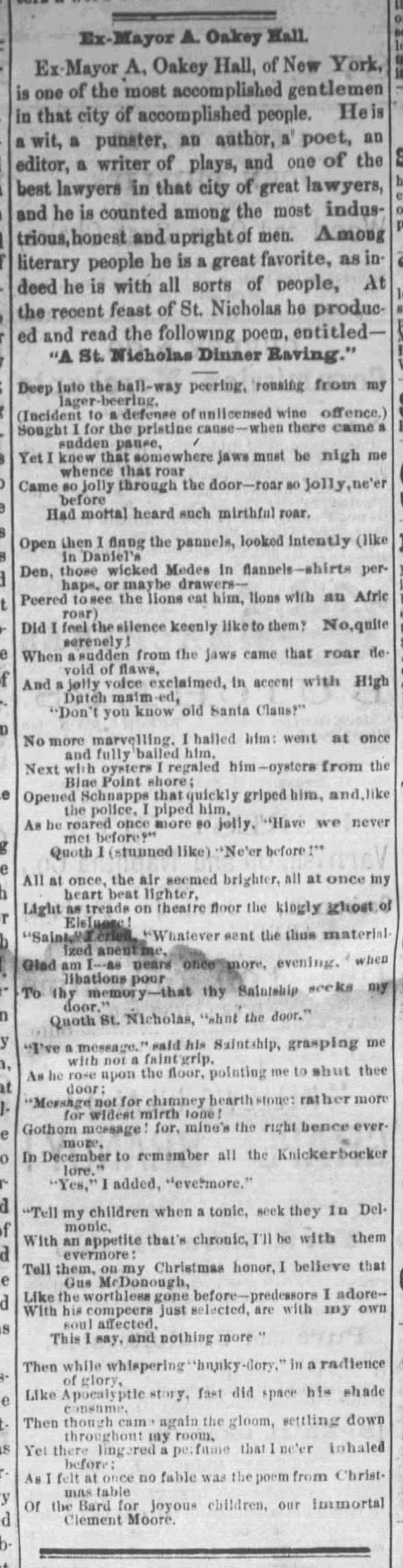
Santa Claus poem by A. Oakey Hall

A. Oakey Hall, Cabinet Photo c. 1870
Public domain via Wikimedia Commons
A la Poe in The Raven with a fine closing tribute to Clement C. Moore, author of "A Visit from St. Nicholas," as
"the Bard for joying children."
Herman Melville's old friend Abraham Oakey Hall delivered this now forgotten Santa Claus poem before The Saint Nicholas Society at their annual dinner, held on December 7, 1874 at Delmonico's (Fifth Avenue and Fourteenth Street). Monday evening, since the proper Feast of Saint Nicholas day, December 6th, fell on a Sunday that year.
"The dinner, which was served in excellent style, was enlivened by the usual Dutch peculiarities, by the burgomaster-appearance of the President [Augustus R. Macdonough], the orange neckties of many of the guests, and the almost universal smoking of tobacco in long clay pipes." --New York Herald, December 8, 1874
A partial transcription of Hall's poem was included in the account of the dinner published in the New York Herald on December 8, 1874; accessible via Chronicling America: Historic American Newspapers, The Library of Congress.
With minor variations the verse text appeared also in the Rock Island Daily Argus (Rock Island, Illinois) on December 16, 1874; and Providence Evening Express (Providence, Rhode Island) on December 21, 1874.

Not transcribed and so presumably lost are the "few introductory stanzas" read before the one that begins "Deep into the hall-way peering...." The New York Herald gives the title of Hall's poem as "A St. Nicholas Dinner Raving." In the fifth stanza all known versions print "widest mirth" where one might expect "wildest mirth." In the last line, the Herald gives "joying children" which must be right, rather than "joyous children" in the Rock Island Argus version.

New York Herald - December 8, 1874

EX-MAYOR HALL'S POEM.

After the above regular toasts were disposed of ex-Mayor Hall was called upon for a speech. In lieu of a speech he read a poem, which, after a few introductory stanzas, concluded as follows:--

A ST. NICHOLAS DINNER RAVING.

Deep into the hallway peering, rousing from my lager-beering,
(Incident to a defence of unlicensed wine offence),
Sought I for the pristine cause--when there came a sudden pause,
Yet I knew that somewhere jaws must be nigh me whence that roar
Came so jolly through the door--roar so jolly, ne'er before
Had mortal heard such mirthful roar.  
Open then I flung the panels, looked intently (like in Daniel's
Den, those wicked Medes in flannels-shirts perhaps, or maybe drawers--
Peered to see the lions eat him, lions with an Afric roar).
Did I feel the silence keenly like to them? No, quite serenely!
When a sudden from the jaws came that roar devoid of flaws,
And a jolly voice exclaim-ed, in accents with High Dutch maim-ed,
Don't you know old Santa Claus?

No more marvelling: I hailed him; went at once and fully bailed him,
Next with oysters I regaled him--oysters from the Blue Point shore;
Opened Schnapps that quickly griped him, and, like the police, I piped him,
As he roared once more so jolly, "Have we never met before?"
Quoth I (stunned like), "Ne'er before!"
 All at once the air seemed brighter, all at once my heart beat lighter,
Light as treads on theatre floor the kingly ghost of Elsinore!
"Saint," I cried, "whatever sent thee thus materialized anent me,
"Glad am I--as nears, once more, evening, when libations pour,
To thy memory--that thy Saintship seeks my door."
Quoth St. Nicholas, "shut the door."
 "I've a message, said his Saintship," grasping me with not a faint grip,
As he rose upon the floor, pointing me to shut the door;
"Message not for chimney hearthstone, rather more for widest mirth tone!
Gotham message! for, mine's the right hence evermore
In December to remember all the Knickerbocker lore."
"Yes," I added, "evermore."
 "Tell my children when a tonic, seek they in the halls Delmonic,
With an appetite that's chronic, I'll be with them evermore;
Tell them, on my Christmas honor, I believe that Gus McDonough,
Like the worthies gone before--predecessors I adore--
With his compeers just selected, are with my own soul affected;
This I say but nothing more."
Then while whispering "hunky-dory," in a radiance of glory,
Like Apocalyptic story, fast did space his shade consume.
Then though came again the gloom, settling down throughout my room,
Yet there lingered a perfume that I ne'er inhaled before;
As I felt at once no fable was the poem from Christmas Table,
Of the Bard for joying children, our immortal Clement Moore.
Wed, Dec 16, 1874 – 2 · The Rock Island Argus (Rock Island, Illinois, United States of America) · Newspapers.com
As Mayor of New York City Oakey Hall had often been mocked in cartoon caricatures by Thomas Nast. Today, of course, Nast is still celebrated for his iconic drawings of Santa Claus, particularly Merry Old Santa Claus in Harper's Weekly on January 1, 1881.

The Historical Society of Pennsylvania Digital Library has images of A. Oakey Hall's prose tale The Santa Claus Ice Palace, in manuscript.
  •  https://digitallibrary.hsp.org/index.php/Detail/objects/14813
Maybe I will get inspired and transcribe that too before Christmas.

And this, also in the HSP collection of  Abraham Oakey Hall manuscripts 1860-1890: Hall's prose history of The Evolution of Olden Manhattan Christmas.
  • https://digitallibrary.hsp.org/index.php/Detail/objects/14827
For now, I see that Oakey Hall's undated "Manhattan Christmas" narrative makes several interesting references to Clement Moore as author of "The Night Before Christmas":
... When [Peter] Minuit departed to pass the remaining Xmasses of his days at home over which St. Nicholas was presiding as Holland's National Spirit, Master Van Twiller came with yet more emigrants to celebrate additional Christmas times. Himself was in aspect no mean double of a Santa Claus: for he was good natured: & a corpulent wine bibbing Dutchman: although of looser life than St Nicholas would have tolerated. The description of Santa Claus given in Clement Moore's Manhattan rhyme would seem to fit the descriptions & pictures extant of that Merry Xmas Wouter Van Twiller. He had a chaplain in a Lutheran Dominie Bogardus: a man of mark & high character whose usual hot temper never came to the surface on Xmas day. But Santa Claus Van Twiller came to grief in 1637, being removed for diverting the monies of the Netherlands corporation to his own private use--Manhattan's original boodler--& his Christmas of that year was not for him a merry one.  --A. Oakey Hall, "Evolution of Olden Manhattan Christmas" manuscript pages 6-7.
From 1775 to 1783 under him a Merry Christmas seems to have quit New York. Then came another welcome 25th day of a month--the Evacuation day of November 25th. With Peace Santa Claus regained his Christmas throne & never thereafter has he quitted it as monarch over juvenility. For did not a Columbia College professor commemorate Santa Claus in the lyric entitled "The night before Christmas" that every New York child learns by the time he or she is seven years old? --A. Oakey Hall, "Evolution of Olden Manhattan Christmas" manuscript pages 23-24.

via Library of Congress