Thursday, March 16, 2017

Jackson on Norsworthy on “The Night Before Christmas”

Jackson on Norsworthy on “The Night Before Christmas”

Scott Norsworthy lists (February 9, 2017) “Recommended fixes” for my “flawed methodology” in Who Wrote “The Night Before Christmas”? Analyzing the Clement Clarke Moore vs. Henry Livingston Question. He believes I ought to have done some things differently.

Of course I agree with him that “Biography of the Heart of Clement C. Moore” should be added to the Moore poems investigated. His transcription of the manuscript now makes the whole poem readily available, whereas I had relied on the cut version of the poem, amounting to 72 per cent of the whole, that was printed by Samuel White Patterson in his The Poet of Christmas Eve: A Life of Clement Clarke Moore 1779–1863.    

Databases

In devising tests that distinguished between Moore’s verse and Livingston’s, I of course ignored all “Henry Plus” pieces and used the Livingston corpus that had been established on Mary Van Deusen’s “Henry Livingston” website several years before I began my investigations. The Moore and Livingston poems were listed in Who Wrote, 164–72. Norsworthy thinks I ought to exclude from the Livingston canon the Carrier Addresses, 1803 and 1819. He suggests (March 8) that the 1803 address is by Isaac Mitchell. He may be right. But in the test described in the last paragraph of the “Accuracy of transcription” section below, the 1803 and 1819 addresses both belong with Livingston rather than with a miscellaneous group of his contemporaries. It would be worth seeing how a Mitchell poem fares. Livingston’s descendants passed both addresses down through the family as his, along with some of his letters and scraps of other writing, and there are no obvious ulterior motives for their having done so. Gertrude Fonda Thomas’s ascription of CA 1803 would have come from Livingston’s daughter Jane, her mother.  But it would be possible to try excluding theses two addresses from the database and to find out whether this makes any appreciable difference in Moore versus Livingston tests of “The Night Before Christmas.”

Norsworthy also wants Moore’s translations from Italian and Greek included, repeating his insistence that verse translations are poetry and “take creative work to achieve.” This I have never denied. Of course they are, and of course they do. Whether translations from a foreign language are suitable for testing by stylometric methods (counts of rates of common words, for example) is less clear. Most attribution scholars would say that they are not. My omission of Moore’s translations was not based on “aesthetic judgements,” as Norsworthy charges, but on familiarity with the field of attribution studies. But, again, it shouldn’t be too hard to indulge Norsworthy over this matter too.

He wants me to compile statistics that from the start compare all Livingston’s poems with all Moore’s. Holding in reserve some items on which to test the efficacy of the tests is, however, common practice among attribution scholars. Norsworthy appears to imply (“too-conveniently”) some kind of sleight of hand in my following it. But in fact it is considered “best practice.” I used all the poems (except the Petrarch translation) in Moore’s manuscript notebook, including the long “Charles Elphinstone,” for this kind of checking, and found that none was, on the full combination of tests, so consistently Livingston-like as “The Night Before Christmas.” And we can now add “Biography of the Heart of Clement C. Moore” to poems reserved for checking the tests. In Figure 4 (Who Wrote, 133), which shows percentages of Livingston favored high-frequency and medium-high-frequency words combined, it would score 42.105 and so be placed in the percentage range occupied by the largest number of Moore poems and remote from where “The Night Before Christmas” near the mean for Livingston’s poems. I’ve not yet been able to check its phoneme pairs, but it is a typical Moore poem in its rates of use of “the” + “a” (6.735 as a percentage of total words) and “that” (17.347 per 1,000 words); it includes the Moore markers “in vain,” “some,” and “many a,” and one might add that it has three instances of “Oh!”—used fairly frequently by Moore but never by Livingston.

Some of Norsworthy’s sarcasm seems to be based on the assumption that my research took no account of phoneme pairs and high-and-medium-frequency words in “Charles Elphinstone,” but the results for this whole poem are reported in Chapter 18 (Who Wrote?, page 92 for words; 93 for phoneme pairs): they are in accord with the figures derived from Moore’s published poems plus the manuscript pieces “From St. Nicholas,” “To Fanny,” and “To Clem.”

I didn’t hold in reserve any of Livingston’s poems, because what mattered in the checking of tests was to find out whether they yielded “false positives” for Livingston—whether, in combination, they falsely ascribed Moore poems to Livingston.

High-frequency words and “lexical” words

No doubt Norsworthy and I could debate at length whether the rates of use of high-frequency words are less subject than choices of lexical or content words to a writer’s conscious and deliberate decision-making. But that issue is of little importance. What matters is that many empirical studies have shown that writers do in fact differ in their rates of use of high-frequency words (however conscious or unconscious their choices among them)—and indeed, I show that high-frequency words and phoneme pairs differentiate most poems by Moore from most poems by Livingston. Because they are so frequent in any piece of writing, they afford enough data to be, in combination, useful discriminators even for short texts such as poems. Attribution scholars have not found the less frequently occurring content words so effective for determining the authors of short poems. It may be possible to devise a reliable means of using words like “brains” and “visions,” but the difference between the sizes of Moore’s and Livingston’s bodies of verse would have to be taken into account—and Norsworthy wants Livingston’s to be reduced by a further 1,400 words.

Accuracy of transcription

Norsworthy urges me to check every word by Moore and Livingston in Mary Van Deusen’s transcriptions of their verse and to correct errors. Getting the text perfectly accurate is indeed desirable. I had amended some mistakes, but I agree that further effort is needed to amend them all. Doing so is most unlikely to make an appreciable difference to the counts of common words. Norsworthy notes the mistranscription of Moore’s “clad” as “glad” and of Livingston’s “sempstress” as “seamstress.” But since neither “clad,” “glad,” “sempstress,” nor “seamstress” occurs in “The Night Before Christmas,” and neither spelling of “sempstress” recurs in either poet’s verse, the authorship tests I employed are unaffected.

I am glad that Norsworthy recognizes that “Mary Van Deusen has made unquestionably valuable and enduring contributions to scholarship on Henry Livingston, Jr. and Clement C. Moore.”

I agree that it would be a good idea to combine counts for capitalized and uncapitalized words. I have done this for a follow-up study that finds high-frequency words and phoneme pairs that combine to distinguish Livingston’s verse from a similarly-sized corpus of verse by contributors to the newspapers and journals in which he published, and that places “The Night Before Christmas” with the Livingston poems. It remains true, however, that when capitalized and uncapitalized words are differentiated, the “Livingston-favored words” results show “The Night Before Christmas,” along with the majority of Livingston’s poems, falling beyond Moore’s range (Who Wrote, 133).

Similes

Norsworthy notes the many similes in “The Night Before Christmas” and observes that Moore is much more partial to similes than Livingston. Joe Nickell had made the same point in 2003, and I answered it in Who Wrote, 89. As Norsworthy says, most similes are signalled by “like,” a word that Moore uses at a much greater rate than Livingston. But “like” is duly counted among “Moore-favored words” in the test of “medium-high frequency words” described in Chapter 17. Despite NBC’s total of eight uses of this word—“six of them crowded into a mere nine lines, in a manner unique within either poet’s work” (Who Wrote, 89)—the overall percentage of Livingston-favored test words associates NBC with Livingston. To Norsworthy the “profusion of similes” in “The Writing of Hezekiah” “seems unusual for Livingston and possibly indicates a different writer.” But the poem was published—in the Country Journal and Poughkeepsie Advertiser, to which Livingston contributed other pieces—over his pseudonym “R,” and the four similes within eight lines derive from Isaiah 38: 9–20, on which “Hezekiah” is loosely based. “Hezekiah” nevertheless scores 64.286 for its percentage of the combined Livingston-favored words graphed in Figure 4 (Who Wrote, 133), which places it within the five per cent range that contains the largest number of Livingston poems. (It has too few test phoneme pairs to qualify for inclusion in Figure 3.) Since another of Livingston’s poems takes off from Isaiah 65: 25, “The Writing of Hezekiah” cannot reasonably be banished from the Livingston canon.

Norsworthy is right that more extended similes are to be found in Moore’s verse than in Livingston’s, but the comparison of the upward flight of St Nick’s reindeer to leaves before a hurricane does not seem beyond Livingston. While “coursers” appears once in Moore’s verse but not in Livingston, Livingston, in his smaller corpus, twice mentions hurricanes, and Moore never does. The extended similes by Moore that Norsworthy cites come from the long and ambitious “A Trip to Saratoga” and “Charles Elphinstone.” It is hardly surprising that elaborate similes do not appear in Livingston’s puzzle-poems. The livelier Livingston similes that Norsworthy cites are from longer pieces that are neither rebuses not acrostics, and he might have added others, such as: “My dear native village I scarcely can see / I’ll hie to my home like the tempest-tost bee” (where the bee is windblown like the leaves in NBC); or the portrayal of the lapdog Belle, “Like a sweet pretty lady she bridled her chin / And trip’d o’er the floor like another Miss Prim”; or the description of little “Master Timmy brisk and airy / Blythe as Oberon the fairy.”

Variant versions

Norsworthy wants me to “deal with the problem of different versions” though he “can’t think of any easy fix.” I don’t believe any “fixing” is needed.  I based my corpus of Moore’s verse on his Poems (1844), which gave the texts he approved for final publication, and, on Moore’s autographs of poems that had not been printed. That still seems to me a reasonable decision. Norsworthy has tracked down and put on his website a few earlier published versions of poems that Moore included in his Poems (1844). He notes that in 1824 Moore’s “Lines Written after a Snow-Storm” were printed in the Troy Sentinel, where “ivy bowers” “is probably a copyist’s or printer’s error for ‘icy bowers’,” the Poems reading, and concludes that if we reject “ivy” from Moore’s corpus we should also reject from NBC the Sentinel’s “Dunder and Blixem,” “later revised by Moore” to “Donder and Blitzen.” But “ivy” is an obvious single-letter misprint, and makes no sense in the context, whereas “Dunder and Blixem” makes excellent sense and is most unlikely to be due to complex scribal or compositorial corruption for the reasons I spelt out in my “Response to Scott Norsworthy.”  Presumably this is why Norsworthy now writes of Moore’s having “revised.” If this implies that the Sentinel’s version of the NBC couplet was Moore’s own original version, Norsworthy needs to explain why that version of the couplet has the Livingston features (Dutch oath, nasal half-rhyming final syllables, idiosyncratically placed exclamation marks) that I noted in my “Response.”

If we were to take Poems (1844), instead of the original Sentinel printing, of NBC as our text for testing, the poem would gain an instance of Moore-favored “that” and lose an instance of Livingston-favored “was,” but there would be no change to Livingston-favored or Moore-favored phoneme pairs, and neither of the graphs on Who Wrote, 132–3—showing NBC beyond Moore’s range for both Livingston-favored phoneme pairs and Livingston-favored common words—would require alteration.

Trigrams

I agree with Norsworthy that for trigrams shared with “The Night Before Christmas” I ought to have carefully checked all Moore’s manuscript poems that I had held back for “checking the tests.” The incidence of shared trigrams was one test that I failed to check in the previously withheld material. Had I done this checking I would have discovered that shared trigrams are ineffectual for distinguishing between Moore and Livingston as candidates for the authorship of “The Night Before Christmas.”

Norsworthy (March 6) has found trigrams that the poem shares with Moore’s manuscript poems, and two in Poems (1844) that I missed because the three-word sequences are interrupted by commas: one with “The Pig and the Rooster”  that reads “Pig turn’d, with a grunt, to his mire anew,” where “with a grunt” intervenes between the beginning and end of the phrase “turn’d . . . to his mire,” so that the syntax is rather different from “turn’d with a jirk” in “The Night Before Christmas;” and another with “The Water Drinker,” where “I, in my” matches “I in my” in NBC. He also lists “and then, in” in “Charles Elphinstone.” Let’s, for the sake of argument, accept these punctuated trigrams as matching the unpunctuated counterparts in NBC.

To Livingston’s matches I can now add “his eye and,” not used by Moore.

So far as I can see, the situation is now that Livingston has three NBC trigrams that are not used by Moore—“new fallen snow” / “new fall’n snows,” “meet with an” / “meet with a,” and “his eye and”—while Moore has nine that are not used by Livingston: “I, in my,” “not a word,” “as the snow,” “and then, in,” “turn’d, with a,” “in a moment,” “of his eye,” “the breast of,” “top of the.”  Moore is here credited with “top of the,” since “the top of the,” found in NBC and once in Moore’s “Irish Valentine,” contains not only “the top of” but also “the top of.” Norsworthy judges that the numbers “strongly support the claim for Clement C. Moore.” But he fails to take account of the fact that a Moore corpus including “Charles Elphinstone,” “Biography of the Heart of Clement C. Moore,” and the shorter manuscript pieces is three times the size (in terms of total numbers of words) of the Livingston corpus. “Charles Elphinstone” alone contains more words than the full Livingston corpus. So the numbers of trigrams that NBC shares exclusively with Moore (9) or with Livingston (3) are exactly proportional to the sizes of their poetic corpora (3 to 1).

Of the trigrams that are used by one of the poets but not the other, only  Livingston’s “new fall’n snows” and “meet with a” and Moore’s “turn’d, with a” are rare enough to be found thirty or fewer times in Literature Online poetry of 1750–1850. All the others occur over fifty times, most of them well over a hundred times. So Moore’s are not, as a group, less common than Livingston’s.

If we focus on trigrams shared with NBC but not necessarily exclusive to either poet, and count the numbers of instances, we find that Moore uses “the breast of” twice, “not a word” twice, “to the skies” five times, “the top of” twice, “out of sight” once, and the other seven of his exclusive ones once each, giving a total of nineteen occurrences, whereas Livingston uses “to the skies” four times, and “the top of” and “out of sight” once each, along with single instances of his three exclusive ones, giving a total of nine occurrences. So Livingston’s rate of use, in proportion to the size of his corpus, considerably exceeds Moore’s.

It might be pointed out that “the top of” occurs twice in NBC, which could be said to create four links to Moore (2 x 2) and two (2 x 1) to Livingston, and that since each instance in NBC is actually “the top of the,” which incorporates the further repeated trigram “top of the,” Moore’s one instance of “top of the” might also be doubled. Allowing these adjustments would bring the totals to ten for Livingston, twenty-two for Moore, with Livingston’s rate of use, in proportion to the size of his corpus still exceeding Moore’s.

I noted in my book, however, that one of Moore’s examples of “to the skies” affords a more extended correspondence with NBC, its “mount to the sky” finding a parallel in Moore’s “mounts . . . to the skies” in “The Organist.”  On the other hand, as I also noted, Livingston uses “in a moment” no fewer than five times in his far from voluminous prose. And we might add that the poems categorized as “Henry Plus,” or possibly Livingston’s, and which amount to two-thirds the size of “Charles Elphinstone,” afford three further instances of “to the skies” and one of the singular “to the sky” of NBC, and also an instance of “the top of the.”

The upshot is, I think, that trigrams end up telling us “nothing, neither way” about the authorship of “The Night Before Christmas.”

Only a small proportion of Livingston’s poems survive, mostly from the period 1776–90. You can see how the size of the corpus affects trigram results by comparing trigrams in Livingston’s with trigrams in “Charles Elphinstone,” which is larger by about eight hundred words than all Livingston’s verse combined. Livingston has five trigrams not in CE (the three that Moore doesn’t use anywhere plus “the top of” and “out of sight”), while CE has five not used in Livingston’s verse: “in a moment,” “the breast of” (twice), “of his eye,” “and then, in,” and “not a word.” Counting all instances of trigrams shared by Livingston or CE with NBC, we can add to CE’s total “to the skies” and the second instance of “the breast of” to get seven; and to Livingston’s total four instances of “to the skies” to get nine.

Norsworthy also cites a few collocations that link NBC to Moore’s verse, but in doing so he enters Moore in a one-horse race that he alone can win: mere gathering of similarities with NBC from a single author cannot establish his authorship.

Norsworthy mentions that “Irish Valentine” contains the rhyme “snow”–“below,” not counted in my chapter on “Rhyme Links.” But of course it wasn’t relevant to that context, since “Irish Valentine” was one of the poems reserved for checking the tests, and in Chapter 18 the instance of the rhyme in that poem is duly recorded (Who Wrote, 99).

Norsworthy has now encountered the attribution technique that analyses “word adjacency networks,” which he thinks “looks promising.” In “Attributing the Authorship of the Henry VI Plays by Word Adjacency,” Shakespeare Quarterly, 67 (2016): 232-56, Santiago Segarra, Mark Eisen, Gabriel Egan, and Alejandro Ribeiro report on the application of the technique to some Shakespeare First Folio plays. How well the technique would work on short poems remains untested. But another mathematically sophisticated technique, derived from signal testing and called “modal distance,” did well on 500-word blocks of verse: it measures the extent to which authors use, or avoid using, certain words together. It is described by Ward E. Y. Elliott and Robert J. Valenza, “A Touchstone for the Bard,” Computers and the Humanites, 25 (1991), 199-209, and “Was the Earl of Oxford the True Shakespeare? A Computer-Aided Analysis’, Notes and Queries, 236 (1991): 501-6. But I know of nobody except Elliott and Valenza who can apply it.

Happy Christmas

Norsworthy certainly shows that wishing somebody a “Happy Christmas,” rather than a “Merry Christmas,” was much less rare in Livingston’s and Moore’s time than in Literature Online, though several of his examples are not of the direct wish, as in NBC’s “Happy Christmas to all.” I happily grant that Norsworthy is brilliant at digging out this kind of information.

MacDonald P Jackson
March 13, 2017

Related posts

  • Recommended fixes
    http://melvilliana.blogspot.com/2017/02/recommended-fixes-for-macdonald-p.html

Tuesday, March 14, 2017

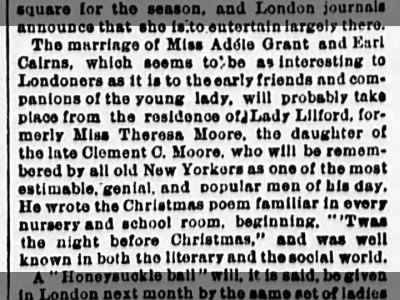
Clement C. Moore, "one of the most estimable, genial, and popular men of his day"


... the late Clement C. Moore, who will be remembered by all old New Yorkers as one of the most estimable, genial, and popular men of his day. He wrote the Christmas poem familiar to every nursery and school room, beginning, "'Twas the night before Christmas," and was well known in both the literary and the social world.
--The New York Sun, May 16, 1886

Moby-Dick in Rhode Island

From the Providence, Rhode Island Manufacturers' and Farmers' Journal, December 1, 1851; found in the online archives of Historical Newspapers at Genealogy Bank:

LITERARY NOTICES.

We have received the following books from G. H. Whitney:
MOBY-DICK, OR THE WHALE. By Herman Melville. New York: Harper & Brothers.

Twenty-five years ago, two or three such books as Typee and Omoo would have been enough for a man's reputation, but now it has been well said, good books are so plenty that they are like beautiful women in a crowd, who pass by before one has an opportunity to fall in love with them. If, in the abundance of new publications, Mr. Melville's old books must be shoved aside, we are glad to see that his new ones come to take their place. No one has equalled him in the romance of the Pacific. He invests savage life with charms such as were never found in it before, and his description of the ocean and of the ship have a fascination that binds the reader to his pages. We have read Typee more than once, we have forgiven Mardi, and we shall turn with the assurance of new enjoyment to Moby-Dick.

Monday, March 13, 2017

1819 Carrier's Address with Santa and Sugar Plums

This New Year's ditty appeared on January 9, 1819 in the Weekly Visitor And Ladies' Museum, a short lived "parlor" newspaper published 1817-1823 in New York City by Alexander Ming. I doubt Henry Livingston had anything to do with the ponderous 1819 Carrier's Address in the Poughkeepsie Journal. But even if he wrote all of that one, this one from the same year has more of the domestic details and Knickerbocker spirit that would enliven Clement C. Moore's "A Visit from St Nicholas," first published in Troy four years later. Unlike Moore, Carrier Boy and his patrons still connect Old Santaclaus with New Year's festivities, rather than the celebration of Christmas Eve or Christmas Day. Found in the online Archives of Historical Newspapers at Genealogy Bank:

Weekly Visitor (New York, New York)
January 9, 1819


ADDRESS OF THE CARRIER
of the
WEEKLY VISITOR,
AND LADIES' MUSEUM,
To his Patrons January 1st, 1819.
This DAY, which ever brings good cheer,
To usher in the Happy Year, 
I come to wish you Health and Joy—
A VISITOR—Your CARRIER Boy.
     In days of old, you know the fact is—
This was Old Knickerbocker's practice:
To treat with New-Year's Cake and dram
The Boys of then New Amsterdam.
Ah, then his humane heart would melt,
And out would come his hoarded geldt—
Tho' dead (God bless him!) now and rotten
Be ne'er his generous ways forgotten.
While young and old so gay and pleasant
Exchange their New Year's wish and present;
While children round their parents press
With clamor,—anxious to possess
The Stocking, hoped with riches fraught;
Which good Old Santaclaus has brought;
Who yearly down the chimney comes
With Rods and Toys and Sugar-Plums,
And leaves for naughty girls and boys
The whips—but for the good, the toys—

Midst all these scenes of festive glee
I hope you will remember me;
Think how I trudge thro' Snow and Rain,
Thro' Cold and Heat and ne'er complain:
And weekly bring to please you, many
A Tract of useful MISCELLANY;
For I can truly boast my trade is
From morn 'till night to Please the Ladies.
I tell of "Hair breadth" 'scapes, and danger—
"Apothecary"—"Child of a Stranger"—
Recount what fates the loves befel
Of Nemorin and Fair Estelle—
With names of couples newly wed,
And many number'd with the dead,
Your SMILES alone my only pay,—
And TRIFLING GIFT on New-Year's Day.
Bestow but these, and I'll depart
And bless you with a grateful heart:—
So may you live exempt from woes,
And never be in want of Beaux,—
And Husbands kind to crown your joy,
Sincerely prays your
CARRIER BOY.

Sunday, March 12, 2017

Henry Ellis on Eskimos, copied by Henry Livingston

Both the prose sketch and engraving "Of the Esquimaux Indians" published in the New-York Magazine for May 1792 over the signature of "R." were copied from original prose and pictures in A Voyage to Hudson's Bay by Henry Ellis. Figures in the 1792 engraving are redrawn from original illustrations that were first published in 1748, then re-engraved in later translations, editions, and anthologies. Below, an image of the original engraving from the 1748 London edition via Library and Archives Canada.


Below is the picture attributed to Henry Livingston, Jr. via the page for Henry Livingston's Prose on Mary S. Van Deusen's great Henry Livingston website. What happened to the igloo and icebergs?

Esquimaux Indians via Henry Livingston's Prose
Correspondence from "R." with Henry Livingston's illustration of Eskimos is acknowledged by the editor of The New-York Magazine in the March 1792 issue:
"Thanks are due to our esteemed friend R. for his communications.-- The view of the Esquimaux Indians merits attention."  --The New-York Magazine - March 1792
The prose sketch and picture titled "Esquimaux Indians of Hudson's Bay" appeared in the the May 1792 issue. As indicated by credits in the lower margin, the picture was drawn by "H. Livingston" and engraved by "Tiebout," presumably Cornelius Tiebout who worked for New York publishers in the early 1790's.
Except for the anti-romantic vent in the last paragraph, Livingston's prose description of "Esquimaux" people in the New-York Magazine is copied nearly verbatim from Henry Ellis.

"R." in the May 1792 New-York Magazine:
They are robust and inclinable to be fat; their heads are large, and their faces are almost perfectly round and very flat; their eyes are small and black, but very expressive; their hair black and lank: although their limbs are generally well proportioned, their feet are extraordinary small. Their behavior is cheerful and sprightly, but they seem to be very subtle, cunning, and deceitful; great flatterers, much addicted to pilfer from strangers, easily encouraged to a degree of boldness, but as easily frighted.
Henry Ellis in A Voyage to Hudson's Bay (Dublin, 1749):
These People are of a middle Size, robust, and inclinable to be fat, their Heads are large. Faces round and flat, their Complexions swarthy, Eyes black, small and sparkling, Noses flat, Lips big. Hair black and lank, Shoulders broad. Limbs proportionable, but Feet extraordinary small. Their Behaviour is chearful and sprightly; but they seem to be very subtle, designing, cunning and deceitful, great Flatterers, much addicted to pilfer from Strangers, easily encouraged to a degree of Boldness, but as easily frighted.  --Henry Ellis, Voyage to Hudson's Bay
 "R." in the May 1792 New-York Magazine:
Two small canoes passing Hayes's River, got to the middle of it, when one of them sunk, in which was an Indian man, his wife and child: the other canoe being small, and incapable of receiving more than one of the parents and the child, produced a very extraordinary contest between the man and his wife; not but that both of them were willing to devote themselves to save the other, but the difficulty lay in determining which would be the greatest loss to the child. The man used many arguments to prove it more reasonable that he should be drowned than the woman; but she alleged on the contrary, it was for the advantage of the child that she should perish, because, he, as a man, was better able to hunt, and, consequently, to provide for it. The little time there was still remaining, was spent in mutual expressions of tenderness; the woman strongly recommending, as for the last time, to her husband, the care of her child. This being done, they took leave in the water; the woman quitting the side of the canoe, was drowned, and the man, with the child, got safe on shore.
Henry Ellis - A Voyage to Hudson's Bay
... Two small Canoes, passing Hayeses River, when they had got to the middle of it, one
of them, which was made of the Bark of a Birch Tree, sunk, in which was an Indian, his Wife and Child: The other Canoe being small, and incapable of receiving more than one of the Parents, and the Child, produced a very extraordinary Contest between the Man and his Wife, not but that both of them were willing to devote themselves to save the other, but the Difficulty lay in determining which would be the greatest Loss to the Child. The Man used many Arguments to prove it more reasonable, that he should be drowned than the Woman. But she alledged on the contrary, it was more for the advantage of the Child, that she should perish, because he, as a Man, was better able to hunt; and, consequently, to provide for it. The little Time there was still remaining, was spent in mutual Expressions of Tenderness, the Woman strongly recommending, as for the last Time, to her Husband, the Care of her Child. This being done, they took leave in the Water; the Women quitting the Canoe was drowned, and the Man with the Child got safe a-shore and is now taken much Notice of by the People thereabouts.
-- Henry Ellis, A Voyage to Hudson's Bay
Unfortunately, the groundless "controversy" over Livingston's alleged authorship of "The Night Before Christmas" has distracted attention from the kind of scholarship that might lead to a better understanding of real contributions by Henry Livingston, Jr. to American literature and culture in the late 18th century.

Saturday, March 11, 2017

Herman Melville's sketch of his uncle, Thomas Melvill, Jr.

Much abridged, Herman Melville's reminiscence of Major Thomas Melvill, Jr. was published in The History of Pittsfield by Herman's friend and former neighbor J. E. A. Smith. Below I give Melville's complete sketch, with missing text supplied from the transcription by Merton Sealts, Jr. in his article on "Thomas Melvill, Jr., in The History of Pittsfield," Harvard Library Bulletin 35.2 (Spring 1987): 201-217. As Sealts reports, the manuscript copy (not in Melville's handwriting) is in the Gansevoort-Lansing collection, Manuscripts and Archives Division, The New York Public Library.

This image is from my personal copy of the 1987 article by Sealts in the Harvard Library Bulletin:

SKETCH OF MAJOR THOMAS MELVILLE JUNIOR
BY A NEPHEW

I have been asked to contribute to the History of Pittsfield some personal reminiscences of the late Major Thomas Melville Jr. long a resident of that Town.
As the request comes—and somewhat urgently—from a near relative I willingly comply though having known my uncle only in the latter and uneventful portion of his life my reccolections are somewhat meagre.
It may be well to begin with a brief recital of his career prior to his residence in Pittsfield.
He was born in Boston in the year 17— [1776] the eldest son of Major Thomas Melville of the Boston Tea Party and an officer of the Revolution, with whose cocked hat & small-clothes, worn to the end of his life, passed away probably the last vestige in New England of the old costume.
In early life at the age of seventeen some time towards the close of the last Century he sailed to France, and eventually became a banker in the Capitol. There he resided until about the year 18— [1811.] Consequently he was familiar with the stirring events which took place in that Country from the closing years of the Republic through the Consulate, and down to a period towards the collapse of the first Empire.
At that time when the part which France had taken in our War of Independence was still fresh in the minds of both Countries, no foreigners were so cordially welcomed into French society as the Americans.
Indeed the friendleness [friendliness] was if any thing, stronger on the French side than on ours, & for this reason, it may be, that the gratitude of the beneficiary seldom exactly comes up to the good will which the benefactor in some instances feels towards him. Under such auspices any young countryman of Washington, if possessed of the requisite manners found his way easy and delightful in the bright circles of the City on the Seine.
So fared it with my kinsman, as I have every reason to infer.
In certain departments the business of a European Banker makes it his interest to be hospitable. If his disposition coincide with his interest, his entertainments may be often extremely agreeable from the piquant mixture of the Company. The polite Bostonian's dinner in Paris lacked not as I have been told this quality, nor the zest of a very social nature in the host. Many distinguished countrymen did he from time to time entertain at his table, together with the Frenchmen of note invited to meet them. Among others, I have frequently heard him name Lafayette.
In the year 1800 my father Allan Melville, then quite young, made his first visit to Europe, and was for some month's the banker's guest. Though the brothers were never closely connected in business, they always retained a warm feeling for each other.
Of an enterprising & sanguine temper—too much so indeed—my uncle aside from his special vocation, engaged in various tempting ventures, incident to the wars then convulsing the Continent. Naturally he shared in many fluctuations.
I remember his telling me that upon one occasion, after prosperously closing in London some considerable affair, he held in his hands, before a cheery coal fire, the proceeds—negotiable bills, and for so large a sum, that he said to himself—holding them at arms length—"This much is sure—here it is—the future is uncertain—break off then, and get thee back to Boston Common." But a false friend—Hope by name (not one of the noted Amsterdam House) advised to the contrary.
Eventually such reverses overtook him, that recrossing the Ocean he returned to his father's roof. With him he brought—and to a strange land for them—his wife & two [four] young children: for as— I should have previously mentioned—he had married in Paris, the bride being a lady of Spanish extraction.
A miniature I have seen of her, presents a countenance of much beauty and of that kind which forcibly arrests the attention.
The War of 1812 breaking out about this time, he received an appointment as Commissary with the rank of Major, and was stationed at Pittsfield.
Thither were sent many prisoners from the Canadian frontier. These were lodged on grounds, then without the village, and known as "The Cantonment." 
 Subsequently he bought the Estate on the Lenox Road, now 1870 the property of Mr. John R. Morewood, a New York merchant.
The purchase was made of the occupant Mr. Elkanah Watson, a gentleman whose interesting life of travel & observation in an era of Historic importance, has been recorded in an entertaining volume by his son. 
The Estate was originally owned and the mansion & extensive offices built, at an early period by Mr. Henry Van Scha[a]ck a rich Mynheer & for those days an adventurous emigrant, from the adjoining river country of the old Patroons. 
Some of the large barns have been burned, others have decayed, and new buildings substituted therefor.

But the mansion still stands, though somewhat changed, and partly modernized externally. 
It is of goodly proportions, with ample hall, & staircase, carved wood-work & solid oaken timbers, hewn in Stockbridge.
These timbers as viewed from the cellar, remind one of the massive gun deck<s> beams of a line-of-battle ship. On this farm Major Melville interested himself largely in the raising of sheep and improvement of their breed, also in the introduction of some crops not previously known in the county. 
 He was the second President of the Berkshire Agricultural Society and had much to do with originating it.
Not far from this period his foreign wife paled and withered a transplanted flower.
His second bride an exemplary lady, was a ward of Gen. Dearborn of Roxbury Mass.
Ultimately he experienced new misfortunes; and living in the plainest way became a simple husbandman, though of broad acres, whereof many lay fallow, or in lake or pasture.
Near this period I first saw him. It was in 1831, I think, at evening, after a summer day's travel by stage from Albany. Well do I remember the meeting, upon that occasion, between him and my father. It was in the larch-shaded porch of the mansion looking off, under urn-shaped road-side elms, across meadows to South Mountain.
They embraced, and with the unaffectedness and warmth of boys—such boys as Van Dyke painted.
In 1836 [1833] circumstances made me for the greater portion of a year an inmate of my uncle's family, and an active assistant upon the farm. He was then grey, but not wrinkled; of a pleasing complexion; but little, if any, bowed in figure; and preserving evident traces of the prepossessing good looks of his youth.
His manners were mild & kindly, with a faded brocade of old French breeding which—contrasted with the surroundings at the time—impressed me as not a little interesting, nor wholly without a touch of pathos.
He never used the scythe, but I frequently raked with him in the hay-field. At the end of a swath, he would at times pause in the sun, and taking out his smooth-worn box of satin wood, gracefully help himself to a pinch of snuff, partly leaning on the slanted rake, and making some little remark, quite naturally, and yet with a look, which—as I now recall it—presents him in the shadowy aspect of a courtier of Louis XVI, reduced as a refugee, to humble employment in a region far from the gilded Versailles.
At that period on Sundays between services, the broad bar-room of the principal tavern of Pittsfield—long since removed—situated on the village square, was the convenient resort, (not for unsober purposes, since the decanters were inexorably closed) of many church attendants whose dwellings were at a distance. Here too dropped in the magnates of the village. Eminent among them was the late Edward A. Newton, well known as a man of fortune, who had travelled, and who lived with all things handsome about him, like the old English Squire in the play.
The exchange of salutations and pinches of Rappee, between this tall & stately gentleman, and my plainly clad but courtly kinsman, presented a picture upon which the indigenous farmers there assembled, gazed with eager interest, and a kind of homely awe. It afforded a peep into a world as unknown to them as the Vale of Cashmere to the Esquimaux Indian.
To the ensuing conversation, also, they listened with the look of steers astonished in the pasture at the camel of the menagerie passing by on the road. It is different now. Those primitive days, with whatever picturesqueness pertained thereto, are gone with the old Elm of the Green.
By the late October fire, on the great hearth of the capacious kitchen of the old farm-mansion I remember seeing the Major frequently sit, just before early bed time, gazing into the embers, his face plainly expressing to a sympathetic observer, that his heart—thawed to the core under the influence of the genial flame—carried him far away over the ocean to the gay Boulevards.

Suddenly under the accumulation of reminiscences, his eye would glisten, and become humid: and with a start he would check himself in his reverie, give an ultimate sigh; as much as to say, "Ah, well!" & end with an aromatic pinch of snuff. It was the French graft upon the New-England stock, which produced this autumnal apple; perhaps the mellower for the frost.
Let it not be inferred here from that the amiable side of my uncle's character partook of indolence. On the contrary he was of a very industrious and methodical turn of mind. Mighty folios of accounts, dating back to the days when he was commissary, with laborious diaries of the farm, remain monuments of his diligence.
By the hearth fire above mentioned, he often at my request, described some of those martial displays and spectacles of state which he had witnessed in Paris in the time of the first Napoleon. But I was too young & ignorant then, to derive the full benefit from his pictorial reccollections.  
Nor though he possessed so much information, and had a good understanding was his mind of that order which qualifies one for drawing the less obvious lessons from great historic events happening in one's own time, and under one's eyes. 
In 1837, though advanced in years, the Major yielding to strong inducements, and with a view of ultimate benefit to his children went to Galena in Illinois, there to occupy a responsible position in a mercantile house.
Eventually when circumstances permitted his family joined him.
In 1841 [1840] I visited my now venerable kinsman in his western home, and was anew struck by the contrast between the man and his environment.
He died at Galena in 184- [1845] not without the consolation of knowing that his venturous removal so late in life to what was then the remote West, had in part been already attended with many happy results to his family, the promise of which benefits had generously impelled the step.

But enough. He survives in my memory a cherished inmate—kindly and urbane—one to whom, for the manifestations of his heart, I owe unalloyed gratitude and—for the rest—pleasingly though strangely associated with Tuileries and Taghconics.
[--Herman Melville]

Wednesday, March 8, 2017

More poetry by Isaac Mitchell in the Political Barometer

Of numerous Carrier Addresses indexed online by Mary S. Van Deusen, only one in 1787 seems definitely attributable to the Poughkeepsie poet Henry Livingston, Jr. Manuscript evidence exists only for the 1787 Address which is written out in Livingston's manuscript book.

Harry Croswell, the young Federalist editor of two newspapers in Hudson, New York (The Balance and The Wasp), criticized everything about his Jeffersonian nemesis Isaac Mitchell, including Mitchell's versified New Year's Addresses in the Political Barometer. Like the 1804 and 1805 Addresses that Croswell (most likely Croswell, rather than senior partner Ezra Sampson) slammed in the Balance, the 1803 Address in the Political Barometer was probably composed by Isaac Mitchell, who founded and co-edited the Barometer with Jesse Buel.

Among other of his enterprises in Poughkeepsie, Isaac Mitchell conducted the Dutchess County Academy.

Found on Newspapers.com powered by Newspapers.com

Mitchell introduced his fledgling newspaper in verse with the following "Proem," printed in the Political Barometer on June 8, 1802. Distinctively, Mitchell rhymes the French word "l'argent" with "wrong."
That to secure the prize, l'argent,
He'll choose the right side--or the wrong. 
Mitchell's l'argent/wrong rhyme anticipates the rhyme of l'argent with "song" in the 1803 News-boy's Address. 
For then, cockahoop with the magical song,
That charms from your purses the glittering l'argent,
The 1807 Carrier's New Year's Address in the Political Barometer also features l'argent as an end-rhyme, this year with long. (The correct l'argent is mistakenly transcribed "l'argeat" on the Henry Livingston website.)
Our merchants sell cheap if you'll bring the l'argent!
And our taverns deal nectar, boys, all the day long!


FORTH from the groaning, griping Press,
Array'd in typographic dress,
I to the world, am dragg'd along,
Prepar'd to hail you with a song.
"A song!" bawls out the man of news,
Is this the stuff you mean to use?
Plain, though the bait, the hook I see,
Catch birds with chaff--you'll not catch me."
Up starts young Frip--"I'll tell you plain,
I hate this newsing, nonsense strain;
We brawlie lads, all spunk and hearty,
Care not for war and Boonapartee;
Tell us of dress, that's first in ton,
And how the gay world dances on,
With fashions fresh brought o'er the sea,
Quite alamode de la Paris."
"This ne'er will do," replies old Lumpkins,
Point out some plan: increase our pumpkins;
Our corn to raise with easier toil,
Or, void of cost, to enrich our soil;
Or, with less pains our hogs to fatten,
And when for price good chances happen."
Up rose a puny-hearted fellow,
Of aspect sore, and visage sallow--
"Give us," says he, "some tales of love,
"The whispering vale and echoing grove,
The flowery fields, the garden's bloom,
And gales ting'd with their rich perfume-----."
"Hold!" bawls a wonder-hunting wight,
(Dole, death and danger his delight)
"No milk and water tales for me,
Give us loud storms which rock the sea;
Or earthquakes, swallowing towns of fame;
Or cities all enwrapt in flame;
Or thunders, shaking either pole;
(Far off, not near, I'd have them roll)
Tell us of pigmies, six feet high,
Or giants tow'ring through the sky;
Or thousands fall'n on battle's plain,
While we at home, in peace remain."
A lawyer and physician, next.
With him who twirls and twists a text,
Strait raise their voices, loud declaring,
What they've to say is worth the hearing:
One talks of writs, demurs, and pleadings,
And one of bolusses and bleedings,
While t'other tracks the bishop's gown,
Quite to the days of Peter, down.
"Zounds!" cries a grogman, o'er his bowl,
"You've he--he--hit it--on my soul!
Bishops and pumpkins--love and thunder!--
Physic and hogs--and--tales of wonder!--
What! print all this?--'tis a queer job!--
"Qu--queer, by Jove!--Landlord! More grog!"
Near, stands a politician, sly,
With sneering phiz, and leering eye,
Who not one word attempts to say;
He knows full well who'll win the day;
Full well he knows, before 'tis utter'd,
Which side the Printer's bread is butter'd--
That to secure the prize, l'argent,
He'll choose the right side--or the wrong,
And wheresoe'er he takes his stand,
He'll try, at politics, his hand.
On wings of speed I haste away.
Still hurried on by night and day:
Sometimes on post-horse, pack'd with care,
I'm hawk'd about, like pedlar's ware;
Sometimes in stage, at ease, I ride,
Gay belles and beaux attend my side;
To great men's tables oft admitted,
And with the straw-thatch'd cot I'm fitted;
East, west, and north, and south I fly,
And once a week I live and die.
Where'er I come, some praise I find,
Yet blame will oftimes sour my mind,
Miss Nan I bring some soothing strain,
Just form'd to hit her love-fraught brain,
And her, all night, in sheets, I rest with,
A bliss, gallants have ne'er been blest with.
Then next (ye stars!) old goody Blakes,
Me, roughly, by the foretop, takes,
While o'er her shoulder, grannum Jewks;
Through two large, google, glass eyes looks,
And while she thrice my name repeats,
Thus, to her crony husband, squeaks:
"O John! Dear John! What kind of cretur
Is that same thing call'd Barometer?"
"Barometer," roars surley John,
"I think 'tis call'd by neighbor Tom:
He says it feeds and lives on air,
Soars when it rains, and sinks when fair,
And warns you 'gainst the gossip's rules,
Lest you get duck'd with gadding fools;
It rises as your tempers do,
And falls, and settles with them too;
Frowns when you scold, laughs when you're mum
And ties the wrangling female's tongue*--"
"Stop there, good John," old Jewks replies,
"My tongue, till death, receives no ties;
If what you say be true, I sweer,
No Broomeater shall enter here."
This said, her fist is clench'd, and I
Think best, with post, away to fly,
Lest rattling storms around us roar,
And John sinks, sneaking, out of door.
Now here I'll close my vers'fication,
With one brief, pointed observation--
When on one plan the whole can fall,
I then will please my readers, all.
*John's description, here, of the powers of the Barometer, is a little inaccurate--in this, however, he is excusable, as the ignorant often believe what they wish to be true. 
The first installment of Mitchell's prose romance Albert and Eliza appeared on the same page with his "Proem." Using the pseudonym "Robert Rusticoat," Croswell of The Wasp subjected Mitchell's Proem to an elaborate "Critique":
MITCHELL, in the first number of the Barometer, bespattered a whole column, with what he called a "Proem;" and a sillier thing, perhaps, never appeared in print. Tho' it is, in fact, beneath criticism; yet I cannot refrain from troubling my readers with a few extracts and remarks.... Wasp, July 7, 1802
Glossing l'argent as "money," Croswell explicates the French word in its context as a "precious confession":
This, Mitchell, I believe is strictly true. I have no doubt, that you would, FOR MONEY, not only take "the right side--or the wrong"--but would FOR MONEY, do almost any thing, short of writing common sense.
Harry Croswell's relenteless mockery of Mitchell carried over to the July 17, 1802 issue of The Wasp: 
POET MITCHELL, is greatly enraged at my Critique on his proem, and I don't wonder--for it is said that he considered this same proem as one of the handsomest and prettiest pieces of verses that he ever penned. This I am not disposed to doubt, for though he has written a vast deal of poetry, his proem, in all probability, is the least exceptionable of the whole--He had vainly puffed himself up with an idea that he was one of the greatest geniuses of the age. Nay, he really believed, that impartial critics (not such as Robert Rusticoat) on reading his productions, would pronounce them far superior to Hudibras and M'Fingal. I should not have been surprised, after witnessing so much of Mitchell's vanity, if he had declared that his proem was a masterly performance--that the style was sublime--that the grammar was correct--that the rhymes were excellent, that "ting'd gales," were the most common things in the world; and that Robert Rusticoat was an ill-natured fellow, who could not distinguish good poetry from bad.
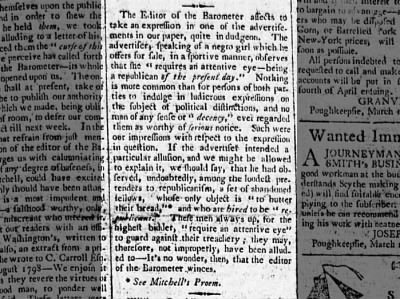
On March 15, 1803 the Poughkeepsie Journal cited "Mitchell's Proem" for the line about printers knowing which side their bread is buttered (butter = bribes from politicians). In the Barometer, Mitchell had complained about a gratuitous swipe at Republicans inserted in the Journal advertisement of a "Negro Girl" for sale. In reply, the Journal editor quoted Mitchell's former words against him--as had Croswell in his Wasp critique.


Also in 1803, Mitchell inaugurated another of his New York newspapers, the Kingston Plebian, with an introductory poem. Both productions again received sharp criticism in Hudson, this time by Croswell (most likely) in his role as co-editor of the Balance:
Mitchell imagines that we did not "relish the word Proem, which entitled his poetic address in the first number of the Barometer." He has therefore "given a different name to a similar production in the first number of the Plebian." --Mitchell certainly quite mistakes the matter. It was not the title of his first-born poetry that we disliked, for that same proem "by any other name, would be as bad." Of this we are convinced that "the Poet's Congee" (the name given to the Plebian production) is in no respect better than the Proem. We give the first couplet as a specimen, and leave the reader to judge.
"The world had long in darkness groan'd,
While man through wildering mazes roam'd." 
 --The Balance, and Columbian Repository, July 19, 1803
I'm still looking for "The Poet's Congee" by Isaac Mitchell, apparently published in the first number of The Plebian.

In January 1803 Croswell famously faced jail time after his first trial for criminal libel, so he might well have missed Mitchell's "Address" that year. Neither the Balance nor The Wasp notices the 1803 New Year's Address in the Political Barometer. However, as shown in the previous post, the next year Croswell got the idea to conduct a critical round-up of New Years Addresses. Thus, early in 1804 the Balance included Mitchell's "Political Barometer" in its critical survey, "New Year's Addresses Reviewed."


Every body knows, that it is much easier to make rhymes than to write poetry; but Mitchell, it seems, finds his powers unequal even to the former. He makes such unnatural matches in coupling his lines, that it would not be surprizing if three fourths of them should sue for bills of divorcement before the year is at an end….Mitchell is extremely apt, when hard pushed, to make metre at the expence of grammar and sense. 
--Balance and Columbian Repository - February 7, 1804
Three prose tales by Isaac Mitchell were serialized in the Political Barometer:
  • Albert and Eliza. Political Barometer, June 8, 1802 - July 13, 1802.
  • Melville and Phalez. Political Barometer, June 7, 1803 - July 26, 1803.
  • Alonzo and Melissa. Political Barometer, June 8, 1804 - October 30, 1804.
Related post: