Tuesday, April 28, 2015

Favorable notices of Gansevoort Melville and Herman Melville's books in the Richmond Enquirer

Thomas Ritchie, Jr. via Find A Grave
Some years back the head-note to Melville Reviews and Notices, Continued in Leviathan predicted new finds in southern newspapers should anyone bother to look:
Previous research has largely, though by no means exclusively, focused on archives from New York, Boston, and the northeastern United States. Relatively neglected southern and western newspapers and periodicals, and foreign publications as well, in print and online archives, seem especially likely to yield important discoveries in the future.

Citation: Norsworthy, Scott. "Melville Reviews and Notices, Continued." Leviathan, vol. 13 no. 1, 2011, p. 88-115. Project MUSE, https://muse.jhu.edu/article/493025.

Now that Genealogy Bank has old issues of Virginia newspapers in their database there's really no excuse for not starting.

What emerges from online searches in the Richmond Enquirer is a pattern of favorable mentions of Gansevoort Melville and unaffected praise for books by Gansevoort's younger brother Herman Melville.


Mastheads of the Daily Richmond Enquirer after May 1845 list William F. and Thomas Ritchie, Jr. as co-editors. Thomas Ritchie, Jr. and William Foushee Ritchie were sons of Enquirer founder, old Thomas Ritchie. As chronicled in the Editor and Publisher and Journalist 12.2:
In May, 1845, Ritchie left the Enquirer after forty-one years of service, and went to Washington to take the chief editorial management of the Union, the official organ of President Polk. 
Just before his retirement from the Enquirer in 1843, two sons. William F. and Thomas Ritchie, Jr., had been associated in the management of the paper. On the departure of his father for the National Capital, William F. Ritchie became its editor.
Another version of editorial changes at the Richmond Enquirer, from The Virginia Magazine of History and Biography:
On March 4, 1843, his sons William F. and Thomas Ritchie, Jr., were admitted into partnership, and the firm of publishers became Thomas Ritchie and Sons. 
On March 19, 1845, the publication of a daily edition called the Daily Richmond Enquirer was commenced, and on May 9th of the same year Thomas Ritchie retired after editing the Enquirer for forty-one years. The editors and owners were then William F. and Thomas Ritchie, Jr. The files of the paper from 1845 to 1860 are not among those in the State Library; but it is known that during this period it was owned and edited by the two Ritchie brothers.
The Richmond Ritchies were associated with Gansevoort Melville as active Democrats and fellow supporters of James K. Polk in the 1844 presidential campaign. The elder Thomas Ritchie, "Father" Ritchie is the "Napoleon of the press" who presided over dinner at the Exchange Hotel in Richmond on March 12, 1845 with John C. Calhoun, General Lamar, and Gansevoort Melville.

On August 5, 1844 the Richmond Enquirer reprinted the supportive column on Gansevoort from the New York Evening Mirror, backing the able new Secretary of Legation at London with special reference to the distinction of his "double revolutionary descent":

Richmond [Virginia] Enquirer, August 5, 1844
via Genealogy Bank
On Friday, June 5, 1846 the Daily Richmond Enquirer gave notice of Gansevoort's untimely passing by remembering him as "a gentleman of talents and high worth":
We are pained to learn by the last steamer, that Gansevoort Melville, Esq., of New York American Secretary of Legation at London, died in that city on the 12th ult., after an illness of three weeks. He was a gentleman of talents and high worth.
On Saturday, July 4, 1846 the Enquirer copied the item from the Albany Argus reporting THE FUNERAL OF GANSEVOORT MELVILLE.

The favorable notice on June 29, 1846 by the Daily Richmond Enquirer of Herman Melville's first book Typee was lengthened by numerous excerpts from excellent reviews in other newspapers and magazines:
“Typee,” or a Residence in the Marquesas Islands.

This work, which we have read with great gratification, bids fair to acquire a most enviable popularity. It is truly a sort of New Robinson Crusoe. Its free, dashing style, and entertaining narratives and descriptions, render it at once novel and instructive. It is from the pen of Mr. Hermann Melville, of New York, a brother of Gansevoort Melville, our late accomplished and much lamented Secretary of Legation at London.

We subjoin some of the favorable opinions which this book has won in other quarters. We are proud to see that the literary genius of America is beginning to be appreciated in the Old World:

“A book full of fresh and richly colored matter. Mr. Melville’s manner is New World all over.”— [London Athenæum.

“A book of great curiosity; striking in the style of composition, many of the incidents but require us to call the savages celestials, to suppose Mr. Melville to have dropped from the clouds, instead of ‘bolting’ from the skipper Vangs, and to fancy some Ovidian graces added to the narrative in order to become scenes of classical mythology.”— [London Spectator.

“This is really a very curious book. The happy valley of our dear old Rasselas was not a more romantic or enchanting scene.” [London Examiner.

“This is a most entertaining and refreshing book. The picture drawn of Polynesian life and scenery is incomparably the most forcible and vivid that as ever been laid before the public. The writer of this narrative, though filling the post of a common sailor, is certainly no common man. His clear, lively and pointed style, the skillful management of his descriptive, the philosophical reflections and sentimental apostrophes scattered plentifully through the work, are the production of a man of letters.” [London Critic.

“These adventures are very entertaining.” [Tait’s Edinburgh Mag.

“There is no lack of incident or novelty, and he who commences the perusal of Mr.; Melville’s narrative will scarcely fail to complete it.” [London Eclectic Review.

“The scenes depicted are novel—the descriptions fresh. It is full of marvelous adventure, perilous journeyings and glowing pincillings [sic] of savage life and scenery, which possess a charm calculated to rivet the reader’s attention as strongly and continuously as De Foe’s Robinson Crusoe. There are so many passages and pages full of curious information, that our only difficulty is to abridge our extracts.” [Simmons’ Colonial Magazine.

“One of the most delightful narratives of adventure ever published. From the first line in the first page to the last in the last, interest, information, and the most genial freshness of description pervade the whole volume. Every chapter has its separate picture and every picture is glowing with life. Throughout it there are snatches of drollery that are irresistibly comic, and sometimes reflections of the most unstrained and winning pathos. We can cordially recommend the book as a most choice and delightful one: if we could possibly squeeze all its pages into a single column, we would prove its excellence by transcribing the entire work.” [London Sun.

“Since the joyous moment when we first read Robinson Crusoe, and believed it all, and wondered all the more because we believed, we have not met with so bewitching a work as this narrative of Herman Melville’s.”— [John Bull.

“The style is racy and pointed, and there is a romantic interest thrown around the adventures which to most readers will be highly charming.” [American Review.

“Those who love to roam and revel in a life purely unconventional, though only in imagination, may be gratified by following the guidance of Mr. Melville. He writes of what he has seen con amore, and his pen riots in describing the felicity of the Typees.”—[Graham’s Magazine.
"This has all the elements of a popular book—novelty, and originality of style and matter, and deep interest from first to last. Few can read without a thrill the glowing pictures of scenery and luxuriant nature, the festivities and amusements, the heathenish rites and sacrifices, and battles of these beautiful islands.” [Hunt’s Merchant’s Magazine.

“The adventures are of a youth in the romantic islands of the Pacific Ocean, among a strange race of beings, whose manners and modes of life are by no means familiar to us.” 
“The scenes described with peculiar animation and vivacity, are of a description that must task the credulity of most plain matter of fact people; yet they are without doubt faithfully sketched, and afford evidence of ‘how little half the world knows how the other half lives.’ The volumes are of the most amusing and interesting description.” [Democratic Review.
--Daily Richmond [Virginia] Enquirer, Monday morning, June 29, 1846; found in the online Newspaper Archives at Genealogy Bank
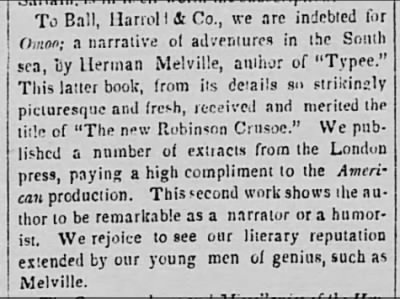
With a similar endorsement of the young author as representative of a growing national literature, Melville's next book Omoo also received highly favorable treatment in the Richmond Enquirer:
Richmond Enquirer, July 2, 1847
To Ball, Harrold & Co., we are indebted for Omoo; a narrative of adventures in the South sea, by Herman Melville, author of “Typee.” This latter book, from its details so strikingly picturesque and fresh, received and merited the title of “The new Robinson Crusoe.” We published a number of extracts from the London press, paying a high compliment to the American production. This second work shows the author to be remarkable as a narrator or a humorist. We rejoice to see our literary reputation extended by our young men of genius, such as Melville.
-- Daily Richmond [Virginia] Enquirer, Thursday, July 1, 1847; reprinted the next morning, Friday, July 2, 1847. Available online via the Newspaper Archives at Genealogy Bank; and now Newspapers.com
For Mardi, the "Checklist of Additional Reviews" in Herman Melville: The Contemporary Reviews, ed. Brian Higgins and Hershel Parker, gives the date of one notice by the "Richmond Enquirer, 11 May 1849."

Here is the brief take on Mardi from the Enquirer, May 11, 1849 under the heading NEW WORKS:
Mardi, and a voyage thither—a romance of Polynesian adventure, in two volumes; by Herman Melville, author of the popular “Typee.”—Same publishers [Harper & Brothers].

As two narratives of voyages in the Pacific, published by the author, had been received with incredulity, he determined to write a fiction, supposing that, vice versa, the fiction might be taken as a verity. It abounds in very spirited and graceful sketches of land and ocean, of the pursuit of the whale, &c. 
 --found in the online Newspaper Archives at Genealogy Bank
Wonderful to say, The 19th Century Rare Book & Photograph Shop is offering the volumes of Mardi owned by long-time editor of the Richmond Enquirer Thomas Ritchie "with his signature, and with his son’s later inscription":
Provenance: Thomas Ritchie (1778-1854), with his signature, and with his son’s later inscription. One of the leading American journalists of the first half of the nineteenth century, Ritchie was the longtime editor and publisher of the Richmond Enquirer, which Thomas Jefferson hailed as “the best [newspaper] that is published or has ever been published in America.” Letters to Ritchie from Herman Melville’s brother Gansevoort are in the Ritchie papers at William & Mary.
A fine and tight set. Out of my league unfortunately, but it would be nice to learn something more about that later inscription--by Thomas Ritchie's son, meaning who? Thomas Ritchie, Jr. or William Foushee Ritchie?

Another place to look for favorable Melville mentions is the Richmond Examiner, edited by John M. Daniel (not W. F. Ritchie). Burton R. Pollin found a good one in Daniel's review of Redburn in the Examiner for November 23, 1849, transcribed in Melville Society Extracts 89 - June 1992. And I guess now we ought to look harder at the Washington Daily Union under the editorship of old Thomas Ritchie.

Monday, April 27, 2015

Gansevoort Melville in Richmond, Virginia--dining with Calhoun, Lamar, and Thomas Ritchie

J. C. Calhoun via NYPL Digital Collections

The developing story here is Thomas Ritchie, "Democratic editor of the Richmond Enquirer from 1804 to 1845, and of the Washington Daily Union from 1845 until 1851." As indicated in the Melvilliana post on Favorable Melville notices, old Ritchie's sons Thomas Ritchie, Jr. and William Foushee Ritchie succeeded their father in the editorship of the Richmond Enquirer. While I break to savor Carl R. Osthaus's chapter on The Editorial Career of Thomas Ritchie in Partisans of the Southern Press, go ahead and enjoy this item placing Gansevoort (with Ritchie, as evident from the New York Herald letter from "John Jones," also quoted below) in the company of John Caldwell Calhoun and General Lamar (Mirabeau Buonaparte Lamar).

In March 1845 Calhoun was passing through Richmond on his way home to South Carolina, staying at the Exchange Hotel. While in Richmond he invited Gansevoort Melville and Lamar for dinner, a more private affair in lieu of the grand public dinner which he formally declined. Calhoun had just completed his year-long service as Secretary of State. Gansevoort's younger brother Herman was close to starting his first book, Typee (1846). In his third book Mardi (1849) Herman would lampoon Calhoun as the cadaverous politician Nulli. In Subversive Genealogy, Michael Paul Rogin finds in the pro-slavery politics of Calhoun a model for Ahab's monomania.

Image Credit: World of Edgar Allan Poe
Gansevoort's dinner with Ritchie, Calhoun, and Lamar at the Exchange Hotel in Richmond took place on Wednesday, March 12, 1845. From the Richmond Enquirer, March 17, 1845:

MR. CALHOUN.

The distinguished and retiring statesman—“retiring from the field of his fame”—(as the first toast in his honor called him)—had a small but agreeable dinner with a few of his friends on Wednesday last, and declined the honor of a public dinner, as the following correspondence shows. There were at the table, as guests, General Lamar of Texas, Gansevoort Mellville, Esq., of New York, the eloquent and accomplished champion who distinguished himself at various points of the late campaign, &c, &c. Mr. Calhoun is rapidly improving in his health, and is returning from Washington with the most liberal feelings towards the present Administration. He left Richmond on Thursday, having been waited upon by several persons.  --Richmond [Virginia] Enquirer, Monday, March 17, 1845; found in the online Newspaper Archives at Genealogy Bank.

Portrait of General Mirabeau B. Lamar / Image Credit:
Texas State Library and Archives Commission
As noted in the Melvilliana post Tall after all,
Gansevoort's presence in Richmond is happily confirmed by correspondent "John Jones" in a letter to the editor of the New York Weekly Herald, dated March 13, 1845 and published March 15, 1845:
"Mr. Melville, the tall democratic spouter, par excellence, from your city, is also here, probably looking up political influence for some valuable appointment for services rendered. Should he be disappointed, it would be a pity, as he is pretty much of the opinion, I understand, that Mr. Polk could not have been elected had it not been for his disinterested exertions during the canvass—Nous verrons."
In the first part of his letter to the Herald editor, John Jones reveals a bit more about the dinner for Calhoun. The presiding "Napoleon of the press" is Thomas Ritchie, editor of the Richmond Enquirer:
DEAR BENNETT—
What can I communicate, that can possibly interest the readers of the Herald, from this dull quarter of the globe, except mere matter of fact? I will attempt to give you a few items, by way of killing an hour.

First. Mr. Caloun created a little stir among his friends here, by staying over one day on his way South, which was taken advantage of by giving him a private and recherché dinner, at the Exchange, by about twenty of his most ardent friends, the Napoleon of the press in these “diggings” being invited to preside, with Mr. Calhoun on his right, and Gerneral Lamar (of Texas) on his left. Some excellent toasts and sentiments were given, and the party separated at an early hour, to attend a select party at R. G. Scott’s, where the evening was spent in the most convivial manner by a set of as choice spirits as can well be congregated together in this region.   
--New York Weekly Herald, March 15, 1845
Thomas Ritchie
via The Library of Virginia
It's unthinkable that Gansevoort did not make one of those eloquent toasts to Calhoun. Ooh that would be fun to find in a Richmond paper.

UPDATE: No toasts located so far, but I did find news of Calhoun's informal dinner with friends at the Exchange Hotel, published in the Richmond Enquirer on the day after:

Richmond Enquirer, March 13, 1845
William & Mary, Earl Gregg Swem Library, Special Collections Database lists two letters from Gansevoort in London to Thomas Ritchie, filed with the Ritchie-Harrison Papers. In Gansevoort Melville's 1846 London Journal, ed. Hershel Parker, Gansevoort mentions his writing to Ritchie on January 3, 1846. As he regularly did for friends and family, Gansevoort also sent newspapers to Ritchie in February and early March 1846. Parker correctly identifies Ritchie as editor of the Washington Union without noting Ritchie's ties to Richmond.

First American Edition of Mardi by Herman Melville
Owned by Thomas Ritchie (1778-1854), with his signature
19th Century Rare Book & Photograph Shop

Melville "remarkable as a narrator or a humorist": notice of Omoo in the Richmond Enquirer

Photo Credit: L. W. Currey, Inc.

To Ball, Harrold & Co., we are indebted for Omoo; a narrative of adventures in the South sea, by Herman Melville, author of “Typee.” This latter book, from its details so strikingly picturesque and fresh, received and merited the title of “The new Robinson Crusoe.” We published a number of extracts from the London press, paying a high compliment to the American production. This second work shows the author to be remarkable as a narrator or a humorist. We rejoice to see our literary reputation extended by our young men of genius, such as Melville.
-- Daily Richmond [Virginia] Enquirer, Thursday, July 1, 1847; reprinted the next morning, Friday, July 2, 1847. Both items found in the Newspaper Archives at Genealogy Bank

Update: For more on Melville in the Daily Richmond Enquirer see related posts on

Dan Schneider Video Interview #10: On Herman Melville- Pt 2

Dan Schneider Video Interview #10: On Herman Melville- Pt 1

Friday, April 24, 2015

Hennig Cohen on The Rebellion Record and Battle-Pieces


From the Introduction by Hennig Cohen in his 1963 edition of Battle-Pieces:
The ingredients of Battle-Pieces, ranging as they did from a Renaissance portrait to participation in a cavalry raid, were diverse in the extreme but scarcely representative of what Melville called the "varied amplitude" of the war. Much had to be filled in. Impressions wanted corroboration, and realistic detail was needed. Hence, as he had done on previous occasions, Melville sought a book which would help him flesh out impressions, which would assist him in seeing his object whole, and which would contribute a degree of order. He found such a book in The Rebellion Record. Despite Melville's statement in his introductory note that he served as a "harp in the window, and noted the contrasted airs which wayward winds have played," the poems are frequently specific, detailed, and selective in terms of subject. They were not often the product of white heat generated by immediacy, but rather of the cool calculation which the passage of time makes possible. 
The Rebellion Record was a periodical designed to present a history of the Civil War in "a digested and systematic shape," through selected newspaper accounts and official reports interspersed with verse and anecdotes. The material was cumulated in a series of eleven volumes and a supplement. Each volume contained a "Diary of Events," a section of "Documents and Narratives" and a section of "Poetry, Rumors and Incidents." On the whole the quality of the writing was adequate but prosaic, unpretentious except for the poems, which were of indifferent quality. The first eight volumes, covering the years 1860 to 1864, were available to Melville in time to have been of use to him for Battle-Pieces.  
There is no evidence that Melville owned a set of The Rebellion Record, but in his note to the poem, "Rebel Color-bearers at Shiloh," he states that the "incident upon which this piece is based is narrated in a newspaper account of the battle to be found in the 'Rebellion Record,'" and the quotation which he gives is accurate. "The Rebel Color-bearers at Shiloh" is, in the order of the poems in the volume, probably the last for which The Rebellion Record is a source. In all, Melville drew upon The Rebellion Record for at least twenty poems, a majority of those which deal with military events. Eighteen concern events before 1863, and of this number twelve contain material which can be traced to The Rebellion Record. Not only did Melville need The Rebellion Record for the nudge it gave his muse but he also depended upon it for raw facts, especially concerning the first years of the war, when his interest had been relatively slight, and which were then as much as five years in the past. 
The poem "Donelson," the longest of those for which he drew upon The Rebellion Record, reveals three principal ways in which Melville used the various newspaper dispatches and official reports in this compendium. For narrative purposes, he would follow closely a number of different sources, choosing facts and incidents and weaving them together with little embellishment or expansion. For intensifying drama or mood, he would take a single source and strip it to its essence. Finally, to suggest larger implications and relationships than narrative, drama, or mood alone could provide, he would use his source material as the starting point for a cluster of imagery weighted with moral significance.  
An example of diverse sources fused into a unified narrative is the account of the Thursday morning fight (lines 59ff.). Within some fifty lines Melville employs material from articles reprinted from the New York Times, Missouri Democrat, Charleston Courier, and Richmond Dispatch. He took items unique to a single newspaper and also information available in several. In the latter case it is sometimes hard to ascertain the exact source. Thus the Courier and the Dispatch report the use of distinctive arm bands to identify the tatterdemalion Confederate troops (lines 99-101), and only the Times notes a "great profusion of gold lace" worn by Confederate officers (line 104). Both the Times and the Missouri Democrat mention the expertise of the Federal sharpshooters (lines 82-83) and the death of Colonel Morrison (line 80), but only the Times describes the injuries caused by falling tree limbs which had been struck by artillery (line 78) or compares the Union riflemen to hunters at a salt lick in ambush for deer (lines 86-88). Melville took the description of Thursday night at Donelson (lines 136-51) from one newspaper, the Missouri Democrat, adhering to the order of the dispatch and echoing its language, but pruning and refining to create a sense of grim determination in the face of icy misery and danger. An extract from this account shows how closely he followed the original:
The night of Thursday will long be remembered by the troops surrounding Donelson. The weather. . .toward the close of the afternoon became chilly and lowering. About six o'clock a heavy rain set in. During the warmth of the day before . . . whole regiments had cast aside their overcoats and blankets, and without tents, and in a great majority of cases, occupying positions rendering a fire a sure mark for the enemy's batteries, with nothing to eat but cold rations, their condition was deplorable indeed. To add to their discomfort, when thoroughly saturated with rain, a pelting snow-storm set in, continuing all night. As can be imagined, with an enemy in front, continually annoying and annoyed, but little sleep was indulged in. The only demonstration of importance on the part of the rebels, during the night, was a formidable attempt on the right wing to obtain Taylor's battery....  But, cold and hungry, with garments stiff with frost, the soldiers were still hopeful and firm. . . . The universal sentiment was, as blunt Col. Oglesby expressed it, "We came here to take that fort, and we will take it. . . ." (See "Donelson," p. 51.) 
The passage in "Donelson" which describes the duel between the Union gunboats and the Confederate water batteries (lines 207-22) illustrates how Melville took a prosaic newspaper article, in this case from the New York Times of February 15, 1862 (Rebellion Record, IV, 172), and reworked it in such a way that it becomes not merely terse, effective narrative but narrative with moral significance. The newspaper account relates how the gunboat "Louisville" was damaged:
At this time the boats were within some four hundred yards, and were on the point of using grape-shot, when a shot disabled the steering apparatus of the Louisville, by carrying off the top of the wheelhouse, and knocking the wheel itself into fragments. There was a tiller aft, and this was instantly taken possession of by the pilot—but he had scarcely reached it, ere the rudder was carried away by a shot from the Tyler. Of course the boat became instantly unmanageable, and swung around, receiving a shot in the woodwork towards the stern, which, I believe, wounded several seamen. Under this circumstance, it was thought best to retire, and accordingly the whole fleet fell back to the position it had occupied in the morning. The most serious damage sustained during the action was from one of those monster one hundred and twenty-eight-pound shots, which passed through a bow-port of the Louisville and dismounted the second gun on the starboard quarter, killing three men and wounding six others. A captain of one of the guns was cut completely in two, and spattered his brains over Captain Dove, who stood by him, and otherwise so mangled him that scarcely a resemblance of humanity remained. (See "Donelson," p. 51 .)
For the "Louisville" passage Melville winnows out journalistic wordiness and compresses details; for example, the number of damaging shots which the vessel received is reduced to one. This increases the pace of the narrative and heightens the drama. Moreover, it provides a focal situation which may be invested with cosmic implications. The projectile from the Confederate battery is a planet, a malign and fateful wanderer in the skies. When it destroys the steering mechanism of the ship, the ship drifts uncontrolled, "lawless," itself useless and a danger to the fleet. The figurative language drawn from astronomy and the law underscores two ideas which recur in Battle-Pieces: the role of Fate in the lives of men and the need for mechanisms of control by individuals and society. 
A final point should be made about the way Melville used The Rebellion Record. In the deliberate choice of certain material Melville contributed to the thematic and structural unity of his book. I have suggested that opposition and reconciliation constitute the principal theme of Battle-Pieces. Melville's use of a sentence from the New York Times of February 17, 1862 is a minor but telling instance of the ramifications of this theme: "In some cases, a few of our wounded were cared for by the rebels, although they were without fire, and could give them but little valuable assistance." The sentence is the basis for this passage in "Donelson":
Some of the wounded in the wood
Were cared for by the foe last night,
Though he could do them little good,
Himself being all in shivering plight. (Lines 254-57) 
The function of this passage is to portray the universality of suffering and the compassion of the enemy. Melville's view that the Union was right on the issues of the war is quite clear. Du Pont's fleet "warred for the Right," Stonewall Jackson "Stoutly stood for wrong," and the defeat of the Confederacy was "Treason thrown." Therefore the use of an incident which reveals such a curious display of generosity raises questions. 
The explanation is that Melville took the first opportunity to speak out for compassion and humanity, the foundation, as he saw it, upon which the opposition of North and South could be reconciled. The irony of the war was rooted in the fact that men were dehumanized by the very ideas that they fought for. In order to attain a reconciliation, principles would have to be subordinated to individuals. Melville could make his point best by emphasizing individuals, common soldiers trapped in a common misery, and by playing down the abstract issues of a "war of Wrong and Right"—to quote the words of "Look-out Mountain." "Donelson" happens to be one of the more ambitious poems in Battle-Pieces and the first in the sequence to have as its subject a military engagement in which the Union was victorious. Hence Melville could afford the luxury of depicting the humanity of the foe.
The nature of the ingredients which went into the making of Battle-Pieces—the Bible, Milton, Shakespeare, personal experiences and impressions, paintings, the illustrated weeklies, newspaper articles and official reports from The Rebellion Record—indicates Melville's distance from the actual events of the war. This was not entirely a disadvantage. Melville had long been uneasy about his dependence upon personal experience, sensing a danger in "immediate literary success, in very young writers" (to quote from Pierre), because of his memories of the days of Typee and Omoo. Nor could "mere reading" of The Rebellion Record or anything else serve as a substitute. His solution was not the recording of a "rich and peculiar experience" nor the skillful retelling of a tale once told. Instead, in the best of the Battle-Pieces, he distilled the essence of the experiences of war, pointing out their symbolic significance, universal application, and complexity. At a distance Melville could see the lineaments of the fundamental.   
--Hennig Cohen, Introduction to The Battle-Pieces of Herman Melville pp.15-19

Thursday, April 23, 2015

Source-study 101

The Storming of Fort Donelson:
Terrific bayonet charge and Capture of the outer intrenchments, by the Gallant Soldiers of the West--
Saturday Feby. 15th. 1862 / Currier & Ives via Library of Congress

In Frontier in American Literature, Edwin S. Fussell brilliantly catalogs and describes Melville's obsession with the American West. Nevertheless, he makes a bad mistake about "Donelson" in the Civil War volume Battle-Pieces which might have been forestalled by proper attention to the basics of source study. Also evident, alas: ignorance of Melville's rejected 1860 volume for which the intended title "Poems by Herman Melville" was known, and pretty widely available in for example Leyda's 1951 Melville Log.

Fussell on "Donelson":
"Storms at the West derange the wires," is an unconsciously ironic line in Battle-Pieces (1866). In this first volume of verses, Melville more than once descended to doggerel, perhaps in part because at first he found it so difficult to think in the medium of poetry, except off and on:
But, full of vim from Western prairies won,
They'll make, ere long, a dash at Donelson.
In view of the fact that the prairies traditionally belonged to the whole nation, Melville's identification of them as a training-ground for Union troops (even with respect to an obviously Western victory) rings hollow; apparently he was half-automatically trying to invoke the old magic of the West for the new cause (Civil War, poetry), but the two worlds simply declined to lie down together.  --Fussell, Frontier p377
In denigrating Battle-Pieces as so much "doggerel," Fussell is following the lead of biographer Leon Howard (who applied the term "hack work," twice) and before Howard, William Dean Howells. But Fussell could not have been more wrong. Factually wrong, on two counts. One, like I said poetry was not a new cause for Melville; and two, Melville had a very good, very concrete reason for introducing his prairie image. To understand that reason you have first to give Melville credit for meaning something intelligible. Then it helps to look at Melville's reliance on the Rebellion Record. This source was known even before Frank Day's 1959 M.A. thesis on "Melville's use of the Rebellion Record in his poetry," published in 1960 by the University of Kentucky Press and now available online through the Clemson University Digital Press. In 1938 Willard Thorp pointed directly to the Rebellion Record in his Introduction to Herman Melville: Representative Selections, Thorp specifically called attention to Melville's heavy dependence on the Rebellion Record in "Donelson":
A glance through some of the documents and journalistic reports in the volumes of this work which relate to episodes turned into poetry by Melville, shows at once that the Rebellion Record was exploited extensively by him. Either he turned at once to its pages when the impulse to write verse again was imparted to him or he happened to be going through them when Richmond fell. His use of this monumental record of the war varies from the close paralleling and mere "versified journalism" derived from the New York Times account of the capture of Fort Donelson in his "Donelson" to the remarkable reconstruction of the character of the brave General Lyon from the matter-of-fact report of the battle of Springfield as he found it in two newspaper accounts in the Record.   
--Thorp's Introduction to Representative Selections
Thorp helpfully gave the right volume number IV and page numbers 170-176. After Thorp's 1938 notice, Howard Vincent in the Explanatory Notes to the 1947 Collected Poems again cited the Rebellion Record as the main source for "Donelson":
Melville's bulletins throughout the poem are a recasting of selected details from The New York Times account of the battle as printed in the Rebellion Record, IV, 170-176.
--Melville's Collected Poems p449
Fussell does footnote the Hendricks House edition of Melville's Collected Poems which makes me wonder if he only had the version lacking Vincent's Explanatory Notes at the end. (The first copy of Collected Poems I bought online was one of those, without the notes.) Vincent's sentence quoted above is all you need to figure out what Melville means by "vim from Western prairies." Plus vol. 4 of the Rebellion Record that is.

As Frank Day found when he went to the Rebellion Record:
Melville's use of "vim," which he italicizes, in his description of the troops' morale, probably was inspired by its use by the Times correspondent, who describes an old man who is stirred by the strains of "Yankee Doodle" as the fleet passes Eddyville: "Off went his hat, and with a vim that sent his hat flying…" (Documents, p. 171). --Frank Day
How the figure of the rejuvenated old patriot might have appealed to Melville and drawn his attention to the word vim may be easier to see in the context of the whole passage from the New York Times account:
An old man, whose head was white as a snow-drift, stood on the shore leaning heavily on his cane and watching with seeming apathy the passage of the boats, whose full appearance his faded eyes probably failed to catch. Just as the Minnehaha passed opposite him the magnificent band of the Fifty-seventh struck up “Yankee Doodle.” Its strains seemed to awaken stirring memories in the old man's mind—off went his hat, and with a vim that sent his hair flying around his head like a snow-bank lifted by the wind, he gave three hearty cheers for the Union—the Union in which himself, his children, and his grandchildren had been born, reared, and protected.   --Rebellion Record vol. 4 
References to the steamer Minnehaha and Fifty-seventh show why Melville conceives of "vim" as a product of "Western Prairies." Earlier in Union preparations for the assault on Fort Donelson, the Minnehaha brought the Fifty-seventh Illinois from Cairo, Illinois to Fort Henry. This regiment was the one formally known as the Fifty-Seventh Regiment Illinois Volunteer Infantry, under command of Colonel S. D. Baldwin:
It was determined by Gen. Grant to make the attack upon Fort Donelson from two directions— by land from the direction of Fort Henry, and by water up the Cumberland, assisted by an adequate column of troops on the banks. Tuesday night, the Fifty-seventh Illinois, Col. Baldwin, arrived at Fort Henry, on the steamer Minnehaha.
As noted by Henry Howe, the seige of Donelson was conducted by troops from western states, chiefly Illinois.
At the first great battle in the west—the taking Of Fort Donelson— an unusual proportion of the soldiers of Illinois took part; and so conspicuously that an eastern poet made it a subject of some congratulatory verses, under the caption of New England's Greeting To Illinois.  --Henry Howe, Times of the Rebellion in the West
Howe's anonymous New England poet associated Western prairies with Illinois:
New England's glad hurrahs—
Bear to the prairies of the West
The echoes of our joy,
The prayer that springs in every breast,—
"God bless thee, Illinois!
No wonder the victory when finally achieved would be commemorated in the North as a victory of the "Loyal West" or "Gallant Soldiers of the West."

Finding enthusiastic "vim" inspired by Illinois troops in the Times report, Melville then must have mentally associated Illinois with prairies as everyone did, and as he did elsewhere, for example in the poem Trophies of Peace. The old patriot's "vim" stirred up by the Illinois regiment gets translated creatively into something else: high spirits among troops in the cheerful early stages of a key battle.  As Frank Day noticed, Melville assigns that vim to the fresh and still upbeat troops, the Illinois soldiers who brought it with them from "Western prairies."

So Melville's image of "Western prairies" does not as Fussell thought refer to military drills and marches over the prairies before the Civil War--though such operations certainly were extensive and significant. As a look at the source for "Donelson" in the Rebellion Record makes clear, by "Western prairies" Melville means Illinois.

Prairie "vim" has to be something like the energetic, wild-and-free feeling communicated in a letter to the Illinois Journal and reprinted in the New York Mirror, December 4, 1841, under the heading THE WESTERN PRAIRIES:
In short, I love the feeling of freshness, and freedom, and wildness which a man on the prairie alone can so well feel.
Further along in Melville's poem the depiction of Fort Donelson corresponds in essential details to the same Times article wherein Melville found vim associated with the Illinois Fifty-seventh:
The ground around the Fort is a rolling upland, covered with heavy timber and dense undergrowth, and broken for miles around into ravines, bordered by precipitous bluffs, whose sides, steep and rocky, almost forbid the passage of even a goat. The Fort itself is situated upon a high bluff, which slants with an easy descent to a point at the water's edge on the north, and is probably not less than one hundred feet above the level of the water. To the rear the bluff has been to some extent levelled for the distance of a mile. On this artificial table-land stands the Fort, whose lines of fortifications and rifle-pits cover the entire levelled space.  --Rebellion Record vol. 4 p171
Here's what Melville made of it:
This stronghold crowns a river-bluff,
   A good broad mile of leveled top,
Inland the ground rolls off
   Deep-gorged, and rocky, and broken up—
A wilderness of trees and brush.
   The spaded summit shows the roods
Of fixed intrenchments in their hush;
   Breast-works and rifle-pits in woods
Perplex the base.—
More of the extensive borrowings that Day inventoried:
the phrasing of the lines "Grant's investment is complete—/A semicircular one" follows remarks in the Times that "the Fort is completely invested" (Documents, p. 173) and that forces were extended "both up and down a line parallel with the river…thus enclosing the Fort in a semicircular line" (Documents, p. 171).
--Frank Day on Donelson
Not only that, but Day shows also how Melville occasionally blended choice bits from two articles reprinted in the Rebellion Record, the NY Times article and another one from the Missouri Democrat. In a single stanza, illustrating the carefulness of his method, and at the same time destroying Fussell's idea of Melville's writing anything "half-automatically" in "Donelson."

Bottom line, the probability that Melville mined this long, literate, dramatic, and richly detailed Times account for "Donelson" is right around 100%. Strange then that so thorough and wise a scholar as Stanton Garner would feel bound to doubt or rather downplay Melville's borrowing habits:
The influence of the Record has been detected in at least twenty of the poems, but the importance of the borrowings has been overstated, tempting readers to believe that Battle-Pieces is "versified journalism," and, therefore, that both the author and his poems were distant "from the actual events of the war." That idea is rooted in Raymond M. Weaver's conception of Herman as a "mariner and mystic" who stood aloof from earthly concerns, for a mystic looks only above and a mariner looks only beyond, at the inscrutable sea. That leaves unexplained the lively interest in the social and political issues of the time demonstrated in many of Herman's other works....
... 
Herman had no need to embellish what he already knew, nor did he. In fact, he may have used the Record somewhat less than has been supposed. It has been noted that in both "Donelson" and in a column reprinted from the New York Times the word "vim" appears; but at the time that word was in common use, as is demonstrated by General Sheridan's philippic against Jeff Hobart. Again, although a piece from the Missouri Democrat and "Donelson" both use the word "sortie," that is the kind of military term that war introduces to the civilian vocabulary.  --Stanton Garner, Civil War World pp389-90
Garner is wrong when he doubts Melville's borrowing of "vim" and "sortie" as well but absolutely right I think about his more important claims for Melville's artistry as a poet. For the legacy of stone-cold imperviousness to the high quality of Battle-Pieces, blame not only or mainly Weaver but also William Dean Howells and Edmund Wilson, and distinguished followers of theirs like Andrew Delbanco. 

Hats off then to Garner for battling Wilson's verdict of "versified journalism." Garner's own great line
"Herman's mind contained a rebellion record of its own."  --Civil War World
 reminds me of Dylan on Dylan: "All my songs are protest songs."

For further study...

Donelson in Melville's Battle-Pieces

Donelson, online text

Frank Day on Melville's Use of the Rebellion Record

Hennig Cohen, Introduction to 1963 ed. Battle-Pieces

Rebellion Record vol. 4 at Google Books

Rebellion Record vol 4 at Hathi Trust Digital Library