Saturday, July 19, 2014

A chequered Elysium: 1846 London Era review of Melville's Marquesas Islands

Marquesas islands Queen
Le Magasin Pittoresque 11 (Paris, 1843)

The only review from the London Era listed in Herman Melville: The Contemporary Reviews is on May 17, 1857, of The Confidence-Man. From The Era, Sunday, April 19, 1846:

THE MARQUESAS ISLANDS; OR, A PEEP AT POLYNESIAN LIFE. (John Murray.) 

America is largely returning her literary obligations to us. Many of our best schoolbooks, as, for instance," Anthon's various editions of the Classics," "Parker's works on English Grammar," and "Woodbridge's Geography," are from the United States literary manufactory. And she is enriching our literature with works of higher mark. "Prescott's Historical Writings," "Dana's Two Years before the Mast," not to mention "Channing's Essays and Discourses," "Bowdich's Translation of Laplace," and many theological, legal, and medical works of acknowledged worth, may be fairly set off against anything we have of late years given her. Here is another case in point. Although "The Marquesas Islands" is not all that sundry enraptured critics have made it out to be, it may bear comparison with any work of fiction our own press has recently produced; for a work of fiction it indisputably is. How any of our contemporaries could persuade themselves that they were reading fact is astonishing. Yet, so it has been; and it is no slight testimony to the merits of the work that it should have deceived critics who are looked up to with considerable respect by the literary world. A young American foremast Jack, tired of six months' whaling, and charmed both with the beauty of the scenery, and, partly, if the truth must be spoken, with the fascinations of the Marquesian ladies, resolves to desert his ship. He finds a messmate who entertains the same intention. They take advantage of a "liberty day," plunge into the interior, and, after infinite fatigue, and running hair-breadth 'scapes in mounting sundry precipices and descending sundry others, find themselves in a lonely valley, the South Sea Paradise. The largest of the Marquesas Islands, that on which our runaway seamen embarked in this adventure, is inhabited by three tribes, who occupy the three natural divisions of the island. One of these tribes bears the repute of being exceedingly sanguinary, and devoted to cannibalism. This very tribe it was our adventurers' desire and object to avoid; but, "as fate or the gods decreed," it was precisely among this very tribe that they fell. Instead of being at once spitchcocked or barbacued, as the recondite practices of the South Sea cuisine may determine, they are taken into favor, made much of, and so pertinaciously stuffed and fed, that, like Sindbad, in a similar situation, they made up their minds that as soon as sufficiently crammed they were to be knocked on the head, and duly served up, with or without sauce piquante. The feeding however, was, at least as far as the principal adventurer, the writer of the tale, was concerned, purely philanthropic. His messmate Toby, so was he hight, went off one day on the cry of ships appro[a]ching the island being raised, but Toby came not back. Whether be escaped on board and forgot his brother adventurer, or whether he served for a meal, the writer leaves us in ignorance; indeed, professes to be hopelessly ignorant himself. But, forthwith, the field being left to himself, he began to lead a life that a Sybarite might envy. He could not exactly say or sing, since neither Burgundy, nor Champagne, nor, indeed, humble Port is grown in the Marquesas, or as yet imported thither,
"My goblets blushed from every vine," 
but he might have said or sung
"And lovely forms caressed me." 
One lovely form in particular, whom he christens Fayaway. With this "dark-eyed girl of Paradise" he wanders day by day, and moonlight night by night, amidst spice-breathing groves, or, another Ulysses, bathes with her and her attendant nymphs in the cool translucent waters of a chrystal lake, which is the gem, the ocellus of this happy valley. Be it said,however, that they seem ever to have been under the superintendence of a respectable middle-aged gentleman, named Kory-Kory, who enacts the duenna, or there is no saying what we might have been called upon next to read and relate. The situation is, at the least, quite as critical as that of Captain Parry and his young Esquimaux favorite, only that the latter, with her fifteen pounds of blubber for dinner per diem, was not so poetical a being as Fayaway, who does not, so far as we remember, eat at all. Of course the Elysium is chequered. Thoughts of home and of society will intrude; the fate of Toby presents as distressing a problem as the pons asinorum; our hero becomes persecuted to submit to the tat[t]oo and to naturalisation; and, at last, a discovery, more horrible than that of the waxen figure in the "Mysteries of Udolpho," proves to him that, on certain occasions, his Arcadian friends do indulge in a little human flesh. At length he escapes. The how, we will not anticipate, but leave Mr. Herman Melville (is this a real, or a travelling name?) to describe for himself, whenever the reader shall choose to send for the book from the library. As the reader will have already concluded, the work is of the "Peter Wilkins" and " George Psalmanazar" class. It wants the simplicity of Defoe's fictions, and, to our mind, at least, does certainly not "lie like truth." There are too obvious a strain and tension in the narrative; too constantly reminding you of the inventive to be mistaken for the descriptive. Besides, though the incidents are not too numerous for recollection, yet no art of memory with which we are acquainted, could enable a gentleman without tablets and "kylevine pen," to bear in mind the details and illustrative minutiae with which they are given. Then, too, there are tolerably long-winded conversations, or results of conversations, and this, too, on subjects of no little nicety, requiring such a knowledge either of the Marquesan language on Mr. Melville's part, or of English on that of the Marquesans, which it is not professed that either party had, and which it is manifest neither could have attained it a four months' intercourse. Other discrepancies and inconsistencies might be pointed oat; but, viewing the work as a plav of the imagination, these are redeemed by the glow and warmth of the whole, and by many charming pictures and pleasing touches of fancy. The object of the work, too, is an additional recommendation. It is to remind one that if civilisation creates much, it also destroys much; that savage life, as it is called, is not all vice, any more than Christian nations are all virtue; that missionary zeal, with the best intentions, may be preached too far; that in our intercourse with the South Sea Islands we have fully as much to repent of, as to pride ourselves upon; and to induce us to reflect, whether our future intercourse may not be carried on more profitably to our convertites, though less profitably, in the poor worldly sense, to the convertors. In a word, Mr. Melville's more recent experience of the South Sea missions, for experience he indisputably has had, has led him to similar conclusions to those expressed some twelve years back by the late Mr. Earle in his unpretending but veracious Nine Months Residence in New Zealand.

--found at The British Newspaper Archive

Thursday, July 17, 2014

The Whale warmly reviewed in the London Daily News

There is something grand and poetical in the vow of the terrible old Ahab that seizes upon one by main force; and the power and vigour of the author in his descriptive passages are solemnly conspicuous.
In Herman Melville: The Contemporary Reviews (Cambridge University Press, 1995; paperback 2009) Brian Higgins and Hershel Parker give reviews transcribed from the London News for Redburn (259-60) and White-Jacket (305). Nothing in the News however for Moby-Dick.

We still need to look further, to see if anybody found this one between then and now. High time all these Melville reviews and notices got loaded into one main searchable electronic data base, don't you think?

Update: This London Daily News review of The Whale does not appear among George Moneteiro's Fugitve References in Resources for American Literary Study 33. Not among the finds reported in Melville Society Extracts 89, 106, 113. Not included in Richard Winslow finds collected in the March 2011 Leviathan article, Melville Reviews and Notices, Cont., and before that in Extracts 124. Let's see, what about items discovered by Gary Scharnhorst, presented in Extracts 74, 75, 89 and 106? No, no, no, and no.

This could take a while, so in the meantime enjoy the review, transcribed from the London Daily News, January 12, 1852:

LITERATURE.

The Whale. By HERMAN MELVILLE, author of "Typee," "Omoo," &c. 3 vols. Bentley.

“The Whale” is not the least remarkable work of a very remarkable writer. About everything that proceeds from the pen of Mr. Melville there is a freshness, an originality, a fascination, that nothing can resist. We defy the reader to take up one of this writer’s fictions, and put it down only partly read. Impossible. He is an ancient mariner, and we are so many wedding guests. We “cannot choose but hear.” Whether the tale has an albatross or a whale for a hero, the compulsion is equally strong; and if Mr. Melville choose to write about a robin-redbreast or a mackerel, it would be most likely all the same.

In “The Whale” as elsewhere the hero is still the same individual—the same adventurous sea-faring philosopher—still, as we may be well pardoned for believing, the author himself. He introduces himself to us at the beginning with most charming want of ceremony as one Ishmael, and states as his simple reason for travelling that he has little or no money in his purse, and nothing in particular to interest him on shore. In this glorious state of independence he chooses whale fishing as a pursuit, and the little island of Nantucket (the hero, we need scarcely state, is an American) as his starting place.

But before getting afloat let us linger for a night with him at the “Spouter” Inn, where nobody but gentlemen in the whale fishery was ever known to go; that has a coffee-room like a cockpit, and a whale’s jaw-bone forming an archway over the bar. Let us share with him his misery at the notion of an inevitable bedfellow, and enter into his conjectures as to what sort of person this bedfellow will prove. The mysterious person in question, who will not make his appearance all the evening, is described by the landlord simply as “a dark gentleman, who eats nothing but beef steaks, and likes ‘em rare.” The young sailor at length is obliged to retire to rest by himself, and in the middle of the night is disturbed by the entrance of his chum—the “dark gentleman” with the peculiar taste in beef steaks—and who proves to be nothing less than a wild Indian, tattooing and all complete. How this eccentric person, having been persuaded as a preliminary not to murder our hero, next shocks him by the ostentatious worship of a little pocket god, and then proceeds to frighten him by smoking in bed, and sleeping in company with his harpoon; how he makes his toilet in the morning by putting on his hat long before any other article of clothing, and even shaving himself under the shade of that appendage; how, in fine, he is discovered to be a most excellent fellow, and by no means vicious; and how he and the hero become all on a sudden the fastest friends on earth—is all capitally told, and is one of the best written parts of the book, for quiet humourous delineation of character.

Ishmael arrives in due course at Nantucket, and makes his agreement with the owners of the Pequod whaling vessel for the three-hundredth lay—that is to say, the three-hundredth share of the profits of the expedition—in return for his services. One of the owners, a very devout Quaker, wishes to give him the seven-hundredth-and-seventy-seventh lay, on the ground that it is not proper to encourage another to lay up to himself treasures on earth; but the sense of justice of another owner—the infidel and utterly lost Captain Peleg—eventually gains the day, and the Quaker Captain Bildad is worsted. Both of these captains by the way are perfect sketches of character in their way; the scene of their dispute, as to the remuneration of Ishmael, is a splendid piece of satire.

But the author is now fairly on board, and here everything is mysterious—and not the least so the ship herself.

The next subject of wonderment is the mysterious seclusion of the captain, whom nobody has yet seen. He does not come on board until the last moment; and then it is silently and in the dark; and after that he secludes himself for some days in his cabin. For some unknown cause, the hero has the greatest apprehension of him; and “foreboding showers” ran over him, when one day the Captain Ahab at last makes his appearance during the afternoon watch. His appearance is peculiar and impressive, but not terrible after all. “He looked like a man cut away from the stake when the fire has overrunningly wasted all the limbs without consuming them, or taking away one particle from their compact aged robustness. His whole high, broad form seemed made of solid bronze, and shaped in an unalterable mould, like Cellini’s Perseus. Threading its way out from among his grey hairs, and continuing right down one side of his tawny scorched face and neck till it disappeared, you saw a slender rod-like mark, lividly whitish . . . By some tacit consent, throughout the voyage little or no allusion was made to it, especially by the mates. But once, Tashtego’s senior, an old gay-head Indian among the crew, superstitiously asserted that not till he was forty years old did Ahab become that way branded, and then it came upon him, not in the fury of any mortal fray, but in some elementary strife at sea.”

Joined to these peculiarities the captain has lost a leg, and has its place supplied by one of polished sea ivory, fashioned from the polished bone of the sperm whale’s jaw. It is this lost leg that brings him to sea, after forty years of service should have purchased him immunity from its hardships. Not that he comes to seek his lost leg. No. He comes for revenge. He has vowed the death of the monster whale who deprived him of it, and whom he has pursued for years in all seasons and in every sea. This monster white whale, known as “Moby Dick,” is as well known as the Flying Dutchman to all whalers, among whom he bears not a dissimilar reputation. He is believed to bear a charmed life; and to capture him, having long been found to be impossible, is at last believed to be almost impious. “The harpoon is not yet wrought that shall give him his death wound,” say the hardened old whalers, as they shake their heads. So Moby Dick goes on his way as he has probably gone on his way for five hundred years before—the hero of a thousand fights, and the destroyer of perhaps as many boats’ crews. Still there is one stern old man with an artificial leg and a scar upon his face, who, rejecting all professional superstitions with unutterable scorn, has but one object in life, and this object is revenge—revenge against the invincible Moby Dick. His whole mental being is entered in this one idea. His crew capture whale after whale of priceless worth, and gather together in the hold a golden shower in oil and ambergris. The old man takes not the smallest interest in these unimportant matters. His whole counsel to his crew is to look out for the white whale. He even goes so far as to nail up a broad Spanish doubloon to the mast as a reward for the first man who shall “raise” him the white whale. More—he makes the crew in a condition as nearly drunk as may be, and binds them to pledge themselves solemnly to hunt the white whale to the death. The scene in which this pledge is given is most solemn and startling. It is graphic and ghastly to the last degree.

Meantime the vessel speeds on; nearing no land, nor proposing to touch at any. She is in the broad Pacific, and is running in the direction of Japan. Occasionally she speaks a vessel. But no mere civilities are exchanged, at any rate on the part of the Pequod. The sole inquiry, hoarsely bawled from the quarter-deck by the scarred captain, is, “Have you seen the white whale?” No: go your ways then, we have no use for you. Occasionally the answer is “Yes.” Then who shall describe the commotion on board the Pequod, as an ivory leg and a scarred face are lowered into the gig and raised carefully up the side of the strange vessel. Once old Ahab boards an English ship in this manner. The captain, a merry, middle-aged, ease-loving gentleman, has seen the white whale, and adds jocularly, as he points to his empty coat sleeve, that he as reason to remember him. The captain of the Scar is all elate. Here is a point of sympathy. He must know “all about it.” For heaven’s sake satisfy his curiosity. And for the next hour there is nothing but yarn spinning, enough to drive any person with a respectable amount of fastidiousness to despair. But Captain Ahab can gain no sympathy on his one important point—his revenge. The English captain sees no use in hunting after so formidable a foe. These accidents will happen, &c. Will his new acquaintance join him in a bottle of wine? But the new acquaintance, after gaining a clue to the course taken by the enemy, returns sullenly to his ship, and continues his ill-starred pursuit.

Ill-starred, indeed, does the pursuit seem. Each day adds to the discontent of the officers and the gloom of the crew. Mystery upon mystery encompass the captain, whose monomania assumes every new day some new and strange developments. The ship seems to sail under a curse; and the more reflective or superstitious of the officers and crew cannot but attribute it to the unholy object of the captain. Now, the captain causes a new harpoon to be forged—of the nail stubbs of the steel shoes of race horses—“the stubbornest stuffs we blacksmiths ever work” as the ship’s armourer tells him. The barbs he causes to be made from his own razors. This harpoon, taking advantage of a terrible storm, he tempers with lightning, to the infinite peril of the ship and crew. An additional tempering with blood is supposed to complete the virtue of the harpoon; and nothing is wanting to gratify the revenge of the captain but—the white whale.

At length one day the white whale—it can be no other—is descried from the mast-head. The boats are manned. Ahab himself stumps on board, one of them, elate with the coming triumph, his whole soul absorbed in the effort to be made. But Moby Dick, without making any direct attack, flings them contemptuously aside, and swamping every boat with a few calm splashes, proceeds on his way. Ahab is now in a fury, pursues the whale all night, and resumes the attack on the following day. But now even more disastrous results ensue, and the whale seems really invincible. Ahab, however, is not in the habit of yielding in a hurry. The third day—he is still on the track of the enemy, and prepares now for a decisive attack. The crisis has now arrived, and the scene that ensues is terrible indeed. The whale is evidently prepared to take his own revenge. The boats are all smashed, or sunk, or swamped, with their crews clinging to the floating masses.

How the author survives to tell his story is contemptuously left in mystery. That he has contrived to tell his story somehow we, in common with his other readers, must congratulate ourselves. We have not read a book of more absorbing interest for some time. There is something grand and poetical in the vow of the terrible old Ahab that seizes upon one by main force; and the power and vigour of the author in his descriptive passages are solemnly conspicuous. He has great command of character too. We have not had an opportunity of mentioning Starbuck, the first mate—but Starbuck is capital for all that. Stubb, too, is a complete individual; and as for our old friend Queequeg, the Indian harpooner, who accompanies the hero throughout the voyage—he is a triumph. But we have no space to enter into minutiae, for which we must refer the reader to the book itself. We can only once more express our hearty admiration of the performance as a work of interest and art.  --London Daily News (Monday, 12 January 1852); found at The British Newspaper Archive


 Image Credit: Wikimedia Commons

Raymond Blathwayt quoting Melville's Pebbles

Raymond Blathwayt
Vanity Fair (September 22, 1909)
Image credit: Wikimedia Commons

On August 2, 1891 the New York Herald published an interview with William Clark Russell by Raymond Blathwayt under the title, "By the Seaside with W. Clark Russell." Blathwayt's interview closes with these lines from Melville's poem Pebbles:
Implacable I, the old Implacable Sea:
Implacable most when most I smile serene--
Pleased, not appeased, by myriad wrecks in me.
Curled in the comb of yon billow Andean,
Is it the Dragon's heaven-challenging crest?
Elemental mad ramping of ravening waters--
Yet Christ on the Mount, and the dove in her nest!
Is this the same interview, or some revised version of it, published December 20, 1889 by the Pall Mall Gazette?  In volume 2 of Herman Melville: A Biography, Hershel Parker cites the Gazette interview titled "The Novelist of the Sea" by an unnamed reporter (V2.899). In the Pall Mall Gazette, the same lines from Pebbles (published in John Marr and Other Sailors, the 1888 volume dedicated to Russell) are confusingly presented as "words never before published."

Costly answer: (after registering and paying up at the wonderful British Newspaper Archive) YES! The interview with Russell in the NY Herald is indeed a revised version of the unsigned interview published in the London Pall Mall Gazette, 20 December 1889. In revision, Blathwayt deleted the incorrect characterization of the quoted lines from a poem in John Marr and Other Sailors as "words never before published."

Blathwayt's 1893 book Interviews incorporates some material from the seaside interview as published in the Herald, and before that in the London Pall Mall Gazette, but not the lines from Melville's poem Pebbles.

On the same date as the NY Herald article, August 2, 1891, the same interview by Blathwayt appeared in the Cleveland Daily Leader under the heading, "Stories of the Sea / An Hour with W. Clark Russell the Charming Writer of Them..."

Brief notice of Battle-Pieces in Cleveland: "musical and meritorious"

http://www.ebay.com/itm/1887-N35-Allen-Ginter-American-Editors-Edwin-Cowles-VG-AA-4858-/400665794244

From the Cleveland Daily Leader, Saturday, September 8, 1866:

BATTLE-PIECES AND ASPECTS OF THE WAR.

By Herman Melville. Extra cloth binding;
fine paper; pp. 272. Published by
Harper & Brothers: 1866. For sale by
Ingham & Bragg, Cleveland.

Mr. Melville has written some very musical and meritorious lines commemorative of battle-scenes, battle-grounds, and the memory of fallen heroes. The present volume is a collection of poems upon subjects introduced by the late war, and some of them of a high order of literary merit. It is entertaining, and will doubtless enjoy extensive popularity.

--found in the Newspaper Archives at Genealogy Bank
Edwin W. Cowles edited the Cleveland Leader.
"Before and during the Civil War, the paper was anti-slavery, with strong editorials pushing for the abolition of slavery and the repeal of the Fugitive Slave Act." --Chronicling America

Wednesday, July 16, 2014

Typee down the memory hole

Here's a glimpse of Typee as touchstone for arguments (not to mention deep and enduring hostilities), between Catholics and Protestants. Early criticism of Melville's first book on religious grounds came mostly from Congregationalist, Dutch Reformed, Methodist, Presbyterian, and other Protestant readers. Notwithstanding rebukes by Melville here and there of French Catholics, the readers who complained loudest about unfair treatment of missionaries in the first edition of Typee, and subsequently in Omoo, were Protestant.

Forgiving Melville his thoughtless impieties in the first edition, the evangelical Protestant press welcomed the American revised edition of Typee which removed objectionable parts with the author's complicity and blessing.

However, as the following item shows, the Catholic press noticed and lamented the expurgations. Anticipating the idea behind Orwell's memory hole, the Kentucky writer advises readers to hold on to their hard copies of the first, uncensored edition, lest Melville's unflattering views and remarks on Protestant missionaries disappear from the historical record.
"It seems that testimonies like these as to the real results of Protestant missionary efforts are not very palatable to the saints at home. Herman Melville spoke too plainly and honestly of what he beheld, and we are informed that his work, in more recent editions, has been, whether with or without his consent we know not, carefully freed from those passages which recorded the effects and success of missionary zeal. This fact should not be lost sight of, and those who have a copy of the first edition of his work should preserve it carefully, for the benefit of future times."
--The [Louisville, Kentucky] Catholic Advocate, Saturday, December 18, 1847;
found at Old Fulton NY Post Cards
Example of censored material, not present in the American revised edition of Typee:
How little do some of these poor islanders comprehend when they look around them, that no inconsiderable part of their disasters originate in certain tea-party excitements, under the influence of which benevolent-looking gentlemen in white cravats solicit alms, and old ladies in spectacles, and young ladies in sober russet low gowns, contribute sixpences towards the creation of a fund, the object of which is to ameliorate the spiritual condition of the Polynesians, but whose end has almost invariably been to accomplish their temporal destruction.

Let the savages be civilized, but civilize them with benefits, and not with evils ; and let heathenism be destroyed, but not by destroying the heathen. The Anglo-Saxon hive have extirpated Paganism from the greater part of the North American continent; but with it they have likewise extirpated the greater portion of the Red race. Civilization is gradually sweeping from the earth the lingering vestiges of Paganism, and at the same time the shrinking forms of its unhappy worshippers. --Typee, chapter 26
 1846 edition of Typee (uncensored), courtesy of Hathi Trust Digital Library:

Tuesday, July 15, 2014

NUDE ART IN NEW YORK (Matt Morgan's "living statues" at Theatre Comique, 1875)

Cleopatra before Caesar / Jean-Léon Gérôme, 1866
From the Cleveland Leader of Thursday, December 16, 1875, crediting the New York World (December 9, 1875) where the original (and longer) version appeared on December 9, 1875 under the heading "THE 'LIVING PICTURES' / What the Y. M. C. A. Object to at the Comique / MATT MORGAN DRAWS A DISTINCTION BETWEEN ART AND INDENCENCY." Both items are accessible online in the archives of Historical Newspapers at GenealogyBank.

NUDE ART IN NEW YORK.

The Scenes at the Theater Comique

N. Y. World, Dec. 9
The following letter was the other day received at the World office:
“MR. EDITOR: Are public theatricals and unlimited license synonymous terms? If so, I can comprehend why Matt Morgan thrusts upon the public his nude and suggestive figures daily and nightly. 
Please reply through your columns, or give this an insertion in your valuable journal, and oblige

AN OLD SUBSCRIBER.”
At a question so intricate as one pertaining to license, limited or unlimited, and in view of the recent action of the authorities, it was deemed best to dispatch a trusty reporter with instructions to inquire rigidly into the matter. One who had visited the Jardin Mabille, had attended trials of repute, and yawned at the “Black Crook” in all its original splendor, and fallen asleep over the impassioned strains of the “Timblale d’Argent,” was selected as a person capable of doing equal justice to unalloyed art and decency. It being a day of matinees, this reporter hastened yesterday afternoon to the seat of the present alleged immorality, the Theatre Comique, and making known his business, was politely shown to the office of Mr. Matt Morgan.
“I have come,” began the reporter, “to inquire, in the interest of public morals, whether your exhibition at this house, or that particular portion of your exhibition styled the ‘beautiful pictures,’ is—er?”

“No, it isn’t.”

“Oh! Well, is it—er?”

“No, it is not.”

“Umph! Well, then, what is it?”

“It’s an attempt (and here Mr. Morgan gathered himself upon his toes) to educate the American mind.”

“To educate the—“

“American mind, sir.”

“And is—er—nudity essential to the education of the American mind, Mr. Morgan?”

“Parbleu! It’s ‘nudity,’ always ‘nudity.’ Sir, have you an esthetic instinct? Would you see Cleopatra in the presence of the mighty Caesar decked out with a panier and pinback? Would you have Diana and her nymphs clad in gray flannel bloomers? Could you expect Phryne to appear before the Tribunal in a costume of Worth’s latest design?”

Here Mr. Morgan paused for breath, and the reporter entered the theatre to discriminate for himself. After enduring the eccentricities of numerous negro and Celtic characters for the space of an hour, the curtain at last rose upon the first of the “beautiful classic pictures.” “Cleopatra before Caesar.” To any one familiar with the original painting, it is but necessary to say that an exact counterpart was given to flesh and blood; to others it may be described as a tall symmetrical woman standing before the representative Caesar, clad in so fine and superior an article of flesh-colored silk and illusion lace mingled in the same mysterious way. Roughly estimating it, about seven-tenths of Cleopatra’s divine figure was exposed to public scrutiny. Surrounding the whole a broad frame was placed, while a suitable back-ground, painted by Matt Morgan, gave the whole a good deal of the appearance of mere paint and canvas. To the strains of Strauss the second picture was unveiled, entitled “The Shower of Gold.” On an Oriental divan reclined a Circassian blonde, whose sole raiment was a blue silk parasol held at a comfortable distance above her head by an African slave. Around about the divan in graceful postures clustered other females, each of whom exhibited a degree of pink skin tights commensurate with the size of her person. In surveying this work of art it was a matter of some perplexity to reconcile the picture with Mr. Morgan’s statement that he has “added to the drapery of the figures considerably.” Since his difficulty with the authorities. Another picture was the “Slave Merchant,” and still another “Diana and her Nymphs Surprised.”
Diana and her Nymphs surprised by Satyrs / Peter Paul Rubens, 1638-40
“Now, sir,” said Mr. Morgan briskly, as the reporter wended his way from the art gallery, “you have seen the performance; do you see anything immoral or indecent in it?” Without waiting for a reply, the artist relieved the embarrassment by continuing: “Of course you don’t; and I intend to exhibit these pictures as long and as often as I choose. Diana in a bathing suit, or Cleopatra in a crinoline! Bah? It’s shocking, and no-where but in the prurient mind of the Young Men’s Christian Association would the idea be tolerated.”
And you wonder why I would rather live in the 19th century? Not just for Morgan's classical tableaux at Theatre Comique, but also for the glorious newspapers with writing like this.


Matt Morgan Digital ID: th-37995. New York Public Library
We're only showing what Matt Morgan was about in the years when Melville and Walt Whitman most likely visited his New York studio. For the record, the story so far:


Looks like McDougall's references to Walt Whitman in the Mercury and This is the Life! might be new all around, to Whitman studies as well as Melville studies. Also a new discovery, Matt Morgan's offer in April 1876 to host a benefit performance for Whitman at the Lyceum Theater.

Related posts at melvilliana:

Monday, July 14, 2014

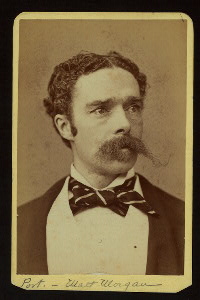
Artist Matt Morgan, works in progress during 1874

Matt Morgan Digital ID: th-37994. New York Public Library
Matt Morgan
Image Credit: NYPL Digital Gallery
Put this in the category of  what Melville might have seen at Matt Morgan's studio in 1874. Besides, that is, older work like those allegorical paintings for scandalous revivals of Black Crook at Niblo's.

In March, Matt Morgan was known to be "at work upon a historical painting of the scene of Charles Sumner's death." (Hartford Daily Courant, March 19, 1874) The Albany Evening Journal gave the title as "The last moments of Senator Sumner" and urged readers to "give the mercenary draughtsman and his canvas a wide berth" (March 23, 1874). Not artist, mercenary draughtsman. This (lost?) painting of Sumner's last moments is not the picture by Morgan featured on the front page of Frank Leslie's Illustrated Newspaper for March 28, 1874.

 
Morgan was also hard at work in 1874 preparing furnishings and scenery for his new theatrical venture, the Colosseum at Broadway and 35th street. According to the NY Commercial Advertiser, Morgan was "known as the chain-lightning artist, being the quickest man in his profession" (September 4, 1874). As summer waned, word of Morgan's latest project arrived from the resort town of Long Branch, New Jersey:
By-the-by, Morgan has become the manager of the Colosseum, which under his auspices is destined to exceed in the future the prestige of the past. Matt is hard at work at some new paintings which is to adorn the Colosseum. Among these is the Devil’s Gorge, a waterfall which in point of artistic merit and of weird, wild beauty, really surpasses anything of the kind hitherto attempted. Then there is a model upon a huge scale of the Mammoth Cave, a picture of Paris on fire, or Paris a la Commune, and a specially charming panoramic idealization or rather pictorial realization of Moore’s melodies.

Matt. Morgan is looking well, and, considering that he works on an average sixteen hours out of the twenty-four, manages to preserve his health and spirits wonderfully. He is in constant communication with Mr. Kinnard, his principal, the proprietor of the Colosseum, a gentleman  of great wealth and more than ordinary enterprise, and between the two the prospects of the Colosseum are flattering in the extreme.

--Commercial Advertiser, August 31, 1874; found in the Newspaper Archives at genealogybank.com
At a private showing on Saturday night, September 12, 1874 the artist previewed "Devil's Gorge," "Paris by Night," and "Paris in Flames." The NY Evening Post correspondent who attended wrote: 
Two of Mr. Morgan’s latest efforts at scene painting, the “Devil’s Gorge” and the “Last Rose of Summer,” elicited encomiums on every side, and the entertainment concluded with an attack upon a heavily laden table, provided by the host.”
(Monday, September 14, 1874; found at Old Fulton NY Post Cards)
Newspaper ads for Morgan's Coliseum show promoted
the grand realistic Cyclorama of
PARIS BY NIGHT
AND PARIS IN FLAMES

THE DEVIL’S GORGE
WITH SPARKLING CASCADES OF REAL WATER
and
THE SIBYL’S CAVE
inhabited by the Gypsy Prophetess  --New York Daily Tribune, September 12, 1874
Morgan and company employed thirty artists on the "Devil's Gorge" scenery according to newspaper puffs like this one in the New York Herald, September 13, 1874:
The Coliseum.
On to-morrow the Coliseum opens with a novel attraction—a cyclorama representing the magnificent scenery of “The Devil’s Gorge” in the world famous Ronda of Andalusia. This work has been in execution for some months past by Mr. Matt Morgan, from sketches made by him while on tour through Spain. In order to carry out this gigantic conception and to give it proper effect no expense has been spared by the management, from the fact that thirty artists are at work on the subject and the expected outlay will not be less than $25,000. This representation will consist of lofty peaks towering to the clouds, fearful precipices, jagged rocks and crags, from the heights of which rush down mountain torrents, and sparkling cascades of real water, through stalactite caverns, romantic vales and woodland glens. The pale moonlight, the shimmering waters, the ruined castles and the overhanging foliage form a coup d'Å“il of grandeur and beauty surpassing anything that has ever been presented in scenic illusions. A series of twelve tableaux, painted especially by Mr. Matt Morgan, illustrating the most beautiful of Moore’s melodies, with vocal and harp accompaniments, will also be presented.
http://www.nationalgallery.ie/en/Conservation/Strongbow_and_Aoife/The%20Artist/Illustrations/Thomas%20Moore.aspx
Irish Melodies by Thomas Moore; illustrated by Daniel Maclise
In a similar announcement, the NY Evening Post identified one of “the chief attractions of the Colosseum for the forthcoming season” as
Devil’s Gorge, situated in the province of Andalusia, Spain. This novel work has been in course of execution for some months past by Mr. Matt Morgan, from sketches made by him while on a tour through Spain.
(Friday, September 11, 1874; found at Old Fulton NY Post Cards)
Morgan resigned in October, the Colosseum enterprise failed in November 1874. By December "chain lightning" Morgan was already

engaged upon two elaborate sets of “The Market Place Outside the Bastille” and “A Garden in the Time of Louis XIV.” for Booth’s Theatre. 
--New York Herald, December 13, 1874