Friday, April 5, 2013

angels with jars, in the stars

In thoughts of the visions of the night, I saw long rows of angels in paradise, each with his hands in a jar of spermaceti. -- Moby-Dick
Ishmael's image of angels in paradise is a meditative vision of the night: borne of dreams, but also perhaps the product of stargazing. Maybe Ishmael means visions of the night SKY. His phrasing echoes Job 4:13 where Eliphaz begins to relate a fearful nightmare. The book of Job has been called "the most distinctively astronomical part of the Bible" (Catholic Encyclopedia). Job's "chambers of the south" (Job 9:9) are constellations in the southern hemisphere, admired in the fourth book of Clarel by another Ishmael, Ungar, that "wandering Ishmael from the West" (4.10):
But Ungar, islanded in thought
Which not from place a prompting caught,
Alone, upon the terrace stair
Lingered, in adoration there
Of Eastern skies: "Now night enthrones 
Arcturus and his shining sons;
And lo, Job's chambers of the South:
How might his hand not go to mouth
In kiss adoring ye, bright zones?
Look up: the age, the age forget-- 
There's something to look up to yet!"  (Clarel 4.7)
As John M. J. Gretchko first noticed in Melvillean Ambiguities, one of the star maps by Julius Schiller in the Harmonia Macrocosmica  of Andreas Cellarius shows (besides the jar-toting angel in Hydria Chananæa) the figure of Job as a southern constellation.


There he is near the bottom of the map, just left of center:  Job.


Back to Ishmael's vision in Moby-Dick as a vision of the night sky, how wonderful is this?  nine asterisks, all in a row!


Ilana Pardes sees it:

"The row of asterisks that follows his description adds a visual correlate of angelic stars while hinting at what remains inexplicable in the “inexpressible sperm.”
-- Melville's Bibles (University of California Press, 2008) page 30.

Pardes is also instructive, and eloquent, on the contrast between the comical serenity of Ishmael's vision and the "manipulative use of divine terror" by Eliphaz in Job:

“Instead of fear and trembling, he puts forth a very different concept of divine vision that is based on a more fluid and playful crossing between the heavenly and earthly spheres. (Melville's Bibles page 31)
Wow!
a more fluid and playful crossing between the heavenly and earthly spheres.
That's it! In his recent reading of the same passage, Caleb Crain gets that "the realms of heaven and earth have collapsed into each other" but regards the collapsing as something perilous--a hostile, faithless, "desperate" move (Melville's Secrets, Leviathan Volume 14, Issue 3, October 2012, pages 6-24 at page 16). That's why we need to look up every now and then. That collapsing of realms, that "crossing between the heavenly and earthly spheres" is Melville at his wicked and spotless best. It's the essence of poetry. Alongside the comment by Ilana Pardes on Melville's "fluid and playful crossing," compare the similar idea advanced by David Atwood Wasson while essaying to define poetry, especially poetry in relation to the aims of epic tragedy:
"Poetry is the free reading up and down from Nature to Spirit and from Spirit to Nature, each seen in the other.  The outward feature of Nature and life must be preserved, with the finest, most delicate exactitude, that we may not read in a blurred type; and yet in all the soul must find its own immanent secret."  -- Epic Philosophy in The North American Review for October 1868, page 518; reprinted in Beyond Concord.
And here we are again, back to secrets.

For more on Melville in the stars, let's check out
John F. Birk's Tracing the Round
and
Bret Zimmerman's Herman Melville: Stargazer
and don't' forget the prince of desert astronomers Dan Matlaga and his illuminating posts for Ishmailites, a few of which are still up here, at Pequod's End.

Related posts:
  • Under the rose
    https://melvilliana.blogspot.com/2013/04/under-rose-footnote-to-caleb-crain-on.html

Thursday, April 4, 2013

Visions of angels with jars

Thinking about Ishmael's vision of angels with jars of spermaceti (Moby-Dick, chapter 94) after reading Caleb Crain on Melville's Secrets led me to the "jolly angel with the jar" in the poem below, a sestet embedded in the amber vase of Melville's prose sketch "Under the Rose":
Specks, tiny specks, in this translucent amber:
Your leave, bride-roses, may one pry and see?
How odd! a dainty little skeleton-chamber;
And—odder yet—sealed walls but windows be!
Death’s open secret.—Well, we are:
And here the jolly angel with the jar!
Attributing the original verses to the Persian poet Sugar Lips, Melville's fictive narrator "Geoffrey" ostensibly gives the impromptu translation by a Greek polyglot under the influence.

As Geoffrey explains at the start of the sketch, angel and jar appear in miniature "relievos" that adorn a particularly attractive amber vase of roses:
“They were of a mystical type, methought, something like certain pictures in the great Dutch Bible in a library at Oxon setting forth the enigmas of the Song of the Wise Man, to wit, King Solomon. I hardly knew what to make of them; and so would as lief have seen the roses in their stead.  Yet for the grace of it, if not the import whichever that might be, was I pleased with a round device of sculpture on one side, about the bigness of my Lord's seal to a parchment, showing the figure of an angel with a spade under arm like a vineyarder, and bearing roses in a pot; and a like angel-figure clad like a cellerer, and with a wine-jar on his shoulder; and these two angels side by side pacing toward a meagre wight very doleful and Job-like, squatted hard by a sepulcher, as meditating thereon; and all done very lively in small.”
So then, could Geoffrey's jolly angel and Ishmael's visionary angels with jars have been inspired by a similar, possibly traditional motif in some painting or engraving of paradise?   Turns out it's harder than I imagined to find a picture of an angel with a jar.  Then I remembered, John M. J. Gretchko found one in a Christianized map of the constellations.  In his 1990 note on "Herman Melville and Andreas Cellarius," Gretchko shows Melville's probable debt for several images in "Under the Rose" to the second of Julius Schiller's two star charts as published by Cellarius in the Harmonia Macrocosmica.  (Melvillean Ambiguities, 47-49)

Harmonia Macrocosmica, Plate 23
Second hemisphere with the Christianized firmament
Angel with jar on shoulder, check. 
Hydria Chananaea
Yes it's a water jar, but look! it's that jar from the wedding feast at Cana, where Jesus turned the water into wine.  So it's both, a water-jar and a wine-jar. 

Gretchko takes the "cellerer" detail in Melville's sketch as an allusion to Cellarius. Plausible enough, though something more seems to be going on with the garden and tomb imagery of "Under the Rose." Melville's narrator Geoffrey specifically likens the reliefs in amber to bible illustrations, allegorical representations of the Song of Solomon. A number of New Testament scenes familiar to Melville are traditionally associated with Christian readings of the erotically charged Song of Songs as an allegory of Christ and the Church, including the Cana wedding and Mary Magdalene at the empty tomb, encountering the risen Christ as a gardener.

Melville revisits Mary Magdalene's vision of Jesus as gardener in Clarel 1.5, in lines that recall also the engraving Melville owned by G. Levy after Rembrandt, Noli me Tangere. As Robert K. Wallace shows in his March 2000 Leviathan article on Melville's Prints.

Clarel and where else, I wonder.

Related posts:
  • Under the Rose
    https://melvilliana.blogspot.com/2013/04/under-rose-footnote-to-caleb-crain-on.html

Under the Rose, Footnote to Caleb Crain on "Melville's Secrets"

In the October 2012 Leviathan Caleb Crain bravely explores essential passages by Melville on love, sex, and death. In a way Crain's article complements the more sharply focused study by Beverly Voloshin which demonstrates the influence of Plato's Banquet on key passages from Melville's letters to Hawthorne, the "Mosses" essay, and Clarel. On the theme of secrets, Crain manages in a short space to bring together and provocatively elucidate some of the most challenging texts in (besides Melville's Hawthorne correspondence and "Mosses" essay) Moby-Dick, Pierre, and Clarel.

Crain's "Excursus" on "A Squeeze of the Hand" in Moby-Dick is fine and to my mind only the beginning of a response to the really great question of Melville's source (personal experience? imagination? yet unidentified writings by others?) for the description of sperm squeezing. Some day I might venture more also about the meaning of the squeezing--conveyed in the illustrated moral that Ishmael derives from the story, the lesson delivered in Ishmael's picture of angels with jars of spermaceti in paradise.

Speaking of angels with jars, there's another one in "Under the Rose," the prose and poem combo in manuscript at Houghton Library, rarely and only posthumously published. Thankfully you can find that "jolly angel" in the Modern Library edition of Melville's Tales, Poems, and Other Writings, edited by John Bryant. Considering the title, the suggestiveness of sub rosa, the angel and jar, the explicit reference to Death's open secret, I thought the poem at least would make a fitting footnote to Crain's essay:
Specks, tiny specks, in this translucent amber:
Your leave, bride-roses, may one pry and see?
How odd! a dainty little skeleton-chamber;
And—odder yet—sealed walls but windows be!
Death’s open secret.—Well, we are:
And here the jolly angel with the jar!
—“Under the Rose”  (Call Me Herman)
What it means is another thing, obviously. I need to think some more about that angel.

Related posts:

Saturday, March 30, 2013

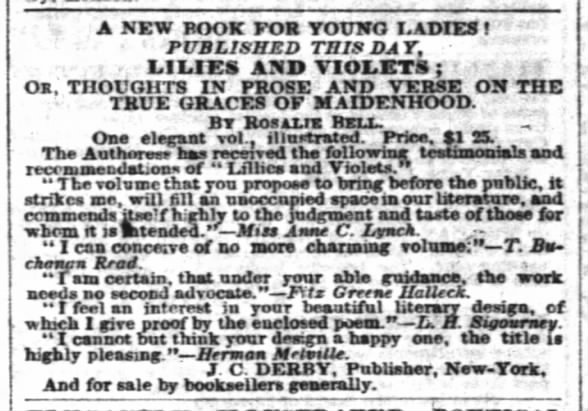
1855 Lilies and Violets, endorsed by Melville


From the publisher's advertisement of J. C. Derby for Lilies and Violets ("A New Book For Young Ladies") in the New York Evening Post, Wednesday, December 27, 1854
"I cannot but think your design a happy one—the title is highly pleasing." —[Herman Melville.
Below, Melville's published endorsement in context, following recommendations by Anne Lynch, T. Buchanan Read, Fitz-Greene Halleck, and Lydia Huntley Sigourney:
The authoress has received the following testimonials and recommendations of “Lilies and Violets”: 
“The volume that you propose to bring before the public, it strikes me, will fill an unoccupied space in our literature, and commends itself highly to the judgment and taste of those for whom it is intended.”—[Miss Anne C. Lynch.
“I can conceive of no more charming volume.”—[T. Buchanan Read.
“I am certain that under your able guidance, the work needs no second advocate.”—[Fitz-Greene Halleck.
“I feel an interest in your beautiful literary design, of which I give proof by the inclosed poem.”—[L. H. Sigourney.
"I cannot but think your design a happy one—the title is highly pleasing." —[Herman Melville.

J. C. DERBY, Publisher, New York,
And for sale by booksellers generally.
Even so brief and seemingly non-committal a comment by Melville has potentially significant implications. For one thing, when ever did any publisher quote Herman Melville's opinion of a new book? And however little the testimonial provides evidence of two letters or communications in Melville's lost correspondence, one from editor "Rosalie Bell" (pseudonym? and whose?) or somebody at Derby soliciting support for the project, and the one from Melville in reply that is selectively quoted in the advertisement.

Like Melville, Lydia H. Sigourney praised the "design" of the proposed anthology. Sigourney liked the design so well she sent along a contribution of her own for inclusion: "Death of a Young Maiden" (p. 319), presumably.
 
Melville did not contribute, unless he wrote one of those sketches or poems in the volume attributed to "Anonymous." Something to look into on a rainy day! For now I would guess Melville picked up some ideas and hints in Lilies and Violets that we find eventually developed in the Weeds and Wildings manuscript, in flower poems like "A Ground-Vine Intercedes with the Queen of Flowers for the Merited Recognition of Clover" and "The Devotion of the Flowers to Their Lady." 

Lilies and Violets was later republished or pirated in 1864 by J. E. Potter under a different title, The Young Lady's Own Book, with credit now going to a different editor, "Emily Thornwell."

UPDATES

"Rosalie Bell" was a pseudonym of Mrs. Catharine V. Devens, formerly Catharine V. H. Oakes (1827-1855), as explained in the editorial note to her letter of September 11, 1854 to Thoreau, published in The Correspondence of Henry D. Thoreau: Volume 2: 1849-1856, edited by Robert N. Hudspeth with Elizabeth Hall Witherell and Lihong Xie (Princeton University Press, 2018) at page 241. Alternatively spelled Catherine, as on the Devens family headstone at Cataumet Cemetery.

Review of LILIES AND VIOLETS in the Salem [Massachusetts] Register, Thursday, December 28, 1854:
This is a beautiful volume, admirably adapted for a gift book, containing selections, in prose and verse, from many favorite writers. The selections are classified, and arranged under the heads Esthetic, Intellectual, Affectional, Devotional, and Domestic. The vignette title page is an elegant specimen of art, and the little embellishments interspersed through the volume are remarkably tasteful and well executed. Miss Anne C. Lynch, the poetess, expresses the opinion that this book will fill an unoccupied space in our literature, and commends itself highly to the judgment and taste of those for whom it is intended. Mrs. Sigourney furnished a poem for what she calls “this beautiful literary design.” — Fitz Greene Halleck, Melville, Reed, and many others of our distinguished authors, have also expressed their warm approbation of the work, and have aided the compiler essentially by their advice and contributions. So many gems, from native and foreign writers, set in a style of such simple elegance, can not fail to prove unusually attractive. The volume must be placed in the choicest catalogue.
The Derby advertisement with Melville's endorsement of Lilies and Violets also appeared in the New York Tribune, Saturday, December 23, 1854; and on the same day in the New York Times. "Published This Day" according to the ad, timed to tempt holiday shoppers with a traditional gift-book.

Sat, Dec 23, 1854 – Page 8 · The New York Times (New York, New York) · Newspapers.com

Wednesday, February 27, 2013

Melville and Hawthorne seen on Berkshire rambles, "like Wordsworth and Coleridge"

From the Boston Herald, Sunday, June 29, 1890:

WHERE HAWTHORNE LIVED.

The Little Red House in Lenox Burned--The Novelist’s Life There.

[From Our Regular Correspondent.]

LENOX, June 28, 1890

* * *
Forty years ago, when Hawthorne lived here, Lenox was the centre of a circle of literateurs. Hawthorne was frequently visited by his friend Herman Melville, who wrote those thrilling tales of the South seas, “Typee” and “Omoo.” Hawthorne and Melville spent much time wandering about the woods and fields encircling Stockbridge bowl. There are men now living in Lenox who remember seeing these two literary men on their rambles through the fields, like Wordsworth and Coleridge about the Lakes of Grasmere...
Grasmere via The English Kitchen

Tuesday, February 26, 2013

New York correspondent Proteus on departure of "our own Melville"

Augustus Kinsley Gardner
Image Credit:  B012640 Portraits, Images from the History of Medicine

Who's Proteus? Looks to me like Melville's NY friend Augustus Kinsley Gardner (1821-1876), son of the editor of the Newark Daily Advertiser. The Duyckincks in their Cyclopaedia of American Literature name the Advertiser as one venue favored by Gardner, along with the Literary World, New World, and Knickerbocker. Several contributions by Proteus deal knowledgeably with the profession of medicine. Gardner's absorbing interest in his professional life and duties as a physician would explain the abbreviated career of Proteus as NY correspondent. Letters from Proteus appeared in the Advertiser from 1850 to 1854, the bulk in 1850-1851.
Aha! According to the biographical sketch by Samuel W Francis in the 1866 Medical and Surgical Reporter Gardner
"Contributed for years an average of many columns a week for the Newark Daily Advertiser."
Gardner's 1848 book Old Wine in New Bottles is compiled from letters to the editor of the Newark Daily Advertiser, signed "A. K. G."

Augustus K. Gardner was also the NY correspondent of New Orleans newspapers including the Commercial Bulletin, which in November 1854 printed Gardner's description of Melville at social gatherings as
 "taciturn, but genial, and when warmed-up capitally racy and pungent..."
(as quoted in Hershel Parker's Melville Biography: An Inside Narrative (Northwestern University Press, 2012) on pages 162-3.
From the Newark, New Jersey Daily Advertiser, Wednesday evening, November 20, 1850:
NEW YORK, Nov. 18
DEAR DAILY—Although as ever before, I write you from New York, Dr. Holmes has taught us that it is not from the metropolis. New York will not be in his opinion considered such, until
—Our first scholars are content to dwell
Where their own printers teach them how to spell.
This state seems impossible to be attained, for our men of letters seems [sic] to avoid cities.  Recently, Professor Longfellow has bought a farm at Stockbridge, Hawthorne another at Lenox, Mass., and our own Melville has deserted the birth-place of himself and his ancestors, and to the Berkshire hills has hied away to bury his genial humor, his fine understanding, but not, I trust, our friendship. Why these men should feel so ambitious of producing a cabbage or a pumpkin, I cannot tell. Perhaps it is their design to devote themselves to the philanthropic purpose of investigating the cause of the potato rot. Possibly the Bostonians have caught the chicken or pear fever which rages epidemically in that city....

[letter concludes with a plug for the new book by Cornelius Mathews]

…A work, issuing from the press, called Chanticleer, a national thanksgiving book, is recommended to precede the turkey and plum pudding era. The anonymous author will probably prove to be a well-known clever writer, who always commands the public attention.
PROTEUS.
Related posts:

      Friday, February 22, 2013

      Pierre and Wordsworth's "nearer mist"

      Wanderer above the Sea of Fog
      Caspar David Friedrich, Public domain, via Wikimedia Commons

      In Herman Melville: Making of the Poet (Northwestern University Press, 2008) Hershel Parker observes the evolution of Melville's seventh book in "Wordsworthian" passages that demonstrate "the unfolding of the inner mind in majestic natural settings" (94). One specific influence on Pierre; Or, The Ambiguities (1852) is a passage from Wordsworth's Excursion (book 3) giving names to rocks, a source for sections in Pierre about boulders named Memnon and Enceladus as shown in Herman Melville: A Biography Volume 2, 1851-1891 pages 57-58. Another source from The Excursion, book 5, is cited by Thomas F. Heffernan: the "fertilising moisture" of certain rocks is recast in Pierre; Or, The Ambiguities as "a subtile moisture, which fed with greenness" the nearby ground ("Melville and Wordsworth," American Literature, November 1977: 338-351 at 340 fn 9.). 

      The following passage from Wordsworth's "Descriptive Sketches" refers to "nearer mist," an unusual phrasing which also occurs in Pierre, in a similar context:

      — 'Tis morn: with gold the verdant mountain glows,
      More high, the snowy peaks with hues of rose.
      Far stretched beneath the many-tinted hills
      A mighty waste of mist the valley fills,
      A solemn sea! whose vales and mountains round
      Stand motionless, to awful silence bound.
      A gulf of gloomy blue, that opens wide
      And bottomless, divides the midway tide.
      Like leaning masts of stranded ships appear
      The pines that near the coast their summits rear;
      Of cabins, woods, and lawns a pleasant shore
      Bounds calm and clear the chaos still and hoar;
      Loud thro' that midway gulf ascending, sound
      Unnumber'd streams with hollow roar profound:
      Mount thro' the nearer mist the chaunt of birds,

      And talking voices, and the low of herds,
      The bark of dogs, the drowsy tinkling bell,
      And wild-wood mountain lutes of saddest swell. 
      -- Descriptive Sketches, Poetical Works page 50 

       And below, the passage with "nearer mist" extracted from the online text of Pierre at Project Gutenberg:

      Well for Pierre it was, that the penciling presentiments of his mind concerning Lucy as quickly erased as painted their tormenting images. Standing half-befogged upon the mountain of his Fate, all that part of the wide panorama was wrapped in clouds to him; but anon those concealings slid aside, or rather, a quick rent was made in them; disclosing far below, half-vailed in the lower mist, the winding tranquil vale and stream of Lucy's previous happy life; through the swift cloud-rent he caught one glimpse of her expectant and angelic face peeping from the honey-suckled window of her cottage; and the next instant the stormy pinions of the clouds locked themselves over it again; and all was hidden as before; and all went confused in whirling rack and vapor as before. Only by unconscious inspiration, caught from the agencies invisible to man, had he been enabled to write that first obscurely announcing note to Lucy; wherein the collectedness, and the mildness, and the calmness, were but the natural though insidious precursors of the stunning bolts on bolts to follow.
      But, while thus, for the most part wrapped from his consciousness and vision, still, the condition of his Lucy, as so deeply affected now, was still more and more disentangling and defining itself from out its nearer mist, and even beneath the general upper fog. For when unfathomably stirred, the subtler elements of man do not always reveal themselves in the concocting act; but, as with all other potencies, show themselves chiefly in their ultimate resolvings and results. Strange wild work, and awfully symmetrical and reciprocal, was that now going on within the self-apparently chaotic breast of Pierre. As in his own conscious determinations, the mournful Isabel was being snatched from her captivity of world-wide abandonment; so, deeper down in the more secret chambers of his unsuspecting soul, the smiling Lucy, now as dead and ashy pale, was being bound a ransom for Isabel's salvation. Eye for eye, and tooth for tooth. Eternally inexorable and unconcerned is Fate, a mere heartless trader in men's joys and woes.

      I was prompted to wrestle again with Melville's words in book 5 of Pierre while reading in Hershel Parker's new book, Melville Biography: An Inside Narrative. In chapter 2, "Textual Editor as Biographer in Training" (35-36), Parker explains the practically irresistible emendation of "nearer" to "nether." Parker offers this appealing change, now effected I see at pages 105 in the Trade Paper edition of Pierre or The Ambiguities (3rd printing, Northwestern University Press, 1999), as an example of the common readerly response of mentally, then marginally correcting a text by substituting "the right word" for a wrong one. The correction makes good "topographical" sense, neatly clarifying the upper vs lower distinction that is already there, an ongoing contrast that later on includes the explicit reference to "upper and nether firmaments." Earlier on Melville pictured "the lower mist" hiding Lucy-as-valley from Pierre-as-mountaineer. Well then, nether means "lower" so correcting "nearer mist" to "nether mist" eliminates the puzzling "nearer" and keeps everything and everybody properly aligned and oriented.  

      Piece of cake?


      Maybe not, after all, considering the precedent in Wordsworth--and considering, too, the shared situation of a youthful traveler in the mountains: Wordsworth's literal Alps and valley, Melville's metaphorical mountain and valley. Metaphorically, Melville's upper and lower somehow represent parts of the psyche, conscious and repressed unconscious. But here as throughout Pierre the language is tricky, the progress convoluted.
      Two paragraphs are involved, and looking again and trying to follow more closely I see a possible twist in the second paragraph, a turn involving both action and orientation that is signaled at the start of the paragraph in the word "But." Before, in the first paragraph, we were looking down into the valley with Pierre seeing things as they looked "to him," but here, wait:  has the orientation weirdly shifted?  The grammatical subject of the relevant sentence is an abstract noun, condition--more concretely, Lucy's condition.  What is emerging more visibly? Lucy's condition. From what is Lucy's condition "disentangling and defining itself? From, emerging out from, its "nearer mist."
      ITS. Possessive pronoun, third person, antecedent "the condition of Lucy." Nearer to whom I guess is still the question. Most immediately to Lucy, below, still contrasted with Pierre above, in or closer to the "upper fog." It is the same "lower mist" as in the previous paragraph, only pictured now as nearer, closer to Lucy. Yes all of this has reference to the mind of Pierre, his conscious thoughts and unconscious stirrings. These metaphorical mists that lately had hidden Lucy from Pierre's conscious thoughts are both "nether" and "nearer": "nether" to Pierre on the mountain, "nearer" to Lucy in the valley. Lucy's condition is emerging from the mists nearer to, closer to Lucy's condition, which are also nether, lower mists in Pierre's subconscious mind.
      What is Lucy's figurative condition? That of a cruelly suffering crime victim, tied up in the basement and held for ransom. O!

      In Wordsworth's scene a sea of mist covers the valley below, seen through an opening or "gulf" in the mist. Bordering this figurative bay is a figurative "shore" of familiar things, all comfortably natural: cabins, woods, lawns. Melville's Lucy belongs to the same kind of cozy valley scenery, seen like the features of Wordsworth's "pleasant shore" through a hole in the mists. In Wordsworth's passage, bird songs and other sounds from that homey lower world waft up through "nearer mist." That's the mist closer to the birds, people, cows and dogs.
      I think. Hmm. I have to admit what Wordsworth means by his "nearer mist" is for me hard to de-mistify.  And what about other (later?) versions with many changes including the change of "nearer mist" to "nearer vapours"? 
      Somebody somewhere must have a better explication of all this. Here's something helpful, possibly. Tracing the influence of Beattie's The Minstrel and James Clarke (Survey of the Lakes), Jonathan Wordsworth explains that 
      "for Wordsworth, the nearer, domestic" sounds are distinct, as in Clarke, "but not those heard through the gloomy midway gulf." 
      -- "The Image of a Mighty Mind (1805, Book 13)" in William Wordsworth's The Prelude: A Casebook, edited by Stephen Gill (Oxford University Press, 2006) page 229. Update! now accessible online via Oxford Academic:

      Wordsworth, Jonathan, 'The Image of a Mighty Mind (1805, Book 13)', in Stephen Gill (ed.), William Wordsworth’s: The Prelude (New York, NY, 2006; online edn, Oxford Academic, 31 Oct. 2023), https://doi.org/10.1093/oso/9780195180916.003.0008.

      Well, that's the association I was getting at, William Wordsworth's "nearer" in relation to the valley as more domestic, which is exactly the condition of Lucy now in relation to Pierre's lofty new enthusiasm.
      I need to get hold of these studies, too:
      • Maxine Moore, "Melville's Pierre and Wordsworth: Intimations of Immorality."  Ha! immorality. New Letters 39 (Summer 1973): 89-107; and
      • Michael Davitt Bell, "The Glendinning Heritage:  Melville's Literary Borrowings in Pierre."  Studies in Romanticism 12 (Fall 1973): 741-762; and
      • Hershel Parker, “Melville and the Berkshires: Emotion-Laden Terrain, ‘Reckless Sky-Assaulting Mood,’ and Encroaching Wordsworthianism,” in American Literature: The New England Heritage, ed. James Nagel and Richard Astro (New York: Garland Publishing, 1981) 65-80; and
      • Johnathan Hall,  "The Non-correspondent Breeze: Melville's Re-writing of Wordsworth in Pierre." ESQ: A Journal of the American Renaissance 39 (1993): 1-19. 
      You probably knew Melville's copy of The Complete Poetical Works of William Wordsworth has been reproduced digitally at Melville's Marginalia Online. Descriptive Sketches is one of the Juvenile Pieces, the line with "nearer mist" appears on page 50--nope, no markings by Melville here or anywhere in this section of the book. 

      More to ponder, as usual. 

      Update

      The later reference in Pierre to the "resolute traveler" in the Alps (Book 21.1) evokes the mountain setting of the earlier passage with "nearer mist" in it. The later, more elaborate passage on the Switzerland of the soul thus returns to the landscape of Wordsworth's "Descriptive Sketches" which describe "a pedestrian tour among the Alps."  Brian Higgins and Hershel Parker point out the main correspondences of symbolism and imagery in Reading Melville's Pierre, 161. And why "resolute"?  Melville's characterization of the "traveler" as "resolute" sounds like another nod to Wordsworth, alluding to the "Traveller" of  "Resolution and Independence," the poem that Melville would parody the following year in "Cock-A-Doodle-Doo!" (first published in the December 1853 issue of Harper's New Monthly Magazine).

      Hey look! a whole dissertation by Cory R. Goehring on
      "The Wordsworthian Inheritance of Melville's Poetics."

       And check this out, Robert A Duggan, Jr. on Melville's poem "The House-top" and The Prelude. 

      It's great to see the Wordsworth-gap closing, as identified by R. D. Madison:

      "The study of the relationship between Melville and Wordsworth remains one of the largest gaps in Melville criticism."  
      -- "Literature of Exploration and the Sea" in A Companion to Herman Melville (Wiley-Blackwell, 2006; paperback 2015) edited by Wyn Kelley, page 285.