Showing posts with label Marion Harland. Show all posts

Monday, July 14, 2014

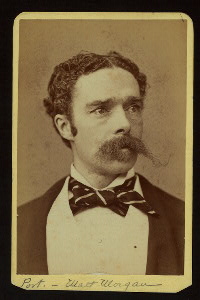
Trying to date Walt McDougall's encounter with Melville at Matt Morgan's studio

1874-1877 I'm thinking is the time frame. How so? Well, McDougall specifically names NY Graphic colleague Charles Frohman as one of the people he saw that one afternoon he went to Morgan's studio with Newark painter John Bolles. Frohman's tenure at the New York Daily Graphic was brief, lasting only from 1874 to 1877. Frohman (1860-1915) was only 14 years old in 1874. He worked in the circulation or advertising department "all day." Then
At night he sold tickets in the box office of Hooley's Theatre, Brooklyn.
--Who's who on the Stage
http://gayinfluence.blogspot.com/2012/02/charles-frohman.html

Also named is Walt Whitman, who as shown at the Walt Whitman Archive was contributing poems for the Daily Graphic in 1873 and 1874.

http://americanart.si.edu/collections/search/artwork/?id=6781

So the overlap for Frohman and Whitman at the Daily Graphic is 1874, which (if that's the right year) would make McDougall what, 16 years old at the time. 

But wait. Marion Harland needs to be home in Newark with her minister husband. Wikipedia says she relocated to Europe in 1873-1875, for her health. Damn! Let's make sure of that. Marion Harland's autobiography puts it this way: she finally got to Europe 21 years after her husband promised her a trip back in 1855, which would put the start of the trip October 15, 1876. They sailed for New York in late September, two years later.

http://pvhn2.wordpress.com/1800-2/mary-virginia-hawes-terhune/

This Free Dictionary entry for her son Albert Payson Terhune confirms from somewhere the dates as 1876-78. Seems that Edward Payson Terhune, Marion Harland's minister husband, 
  was the American chaplain at Rome, Italy, in 1876-1877. Free Dictionary
 (citing Appleton's Encyclopaedia)
And look, after Europe the family settled in Springfield, Massachusetts. So ha! we're back to 1874 as the only year in which Walt McDougall could have invited Melville home in Newark to meet his neighbor Marion Harland, and on the same day also have seen Charles Frohman of the Daily Graphic and Daily Graphic contributor Walt Whitman at Morgan's studio.

Next step: dip into Hershel Parker's biography, Volume 2, and find out what Melville was doing in 1874. Writing poetry, as Lizzie nervously revealed to the family in Boston, at Thanksgiving (777-8).

Later: Not sure if Whitman was on the scene in 1875 also.  For now, let's make it 1874-1875 to be safe.

Still later:  In 1876 Matt Morgan led efforts to relieve Walt Whitman in his widely publicized illness and alleged financial distress:
“Matt. Morgan, who is now trying to run the Lyceum in Fourteenth street as a vaudeville theatre, proposes to give a benefit to Walt. Whitman.” --Albany Evening Times, Friday, April 7, 1876; found at Old Fulton NY Post Cards
Morgan made his offer in a letter to the New York World, as reported in the Cincinnati Commercial Tribune:
A MATINEE benefit for Walt Whitman has been offered by Matt Morgan of the Lyceum Theater in New York, who has written a note to the editor of the World, making the offer, as follows
"Believing that my illustrious fellow countryman, Robert Buchanan, (making the necessary allowances for his poetical exaggerations) has struck the right cord in his allusions alike to the merits and the needs of Walt Whitman, fully appreciating Mr Whitman's services alike in the cause of literature and humanity, and sincerely believing that the heart of the great American people in general, and of the New York public in particular, will be quick to respond generously in the extremity of one of the most original writers and best men in the country, I feel myself honored in taking this opportunity of hereby offering my theater and my company for any matinee performance for the benefit of Mr Walt Whitman, to be given at such date as any of his authorized friends may designate.”
--Monday, April 10, 1876; found in the Newspaper Archives at Genealogy Bank
 Related posts at melvilliana;

Walt McDougall in the American Mercury


Check out this earlier and different version of Walt McDougall's encounter with Herman Melville at Matt Morgan's studio. Turns out that McDougall's 1926 book This is the Life! incorporated material that McDougall had previously published in H. L. Mencken's American Mercury. This is the Life! is dedicated to Mencken.

From McDougall's article, "Memories of a Cartoonist" in The American Mercury (March 1925):
An endeavor to list all the rivals that were set up to Puck and Judge would be barren of interest, for, with the exception of Life, they were shortlived. But each of them was a bow of promise to peripatetic artists while it lasted. Farthest back in my memory is the Tomahawk, started by Matt Morgan, a dashing, brilliant English artist whose studio was the resort of nearly all of the illustrators and writers of the day. There I first saw Walt Whitman, on my only visit to the place in company with John Bolles, a Newark painter. That afternoon there came, too, Thomas Wüst, a distinguished German cartoonist, Hopkins and Miranda, and Charles Frohman, then in charge of the distribution of the Daily Graphic, William H. Shelton, famous for his escape from a Confederate prison, and the dapper Gray Parker, with others no less distinguished but unknown to the two obscure Newarkers.
In the centre of the studio was parked a new washtub half-full of claret punch, which, it seemed, was a permanent adjunct of the apartment and gave me an exaggerated idea of Morgan’s affluence. His weekly was several grades above the other comic papers of the time, but it soon died and he returned to London. John Hyde, another Englishman and a good draughtsman who used to make the alluring front pages for the Police Gazette, wherein almost fabulously beautiful legs were always prominent, was present and I was informed that there was much jealousy between the two Britishers. There I also met Herman Melville, author of “Typee,” and invited him out to Newark to meet Marion Harland, wife of our minister, who lived a few doors from us. Under the influence of the punch he accepted my invitation, but never came. I met him frequently afterward, as I did Walt Whitman, lounging along Park Row, a rather moody, sulky man, I imagined, but now I think he was simply shy.

That gathering was somewhat different from the daily assembly of chess players in my father’s rather shabby studio three floors up in Broad street, Newark…. (264-5)
Compare the later version of McDougall's encounter with Melville, from This is the Life!:  
I had almost forgotten to mention among them one whom for many years I did not properly appreciate, Herman Melville, the author of “Typee,” and whom I very often encountered, as I did Walt Whitman, lounging along Park Row, a rather moody, sullen man, I thought, but now I imagine that he was shy. Under the influence of the punch, perhaps, I invited Melville to our house, to meet Marion Harland, and he accepted the invitation graciously enough but he never came.
In revision, McDougall adds the reflection that he "did not properly appreciate" Melville, then and "for many years" afterward. Instead of "sulky," McDougall in the book version says he thought Melville "sullen." And in the 1925 magazine version, McDougall helpfully explained his connection to Marion Harland, a link left mysterious in the 1926 book version. Only in the earlier magazine version do we learn: the famous author was a Newark neighbor of the McDougall family and the wife of their minister (Edward Payson Terhune, Google further informs).

Hey, what about this? We were already mesmerized by that washtub of punch. So far gone as to speculate about Melville's (not uncharacteristically) "warming up" with it at Matt Morgan's studio. Now we find that McDougall blabbed it outright in the 1925 American Mercury. In the magazine version, McDougall stated clearly, without qualification, that Melville was "under the influence" when he accepted McDougall's invitation to come to Newark and meet Marion Harland.
Under the influence of the punch he accepted my invitation, but never came.
But in the book version McDougall re-imagines the scene. Now, with some qualification ("perhaps"), he generously attributes any sort of elevated behavior to himself only:
Under the influence of the punch, perhaps, I invited Melville to our house, to meet Marion Harland, and he accepted the invitation graciously enough but he never came.
Somebody was high, but who is ambiguous, now that we have two different versions to consider.

Miscellaneous extras:
  • Walt McDougall must have heard a few stories from his friend Julian Hawthorne about Melville. McDougall on Hawthorne: 
Bill Nye and Julian Hawthorne, alike in soul, devoid of affection or conceit, diffident, shy of strangers yet alike compelled to meet them with a pretense of geniality secretly abhorrent, made my room their daily lounging place…. Hawthorne would describe a new dish so vividly that the hungry Nye would suggest that we adjourn to Hash and Crook’s restaurant in the Times Building and sample it at his expense. Hawthorne told me that once, when a boy, he found fourteen pies in his mother’s pantry and ate them all.

He was low-voiced, with a strong partiality for the supernatural; a man, who, with less education, might have been a spiritualist. I fancy that he found in the flippancy of Nye’s and my conversation a sort of mental anaesthetic. I have never known two such manly, gentle, undefiled souls, yet both were overwhelmed by heart-breaking disasters. Nye’s career was meteoric; Hawthorne’s lasted thirty years. Both are already dim memories, mere names. --Pictures in the Papers, American Mercury (September 1925): 72-3. Also (revised) in This is the Life!
Related melvilliana posts:

Saturday, July 12, 2014

Walt McDougall remembers Melville (and Whitman), at Matt Morgan's studio and "lounging along Park Row"


For an earlier version by Walt McDougall of his social encounter with Melville at Matt Morgan's studio, see Walt McDougall in the American Mercury

For more thoughts on Melville at Morgan's studio see Matt Morgan on Broadway.

Graphic artist Walt McDougall (1858-1938), as quoted in the newspaper review by George Currie:
“Herman Melville, whom I often encountered, as I did Walt Whitman, lounging along Park Row, a rather moody, sullen man, I thought, but now I imagine that he was shy.”
(Brooklyn Daily Eagle, Sunday, February 21, 1926)
Found some great photos of Walt McDougall on Facebook.


Then, taking the hint in the Brooklyn Daily Eagle, I grabbed McDougall's 1926 book This is the Life! in the Hathi Trust Digital Library. Goodness!

<

Recalling old colleagues in chapter three (Living by One's Wits), McDougall reaches way way back to the humor magazine Tomahawk, illustrated by Matt Morgan. McDougall seems to make this Tomahawk a New York affair. He also mentions contributing occasionally to Puck (not Punch), launched in New York on September 27, 1876.  
Puck started as a German-language weekly but an English version appeared the following year in March, 1877.  --Delaware Art Museum
Was the old London Tomahawk (1867-1870) revived by Morgan in New York, some time in the later 1870's? Or perhaps McDougall is misremembering Morgan's association in New York with Frank Leslie’s Illustrated Newspaper and (even more likely) Frank Leslie’s Budget of Fun.
Leslie hired Morgan in August 1870 to replace the late William Newman (died July 1870). --Yesterday's Papers
In any case, the reminiscence is clearly tied to Matthew Somerville Morgan and Morgan's New York studio, where McDougall claims to have seen Melville one afternoon among a host of others:
Farthest back in my memory is the Tomahawk, started by Matt Morgan, a dashing, handsome Englishman of the Herbert Standing type, whose studio was the daily resort of many of the illustrators, poets and actors of the time. There I first saw Walt Whitman on my only visit to the place with John Bolles, a Newarker. That afternoon there came Thomas [Theodore] Wüst, Hopkins and [Fernando] Miranda, with Charles Frohman, then circulation manager for the Graphic, William H. Shelton, famous for his escape from a Southern prison, and the dapper Gray Parker, then on Harper’s staff, with others no less distinguished but quite unknown to the two obscure Newarkers.
I had almost forgotten to mention among them one whom for many years I did not properly appreciate, Herman Melville, the author of “Typee,” and whom I very often encountered, as I did Walt Whitman, lounging along Park Row, a rather moody, sullen man, I thought, but now I imagine that he was shy. Under the influence of the punch, perhaps, I invited Melville to our house, to meet Marion Harland, and he accepted the invitation graciously enough but he never came.

I remember that both Bolles and I thought the conversation nothing much for such distinguished company, for we were both, no doubt, looking for pyrotechnics. We agreed that we had heard much more brilliant talk right in my own home. I thought Whitman a domineering old windbag who couldn’t keep his tobacco out of his splendid white whiskers, but when I grew up I came to like him very much, and Horace Traubel, whom I knew very well after I went to live in Philadelphia, while he was still a bank clerk, told me that the old poet often urged him to bring me over, but I knew that the secret of his liking was the fact that I was the only man he knew who, like himself, chewed Mayflower tobacco, long since an extinct brand.
In the center of Morgan’s studio was parked a new washtub half filled with claret punch, which, it seemed, was a permanent adjunct of the apartment and which gave me an exalted idea of the owner’s affluence. I remember seeing a similar punch bowl when a child on the occasion of a big baseball game, and, much later, on the dedication, or whatever it was, of Grant’s Tomb. 
The Tomahawk was several degrees above the other comic papers in many respects, but it soon died and Morgan returned to London.... (This is the Life! 64-66)
Update: For historical background, check out these books available online:
William Murrell, A History of American Graphic Humor (1865-1938);
F. Weitenkampf, American Graphic Art;
J. Brander Matthews on The Comic Periodical Literature of the United States, in Vol. 7 of The American Bibliopolist (1875): 199-201;

and wow! the great recent study by Richard Scully, "Sex, Art, and the Victorian Cartoonist: Matthew Somerville Morgan in Victorian Britain and America," International Journal of Comic Art 13.1 (Spring 2011): 291-325.

Matt Morgan Digital ID: th-37995. New York Public Library
Update 2: More on Matt Morgan, from the Twentieth Century Biographical Dictionary of Notable Americans:
MORGAN, Matthew Somerville, artist, was born in London, England, April 27, 1839; son of Matthew and Mary (Somerville) Morgan, both of whom were actors. He was a scene painter in Princess's theatre, London, for a time, and later artist and correspondent of the Illustrated London News in Rome, Italy. He studied art in Paris, Italy and Spain; made a journey into Africa by the French Algeria route in 1858, and served as war correspondent of the Illustrated London News during the Austro-Italian war in 1859. He was proprietor and joint editor of the London Tomahawk, a comic paper, and made a series of cartoons ridiculing the royal family. He was one of the founders of London Fun, and was the principal scene painter at Covent Garden during the run of Italian opera, 1867-69. He came to the United States in 1870 as cartoonist and caricaturist for Frank Leslie's Illustrated Newspaper. He was manager of a theatrical poster lithographic establishment at Cincinnati, Ohio, 1880-85, and organized in Cincinnati the Matt Morgan Art Pottery company in 1883, and the Cincinnati Art Students' league. He returned to New York city and opened a studio as a scene painter and illustrator. He painted pictures for Roman Catholic churches, several panoramic views of the civil war, exhibited in Cincinnati in 1886, and at the time of his death was finishing scenery for Madison Square Garden, New York. He contributed to the exhibitions of the Water-Color society. He published American War Cartoons (1874). He died in New York city, June 2, 1890.
--vol 7, ed. Rossiter Johnson
So most of Morgan's work "as cartoonist and caricaturist" in America falls within the decade of the 1870's. He returned to New York in the late 1880's, but by then was professionally engaged in a different sphere, "as a scene painter and illustrator." As the reference to Charles Frohman indicates, McDougall's encounter with Melville coincides with his early career at the New York Graphic. Frohman worked in the circulation department at the Graphic from 1874-1877 (Charles Frohman: Manager and Man). Another reason for dating the reminiscence to some time in the mid to late 1870's, when McDougall was about twenty, give or take a couple of years.

McDougall says he found enough courage in the tub of punch at Morgan's to invite Melville home to meet Marion Harland. And Melville accepted but never showed.

http://www.lva.virginia.gov/public/vawomen/2006/terhune.htm

But what does McDougall mean, "lounging along Park Row"?

Related posts at melvilliana: