
Original research and riffs on Herman Melville, authorship, and nineteenth-century American literature.
Friday, September 29, 2023


Wednesday, September 27, 2023
Project MUSE - Herman Melville's Love Letters
My favorite sentence in this 2018 article by Jordan Alexander Stein is the one showing he had not read either volume of Hershel Parker's magnificent Herman Melville: A Biography. Published in 1996 and 2002 by Johns Hopkins University Press--also, ironically, the publisher of ELH where Stein's essay on "Herman Melville's Love Letters" appeared:
Project MUSE - Herman Melville's Love Letters
"Likewise, as patient an archival scholar as Hershel Parker concludes the first volume of his exhaustive Melville biography with the unverifiable assertion that the day on which Melville received Hawthorne's letter "was the happiest day of Melville's life."
ELH Volume 85, Number 1, Spring 2018 pages 122-3, citing "Hershel Parker, Herman Melville, A Biography: Volume 1, 1819–1851 (Baltimore: Johns Hopkins Univ. Press, 1996), 883."
Hahahaha 😂😂😂
The cited page is the last in Volume 1 of Parker's biography. There Parker brings chapter 40, "Melville in Triumph," to a thrilling close with Melville's "farewell gift" of Moby-Dick to its dedicatee in what Parker has believably re-created as a private, self-funded "publication party" with Nathaniel Hawthorne as the "solitary guest" (page 879).
Hawthorne had not even read the book, so there was no letter of praise yet for Melville to receive and get happy about.
For Parker's estimation of the lost letter from Hawthorne, and finely stated appreciation of Melville's ecstatic reply (with due attention to allusions and metaphors, the figurative as well as the literal sense of Melville's reported words) you only have to open Volume 2 and follow along for five pages or so, starting on page three. That is, Parker's extensive treatment of this particular "love letter" from Herman Melville appears right where you would expect it, early in the first chapter of the next volume.
By saddling Melville's best biographer with an "unverifiable assertion" he never offered, Jordan Alexander Stein demonstrated convincingly (back in 2018) that he had not read either volume of Parker's work. What made Herman Melville "happiest" according to Parker was the inscribing and then physically giving of something truly great to his friend. Getting Hawthorne's letter afterward was wonderful, too, "joy-giving and exultation-breeding" as Melville told him. But the joy of bestowing Moby-Dick to the fellow-man he wrote it for surpassed even that, says Parker.
Saturday, September 23, 2023
Herman Melville, Dead White Male | History News Network
By Clare Spark, author of Hunting Captain Ahab (Kent State University Press, 2000; 2nd ed. 2006):
"Critics are eager to classify him, to annex a domesticated and pacified artist to their own political projects, not to understand his unresolved ambivalence about the possibilities of a freethinking democratic polity that could lead to mob rule. Hence nervous critics have frequently insisted on making him either an ultraconservative, a centrist, or a left-wing radical, and have managed his biography accordingly...."
Herman Melville, Dead White Male | History News Network
Another version:
Tuesday, September 12, 2023
Sunday, September 10, 2023
Fragments from a Writing Desk: Puzzled Reviewers of (DAYSWORK) and my relief and ...
Thursday, September 7, 2023
Harry Hubbard in Stockton, 1887 notice of his illness with mentions of Melville and THE WHALE
 |
| Stockton Albertus Del Orient Browere via American Gallery |
Henry F. Hubbard (1820-1887) was a "green hand" with Herman Melville on the whaleship Acushnet. Hubbard, just 20 years old, and the future author of Moby-Dick, 21, signed on late in December 1840. On January 3, 1841 they sailed out of Fairhaven, Mass. with Captain Valentine Pease on Melville's (and their ship's) first whaling voyage. Eighteen months later, in June of 1842, Melville and another "green hand" Richard Tobias Greene famously deserted at Nuku Hiva in the Marquesas. Melville and Hubbard would reconnect in the early 1850's when Hubbard visited Pittsfield. On March 23, 1853 Melville inscribed a copy of The Whale to
"Henry Hubbard from his old shipmate and watchmate on board the good ship Acushnet (Alas, wrecked at last on the Nor'west)"
https://www.lib.uchicago.edu/collex/exhibits/special-collections-special-director/whale-1851/
At
some point (then or earlier) Hubbard updated Melville on the fates of
former shipmates, as shown by Melville's extant memorandum of What became of the ship's company of the whale-ship "Acushnet" according to Hubbard who came home in her. Melville's memo and Hubbard's inscribed copy of The Whale (with two interesting annotations about real-life counterparts of Stubb and Pip) are presented and fully discussed in the 1988 Northwestern-Newberry Edition of Moby-Dick.
Hubbard made a name and fortune for himself in California. His obituary in the Stockton Evening Mail of March 26, 1887, cited for relevant biographical facts of Hubbard's life by the N-N editors, contains no reference to Moby-Dick
or its author. Melville and the British title of his great whale book
were both mentioned, however, in a previous notice published by the same
newspaper under the heading, "H. F. HUBBARD'S SICKNESS." The writer
thought Harry Hubbard's whaling adventures "would make an interesting
book" and believed also that
"Many of his experiences were mentioned by Melville in his works."
Transcribed below from the Stockton, California Evening Mail of March 9, 1887. Found on newspapers.com; accessible also via the California Digital Newspaper Collection.
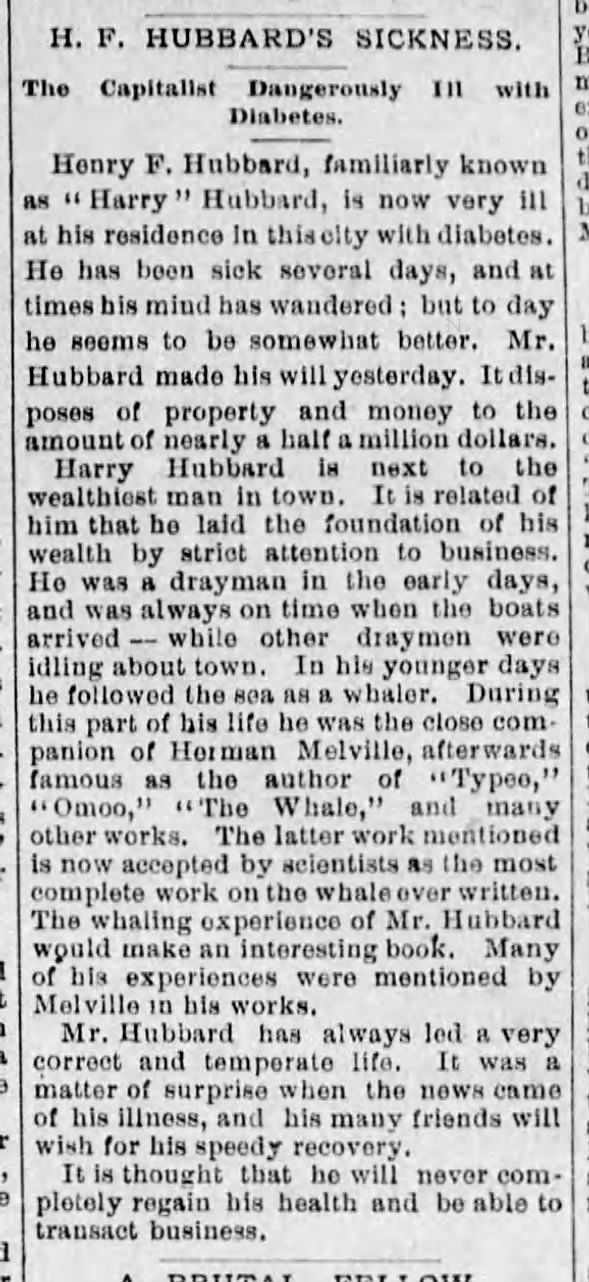 09 Mar 1887, Wed The Evening Mail (Stockton, California) Newspapers.com
H. F. HUBBARD'S SICKNESS.
The Capitalist Dangerously Ill with Diabetes.
Harry Hubbard is next to the wealthiest man in town. It is related of him that he laid the foundation of his wealth by strict attention to business. He was a drayman in the early days, and was always on time when the boats arrived--while other draymen were idling about town. In his younger days he followed the sea as a whaler. During this part of his life he was the close companion of Herman Melville, afterwards famous as the author of "Typee," "Omoo," "The Whale," and many other works. The latter work mentioned is now accepted by scientists as the most complete work on the whale ever written. The whaling experience of Mr. Hubbard would make an interesting book. Many of his experiences were mentioned by Melville in his works.
Mr. Hubbard has always led a very correct and temperate life. It was a matter of surprise when the news came of his illness, and his many friends will wish for his speedy recovery. It is thought that he will never completely regain his health and be able to transact business.
 |
| Daily Alta California - March 26, 1887 |
Tuesday, August 29, 2023
Song of the Communist, 1850 poem by Edward Abiel Washburn
In this unfortunately forgotten "Song of the Communist," Episcopal clergyman Edward Abiel Washburn (1819-1881) satirized French communists as deluded believers in "a magic state Elysian" to be effected by the abolition of law, marriage, and property. Pierre-Joseph Proudhon is the false "Prophet" of these happy activists who vainly await a new age of "Social bliss."
 |
| Proudhon |
The Literary World - May 18, 1850

Original Poetry.
SONG OF THE COMMUNIST.
I.
PASS the flask, thou pleasant fellow,
Brimming from the choicest vat,
Kept for us, till ripe and mellow,
By some dead aristocrat:
Hail we here the newborn season
Of the grey and wrinkled earth,
Hail the day of fullblown reason,
Day of freedom, wine, and mirth.
II.
Chiliads of slavish ages
Ended are, a worthless host,
Iron lords and bearded sages
Given up at last the ghost;
Kings have wielded heavy sceptres,
And the luckless urchin, man,
Has been thwacked by his preceptors
Since the school of time began.
III.
Ah! what hapless, cringing masses
Bowed the neck in years of old,
Bending still, like foolish asses
Laden with their masters' gold :
Dreamy Platos built before us
Airy schemes of social laws,
But the world has laughed in chorus
At their weak, ideal saws.
IV.
Prophet of the new creation,
Proudhon with the fiery tongue,
Stand and pour the revelation
Such as seer has never sung.
Let the thoughts thy spirit speaking
Have volcanic utterance;
Now unveil the glory breaking
On regenerated France.
V.
What is law but contradiction
Of the sacred rights of man?
What is marriage but a fiction
Hallowed by the churchly ban?
What is property, O neighbor,
But the most unblushing stealth?
Who made me to live by labor,
Thee to pocket nature's wealth?
VI.
Look, where history commences,
Lord and ladyship were not:
Eden was not lined with fences,
Adam was a sansculotte;
Marriage yoked not drudging woman,
At the word of tithe-fed priests;
Acorns and all else were common,
Man was free as other beasts.
VII.
See, again, upon our vision,
Those primeval scenes arise,
Bursts a magic state Elysian,
Paris is a Paradise!
See phalansteries unfolding
All of social good and fair;
Princes meek, their napkins holding,
Wait behind the people's chair.
VIII.
Debtors dwell in bankers' houses,
Unbelief dons gown and stole,
Ouvriers, in unwashed blouses,
With gay ladies cheek by jowl;
Madame Sand is chief appointed,
Sue will grace the woolsack well,
And for Church, the Lord's anointed
Shall be good Abbé Chatel!
IX.
Happy age! and happy Paris!
Speed the cycle of thy fate,
Social bliss no longer tarries,
Proudhon speaks the word "Create."
Be the puny Godhead banished,
Who has ruled us hitherto,
The old-world régime is vanished,
Proudhon has made all things new.
Newburyport, Mass.
E. A. W.
After his death in 1881, E. A. Washburn was remembered as "a true poet" in the memorial sermon delivered by Thomas March Clark:
He was also a true poet, as the few verses from his pen which have been allowed to see the light sufficiently prove, while others remain behind, which we trust will not always be lost to the world. There was in his mind a singular union of the dry light of metaphysics with the moist, warm atmosphere of feeling, and while he sometimes talked like an old Grecian sage, at other times he would tune his harp to some sweet hymn of his own, or some rare translation of an ancient Latin lyric, so compact and beautiful as to make one doubt whether he could be anything more than a poet. When he sat down to write, you might say with Robert Burns:
"Perhaps it may turn out a sang,
Perhaps turn out a sermon."It may seem still more extraordinary to some persons that such a man should have been able to write the most exquisite humorous verses, although, indeed, the element of humor in some form belongs to almost all great men, and no one can have a well-rounded and complete intellect without it. If John Calvin had been capable of humor, it would have been a great relief to him, and to the world after him. No compend of Dr. Washburn's writings would be complete if it did not contain some specimens of his lighter verses, which are now for the most part in private hands. I think that no one ever charged him with frivolity; on the contrary, he was regarded as somewhat stern and imperious, and as a man who was desperately in earnest; and yet he could unbend and become as a child, and even seem to enjoy frivolity in others. But for this, with all the woes that he had to bear, he might have been taken from us even earlier than he was.
 |
| New York Herald - September 7, 1879 via Genealogy Bank |
E. A. Washburn long recognized the appeal of utopian schemes for reforming society. At the 1879 meeting of the Evangelical Alliance in Basel, Switzerland
"Rev. Dr. Washburn, of New York, spoke at some length on the nature and dangers of Socialism. He regarded Christianity as the only source of relief for socialistic vagaries and disorders."
-- New York Herald, September 7, 1879.
As reported in The Methodist Quarterly Review, volume 62 (April 1880) on page 273, Washburn offered practical alternatives to the destructive embrace of Socialism:
As printed in the Literary World, the subscribed initials "E. A. W." in connection with "Newburyport" sufficiently identify Edward Abiel Washburn (then rector of St. Paul’s Episcopal Church in Newburyport, Massachusetts) as author of "Song of the Communist." Belatedly I checked the Index to Volume 6, and found "E. A. Washburne" twice credited under the heading POETRY, for "Song of the Communist" on May 18 and Thorwaldsen's Mercury on February 9, 1850. Re-titled "Thorwaldsen's Christ," the earlier poem was first collected in the 1859 volume Gifts of Genius: A Miscellany of Prose and Poetry; and later in Voices from a Busy Life. Nevertheless, it is gratifying to find positive confirmation of Washburn's authorship, as well as fascinating context, in the Duyckinck Family Papers at NYPL. "Song of the Communist" is specifically referenced in the following letter from E. A. Washburn to editor Evert A. Duyckinck, written at Newburyport in September 1850:
Dear Sir
I had the pleasure some months ago of reading a note from you to my friend, Mr. Gideon Nye in which you spoke very highly of some lines sent by me-- the Song of the Communist, -- and expressed a wish for further acquaintance. Let me thank you for the courtesy, and say in reply that I shall be very happy to contribute my poor scraps of prose and verse for your columns. I send you today a sonnet on Wordsworth, & some lines on Keats.
If published, I will thank you to place both together as written. The verses on Wordsworth may have somewhat more of interest since the poet's recent death.
I am
Very truly Yours,
E. A. Washburn
Citation:
Manuscripts and Archives Division, The New York Public Library. "Washburn, Edward Abiel (1819-1881)" The New York Public Library Digital Collections. 1851 - 1855. https://digitalcollections.nypl.org/items/35f62d20-efb0-0133-2df0-00505686a51c
 |
| E. A. Washburn, 1850 letter to Evert A. Duyckinck via NYPL Digital Collections |
More uncollected poems by Edward Abiel Washburn
- Music: from the German of Tieck
Holden's Dollar Magazine for June 1851, page 244.
- Mount Washington
Literary World of November 1, 1851, pages 349-50.
- The Elm of the Old Morss House
first published in the Newburyport, MA Herald on June 17, 1851.
- A Religious Encyclopædia, ed. Phillip Schaff.