
Original research and riffs on Herman Melville, authorship, and nineteenth-century American literature.
Sunday, July 2, 2023
Melvilliana: Declaration of Independence makes a difference
Melvilliana: Declaration of Independence makes a difference: It rained on the Fourth of July in 1836, but the patriotic citizens of Albany, New York "celebrated with an ardor which nothing could d...


Saturday, July 1, 2023
Melvilliana: Fourth of July Romance
Melvilliana: Fourth of July Romance: From the New York Atlas , July 2, 1854; found at GenealogyBank : A NEW ROMANCE BY TYPEE MELVILLE.-- The July number of Putnam's M...
Monday, June 19, 2023
Melvilliana: Lincoln's solemn vow
Melvilliana: Lincoln's solemn vow: The first reading of the Emancipation Proclamation before the cabinet Painted by F.B. Carpenter / engraved by A.H. Ritchie via Library of...
Tuesday, June 13, 2023
Melvilliana: Elizabeth S Melville, Happy 201st Birthday!!!
Links below to earlier posts on Melvilliana in honor of Herman's wife Elizabeth Shaw Melville, born his day 201 years ago on June 13, 1822:
- Melvilliana: Elizabeth S Melville, Happy 198th Birthday: Today is the birthday of Herman Melville's wife Elizabeth S. Melville aka Lizzie, born Elizabeth Knapp Shaw in Boston on June 13...
Sunday, May 28, 2023
Where is Melville?
 |
| A Man of the Sandwich Islands, with his Helmet © National Maritime Museum, Greenwich, London |
Disappointed with Kiana: A Tradition of Hawaii (1857) by James Jackson Jarves, one contemporary reviewer complained that "Romance plainly is not Mr. Jarves' forte" and wondered,
"Where is Melville?"
Surely the author of Typee, Omoo, and Mardi would have made a more entertaining story out of the same Polynesian material.
A newspaper clipping of the 1857 Kiana review was kept by the Melville family and eventually deposited at Harvard. I'm guessing it's still there:
- G. News clippings and other. Herman Melville papers, MS Am 188-188.6, MS Am 188. Houghton Library. https://id.lib.harvard.edu/ead/c/hou00338c00597/catalog Accessed May 28, 2023.
Jay Leyda put it in The Melville Log Volume 2 on page [583]:

Cited in the back of Volume 2 as "clipping, HCL-M" = "Papers & library of the Melville family, Harvard College Library."
Leyda got the place (Boston) right, along with the correct month (September) and year (1857) of the newspaper clipping. For those who care about such things, I'm happy to supply the missing name and date of the newspaper in which this interesting query appeared. Transcribed below, from the Boston Daily Traveller of September 14, 1857:
 |
| Boston Daily Traveller - September 14, 1857 |
Mr. Jarves' well known books--Parisian and Italian Sights--led us to look with favor upon anything coming from his pen. We are sorry to be disappointed in KIANA, a Tradition of Hawaii, just published by Munroe & Co. Romance plainly is not Mr. Jarves' forte. He had a charming subject, susceptible of the highest style of treatment in this difficult province of fiction. There is a tradition among the people of the Sandwich Islands, that during the reign of Kiana, eighteen generations of kings previous to Kamehameha I., a white priest came among them with an idol and a new god, lived with them long, and dying, left a reputation for goodness that was green in the memories of the Hawaiians three centuries later. The date of this tradition synchronizes with that of the loss of two vessels sent by Cortez upon an exploring expedition to California. Mr. Jarves supposes the possible identity of the white strangers of Hawaii with the missing adventurers of Cortez, and from this fertile source derives the materials for his story.
With such a beginning one might look for a romance equal to Mayo's Kaloolah or Melville's Omoo and Typee. The field is illimitable, the colors of every hue, and the license ample, only the skill of the romancer was wanting. It is a pity so good a piece of canvass should be spoiled. Where is Melville? Will he not leave the mazes of Pierre or the Ambiguities, and the eccentricities of the Confidence Man, and with some such charming tradition as this bring back the days and the delights of beautiful Fayaway, or take us voyaging to another Mardi. -- Boston Daily Traveller, September 14, 1857.
Emily Dickinson's friend Samuel Bowles of the Springfield, Mass. Republican had served as editor of the Boston Traveller since April 1857. In Springfield, Bowles was formerly assisted by Melville's "friendly critic" Josiah Gilbert Holland, so identified by Jay Leyda:
- Leyda, Jay. “Another Friendly Critic for Melville.” The New England Quarterly, vol. 27, no. 2, 1954, pp. 243–49. JSTOR, https://doi.org/10.2307/362806. Accessed 28 May 2023.
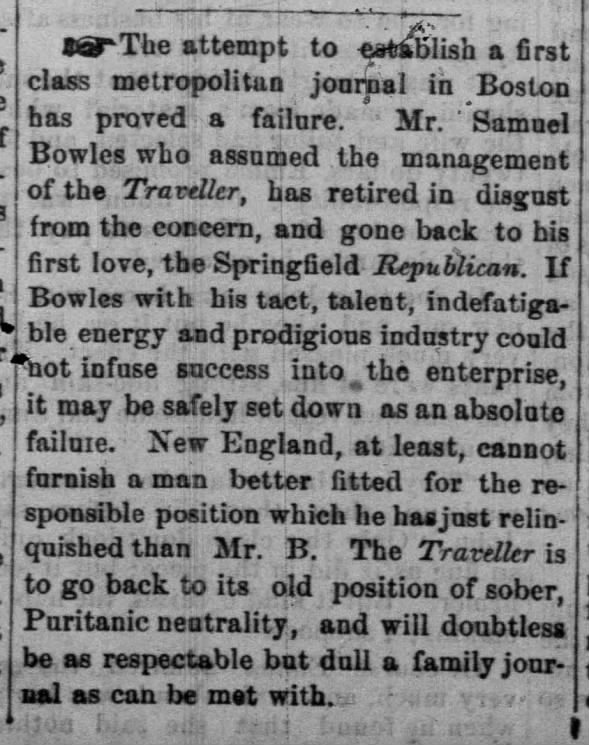
The departure of Samuel Bowles as editor of the Traveller was announced on September 10th in the Boston Evening Transcript. Possibly the Kiana review on September 14, 1857 was one of the last literary pieces that Bowles contributed or supervised as editor of the Boston Traveller.
Where is Melville?
In the Boston Traveller Bowles or somebody wondered, "Where is Melville?" We might be able to answer the question, now that we know the date on which it appeared in print. Where WAS Herman Melville on September 14, 1857? Back home in Pittsfield, Mass., brainstorming lecture topics, as he revealed the next day in a letter to George W. Curtis:
-- I have been trying to scratch my brains for a Lecture. What is a good, earnest subject? "Daily progress of man towards a state of intellectual & moral perfection, as evidenced in history of 5th Avenue & 5 Points."Even better, brainstorming lecture topics and satirizing utopian schemes of famous communists after reading Robert Owen:
By the wondrous and, hitherto, mysterious organic construction of man and woman, the adults of the first generation that shall acquire a practical knowledge of their own powers to re-form the matured character of each individual, will be enabled, almost to re-create the character of succeeding generations; to re-create it by training each individual from birth, by a new and very superior arrangement of external circumstances, to have a sound physical constitution, to have superior dispositions, habits and manners, to have much valuable knowledge, and to make a daily progress towards physical, intellectual and moral perfection.
-- Robert Owen, The Book of the New Moral World (London, 1836) page 103.
 |
| Robert Owen, Esq. via NYPL Digital Collections |
Melville's words and phrasing, specifically the stipulation of "daily progress" in the march "towards" a condition of "intellectual and moral perfection" are Robert Owen's in The Book of the New Moral World (London, 1836). "Subjects: Communism" as catalogued by HathiTrust Digital Library.
As it turned out, the real lecture Melville composed on Statues in Rome was delivered in Boston on December 2, 1857 and reported the next evening in the Boston Evening Traveller. Traces of Melville's epistolary parody of Owen linger in his reference to the utopian "scheme of Fourier" that had yet to dissolve the need for a whole code of laws against criminal conduct.
Related posts
- Melville's friendly critic at the Springfield Republican
https://melvilliana.blogspot.com/2014/08/melvilles-friendly-critic-at.html
- Melville's anti-communist math
https://melvilliana.blogspot.com/2021/08/2-2-4-melvilles-anti-communist-math.html
- Melville on Justinian and Juvenal, remembered in Minnesota
https://melvilliana.blogspot.com/2021/08/melville-on-justinian-and-juvenal.html
- Can art not life make the ideal?
https://melvilliana.blogspot.com/2015/02/can-art-not-life-make-ideal-herman.html
Friday, May 26, 2023
New York Dispatch, review of ISRAEL POTTER
This item is not collected in Herman Melville: The Contemporary Reviews, edited by Brian Higgins and Hershel Parker (Cambridge University Press, 1995; and 2009 in paperback). Contemporary Reviews gives two notices from the New York Dispatch, of The Piazza Tales on pages 477-8 and The Confidence-Man on pages 487-8.
 |
| New York Dispatch - April 22, 1855 via Genealogy Bank |
New Publications.
"ISRAEL POTTER." -- His fifty years of Exile,
by Herman Melville, Author of "Omoo" and "Typee," &c.
New York: Putnam & Co., 10 Park Place.
This last production from the pen of the author of "Typee," has been published in serial form in "Putnam's Magazine," where its monthly appearance has been looked for anxiously by the readers of that excellent periodical. It is the fanciful autobiography of a revolutionary soldier who spent his life in the unrequited service of his country. The celebrated naval hero, Captain Paul Jones, figures almost as prominently in the novel as does the hero himself--also Benjamin Franklin and others of the men of the Revolution. The tale is well told, the dialogue lively, and the incidents well strung together. In some respects this is the best of Herman Melville's works. It is more artistically finished than his former romances, and does not deal quite so luxuriantly in the marvellous, although the adventures of the Exile are wonderful enough to satisfy the most eager lovers of excitement. But we miss in this work the charming freshness which pervades every chapter of Mr. Melville's tales of the Pacific Ocean. He deals here in stern reality more than poetic beauty. As a tale of the Revolution, however, "Israel Potter" is second only to Cooper's Revolutionary novels, and it far surpasses those which have since flooded the country. Herman Melville knows his ground, and hence a thorough unity pervades the work. All who have read "Fifty years of Exile," as it passed through the pages of Putnam, will be desirous to procure the book complete; and those who have not heretofore read it have a rich treat in store. The book is very neatly got up.
-- New York Dispatch, April 22, 1855.
- Sunday Dispatch, super friendly notices of TYPEE and OMOO
https://melvilliana.blogspot.com/2022/01/sunday-dispatch-super-friendly-notices.html
- Sunday Dispatch review of MARDI
https://melvilliana.blogspot.com/2022/01/sunday-dispatch-review-of-mardi.html
- Dispatch notice of BATTLE-PIECES
https://melvilliana.blogspot.com/2022/01/dispatch-notice-of-battle-pieces.html
Subscribe to:
Posts (Atom)