Monday, April 27, 2020

Moby-Dick in Albany bookstores

The Museum Building in Albany, NY via Hoxsie!
As Hershel Parker points out in Herman Melville: A Biography Volume 1, 1819-1851 (Johns Hopkins University Press, 1996) page 878, the American edition of Moby-Dick was available in Albany, NY and Boston, MA by November 12, 1851 "at the latest." In Albany four different booksellers advertised "MOBY DICK, OR THE WHALE" for sale, two days before the official publication date of November 14, 1851.

Gilbert's News Depot and Book Store, one of the Albany shops with copies of Moby-Dick, was located in the Museum Building at State and Broadway.

From the Albany Evening Journal of Wednesday, November 12, 1851; found on genealogybank.com:

Albany NY Evening Journal - November 12, 1851
via GenealogyBank
These Albany, NY book dealers offered Moby-Dick for sale on November 12, 1851:
  • E. H. Pease & Co., 82 State st. Owned by Erastus H. Pease who specialized in religious publications and books for children.
  • E. H. Bender, Bookseller, Stationer and Binder, 75 State st. 
"E. H. Bender, on State street, has long been a well-known bookseller."

-- Bi-centennial History of Albany (New York: W. W. Munsell & Co., 1886) page 650.

  • W. C. Little & Co., 53 State st. Weare C. Little specialized in law books. 
  • Gilbert's News Depot and Book Store, Museum building. Prosper L. Gilbert (1820-1870) owned the news depot at State Street and Broadway, below the Museum. 
Albany Evening Journal - November 12, 1851
"MOBY-DICK, OR THE WHALE."-- We have enjoyed ourselves so richly in following Melville's heroes in "Typee," "Omoo," &c., that we look forward with pleasure to the hours of leisure that will allow us to look through "Moby-Dick." We are sure there is amusement in it; for it opens promisingly. For sale by E. H. Pease & Co.  --Albany Evening Journal, November 12, 1851.

Sunday, April 19, 2020

Omoo in the Albany Evening Atlas

Here is a favorable review of Herman Melville's second book Omoo from the Albany Evening Atlas of May 4, 1847. The Atlas was then edited by Henry H. Van Dyck and William Cassidy. Like the notice of Moby-Dick in Cassidy's Albany Atlas, this one has not been transcribed or logged in previous Melville scholarship. Gary Scharnhorst discovered the two reviews of Mardi in the Albany Atlas that are reprinted in Herman Melville: The Contemporary Reviews, edited by Brian Higgins and Hershel Parker (Cambridge University Press, 1995) at pages 211 and 227-8. Both Albany Atlas reviews of Mardi are quoted in the first part of Scharnhorst,'s two-part article, "Melville Bibliography 1846-1897: A Sheaf of Uncollected Excerpts, Notices and Reviews," Melville Society Extracts 74 (September 1988) pages 8-12 at page 10.

Found on Fultonhistory.com:

Albany Evening Atlas - May 4, 1847
via FultonHistory

New Publications. 

OMOO, A Narrative of Adventures in the South Seas; by HEMAN MELVILLE, author of "Typee." Complete in two parts. 
Another delightful work by the author of Typee, which was one of the most delightful books ever written by an American author. The title of the present work, "Omoo," is borrowed, the author tells us, "from the dialect of the Marquesan Islands, where, among other uses, the word signifies a rover, or rather a person wandering from one island to another." Very appropriate is the title and charming is the thread of narrative and adventure, drawn by our writer amidst the lovely islands of the illimitable Pacific. He takes up his story from the time of his escape from the Typee valley, named in the concluding pages of his former work. His escape being effected by means of an English vessel which had touched at the island to recruit her men. He spent about three months, wandering in various parts of the islands of Tahiti and Imeeo, and the points of his observation and researches are given in the volumes before us, and much have we been entertained and instructed by their perusal. They are written in the same graphic and transparent style that distinguished Typee, and in the same picturesque spirit. It would be easy to select page after page of great beauty, full of the finest sketchings both of scenery and character, whilst the wild and romantic adventure prevalent thro'-out, leads on the attention unflagging, from the commencement to the close. 
We add a short extract from the conclusion of the work, descriptive of his departure from the Island of Imeeo. 
"An hour or two after midnight, every thing was noiseless; but when the first streak of the dawn showed itself over the mountains, a sharp voice hailed the forecastle, and ordered the ship unmoored. The anchors came up cheerily; the sails were soon set; and with the early breath of the tropical morning, fresh and fragrant from the hill sides, we slowly glided down the bay, and were swept through the opening in the reef. Presently we 'hove to,' and the canoes came along side to take off the islanders who had accompanied us thus far. As he stepped on the side, I shook the doctor long and heartily by the hand. I have never seen or heard of him since. 
"Crowding all sail, we braced the yards square, and, the breeze freshening, bowled straight away from the land. Once more the sailor's cradle rocked under me, and I found myself rolling in my gait. 
"By noon the island had gone down in the horizon and all before was the wide Pacific." 
Issued by those eminent publishers the Messrs. HARPER, the work, as a matter of course, possesses all the requisites of clear type, fine white paper and neat exterior.

It is for sale at the Literary Rooms of W. C. LITTLE & Co.  
Related post:

Saturday, April 18, 2020

Moby-Dick in Cassidy's Albany Atlas

William Cassidy (1815-1873)
via New York State Library
Here is an early, previously uncollected notice of Moby-Dick from the Albany Evening Atlas of November 21, 1851. I will add it to the census of 1851-2 reviews and notices, reluctantly counting it there as "Mixed" instead of "Favorable" since the reviewer (William Cassidy?) faults Moby-Dick for "evident marks of carelessness and haste." Two notices of Mardi on April 18 and May 17, 1849 are transcribed from the Albany Atlas in Herman Melville: The Contemporary Reviews, ed. Brian Higgins and Hershel Parker (Cambridge University Press, 1995) at pages 211 and 227-8.

The Albany Atlas was then published by Henry H. Van Dyck and edited by Van Dyck and William Cassidy. Found in Tom Tryiniski's great archives of historic newspapers at Fultonhistory.com.
Albany, NY Evening Atlas -  November 21, 1851
via FultonHistory
MOBY-DICK, OR THE WHALE, by Herman Melville, Harper & Brothers. 
After exhausting the treasures of romance which are to be found on the Islands of the sea, and in the ships which float upon its billows, the inimitable Melville has, in this work, penetrated beneath its surface, and brought to light one of the great wonders of the deep, the Leviathan whom God hath made to play therein--the Whale, its history, its habits, the seas it frequents, the exciting scenes connected with its capture, and its value as an article of commerce, are some of the items which go to make up this rather bulky volume. And with all there is mingled much of that daring, dashing kind of adventure, for the delineation of which our author is so justly famed. We cannot say that we admire this volume as much as some of its predecessors. The style has not been used as much as it should have been, and it bears evident marks of carelessness and haste. But, nevertheless, whatever Melville writes will be read, for he is one of those few who have made their mark upon the literature of the age. 
Related posts:
In 1831 Herman Melville, age 12, heard William Cassidy, age 16, declaim the stirring Extract from Harper’s Speech on French Aggressions at City Hall in Albany:

Omoo in Macon GA

From the Georgia Journal & Messenger (Macon, Georgia) for June 2, 1847, then edited by Samuel T. Chapman and Simri Rose. Now accessible via Georgia Historic Newspapers
https://gahistoricnewspapers.galileo.usg.edu/lccn/sn85038491/1847-06-02/ed-1/seq-2/
and Tom Tryniski's online archives of historic newspapers at Fultonhistory.com.

Macon, GA Journal and Messenger - June 2, 1847
via FultonHistory

NEW BOOKS.

...
     OMOO: A NARRATIVE OF ADVENTURES IN THE SOUTH SEAS, by Herman Melville.— All who have read the deeply interesting work called Typee, from the pen of the above author, will of course be anxious still further to pursue the romantic wanderer among the Islands of the South Seas. Originally a sailor before the mast of a whaler, the author became a rover among the savages of the Marquesas Islands, and finally a captive in the valley of Typee, inhabited by primitive savages. As the volume called Typee was written principally to give a correct idea of the manners, customs, mode of living, &c., &c., of the South Sea Islanders, unbiased by missionary influences; so the book now before us is intended to give a familiar account of the present condition of the converted Polynesians. It is admirably written and abounds in interesting narrative. Many of the incidents are highly amusing and ludicrous, and the reflections just such as might be expected from a wild roving sailor, who possessed vast capacity, combined with a devil-may-care spirit, which made him equally at home in the hulk of a whaler, the hut of a savage, or the palace of a Tahiti sovereign. He treats of subjects hitherto little understood by the general reader, but which will be found not the less interesting because novel and far-fetched. It is a highly interesting Book.

     All of these works are from the prolific press of Harper & Brothers, and have been handed to us by Mr. Boardman, who offers them, together with an extensive collection of standard works, for sale.

Thursday, April 16, 2020

Lady sailor on whaleship LYDIA, "equal to any man"

This early report of a black woman on the crew of a Nantucket whaleship appeared in the New London Bee (New London, Connecticut) on June 10, 1801, reprinted from the New England Palladium (Boston, Massachusetts) of June 5, 1801. Found in the online Newspaper Archives at GenealogyBank.

The given date "18th May last" means May 1801, indicating completion of the second of two voyages by the Lydia when William Clark (or Clarke, elsewhere) served as captain in 1800-1801. The female sailor went disguised as a man on both voyages, as documented in Alexander Starbuck's History of the American Whale Fishery (Waltham, MA, 1878) pages 195-196:
"One of the crew a disguised female; had been two voyages undetected."
New London, CT Bee - June 10, 1801 via GenealogyBank
On the 18th May last, arrived at the bar off the harbor of Nantucket, the ship Lydia, capt. Clark, belonging to Micajah Coffin & Sons, of that place, from a southern whaling voyage, with her casks full of whale oil. One thing worthy of notice happened in the course of the voyage, which will serve to show that the female form may exist without possessing all the soft and delicate habits so much admired in the sex. On the voyage, one of the blacks belonging to capt. Clark's crew was discovered to be a woman; notwithstanding which, capt. C. informs us, that she has performed all the duties incumbent on a sailor equal to any man he had on board. What induced the young lady to disguise herself and enter into so dangerous and laborious an employment we have not yet been informed.

Palladium -- June 5. 
Reprinted from a "Boston Paper" in the New York Gazette on June 11, 1801; and Alexandria, VA Times and District of Columbia Daily Advertiser on June 15, 1801. Also reprinted in the Philadelphia, PA Gazette of the United States for June 11, 1801.

Tuesday, April 14, 2020

Pittsfield's Bildad

Robert Melvill aka Robert Melville was Herman Melville's first cousin. Herman's father Allan Melvill was the older brother of Robert's father Thomas Melvill, Jr. While Herman was living at Arrowhead in Pittsfield, Massachusetts and still working on Moby-Dick, his cousin Robert got appointed administrator for the estate of deceased Pittsfield resident Bildad Williams (1784-1851). Robert Melvill was a Pittsfield farmer. With his wife Susan, Robert ran the old Melvill mansion as a boarding house, until the property was sold to John Rowland Morewood. Later in 1851, some time after the Morewoods returned to Pittsfield from England, Robert moved to Galena, Illinois. Later he settled in Davenport, Iowa. I don't know how or why Herman's cousin Robert Melvill would have been involved in the settlement of Bildad's estate.

Bildad in the Bible is one of Job's three friends. In Moby-Dick, one of the Quaker owners of the whaleship Pequod is named Bildad. As Ishmael describes him in chapter 16 of Moby-Dick, the fictional Bildad is characteristically pious and parsimonious. At sea, Captain Bildad had been a notoriously demanding employer or "task-master":
Now Bildad, I am sorry to say, had the reputation of being an incorrigible old hunks, and in his sea-going days, a bitter, hard task-master. They told me in Nantucket, though it certainly seems a curious story, that when he sailed the old Categut whaleman, his crew, upon arriving home, were mostly all carried ashore to the hospital, sore exhausted and worn out. For a pious man, especially for a Quaker, he was certainly rather hard-hearted, to say the least. He never used to swear, though, at his men, they said; but somehow he got an inordinate quantity of cruel, unmitigated hard work out of them. When Bildad was a chief-mate, to have his drab-colored eye intently looking at you, made you feel completely nervous, till you could clutch something—a hammer or a marling-spike, and go to work like mad, at something or other, never mind what. Indolence and idleness perished from before him. His own person was the exact embodiment of his utilitarian character. On his long, gaunt body, he carried no spare flesh, no superfluous beard, his chin having a soft, economical nap to it, like the worn nap of his broad-brimmed hat. 
--Moby-Dick Chapter 16: The Ship 
Pittsfield's real Bildad also might have been hard to work for. Or maybe he was just unlucky in his reliance on rascally "boys," like Pitch in The Confidence-Man ("all boys are rascals"). No telling why, exactly, but in October 1838, a young apprentice named Henry ran away from Bildad Williams.
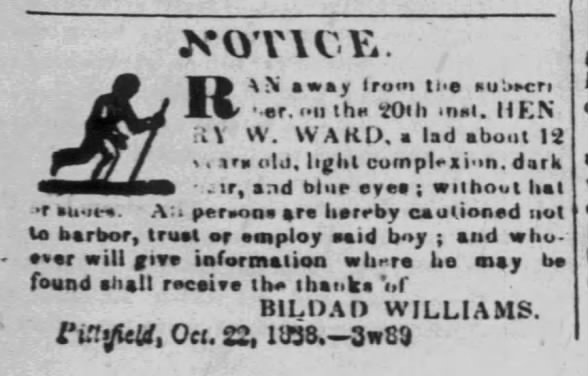
Thu, Nov 15, 1838 – 1 · The Pittsfield Sun (Pittsfield, Massachusetts) · Newspapers.com

NOTICE.

RAN away from the subscriber, on the 20th inst, HENRY W. WARD, a lad about 12 years old, light complexion, dark hair, and blue eyes; without hat or shoes. All persons are hereby cautioned not to harbor, trust or employ said boy; and whosoever will give information where he may be found shall receive the thanks of
BILDAD WILLIAMS.
Pittsfield, Oct. 22, 1838. 
Henry W. Ward must have been returned to Bildad, for he ran away again two years later:

Pittsfield Sun - February 4, 1841 via GenealogyBank

NOTICE.

RUN away from me on the 27th ult. a Boy by the name of HENRY W. WARD, 14 years old, stocky built, gray eyes, dark hair, and walks stooping. He wore away a light mixed roundabout, black vest with a red back, and moleskin pantaloons--all considerably worn. He also wore away a good hair seal cap, and a pair of good boots, and took some other articles of clothing. All persons are forbid harboring, trusting or employing said runaway; and whoever will give information where he may be found will confer a favor on
BILDAD WILLIAMS.
Pittsfield, Feb. 2, 1841.
The summer before Henry's second departure, in July 1840, a warrant had been issued against the estate of Bildad Williams, evidently in connection with bankruptcy proceedings.

After Bildad's death from "Disease of the kidneys" on April 27, 1851, Herman's cousin Robert Melvill was named Administrator of the estate.

Pittsfield, MA Sun - May 8, 1851
via GenealogyBank

Bildad Williams' Estate.

NOTICE is hereby given, that the subscriber has been duly appointed Administrator on the estate of BILDAD WILLIAMS, late of Pittsfield, in the County of Berkshire, deceased, and has taken upon himself that trust, by giving bond as the law directs. All persons having demands upon the estate of the said deceased, are requested to exhibit the same; and all persons indebted to said estate, are called upon to make payment to
ROBERT MELVILL, Adm'r.
May 6, 1851.
In Robert's ad for the subsequent estate sale, remaining possessions of the deceased included "a large assortment of Household Furniture" along with "Comb Makers Tools and other articles."
Pittsfield, MA Culturist and Gazette - May 14, 1851
via GenealogyBank


Notice.

THE Subscriber will expose for sale at Public Auction on Saturday, the seventeenth day of May inst., at the residence of the late Bildad Williams, a large assortment of Household Furniture. Comb Makers Tools and other articles.

ROB'T. MELVILLE, Administrator.
Pittsfield, May 13, 1851. 
The official register of deaths in Pittsfield gives the occupation of Bildad Williams as "Comb Maker." So then, young Henry Ward the 1838 and 1841 runaway possibly had been employed by Bildad in the manufacture of combs. However, according to the United States Federal Census for 1850, Bildad Williams at that time worked as a "Grocer."

Bildad's given age of 66 in the October 1850 census and April 1851 death register puts his birth year around 1784. In the category of "Sex and Condition" the death register indicates "Widower-Colored." According to the 1850 Census Bildad Williams lived alone, and owned Real Estate valued at $800.

Bildad's wife Juliana Williams died on June 28, 1846, age 65.

Pittsfield Bildad was born in Connecticut, according to census and death records accessible on Ancestry.com. At seventeen, a Bildad Williams ran away from Cato Williams (his uncle? or father?) in Mansfield, Connecticut.
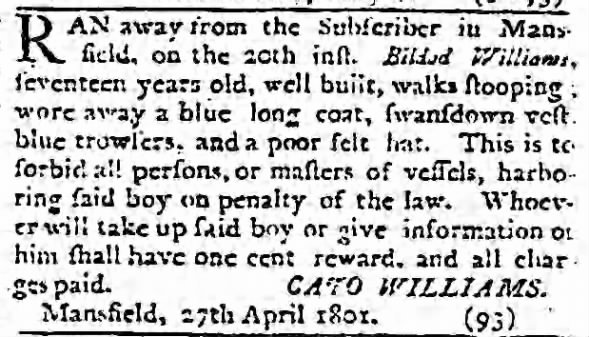
Cato Williams, Bildad Williams ran away, MansfieldCato Williams, Bildad Williams ran away, Mansfield Mon, May 11, 1801 – Page 4 · Hartford Courant (Hartford, Connecticut) · Newspapers.com
"RAN away from the Subscriber in Mansfield, on the 20th inst. Bildad Williams, seventeen years old, well built, walks stooping; wore away a blue long coat, swansdown vest, blue trowsers, and a poor felt hat. This is to forbid all persons, or masters of vessels, harboring said boy on penalty of the law. Whoever will take up said boy or give information of him shall have one cent reward, and all charges paid. CATO WILLIAMS. Mansfield, 27th April 1801." 
Robert Underhill, current President of the Historical Society of Clarendon Vermont, has identified Mansfield's Bildad Williams as the son of Cato Williams with his wife Lydia Williams. As reported by Underhill and others, this Cato Williams died in Westfield, MA in 1828. A Cato Williams is listed as the head of household in the 1820 U. S. Federal Census for Lenox in Berkshire County, Massachusetts. The Williams household of five was then comprised of four "Free Colored Persons" and one "Free White Person." Another researcher on Ancestry.com gives the father of Bildad Williams as Elisha Williams (1717-1784), who owned property in Mansfield, CT next to land sold for $215 in 1809 by Jesse Spafford to Lydia, Isham, and Bildad Williams. In 1817, Bildad sold his remaining share of the Mansfield property to Simeon Allen.

Originally in Windham County Connecticut. Mansfield was annexed to Tolland County in 1827. Tolland County, CT happens to be the stated birthplace of Melville's fictional cabin boy, Pip. In Moby-Dick, Melville's narrator Ishmael refers to Pip's "native Tolland county in Connecticut" (Chapter 93); and Pip relates a story about his father in "old Tolland county" (Chapter 99). The Black cabin boy Pip may be partly based on John Backus, Melville's shipmate on the whaler Acushnet. But the birthplace of Backus has not been established, leading some readers of Moby-Dick to wonder with the editors of the 1988 Northwestern-Newberry Edition, page 853, "what made him bring in Tolland County at all?"

This Mansfield, Connecticut Bildad was reportedly 17 in 1801, which would make his birth year 1784--identical with that of the "colored" widower Bildad Williams who died in Pittsfield at the age of 66 on April 27, 1851. The same Bildad whose estate, after his death, was sold at auction by Herman Melville's cousin Robert.

In spite of the published warning to "masters of vessels" by Cato Williams in May 1801, Mansfield's Bildad Williams actually did receive New England Seamen's Protection Certificate number 2209 in New London on September 19, 1801. Age 18;  height 5' 8"; complexion "Mulatto."

So Bildad Williams from Mansfield, Connecticut went to sea. Where he sailed is unknown--the earliest New London Crew Lists on the website of Mystic Seaport Museum, are from 1803. From New London, Bildad in 1801 would not have gone a-whaling. The first commercial whaling voyage from New London was by the Dauphin in 1805, according to Alexander Starbuck's History of the American Whale Fishery.

Moby-Dick fans may be interested in the relative scarcity of sailors named Bildad. Of Melville's two retired Quaker captains, Peleg bore the commoner name. The 30,988 total records in the Registers of Seamen's Protection Certificates contain more than thirty Pelegs, but just one Bildad.

Related post:

Was Ishmael Black? Facts Behind Herman Melville’s Fiction | The Journal of African American History: Vol 102, No 3

By Robert J. O'Hara:

Was Ishmael Black? Facts Behind Herman Melville’s Fiction | The Journal of African American History: Vol 102, No 3