Thursday, January 11, 2018

Melville in William Wallace Warden's Pen and Pencil


Edited by William Wallace Warden (1821-1890), The Pen and Pencil was an ambitious weekly journal of literature and art, published in Cincinnati, Ohio and Chicago, Illinois. Short-lived, Warden's venture lasted less than seven months: the rare volume 2 held by the University of Iowa and accessible online courtesy of Hathi Trust Digital Library ends with the third number of July 16, 1853.

At the outset Warden confessed his inexperience in a letter to Rufus W. Griswold, written at 2 a.m. on December 27, 1852 and accessible online via Digital Commonwealth:
"I am young and have much to learn in literary matters, and I am anxious to hear of my imperfections."
In the same letter, Warden asks Griswold to forward the conclusion of a "tale" by Alice Cary slated to appear in the first number of his new literary journal. A sketch by Alice Cary (spelled "Carey") titled "The Past" was published in Pen and Pencil on January 1, 1853, serving as a kind of preface to the serialized tale of Charlotte Ryan that began in the fifth number (January 29, 1853) and concluded in the eighth (February 19, 1853). The introductory sketch and tale of "Charlotte Ryan" were both included in Alice Cary's Clovernook or Recollections of Our Neighborhood in the West, Second Series (New York: Redfield, 1853). In his letter to Griswold, Warden also wonders how much to pay Phoebe Cary for a poem of "six or seven verses" he wants to publish. Phoebe Cary's poem My Baby Brother (in six stanzas, "Written for The Pen and Pencil") appeared in the January 22, 1853 issue of Pen and Pencil, credited to "Peoebe Carey."

Below, a friendly puff in the Louisville Daily Courier:

Found on Newspapers.com

The first volume of Warden's Pen and Pencil contains several brief references to Herman Melville. The earliest Melville mention in Pen and Pencil occurs in the second number (January 8, 1853) in an unsigned essay on "The Teeth":
Indeed, the natives of all savage and unsurgeoned countries, have invariably fine teeth. Having healthy constitutions, they have healthy teeth. Speaking of the inhabitants of the Marquessas, Herman Melville says,—"Nothing in the appearance of the islanders struck me more forcibly than the whiteness of their teeth." --Pen and Pencil - William Wallace Warden
Another Melville reference occurs in the article titled "Whales and Whale Fishing," excerpted from Eliza Cook's Journal (December 11, 1852):
We must here conclude our subject, but not without recommending our readers to peruse the great Whale Epic of Herman Melville--certainly one of the most curious, instructive, imaginative, and graphic books of the present day. --Pen and Pencil, February 26, 1853.
A more extended notice of Herman Melville in Pen and Pencil occurs in a review of The Captive in Patagonia by Benjamin Franklin Bourne. The Cincinnati reviewer, presumably Warden, tried to contrast South American Indians as portrayed by Bourne with Melville's romanticized South Sea islanders. Besides Typee and Omoo, the reviewer was also reminded of Poe's Narrative of Arthur Gordon Pym.
On the whole, the " Captive" is a sort of dismal Typee or Omoo, though the subject is very unattractive compared to those in which Herman Melville revelled of old. The Patagonians are too stupid and brutal to be interesting in any way. We hope no literary man will go any farther South! A book on Terra del Fuego might be too much for our nerves.
It seems to us that "the natives " are very much alike in all books of travels, that is to say they are savages in appearance, and in other respects incomprehensible. However, we would rather meet the swimming girls of Typee than the greasy thieves of Patagonia, even between the covers of a volume.
Somehow, the book before us reminds us of Poe's Gordon Pym— a tale, by the way, not included in the collected works of that writer. Why, we know not. --Pen and Pencil - April 23, 1853
In the May 21, 1853 issue Warden criticizes promotion of "hoaxes" in Putnam's Monthly Magazine, instancing Horace Greeley's unsigned article Modern "Spiritualism" in January 1853, and another the next month on the "Bourbon Question" by Rev. John H. Hanson titled, Have We a Bourbon Among Us?  Protesting the supposed dearth of good literature in English, Warden jokes,
 "We cannot live on one romance by Hawthorne, and half a one by Melville per annum" --Pen and Pencil - "Editor's Port-Folio."

May 1853 is too early for a contemporary critic to be talking about Melville's magazine fiction, since his first published effort in that line, Cock-A-Doodle-Doo! would not appear in print until December 1853, in Harper's magazine. Half a romance by Melville could describe either Moby-Dick (1851) as half-romance, half-Cetology, or Pierre (1852) as half-romance, half-metaphysics.

Later on in the same editorial of May 21, 1853, Warden attacks "determined flunkeyism" in recent Harper's articles on on Napoleon Bonaparte (by John Abbott, mis-identified by the Cincinnati editor as Jacob Abbott) and Louis Napoleon (with particular reference to France—Her Emperor in the April 1853 issue of Harper's New Monthly Magazine). In the course of criticizing "toadyism" in the exaltation of French emperors past and present, Warden alleges that Harper's routinely published flattering articles paid for by the contributor or another sponsor.

In a previous "Editor's Port-Folio" column on April 16, 1853, Warden examined the sorry state of American literature in "an age of literary mediocrity." Warden excepted Hawthorne and Melville as
"our only writers of elaborate fiction."  --The Pen and Pencil 1.16 (April 16, 1853).
That April 16, 1853 column is worth a closer look, as Warden helpfully identifies various contributors to New York newspapers and magazines. Charles Seymour, for example, gets named as author of "Pavement Sketches" and "School-house Sketches"; as former co-editor of The Lantern and Yankee Blade; and as current literary editor of the New York Daily Times, edited by Henry Raymond. Decades later, some of these associations would be independently confirmed in "Reminiscences of an Old New Yorker" (serialized in Frank Leslie's Sunday Magazine).


Warden's naming of Charles Seymour as author of "School-House Sketches" enables the further identification of Seymour as the writer who invoked Melville with Sinbad as legendary adventurers in the episode of "School-House Sketches" titled "Running Away," published in the July 1853 issue of The United States Democratic Review:
For my part, I have never ceased regretting the failure of the adventure, which might have made me a Herman Melville, or a Sinbad the Sailor, instead of a poor devil of a —; well, fill up the blank as your wisdom dictates. We are in, and somebody must be secretary of state in a country. But mum’s the word! 
--School-House Sketches, Running Away
One colleague of Charles Seymour's on the editorial staff of the New York Daily Times was Fitz-James O'Brien, described by Warden as "a brilliant critic, a pleasing poet, and a witty essayist." O'Brien wrote a couple of major review essays on Melville for Putnam's magazine in 1853 and 1857, as long known in Melville scholarship.

Not so well known today: the "City Hall Bell-Ringer" of the New York Daily Times--identified as "Mr. Weldon" by Warden, in fact Charles Welden (d. 1861); and Frank Tuthill (1822-1865) the physician and city news editor, later associated with the San Francisco Evening Bulletin and author of The History of California.

William Wallace Warden moved to Washington D. C. in 1862 and was there employed as Washington correspondent of the Cincinnati Enquirer. Eventually Warden became a private secretary to President Andrew Johnson, serving until the end of Johnson's administration.
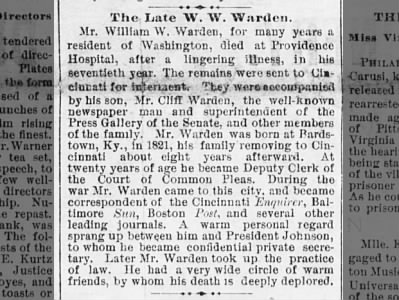


Published shortly before Warden's death, an article by M. P. Handy in the Philadelphia North American gave away the pen names over which William Wallace Warden contributed insider views, while employed as Jonson's confidential secretary and afterwards:
  • "Data" in the Philadelphia Ledger and Baltimore Sun
  • "Wallace" in the Richmond Dispatch
  • "Zeta" in the New Orleans Times
  • "Dibon" in other leading newspapers
In Cincinnati Warden wrote "over the nom de plume of 'Ubiquitous Allabout."


Washington, D. C. Evening Star - March 19, 1890
The fullest biographical notice of Warden I have found so far appears in The Weekly Law Bulletin and Ohio Law Journal, Volume 23 (April 14, 1890).

Back to Pen and Pencil: in the June 18, 1853 number Warden recounts a visit to Louisville on the steamboat Jacob Strader. Enjoyment of the breeze and scenery from the cabin roof prompts an islamicist reverie (with peris, houris, and other features of the cultural discourse examined by Timothy Marr in The Cultural Roots of American Islamicism) and a glance at Melville's Mardi:
Now what can a poetical minded lounger, an easy going Lotus-eater, require more than pleasant scenery and pretty faces to look at, and a nice cool breeze blowing away all his feverish cares and troubles, as the breath of the houris blows the memory of sorrow from the brows of the faithful in the paradise of Mohammed, for which, and other particulars, see Abubeker & Co., and the Arabian commentators. We had not been cool for a fortnight, and at that moment would not have given that breeze for a middling sized empire in "Mardi," or any other out of the way region.
--Pen and Pencil - June 18, 1853
 

JACOB STRADER Steamboat - Original Image

Monday, January 8, 2018

Pantagruelising and Plato in a letter to Hawthorne

A remarkable letter from Herman Melville to Nathaniel Hawthorne appears in the current Critic. It would fill two columns of the Speaker. Here is the most characteristic paragraph—quoted rather because it is addressed to Hawthorne than because it was written by Melville :—
"If ever, my dear Hawthorne, in the eternal times that are to come, you and I shall sit down in Paradise, in some little shady corner by ourselves, and if we shall by any means be able to smuggle a basket of champagne there (I won't believe in a temperance Heaven), and if we shall then cross our celestial legs in the celestial grass that is for ever tropical, and strike our glasses and our heads together till both musically ring in concert, then, O my dear fellow-mortal, how shall we pleasantly discourse of all the things manifold which now so distress us—when all the earth shall be but a reminiscence—yea, in its final dissolution in antiquity. Thus shall songs be composed as when wars are over—humorous, comic songs: 'Oh, when I lived in that queer little hole called the world'; or, 'Oh, when I toiled and sweated below'; or, 'Oh, when I knocked, and was knocked in the fight'—yea, let us look forward to such things."
This is Pantagruelising in a high key. The Paradise is that of the religious world of Plato's day, taken less seriously than it was by either his contemporaries or himself.
Published in London, The Speaker was a weekly Review of Politics, Letters, Science, and the Arts, edited by T. Wemyss Reid. "Panatgruelising" means, besides reading Rabelais,
"drinking stiffly to your own Heart's desire"  --The Life of Gargantua and of Pantagruel.
Raymond Weaver's article on The Centennial of Herman Melville in The Nation (August 2, 1919) opens with the same now famous image of Melville's "shady corner" in Paradise with Hawthorne.
The Speaker got it from Mr. Stoddard on Herman Melville in The Critic for November 14, 1891; which The Critic got from Richard Henry Stoddard's signed memorial tribute in the New York Mail and Express (October 8, 1891). Following Stoddard, The Critic gave the whole letter as first printed in Julian Hawthorne's biography, Nathaniel Hawthorne and His Wife (1884).

Melville's letter appears of course in the scholarly Northwestern-Newberry edition of Melville's Correspondence (there dated June 1? 1851). Re-dated by Hershel Parker to "Early May 1851," the complete letter is conveniently available with excerpts from other Melville letters in the back of the 3rd Norton Critical Edition of Moby-Dick. 

Related post

Wednesday, January 3, 2018

Tuesday, January 2, 2018

Clement C. Moore on wine in the Bible

I won't believe in a Temperance Heaven. --Herman Melville
In August 1835 Clement C. Moore wrote a rebuttal of arguments by some Temperance reformers that only non-alcoholic "wine" was approved in scripture. Moore's invited commentary on biblical references to yayin, "wine" and tirosh, "new wine" appeared in The Churchman and was reprinted in The New York American on July 29, 1836 and other newspapers as well, for example the Newark Daily Advertiser (also on July 29, 1836).

Newark [New Jersey] Daily Advertiser - July 29, 1836
 "We publish an essay to-day from the pen of Professor Moore of the Hebrew department of the Episcopal Seminary in New York, on a mooted question of some public interest."
As it turned out, Moore's published rebuttal did not really end the "tirosh and yayin controversy." On September 9, 1836 New York American for the Country duly printed a long reply to Moore by Edwin James, then an editor of the Temperance Recorder. For now I'm most interested in retrieving Moore's essay for the enlarged view it offers of Moore as a moderate advocate for temperance, and for potential illumination on Moore's verse diptych "The Wine Drinker" and "The Water Drinker." These two pieces were published together in Moore's 1844 volume Poems. Manuscript copies of both poems are extant in the collections of the New-York Historical Society.


Below is the text of Moore's scholarly examination of wine in the Bible, transcribed from the New York American. I like this version for the editorial preface that introduces Moore as "the truly amiable, learned and liberal Professor of Hebrew in the Episcopal Theological Seminary." Indenting has been modified in places, hopefully to clarify when Moore is quoting from the Temperance Recorder = TR.
THE TEMPERANCE CAUSE has been injured—it is useless to dissemble the truth—by the misjudging fanaticism of a few zealots, who would push it beyond its legitimate aims. Among the efforts of these intemperate friends of temperance, was the remarkable one of attempting to prove by an ostensibly learned appeal to Hebrew etymologies and synonimies, that fermented wine was every where in the Bible denounced as a curse, and that the only wine recommended or permitted, either in sacrifice or for use, was unfermented, or new, wine.

We have seldom seen more cool, but more complete, demolition inflicted upon elaborate and seemingly erudite error, than in the letter we copy today from the Churchman, written by the truly amiable, learned and liberal Professor of Hebrew in the Episcopal Theological Seminary, C. C. Moore. We think the tirosh and yayin controversy is pretty effectually killed by this excellent compound of common sense and true learning.

[From the Churchman.]

Opinion of Professor Moore on the meaning of the words translated "wine" and "new wine."

New York, Aug.—, 1835.

DEAR SIR,— I have examined, with the aid of Taylor's Hebrew Concordance, not only the texts which you asked me to look at, but every place in the Hebrew Bible where the word yayin or tirosh occurs; and send you the accompanying references, by which you may examine for yourself each passage in which either of the above words is found.

With regard to the assertions made in the essay contained in the number of the Temperance Recorder which you put into my hands, the following remarks are suggested by the investigation which I have made.

I shall make some quotations from the essay in question.
"By habitual we mean the occasional or common use, as a drink—the medicinal and sacred use being wholly out of the question." [TR]
Now, I wish to know why the sacred use is wholly out of the question. The drink-offerings prescribed in the Levitical law are of yayin; and it would be most extraordinary if that should be directed to be used on holy occasions, when the best of every thing should be selected, which is "a subtle, insidious, and most dangerous poison," the habitual use of which "is a sin."
"We would gladly believe that the Scriptures nowhere speak with allowance or approbation of the habitual use of that which chemistry and experience have alike proved to be a poison." [TR]
Philosophical investigation finds out many things with which common use and common sense have no concern. Poison has been discovered in potatoes: phosphorous in every bone; fire in the atmosphere which we breathe; animalculae in the water which we drink, &c., &c., and common sense, without the aid of chemistry, knows that any thing may be rendered noxious by the improper and unrestrained use of it. Nothing, in certain circumstances, is more dangerous, or has produced more violent effects, than cold water. If the assertion, that fermented wine is "a poison," be true, it must be an inconceivably slow one; for we see multitudes living to a good old age, and some to a very advanced period of life, in the constant use of it. Such assertions are really too absurd to deserve serious notice.
"We do not like to suppose that the Bible calls the same substance in one place 'a blessing,' and in another place 'a mocker.'" [TR]
The same "substance," (yayin,) if used in moderation, is among the blessings of Providence, but if used intemperately, may not only be a "mocker," but a curse and a destroyer, like every other blessing which is abused. As well might it be urged that the use of fire is unlawful, because it is a dangerous element, which oftentimes proves very destructive, and is represented in Scripture as an instrument of punishment and token of wrath, employed by the Almighty. As well might all our natural passions be considered sinful. Nothing is more apt to make a man do wrong than anger; and yet God himself is frequently said to be angry.

But let us examine whether no positive evidence appear, that this "mocker" is sometimes considered in the Bible as a blessing. Isaiah lv. 1, the prophet exclaims, "Come, buy wine (yayin) and milk, without money and without price." However figurative that language may be, the prophet surely cannot be supposed to offer an invitation to come and get that which is "a poison," "a mocker," &c. &c. Isa. xxiv. the consequences of the curse that was to come, "The new wine (tirosh) mourneth," verse 9, "They shall not drink wine (yayin) with a song." The one who uttered the prediction could not have deemed either "substance" as noxious, since the being deprived of them was among the threatened evils. Micah vi. in God's controversy with his people it is said, verse 15, "Thou shalt sow, but thou shalt not reap; thou shalt tread the olives, but thou shalt not anoint thee with oil; and sweet wine (tirosh,) but shall not drink wine, (yayin.)" That is to say, although the must (tirosh) be trodden out, it shall not be used in the state of wine, (yayin.) and this was a curse. Zech. x. 6,7, "And I will strengthen the house of Judah," &c. &c. "and they of Ephraim shall be like a mighty man, and their heart shall rejoice as though wine, (yayin.)" The speaker, who is God, certainly does not consider yayin in this place as "a poison."
Among the curses in the 28th of Deuteronomy is the following in verse 39, "Thou shalt plant vineyards, and dress them, but shalt neither drink of the wine, (yayin,) nor gather the grapes."

Psalms civ. 15, among the blessings bestowed by God, is "wine, (yayin,) that maketh glad the heart of man."

Genesis xlix.11, Jacob, on his death-bed, says of Judah, "He washed his garments in wine; (yayin;)" and verse 12 "His eyes shall be red with wine, (yayin,) and his teeth white with milk."

Cant. i.4. "We will remember thy love more than wine, (yayin;)" "the upright love thee;" verse 2, "for thy love is better than wine (yayin.)"

Cant. iv. 10, "How much better is thy love than wine, (yayin.)"

Cant. v. 1, "I have drunk my wine, (yayin,) with my milk."

Cant. viii. 2, "I would cause thee to drink of spiced wine, (yayin.)"

Cant. vii. 9, "And the roof thy mouth like the best wine, (yayin.)"

Hosea xiv. 7, God says, I will be as the dew unto Israel, &c., &c. They that dwell under his shadow shall return; they shall revive as the corn, and grow as the vine; the scent thereof shall be as the wine (yayin) of Lebanon."

Prov. ix. 1, 2, "Wisdom hath builded her house, &c.; she hath mingled her wine, (yayin.)"

Amos ix. 14, the LORD saith, "I will bring again the captivity of my people of Israel, &c., and they shall plant vineyards, and drink the wine (yayin) thereof." And as the reverse of the above blessing, it is said in Zeph. i. 13, "They shall plant vineyards, but not drink the wine (yayin) thereof."

I think that the above passages sufficiently show the value of the following "opinion" of the same writer:—
"Our opinion is, that fermented wine is not spoken of in the Bible as a blessing."[TR]

"The word 'wine,' as used in our Bibles, means sometimes grapes, the fruit of the vine, either recent or dried." "That it sometimes means the fruit of the vine eaten as food, is probable from Deut. xii. 17, 'Thou mayest not eat the tithe of thy corn, of the wine, or thy oil,'" &c. [TR]
A very weak reason. The word אכל is used very frequently and extensively for to eat, devour, consume, &c.— As well might we infer from the text quoted, that "oil" means olives. See also Deut. xiv. 26, which might, equally well be adduced to prove that yayin and "strong drink" (shikar) were something eatable. Nonsense!
"The wine here spoken of (Gen. xxvii. 28) was a blessing. Could it be made to appear that it contained one particle of alcohol, we would relinquish the whole temperance reformation, as an impious and fanatical attempt to take away from men that which the Creator gave them as a blessing." [TR]
In Hosea iv. 11, we find these words, "Whoredom and wine, (yayin,) and new wine, (tirosh,) take away the heart." This looks as if there were a particle of alcohol in tirosh, as well as in yayin.
"The united voice of human science and human experience has declared fermented wine to be a subtle, insidious, and most dangerous poison." [TR]
A most bold and groundless assertion. It is "poison," in the use of which hundreds and thousands live to extreme old age; a "poison" which is commanded to be employed in the sacrifices to the Deity, which are enjoined in the Levitical law; a "poison," the use of which is expressly permitted to man in various parts of the Bible, and which is there enumerated among the blessings of Providence.
"Is the wine which Isaac, in his prophetic blessing, prayed to God to give in abundance to his younger son, the same wine which had already produced such disastrous effects in the families of Noah and of Lot?" &c. "We answer, without hesitation, it was not." [TR]
The word used on the occasion referred to (Gen. xxvii 28) is tirosh; but we have seen enough to show that no moral inference can be drawn from the selection of that word. And Isaac himself, just before uttering this prophetic blessing, drank the poisonous and wicked liquor, yayin, verse 25.

As to the Septuagint translators, whose authority is set aside by the writer from whom I have been quoting, it surely is probable that they knew the meaning of Hebrew words quite as well as any modern critics. But when people have a "bias," no authority is apt to be of much weight with them.
"If those learned disputants, who think there is impiety in contending against the use of fermented wine on any occasion, except for medicine, have higher authority than Gesenius for their belief, that the tirosh of the Bible was fermented, intoxicating, alcoholic wine, and that, notwithstanding this, it is every where spoken of as a blessing; while the fermented wine, 'yayin,' is called, as it well deserves to be, 'a mocker,' we beg them to come forward with their authorities and their proofs. We do not quote many authorities, because we are not men of learning; nor do we advance many proofs, because to our minds, a few, so they be unanswerable, are quite enough." [TR]
Now the writer of the above passage, if he be honest and impartial, must be soon convinced of his error, upon his own grounds. That the tirosh of the Bible was a word applied to fermented liquors, appears from Hosea iv. 11, already quoted; and that it is not "every where" spoken of as a blessing, appears from the same place.

The simple truth appears to be this; tirosh is the juice of the grape more recently expressed than yayin; though probably applied to the liquor soon after, as well as before, fermentation. This word tirosh is not unfrequently used when the harvest returns are mentioned, as if to designate new produce, a liquor not old enough to be accurately called yayin; wine not yet put into bottles; bottled wine being always expressed by yayin. And it appears, from the things with which it is enumerated, or from some other circumstance, to be a more recent produce of the grape than yayin. That tirosh was probably a newer liquor than yayin appears from Deut. xiv. 22-26. Here the tithe of wine is called tirosh; but if a long journey is to be performed before the tithes are eaten, the tirosh and other tithes are sold; and, after arriving at the destined place, yayin is to be purchased instead of tirosh. Here we may also observe, that the use of yayin is expressly permitted.

That yayin was in common use, is as evident from the whole tenor of Scripture as that water was drunk. That its use was permitted, is plain from the following passages, viz., Deut. xiv. 26, just referred to; Numb. vi. 26, "And after that, (his offering,) the Nazarite may drink wine, (yayin.)" The drink offerings in the sacrifices show that wine (yayin) is permitted. Amos ix. 14, "And I will bring again the captivity of my people of Israel"—"and they shall plant vineyards, and drink the wine (yayin) thereof." And all the passages above quoted to show that yayin was considered a blessing, prove that its use was permitted.
The intemperate use of yayin is reprehended in the Bible; and so is that of flesh, and oil, and sleep.

In none of the passages in which the word tirosh is employed, do I see any thing which points to what may be called its moral qualities, except Hos. Iv. 11; where it is evidently thought to be capable of doing harm like yayin.

The amount of the matter is this. Yayin, which occurs one hundred and forty times, was in common use, as appears from almost every place in which it occurs. Its use was expressly permitted, as is evident from passages above quoted. It is also manifest that it was enumerated among the blessings of Providence, if the plain language of Scripture may be admitted to prove anything contrary to the "bias" of the writer in the Temperance Recorder. And if yayin be a poison, it is most extraordinary that its poisonous quality should have been so lately discovered; as it has been in general use ever since the days of Noah.

Tirosh, which occurs thirty-eight times, is newer liquor than yayin. The word is applied to intoxicating liquor. There is no evidence of its moral qualities being superior to those of yayin; nor of its being permitted to be used in preference to yayin.

And now let me ask, what must be the effect upon the minds of those who are not inclined to respect religion, when they perceive that professors of Christianity make use of Scripture in this way to serve their own views, or to prove the truth of some individual "bias," with the whole current of Scripture authority, when fully examined, directly opposed to them? It is needless to dwell any longer upon this subject. I feel disgusted and offended by such wild attempts at subverting the common sense of mankind.

I examined the subject long ago; but absence from town and other hindrances have prevented me from sending you this communication sooner.

Yours respectfully,

CLEMENT C. MOORE.
New York American for the Country - July 29, 1836
via GenealogyBank

Monday, January 1, 2018

Moore declines to help revise metrical Psalms

Here's something new, not in The Poet of Christmas Eve, Samuel White Patterson's affectionate but now outdated biography of Clement C. Moore. The General Convention of the Protestant Episcopal Church named Moore to the Committee on the Psalms in Metre in 1829, without Moore's knowledge or consent. As an admired poet and professor of Hebrew, Moore must have seemed ideal for the job of correcting and revising the metrical Psalms. But Moore respectfully declined to modernize the Psalms in any haphazard fashion, or on dubious grounds. And, as he also expressed to Bishop White, Moore felt "vexed and mortified" by some new and in his view unsuitable additions to the good old hymnal. Moore's 1831 letter to William White was reprinted decades later in church periodicals, along with Bishop White's sympathetic reply. Transcribed below, the exchange between Moore and White as published in The Churchman and reprinted in The Church Journal on April 21, 1858; found in the archives of Historical Newspapers at GenealogyBank.
CORRESPONDENCE between Bishop White and Clement C. Moore, LL.D., on the present Collection of Hymns.

NEW YORK, May 1, 1831.

Right Rev. and Dear Sir:-- A few days ago, I received a notice from Mr. Kemper, that you request the members of the Joint Committee of the General Convention on the Psalms in metre, to meet at your residence, in Philadelphia, on the 17th inst. Not being a member of the General Convention, I was placed on the above mentioned Committee entirely without my knowledge; and the notice from Mr. Kemper is the first official information which I have received of my appointment. This, I hope, is a sufficient reason for not having sooner expressed to you the disinclination which I feel to act in this matter. Nothing can be further from my mind than any feeling of disrespect for the reverend and respectable body who have done me the honor to add my name to that of the other gentlemen of the Committee. But this is a subject on which I have so decided an opinion, that it is right openly, though respectfully, to express that opinion, and to act in accordance with it. 
Were it proposed to have a new and better version made of the Psalms, than the one now in use, I should see nothing in principle against which to object; but, to expunge some parts, to make additions and alterations in others, and thus to produce a new-modelled (or rather mangled) mass, which shall neither belong to King David nor to anybody else, is a work in which I must decline to take any part. The spirit of innovation which is abroad in the world, I feel afraid of; and I would rather suffer many inconveniences than see it approach the solid parts of our sacred edifice. It appears to me especially unaccountable why an attack upon the old version itself should now be thought advisable, after the recent addition to the collection of hymns in the Church service. There surely can be no taste that may not be suited in that collection; for, among some hymns that are undoubtedly excellent, may be found love songs for the amorous, rhapsodies for the enthusiastic, definitions for the philosophical, and abundance of jingle for the mere lover of rhymes and rhythm. I must say in sober and serious truth, that scarcely a Sunday passes without my feeling vexed and mortified to see the plain and sometimes homely, but simple and unaffected, and, in many places, nervous and elegant version with which our predecessors were contented, in danger of being supplanted by such a farrago as is exhibited in our present collection of hymns.
I have written thus freely, because I think that the simplicity and dignity of our Church service have already been impaired by these additions of modern fastidiousness and fashionable refinement; and that, if we now proceed to tear down any part of the old edifice itself, it is impossible to say what ruin may eventually be brought upon us. I may be unwarrantably timid, but I trust that you will believe me sincere and honest. Once more, I must decline to take a part in the business committed to me by the General Convention.
With every sentiment of affectionate veneration, believe me, sir, truly yours,

CLEMENT C. MOORE.
Bishop White replied to Moore from Philadelphia on May 5, 1831, as follows:
Dear Sir:— I received your letter of the 1st inst. The sentiments contained in it so nearly resemble those which I expressed to the Committee on the Psalms and Hymns, from a paper read to them at their first meeting in October, 1826, that I am desirous of furnishing you with a copy of the said document. It consists of about a sheet, and I hope to transcribe it in time for the return of some one of the gentlemen who will be here from your city in the next week.

In the meanwhile, I am yours respectfully and affectionately,

Wm. White.
The short "paper" of 1826 that White hoped to send Moore was probably the one titled "Thoughts on the Proposal of Alterations in the Book of Psalms in Metre, and in the Hymns, now before a Committee of the General Convention: By a Member of the Committee," and eventually published in Memoirs of the Protestant Episcopal Church (New York, 1836).

The Church Journal - April 21, 1858
1 of 2
The Church Journal - April 21, 1858
2 of 2

Church Journal obit of Clement C. Moore

... no part of his character was more lovely than its gentle, sweet, childlike humility and simplicity, which could not fail to win every one who has ever seen or known him.
From The Church Journal, July 15, 1863; found in the archives of Historical Newspapers at GenealogyBank:
DR. CLEMENT C. MOORE.—Thousands will be grieved to read—as we did in the daily prayers of Monday evening—that the venerable and beloved Dr. Moore, after a brief illness, died on Friday last at Newport, in the 84th year of his age. He had survived,—the last of the noble three who had been connected with the General Theological Seminary almost from its first conception. We believe he was the oldest, he certainly was in appearance the frailest and feeblest; yet he stood chief among the mourners by the open grave of Dr. Wilson, who had resigned his active professorial duties in the same year with himself (1850); and afterwards, bowed with age and infirmity, he stood beside the coffin of Dr. Turner in S. Peter's church, and mingled his tears with those of younger mourners. A few times since then he has been seen in the streets near the Seminary, slowly and tremblingly drawing one foot after another in shortening steps, as one ready to lay down his life at a moment's notice: and now he too is gone, and the Three so long associated together in the service of the Church on earth, are doubtless reunited once more, and are rejoicing together among the spirits of the blest in Paradise. His funeral was celebrated on Monday, the 13th inst., in Trinity church, Newport, by the Rev. O. S. Prescott, assisted by the Rev. Dr. Ogilby, of this city.

To the munificence of Dr. Moore the Seminary is indebted for the whole of its landed estate in this city. And a few years ago, when the lien given him in return for pecuniary advances made by him long ago became an incumbrance dangerous to the interests of the Seminary in its embarrassed condition, he generously extinguished the lien without consideration,—the amount being nearly $50,000. His personal services, as Professor of Hebrew and Oriental Literature, were modestly and unpretendingly rendered, for a long series of years, and for the most part gratuitously. His literary taste and power were well known, though entirely free from the least tinge of ambition. Perhaps, next after a singular liberality, large even in proportion to his large wealth, no part of his character was more lovely than its gentle, sweet, childlike humility and simplicity, which could not fail to win every one who has ever seen or known him. He has earned a perennial place in the Christmas rejoicings of children: and so long as the General Theological Seminary remains a fountain of usefulness for the Church, and so long as children rejoice in keeping up their traditionary observance of their favorite Christmas-tide, so long will the memory of the learned and munificent Professor, and love for the gentle and childlike soul, remain, among the generations of Churchmen, ever green.

The Church Journal - July 15, 1863 via GenealogyBank
Another heartfelt reminiscence of the late Clement C. Moore appears in the Bishop's Address by Henry John Whitehouse to the 1863 annual convention of the Illinois diocese, Protestant Episcopal Church.


I cannot help recording on pay humble page the name of another, precious to the Church, who has gone in ripe old age, Clement C. Moore. L L. D. etc., son of a Bishop, the first my childish eye ever saw, and whose kind hand, I have heard, was wont to lift me to his knee. The son in his modest, honorable and devout life has been worthy of his sire, as the Christian scholar and gentleman, learned in a large sense for depth and extent, critically familiar with the languages of the Bible, a well read Theologian, accomplished in music and art, and adorning in his life the doctrine of God, his Saviour. In the early years of the General Seminary in New York, which owes to his munificence her valuable domain, Dr. Moore was Professor of Hebrew, and we used the Grammar and Dictionary which he had himself written and published, one of the earliest American efforts in that department. He always presented a copy to each student; and I keep mine with the later gift of his collected poetry. In that, he is the Poet Laureate of Santa Claus, with dancing rhymes to make childrens' hearts merry, and old ones young again. How wise and good and kind he seems to me now, as I look back through those long years, and group him with Onderdonk, Wilson, Turner, and the honored living layman Gulian C. Verplanck, who, at that day, also cast his rich offering of graceful learning into the new Training School of the ministry.  --Bishop Henry J. Whitehouse on the late Clement C. Moore, "Poet Laureate of Santa Claus,"; from the Journal of the Annual Convention (1863) of the diocese of Illinois, Protestant Episcopal Church.
Link to obituary of Clement C. Moore in the New York Herald:
Related posts:

Sunday, December 31, 2017

Santa Claus comes on New Year's Eve

Howitt's Journal of Literature and Popular Progress - January 1, 1848
The picture above shows what Santa Claus will look like tonight, around midnight. Santa Claus comes on New Year's Eve, as explained in the 1848 article in Howitt's Journal that accompanies the illustration of Santa Claus "sitting before the empty fire-place of an American house."
In Germany, the servants of tradesmen come for New-Year's gifts, as they do for Christmas-boxes with us; and your baker sends you a large cake, like a couple of great serpents wreathed into two connected circles, perhaps originally intended to represent the old year and the new. 
The Dutch, a kindred nation, carried over their national custom to America; but singular enough, one of the chief features of their New Year's-Eve is the arrival of Santa Claus, with gifts for the children, and whose figure as represented by an American artist, and which has been handed to us by an indefatigable American friend we present to our readers at the head of this article.
Howitt's Journal gives Santa a good, practical excuse for not showing up in the U. S. until New Year's. He's been working hard all month and only made it to northern Europe a couple of weeks before Christmas:
Santa Claus is no other than the Pelz Nickel of Germany and the North; he is in fact, the good Saint Nicholas of Russia, the patron-saint of children; he arrives in Germany about a fortnight before Christmas, but as may be supposed from all the visits he has to pay there, and the length of his voyage, he does not arrive in America, until this eve. Here he is, sitting before the empty fire-place of an American house, with his foot on the old fashioned dog, a little after midnight, all the family having retired to bed to be out of his way, and having hung up the stockings that he may fill them with gifts. Here he sits, smoking his pipe, and delighting himself with the thought of what he shall leave for the children, and of the delight and surprise in the morning.  --"New Year's Eve in Different Nations" in Howitt's Journal Volume 3
More testimony for the expected arrival of Santa Claus on New Year's night may be found in the "Address of the Carrier" on New Year's Day 1819, as published in the Weekly Visitor, and Ladies' Museum (January 9, 1819):
While young and old so gay and pleasant
Exchange their New Year's wish and present;
While children round their parents press
With clamor,—anxious to possess
The Stocking, hoped with riches fraught;
Which good Old Santaclaus has brought;
Who yearly down the chimney comes
With Rods and Toys and Sugar-Plums,
And leaves for naughty girls and boys
The whips—but for the good, the toys—
--1819 Carrier's Address
To be clear, New Yorkers in the 19th century might expect Santa Claus at Christmas, or New Year's, or both. As a letter signed "Jeptha" in the New York American explained,
"he sometimes comes on New-Year's night to dispose of the refuse of his Christmas luggage."  --New-York American for the Country, January 3, 1824.
"A Visit from St. Nicholas" had only just appeared, anonymously, in the Troy Sentinel (December 23, 1823), so the 1824 description of Santa's physical appearance by "Jeptha" offers a nice, detailed view of what Santa looked like before the influence of Moore's "Visit." A similar conception may have influenced the artist Robert Weir, whose 1837 "Santa Claus, or St Nicholas" in part resembles the "little short hump-backed man" depicted in 1824 by "Jeptha":
"... this Saint Nicolas, for that is his proper name, he is the tutelary saint of this city, and chiefly favours the rising generation, to whom, on every Christmas eve, he brings various presents, adapted to the age or capacity of the receiver—he is a little short hump-backed man, with sharp grey eyes buried beneath ponderous black brows, which curve forward to join the sides of a long crooked hawk-bill nose, which overhangs a toothless trench beneath, that serves him for a mouth, though the beaked chin curves up so near the end of the nose, that it is difficult to conceive of any thing passing between without being impaled on the one or the other; his head is immensely large, and sets like a huge extinguisher upon his small body beneath, whose form is concealed by an immense wrapper coat filled with pockets, each stuffed to its limits with cake, almonds, raisins, toys, &c.; his feet are armed with a pair of skates, indicating that he comes from Holland, and, thus accoutred, he skates up and down the nursery chimnies, leaving his largesses behind him in every direction, and there's not a grown person but recollects with pleasure, nor a child but anticipates with delight, the well stuffed stocking of Santa Claus."
Robert Walter Weir, Saint Nicholas
Saint Nicholas
1837 by Robert Walter Weir via Wikimedia Commons
Correspondence in Sedgwick Family Papers from the latter 1820's attests to the emerging custom, in western Massachusetts as well as New York, of receiving gifts from Santa on New Year's Day. As documented by Stephen Nissenbaum in The Battle for Christmas, Elizabeth E. Sedgwick wrote to her father William Ellery on January 12, 1828 that
Nothing could exceed the joy of the children on New Year's morning, when awakening with the first dawn of light, they jumped up eagerly to examine their stockings, which, certain of "Santa Claas" bounty, they had had suspended the evening before from the bed post--and which, according to their anticipations were full to overflowing." --quoted in The Battle for Christmas (New York: Alfred A. Knopf, 1996), page 163.
As discussed in another post, one extant letter from Sophia Hawthorne to her daughter Una shows that even as late as 1852, children could rightfully expect presents from old St Nick on New Year's morning, after his annual visit on New Year's Eve.
"St Nicolas says he cannot put any of his presents into your funny long stocking, & so he asks me to write you a note & put it in, that you may not be disappointed; for he is a very kind old gentleman. So as it is the end of the old year, & in a few hours the new year will begin, I will say a few words of loving counsel...." --Sophia Hawthorne, letter to Una Hawthorne [1852] with a New Year's message from St. Nicholas. Accessible online courtesy of The New York Public Library Digital Collections.
In any event, by New Year's Eve 1832 the various traditions about when Santa Claus comes were pretty well mixed up, even (or rather, especially!) in New York City. Christmas or New Year's? Wait, how about St. Nicholas' Day, December 6th? On New Year's Eve a Philadelphia newspaper reprinted this item, without comment, from the New York Courier:

Poulson's American Daily Advertiser - December 31, 1832
via GenealogyBank
SANTA CLAUS.—A correspondent inquires of us under this signature "whether Santa Claus, with his stocking is not confined in his pretended visits to the eve of the new year and of course his introduction on Christmas eve inappropriate." Santa Claus is Saint Nicholas and his visitations always take place in Holland on Saint Nicholas' day, which falls we believe on the 6th December. How the day came to be celebrated here either at Christmas or on New Year's day we are unable to say.—
The last chapter in The Book of St Nicholas by James Kirke Paulding makes a fractured fairy tale out of "The Ride of Saint Nicholas on New Year's Eve."


In 1844, correspondent "L. P." of the Boston American Traveller described New Year's festivities in upstate New York. "L. P." especially loved the tradition of social visits as then still practiced in Waterford and urged Bostonians to adopt the "glorious" New York mode of celebrating the New Year:
"let us Yankees copy the glorious New Year's hospitality of the New Yorkers, in exchange for the compliment they have paid us in adopting our Thanksgiving."
Waterford, New York still expected presents from "old Santa Claus that honest house-breaker" on New Year's day.

Boston American Traveller - January 9, 1844
"A happy New Year! a happy New Year!" blessings on old Santa Claus that honest housebreaker, braying of penny trumpets and other boisterous mirth of the younger children (we are all children to-day) attests that the good Saint has not been remiss in his annual visits, now comes the display of stuffed stockings which have been duly hung up to receive the old fellow's favors and now you are fairly waked by the clamor, up you jump quickly for New Year's day dawns on no laggard, and you have the busiest day of your life before you." --"L. P." on New Year's Day in Waterford, New York; from the American Traveller [Boston, Massachusetts] January 9, 1844 via GenealogyBank.
Under the heading "New Year's Day," the holiday editorial in the New York Truth-Teller (December 28, 1839) affirms among other things the persistent belief that Santa comes on New Year's night:
"The children will of course have their stockings in the chimney nook, to receive the innumerable bounties of the generous "Santa-Claus" or St. Nicholas, in loading whose huge panniers many a confectionary and toy shop will be stuffed."
22 Dec 1847, Wed The Buffalo Commercial (Buffalo, New York) Newspapers.com
On January 2, 1841 The New York Mirror published an illustration titled ST. NICHOLAS, ON HIS NEW-YEAR'S EVE EXCURSION (AS INGHAM SAW HIM,) IN THE ACT OF DESCENDING A CHIMNEY." Printer and bookseller Daniel Fanshaw wrote the prose essay (signed "D. F.") that was featured along with the front-page picture by "Ingham."

New York Mirror - January 2, 1841
"... we prevailed upon our friend Ingham to give us a sketch of him, just as he saw him one bright, frosty, moonlight night, as he was returning home late from a party of friends. As we had not time for a copper or steel plate engraving, we got our young friend Roberts to do his prettiest on wood, that our subscribers might have an opportunity of becoming familiar with the good-natured countenance of our old patron, who, in these degenerate days, is very seldom seen among us New-Yorkers; and we feel that our friend Ingham has been a very highly favoured mortal in being permitted to see him whom we have so many years longed to get a peep at. St. Nicholas knows how often we have hung up our stockings by the fire, and hied off to bed on New-Year Eve a full hour earlier than usual, lest he might pass our house because we were not yet asleep, and we find our stockings empty in the morning in consequence of our being night spooks. He knows how often we have anxiously and fearfully peeped up the chimney to see if he was not yet there; and yet he has never deigned to show himself to us, but has allowed friend Ingham to have a full and deliberate view...."
"Ingham" by the way is Charles Cromwell Ingham (1796-1863) the Irish-American painter and a founder of the National Academy of Design. On another page in the same issue of the New York Mirror (January 2, 1841), editor George Pope Morris reprinted C. C. Moore's "A Visit from St. Nicholas," altering the first and last lines to make St. Nicholas arrive on New Year's night.

 'Twas the night before New-Year, when all through the house
Not a creature was stirring, not even a mouse....

Related post: